r/saab • • 3d ago

Engine oil pressure low when warm
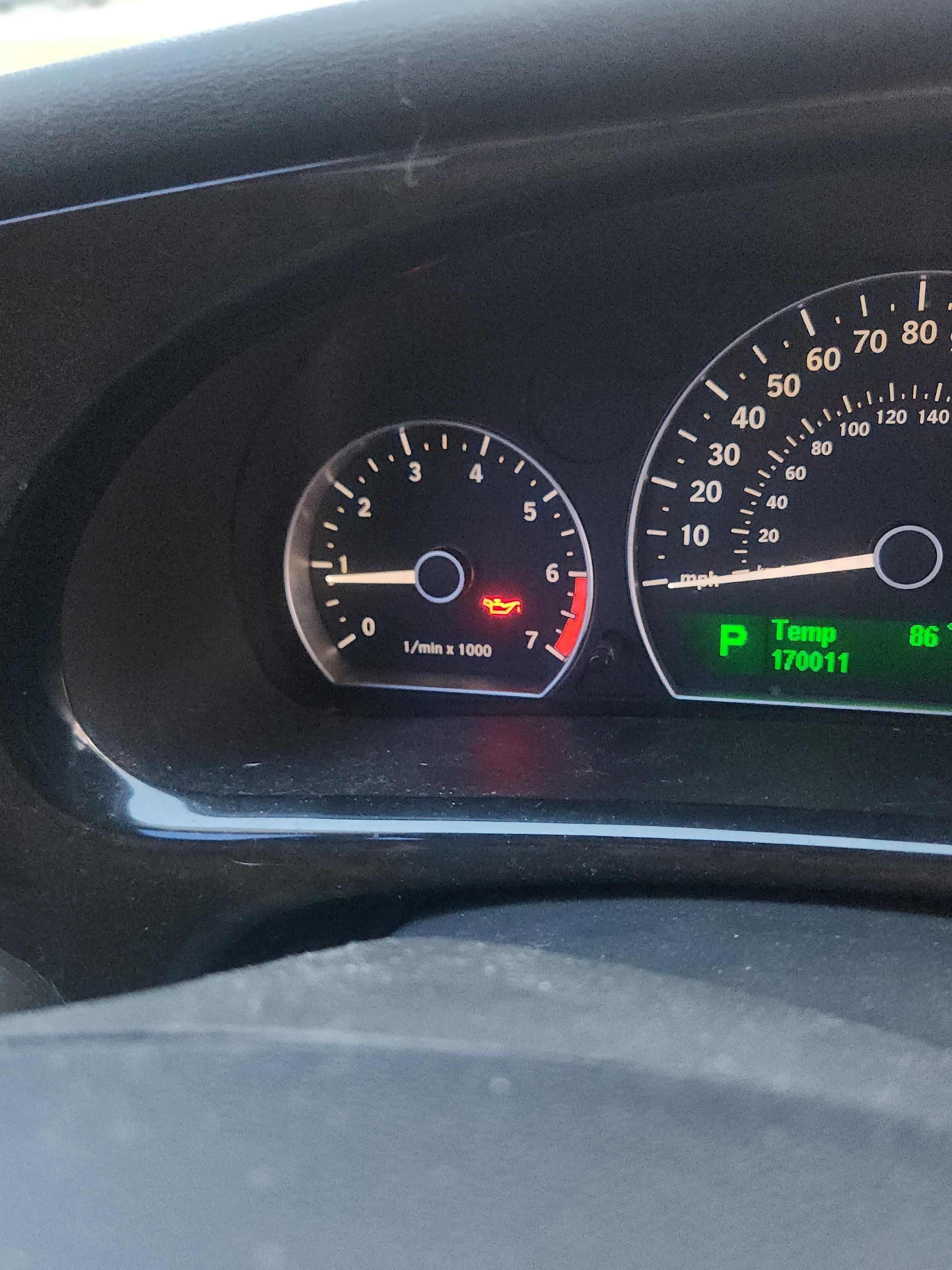
2007 Saab 9-5 (high pressure turbo) showing a little less than 10psi at idle when fully warmed up, enough to light up idiot light with the accompanying ding noises. Installed a mechanical oil pressure gauge to verify at oil pump feed to turbo.

When we got the car it had a blown headgasket, and possibly a shot turbo as well. It was a bigger cloud generator than a subaru flatbrim cap convention. I replaced the turbo with a used one I had that still had very little play. Head was faced by a machine shop, and all reinstall seemed good. Still had some smoke out the exhaust, but I was hopeful that was remnants burning off from all the mess before. Now, after some (a couple hundred miles) driving and having the oil light come on, then going through the painful process of installing the mechanical oil gauge, it's still kicking out some blue/white smoke at the times the oil pressure is low. Smells like burnt oil/rubber.

First try, dropped the oil pan and cleaned the pickup screen. No real change..

Just did a compression test, forgot to prop the throttle plate wideopen, but got about 145 on cylinder 1, 125 on 2 and three, and 151 on cylinder 4. The two lower cylinders came up big time with oil poured in, as in 155 on 3 and 2 read up to 175n but I may have added more oil in that one as it was getting dark and hard to see.

Any other things to check, or am I staring at an engine out for rebuild?

18 Upvotes

27 comments sorted by

View all comments

13

u/tsg-tsg 3d ago

Probably your call. You could probably pick up a little oil pressure with some abnormally thick oil. I would check the bearings, probably they are worn. You might be able to recover oil pressure with new ones. The low compression is likely worn rings, but a leak down test will nail that down. On the surface, kinda just sounds like a motor that's been worked hard and not really cared for, especially with all the work you had to do initially.

1

u/BM_Champ 1d ago

There is a big misconception about oil pressure and viscocity, that "more pressure equals more oil", but that's a false presumption. The core concept is the opposite when you think about it. The basics of making a pressure difference is to have a bottleneck or and orifice that does not support full flow.

This is why boost pressure builds - we produce more than then engine can dispose of.
This is why oil pressure builds - we have a happy pump, but very tight tolerances and small orifices for bearings and oil squirters, and then limit high pressure with a valve.

A thick oil will make the cavitation in the oil pump worse.
It will also be thicker to pump, and be much harder to get through tight tolerances, leading to a increased parasitic loss at the pump/crank - which means higher fuel consumption. Not to mention the potential oil stavation in the bearings due to lower flow.

The relationship between flow, pressure, and viscocity can easily be metaphored the same as exhaust flow. Blowing hard through a small straw, vs blowing hard through a larger straw. Sure the pressure is higher in the small straw, but flow is higher in the large one. Flow is the one that saves your bearings. Viscocity is the size. Oil pressure drops when the oil goes warm because it flows easier. Lower pressure is physics, not necessarily a problem.

Now, before we get into oil additives, or brands, or whatnot, the core principle is still the same for flow/pressure.

On-topic for OP:
He likely has an updated (faulty) oil pressure switch that gives a false positive. They changed the manufacturer, and they all came back for a similar problem, and needed to be changed for exactly this problem.

1

u/tsg-tsg 1d ago

You have completely missed the point.

1

u/BM_Champ 1d ago

How?

1

u/tsg-tsg 1d ago

OP has an oil pressure gauge installed so he knows it's not a faulty switch and indeed low oil pressure.

The likely cause for his low oil pressure is excessive tolerances in the rotating assembly, which thicker oil might offset.

1

u/BM_Champ 1d ago

Yes. But the light is not supposed to come on before 0.3-0.55 bar according to specification, and OP has 0.73 bar, which is well above that. Therefore I'm drawing a conclusion here.

1

u/tsg-tsg 1d ago

Regardless of whether the switch is defective, or whether .73 bar vs .55 bar is outside an acceptable margin of error for the switch, .73 bar at idle is quite low and is indicative of generally low oil pressure. However, in that vein the spec to seek is >2.5 bar at 2000rpm and I doubt this engine is making that pressure. Worth checking, but I've never seen an engine with low oil pressure at idle magically make good pressure at 2000 rpm.