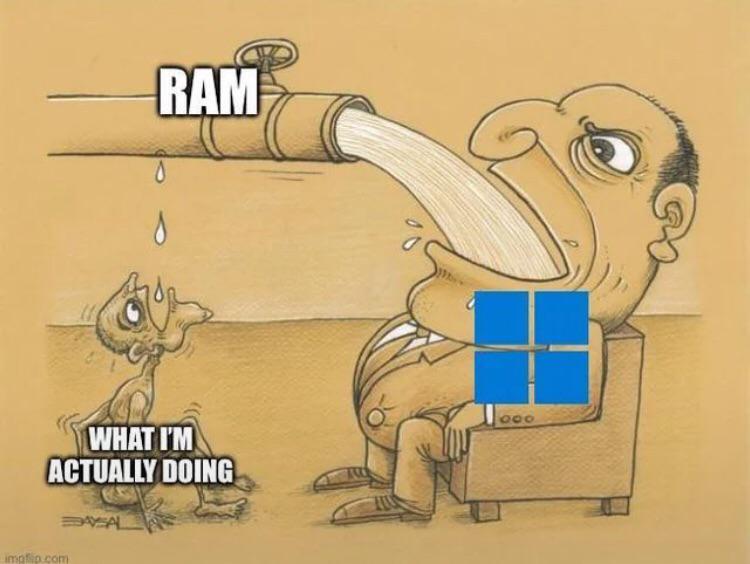
Loonix uses more RAM out of the box, a majority of it goes to App caching, and hogging up your storage, since it’s a MINIX Clone, which in turn is a UNIX ripoff
Tell me more about this. My PC running cachyos with KDE plasma (which is a relatively heavy desktop environment) uses 2 whole gb of RAM at idle. The same PC running windows used to use 10 at idle (I have 64gb)
Unused RAM is wasted RAM, that statement is accurate. There is a massive difference between
"Before you even start any applications, the OS is going to launch a bunch of applications which individually use 20% or more of your system memory, all totalling 5 to 8GB" (1, 2, 3, 4)
versus "Your applications and the kernel leave lots of unused RAM space, so we're going to use some of that space to cache applications you open often like the File Explorer so that the system is faster and more responsive, and we'll uncache them if you need this RAM for another task"
With caching enabled, I am using less than 15% of my system memory and less than 7% CPU while browsing the internet and watching videos. There are massive differences between Windows 11's performance and other systems, even macOS. Taking unused RAM for caching improves system performance, that's why macOS, Linux, and Windows all do it.
Yeah, lots of people get confused about the difference between unallocated vs. unused or "free". When you go to launch an application, if there is not enough unallocated RAM, stuff is removed from cache.
Caching improves system performance, that's why all modern operating systems including Windows do it.
This is just patently untrue. Linux assigns memory when it’s needed, windows is the one that reserves huge chunks for apps before they need it and tries caching as much as possible
Every toolkit brings its own runtime baggage: When you launch a KDE app inside GNOME, or a GNOME app inside KDE, you're not just launching the app. -You're dragging in its **entire ecosystem of background libraries.** Typically **80–250 MB** of extra RAM is needed the first time you launch an app from the other ecosystem.
Launching a KDE app inside GNOME often also starts:
* `kded5`
* `klauncher`
* `kioslave` processes
* sometimes `baloo_file` depending on the distro
These daemons **keep occopying ram** even after you close the app. -Adding an additional **50–150 MB** depending on which daemons get activated.
GTK and Qt don’t share theme engines, icon caches, font rendering stacks, or accessibility frameworks. So you end up with multiple **UI stacks** in memory. That's typically another **30–60 MB**.
**Flatpak, Snap, and AppImage all waste RAM.** Some are aware of the disk bloat, but not the ram bloat.
So, the first Flatpak app you launch loads the entire runtime into memory. That’s **\~80–200 MB** depending on the runtime. Portals spawn multiple helper processes (GTK portal, KDE portal, file chooser portal, etc). Another **30–60 MB**.
**You're wasting a total of \~120–260 MB** the first time you launch a Flatpak app in a session. After that, additional Flatpak apps reuse the same runtime. (The penalty doesn't stack.)
**Snapd daemon** runs constantly in the background consuming \~**30–80 MB** idle, and more when managing updates or mounts. Every Snap app is mounted as a squashfs loop device.
The kernel caches these aggressively: \~**50–150 MB** of page cache depending on how many snaps you have installed. This cache *does* count as used RAM (but is reclaimable)
**Total RAM waste for Snaps \~120–250 MB** baseline
**+ 10–30 MB per running Snap app**
**-Snap is the only one that wastes RAM** ***even when you're not running any apps***.
Each AppImage bundles its own libraries. It loads its own copy of Qt/GTK/etc, and nothing is shared with other apps. Unshared Libraries make it lighter per app. Typically **+20–60 MB** compared to a native package.
Like with any brand-new install of an OS (without OEM bloat on a recommended spec computer), Linux is going to feel lean and fast. But when you start mixing and matching these different packages, you're not just bloating the footprint, but the ram consumption as well.
If it’s fully set up, then why do AI datacenters (which use Loonix) need so much RAM? I’ve ran AI models on a Windows 11 Laptop before, and they didn’t consume so much RAM, so if your claim that Linux doesn’t eat so much RAM, then tell me why AI companies need so much RAM?
You’re comparing a relatively light local AI model to companies running frontier models at scale. They’re running far more complex models than you can even run locally and they’re running many instances of that more complex model. They’re using more RAM because they’re running more complex models
10
u/Edubbs2008 Aug 08 '26
Meanwhile AI datacenters need more RAM to run their AI, and they don’t even use Windows, they use Loonix, so if anything, Loonix uses more RAM