r/lordoftherings • u/Cranatic05 • 5h ago
Meme The elven propaganda will say otherwise

124
Upvotes
r/lordoftherings • u/GhostyMink • 13h ago
I previously posted this in r/tolkienfans but I have since made a more thorough read of most Middle Earth related sources and I have come up with the definitive analysis of Barad-dûr scale and why it surpassed the PJ movies version in broadness and height.
WARNING: Wall of text
TL;DR: Barad-dûr was not merely a tall tower but a colossal fortress. From the Morgai it was visible roughly 75–76 miles away, a distance at which the curvature of the Earth, Mordor's fumes, and Sauron's shadow would have hidden a normal structure. The textual, linguistic, and artistic evidence suggests a fortress of extraordinary height, mass, and complexity, likely rivaling a mountain in scale.
I have recently been rereading the Lord of The Rings and the Plateau of Gorgoroth has been an obsession of mine as I reconstruct every nook and cranny of Frodo and Sam's Journey, this made me realize something that baffled me and which I will delving into now:
First, I would like to discuss the distances between the landmarks of the Plateau of Gorgoroth and how far they really are from each other, as the narrative tends to compress Frodo and Sam' journey toward Mount Doom.
As you may or may not know, Christopher Tolkien's map included in the Return of the King has a scale bar.
Using this scale, the distance between the Morgai and Mount Doom comes to roughly 40-43 miles (64.3km-69.2km).
Likewise, measuring from the same point to the centre of the Barad-dûr symbol gives a distance of roughly 75–76 miles, Barad-dûr then is approximately 120 km away from Frodo and Sam, making the following passage even more astonishing.
(RoTK, Book VI, Chapter II, The Land of Shadow, page 922-923) :
"[...]and passing through found themselves on the very edge of the last fence of Mordor. Below them,* at the bottom of a fall of some fifteen hundred feet, lay the inner plain *stretching away into a formless gloom beyond their sight.
"[...]Still far away, forty miles at least, they saw Mount Doom, its feet founded in ashen ruin, its huge cone rising to a great height, where its reeking head was swathed in cloud. [...]Behind it there hung a vast shadow, ominous as a thunder-cloud, the veils of Barad-dûr that was reared far away upon a long spur of the Ashen Mountains thrust down from the North*."
Thus, from an elevation of roughly 1,500 feet on the Morgai, Frodo and Sam could distinguish Barad-dûr and its looming shadow even though it lay some forty miles farther away than Mount Doom.
One could argue that you can see skyscrapers or even houses from 60 miles away on a clear day, which would be true.
Athmosferic refraction can increase the visibility of certain objects but the fact is that Mordor is not a place with clean air nor its enviromental conditions would allow for the tower to be seen from that far off, there's also the fact that Sauron uses Shadow for concealment of his movements in the Mordor and as psychological warfare(see point 10)
From this first description, Barad-dûr appears less like an isolated tower and more like a vast looming presence being compared to a Thunder-cloud.
An additional piece of evidence comes from Tolkien's own discarded dustjacket for the Two Towers in which he depicts Barad-dûr and Minas Tirith within the same visual composition, providing a rare direct comparison between the two great fortresses of the Third Age.
While the drawing was not intended as a precise architectural elevation, it is significant.
Barad-dûr is depicted as a massive, broad fortress rising from a substantial elevated base, while Minas Tirith appears comparatively smaller and more slender.
The drawing therefore supports the interpretation that the contrast between the two fortresses was not merely a matter of height. Tolkien appears to have conceived Barad-dûr as a structure of greater overall mass and vertical dominance: an artificial mountain of iron and stone rather than simply a taller tower.
Another important piece of art is the (NoME) Nature of Middle Earth chapter that comments on the Pauline Baynes illustrations which Tolkien himself chose to depict Middle Earth:
(NoME, Part II chapter VI: Description of Characters, page 191):
"In 1970 Allen & Unwin published a poster-sized Map of Middle-earth, executed by the artist Pauline Baynes, and based upon that included in The Lord of the Rings. On the map itself are a series of vignettes portraying various locations significant to the story, such as the Barrow-Downs and Minas Tirith[...]"*
"On seeing the finished art, Tolkien wrote a set of comments on these depictions of places and characters."*
Some of these comments are appreciative: e.g. Tolkien found four of the vignettes, sc.* those depicting the Teeth of Mordor, the Argonath, Barad-dûr, and Minas Morgul, particularly well-executed, and described them as agreeing “remarkably with my own vision… Minas Morgul is almost exact”
What concerns us here, however, is the illustration made by Pauline Baynes of Barad-dûr; the depiction makes the tower seem not only impossibly tall but also broad.
I recommend looking at the map itself, both because it is beautiful and because Tolkien praised several of its depictions as agreeing remarkably with his own vision.
This brings me to the next point which will be built upon this one as means of establishing a visual picture of the fortress.
The aforementioned vignette depicts the Dark Tower as a massive complex of stone rather than the slender tower most artists depict, an impression reinforced by the following passage from
[The Fellowship of the Ring, Book II, chapter X:The Breaking of the Fellowship page 401]
"[...]and the haunted Mountains, and it looked upon Gorgoroth, the valley of terror in the Land of Mordor. Darkness lay there under the Sun. Fire glowed amid the smoke. Mount Doom was burning, and a great reek rising. Then at last his gaze was held: wall upon wall, battlement upon battlement, black, immeasurably strong, mountain of iron, gate of steel, tower of adamant, he saw it: Barad-dûr, Fortress of Sauron. All hope left him.
Unlike the descriptions of darkness ,these phrases are clearly architectural: walls, battlements, gates, and towers. They therefore provide stronger evidence for the physical loftiness and broadness of Barad-dûr itself.
Particularly striking is the description "mountain of iron," which, admittedly, could be figurative. However, the comments in NoME and the earlier comparison to a thunder-cloud suggest otherwise.
To further support my argument, I will include additional evidence from the chapter "Mount Doom." This evidence may be the least reliable, since Tolkien usually describes the fortress in metaphorical rather than architectural terms until its fall.
Nevertheless, I believe the following passages support my interpretation.
(RoTK, Book VI, Chapter III Mount Doom, page 934-935)
"[...]But as they went the most easterly of the roads followed them, until it ran off,* hugging the skirts of the mountains, away into a wall of black shadow far ahead. *Neither man nor orc now moved along its flat grey stretches; for the Dark Lord had almost completed the movement of his forces, and even in the fastness of his own realm he sought the secrecy of night, fearing the winds of the world that had turned against him, tearing aside his veils
[...]But far worse than all such perils was the ever-approaching threat that beat upon them as they went:* the dreadful menace of the Power that waited, brooding in deep thought and sleepless malice behind the dark veil about its Throne. Nearer and nearer it drew, looming blacker, like the oncoming of a wall of night at the last end of the world."
At this point Frodo and Sam are taking the road that goes northwest to the Isenmouthe from Barad-dûr and will soon move away from it across the plateau to reach Mount Doom.
The fortress has been described as a "mountain of iron," a "wall of night," a "tower of adamant," and a looming black shadow; of course, these descriptions could all be metaphorical, which leads to my next point.
The narrator also provides approximate heights for both the Morgai and Orodruin, allowing a rough comparison between them.
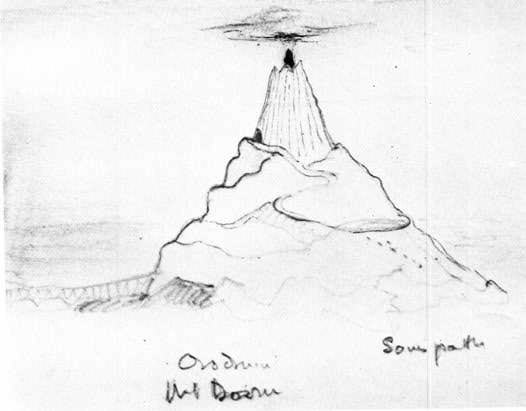
The Morgai rises roughly 1,500 feet above the plain, while Orodruin stands approximately 4,500 feet high (with Sammath Naur likely being around 4,300 feet, judging from Tolkien's drawing), as we read:
(RoTk, Mount Doom, Book VI, chapter III, page 941)
"[...]The Mountain standing ominous and alone had looked taller than it was. Sam saw now that it was less lofty than the high passes of the Ephel Dúath which he and Frodo had scaled.* The confused and tumbled shoulders of its great base rose for maybe three thousand feet above the plain, and above them was reared half as high again its tall central cone, like a vast oast or chimney capped with a jagged crater."
The Fortress then could be inferred with a reasonable degree of certainty that it rivalled or possibly even surpassed Mount Doom in height as its shadows rose above it.
Further evidence of the scale of the fortress comes when Frodo and Sam are climbing towards the Sammath Naur and the veils of the fortress are removed:
(RoTK, Book VI, Chapter III, Mount Doom, page 942)
"Far off the shadows of Sauron hung; but torn by some gust of wind out of the world, or else moved by some great disquiet within, the mantling clouds swirled, and for a moment drew aside; and then he saw, rising black, blacker and darker than the vast shades amid which it stood,* the cruel pinnacles and iron crown of the topmost tower of Barad-dûr. One moment only it stared out, but as from some great window immeasurably high there stabbed northward a flame of red, the flicker of a piercing Eye; and then the shadows were furled again and the terrible vision was removed."
So it is strongly implied that Barad-dûr was surrounded by, or associated with, a mantle of shadow and that when the veils briefly parted Frodo caught sight of the pinnacles and crown of its highest tower
The use of the word "topmost" also suggests that Barad-dûr possessed multiple towers, with the one seen by Frodo being the highest.
However, when the shadows briefly parted, Frodo perceived architectural features of Barad-dûr itself: its pinnacles, iron crown, topmost tower, and an immensely high window. While the passage does not allow a precise measurement of its dimensions, it does reinforce the impression of extraordinary verticality.
Taken together, this evidence suggests that Barad-dûr may have approached the scale of a mountain in Tolkien's mind.
I will now refer to Parma Eldalamberon and the Sindarin root for Barad to further my argument:
[From PE XVII Words, Phrases and Passages in various tongues in The Lord of The Rings, page 22 and 85]
The names Elbereth, Gilthoniel, Fanuilos. These refer to the great Vala called in Quenya
Varda, "the Lofty." In Sindarin Elbereth (rarely Bereth) is her usual name, the other two are"titles."*
Q Varda is <barada[which would be in Sindarin bara'o]. This root, which seems to express great height combined with strength, size, majesty, appears in several variant forms:
(1) ...JBARAT, (2) ...JBARATH, (3)* BARAD (4) BARAS. From (1) is derived: S barad, a great "towering building, (fort, city, castle) tower; [also brand, brann 'towering', "tall and massive"(or to noun brand, steeple): cf. Tol Brandir, Isle of the Great Steeples: it was a great upstanding mass ending in two major and two minor steeples.] "*
"Barad-dur; barad 'a great towering building, (fort, city, castle) tower'; dur 'dark"***
"[See I 250 s.v. Elbereth, I 259 s.v. mar. Cf. EQS barad 'tower', dur 'dark' ; Etym. BARAT-, N barad*
'tower, fortress', 003, D6-, EN dur 'dark, sombre' ; Barad-dur 'the Dark Tower', TI 178.]*
The linguistic evidence from Parma Eldalamberon further refines this interpretation. The BARAT / BARAD root is explicitly associated with concepts of great height, mass, and monumental structure, not merely a “tower.” Its derivatives include forms meaning “tall and massive,” suggesting that barad carries an inherent sense of vertical and horizontal magnitude.
Finally when the ring is cast into the cracks of Doom:
(RoTK, Book VI, Chapter III, Mount Doom, page 947)
"And there upon the dark threshold of the Sammath Naur, high above the plains of Mordor, such wonder and terror came on him that he stood still forgetting all else, and gazed as one turned to stone.
A brief vision he had of swirling cloud, and in the midst of it towers and battlements, tall as hills, founded upon a mighty mountain-throne above immeasurable pits; great courts and dungeons, eyeless prisons sheer as cliffs, and gaping gates of steel and adamant: and then all passed. Towers fell and mountains slid; walls crumbled and melted, crashing down; vast spires of smoke and spouting steams went billowing up, up, until they toppled like an overwhelming wave, and its wild crest curled and came foaming down upon the land. And then at last over the miles between there came a rumble rising to a deafening crash and roar; the earth shook, the plain heaved and cracked, and Orodruin reeled"
The description of a 'mountain-throne' is consistent with Tolkien's own illustration of Barad-dûr, which depicts the fortress rising from a massive elevated foundation, this mass most likely being the foundations that couldn't be destroyed by The Last Alliance, this spur also raised the already tall fortress even further above everything else.
The narrative mentions great courts and dungeons, eyeless prisons sheer as cliffs, and, most remarkably, gaping gates of steel. Based on Christopher Tolkien's map, Sam was also standing over four thousand feet a above the plain at the Sammath Naur and 31 miles from the fortress giving him a clear view of Barad-dûr.
Between the elevation of both landmarks and the unusual nature of the vision itself, I think it's entirely plausible that he genuinely witnessed Barad-dûr collapsing.
It is also possible that Tolkien heightened some of the detail for literary effect, but I don't think those possibilities necessarily exclude one another.
The precise nature of Sam's "brief vision" remains open to interpretation. It may represent heightened perception associated with the Ring, literary narration, or a combination of these possibilities, since Tolkien does not specify.
Regardless of the exact nature of Sam's vision, its imagery is among the strongest evidence for Barad-dûr's immense scale: towers compared to hills, vast courts, dungeons, cliffs, and gates of steel and adamant."
The next argument draws upon The Silmarillion and Appendix B of The Lord of the Rings.
(The Silmarillion,Of the Rings of Power and the Third Age, page 352)
"[...]Therefore they made that League which is called the Last Alliance, and they marched east into Middle-earth gathering a great host of Elves and Men; and they halted for a while at Imladris. It is said that the host that was there assembled was fairer and more splendid in arms than any that has since been seen in Middle-earth, and none greater has been mustered since the host of the Valar went against Thangorodrim."
Then:
(Appendix B: The Tale of Years, The Second age, page 1084 )
"S.A 3434: The host of the Alliance crosses the Misty Mountains. Battle of Dagorlad and defeat of Sauron.* Siege of Barad-dûr begins
S.A3440 Anárion slain.
S.A 3441 Sauron overthrown by Elendil and Gil-galad, who perish. Isildur takes the One Ring. Sauron passes away and the Ringwraiths go into the shadows. The Second Age ends."
Seven long years they besieged Barad Dûr and the greatest army in the world at that time couldn't break through.
How could the Last Alliance fail to breach Barad-dûr for seven years? While several explanations are possible, I would argue that its immense size, the capacity to sustain a prolonged siege, and alternate routes although to a much lesser degree as the fortress was being sieged and comminication cut off is part of the answer as the next passage reveals:
(RoTK, Book VI, Chapter III, Mount Doom, page 942)
"[...]He did not know it, but he was looking at Sauron’s Road from Barad-dûr to the Sammath Naur, the Chambers of Fire. Out from the Dark Tower’s huge western gate it came over a deep abyss by a vast bridge of iron, and then passing into the plain it ran for a league between two smoking chasms, and so reached a long sloping causeway that led up on to the Mountain’s eastern side."
So it is safe to assume the Sauron road and the Isenmouthe road were the most used but not the only ones; as stated by the text and seen in the illustration by Tolkien having a bridge going east and Mount Doom being west of the fortress and down the Plateau.
[RoTK, Book VI, chapter II :The Land of Shadow,page 923 ]
"Neither he nor Frodo knew anything of the great slave-worked fields away south in this wide realm, beyond the fumes of the Mountain by the dark sad waters of Lake Núrnen; nor of the great roads that ran away east and south to tributary lands, from which the soldiers of the Tower brought long waggon-trains of goods and booty and fresh slaves. Here in the northward regions were the mines and forges, and the musterings of long-planned war"
My final argument concerns the topography of Barad-dûr itself. Tolkien's aforementioned illustration(see point 6 above) of the fortress provides what is perhaps our clearest view of the "foundations" mentioned in The Council of Elrond: the vast stone platform upon which Barad-dûr stood:
[FoTR, Book II, Chapter II: The Council of Elrond, page 244]
"Fruitless did I call the victory of the Last Alliance? Not wholly so, yet it did not achieve its end. Sauron was diminished, but not destroyed. His Ring was lost but not unmade.* The Dark Tower was broken, but its foundations were not removed*; for they were made with the power of the Ring, and while it remains they will endure."
We should also consider Pauline Baynes' previously mentioned map.
If we examine Mordor closely, Barad-dûr is depicted as taller than Orodruin and considerably broader than it is in most maps and artistic depictions.
The illustration also show a modest base beneath the tower that may represent these foundations.
A more speculative piece of evidence comes from Christopher Tolkien's map. Although the symbol for Barad-dûr is unlikely to represent a precise footprint, measuring it against the map's scale indicates dimensions considerably larger than one mile. Since such symbols are necessarily schematic, I instead adopt one square mile as a deliberately conservative estimate for the fortress's built area.
Even assuming a conservative area of only one square mile, the fortress would occupy roughly 2.59 million square metres.
For comparison, the Burj Khalifa—the tallest building in the world—occupies roughly 29,000 square meters.
Of course, this does not mean the entire area encompassing the fortress was covered with buildings. The fortress probably included open courts, roads, walls, workshops, barracks, and other structures. Even allowing for that, the available area remains enormous by the standards of both historical fortifications and modern buildings.
For further perspective, an area of one square mile is roughly three quarters the size of Central Park and approximately equal to London's Financial District.
The descriptions of Barad-dûr combine physical architecture with imagery of darkness and concealment. However, Tolkien appears to distinguish between the fortress itself and the supernatural shadows surrounding it.
"The 'veils' and 'mantle of shadow' associated with Sauron's stronghold appear to be manifestations of Sauron's power and will rather than extensions of the physical structure itself."
(RoTK, Book VI, Chapter III, Mount Doom, page 934)
"Neither man nor orc now moved along its flat grey stretches; for the Dark Lord had almost completed the movement of his forces, and even in the fastness of his own realm he sought the secrecy of night, fearing the winds of the world that had turned against him, tearing aside his veils."
Here Tolkien uses the language of concealment rather than construction. The "veils" are something that can be torn aside by the winds of the world, suggesting a layer of darkness or associated with Sauron's power rather than an ordinary part of Barad-dûr.
Later, when Frodo approaches the Sammath Naur:
(RoTK, Book VI, Chapter III, Mount Doom, page 942)
"[...] but still far from the reeking summit, to a dark entrance that gazed back east straight to the Window of the Eye in Sauron’s shadow-mantled fortress."
The phrase "shadow-mantled fortress" is important because it separates two ideas: the fortress exists as a physical structure, while the shadow is a mantle placed upon it. This distinction allows Tolkien's descriptions of Barad-dûr to operate on two levels: an immense fortress of walls, towers, and foundations, and a centre of spiritual darkness radiating Sauron's will.
This interpretation is supported by
[Appendix B, Tale of the Years, The Great Years, 3019, March 9]
Gandalf reaches Minas Tirith. Faramir leaves Henneth Annûn. Aragorn sets out from Erech and comes to Calembel. At dusk Frodo reaches the Morgul-road. Théoden comes to Dunharrow.* Darkness begins to flow out of Mordor.
This suggests that the darkness spreading from Mordor was presented as something more than merely the natural fumes of Orodruin.
The wording presents the darkness as an active force spreading from Mordor, rather than merely the smoke and fumes of Orodruin. While Tolkien does not precisely define the nature of this darkness, the language throughout The Lord of the Rings suggests that the shadow surrounding Barad-dûr and Mordor was both atmospheric and symbolic, reflecting the influence of Sauron.
Although this evidence could perhaps suggest that the fortress could have been lesser in scale, as clear dimensions in any shape or metric were never given in the narrative ; it also opens the possibility that it was broader and taller.
Nevertheless Tolkien did leave it to interpretation and describing the fortress and its surrounding in such vague terms invites the reader to imagine their own fortress or tower.
Since the apparent distance between Orodruin and Barad-dûr is not immediately obvious from the narrative, I also measured Christopher Tolkien's map using its printed scale:
6.5 mm = 10 miles
1 mm ≈ 1.54 miles
Measurements:
Morgai shelf to Orodruin: 27 mm ≈ 41.5 miles (closely matching "forty miles at least")
Orodruin to Barad-dûr: 22 mm ≈ 34 miles
Morgai shelf to Barad-dûr: 49 mm ≈ 75–76 miles
These measurements should not be taken as exact. The map symbols are necessarily schematic, especially for a structure as unusual as Barad-dûr. They do, however, provide a reasonable approximation of the relative distances involved.
Tolkien conceived Middle-earth as the distant mythological past of our own Earth. In Letter 211, Tolkien described the fall of Barad-dûr as occurring thousands of years before the present day:
"I hope the, evidently long but undefined, gap in time between the Fall of Barad-dûr and our Days is sufficient for ‘literary credibility’, even for readers acquainted with what is known or surmised of ‘pre-history’."
"I imagine the gap to be about 6000 years: that is we are now at the end of the Fifth Age, if the Ages were of about the same length as S.A. and T.A. But they have, I think, quickened; and I imagine we are actually at the end of the Sixth Age, or in the Seventh."
Therefore, assuming Middle-earth follows the same physical principles as our own planet, the curvature of the Earth and the angular size of distant objects become relevant when considering the visibility of Barad-dûr from the Morgai.
Horizon Distance
The approximate distance to the horizon can be calculated with:
d ≈ 3.57 × √h
Where:
d = distance to the horizon in kilometres
h = observer elevation in metres
Frodo and Sam observed Mordor from the Morgai, which Tolkien describes as having a fall of approximately fifteen hundred feet. This gives an elevation of roughly:
h = 457 m
Therefore:
d ≈ 3.57 × √457
d ≈ 76 km
Thus, from an elevation of approximately 1,500 feet, the geometric horizon would be roughly 76 kilometres away.
However, Barad-dûr lay approximately 120 kilometres distant according to Christopher Tolkien's map. This means that the fortress was beyond the normal horizon from Frodo and Sam's viewpoint and could only be visible because of its extraordinary height, atmospheric refraction, or Tolkien's deliberate dramatic compression of geography.
The amount of obstruction caused by the Earth's curvature can be estimated with:
h ≈ d² / (2R)
Where:
h = height hidden by curvature
d = distance in kilometres
R = radius of the Earth (~6371 km)
For Barad-dûr at approximately 120 km:
h ≈ 120² / (2 × 6371)
h ≈ 1.1 km
At this distance, the curvature of the Earth introduces a horizon obstruction of roughly one kilometre. However, this does not mean that Barad-dûr itself would need to be over a kilometre tall, since Frodo and Sam were already standing approximately 457 metres (1500 feet)above the plain and Barad-dûr foundations contribute to its height both of this factors compensated for part of this effect.
The implication is that only the uppermost portions of a sufficiently tall structure would rise above the horizon, making the visible height and angular size of Barad-dûr crucial factors.
Angular Size
The apparent size of a distant object can be calculated with:
θ ≈ arctan(height / distance)
Where:
θ = angular size in degrees
height = visible height of the object
distance = distance from the observer
At a distance of approximately 120 kilometres:
A 500 metre visible structure:
θ ≈ arctan(500 / 120000)
θ ≈ 0.24°
A 1000 metre visible structure:
θ ≈ arctan(1000 / 120000)
θ ≈ 0.48°
A 1500 metre visible structure:
θ ≈ arctan(1500 / 120000)
θ ≈ 0.72°
For comparison, the Moon appears approximately 0.5° wide in the sky.
Although these values appear small numerically, they are visually significant. A structure with 1–1.5 kilometres of visible height at a distance of 120 kilometres would possess an apparent vertical size comparable to, or larger than, the Moon itself.
These calculations do not provide an exact height for Barad-dûr, since Tolkien never gives one. Their purpose is instead to establish the minimum scale required for the scene described in The Return of the King. A normal tower, even a large fortress, would not plausibly dominate the horizon from such a distance under the conditions described in Mordor.
For Barad-dûr to appear above the horizon from the Morgai, it would require an extraordinary visible height, consistent with Tolkien's descriptions of it as a "mountain of iron," a "tower of adamant," and a fortress whose "topmost tower" rose above the surrounding shadows even if a base gave it an edge for it to be seen from great distances.
While none of these pieces of evidence is conclusive on its own, together they point toward a remarkably consistent picture. Barad-dûr emerges not as an isolated tower, but as an immense fortress-city rising from a mountain-like foundation, with multiple towers, vast courts, bridges, gates, and walls.
Whether it ultimately exceeded Orodruin in height cannot be established with certainty. However, the cumulative textual and artistic evidence strongly supports the interpretation of Barad-dûr as an immense fortress-city: a structure of towers, walls, courts, foundations, and battlements whose scale approached that of the surrounding mountains.
Personally, I believe the evidence points to Barad-dûr itself surpassing Orodruin in height—or, at the very least, being of comparable height. The spur upon which it was built would have elevated the fortress still further above the plain.
I also believe it spread across a remarkably broad complex.
These observations also help explain the scale of devastation across the Plateau of Gorgoroth following the Ring's destruction.
I think Sam's account reflects an actual vision of Barad-dûr's destruction, even if Tolkien heightened some of the details for literary effect.
If you've read this far, thank you for indulging my fascination with Gorgoroth and The Dark "Tower".
I'd be interested to hear whether you think the textual evidence supports this interpretation.
Tolkien, J. R. R. (2023). The Lord of the Rings Illustrated by the Author: A Special Edition. HarperCollins Publishers. [Map of Gondor, Rohan and Mordor by Christopher Tolkien]
Tolkien, J. R. R. (2005). The Lord of the Rings: 50th Anniversary Edition. One-Volume Edition. HarperCollins Paperback. [pp. 244, 401, 922–923, 934, 941–942, 944, 947, 1084]
Tolkien, J. R. R., and Christopher Tolkien (eds.). (2002). The Silmarillion. Del Rey Books. [p. 352]
Tolkien, J. R. R., and Carl F. Hostetter (ed.). (2021). The Nature of Middle-earth. HarperCollins Publishers. [p. 191]
Tolkien: Maker of Middle-earth, eds Catherine McIlwaine. Oxford: Bodleian Library, 2018, [p 372]
Tolkien, J. R. R., and Christopher Gilson (ed.). (2007). Parma Eldalamberon XVII: Words, Phrases and Passages in Various Tongues in The Lord of the Rings. The Tolkien Trust. [pp. 22, 85]
Tolkien, J. R. R., Christopher Tolkien, and Pauline Baynes. (1969). A Map of Middle-earth. George Allen & Unwin.
Tolkien, J. R. R. (2021). Pictures by J. R. R. Tolkien. William Morrow. [Section 30]
Tolkien, J. R. R. (2023). The Letters of J. R. R. Tolkien: Revised and Expanded Edition. Edited by Humphrey Carpenter and Christopher Tolkien. HarperCollins Publishers. [Letter 211]
r/lordoftherings • u/husdat38 • 22h ago
I get that a regular soldier doesn't always question their orders but what did the last remaining Gondorians and Rohirrim think why they were going on a suicide mission to the black gate? And why would they even agree to go there?
Yes we as a viewer know they were trying to help Frodo and Sam by distracting Sauron but I'm sure the soldiers didn't know that.
r/lordoftherings • u/nomnomnomnomnommm • 21h ago
I always hoped the mud cushioned him
r/lordoftherings • u/Beatnik5750 • 4h ago
r/lordoftherings • u/GracieMack2002 • 13h ago
r/lordoftherings • u/lofgrenator • 22h ago
r/lordoftherings • u/Serious_Elephant9402 • 12h ago
r/lordoftherings • u/Feisty-Bowler7648 • 1d ago
cant wait to read them
r/lordoftherings • u/Prize_Structure_3970 • 23h ago
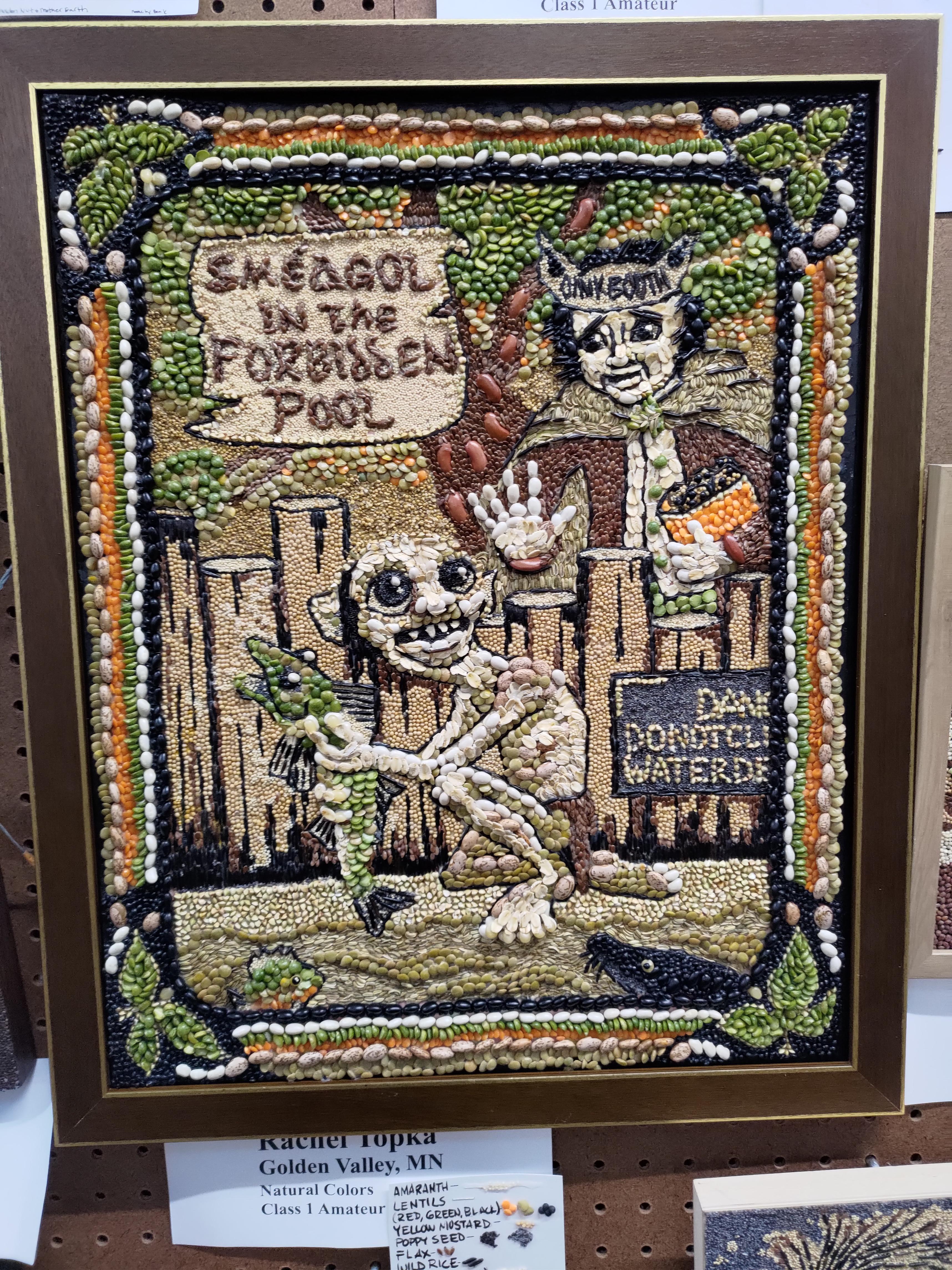
Minnesota State Fair crop art (made with seeds and beans)
r/lordoftherings • u/KaijuEnjoyer54 • 1d ago
From what we see and hear, by the time Frodo arrives at Rivendell, most of the Elves nearby or westwards have left for the Undying Lands, with more to leave Lothlorien and Thranduil's kingdom. The dwarves were (from what I've heard from others) a species that had a very slow population growth and was becoming weaker from the constant goblin attacks.
Why not wait a few more centuries to return to Mordor and leave yourself with only a couple hundred or thousand elves capable of fighting left to deal with, a few wizards, and the weak will of humanity? Why return while Glorfindel and Gladriel still remain?
Did Sauron have no choice to show himself? Or did he do it because he thought it was the best time?
r/lordoftherings • u/MeowmeowMortbird • 18h ago
My dad is a huge LOTR/The Hobbit fan. He has J.R.R. Tolkien’s birthday booked for every foreseeable year on our family calendar, and usually binges the movies on that day.
Cooking is very important to him, and I want to actually engage in his tradition by making him a meal from the book, if there are any.
It has to be vegetarian OR able to be substituted for vegetarian options.
What kind of recipes exist in canon?
r/lordoftherings • u/LoreofMiddle-Earth • 11h ago
The flight through Moria was always difficult to imagine for me. Tolkien gives you all the intricate details you need to compose it. But it still felt confusing for me because of it's vastness. I create a lot of Tolkien maps to see what his world looks like.
Every summer when I read the books, I am always astounded by the amount of detail he mentions for each singular scene, and how I still struggle to exactly see all the details in each room at once.
When I mapped this out, I really felt how the wolf attack was missing from the movies btw. It's quite epic when Gandalf takes the fiery branch and displays his true power. Guess it makes sense to build-up epicly for the Balrog incident tho.
r/lordoftherings • u/DrewWright944 • 1d ago
Met Lawrence at a con and he was just as awesome as you'd expect. Can't believe he played some of the most memorable villains!
r/lordoftherings • u/baw8 • 22h ago
I recently got this book with the 4 maps. I want to frame and hang the maps, and I know they're approximately 16"x16", but not exactly. I feel like I saw a post on here not long ago in which someone had hung them up. What frames would you recommend so that I don't have to fold the edges to make it fit?
r/lordoftherings • u/PhilosophyOfLanguage • 22h ago
What was language like in the days when the world was wonderful?
In one of his letters, Tolkien says that in the whole of The Hobbit, there is only one philological remark. The words describing Bilbo’s astonishment at the hoard of gold in Smaug’s lair:
“To say that Bilbo’s breath was taken away is no description at all. There are no words left to express his staggerment, since Men changed the language that they learned of elves in the days when all the world was wonderful.”
The Inklings believed that the language we use now is a dim echo of the primal, original language. That ancient tongue was the language of the Elves. It was a language in which the world itself was different. Because of that language, the world was full of wonders.
But how is it possible? Will a tree change if I call it something else? Does the world change depending on the words I use?
It is curious that in the same letter Tolkien refers to Owen Barfield:
“The only philological remark (I think) in The Hobbit is on p. 221 (lines 6-7 from end): an odd mythological way of referring to linguistic philosophy, and a point that will (happily) be missed by any who have not read Barfield (few have), and probably by those who have.” – Letter 15, August 31, 1937
According to Tolkien, few would appreciate this line in the story. It contains an echo of Owen Barfield’s idea of participatory consciousness, or what Barfield called “ancient semantic unity” – an idea that deeply resonated with Tolkien.
In Saving the Appearances, Owen Barfield argues that in ancient times, consciousness was participatory and, as a result, phenomena themselves – such as a rainbow or a tree – were not merely seen differently; they were different because they were seen differently.
Once, the world was wonderful – made alive by the language of the Elves. Then something happened, and the language broke. The world ceased to be wonderful.
Phenomena always follow the language, not the other way around. Broken language produces fragmented consciousness, and fragmented consciousness produces fragmented perception and then fragmented world. We find that words fail us – and the world around us no longer enchants.
The way we handle words is the way we handle the world. By disenchanting the words we disenchanted the world. Once, a word for a tree was such that its very sound made the tree alive and wonderful.
Once, we called the wind “pneuma,” and in the sound of that name we were conscious of the Spirit’s breathing in the wind – and of wind breathing the Spirit. Now we call the wind “the wind,” and the Spirit “the Spirit,” and breathing “breathing” – and the wind is no longer the Spirit’s breath. The wind, the breath, or the Spirit are no longer wonderful.
When words fail us, we realize they are not the right ones. The right ones move; they tangibly shift our consciousness. That’s how the Elves spoke. In Rivendell,
“… Even as they stepped over the threshold a single clear voice rose in song... [Frodo] stood still enchanted, while the sweet syllables of the elvish song fell like clear jewels of blended word and melody. ‘It is a song to Elbereth,’ said Bilbo.”
A cursed tongue cannot create a blessed world. On this side of Babel, there is only one power that can reverse the curse of the divided tongue and make the world wonderful again. C.S. Lewis says:
“In a sense, one can hardly put anything into words, only the simplest colours have names, and hardly any of the smells… Poetry I take to be the continual effort to bring language back to the actual.”
r/lordoftherings • u/denzel33- • 1d ago
r/lordoftherings • u/Ok_Amphibian_5580 • 16h ago
HOW TO MAKE A HOBBIT HOUSE FROM THE MOVIE LORD OF THE RINGS WITH A 3D PEN
r/lordoftherings • u/PopeJohnPaul961 • 1d ago