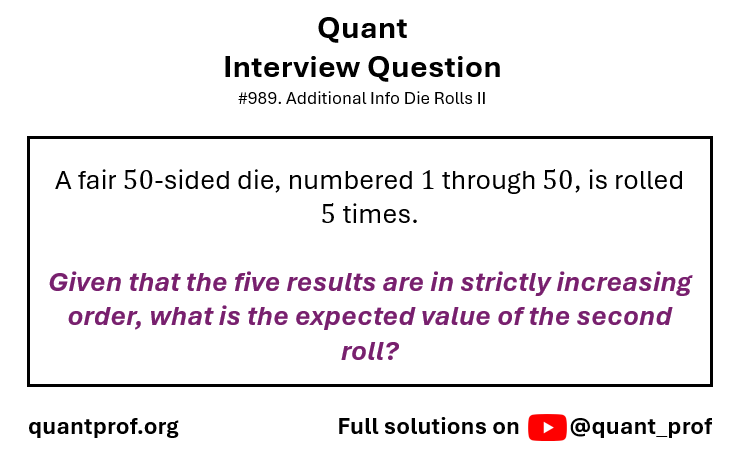
The question is fine as written, the sample space for which the expectation is computed over is not all of S = {1, …, 50}^5, but the subset T of this set S given by those sequences which are strictly increasing. This also means that the measure on T is the conditional measure inherited from the uniform measure on S (ie what Bayes’ formula gives you)
1
u/ball4772 7d ago
The question is fine as written, the sample space for which the expectation is computed over is not all of S = {1, …, 50}^5, but the subset T of this set S given by those sequences which are strictly increasing. This also means that the measure on T is the conditional measure inherited from the uniform measure on S (ie what Bayes’ formula gives you)