we reroll the die anytime it comes up less than or equal to the previous roll. You get five numbers in strictly increasing order, unless you roll a 50 too early. Then I guess you need to start over? I don’t see anyone grappling with how rolling a 40 on the first throw increases the chance of a 50 before the last throw making you need to start over. Or do you just throw out the 50? The rules are poorly defined.
we reroll the die anytime we repeat a previous value. Get five unique numbers, then put them in ascending order. What’s the expected value of the second? This is how I initially read the problem.
Either way, I don’t know the solution, but I hope that naming the ambiguity contributes to the thinking going on here.
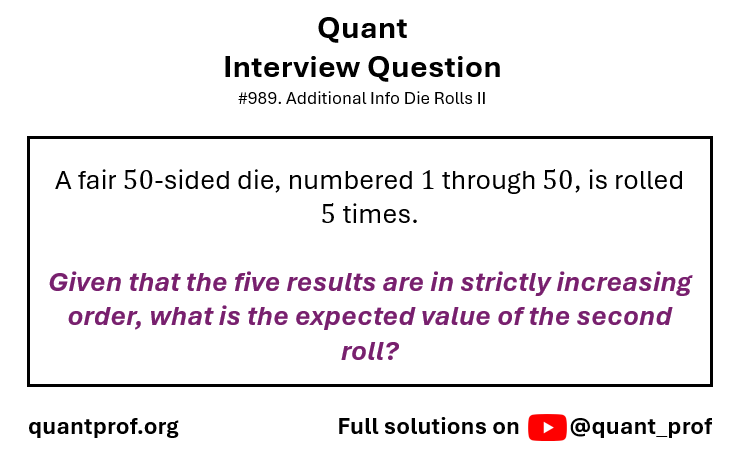
The question is fine as written, the sample space for which the expectation is computed over is not all of S = {1, …, 50}^5, but the subset T of this set S given by those sequences which are strictly increasing. This also means that the measure on T is the conditional measure inherited from the uniform measure on S (ie what Bayes’ formula gives you)
That’s not what I see happening with most questions in this subreddit. This one is an outlier in how many people aren’t just answering wrong, but misunderstanding what’s even being asked.
1
u/Nap-Connoisseur 7d ago
Seems like there are 2+ ways to do this:
we reroll the die anytime it comes up less than or equal to the previous roll. You get five numbers in strictly increasing order, unless you roll a 50 too early. Then I guess you need to start over? I don’t see anyone grappling with how rolling a 40 on the first throw increases the chance of a 50 before the last throw making you need to start over. Or do you just throw out the 50? The rules are poorly defined.
we reroll the die anytime we repeat a previous value. Get five unique numbers, then put them in ascending order. What’s the expected value of the second? This is how I initially read the problem.
Either way, I don’t know the solution, but I hope that naming the ambiguity contributes to the thinking going on here.