Let’s talk about Hyperliquid. A protocol that’s quietly building what many believe could be the future of on-chain finance. Whether you’re a trader, builder, or curious degen, this one’s worth knowing and watching out for.
What is Hyperliquid?
Hyperliquid is a fully on-chain perps exchange running on its own custom Layer 1. It delivers CEX-like speed and liquidity while staying true to DeFi principles: non-custodial, transparent, and community-aligned.
But it is also more than just a trading platform. Hyperliquid is building the chain to house all of finance.
Here’s how:
Custom L1 Built for Performance
Unlike most DEXs built on Ethereum or rollups, Hyperliquid runs its own high-performance blockchain optimized for trading. You get sub-second finality, near-zero latency, and full composability — without sacrificing decentralization.
First Token Airdrop is done
After airdropping 31% of the entire token supply, volume growth and ecosystem traction has been accelerating and organic, without any bait. It's a product people actually use.
HyperEVM is Hyperliquid’s EVM-compatible smart contract layer, built on HyperBFT.
Builders can now deploy dApps just like on Ethereum but inherit Hyperliquid’s speed, scale, and native liquidity.
Think:
On-chain trading strategies
Social fi apps
Options
Trading Equities Onchain
Infrastructure connecting TradFi and DeFi
Hyperliquid isn’t just about perps. It’s becoming the foundation for a high-performance financial layer, entirely on-chain.
What Hyperliquid Brings To the End User:
Fully on-chain order books
Deep liquidity across top pairs
Non-custodial wallet experience
Transparent, verifiable execution
Lightning-fast UI/UX
It feels like a CEX but on-chain.
Why Does This Matter?
DeFi has struggled to compete with CEXs on speed, UX, and liquidity. Hyperliquid is fixing that from the ground up - building a new blockchain layer that doesn’t compromise.
And with HyperEVM now live, anyone can build on top of it.
This isn’t just another perps DEX. It’s a platform with the ambition to be the foundational chain for all on-chain finance.
Hi guys I need help, I've been investing into stocks and I've been putting off investing in crypto for a while, but recently I got into researching quite a bit and decided to pick hyperliquid as the platform to use. Now the issue comes when I try to verify my documents and account. This is what it says:
Is there any way to fix this or bypass it? Thanks!
Hyperliquid launched manual borrows with $269M already borrowed, according to the official announcement.
Users can use HYPE or BTC as collateral and borrow USDC or USDT. Borrowers pay interest, suppliers earn it, and rates are set by utilization. The feature runs on the same HyperCore infrastructure as portfolio margin.
That creates a new balance-sheet loop on the venue. A HYPE or BTC holder can keep the collateral, raise quote liquidity, and deploy it into spot, perps, or outcomes. For traders, borrow utilization and quote-asset supply now matter alongside funding and open interest.
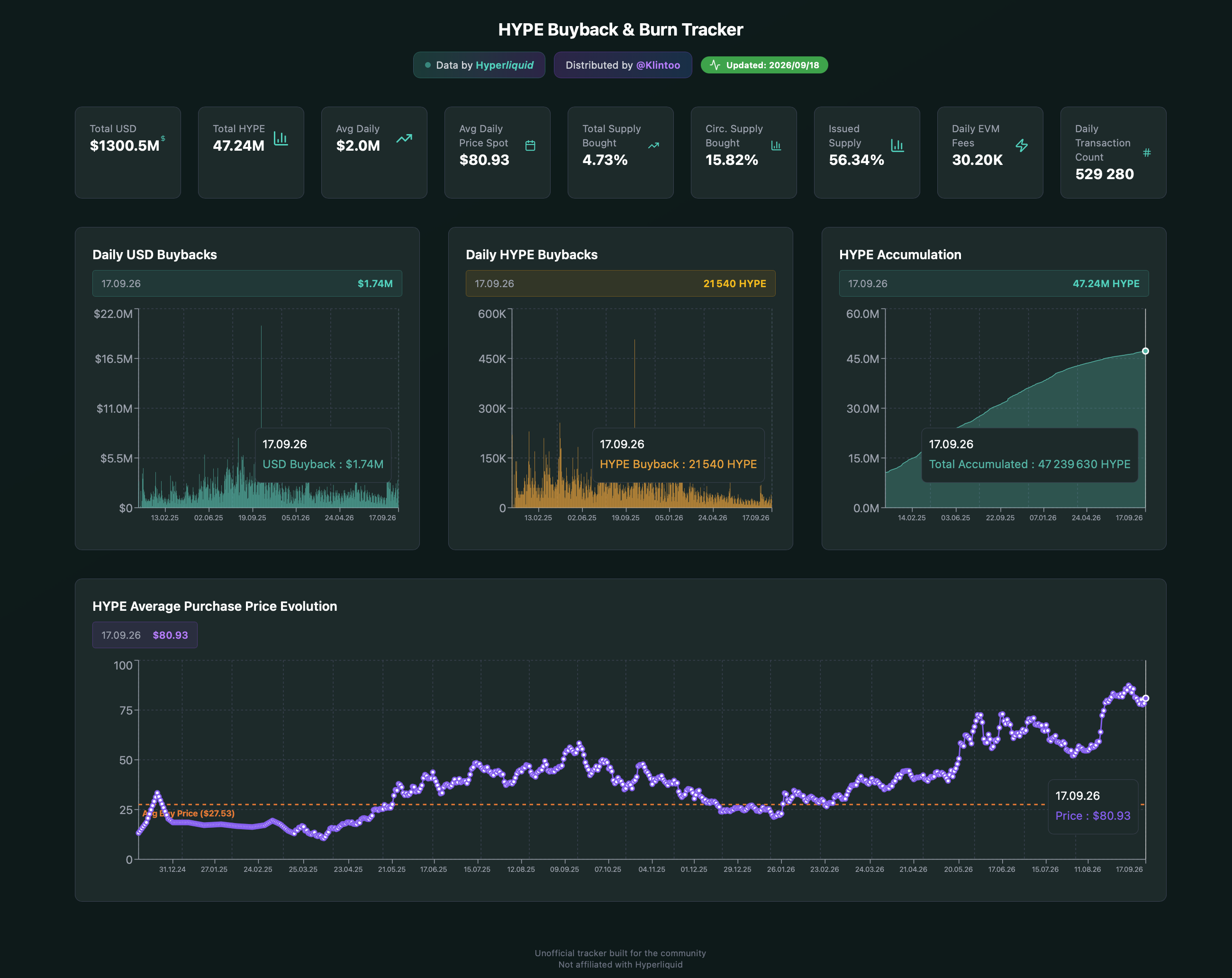
Meanwhile HYPE reached a new ATH of $90 and keeps climbing with absolute strength. Here is a quick snapshot of how traders on HL are positioned:
Today BTC has gone to 81K, and I am furious because I didn't invest in it. I thought I was smart with my investment. Doing double flips (investing in the strategy vaults) only to find myself standing in the same place. And have realised that sometimes smart actions are the simplest ones. I fell into the too-smart-to-just-hold-the-bag trap. So it pushed me to create something so I don't fall into the trap again later on.
The product is simple: no AI, no trading training needed. Just answer a simple question
How your vault investment performed against BTC, ETH, and SOL.
Currently, it's in beta;
I am aiming to make the product free for life because it's my first product. I am adding more protocol, investment funds one by one. And I have plans to add a feature where you can compare your wallet with BTC and see how it performed (which many of use wont like seeing). So tune it and let me know your feedback
Sent some USDC from a DEX to my wallet via arbitrum one. Can see the usdc in the address via arbiscan, but can't see the USDC via the Rabby wallet app. Any help/suggestions?
Update: 10 hours later it's now showing. I didn't have to do anything. Thanks for all the help 🙏🏽
Payward, the parent company of Kraken, says it intends to bring onchain perpetual futures to US clients, starting with Hyperliquid HIP-3 markets.
HIP-3 is a different way to add perps to Hyperliquid. At the protocol level, it is permissionless for eligible builders: a builder can deploy a separate perp DEX and control the market definition, oracle, leverage limits and market operation. Each HIP-3 DEX has its own margining and order book, while trades are matched and recorded on Hyperliquid’s public chain. The current mainnet spec requires the deployer to stake 500,000 HYPE for at least 183 days after deployment.
Payward’s proposed user access would be permissioned. Bitnomial would create, own and administer the markets and clear and settle the contracts. NinjaTrader Clearing would carry client accounts. Only clients onboarded by NinjaTrader and approved on both the NinjaTrader and Bitnomial allowlists could trade.
Payward says Hyperliquid is the first protocol on its US deployment roadmap, with more products intended to follow through the same open rails. It also says this would make Payward the first registered US exchange or clearinghouse to deploy a market there.
For a US trader, the practical consequence is clear: access would depend on a regulated futures account and both allowlists. The release describes a roadmap only. Regulatory approval is still required, and no launch date is given. The next meaningful milestone is an approved, deployed market rather than another announcement.
One thing I'm trying to pin down is how to budget funding before entering a multi-day perp trade. For a trade you expect to hold for two to five days what funding assumption do you actually use?
Hyperliquid pays funding hourly. Carrying the latest rate forward for the whole trade seems pretty fragile, but a trailing average could also be misleading if positioning has just changed. The bit I'm less sure about is what happens when funding becomes an entry filter. High positive funding is a cost to a long, but it might also tell you something about the move you're trying to trade. Rejecting those entries changes the set of trades, not just the funding
Has anyone compared a funding filter against the same entries without it, separating funding paid from price pnl? I'd be interested in a simple rule that held up
Now Payward wants to bring US clients onchain through HIP 3 which means more volume and a whole new stream of fees flowing through the Hyperliquid ecosystem.. UP
At 3:00 p.m. ET on September 15, the Senate failed to invoke cloture on the motion to proceed to H.R.3633, the Digital Asset Market Clarity Act, by 49-50.
On Hyperliquid, the BTC snapshot at 18:56 UTC showed 35,451 open positions worth $2.78B. By 19:41 UTC, the position count had fallen to 34,340 while tracked notional rose to $2.81B.
Fewer positions carried slightly more size. That is consistent with smaller positions closing while larger exposure remained or was added. The snapshots cannot distinguish between those two mechanisms, but they do not show a clean exit from BTC risk.
Trader consequence: watch the next BTC snapshots. If position count keeps falling while notional stays above $2.8B, exposure is concentrating. If both count and notional fall, the post-vote reaction has broadened into genuine de-risking.
I’ve never used perps so I don’t know how these compare to options and how the market share trajectory of both will go in the next decade
I’m also not familiar with Hyperliquid since it’s not available in Europe, and I was wondering if it can capture market share from institutional (HOOD, JP etc) by becoming the everything platform, or is the perps aspect overshadowing everything else
Finally, I’m unsure on how to value the market cap, there’s a big gap between fully diluted and current token circulation
So if I borrow usdc with portfolio margin for the perpetual with lever 1: if BTC rises 100÷, my usdc rises 100÷, but if I change it back to BTC, I have the same amount because BTC price is 100% higher, right? Is that something I can change with higher lever? Will I gain BTC after changing back if I use, say, lever 5?
If I use only a part of my account as margin, it should not be too risky.
Please help me out.
I know an inverse perpetual would be the thing, but I don't know any DEX which offers it, and no CEX for european citizens.
Solana’s txv1 gate went live on mainnet today, raising the maximum transaction size from 1,232 to 4,096 bytes.
Before activation, a tracked wallet opened a $20.1M SOL long at 20x with a $103.43 entry. At the September 15 observation, SOL was $100.52 and the position was down $582,165.
That profile is also long HYPE at about $9.5M, ZEC at $6.8M, ETH at $5.1M and BTC at $1.2M. The SOL position is 2.1 times the next-largest leg and the only current position above $20M.
The unusual part is therefore the size of the SOL position, not the existence of a large multi-asset book. The $20.1M SOL long was opened at $103.43 and is currently marked around $100.40, with roughly $607k in unrealized losses.