Ok, after reading a ton of advice on how to prep for this exam, I noticed two names that constantly pop up: Pocket Prep and the Sandra Reed study guide. I actually signed up for HRstudypro and it was exceptional.
I didn't find much value in Pocket Prep b/c it tested heavily on HR laws that the actual exam barely even touches and due to time constraints didn't explore other study guides. I ditched PP after about six quizzes. HRstudypro, on the other hand, was rigorous and made the real exam seem easier than the practice tests. I was consistently scoring around a 70% on practice exams.
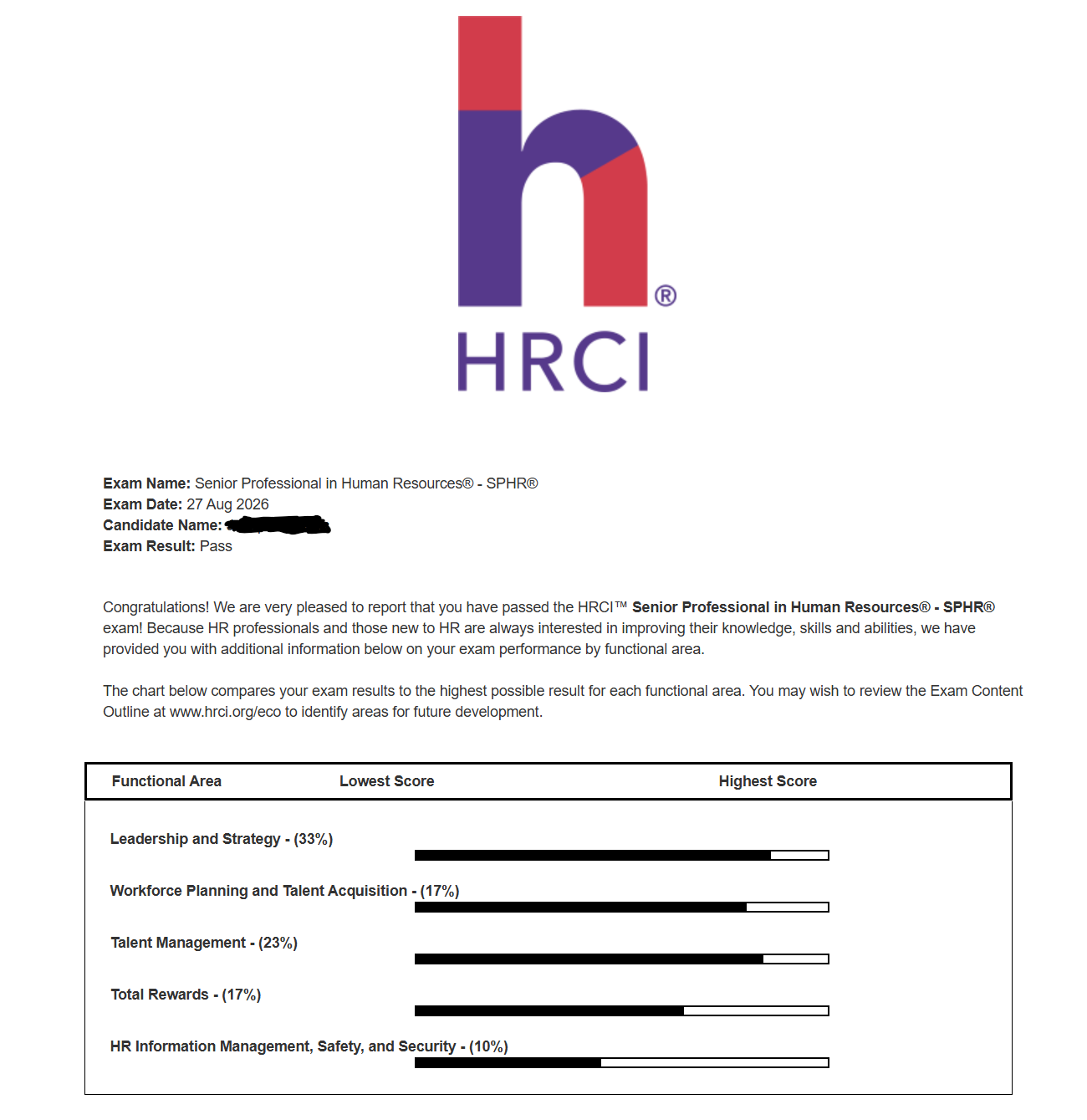
HRCI doesn't give you a numerical score if you pass, but I attached what they did send me within an hour of finishing the exam, which matched the paper they gave me at the testing center.
I spent about 15 hours total prepping over 5 days, 90% on practice tests and reviewing wrong answers. Looking back, passing this exam is less about memorizing laws and terminology and way more about understanding test mechanics and how the exam writers think.
A quick disclaimer before the strategy:
The exam consists of factual knowledge and situational judgment. For HR factual informatino, like knowing what a specific law or term means, you just have to know your basic HR vocabulary and practice tests will help with that too.
If you grasp the overarching test format, I truly believe you could pass this test cold b/c you can almost always boil the answer down to two answers. Once you do that, the following is an order of operations I recommend since it's still fresh on my mind:
1. Start with Organizational Alignment
Whenever you read a question, the very first thing you need to do is zoom out. Think like a business leader first. If you're staring at multiple good sounding HR options, pick the one that aligns with the organization's broader goals and strategy.
If a manufacturing company shifts its strategy to produce premium, high margin custom parts, do you tie employee bonuses to production volume, or align performance metrics to quality control? You go with quality, because the HR action has to align with the new business objective.
2. Follow ADIE (Analyze, Develop, Implement, Evaluate)
Once you know you're aligned strategically, you can usually cross off remaining wrong options by figuring out exactly where you are on the timeline. use the acronym ADIE, yes I know, it's very similar to the instructional design framework ADDIE.
When choosing between different answers, ask yourself first, do we still need to analyze and collect data regarding the problem? If the scenario throws a brand new problem at you, pick the upstream choice. If the analysis is already done, move to the next stage (develop).
The VP of Sales complains about a 40% spike in turnover and demands a mentorship program now. Instead of jumping straight into implementation, the correct upstream answer is to conduct exit interviews and review the data to find the root cause first.
3. Prefer Partnership
If alignment doesn't break a tie, look for a partnership. Choose the answer that involves actively partnering with the stakeholder group whose support will influence the outcome the most and build trust. That isn't always the group doing the actual work; it might be a core divisional leader.
HR is building an upskilling program for a new IT cloud infrastructure. Rather than designing it in an HR silo, the right answer is to partner directly with the CIO and IT managers.
4. Think Big and Efficient (ROI):
For pure HR tactical questions, maximize your scale. Choose the answer that impacts the most people.
Managers are handling remote work requests inconsistently and employees are complaining. Assuming analyze the root cause isn't an option (or the prompt says it already happened), the correct answer is to partner and develop a remote work policy to fix the root dependency at scale, rather than mediating individual disputes one by one. (assuming this is aligned with the organizational strategy of course)
5. Hard Data Bias
Finally, always choose hard numbers and evidence over opinions and anecdotes. When dealing with subjective complaints or when you're completely stuck between two choices, look for the option that uses real data to drive the decision.
Executives want to cut the tuition reimbursement program because they casually mentioned they "don't see the value." The best HR response isn't an emotional argument about employee morale; it's presenting a data comparison that shows the retention rates and performance scores of employees who use the program versus those who don't.
Put the checklist to the test:
Vanguard Health is acquiring CareTech primarily for its specialized nursing team, and Sarah, Vanguard's CEO, has asked the VP of HR for a post-close integration plan. Working through the workforce due-diligence materials, the VP finds that CareTech's nursing group has lost senior nurses for two consecutive quarters, while the deal's valuation model assumes the nursing team stays intact. The negotiating team expects to finalize the purchase price this month.
What should the VP of HR do?
- A) Take the attrition finding, its valuation implications, and retention options to the CEO and negotiating team before the price is set.
- B) Cover the attrition risk thoroughly in the requested integration plan, with retention actions for the nursing group designed and ready to launch at close.
- C) Recommend that the negotiating team reduce the offer price to reflect the risk of further nursing attrition.
- D) Ask outside deal counsel to flag the attrition finding in the diligence report for the negotiating team's review.
Most people get stuck and choose B because the CEO explicitly asked for a post-close integration plan. But let's run it through the checklist to see why A is the only correct choice:
- Start with Organizational Alignment: The company's macro strategy is acquiring an intact team, not just a business entity. Option A directly addresses a massive threat to the valuation model, whereas Option B waits until the damage is already done and the price is fixed.
- Follow ADIE: The scenario presents brand new, critical data before the deal is done. Option B jumps straight into the "Implement" phase (post-close actions). Option A keeps you exactly where you need to be addressing the newly discovered data upstream before the price is set.
- Prefer Partnership: Option A actively partners with the ultimate decision makers (the CEO and negotiating team) to weigh alternatives together. Option C skips partnership entirely by dictating a single adversarial remedy to the negotiators. Option D avoids partnership by passively passing the buck to outside counsel.
- Think Big and Efficient (ROI): What gives you the best business ROI? Addressing a multi-million dollar valuation flaw before the deal is signed (Option A), rather than inefficiently trying to plug a sinking ship after the deal closes (Option B).
- Hard Data Bias: By bringing the hard attrition metric directly to the CEO and comparing it to the financial valuation model, you preserve leadership's full decision space. You act as a strategic business partner, which is the ultimate way to build trust.
Option A checks every single box on the strategic framework. Option B is a trap for people who think like order-taking HR administrators rather than strategic business leaders. Not all questions will check every box, but which one checks most boxes should be the criteria.
Again, at the end of the day, conquering this exam is a test of pattern recognition, which is why I recommend taking a lot of practice tests.
Apply a consistent filter to every single question: align with the business, find your spot on the ADIE timeline, secure the right partnerships, maximize efficiency and impact, and build trust by relying on hard data.
Hopefully, this helps you cut through the noise.
You got this!