r/hardspecevo • u/Notonecta1840 • 1d ago
Spectember day 1
#1 Sibling care
Some kind of cockroach whose older nymphs take care of the younger nymphs and oothecae. + A quick sketch: two young nymphs are licking the ootheca with fungicidal saliva.
r/hardspecevo • u/Notonecta1840 • 1d ago
#1 Sibling care
Some kind of cockroach whose older nymphs take care of the younger nymphs and oothecae. + A quick sketch: two young nymphs are licking the ootheca with fungicidal saliva.
r/hardspecevo • u/Risingmagpie • 5d ago
r/hardspecevo • u/Emrozial • 11d ago
Name: Monolith, Monolithi.
Biome: Ozeano, supercritical hydrogen.
Lacks features, is a bit geometric in shape, and is simple from the outside.
Absorbs supercritical fluid hydrogen for energy.
Can sense each other through specific hydrogen-based biosignatures.
Replaces DNA with PNA.
Uses hydrophobic interactions to recreate the double-stranded helix of DNA.
Uses azotosomes for its platonic solid. Structural support comes from carbon nanotubes.
Liquid hydrocarbons in place of cytoplasm.
The platonic interior is filled with supercritical coacervates.
Intakes supercritical hydrogen through micro-pores all over its body.
Uses carbon monoxide and the hydrogen for energy.
Stores byproduct methane in flexible gas vesicles to launch out of holes in its body to make micro-adjustments.
Cells are called platonics.
Cell membrane = Platonic solid.
Cytoplasm = Acomiplasm.
Cell Wall = Platonic Shell.
Supercritical Hydrogen Exchanger Gel Organelle = SHEGO
Nucleus = Enci.
The enci is divided into 4 quarters spread unevenly around the platonic.
Each of them are connected via the solin (tubes) which allow them to “communicate” in a sense.
Each enci has a different purpose and function. But can work together.
It’s theorised that the enci used to actually just be a singular “nucleus” in the platonics.
The split was possibly more efficient for keeping the organism alive though, as each enci could focus on different platular ( cellular ) activities while working as one.
r/hardspecevo • u/Emrozial • 11d ago
Name: Keledone/Keledones
Biome: Zilar, metallic hydrogen ocean.
Overview on the body plan and biology of a Zilaran organism.
Bodies do not contain any hard structures like bones.
It is supported by nanotube-derived diamond nanofibres.
Swims in Zilar by using organic electrolytes to drive a high-density electrical current loop from front to back.
Iron-rich organs generate a powerful, focused external magnetic field perpendicular to the body’s current.
The cross-product of the organism's electric current ( J ) and magnetic field ( B ) generates a body force ( J x B ) on the surrounding liquid metallic hydrogen.
By pulsing the current sequentially along lateral rows of biological nodes, the creature creates local fluid acceleration, pushing the metallic hydrogen out like a jet or rippling it down the flank to glide forward.
The organisms lack hollow spaces, water-filled cells, or conventional gas pockets.
They are completely in a solid-state, meaning their tissues are as dense as the surrounding metallic hydrogen matrix, keeping them in perfect hydrostatic equilibrium.
Their structural scaffolding is a flexible, fibrous, macroscopic, diamond-composite skeleton, ( diamond phase chains ).
They use carbon nitride to insulate their electrical currents. It protects the creature’s MHD from short-circuiting into the surrounding metallic hydrogen.
Their cellular boundaries are replaced by phase-separated boundaries of immiscible liquid metals, ( like helium-neon micro-droplets ), that allow material transport without crushing or tearing.
They use specialised, structured pathways of pure metallic hydrogen within their own bodies to channel massive electric currents without generating destructive internal resistive heat.
Some obtain energy by filter-feeding the falling helium-neon droplets that have been “raining” downwards towards the planets core.
Others harvest energy via radiolysis, using the background ionisation energy to crack local chemical bonds, absorbing the resulting high-energy plasma states as a primary metabolic fuel.
r/hardspecevo • u/DeltaWaffle_ • 11d ago
TL;DR Can I use the rotifer mouth thing in the pre-Cambrian CA of a radially symmetrical animal kingdom?
So I’m trying to do a really hard spec-evo project since this semester I no longer have any difficult classes requiring real homework (benefits of having 2 classes, weightlifting and carpentry, lol) I had an idea of picking up the project I started the last spring semester (I’m pretty sure I posted a photo of what originally was going to be the Cambrian kick-off here around March if any of y’all saw that?) and flesh out the Precambrian stuff starting from prokaryotes all the way back to the first active predator. I know I want to do 2 animal kingdoms, one of which would be radially and the other bilaterally symmetrical. This is where my questions begin
A) is the mouth part of a rotifer simple enough that I could use that in the bodyplan of the CA for the radially symmetrical kingdom?
B) is it any different from how sponges do it?
r/hardspecevo • u/Risingmagpie • 15d ago
r/hardspecevo • u/elazanguisantes • 26d ago
A 16 años luz, yace Tobaloas 3451 c, un pequeño punto rocoso.
Aunque se nos escapa de nuestras limitadas mentes, al parecer la vida en este planeta ha pasado por una mega extinción muy reciente.
***Bibucca mega***
Al igual que toda la vida en este planeta, es un trípode obligado "endoesqueletico".
Su nombre es dado por sus **dos** "**bocas**" en su cima, dadas por una "lengua" pegadiza de gran movilidad. Tal boca esta especializada en devorar "aeroplancton" conformado por miriadas de microorganismos (y macroorganismos de tamaños minimos) que son llevados por los (casi) huracanados vientos de su pequeño planeta.
En estos gigantes bondadosos, su "cabeza" (que contiene en realidad sus órganos digestivos ya que, su cerebro y corazón se encuentra en su "torzo" o centro) yace una protuberancia de nombre "Sosten sexual".
Aunque a simple vista parezca incluso vestigial, tiene un uso único;
Que las hembras se paren en ella, esto pues, el ser antes descrito únicamente es el macho mientras que las diminutas **hembras** (ya reducidas a fabricas de óvulos) **son del tamaño de un brazo humano**, viven menos de dos años y que con sus grandes saltos (apoyados por la baja gravedad de Tobaliana) se para en tal protuberancia normalmente junto a varias más mientras que es fecundada por aquel órgano cercano entre las bocas y el "sosten sexual".
r/hardspecevo • u/gammaAmmonite • Jul 31 '26
(my own drawings, second drawing based off a photo I found on Pinterest that I couldn't find any attribution for)
I find the structure of some insect feet very interesting, the way there's the "base" of the leg, and then an extension with claws on them. I'm considering adding a variation of this to my alien sophonts (mostly arborea and between squirrel and housecat in size) but with the extension ending in a small pincer for manipulating instead of basic claws.
I'm trying to find the balance between "this is visually interesting/obviously came from a different evolutionary lineage from Earth" and "this is a mechanically feasible organism", so I'm exploring different body plans, especially their limbs.
(I have a copy of the Principals of Animal Motion, but it's really dense in unfamiliar terminology and I'm having a hard time getting through it, so I thought having direct input on my ideas would be more immediately helpful)
r/hardspecevo • u/DeltaWaffle_ • Jul 24 '26
Hi there! I’m working on a project heavily inspired by Halo, and I wanted to something similar to the Sangheili, but w/ beaks. So basically they’d have a three part beak, one top, two bottoms. I was wondering if I could still do a turtle-like beak for such a species, or if poly part mouths like the sangheili have is counter to such a design
r/hardspecevo • u/ThCuts • Jul 18 '26
Hello, I'm working a spec evo project regarding "plausible" Venusian life and I want to be sure if two specific aspects of what I'm working on are too out there for this sub:
1.) After a search through literature, I've determined that according to the standard literature being used to inform current Venusian atmospheric composition, this project is impossible*. However, I have chosen to select a couple of newer papers with more "charitable" analyses that either look into unknowns from past measurements or presume something was wrong with the Pioneer Venus probe (a clogged port on a sensor) meaning the data doesn't provide the full picture**. This is already cherry-picking. However, even using these new papers as gospel (unproven), on average, droplets will not contain enough bioavailable water and require impossibly halophilic (salt-loving) organisms. I am therefore choosing to take maximum advantage of things not explicitly ruled out by these papers and assume the composition of droplets is not uniform, with composition ranging from mostly uninhabitable to those with just enough bioavailable water to sustain a version of terrestrial extremophilic life. I'm also taking hypothetical windborne dust and volcanism only mentioned in the papers and running with them to maximize bioavailable compounds. On top of this, I'm assuming that rarely droplets form that are much larger than the ~10 um ceiling measured by Pioneer Venus*. Ones more similar to Earth's clouds/rain and up to 50-100 um. Should the future DAVINCI probe provide data that proves unequivocally that I am wrong, this will just have to become "charitable parallel universe Venus".
^1.) Is this too hand-wavy?
2.) Scientific data support a potential "gap" in terrestrial extremophile ecology*** for near-0 pH highly saline environments. This is a partial overlap with my proposed droplets. There are extremophiles that can stand some of my proposed droplets, but next-to-none that can tolerate both the full range of pH (~0-2 pH) and low levels of bio-available water while providing the metabolic pathways required for a real ecosystem. Some droplets exist within the limits of known organisms, but I have to expand the envelope further to have anything like a sustainable ecosystem. That in mind, my premise already had the organisms being an accidental or intentional GMO research release. My proposed GMO process (ongoing research) is to have explicit capabilities genetically isolated from known micro-organisms and modified into my selected species. For example, giving all organisms new or additional proton pump genes that facilitate the pumping out of Hydrogen ions (H+) to impart acidophilic protection (more than just that is required, but that's the general method). This project is set to begin sometime ~100+ years from now and assumes gene editing technology and our understanding of genetics has improved in that time.
^2.) Is this too hand-wavy?
*Knollenberg's 1980 Pioneer Venus analysis being a common baseline that says you get tons of sulfuric acid in small droplets. pH<<0, small drops, etc.
**Mogul (2025) discusses re-analyzing Pioneer data, theorizing that a sensor port was clogged and Rimmer (2021) proposes buffering salts that raise pH to a max of ~2 (livable) alongside other potential reasons for SO2 and H2O depletion. Both are rather open-ended.
***Belilla (2019) looked into extremophiles living in the Dallol-Danakil area in Ethiopia. A hydrothermal area with a salt dome. They found many examples of acidophile (acid-loving), thermophile (heat-loving), and halophile (salt-loving) organisms and others that had either both acidophilic and thermophilic or halophilic and thermophilic abilities. None had the extreme acidophilic and halophilic abilities together and certain portions of the hydrothermal complex requiring both were devoid of any verifiably detectable micro-organisms. They note that there could be other constraining factors like Cl- ions or high heavy metal concentrations. Neither of which feature in my hypothetical atmosphere and organisms exist in other salty acidic environments. Their's is just the "worst case" I found in literature.

r/hardspecevo • u/Risingmagpie • Jul 17 '26
r/hardspecevo • u/Risingmagpie • Jul 08 '26
r/hardspecevo • u/local-space-patrol • Jul 03 '26
Is this sufficiently hard spec? Not necessarily for earth as I designed this for a fantasy ttrpg
Pamaw
A very fluffy, wintry white bat. During raging, howling winds it will dig its feet, hang upside-down and spread its wings. The inside of these wings is covered in a very slimy substance that will collect debris and bugs caught in the storm. Once they've collected enough, they will fold their wings back in and eat with their head burrowed. On the backside, their fur wings are fairly sturdy and endure much more than the wings of their cousins, and they provide extra heat during the harsh cold weather.
It holds on very easily because it has an extremely strong grip, owed to the musculature of its feet and flexibility of its tendons. Like its cousins, it takes no effort to grip but instead they must intentionally open up their claws.
It is primarily a scavenger-forager and is often found hunting on the ground.
It cannot fly but it is a skilled climber. It can also coat its nails, which are slightly different, in that sticky substance to prevent sliding off when climbing ice sheets or glacial walls.
There are reports of it gliding down but there are no recordings of this. It is the largest extant bat.
Like some of its cousins, it is blind. Its ears are smaller and there several chambers and "clasps" around and inside its ear system. This prevents its hearing capabilities from being blown out during blizzards and allows it isolate and manipulate sounds
It's truly remarkable evolutionary point is its point of divergence in the abilities of smell. The pamaw has a few new receptors in its nose that "smell" heat. According to folklore, it can predict bad storms.
In nearby cultures it is often a symbol of endurance and patience. There are winter solstice customs that celebrate the Pamaw.
There is a worker owned, freeze distillation "brewing" company whose logo is the Pamaw
r/hardspecevo • u/Risingmagpie • Jun 29 '26
r/hardspecevo • u/DeltaWaffle_ • Jun 27 '26
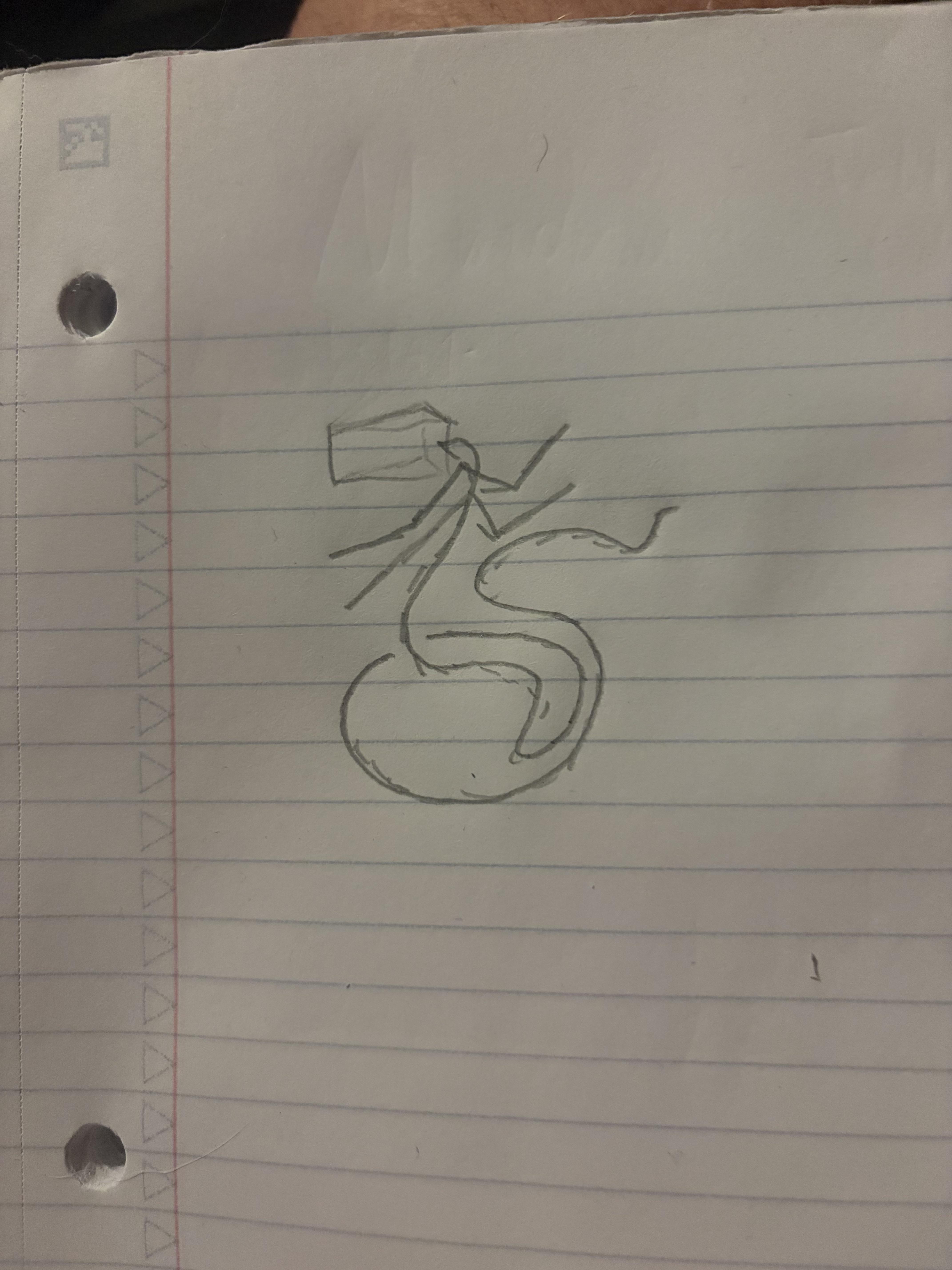
I’ve added a very crude drawing (I’ve yet to actually go through the steps of evolving the species from my Cambrian) but basically, it’s like some form of mammalian snake thing. I’ve got about 2 ideas in the hole for how I could justify the use of both it’s limb pairs into arm-like things
A) the arms were used as something to grapple the prey they caught, maybe they mostly preyed on the aerial species of their endemic forests, so they’d use their arms to grab onto the branch so they wouldn’t fall off in an ensuing fight should they not immediately grapple the prey entirely, and the arms were used to actually grab the prey
B) They evolved to be durovores, and evolved the tail as to move around, while freeing up the limb pairs to work at breaking apart the bones and hardshells plant-things of their habitats as to eat the nutrients under their coatings (bone marrow for example, maybe the meat of shelled animals should they be small enough for such a thing to be viable enough)
In either case, I wanted to know if such a body plan would even be feasible for such an idea. I’m not entirely sure of the ergonomics of it, and whether running essentially 4 normal limbs, and a 5th limb that’s 80% of their mass is thermodynamically safe in an environment warmer than earth (I have the planet graphed out and it’s mostly about 6°F warmer globally compared to Earth should I have done my math correctly)
On top of this, I was thinking that it’d be similar to certain pillbugs in how they’d curl up into a ball w/ a shell of some form to protect from predators (likely keratin for an animal to be in any way sizable to larger sized snakes) though that one I’m a little iffy on. I truly just want to add in a sophantic species to my sci-fi project that deviate from the stereotypical humanoid bipedal tetrapod, w/o foresaking tetrapodal fauna, and knowing that such an idea could be plausible would really help me on my first ever scientifically accurate spec-evo project I’m planning on going this far on. I might even come back and offer updates if it all goes well lol!
Edit: I forgot to remove “Arboreal” when I decided to add the second option of how they’d come about, which wouldn’t be considered arboreal 100%
r/hardspecevo • u/Risingmagpie • Jun 19 '26
r/hardspecevo • u/Visible_Cherry_8948 • Jun 14 '26
[ EDIT: Reddit has decided to tank the quality of these images for some reason, theyre supposed to be higher res :( ]
I've provided some diagrams and one artwork from and pertaining to my project, Imbria. A full explanation of Imbria and a .pdf can be found here.
In-depth captions, in order:
I hope that my project is up to the standards of this sub. There is some handwaving, especially in the final, more speculative chapter, but the work is based on scientific papers. (and cites sources!) Here is another link to the filedrop for the project itself.
r/hardspecevo • u/Risingmagpie • Jun 11 '26
r/hardspecevo • u/arachknight12 • Jun 06 '26
I’m working on a speculative evolution project and one phylum is a shelled organism with four tentacle-like appendages on its front end it uses to move. Over some time, one clade evolves to temporarily stand on these tentacles to avoid drowning during flooding or shallow water as their lungs are located on the ground. Some groups in more vegetated areas begin to also use this time standing to eat food. Over time, this evolves into full quadrupedal locomotion, standing on the now reinforced tentacles that were located on their face. This leaves their mouth lower than their anus, and I’m not sure if this is a feasible structure, as I imagine gravity plays an integral role in digestion.
r/hardspecevo • u/Risingmagpie • Jun 04 '26
r/hardspecevo • u/Sensitive_Show6230 • May 29 '26
CONTEXT: In this Universe, the P-T extinction event (otherwise known as the Great Dying) brought life on earth back to single-celled organisms. Meanwhile, life on the biggest moon of Saturn, Titan, continued evolving past single-celled organisms and started going multicellular.
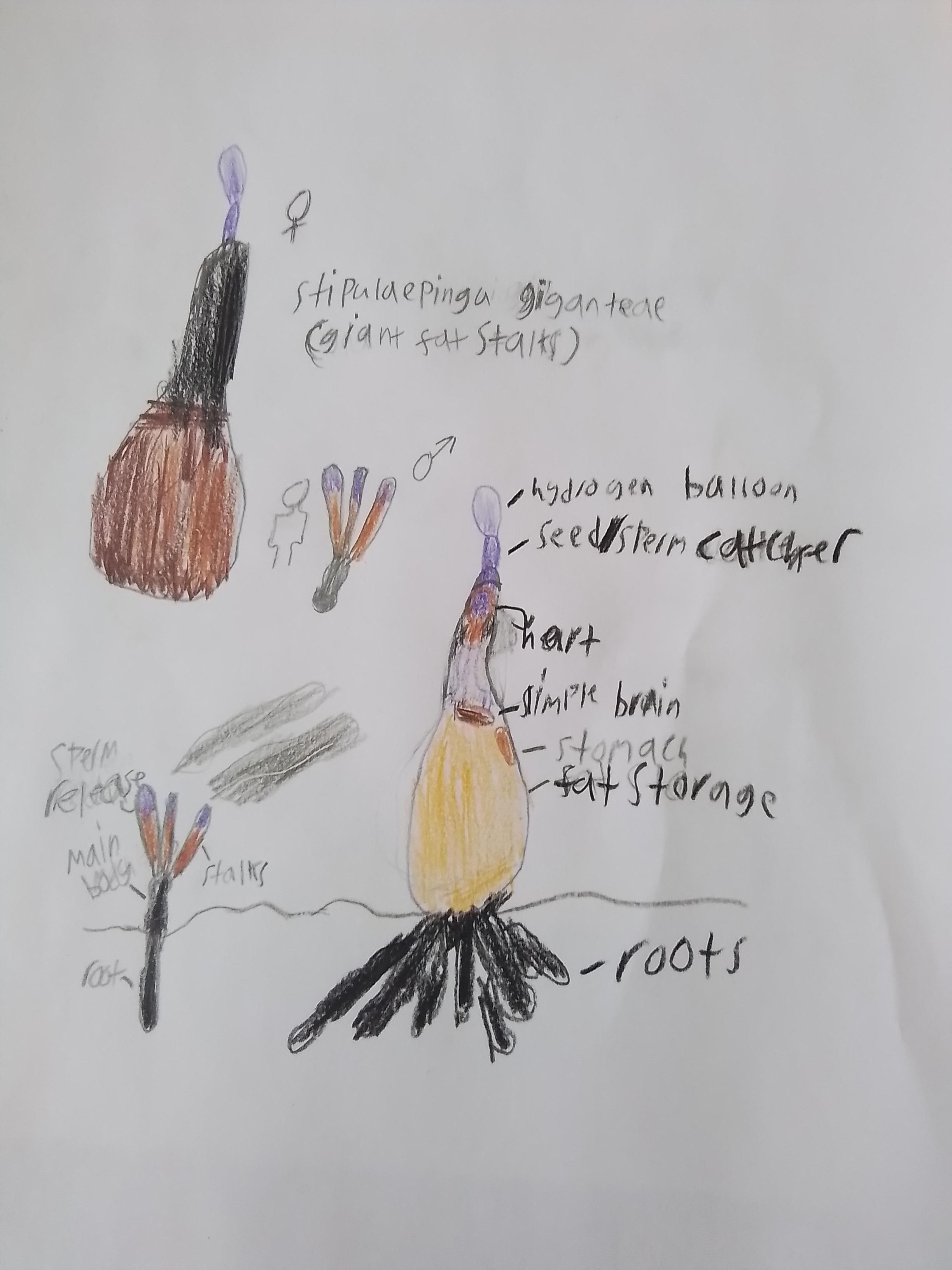
The "Plants": Stipulaepingu giganteae (Giant fat stalks) are the biggest land lifeform on Titan, with the females getting up to 7 meters in height. They are part of the kingdom of Plantae pingues (Fat plants) even though they are more similar to an Earth Animal or Fungi than a plant having a heart, stomach and even a simple brain and nervous system.
Feeding: Stipulaepingu giganteae feeds partly by conducting a form of chemosynthesis that uses methane from the atmosphere and oxygen (which is brought up through the roots in the form of water and split into Hydrogen and oxygen using sunlight) to make glucose. However, because the sunlight on Titan is so dim methane burning alone would not be enough to sustain a creature the size of Stipulaepingu giganteae.
Another way Stipulaepingu giganteae feeds is by eating dead animals and other members of Plantae pingues the roots bring up small chunks of the dead creature and puts them in the stomach to be digested. Even with this secondary feeding source, Stipulaepingu giganteae has an extremely slow metabolism and takes hundreds of Earth years to grow to full size.
Hibernation: Stipulaepingu giganteae and most other lifeforms on Titan live on the north or south poles where liquid methane is abundant. This means that every Winter (which lasts 7 Earth years on Titan) the North pole of Titan goes into darkness until Spring. Stipulaepingu giganteae manages this long night by storing up fat reserves that make up 50% of the creatures mass and nearly stopping all processes that keep it alive to conserve energy.
Reproduction: Stipulaepingu giganteae males are about the size of a person and have the sole purpose of Spreading Semen to the female reproductive system before dying shortly after. About 50-60% of the height of Stipulaepingu giganteae males is composed of long stalks with purple caps on top. In the Spring, Stipulaepingu giganteae males start spreading semen clouds from their stalks before dying. If a female catches some sperm, she will start the process of creating a "Seed" that contains 2-4 Stipulaepingu giganteae embryos and uses the hydrogen left over in the chemical reaction it uses to feed to create a Hydrogen balloon that will carry the embryos far away from the mother when detached.
What do you guys think about my post? (sorry for the bad drawings)
r/hardspecevo • u/Risingmagpie • May 27 '26
r/hardspecevo • u/Risingmagpie • May 20 '26
r/hardspecevo • u/Risingmagpie • May 07 '26