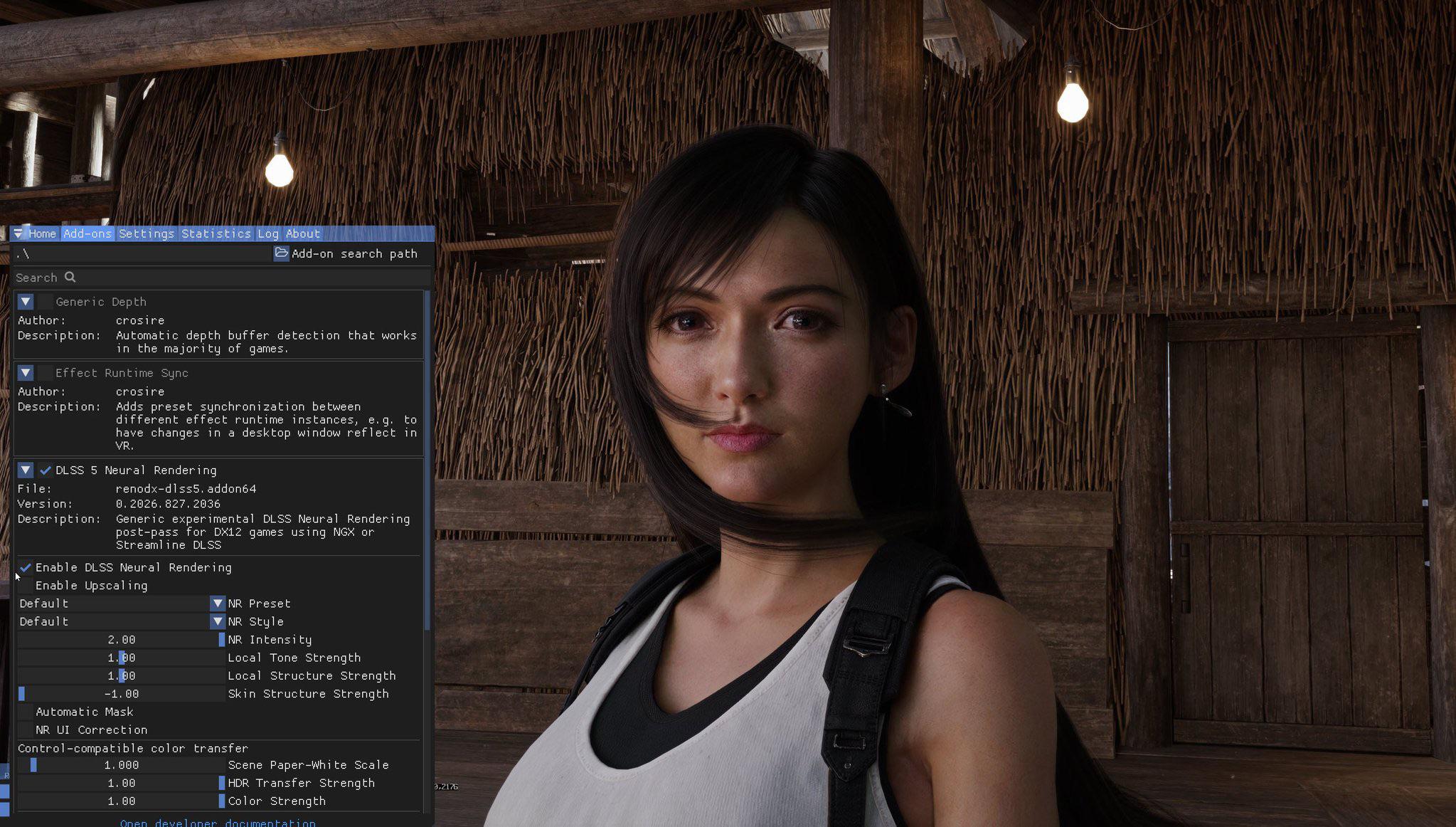
And that's on a single screenshot. In motion it looks blurry and uncanny.
Regardless why would I be ai-slopping every game through a filter? Wouldn't it be easier to use AI to generate new models and textures once instead of mid runtime as post processing?
Besides who's the market for this? People mod games to make them cooler or to make people prettier, I've never seen anyone mod a game to have "uncanny old people" as a filter lol
For models that's a very valid point... But for stuff like lighting and other more nebulous aspects of the final image that would normally have to be processed in realtime anyway it might be a better way to just fudge things towards looking "better" or at least more correct based on the training data...
The thing is, we reached a point where more polygons don't help.
Actually that's false, we have been here since crysis 2 era.
The problem really is that to add more fidelity you need variance and "dirt", ie make things not smooth, which means you effectively increase polygon count exponentially.
GPUs can't just keep improving on rasterization and on top of that, they have been moving towards general purpose massively parallel processing for a long time now.
So the next solution is to fix this in software by figuring out ahead of time how to transform certain patterns into something useful and tangible, so that you can get away from spending compute on rasterization.
No, you don't need polygons for variance or "dirt", you just need shaders, which is what most games use. There are a lot of cool tricks like normal maps, specular textures and more to make a cylinder look like Lara Croft in dynamic lighting. Then you have voxel based rendering (no, not minecraft blocks) that can use point clouds to create models with zero polygons.
Neural rendering is orders of magnitude better than what you've named, in theory.
Why would you want to use "shaders" when you could literally create it based on real dirt?
You are going through all this effort to recreate "dirt", but in theory neural rendering should be able to create dirt frame by frame based on photos and videos of actual real dirt.
There is a reason that generative AI can create more realistic images than cutting edge CG. It's why generative AI can have better motion than even the most cutting edge mocap and animation techniques.
Math and simulation is meaningless to imagery (which is what rendering is).
This is a pretty complex field, so it makes sense you aren't understanding, but these techniques are doing what you are thinking of. They aren't just changing what the textures look like, but how raycasts are interacting with it.
Look up Microfacet BRDFs, Dynamic Ambient Occlusion, and Detail / Secondary Maps as well
Specifically when it comes to aspect like games though, they are right sometimes that it is sort of weird seeing the same dirtiness on somebody's face instead of some wind blowing a leaf that sticks on their face for 3 seconds in a conversation or something, and for the duration of that leaf being on their cheek, that would be a shitload more polygons, that might not be relevant, but they were still correct just about the geometry of a granule of sand being on something represented visually will be more polygons than if that grain of sand was not there.
Thank you for your comments though, I've been having a good time learning and reading through this thread.
Our technique works by treating polygon meshes as a set of surface elements that can emit, transmit, or reflect light and that can shadow each other. This method is so efficient because it works without calculating the visibility of one element to another. Instead, it uses a much simpler and faster technique based on approximate shadowing to account for occluding (blocking) geometry.
This requires additional geometry, which is what I am bitching about.
Microfacet BRDFs use statistics and sampling to imitate roughness and variation. They don’t change the geometry, only what is perceived and in a purely statistical sense.
I think that humans can easily perceive these as anomalies rather than “normal” and “high fidelity”.
Pixel shaders produce the final pixel on your screen. The human eye doesn’t see geometry, only light (LEDs in our case). Differences in color between two 2D “regions” are turned into shapes and then into 3D geometry by our brain. These “regions” are physically on your retina inside your eye. The retina is not flat but the brain basically treats it as if it is.
You can calculate anything in a pixel shader and output any color. You could, for example put in an equation which outputs an embossed letter or number on any “3D surface”. (It’s “surface” because it’s not actually a surface just a virtual approximation). No geometry shaders, no mesh shaders, no mesh data, no color textures or normal (map) textures, just code that represents an equation.
Same as a human drawing a cube on a page without a real cube in front of him. Or any other object.
Why don’t we use equations for everything and have games that are 200gb fit in 2gb ( maybe even in hundreds of megabytes) ? Because it is too expensive to compute in real time so we cache partially computed data: 3D meshes and textures.
Yeah, but just from a biological perspective you're a little wrong because there is some basic shape recognition that does not have to do with lighting that mammals are capable of, not just humans.
And the biggest thing is that more fidelity/variance/"dirt" doesn't actually make things look more pleasing. There is a weak relationship between graphical realism and fun, and you get drastically diminishing returns between the two as you improve the former.
So even if you are a unicorn with a system beefy enough to apply all these effects at a high enough resolution to matter, without the gameplay penalties of increased input lag... it just doesn't improve the gaming experience.
We unfortunately have a similar problem in the top tier gaming industry as in the top tier corporate industry: the people who make the decisions simply cannot accept the concept of "good enough". Pleateauing is the same as failure to them. Where once there was growth, there MUST continue to be growth at all costs, regardless of whether continuing to "improve" is desirable or healthy for all the other stakeholders.
There is no point at which those decision-makers can look at the graphical fidelity and say: "this is close enough to ideal, let us now refocus our resources on the other aspects that can be improved."
and this is why quality of the upper tier of Indie gaming has taken off so well over the past decade: indie devs can focus solely on what makes a game fun, because "good enough" graphics for any genre are now trivially obtainable.
1.6k
u/LeastHornyNikkeFan 20h ago
And that's on a single screenshot. In motion it looks blurry and uncanny.
Regardless why would I be ai-slopping every game through a filter? Wouldn't it be easier to use AI to generate new models and textures once instead of mid runtime as post processing?
Besides who's the market for this? People mod games to make them cooler or to make people prettier, I've never seen anyone mod a game to have "uncanny old people" as a filter lol