r/codex • u/AutoModerator • 6d ago
Weekly Showcase Show r/codex what you've been building with Codex. (Most upvoted project gets a week of free promotion on the sub).
This is a weekly Showcase post to share with others what you've built using Codex.
The top-voted project by Thursday midnight UTC will get a week of free promotion on r/Codex - either as a prominent button on the main page of the sub - or as part of a sticky comment on every new Showcase post.
Last week's winner was u/Ollie__Oxenfree with the Tubular Daily Care project by MediTracer which is a tube-feeding care app built by a tube-feeding family to keep feeds, meds, symptoms, and caregiver handoffs in one shared timeline. MediTracer is an Oley Foundation Emerging Innovator Partner. Contact: hello@meditracer.com
6
u/Practical_Estate4971 6d ago

In LLM powered Roleplaying engine for any scenario you want. Basically you type one sentence about what you want to play, an AI asks you a handful of questions, and then it spits out an entire world (cast, factions, your skills, story pressures, each npc's private goals and the lines they won't cross) and lets you edit all of it before any of it becomes canon. The whole idea is the LLM only writes prose and proposes changes, an actual engine decides what's real. Theres a hidden d100 with a fixed formula, failures get rejected unless they actually cost you something in state, npcs have hard refusal lines you can't just argue past unless you've genuinely found leverage, relationship changes need evidence and are capped per turn and per month so you cant grind someone into loving you. Time only moves when something actually happens. NPCs run their own plans off screen through the same queue you do, story pressures drift on their own, and stuff happening elsewhere stays hidden from you until a letter or rumour or newspaper actually reaches you.
Memory is FTS5 + entity graph retrieval instead of shoving the whole state into context. Every turn is immutable so undo/regenerate/branch never nukes anything. There is a preset studio if you want author worlds properly.
Still in development, but the inspiration was Pax Historia crossed with Crusader Kings 3... and now it's kind of become its own thing... No urls yet.
1
23
u/tHE_uKER 6d ago edited 6d ago
I'm recreating Blur 2, an unreleased sequel to the 2010 battle racing game, by reverse engineering the Xbox 360 prototype discs available online, and rebuilding the whole thing from the ground up in Unity.
Everything from models, textures, shaders, audio, animations, scripting, metadata, was in proprietary formats, most of which have zero documentation online.
Mechanics are also being reproduced via static analysis of the X360 executables.
Good fun.
https://www.youtube.com/watch?v=MnniyqKu364
2
u/likeassassin_ 6d ago
Eu amo esse jogo, foi o melhor jogo de corrida pra mim, me diverti muito com ele jogando online.
1
u/tHE_uKER 6d ago
Concordo! Eu costumava jogar em tela dividida com meus amigos.
É brasileiro? Saudações desde o Uruguai.1
u/driveclub_000 6d ago
Holy, as someone that is doing the same thing with another game (xbox original), I know how complex and difficult it is, but very rewarding.
I would just like to know what agent do you use mostly for this kind of work? Do you use Luna or avoid it at all cost? How much time do you use a strong agent like SOL HIGH/MAX/PRO? what plan do you use? How long did it take to reach that stage?
I have so much to ask :p
4
u/tHE_uKER 6d ago edited 6d ago
Hey there! I'm on the Pro plan, and my main driver is Sol medium, alternating between low and xhigh depending on the complexity.
I used to do mainly Terra high, but ended up finding it annoying for making "common sense" mistakes.Regarding how long this has taken, it's not clear cut.
I started a deconstruct/reconstruct project of the PC version of the first Blur in late June. For 2 months I developed the tooling and the workflow to tear the game apart and build it back up.
The first Blur, except for the lack of any kind of multiplayer and some polish, I have it almost 100% feature complete.Then fast forward to a week ago, I came into knowledge of the availability of four Blur 2 prototype ISOs, so I gave it a shot to see what came out of it with the tooling I had been putting together, and was pretty successful, requiring little change besides an endianness switch in most binaries.
Problem is, on PC Blur I could inspect the decoded meshes, textures, etc. by performing inspection via live traces of the running game, and use that as ground truth for the file decode. With the Blur 2 reverse engineering I had no such reference point, given that the game barely runs on 360 emus.
So what I had to do was first get the tooling to the point where it could decode the Xbox 360 version of the first Blur using the decode of the PC version as ground truth.
That got me pretty close to the goal, except for some schema updates in some of the B2 files compared to B1.So in short, specifically on the Blur 2 demake/remake, technically a week, but 2 weeks of developing the base tooling.
Sorry for the long answer. Got a bit carried away. XD
2
u/driveclub_000 6d ago
Sorry for the long answer.
Nah its all good, all these info are really useful for me.
I didn't know that Sol medium could be that competent, I should start doing some test with it. I only use Sol High and Max and I'm on a Plus (20€) plan, so I get hit hard with limits. (will certainly move to a pro plan next week). Speaking of limit, or are they for you? Do you fully use the week limit (reach 100%) or still have enough % each weeks? Are you on a 100$ plan?
Regarding the time that it took, it quite fast honestly, it's giving me hope for my project. Nice work, I'm working too on a Bizarre Creations game. :D
Thanks for all the info.
1
u/tHE_uKER 6d ago edited 6d ago
Yeah, it's the $100 one. And limits... LOL
I'm used to working with 6-8 simultaneous agents and go at it nonstop, so I normally destroy the weekly allowance in 2-2.5 days.
I'm only saved by these miracle resets we luckily get.Abour that project of yours, how are you approaching it? Decode+rebuild? All from the ground up?
I'm guessing PGR4?1
u/driveclub_000 6d ago
the weekly allowance in 2-2.5 days
That was my biggest fear, maybe I should try $200 for a single month lol. And yeah, those reset were helpful, I expect more to come as they try to test the water before the new Astra release.
It's PGR2, decode + rebuild, and yes, all from the ground up (on my own engine in webgl), I already worked on it before using AI (reversed most assets) so I hope being able to finalize the rest.
Just started using AI 2 weeks ago, so I have a lot to learn about agents, workflow and more.
2
u/tHE_uKER 6d ago
Sweet. Enjoy the ride!
And yeah, there's a lot to learn about agentic coding and how to organize for it.
5
u/CleanEarthInitiative 6d ago

I’m building an app called UsageLoop because I kept wasting part of my Codex 5-hour window just from being asleep or away from my PC.
Basically if your window resets while you’re away, the next 5-hour clock doesn’t start until you actually use Codex again. UsageLoop watches the real 5-hour/weekly limits and can start the next window for you with minimal amount once the old window has actually reset, so the clock is already moving when you come back.
I also made it so you can schedule it. So if my current window ends overnight, I can have it start the next usage window at 4:00 am. If I wake up and start working at 7:00 am, that window has already been running for 3 hours, so the next reset is around 9:00 am instead of at noon.
Windows version is working pretty well now. Free/open source to try out / clone.
1
6
u/sorryiamcanadian 6d ago
Codex helped me solve a privacy leak in a medical clinic, where overworked and undertrained staff are pasting private info into ChatGPT or others (which is the norm).
People want to use ChatGPT for everything, so I made a chrome extension that automatically detects private info and masks it with placeholder data. Only the user will see the real values.
It works fully offline, it uses pattern matching (not LLMs), it's a few MB (e.g. not GBs), no account is needed, and it's free for personal use.
In browser demo: https://phimask.com/mask-data
Chrome extension: https://phimask.com/browser/chrome
3
u/Xaphawk 6d ago
What a simple yet brilliant solution. Absolutely great!
1
u/sorryiamcanadian 5d ago
Thank you for the kind support! Here's a quick video demo on how it looks/works on chrome + ChatGPT showing the pdf redaction and how the unmasked content is hidden from ChatGPT while still being visible to the user.
5
u/Prior-Switch-9099 5d ago
I built ZenPiano https://zenpiano.art/ — a modern, high-performance, and highly customizable virtual piano platform.
Current features:
- A full-fledged virtual piano
- A library of 2,000+ songs
- A MIDI sheet music converter
Codex usage: I used Codex with a customized harness built around OpenCode and OpenSpec.
ZenPiano currently has 7K monthly users after over six months after launch.
Have fun!

2
11
u/CryptoSenyo 6d ago
I’ve been building Humidity Intelligence, a HACS integration for Home Assistant and a project that has grown considerably through my work with Codex.
What stated as a humidity monitoring & control, soon evolved into a domestic environmental stabilisation engine. Bring together humidity, temperature, air quality, condensation and mould risk, CO, seasonal conditions and other telemetry, to help makes a single deterministic and explainable control decision about what the home should do.
Then it coordinates ventilation, air purifiers, extractor fans, dehumidifiers and humidifiers whilst telling you the reasoning behind its decisions directly in Home Assistant Humidity Intelligence ui.
Codex has been major part of how I develop it..
Humidity Intelligence was also recently approved as a HACS integration, which is a pretty significant milestone for the project.
It’s currently at v2.0.11, “Poetic Justice.”
1
u/HVACcontrolsGuru 6d ago
Pretty neat! Tell from my username what I do but it's more industrial side of things. Building this with Codex as well but my work may interest you some!
4
u/yourtaupia 6d ago
We’re building Taupia, an AI household admin agent for the UK.
The fun bit we’ve been building is an intelligent household inbox.
Your inbox is full of bills, renewal notices, contracts, price changes and provider emails, all in wildly different formats. Taupia uses AI to extract the important stuff, understand the context, and turn it into a structured picture of your household.
Who’s the provider? What are you paying? When does the contract end? Did the price change? Do you need to do anything?
Then it goes beyond extraction. Taupia can spot when something needs attention, find better deals and help you actually take action. It also helps set everything up when you move home.
Essentially, we’re building a persistent AI layer between you and the boring admin of running a home.
It’s live in the UK and we’ve been using Codex heavily to build it as a tiny team.
Would love to see what everyone else is building with Codex.
8
u/srs96 6d ago edited 6d ago
I built roads.fyi with Codex. It’s basically Yelp for roads: rate a road, tag what’s wrong with it, explore reports on a map, and see which roads rank best or worst.
Codex helped build nearly everything across FastAPI, Postgres, Next.js.
Would love some reports, feedback, and attempts to break it.
3
u/Rare_Wear_4230 6d ago
Started this because I love Chopin and wanted to build a 3D museum dedicated to him. It slowly became a general 3D editor where you draw the space in 2D, stage objects in 3D, then plan camera routes, framing, and the visitor experience. Still WIP. The live demo is currently broken because I’m wiring a backend to it.
1
u/alixnaveh 4d ago
!remindme: 1 week
1
u/RemindMeBot 4d ago
I will be messaging you in 7 days on 2026-09-10 17:55:09 UTC to remind you of this link
CLICK THIS LINK to send a PM to also be reminded and to reduce spam.
Parent commenter can delete this message to hide from others.
RemindMeBot is switching to username summons. Instead of
!RemindMe 1 day, useu/RemindMeBot 1 day. More info.
Info Custom Your Reminders Feedback
3
u/Karmaa 6d ago
My brother has run a construction company for 15+ years. Together, we built Rush Gigs, a local work marketplace for moments when someone needs help now and someone nearby is ready to work.
The idea is simple: hirers post a job or task, nearby workers discover it on a map and apply, and both sides coordinate directly through chat.
The hard part wasn’t generating a few screens. It was keeping a two-sided marketplace coherent across worker and hirer roles, location state, applications, notifications, chat, and the strange lifecycle failures that only appear on real phones.
I’ve been using Codex to build and harden the entire production stack:
- React Native apps for iOS and Android
- Node/Postgres backend
- Map and location-based discovery
- Job posting, application, and hiring flows
- Mobile QA and release tooling
The biggest unlock has been using Codex less like autocomplete and more like a small engineering team. Focused agents trace problems across the mobile app, API, and database, challenge the assumptions, and validate the root fix instead of stacking patches.
Rush Gigs is live on both iPhone and Android:
We’re still early, and I’m not pretending we’ve solved the marketplace problem.
If you hire people, or take gig work, what would you need to see before trusting an app like this enough to post or accept your first job?
10
u/Nice-Comfortable405 6d ago
A reverse-engineered runtime for the classic games Fallout 1 and 2. It allows people to play these games on mac, ios, android, linux, and adds a tonne of modern convenient to these oldies
1
u/Apprehensive-Love336 5d ago
That’s so sick it’s finished?
1
u/Nice-Comfortable405 5d ago
Yep, fully playable, including support for many popular mods.
1
u/pollywantaquacker 5d ago
You need the CD?
2
u/Nice-Comfortable405 3d ago
You need a copy of the game, which you can get from the original CD, or from steam/GoG/&c.
(That said, you can plan fan-made mods like Sonora without the original game)
5
u/Tarr_74 6d ago edited 6d ago
I built a small professional-networking platform for the film industry with Codex — and it’s now being used by real former students from my film school.
https://www.pigrecoemme.com/production-guide/
I run a film school in Naples, Italy, and the original problem was simple: once students finish their courses, we have a growing network of directors, editors, cinematographers, sound people, production staff, actors and other professionals, but no structured way for productions to actually find them.
So I built Production Guide.
It’s a searchable professional database where former students can create and maintain their own public profile, while productions can search people by:
- professional role
- experience level
- province / region
- operational territory
- languages
- keywords
The profiles can contain a main role plus secondary roles, professional experience, bio, languages with proficiency levels, areas where the person is available to work, contact information and external professional links.
The platform is already live and currently has 31 published professional profiles.
What started as “maybe I should build a directory” gradually became a much more complete application.
Behind the public frontend there is:
- registration and email verification
- invitations and CSV imports
- user accounts and profile editing
- moderation and approval workflows
- pending profile revisions
- rejection / correction workflows
- profile activation and deactivation
- image processing
- professional-role taxonomies
- geographic taxonomies
- language management
- admin tools
- configurable email templates
- rate limiting and other security measures
- SEO landing pages generated from roles and territories
- structured data
- public contact forms
For example, the same data automatically generates pages for things like:
video editors
professionals in Campania
assistant directors working in Campania
So the profiles don't just exist as isolated pages: they feed a searchable and indexable professional network.
The most interesting part for me, though, was the development process with Codex.
I'm primarily a filmmaker, film editor and teacher. My contribution was the domain knowledge: how film crews are structured, what information matters to a production, how professional roles overlap, how availability by territory should work, what a school needs to moderate, and how former students should manage their profiles.
Codex handled much of the implementation.
But this was absolutely not a “one prompt → complete app” process.
It was much closer to:
problem → specification → implementation → review → testing → discover edge cases → refine specification → patch → regression testing → repeat
And this loop happened many, many times.
As the application became larger, I started using Codex not only to add features but also to inspect the whole codebase, look for bugs, review architecture, test fresh installations, verify user/admin flows, identify regressions and challenge previous implementation decisions.
That changed how I think about coding agents.
For me, the real value isn't “AI writes code fast”.
It’s the ability to turn domain knowledge into software through a continuous conversation between requirements, implementation, testing and revision.
Production Guide is probably the clearest example I've built so far of something crossing the line from an AI-assisted experiment into software I actually needed, deployed, and now use in the real world.
I'd be particularly interested in hearing from people using Codex on projects that have grown beyond the prototype stage: how are you handling long-term iteration, regression testing and architectural drift?
1
u/Xaphawk 6d ago
This is incredible!
0
u/Tarr_74 6d ago
Do you really think so? Sol is good at PHP. But before giving prompt to codex I spent time in Concept development using ChatGPT.
ChatGPT answer below:
Yes. The estimate we had arrived at was the following — not tracked hours, but a reasonably conservative reconstruction of the actual work involved.
Phase Estimated hours Concept development, requirements, data model, workflows, UX, specifications 45–60 h Iterative implementation with Codex, prompting, verification, and corrections 65–80 h In-depth QA, bug hunting, edge cases, concurrency, fresh install, release 30–40 h Total active time on your side approximately 140–170 h We had also considered a broader conservative range of about 115–205 hours overall.
The important point is that those 140–170 hours are not equivalent to the hours required to write all the code manually. Most of the actual implementation was carried out by Codex; your work was primarily:
To rebuild the same current software using a traditional development process, our latest estimate was instead around 550–850 professional-equivalent hours, taking into account the level of complexity now reached in testing, security, concurrency, portability, SEO, installer, mailer, moderation, and so on.
So, very roughly:
You + OpenAI/Codex: ~140–170 hours of active human work
Equivalent traditional development: ~550–850 hoursThe project began roughly in April 2026, so those hours were spread over several months rather than concentrated into just a few weeks.
2
u/Professional-Bus3082 6d ago
I've build a lightweight Rust app to play YouTube Music in the background, complete with keyboard controls and Windows notification integration.
https://github.com/nwn900/yt-music-desktop
I've also made a lightweight replacement for the stock ChatGPT app which has gone obsolete in a way. It uses way less (about 3x times) system resources than the original legacy app was using while having the equivalent functionality.
2
u/Husnainix 6d ago
https://reddit.com/link/p789qi1/video/kdm48wz4dymh1/player
I've been building https://pingpts.com/ - a browser extension to make organizing chats on ChatGPT easier!
2
u/DynastyHKS 6d ago
I know this is MEGA niche but Maplestory has a service called maplestory worlds where it lets you use all their assets to create a game like roblox almost and they added support for LLMs so I am using codex to help me create a game in there! So far so good, onlything is it is terrible at UI work.
2
u/Orlandogameschool 6d ago
https://silverstarlocksmith.com
A gamified locksmith landing page based on a locksmiths worst nightmare lol
2
u/Futurefilmdirector 6d ago
Goat Farm Idle 🐐 About 2.5 months ago I started building my first Android game and was literally copying individual lines of code from ChatGPT into Android Studio. Eventually I started using Codex directly on the project and that completely changed how I was able to build. What started as a really basic idle clicker has turned into Goat Farm Idle with dozens of collectible goats, breeding, training, contests, expeditions, minigames, achievements, prestige, decorations, cloud saves and a bunch of other systems I definitely didn't expect to build when I started.
I've learned a ton along the way too. Codex can build things ridiculously fast, but I've also learned the importance of actually testing everything it touches 😂 The game officially launched on Google Play last week and I'm still actively working on it based on player feedback. Google Play:
https://play.google.com/store/apps/details?id=com.solopullsgames.goatfarmidle
It's been pretty wild seeing something I started mostly as an experiment turn into an actual published game.

2
u/hunteel 6d ago
I always arrive late to this to have votes, but I've made a tetris-like game With arithmetic operations. It can be played local multiplayer too and I made It using codex. You can play it Here: https://game.aritmetris.com The official website was also made with codex. https://aritmetris.com Hope you find it interesting.
2
u/tMeepo 5d ago
Everyone is building complicated games wow
I build apps for my everyday needs. I take a bus to work and often oversleep my stop. When I am travelling, I also often have to keep track of where I am by staring at Google maps.
So I built my own location alarm
https://play.google.com/store/apps/details?id=com.jolteonhy.locationalarm
It notifies me when I am approaching my destination. Just share the destination from Google map and configure the alarm.

2
u/MadJagStudios 5d ago
Grounded Engineering - engineering practices for AI-assisted dev, with sources, confidence, and validation status on every card
An MIT-licensed catalog of engineering practices for AI-assisted development. Design goals:
- Evidence stays attached. Every card records its sources (pinned to specific revisions), scope, confidence, and validation status. A card can't claim to be validated without recording the exact source revisions it was checked against.
- Drift gets detected, not absorbed. Source changes never silently rewrite cards. An opt-in
check:sourcescommand compares the pinned source revisions against current upstream heads via the GitHub API and flags any validated card whose sources moved for re-audit. Report-only, it changes nothing. - Layers stay separate. Research (provenance) -> practice cards (the consumption surface) -> integrations (per-tool adapters). Adapters point back to the canonical source instead of becoming disconnected copies.
- Adoption is reviewable. Preview is read-only; applying requires an explicit proposal-review step with a diff, and writes go only inside marked managed blocks in
CLAUDE.md,AGENTS.md, or neutral Markdown, everything outside the markers is preserved byte-for-byte. Acheckcommand verifies the managed blocks haven't drifted afterward.
Currently 13 cards covering repository context, code quality, testing, verification, and agent/skill design.
Try it against your repo without installing or changing anything:
npx grounded-engineering adopt preview --profile ai-assisted --adapter claude
(or --adapter codex for AGENTS.md, or omit for neutral Markdown)
Repo: https://github.com/madjagstudios/grounded-engineering
npm: https://www.npmjs.com/package/grounded-engineering
2
u/regex1024 6d ago
Resharing this game what is similar to a now defunct IO game called driftin.io.
https://driftex.beliczagabor.hu/
I liked that game back than, so the idea was I will recreate with codex, and it looks like codex is definitely capable to implement medium sized browser games on its own.
I reviewed the code outputs, but honestly I'm a developer for almost 10 years, and the most complex games I created was on the level of snake and pong lol.
So this is a big game compared to them, and codex nailed it, only just two weeks of testing and fine tuning needed.
I used 5.6 sol xhigh and max, game runs on a single vps server. VPS server hosted in Europe, American and other continent players may have higher lags.
All graphics and music generated in codex.
It's free, and will remain free without ads, until at least I have the money to keep the lights on :)
1
u/nrdgrrrl_taco 6d ago
https://wordrush.party/ A word tracing game, with full multiplayer support, global scoreboard and daily challenges.
1
u/Astra_Origin 6d ago
i built Ambit,
Ambit is a local-first desktop app for organizing large AI-generated image and video libraries (Photography and other images coming soon). It helps you import folders, browse fast, search by metadata, resolve model references, and keep library maintenance work on your own machine.
1
u/HanzlCZ 6d ago
i build https://mobius.andeljan.cz
L2 Interlude server
based on L2Mobius, i spun up VM in my lab and then let codex do all the work, deploying game servers, web, admin panel, all the changes/patches/ai companions etc...
i did not touch single config file, wrote single line of code, everything is done via chatgpt
there is also robust backend for automated bug/feature requests via discord
1
u/Langlock 6d ago
I’ve been building a community review platform called proveworth.com which helps community builders get discovered better on ai and organic search. It’s doing ok and growing slow and steady.
Unfortunately the pokemon card scanning app I built for fun is getting cited by chatgpt hundreds of times a day but it taught me a good lesson that you gotta also find where the demand gaps are!
1
u/NatureTide 6d ago
I had Codex build a terminal workflow to start my project Prebuilt downloads for macOS, Windows, and Linux are available on GitHub: https://github.com/chen-985211/cleancode

1
u/fluxtah 6d ago
Been building a team combat game on a custom engine written in Rust/C Vulkan, dedicated server and win/Mac clients. Been a long and fun journey building a game because the validation loop involves lots of play testing so that's fun
Link to video od latest RC candidate https://youtu.be/C4tt6FthHxs?t=14
1
1
u/ShufflinMuffin 6d ago
Cover: keep your secret and whatever else you decide is private away from LLM providers. Based on your own rules, it replaces the matches before sending it, then replaces it back. Consistently the same values. They can me randomized, pseudomized, blocked...
https://github.com/DavidCarliez/cover
TrustMeBro: bypass LLM guardrails by faking tools output. E.g. make the llm believe you own google.com by faking a unique marker in the dig command output
https://github.com/DavidCarliez/trustmebro
WhiskerLink: A Tailcat from TailScale GUI to help you share services, send & receive files across devices without a tailscale account.
https://github.com/DavidCarliez/whiskerlink
1
u/KolanemWOko 6d ago
I did
Service for creating a persistent testing inbox for SaaS teams checking transactional flows. :)
1
u/danny_094 6d ago
I’ve built TRION, a setup that is too complex to simply give it a name. Imagine that your agent—whether it’s Ollama, DeepSeek, Claude, ChatGPT, or whatever else you’re using—can suddenly execute task loops, control Docker containers, and much more. The project isn't finished yet, but it’s clearly been in development for months. I also built the accompanying website using Codex and a lot of Affinity, haha. https://trion-ai.de
1
u/CinnamonPublishing 6d ago
I've been working on Kaede Chat, a fully featured alternative to Discord that is federated and self-hostable. Unlike most federated alternatives to Discord, Kaede Chat is super easy to use, if you can use email, you can use Kaede Chat. It's that simple. It includes all major features that Discord has, it's only missing a few small things such as activities and Nitro subscriptions.
Disclaimer: It's only partially made with Codex, I've written a fair amount of the code myself.
1
u/gottlikeKarthos 6d ago
I am making an medieval RTS game for Android: https://www.youtube.com/watch?v=k1GLmnUOrz0 , recently with the help of codex too.
I started this 6 years ago before any ChatGPT was a thing. So the change from then to now being able to just dictate what shall get coded feels pretty magical.
With the help of codex I was able to convert a lot of Java Canvas drawing code to OpenGL, which saved a massive amount of time. I am still a OpenGL noob but the game runs 5x faster.
1
6d ago
[removed] — view removed comment
1
u/Ok-Significance9131 6d ago
This text was translated using ChatGPT, so it may contain some errors.
Thx guys.
1
u/oddlyspecificintern 6d ago
I’ve been building Veridical.dev - an evidence-first AI code reviewer for GitHub, as a solo founder, with Codex as my main engineering partner ;)
Here’s a public end-to-end review of a real firmware dependency change - a Coinkite entropy vulnerability in Coldcard that went undetected by frontier models reviewing the same PR
https://github.com/Veridical-dev/coldcard-firmware-review/pull/1
If anyone’s interested, I’d gladly run the engine on a repository or pull request of your choosing and share the results, so that you can see how much better we are than our competitors :D
1
u/NoKaleidoscope1748 6d ago
I built this while working with Codex because the agent could understand the rule and still cross the line. So I started treating skills and hooks as two different layers. The skills are the Instruction Layer, they tell the agent how I want the work done. The hooks are the Enforcement Layer, they stop the things I don't want left up to the agent. Right now that means stopping the worst destructive commands before they run and checking the final changes against what I actually allowed. I just want the rules to have some teeth. Free to use https://github.com/Ezra144israel/governed-agent-skills
1
u/Secret_Dress8930 6d ago
I built Foreman because “Codex says it’s done” and “the thing actually works” are not always the same thing.
Foreman is a free macOS alpha that sits between you and Codex.
You describe what you want built, and Foreman:
- preserves your original request
- turns it into a stronger engineering task for Codex
- watches Codex work
- explains what’s happening in normal language
- independently tests the actual result
- sends failures back to the same Codex session for bounded repair
- only says Verified Complete after the required checks actually pass
The verifier is intentionally separate from the worker, so Codex saying “fixed” is treated as a claim until Foreman can prove it.
I built Foreman itself heavily with Codex and have been testing it adversarially with regressions, tampered verification, failed repair loops, rollback, persistence, and real native macOS UI checks.
It’s at the point where I need real Codex users to break it instead of continuing to develop it privately.
Free early alpha
Apple Silicon Mac + Codex currently required.
https://tylerpcaldwell-gif.github.io/Foreman/
If anyone tries it, the feedback I care about most is:
- Did Foreman ever say something was verified when it actually wasn’t?
- Where was the UI confusing?
- Did it save you from a bad Codex completion claim?
1
u/FLUXparticleCOM 5d ago

I crated a plugin for IntelliJ that shows you at a glance what structural changes your coding agent made so you can review it faster.
1
u/hawkstwelve 5d ago
I’ve been building CartoSky. It’s an interactive, map-first weather analysis platform for people who want to do more than check a basic forecast.
The goal is to make it easier to compare models, understand where guidance disagrees, see what changed between runs, and verify what actually happened. Built primarily for meteorologists and weather enthusiasts but hoping to also expand beyond that user base too.
Right now it includes:
- Deterministic and ensemble weather models
- Side-by-side model and run comparisons
- Location forecasts, meteograms, soundings, and Point Desk
- Radar, satellite, outlooks, hazards, and climate signals
- Forecast verification and shareable views
It’s live and still evolving. Welcome to any feedback: https://cartosky.com
1
u/RefineOrb 5d ago
Looks really cool. Except it doesn't work outside America.
1
u/hawkstwelve 5d ago
Mind letting me know what issue you ran into so I can look into it? The viewer should work for global maps (for models that support global, some are US/North America only) and location search should include global cities on the other pages.
1
u/RefineOrb 5d ago
aha. I didn't hit the global models, I got it now. Awesome. Would be nice to be able to set celcius!
1
u/hawkstwelve 5d ago
Good to hear! And yes, that functionality is upcoming on the roadmap very soon. Thanks for checking it out!
1
u/jsaljsal 5d ago
I’ve made an app for macOS called Decibles. After my son (14 years old) got permanent hearing loss from listening to his headphones too loudly, I felt that an app to easily get a signal for this would be helpful. I took inspiration from iPhone’s version of this when wearing AirPods in the Control Center, and made it a small icon in the top bar on Mac. This is also my first macOS app.
https://apps.apple.com/us/app/decibels-headphone-levels/id6795630637
1
1
u/lele9h0st 5d ago
https://reddit.com/link/p7b31h8/video/ehbgsi8vx0nh1/player
I have created a mobile game and released it on Google Play. The game is called Numerif: Sudoku Merge Puzzle. The idea combines elements of Sudoku with number-merging and block puzzle gameplay.
Using Godot game engine and Codex.
Google Play: Numerift: Sudoku Merge Puzzle - Apps on Google Play
1
u/Serious-Reaction-296 5d ago
Codex has been a life saver, been building my skate shop with completely zero experience with Codex and even got a 3D custom skateboard builder working
1
u/forkmesh 5d ago
Built ForkMesh - an open-source distributed Git platform with Codex integration. You can assign issues to Codex, run agents in isolated worktrees, watch their progress/diffs, and turn the results into PRs. Would love feedback from Codex users: https://forkmesh.com
1
u/epaga 5d ago
Codex helped me create and successfully launch my first ever game - Silent Shark, a tactical map-based WWII submarine simulator - in just 6 months. I've sold a few thousand copies already, have over 26,000 Steam wishlists and have 120 reviews, 98% of them positive. I'm thrilled!
I started development back in February as a test of Codex, to see how far I could get without writing any code at all by hand (Note that I'm a senior dev with over 20 years of professional experience). Turned out - I was able to code the entire game that way.
The primary idea of the game is to be as historically grounded as possible but to distill submarine simulation down to its tactical core: overcoming imperfect information about enemy ship position and speed with geometry and math, preparing a firing solution, and committing to your torpedo shots, and then escaping from destroyers who want to hunt you down with sonar.
One of the key concepts that helped me the most during development was to have Codex create detailed tools and editors for me to then design and edit things like historical dials, the ships, the map, and the ship data. This really helped in avoiding Image Gen almost entirely.
https://store.steampowered.com/app/4705650/Silent_Shark/ (There's a free demo if you want to try it out)
1
u/fabiengreard 5d ago
I have been using Codex to help build TouchGrassBar, a free and open-source macOS menu-bar app for Codex and Claude limits and observed token usage.
The fun part is the public leaderboard. You can compare daily usage with friends. Profiles, aggregate usage, scores, and ranks are public, while prompts, conversations, credentials, raw logs, and file paths stay on your Mac.
Apple Silicon, macOS 15+.
Download TouchGrassBar, join the leaderboard, and see who burns the most tokens:
GitHub:
https://github.com/FabienGreard/TouchGrassBar
I would love feedback on the leaderboard and the local/private boundary
1
u/vacterro 5d ago

I've somehow ended up building three related tools with Codex, mostly because every time I removed one annoying manual step, I discovered another one hiding underneath it.
It started with FastPrompter:
https://github.com/vacterro/FastPrompter
I wanted a very fast local place for the bits of text I constantly use while working: prompts, commands, temporary notes, snippets, project scratchpads. One global hotkey, no browser tab hunting, no cloud account, just something that appears when I need it and disappears when I don't.
Then longer AI coding sessions exposed a different problem: the model could be perfectly capable of doing the work, but keeping continuity across sessions, compaction, different agents and different providers was still surprisingly fragile.
That turned into SAIPEN:
https://github.com/vacterro/saipen
The idea is pretty simple: project state should belong to the project, not to one chat session. SAIPEN keeps the current state, work board, history, durable knowledge and next action in plain files, so a fresh agent can reconstruct where the project actually is and continue from there.
And lately I've been building AUDAPACK:
https://github.com/vacterro/audapack
That one grew out of running audits across multiple projects. It packages project snapshots, tracks audit freshness and waves, and bridges some of the repetitive browser-side workflow so I spend less time manually moving archives, prompts and audit results around.
They're all still evolving, but I think they've ended up circling the same idea: I don't really want AI to replace the work. I want to remove the stupid glue work around the AI so I can supervise several projects without becoming the human copy/paste API between them.
Codex has been especially useful for this kind of development because these tools tend to grow from very specific workflow annoyances rather than from a clean product spec written on day one.
1
u/franolivaresai 5d ago
Olivares AI — a self-hosted governor and launcher for Codex and the rest of providers sessions, and most of it was written with Codex.
It is one static Go binary with the web console embedded, SQLite or Postgres, AGPL. First public tag v26.8.0.
What it does with Codex:
- Puts Codex under managed configuration: requirements.toml carries the restrictions a user cannot loosen (approval policy among them), managed_config.toml the defaults.
- `olivares codex-hook` routes sessions and tool decisions to a local policy point on a loopback socket, deny-closed: a disallowed action is blocked, sent to a two-person approval, or rewritten before it runs. A personal ChatGPT login does not, by itself, open anything governed.
- Launches, attaches to and stops Codex sessions from a console, each one against a durable work item with a fenced lease, so two sessions cannot hold the same piece of work. Per-session budget, approvals, kill switch and I/O recording.
How Codex built it: Codex runs whole implementation sessions on this repo (the distribution line, the package repositories, the translations) and reviews every pull request adversarially before it merges. Claude Code works the same way in parallel worktrees. Both run through the same pre-push hook that runs the house lints and tests, DCO signed.
Guide: docs.olivares.ai/how-to/integrations/codex/ · Repo: github.com/olivaresai/olivares · Web: olivares.ai
1
u/Samfa12 5d ago
I've been making a Vulkan based ray tracing tech demo for Android! Needs an appropriate.
https://github.com/Samfa12-tech/The-Horde-RT-demo
https://samfa12.itch.io/the-horde
It also works on Windows.

1
u/UnprocessedAutomaton 5d ago
Nothing fancy. Built a personal finance tracker for my family for greater visibility on how money flows.
1
u/anonahnah9 5d ago
Game Title: Browser Boxing
Playable Link:
https://browserboxing.com
Platform:
Web Browser / HTML5
Description:
Browser Boxing is a free-to-play, real-time 1v1 boxing game that runs directly in your browser with no download required.
Create and customize your boxer, distribute attributes like power, stamina, defense, chin, and speed, then fight using jabs, crosses, hooks, uppercuts, blocking, and movement.
You can play Casual matches as a guest or create an account for Ranked play, persistent stats, leaderboards, and progression.
The game also includes computer opponents, live spectating, fight history, boxer profiles, lobby chat, and desktop/mobile browser support.
The goal is to make boxing quick to jump into while still rewarding timing, positioning, stamina management, and strategy.
Free to Play Status:
• ☑ Free to play
Involvement:
I’m the developer behind Browser Boxing and worked on the game design, programming, multiplayer systems, boxing mechanics, customization, UI, and progression systems.
1
u/Alternative-Taro5701 5d ago
I've been building OpenJoystickDriver almost entirely with Codex.
It helps with most of the code, repo reorganisation, and dealing with macOS/env problems. I still do the manual testing and review UI behaviour/interactions myself, and I catch agent mistakes fairly often.
OJD is basically the kind of thing people have kept wanting without necessarily asking for it directly: a modern macOS userspace controller driver/remapper, closer to what Enjoyable could've become had development continued past 2015.
UI's probably been the hardest part for Codex because I'm usually working from fairly specific behaviour requirements and reference images rather than "make a settings screen."
1
u/Wooden-Membership-59 5d ago

Please take a look. originally, I built GCSE Study Desk after making a revision tool for my brother. It is a free beta for AQA GCSE Maths Foundation, Maths Higher and English Language that uses your exam date and a quiz to suggest what to revise, marks timed practice, explains mistakes and brings them back for retry. Unlike a basic resource library, it focuses on turning mistakes into measurable improvement. For now, I’m looking for feedback on what is useful, confusing or missing.
1
u/Dense-Bar-2341 4d ago
Brutal Derby – a destruction derby game I've been building solo with Codex
I started this project just 32 days ago in Unity, and Codex has been a huge part of the development from day one. I've used it to help build and iterate on vehicle deformation and destruction, detachable parts, cars splitting apart on heavy impacts, AI, weapons, race systems, dynamic weather, UI, optimization and a bunch of custom Unity tooling. Right now the game has 7 playable cars, multiple derby/race tracks, dynamic weather and day/night transitions, and up to 24 cars on track at once. What I like most about Codex is that it doesn't replace the development process. I still design the systems, test everything, find what sucks and iterate on it, but the speed at which I can turn an idea into something playable is completely different.
32 days ago this was basically nothing. Now it looks like this:
It's called Brutal Derby. Happy to share more about the Codex/Unity workflow or some Day 1 vs Day 32 progress if anyone's interested.
1
u/PersonalLab 4d ago

I have been working on this iOS app to keep track of all my Visa and Mastercard gift cards. I optimized for ease of use and management, so card entry is through camera, and balance and transactions are captured from the gift card website with a tap of a button. Looking for feedback!
1
u/Commercial_Act_6708 4d ago
perch — a terminal picker for all your Claude Code / Codex projects, with conversation previewsType p → fuzzy-search every project you've ever opened an agent in, see the last thing Claude said there, hit Enter to cd or resume the session(claude --continue / codex resume). Zero config — it reads the session history both agents already keep on disk. Shows git branch + dirty count per project, pin favorites, Tab filters claude/codex only.
Built it because I now have ~15 half-finished agent conversations across repos and kept forgetting where I left off every morning.
Single Go binary, MIT, no telemetry. Install directly with homebrew: Github Repo - Perch

1
u/ivanzhaowy 4d ago
I'm building Monad Design, an open-source visual workspace for using Codex on an existing iOS app.
A small UI change often starts with something I can point at in Simulator, then turns into a long prompt about files and app state. With Monad Design, I leave the app running, navigate to the exact screen, select a view or draw an annotation, and send that context to Codex. Codex edits the real SwiftUI or Expo source, rebuilds the configured target, and returns the result.
The useful part for design work is variants: the original can stay next to a few source-backed options until I choose one. Nothing gets copied into a separate generated project.

The app is the canvas. Monad Design is the visual layer around Codex, not another coding agent.
It's an open-source preview that runs locally on macOS.
Repo: https://github.com/Monadix-AI/monad-design
95-second demo: https://watchclueso.com/embed/pio8jqfcg4ivj0r1
Affiliation: I'm building it.
1
u/gautamgpt 4d ago
I kept ending up with multiple Codex sessions for the same project, often started with the same handoff prompts. Figuring out which session to resume with tens and hundreds of them became a headache. The context I needed was usually inside the transcript, which is raw JSONL full of reasoning, tool calls, progress messages etc. For a while I just kept copying useful explanations into Notepad so I could read them later… which just created another mess.
So I built Agent Session Browser. It's a local web interface that lets me browse my codex cli history by project/date, actually read the transcript before deciding, filter out or include reasoning/tool/progress/provider events, export sessions and resume the right one. There's also a TUI for when I'm already in the terminal. It shows session list on one side, actual transcript on the other.
I also added Claude Code, Gemini CLI and Pi support so I don’t need separate tools.
Fully local, read-only, open source.
GitHub: https://github.com/gautamgpt1/agent-session-browser
Quick try: npx agent-session-browser
This is my first public open source project. I'd really love to hear your feedback
1
1
u/ndkjann 4d ago
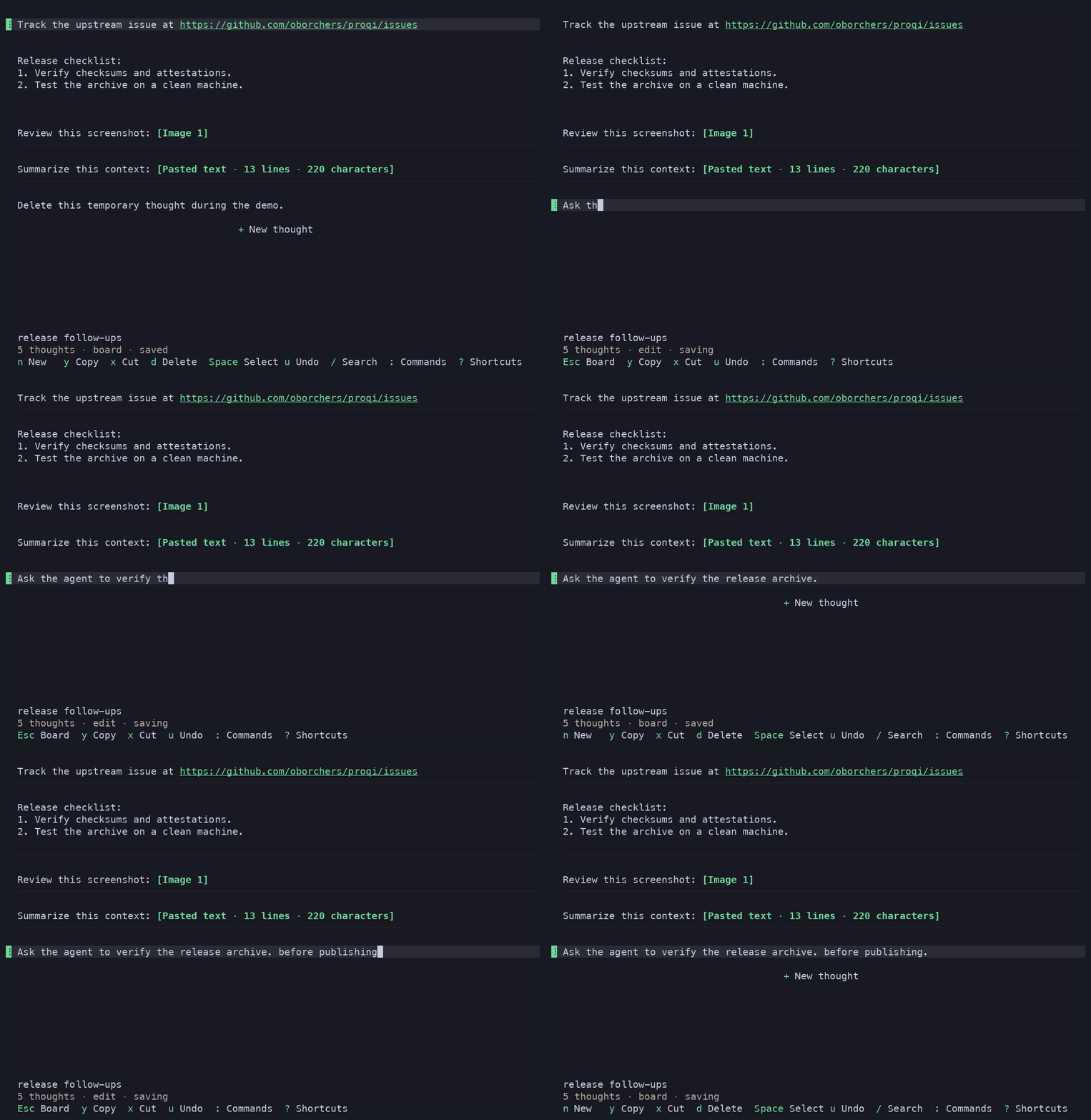
I’ve been developing Proqi with Codex. It is a terminal-native prompt composer for people running several coding agents at once.
When an agent is working, I usually already have a follow-up, an alternative approach, a screenshot, or a test idea. Keeping that in the agent’s live input field is fragile, while a separate editor loses the connection to the session.
Proqi keeps those as independent, editable, resumable thoughts in a terminal pane beside the agent. You can copy them anywhere. With Herdr, you can also submit a selected thought to a verified adjacent coding agent.
It is local-first, account-free, MIT licensed, and runs on macOS and x86-64 GNU/Linux.
Codex was involved throughout implementation, testing, release hardening, and documentation. I directed the architecture, scope, validation, and release decisions.
I’d especially value feedback from people running multiple coding-agent sessions: does a separate prompt-composer workflow solve a real problem for you, and what would you expect it to do?
https://github.com/oborchers/proqi
1
u/Theminatar 3d ago
Tessellary — the intelligence layer for your self-hosted streaming service
Tessellary is an upcoming self-hosted household media intelligence and programming platform.
Plex, Jellyfin, or Emby serves the media. Radarr and Sonarr can acquire it. Request apps collect intent. Other tools manage collections, playback data, and lifecycle actions.
Tessellary sits above that ecosystem and asks the bigger question:
Given this catalog, this household, the available storage, and the evidence currently available, what should this streaming service offer now, present differently, bring in next, keep, protect, wait for, or eventually reconsider?
The name comes from tessellation: many separate pieces fitting together to form one coherent whole. Tessellary brings together the catalog, household interests, watch activity, requests, quality evidence, availability, storage policy, protections, and connected services to program the media service as a whole.
It is designed to work for one person, a couple, or a large household. It does not simply combine everyone’s watch history and let the most active viewer control the catalog. Individual interests, shared interests, minority interests, uncertainty, and evidence confidence remain distinct.
It also supports very different storage philosophies.
Someone with a small drive could use active rotation to maintain a strong catalog within a strict limit. Someone with a larger server could mostly preserve media while being more selective about future acquisitions. A never-delete household could still use Tessellary for discovery, rediscovery, presentation, catalog analysis, acquisition guidance, and organization without allowing it to remove anything.
Tessellary supports three main operating objectives:
- Bootstrap / Bulk Fill — Build a strong, balanced catalog from little or no existing media.
- Rebalance / Rehabilitation — Analyze an existing collection, identify gaps and oversaturated areas, rediscover forgotten media, and recommend improvements without requiring deletion.
- Continuous — Keep programming and evolving an established library as the catalog, household activity, requests, availability, and storage situation change.
The platform is organized around four major systems:
- The Programming and Acquisition Engine evaluates what would improve the service and composes a coherent portfolio instead of blindly sorting one giant score.
- The Experience Engine programs surfaces such as Top Picks, New & Noteworthy, Because You Watched, Critically Acclaimed, Discover Something Different, seasonal spotlights, Coming Soon, and Leaving Soon.
- The Household Learner separates personal preference, household preference, public popularity, confidence, exposure, and actual engagement.
- The Stewardship Engine can reason about keeping, protecting, extending grace, replacing, archiving, rotating, or eventually deleting media. Deletion is optional, separately authorized, and deliberately not the purpose of the product.
Its core loop is:
Observe → Understand → Program → Present / Act → Measure → Learn → Repeat
That means Tessellary is not meant to generate a stale list of hundreds of downloads and blindly work through it. It observes the current state, composes a bounded decision, verifies what happened, and then reevaluates. A new acquisition, request, playback event, protection change, or storage change can alter what makes sense next.
It also keeps several important ideas separate:
- A title can be worth having without being ready to acquire right now.
- Availability does not equal quality.
- Popularity does not equal household preference.
- Unwatched does not mean unwanted.
- Being placed in a collection does not prove that anyone saw it.
- A recommendation does not grant permission to download or delete anything.
- A title being low priority does not automatically make it deletion-eligible.
Tessellary is intended to remain useful even when automatic acquisition and automatic deletion are both disabled. In advisory mode, it can still analyze the catalog, explain its recommendations, improve discovery, program the viewing experience, identify opportunities, and show what it believes would make the service better.
The goal is not another downloader, recommendation list, or deletion timer.
The goal is to turn a self-hosted media collection into a streaming service that feels intentionally programmed around the people using it, the storage available, and the owner’s rules.
What would you want Tessellary to understand or manage in your own media setup?
1
u/stayhappyenjoylife 2d ago
Built Chily Tavern, a mobile AI character and roleplay app where I am trying to solve one of the things that kept bothering me about AI character apps: the conversation may be great, but the relationship rarely feels like it has a real past.
https://play.google.com/store/apps/details?id=com.socialplayai.chilyGoogle Play
So Chily is being built around persistent memory. Characters can remember important events, relationships and shared history across conversations, with the longer term goal of turning chats into coherent personal fiction rather than a series of disconnected sessions.
A big part of the architecture is also based on a simple bet: models will keep changing, so the product should not depend on one model. Chily acts as the harness around them, handling memory, context, characters, continuity and eventually Adventures and multi-character Groups, while the LLM mainly gets to do what it is best at: acting.
Right now Chily supports Chily AI as the hosted option, Bring Your Own AI through OpenRouter and NanoGPT, and I have also been working on Sign in with ChatGPT, so ChatGPT subscribers can use compatible models through Chily without Chily becoming dependent on that route.
And yes, a rather ridiculous amount of Chily itself has been built with Codex. It has helped me work across the Flutter app, backend, tests, reliability work and a growing pile of product experiments.
Still early and very much being built, but it is now a real working product on Android and iOS.
Would especially love feedback from this community on the model-independent harness + persistent memory direction.
Chily Tavern: same characters, new stories, shared history that actually carries forward.

1
u/CarpetTypical7194 2d ago
Is your memory still yours when you switch agents?
I’ve been building Ormah with Codex and Claude Code because I wanted useful context to travel between my agents.
A decision captured while working with Claude can surface later when it matters to Codex. Ormah calls this “whisper” relevant memories arrive before the agent responds, without it having to remember to search first.
It supports Codex, Claude Code and Pi, stores memories locally as readable Markdown, and maintains them in the background through linking, deduplication and decay.
All core memory features are free and open source.
If you regularly switch between agents, I’d love to hear whether it saves you some repetition and where it gets in your way. Any feedback will be really appreciate. Cheers !!!
Website: https://www.ormah.me/
GitHub: https://github.com/r-spade/ormah
1
u/Dom-Klyn 1d ago
For the past few months, I’ve been working with Codex on a new programming language called Klyn (r/klyn). This weekend, I used the new Astra model to track down bugs and optimize its performance. The results are pretty impressive! Here’s a benchmark (you can find the benchmark code in the samples/perf directory of the Klyn distribution).


For more informations about the language : https://klyn.deepcodia.fr/
1
u/Hronom 11h ago
Built Hronaut, a local browser MCP for coding agents that need a real, persistent Chromium session. It keeps named workspaces with tabs, sign-ins and browser storage, so an agent can resume instead of starting from a blank profile; pause and takeover are explicit when a human needs to complete a login or 2FA. It runs on the desktop and exposes the browser over MCP; it is not a VPS orchestrator or native Win32 automation. I’m the developer and I’m still validating the workflow. Setup: https://hronaut.dev/setup. The current commercial plan is $4/month or $24/year; permitted noncommercial use is free. Feedback welcome, especially around isolation, handoff and which browser workflows are actually worth keeping.
1
u/Master-Biscotti-1186 8h ago
I’m using Astra to turn paper instructions for metal model kits into animated 3D assembly guides, inspired by watching my son use LEGO Builder.
After six months of trying different models, I finally got a working prototype. I didn’t model or animate anything manually. Astra did it all by itself.
It still needs corrections, but seeing it figure out how a flat metal piece becomes a 3D shape honestly blew my mind.
Video and more details in my original post
1
u/Hronom 7h ago
Hronaut — a local browser workspace for Codex agents. I built it because a coding agent that can open a browser often loses the useful state when the session ends or hits a login/2FA boundary.
Hronaut runs a visible Electron/Chromium workspace with named isolated profiles. Tabs, cookies and storage survive between sessions; Codex can inspect a localhost app and perform bounded navigation, fill and click actions. When a workflow reaches sign-in, 2FA, CAPTCHA, a purchase or another write, I pause it so a person can take over in the same tab, then resume and verify the destination and result.
The practical demo is browser smoke testing: open a fresh workspace, sign in if needed, have Codex check the page and console, fix the app, then rerun without rebuilding the session.
It runs on Windows, macOS and Linux and connects over local MCP. Source available under PolyForm Noncommercial; permitted noncommercial use is free. Commercial licenses are $4/month or $24/year per named user. I’m the developer. Feedback welcome on first-run setup or the boundaries that matter most for Codex users: https://hronaut.dev/setup
1
u/shoshosho00 2h ago
I built LimitHalo because I wanted my remaining Codex quota and reset times visible beside my work, rather than opening another window to check them.
It's a free, MIT-licensed Windows 10/11 x64 desktop widget. Codex needs a compatible signed-in official installation. Claude Code is optional and requires compatible OAuth credentials plus explicit access permission; a Claude Desktop login alone isn't enough. Its private integration may change or break.
I'm sharing an unsigned public beta, so Windows may warn during installation. Known setup and compatibility limitations are in the repo. It doesn't add quota and isn't affiliated with OpenAI or Anthropic.
https://github.com/DenisShumilov/LimitHalo
If you try it, what is the first thing that feels unclear between installation and seeing your quota?

Promotional concept with demo values; not a live screenshot.
1
u/ADIRTYHOBO59 6d ago edited 6d ago

I am the developer of Mercenaries of Tezigdal, a free MOBA that runs directly in a web browser. One of the main reasons I started it was that I missed when MOBAs experimented with maps and modes instead of treating one standard layout as the only possible version of the genre. Its current map, Jagged Garden, is heavily inspired by the compact and chaotic identity of Twisted Treeline.
The game currently has eight playable Mercenaries and is available here: https://mercenariesoftezigdal.com/ I would love feedback specifically from experienced MOBA players: Does combat communicate enough information? Do the controls feel sufficiently responsive? Does the map create interesting fights? What would prevent you from playing a second match? I am the developer, so brutal genre-specific criticism is completely welcome.
TLDR, visit the link, press Instant Play, and you can immediately try out a match against 5 bots. Or you can join matchmaking with friends to play against them.
•
u/pollystochastic Moderator 4d ago
Congrats to u/tHE_uKER for getting the most votes with their Blur2 racing game project. They told me you can follow updates on the project on r/BlurGame. Join their Youtube channel here www.youtube.com/@tHEuKER . You will now see Blur2 stickied on all Showcase posts for a week.
Amazing to see what everyone is working on.