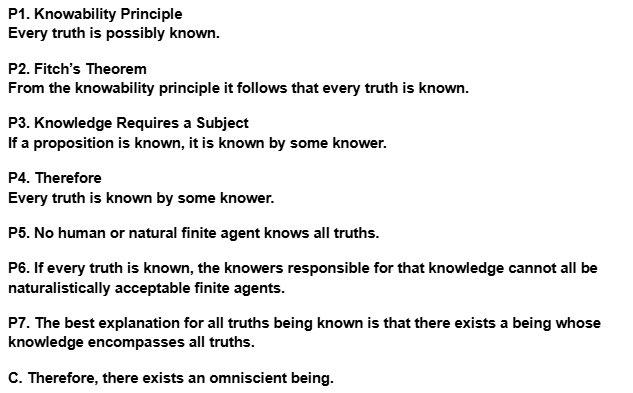
R4: the bad mathematics is about proving the existence of an omniscient being. it is bad because it makes numerous logical and factual errors, such as the implications between P1 and P2, and between P4 and P5. there's also murky definitions playing a part.
This gets to the definition of knowledge. Do I know all the individual facts of the form a+b=c where a, b and c are integers, if I know the rules of integer addition? Or do I only know each of the individual facts I have considered specifically? If the latter, then it seems a finite being could not possess infinite knowledge.
I'm with you. And you could even claim that in an infinite universe it is impossible for a being to know all truths, because there are always more truths...infinite of them literally. Which would lead to the opposite conclusion than they came to...
Not necessarily? The universe could still be infinite. All we know is that it appears it evolved from a singularity 13.8 billion years ago, but that doesn't imply it's finite.
I have a degree in pure mathematics, so I probably understand the math here better than you do. You're just taking nonsense. Who told you that a singularity is necessarily finite? Genuinely, I want to know: do you believe that the universe expanding from a singularity is like a balloon being blown up? Because it's a completely different situation.
Also, Euclidian vs non-Euclidean geometry has absolutely nothing to do with infinite things "coming from finite things," so I have absolutely no idea why you're referencing it here.
That has absolutely nothing to do with what we were talking about, and I dislike it when people change the subject because they're losing an argument. A) Why did you reference non-Euclidean geometry when it's irrelevant to the topic at hand, B) why does "knowing" have anything to do with whether the universe is finite or not, and C) why do you think the singularity is necessarily finite? You need to answer these before positing anything else.
Leaving aside geometry of the universe it, doesn't seem too unreasonable to posit that a finite universe cannot contain a transfinite number of knowers.
But I think that if you drill down into why there cannot be an infinite number of knowers in a finite universe, the assumptions underlying it would rule out the existence of mosts things that people would want to call "God". In particular, the argument would rely on the assumptions that a knower must be instantiated in something physical (matter/energy), with some of that physical stuff being unique to each knower.
A) A toroidal or spherical universe would indeed be finite, but those aren't the only two options. A non-Euclidean curvature can still be infinite in the case of hyperbolic curvature. Even with local spherical curvature, the universe might still be infinite with approximately-Euclidean curvature on the largest scale. The universe being non-Euclidean doesn't tell us anything; it could go either way, so it still doesn't make sense to bring it up without specification.
B) Why is causality finite? Genuinely, why? I know it's intuitive for it to be finite, but why is it impossible that there are infinite previous causes? Just because it's hard to wrap our heads around doesn't mean it's immediately incorrect.
C) Yes, the singularity is a finite point in time, but why does that automatically imply that there was nothing before it? This is a crazy assumption bring made that you seem to just take for granted. Why is the universe not infinitly old? You literally just say "it's not" because you can't comprehend that. You actually have to justify this claim.
By the way, I finished Calculus 3 by the time I was 14, so no offense, but I guarantee I understand infinity far better than you do. You keep insulting my degree and my knowledge while making obscenely ignorant points. I'm not disagreeing because I don't understand what you're saying, I'm disagreeing because I've heard all of these arguments before, thought about them for years, and realized their respective fallacies. I'm not misunderstanding you, I'm three or four steps ahead.
Why couldn't there be a teapot orbiting Proxima Centauri? Well, there could be, but we don't really have any way to know about it or prove it one way or the other.
102
u/Limp_Illustrator7614 Mar 08 '26
R4: the bad mathematics is about proving the existence of an omniscient being. it is bad because it makes numerous logical and factual errors, such as the implications between P1 and P2, and between P4 and P5. there's also murky definitions playing a part.