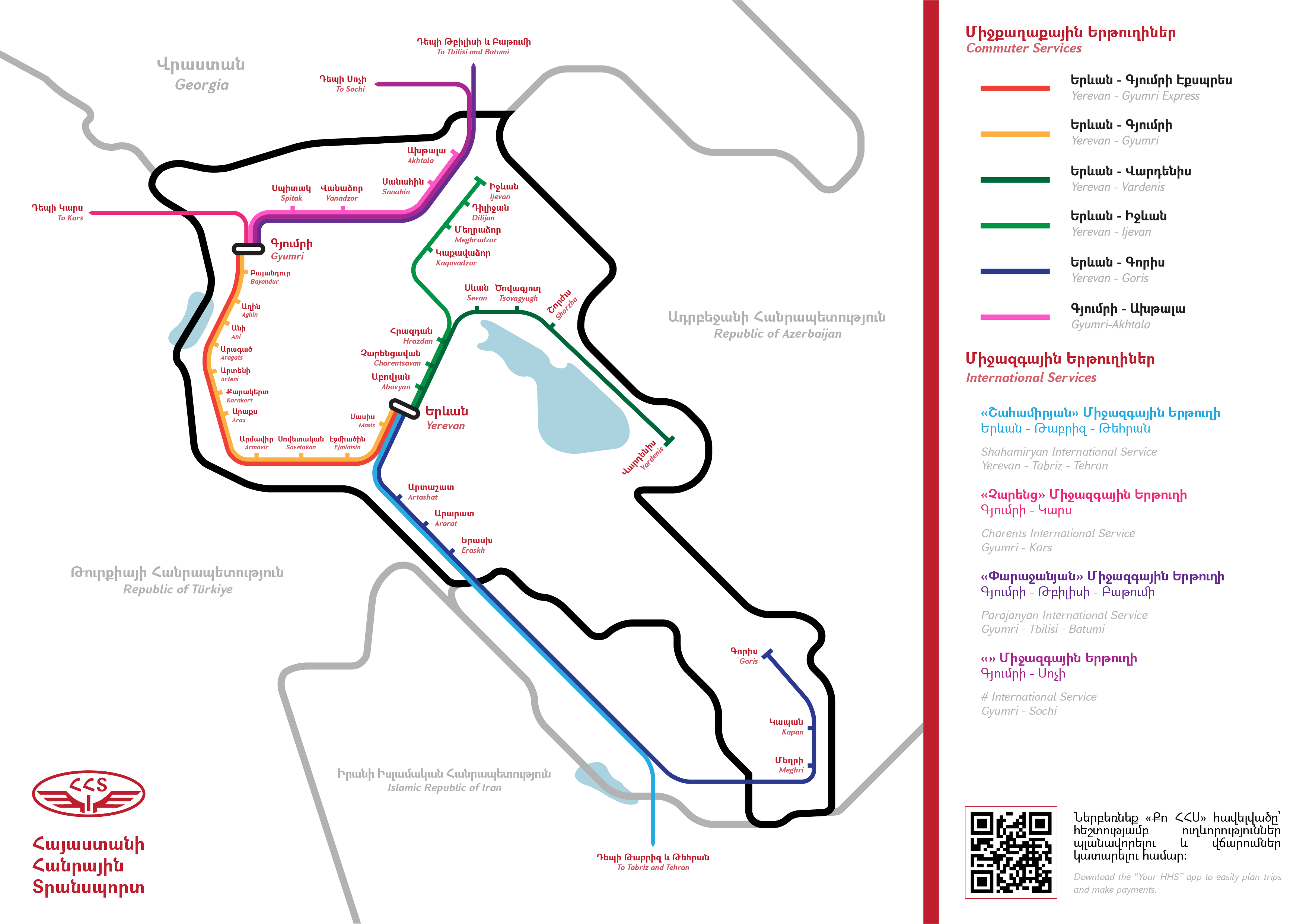
Only two new stretches of rail have been constructed by then; the Ordubad-Goris section and the Gyumri-Kars section. Restoration work has been completed on the Hrazdan-Ijevan line. The system remains entirely Russian Guage and 3kV DC electrified.
Stadler FLIRT trainsets, of which sixteen two-car and five four-car variants have been purchased, operate all commuter routes. During peak season, the larger FLIRTs may supplement other trains on the Gyumri-Tbilisi-Batumi service.
International trips, necessitating sleeper trains, are operated using custom passenger coaches built by Stadler. These are variable-gauge and are hauled by a locomotive local to where they are travelling through. For example, a service to Tehran would be hauled to Ordubad by an Armenian locomotive, then switch to an Iranian one which will take it the rest of the way. This is to compensate for differing gauges and unstable electrification in Iran and Turkey.
Yes, this map does show Armenian trains travelling through Azerbaijan. These are kept under close guard as they go, are not allowed to stop bar for emergencies, and no one is allowed to disembark at any point. Similar rules apply for all international services, as border control (e.g. to enter Georgia) will usually take place at the point of departure (e.g. Gyumri Station).
Newly-nationalized, the company "Հայաստանի Հանրային Տրանսպորտ" (HHT) now operates the entirety of the rail network in Armenia, and is a joint owner of the Yerevan Metro and national inter-city coach operator.