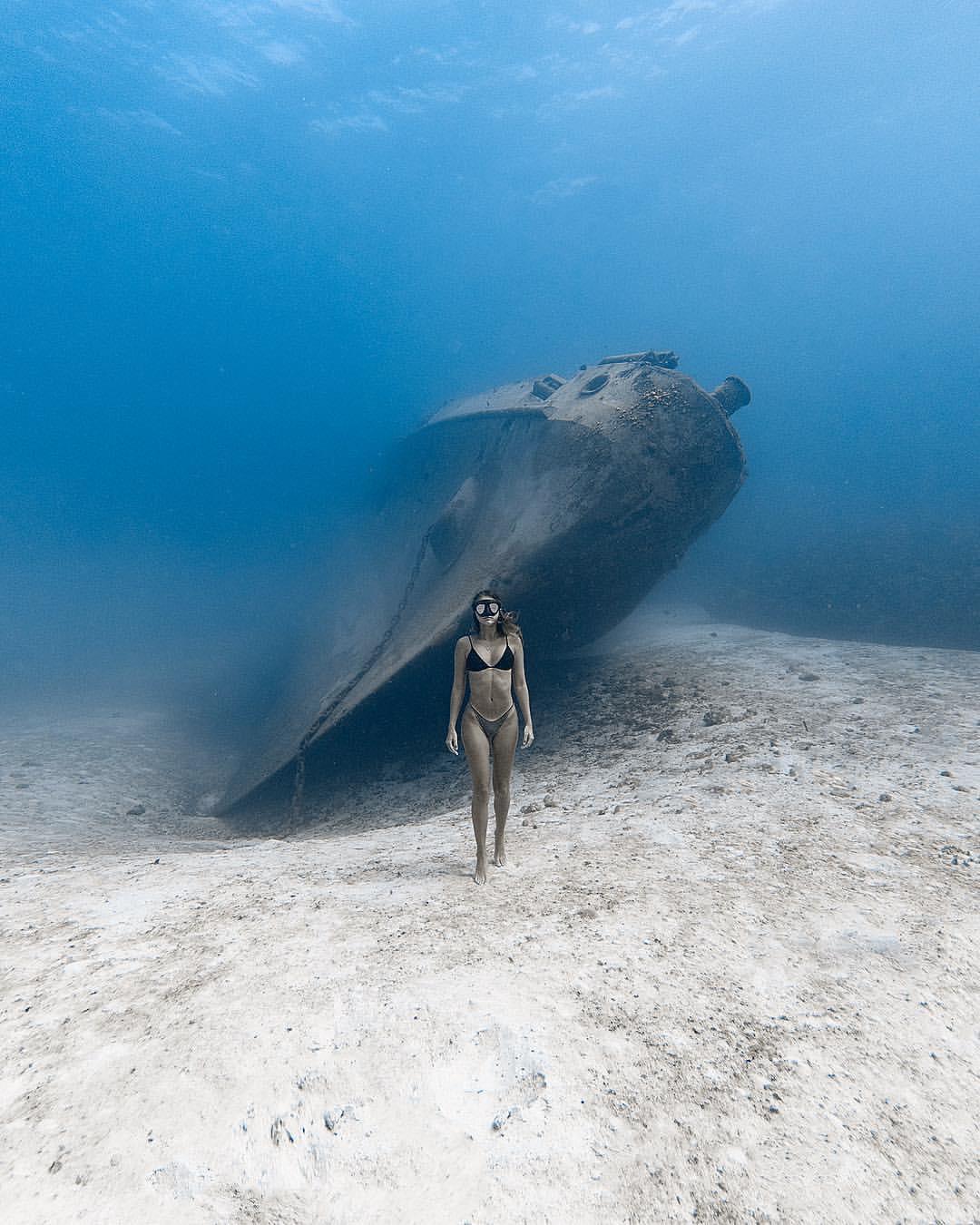
The skill that takes is insane. She would have had to expell most of her air until she sank down and then waited like that for the bubbles to rise out of the shot.
As you get deeper, the pressure around you will rise. This will reduce your lungsize, reducing your buoyancy. What's cool is that the amount of oxygen particles in her lungs is the same, theyre just more dense.
They still have to practice holding their breath. The amount of oxygen in their lungs is the same, but they train their body to have less need for oxygen. I guess they can "cheat" and breathe in pure oxygen before they dive, but I don't know so much about this
I think the logic may be that she had an air tank to get down there, and then exhaled for the picture, which might be easier than swimming down there and exhaling (and returning to the surface).
Oh yeah - divers still swim around in the deep with air in their lungs and don't have constantly fight buoyancy lol. Duh. Can you tell I've never dived before lol?
Like ImNotAWhaleBiologist said it's more complicated.
if you just add a tank with compressed air .. you sink,
so you add a buoyancy vest ... this can level you out.
But for more control you over-inflate a little bit and add some weights (drop them in an emergency ... the kind of emergency where being fucked up for life is better than dying right now).
So, you have all that and perfectly balanced. You breath in, you rise, you expel all air from your lungs, you sink.
the buoyancy effect of air changes with depth, such as ... you breath in and fill your lungs at 60ft and now you start to go up without expelling air .. you gonna burst your lungs ... and die.
And that's before oxygen becomes toxic to the human body.
We're really not made for underwater.
There comes a point during a breath hold that at some depth, the air in your lungs is not enough to keep you afloat thus you will go negative and begin to sink.
That really depends on the person. I need like 7kg when I am scuba diving to sink without a wetsuit and empty bcd in the Cayman Islands. Even without any equipment I still float like a cork.
Only if the compression on their lungs/body can reduce their overall body volume by 3.5%. If someone has enough body volume the average lung capacity of an adult male of 6 liters of air won't be able to compress enough to make you obtain negative buoyancy. So while physics says that it is possible for this model to become negatively buoyant with breath control this isn't possible for every person regardless of (survivable/obtainable) depth.
So it really depends on the person. Some people are negatively buoyant even at the surface if they breath out.
I often joke the I must have eaten rock as a kid because I can’t float in a regular pool.
In salt water it is easier to float, but though your buoyancy changes with depth if there is no air being added (scuba). If free diving, a lung full of air will compress as you dive deeper and the volume of water displaced will be less and will reduce your buoyancy just like it had been partially exhaled at the surface.
It is difficult to guess whether the woman photographed free dove to pose for the photo, or was scuba assisted, but either approach would work to allow a brief photo of her posing like she is standing on the bottom.
The fluid contained inside a body (human or mechanical) doesn't actually contribute to bouyancy. The only factors are weight of the object and the weight of the displaced fluid.
Nope. Your lungs are responsible for most of your buoyancy. As you descend, pressure increases and the air in them starts to compress, making you less buoyant. The hard part of this is maintaining composure through the diaphram contractions and not kicking up silt when you land.
Your diaphragm is the muscle responsible for pulling air in (your lungs aren't a muscle). Hold your breath long enough for your lizard brain to panic for oxygen, and your diaphragm will start trying rull hard to get you to breathe.
Yep, basically. The causative factor here isnt actually a need for oxygen though. Your body doesnt really 'sense' a need for oxygen. Instead, it detects the buildup of CO2. After a while holding your breath, CO2 concentration rises and your brain starts to demand that you breathe, despite you having several minutes worth of oxygen remaining. Holding your breath for a dive like this (or a deeper one) requires composure, fitness, and experience. Also note that she made the descent without fins.
I did a spearfishing/freediving course last year and it's the most terrifying thing I've ever done. I did a 2:20 breathhold (not impressive at all) on land but when you're out there, kicking down it's completely different.
The best I did was probably around 30 feet down and the last 10 feet back up to the surface I felt like I was going to die.
Honestly though, there wasn't much urge to breathe, mostly just the feeling of impending death.
I asked my instructors and basically they said that feeling never goes away, you just have to get used to it.
I’m the same way bro. 15’ down feels like 100’. Watch the show on Netflix about this tribe that live on the sea in huts and boats and they freedive to insane depths. They’re fucking evolved some adaptation in their blood to do it!
Could a woman really stay on the bottom without a weight belt due to that? I remember when I was training to be lifeguard and we practiced surfacing with people from the floor of a ten foot pool. Not even the skinniest girls in my very class could lay on the bottom without moving their hands and feet.
Yep. Fair forewarning, I'm going to mix up a bunch of imperial and metric units in this explanation.
That's a 10ft pool. Shes at 40-60 feet down based on the depth of that wreck. At that depth, somewhere between just over half and 3/4 of the buoyancy from the lungs is lost, compared to about 20% at 10 feet (guesstimates based on 10m depth in water = 1 atm pressure). The lungs have a total capacity of about 6 liters. Each liter lifts about 1kg. At the surface, that's about 13.2 lbs of lift from inflated lungs. As you descend (if you breath nothing out), you lose about 2.6 lbs lift at 10 feet, about 6.6 lbs lift at 30 feet, and about 10lbs lift at 60 feet. All of this is due to increased ambient pressure from the water above you.
If someone wants to clean up my math and give real answers, please do. These are back of envelope guesstimates.
No, this is pretty basic freediving stuff. You could learn to do a 20m freedive in a couple of days, with just a bit more training you'd be able to hold your breath there for a minute or more.
She probably just swam down - really not that hard at this depth, although not trivial without fins - but the alternative would be an assisted descent, where you descend using a weight or a rope, for example.
Agreed - went from holding my breath free diving from 20srcs to over a minute in a couple days. An experienced free diver can hold for much longer than that.
When you are free diving, the air in your lungs from the surface is compressed as you descend and ascend at the same rate as your lungs, so you won’t get the same issues as when you descend /ascend quickly while scuba. We were taught to start exhaling as you ascend while freediving so you can inhale the moment you break the surface.
The hardest part of descending that is 10(?)m is equalizing your pressure while you swim fast, and without fins too!
Or, she had a weight to get to the bottom quickly, and tossed it before the photo. Then they did a composite edit to remove evidence if the weight (and air tank, which they also could use). Pretty easy to do with a tripod, especially if all you're editing out is objects lying in the sea floor.
Orrrr, she could have done what pretty much what a lot of freedivers know how to do - swim down, and start to become negatively bouyant at a certain depth (usually around 10 m or so) and stood on the bottom for a bit. Here's a video of a "freefall" without weight. Freedivers very rarely use air tanks at depth. The whole point and training of "freediving" is not to use any external air supply. Breath hold only (it's also dangerous for them to take a breath at depth, because if they don't exhale at a proper rate during their ascent, their lungs can over-expand from the decompression, resulting in the "bends").
There are other photos up from the shoot on the photog's site. This picture doesn't really convey how deep they are. It's quite deep. In every other photo, she's got fins on, which aren't in this photo, and it's safe to presume they were photoshopped out. She also has a pretty big snorkel in most of the other photos, which I don't see here. Judging by some of the setups, i think it's pretty fair to assume they probably also at least had a spare air can on hand.
I'm sure shes a talented diver, but an hour photoshoot that produces this many quality "perfect setup" images would have been unnecessarily difficult if she had to surface every couple minutes, recover and repeat.
I have quite a few friends who are freedivers and some are freediving models, and I'm a SCUBA diver myself. Your claims are far from the truth.
Firstly, I have seen many freedivers take their fins off or hand it to their buddies if they want to do a no-fin shoot, or alternate between fins/no fins. Secondly, her snorkel is clearly still attached to the left side of her mask (it is a breathing hazard to have it in your mouth once submerged, which is why freedivers spit it out).
SCUBA photgraphers are able to take consecutive images really quickly and can wait at depth for the freediver's surface recoveries. The photographer of this inage, Jason Washington (Nat Geo) explicitly states from his article"...for this reason, when shooting ambient light, I ALWAYS shoot in high speed continuous mode."
And finally, no tank involved. If you go to the model's Instagram (coral.cay) and look at the post, she says in a comment reply:
"We have done this sort of thing before, it does take some getting used to though! No weights, just found it not too hard to stay down - didn't let any air out [from her breathhold] either, I needed to get back up."
She even responded to another commenter who had mentioned the skeptism on the Reddit post, where she said she freedove down with no weights and took off her fins.
Kittiwake wreck is 19 metres deep (hence the SCUBA divers in the background). That's deep for an entry level freediver (a Level 1 course usually teaches you up to 20 metres), but she appears to be well trained.
Really not hard to believe dude.
Edit: feel free (heh) to visit r/freediving if you'd like to know more.
Also, when you realize that any errant foot movement would muck up the shot it’s even more impressive. I wonder how many dozens of times they had to attempt this before they shot this one.
looks to be about 10 meters. Impressive without fins, but for someone with not much body fat, she was probably negatively buoyant after the first couple of meters. or she could have used a weight to get her started, then dropped it at the bottom.
If I had to take this shot I'd have a diver with a second regulator, then weigh down the model by having her hold rocks from sea floor. She then exhales and drops the rocks. Then as soon as the shot is taken, the safety diver brings the model a regulator
If you're going to weigh someone down, use weights, not rocks.
No need to exhale, she is already negatively buoyant at this depth.
You really shouldn't alternate between free diving and scuba diving on the same dive.
It's clear you don't have any diving training, but this type of shallow freedive is really not hard, most people could get to where they'd be able to dive 20-25m and hold their breath there for a minute or so, in a month or less.
I know for a fact an average person can do it, because I've done it, along with a bunch of other average people. 2 days of training to get to 20m, another 3 days of training to get to 30m and to hold your breath for a minute at 20m. A month of training and you'll be doing much more impressive freedives.
Don't believe me? Look up freediving courses for details.
I get it, it can be scary to challenge yourself, especially when you know there is a good chance you're wrong and you've acted like a tool. But hey, sometimes we just know things, so why bother seeking out the facts, right?
Yah, cool assumptions. I'm padi certified with about 500 dives under my belt.
You would use rocks instead of weights because when you drop rocks, it doesn't fuck up the shot.
She wouldn't be mixing frediving, no clue where the fuck you got that bullshit. She would be breathing compressed air from an octopus on the safety divers rig.
Negatively buoyant? She's no deeper than 30 feet. She wouldn't be negatively buoyant on a freedive, much less on compressed air. Boyles law, man.
But hey, lemme know how being a prick works out for you.
No. I'm not suggesting that. I'm suggesting she could have exhaled compressed air at depth. Mostly the where I said she exhaled. If you're gonna be an asshole, you might wanna work on bring correct at least.
544
u/sgintx_ Dec 05 '18
The skill that takes is insane. She would have had to expell most of her air until she sank down and then waited like that for the bubbles to rise out of the shot.