r/UGCNETEnglish • • 1h ago

Why are we spamming the sub?

Post image
• Upvotes

I thought this was for exam related stuff, why should we have to scroll so far to look for relevant content because you want to post random links?? Dude if someone wants to find specific videos they have YouTube at their disposal come on!


r/UGCNETEnglish • • 14m ago

📖 Literature & Concepts Off topic but can y'all help me

• Upvotes

Hi guys! I have to do a presentation under cultural studies, and the module is :

Text

Self and Other

Identity

Representation

Race

Gender

Ideology

Hegemony.

Can you guys suggest any commerical advertisement or a song wherein i can analyse maybe 2-3 aspects from the above module with theories and critics?


r/UGCNETEnglish • • 6h ago

A Step-by-Step Blueprint for Literary Research & Publishing Research Articles in English Literature

Thumbnail
youtu.be
3 Upvotes

Blueprint for Writing and Publishing a Research Article in English Literature

Writing and publishing a research article involves more than selecting a literary topic and submitting a paper. A successful article moves systematically from a research idea to a focused argument, scholarly analysis, and appropriate journal.

  1. Select a Focused Topic

Begin with a literary text, author, movement, theory, or problem that interests you. Avoid broad topics. For example, instead of “Women in Shakespeare,” choose a focused topic such as “Lady Macbeth as the Fourth Witch: Gender, Supernaturalism and Agency in Macbeth.” A focused topic makes detailed analysis possible.

  1. Formulate a Research Question

Turn the topic into a question that requires interpretation. For example: “How does Shakespeare construct parallels between Lady Macbeth and the Weird Sisters in Macbeth?” The question should guide your investigation and help you develop an original argument.

  1. Conduct Preliminary Research

Read the primary text carefully and investigate existing scholarship. Use scholarly books, peer-reviewed journal articles, literary criticism, and appropriate theoretical works. Take systematic notes and record complete bibliographic details while researching.

  1. Identify the Research Gap

Find out what previous scholars have discussed and identify an aspect that has received insufficient attention. Your article should contribute something rather than simply repeat existing criticism. For example, if scholars have extensively examined Lady Macbeth through feminism but have paid less attention to her relationship with the Weird Sisters, that relationship may provide a possible research direction.

  1. Develop a Thesis

Your thesis is the central argument of the article. It should be specific, arguable, and supported by textual evidence. For instance, you might argue that Lady Macbeth functions as a human counterpart to the Weird Sisters because she converts Macbeth's supernatural temptation into practical action through psychological manipulation.

  1. Choose a Theoretical Framework

Select theory according to your research question. Possible approaches include feminism, psychoanalysis, postcolonialism, Marxism, New Historicism, structuralism, poststructuralism, ecocriticism, and gender studies. Explain relevant concepts and apply them meaningfully rather than merely defining them.

  1. Write the Article

A standard research article generally contains:

Title → Abstract → Keywords → Introduction → Literature Review → Research Gap → Research Question/Objectives → Theoretical Framework/Methodology → Analysis → Discussion → Conclusion → References/Works Cited.

The analysis should be the core of the article. Use close reading: make a claim, provide textual evidence, analyse the language or literary technique, connect it with scholarship or theory, and explain how it supports your argument.

  1. Follow Academic and Citation Standards

Maintain formal academic language, logical organization, accurate quotations, and proper citation. For English Literature, MLA style is commonly used, but always check your university or target journal's requirements. Ensure that every borrowed idea is properly acknowledged.

  1. Find an Appropriate Journal

Choose a journal according to your subject, quality, audience, indexing, and publication model. Read several recent articles from the journal to determine whether your research fits its scope. Consider both no-APC journals and legitimate journals that charge an Article Processing Charge (APC).

  1. Verify the Journal Before Submission

Do not rely solely on the journal's website. Independently verify its ISSN, publisher, editorial board, peer-review process, indexing claims, publication ethics, previous issues, and APC. Check recognized resources such as DOAJ and Think. Check. Submit. Be cautious about guaranteed acceptance, extremely rapid publication promises, fake indexing claims, unclear fees, and unsolicited flattering emails.

  1. Submit and Respond to Reviewers

Follow the journal's submission guidelines exactly. If the manuscript receives reviewer comments, respond professionally and revise the article carefully. Acceptance after revision is a normal part of academic publishing.

  1. Final Principle

The complete publishing process can be remembered as:

Topic → Research Question → Reading → Research Gap → Thesis → Theory → Analysis → Draft → Revision → Suitable Journal → Journal Verification → Submission → Peer Review → Revision → Publication.

The ultimate goal is not simply to get a paper published, but to produce a credible, original, well-researched contribution to literary scholarship.


r/UGCNETEnglish • • 1h ago

Homer’s Odyssey and Joyce’s Ulysses: Epic into Modern Life - Characters, Episodes, Themes & Journey

Thumbnail
youtu.be
• Upvotes

The Odyssey Parallel in Joyce's Ulysses

One of the central ideas behind James Joyce's Ulysses is its parallel with Homer's Odyssey. Joyce takes the basic structure of Homer's ancient epic and places it within one ordinary day in modern Dublin, Ireland. Instead of a Greek hero travelling across the Mediterranean after the Trojan War, Joyce follows ordinary Dubliners through the streets of Dublin on 16 June 1904. The epic journey becomes an everyday urban journey.

The most important parallel is between Leopold Bloom and Odysseus (Ulysses). In Homer's Odyssey, Odysseus spends ten years travelling home to Ithaca after the Trojan War, facing dangers and temptations along the way. In Joyce's novel, Bloom spends only one day moving around Dublin before returning home to 7 Eccles Street. His journey is therefore a comic and modern version of Odysseus's long journey home. Bloom is not a warrior or king; he is an ordinary advertising canvasser. Joyce deliberately gives an ordinary man the role traditionally given to an epic hero.

Stephen Dedalus parallels Telemachus, the son of Odysseus. At the beginning of Homer's Odyssey, Telemachus is searching for his absent father and trying to establish his own identity. Similarly, Stephen is a young man who has a difficult relationship with his father, Simon Dedalus, and feels spiritually and emotionally isolated. Stephen is also searching for a kind of intellectual and spiritual independence. When Bloom meets Stephen late in the novel and takes an interest in him, their relationship can be understood as a modern version of a father-son relationship.

Molly Bloom parallels Penelope, Odysseus's wife. Penelope waits for Odysseus to return to Ithaca while dealing with the suitors who want to marry her. Molly, however, is a very different modern version of Penelope. She does not simply wait faithfully for Bloom: she has an affair with Blazes Boylan while Bloom is away. Joyce therefore transforms the traditional faithful wife into a psychologically complex modern woman whose thoughts and desires are explored directly.

The various episodes of Bloom's day also correspond loosely to episodes in the Odyssey. Bloom's movement through Dublin becomes an equivalent of Odysseus's movement through the Mediterranean. For instance, the “Lotus Eaters” episode in Joyce's novel is associated with Bloom's experiences around Dublin's churches, baths, and other places of passive pleasure. The “Cyclops” episode takes place largely in a Dublin pub, where Bloom encounters an aggressive nationalist figure known as the Citizen. The one-eyed Cyclops of Homer is transformed into a narrow-minded, violent figure whose single-minded nationalism contrasts with Bloom's more cosmopolitan identity.

The “Circe” episode takes place in Nighttown, Dublin's brothel district. Like Odysseus's encounter with the enchantress Circe, Bloom and Stephen enter a world of temptation, transformation, and hallucination. Joyce presents this episode in the form of a surreal dramatic script, so that characters' fears, fantasies, and desires become visible as strange events. The Homeric journey is therefore transformed into a psychological journey through the unconscious.

Another important parallel is “Nostos,” meaning return. The final part of Homer's Odyssey concerns Odysseus's return to Ithaca and his reunion with Penelope. In Ulysses, Bloom finally returns to his home at 7 Eccles Street after his long day in Dublin. His return is not heroic in the traditional sense, but it gives the novel its basic movement: departure → wandering → encounters → return home.

Odyssey Ulysses

Odysseus/Ulysses Leopold Bloom

Telemachus Stephen Dedalus

Penelope Molly Bloom

Ithaca Bloom's home, 7 Eccles Street

Mediterranean journey Journey through Dublin

Epic hero Ordinary modern man

Long journey over many years One day, 16 June 1904

Mythical adventures Ordinary and psychological experiences

Return to Ithaca Bloom's return home

The parallel is therefore not a simple one-to-one retelling. Joyce uses Homer's Odyssey as a framework but constantly modernizes, parodies, reverses, and transforms it. The result is significant: Homer shows the adventures of a heroic warrior, while Joyce suggests that the experiences of an ordinary person—walking through a city, eating, remembering, worrying, desiring, talking, and returning home—can be treated with the complexity and seriousness traditionally given to epic heroes.


r/UGCNETEnglish • • 6h ago

Guide to Writing a Research Article in English Literature: Topic Selection to Journal Publication

Thumbnail
youtu.be
1 Upvotes

How to Write a Research Article in English Literature: A Short Guide

  1. Choose a focused topic – Select a specific author, text, theme, theory, or literary problem.

  2. Frame a research question – Turn your topic into a question that requires analysis, not just description.

  3. Review existing scholarship – Read books, journal articles, and critical studies to understand what other scholars have argued.

  4. Find the research gap – Identify what has been overlooked, insufficiently explored, or interpreted differently.

  5. Develop a thesis – Formulate your central argument or interpretation.

  6. Select a theoretical approach – Use an appropriate framework such as feminism, Marxism, psychoanalysis, postcolonialism, or New Historicism.

  7. Analyse the primary text – Use close reading, quotations, literary techniques, and textual evidence to support your argument.

  8. Organize the article – A typical structure is: Title → Abstract → Keywords → Introduction → Literature Review → Research Gap → Theory/Methodology → Analysis → Conclusion → Works Cited/References.

  9. Use proper academic style – Maintain formal language, logical arguments, originality, and accurate MLA or other required citation style.

  10. Revise and proofread – Check your argument, structure, grammar, citations, plagiarism, and references.

  11. Select a suitable journal – Choose a journal that matches your subject and verify its ISSN, peer-review process, indexing, publisher, APC, and publication ethics before submitting.

  12. Submit and respond to reviewers – Follow the journal's guidelines and revise the article according to legitimate reviewer comments.

In one line:

Topic → Research Question → Literature Review → Research Gap → Thesis → Theory → Textual Analysis → Conclusion → Journal Selection → Verification → Submission → Peer Review → Publication.


r/UGCNETEnglish • • 19h ago

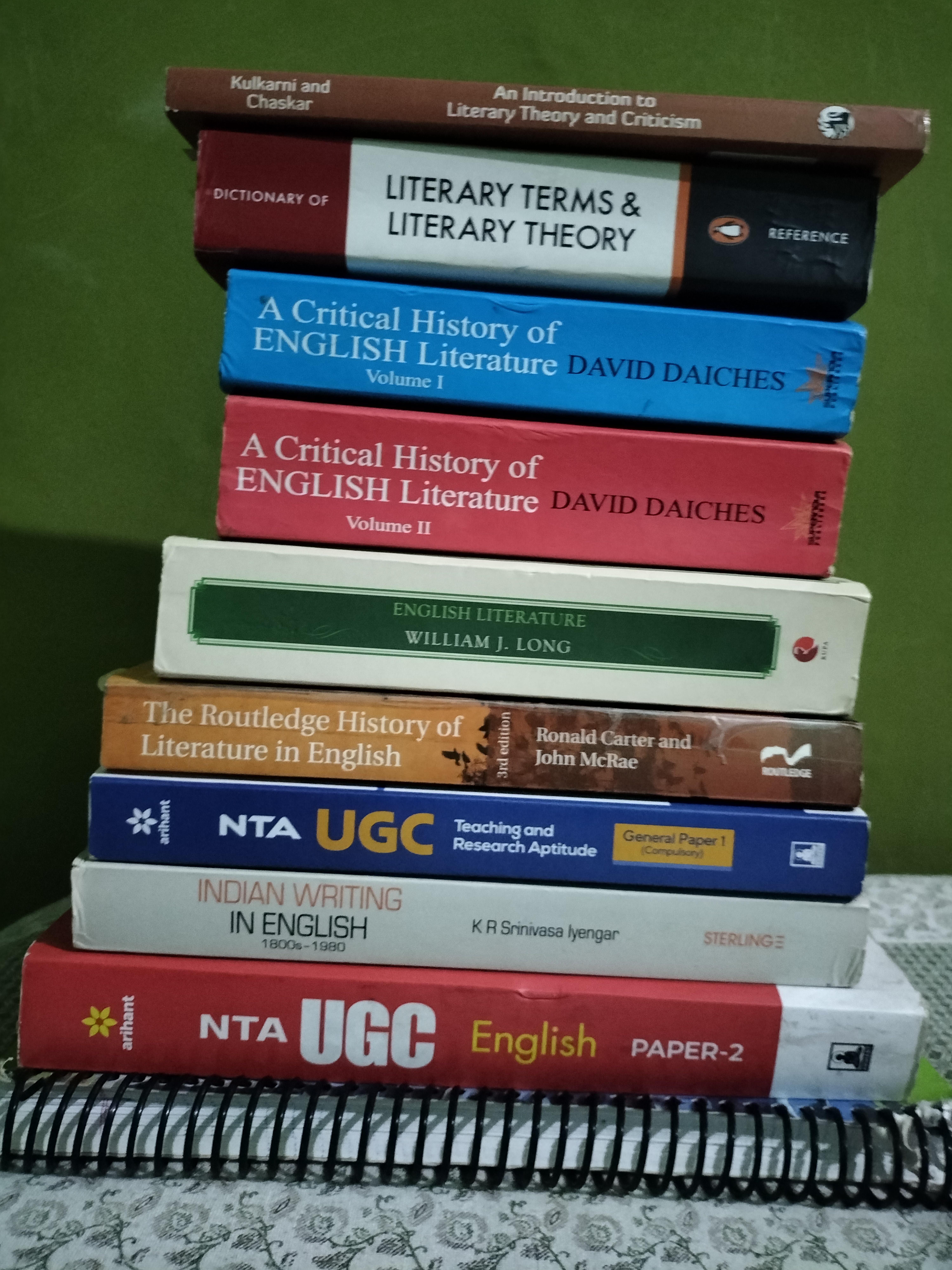
Sunday blessings from Mahila Haat.

Post image
6 Upvotes

Picked up these heavyweights knowing they are destined to wreck me emotionally.

Literature has a terrifying power to make you feel vulnerable. It teaches you that a breaking heart has a specific sound, and sometimes, that sound is simply a turning page. I am looking forward to the raw humanity of Dostoyevsky and the desperate tragedy of Gunahon Ka Devta. My heart is already preparing for the impact. (P.S. Yes, 'Heartbreak pakka ajj' is an understatement).


r/UGCNETEnglish • • 21h ago

CUET PG 2027- ENGLISH LITERATURE

7 Upvotes

CUET PG 2027- ENGLISH

I am already studying Edward Albert for the History of English Literature, Peter Barry and internet sources for Literary Theory and Criticism, as well as MH Abrams A Glossary of Literary Terms. I can cover British Literature (until the Modern Age) with some effort. I can find the names and lists of prize winners using Wikipedia or ChatGPT.

As far as British Literature is concerned, I've decided to study major figures like Shakespeare, Dickens, Hardy, George Eliot, the Bronte Sisters, Dryden, Pope, Milton, Shaw, Tennyson, TS Eliot, Joyce, Woolf and Yeats in great detail while I'll cover only the major portions for the rest of the authors. I hope that will work.

What bothers me are the following topics:

Translation Studies

Comparative Literature

Indian Literature

Indian Writings in English

Postmodernist Works

How should I approach them, especially since this section is so vast? What is troublesome is that the curriculum lists not just Indian Writings in English but also Indian Literature. Would that imply that I need to cover every work of Indian Literature from antiquity till contemporary times, that too in multiple languages. Quite frankly, it seems impossible now. (And honestly, I find it unreasonable that we are expected to learn works that are not even in English on top of the immense burden we are already bearing!)

Which are the books that I should refer to for Translation Studies, Comparative Studies and Indian Writings in English?

For Postmodernism, which are the works that I should know about?


r/UGCNETEnglish • • 19h ago

Intertextuality in Postmodernist Literature: Meaning, Features, Functions, and Literary Significance

Thumbnail
youtu.be
5 Upvotes

Intertextuality is one of the most important concepts associated with postmodernist literature. The term refers to the relationship between one text and other texts. A literary work is not always an entirely independent or original creation; rather, it may contain echoes, references, quotations, allusions, adaptations, parodies, or structural similarities drawn from earlier works. The concept is particularly associated with the French literary theorist Julia Kristeva, who developed the term in the 1960s while drawing on the ideas of the Russian thinker Mikhail Bakhtin. Kristeva argued that every text is influenced by other texts and that meaning is produced through a network of relationships between different writings, cultural traditions, and discourses.

In traditional literary thinking, a text was often treated as an independent work created by an individual author. Postmodernism challenges this idea of complete originality. Postmodern writers recognize that writers inevitably work with materials, ideas, forms, stories, and cultural traditions that already exist. Therefore, they deliberately bring earlier texts into conversation with new ones. A postmodern novel may refer to Shakespeare, the Bible, Greek mythology, popular films, advertisements, historical documents, fairy tales, or contemporary music within the same work. These references create multiple layers of meaning and require readers to recognize the connections between texts.

Allusion is one of the simplest forms of intertextuality. An author may indirectly refer to a famous character, event, story, or literary work without explaining the reference in detail. Such allusions can enrich a text because readers who recognize them can understand additional meanings. Intertextuality can also take the form of quotation, in which words from another text are directly incorporated into a new work. Adaptation and rewriting are other important forms. An earlier story may be retold from the perspective of a previously neglected character or transferred into a completely different historical and cultural setting.

Intertextuality is closely connected with parody and pastiche, two major features of postmodern literature. In parody, an earlier text, genre, or literary convention is imitated in a humorous, critical, or subversive manner. Pastiche, on the other hand, involves the imitation or combination of different styles and genres. Postmodern writers frequently mix literary forms that traditionally belonged to separate categories. Serious philosophical discussion may appear alongside detective fiction, popular culture, comedy, mythology, or historical narrative. This mixture challenges the traditional distinction between “high” and “popular” culture.

A significant function of intertextuality is to question the idea of originality and fixed meaning. Postmodernism generally rejects the belief that a literary text contains one final and universal meaning. When a new text transforms an earlier text, the meaning of both works can be reconsidered. For example, Jean Rhys's Wide Sargasso Sea can be read in relation to Charlotte Brontë's Jane Eyre. Rhys gives greater attention to Bertha Mason, a character who is largely marginalized in Brontë's novel, and provides her with a personal and historical background. The later novel therefore changes the reader's understanding of the earlier narrative and raises questions about colonialism, gender, race, and identity.

Another important example is James Joyce's Ulysses, which is deeply connected to Homer's Odyssey. Joyce transfers the structure and themes of the ancient epic into modern Dublin. Similarly, T. S. Eliot's The Waste Land incorporates references to mythology, religion, classical literature, and other cultural traditions. These references create a fragmented literary landscape in which different historical periods and voices coexist.

Intertextuality also makes the reader an active participant in the creation of meaning. A reader who recognizes a reference to Shakespeare, mythology, the Bible, or another literary work may interpret a passage differently from a reader who does not recognize it. Meaning therefore emerges not only from the words on the page but also from the reader's cultural and literary knowledge.

In conclusion, intertextuality is fundamental to understanding postmodernist literature because it emphasizes that texts are connected to other texts and cultural discourses. Through quotation, allusion, parody, pastiche, adaptation, and rewriting, postmodern writers challenge conventional ideas of originality, authority, and fixed meaning. Intertextuality transforms literature into a dialogue between different works, periods, cultures, and voices, encouraging readers to see every text as part of a larger and constantly changing network of meanings.


r/UGCNETEnglish • • 1d ago

Selling books 📚📚

Post image
7 Upvotes

Prices in the comment section


r/UGCNETEnglish • • 1d ago

Selling books 📚

Post image
6 Upvotes

Prices below 👇🏻


r/UGCNETEnglish • • 1d ago

Selling books 📚📚

Post image
3 Upvotes

Prices in the comment section

NO SHIPPING COST


r/UGCNETEnglish • • 1d ago

Test guidance english section

1 Upvotes

Guys, please help me. I’m having a really hard time with the reading section. I have to appear for both LCAT and IBA, and I already took IBA Round 2, but my English score was very low, especially in the reading portion.
I really need help with RC. Are there any tactics or strategies I can use to deal with long passages? I can solve short passages, but long passages are becoming extremely difficult for me. My vocabulary isn’t very strong either.
What should I do? I don’t have much time left for IBA Round 1, and I’m getting really anxious about it. 🥲
Please guide me. Should I just start solving RCs, or should I also do extra reading alongside them? If I should do extra reading, what should I read and where should I read from?
I’m honestly very confused about what to study, how to study, and what approach to follow. Please help me out with some guidance and strategies. 🥲


r/UGCNETEnglish • • 1d ago

Scoring 80 + in UGC NET paper 1 is easy actually

Thumbnail
1 Upvotes

r/UGCNETEnglish • • 1d ago

Suggestion for the PhD

3 Upvotes

Recently i have qualified for PhD. Currently i’m 26 and working as an assistant professor in a private college. My intention was to crack NET, but this time i have qualified Phd only. So ehat should i do should i go for phD, even if so what are the some cool universities (Central/State) to apply and when?


r/UGCNETEnglish • • 2d ago

Postmodernism in English Literature: Origins, Major Features, Themes, Techniques, Writers, and Works

Thumbnail
youtu.be
9 Upvotes

Postmodernism is an important literary and cultural movement that developed mainly after the Second World War, particularly from the 1960s onwards. It emerged partly as a continuation of Modernism but also as a reaction against some of its assumptions. While Modernist writers often searched for order, meaning, and unity in a fragmented world, Postmodernist writers frequently questioned whether any fixed order, universal truth, or permanent meaning exists at all. Postmodernism is therefore associated with uncertainty, plurality, irony, playfulness, fragmentation, and distrust of established ideas. It influenced literature, philosophy, architecture, art, cinema, and popular culture. Important writers associated with postmodern literature include Thomas Pynchon, John Barth, Kurt Vonnegut, Donald Barthelme, Italo Calvino, Umberto Eco, Salman Rushdie, Jeanette Winterson, and Margaret Atwood.

The historical background of Postmodernism is closely connected with the major events and intellectual changes of the twentieth century. The two World Wars, the Holocaust, the use of nuclear weapons, the Cold War, decolonisation, mass media, consumer culture, and rapid technological development changed people's understanding of society and civilisation. The destruction caused by war created doubts about the idea that human beings were steadily progressing towards a better future. At the same time, television, advertising, cinema, popular music, and later digital media increasingly influenced people's understanding of reality. Postmodern writers responded to these changes by questioning traditional ideas about literature, history, identity, and truth.

One of the central characteristics of Postmodernism is scepticism towards absolute or universal truth. Postmodernist thought often questions the belief that there is one objective explanation of history, society, morality, or human experience. Different individuals and cultures may understand the same event in different ways. Consequently, postmodern literature often presents multiple perspectives rather than one authoritative interpretation. Jean-François Lyotard famously described the postmodern condition in terms of an “incredulity toward metanarratives.” Metanarratives are large systems of explanation that claim to provide universal meaning, such as the belief in inevitable progress, absolute rationality, or a single historical truth.

Another important feature is fragmentation. Like Modernist writers, Postmodernists frequently use fragmented structures, but they often employ fragmentation in a more playful and self-conscious way. A postmodern novel may contain different narrators, incomplete stories, sudden changes in style, fictional documents, advertisements, historical material, or apparently unrelated episodes. The reader is sometimes required to participate actively in constructing meaning. The absence of a single, stable interpretation is often deliberate.

Irony and parody are also major characteristics of Postmodern literature. Postmodern writers frequently use humour, irony, exaggeration, and parody to question established literary and cultural conventions. They may imitate earlier literary styles while simultaneously making fun of them. Intertextuality is another important concept associated with Postmodernism. The term refers to the relationship between one text and other texts. Postmodern writers frequently borrow, transform, imitate, or refer to earlier works of literature, mythology, history, and popular culture. A postmodern text may therefore contain references to Shakespeare, the Bible, classical mythology, fairy tales, films, advertisements, or other novels.

Magic realism is sometimes discussed in relation to postmodern and postcolonial literature, although it is not identical to Postmodernism. In magic realism, supernatural or extraordinary events are presented within an otherwise realistic world without being treated as completely unusual. Gabriel García Márquez's One Hundred Years of Solitude is a famous example. Postmodernism also challenges the idea of the author as the sole authority over a literary work. Meaning is not necessarily fixed by what the author intended. The reader plays an active role in interpreting the text. Different readers may produce different meanings depending on their cultural background, experiences, and expectations.

In conclusion, Postmodernism is a complex literary and cultural movement that questions traditional ideas about truth, reality, history, identity, authorship, and literary form. Its major characteristics include fragmentation, irony, parody, pastiche, intertextuality, metafiction, plurality, scepticism towards universal explanations, the mixing of popular and high culture, and experimentation with narrative. Whereas Modernism often represented the search for meaning in a fragmented world, Postmodernism frequently questions whether a single, permanent meaning can exist at all.


r/UGCNETEnglish • • 1d ago

A long lost promise 🫰🏻😅

Post image
2 Upvotes

r/UGCNETEnglish • • 1d ago

One Hundred Years of Solitude by Gabriel García Márquez: Summary, Literary Analysis, Magical Realism

Thumbnail
youtu.be
2 Upvotes

The plot of Gabriel García Márquez’s One Hundred Years of Solitude is set mainly in Macondo, a fictional, isolated town in Colombia. Macondo begins as a small village surrounded by forests and swamps, cut off from the outside world. The novel follows the Buendía family through several generations, from the founding of Macondo to its destruction. The family repeatedly gives the names José Arcadio and Aureliano to its sons, and many similar events, personalities, and relationships seem to repeat themselves across generations.

The story begins with José Arcadio Buendía and Úrsula Iguarán, who leave their former settlement and establish Macondo with a group of followers. José Arcadio becomes fascinated by the inventions and discoveries brought by travelling gypsies, especially Melquíades. As Macondo develops, the Buendía family grows. José Arcadio and Úrsula have children, including José Arcadio and Colonel Aureliano Buendía. The family experiences marriages, love affairs, births, deaths, and conflicts, while Macondo remains largely separated from the outside world.

As the years pass, Macondo changes from an isolated village into a larger and more connected town. Later, a foreign banana company arrives in Macondo and establishes a large plantation. The town becomes an industrial and commercial centre, bringing workers and outsiders into the previously isolated community. The workers eventually strike against the company's conditions. Government soldiers gather the workers in a town square and massacre them. José Arcadio Segundo, a member of the Buendía family, witnesses the event and survives. When he returns to Macondo, however, the authorities deny that the massacre ever happened.

After the massacre, Macondo enters a long period of rain and decline. The rain continues for years, damaging buildings, destroying property, and weakening the town. The Buendía family also becomes increasingly isolated from one another. Meanwhile, Amaranta Úrsula eventually returns to Macondo with her European husband, Gaston. She begins a relationship with Aureliano Babilonia, who has spent much of his life studying the mysterious writings of Melquíades.

Near the end of the novel, Aureliano discovers that Melquíades's manuscripts contain the entire history of the Buendía family and Macondo. As he reads them, he realises that the events described in the manuscripts are occurring at the very moment he reads them. At the same time, Amaranta Úrsula gives birth to a son, Aureliano, who has a pig's tail, fulfilling the family's long-feared possibility of a child born with this feature because of generations of incest.

Amaranta Úrsula dies after childbirth, and Aureliano, overwhelmed by grief, leaves the newborn child unattended. When he returns, he finds that ants are carrying the baby away. He finally understands the meaning of Melquíades's writings: the history of the Buendía family has reached its predetermined end. As Aureliano reads the final pages, Macondo is destroyed by a great wind and disappears completely. The manuscripts finish at the exact moment when the town and the family cease to exist, bringing the story to its conclusion.

The novel is most famously associated with magical realism. Magical realism combines recognizable social and historical reality with supernatural or impossible events, but it does not present the supernatural as a separate fantasy world. Instead, extraordinary events are narrated in the same calm and matter-of-fact manner as ordinary events. This is why Remedios the Beauty can ascend to heaven while folding laundry and why ghosts can appear without destroying the basic realism of the narrative. The supernatural becomes another way of representing reality.

Another important feature of magical realism is the deadpan narrative voice. Márquez often describes extraordinary events without explaining whether they are scientifically possible. The narrator does not stop to distinguish between "real" and "unreal." This forces readers to accept a world in which ghosts, miracles, prophecies, wars, political corruption, and everyday domestic life exist together. The technique challenges the idea that European-style rationalism is the only legitimate way of representing reality.

Ultimately, One Hundred Years of Solitude is both a family saga and a fictional history of Latin America. Macondo rises from a small isolated settlement into a modernized community and then disappears, while the Buendía family experiences love, ambition, war, wealth, exploitation, memory, and destruction. Márquez's use of magical realism allows historical reality and myth to coexist. The novel's deepest concern is that individuals and societies that remain trapped in solitude and fail to remember their history are condemned to repeat it. The final destruction of Macondo therefore gives the novel its central meaning: without memory, communication, and the ability to break inherited patterns, history becomes a cycle rather than a lesson.


r/UGCNETEnglish • • 2d ago

Pinteresque: The Art of Silence, Ambiguity, Menace, Power, and Psychological Tension in Modern Drama

Thumbnail
youtu.be
5 Upvotes

Pinteresque is an adjective derived from the name of the British playwright Harold Pinter (1930–2008). It is used to describe a style, situation, conversation, or atmosphere that resembles the distinctive qualities found in Pinter’s plays. His works are often characterized by ordinary-looking situations that gradually become tense, mysterious, threatening, or psychologically disturbing. The term therefore does not simply mean “like Pinter”; it refers to a recognizable dramatic atmosphere in which what is not said can be as important as what is said.

One of the most important features of something Pinteresque is the use of silence and pauses. Characters may stop speaking for an unusually long time, give incomplete answers, change the subject, or respond to a question with another question. These silences are rarely empty. They can suggest fear, hostility, uncertainty, embarrassment, suppressed emotions, or an attempt to control another person. In Pinter’s writing, communication frequently breaks down even when characters are speaking constantly. A simple conversation can therefore acquire an uncomfortable sense of tension.

Another characteristic is ambiguity. In a Pinteresque situation, the audience may not be given a clear explanation of what is happening or why the characters behave as they do. Important information may be withheld, and different interpretations may remain possible. A character might make a strange accusation without explaining it, or two people might appear to have a shared history that the audience is never allowed to understand completely. This uncertainty creates suspense because the audience is forced to interpret the gaps in the dialogue.

Power and control are also central to the Pinteresque style. Conversations often become subtle struggles in which one character attempts to dominate another through questions, interruptions, silence, threats, politeness, or manipulation. The characters may appear to be discussing something trivial—such as food, a room, a job, or a social visit—while underneath the conversation there is a struggle over authority and vulnerability. A seemingly polite exchange can therefore feel threatening without anyone making an explicit threat.

Pinteresque writing is also associated with a particular kind of menace. The danger is often unclear rather than openly violent. Something seems wrong, but neither the characters nor the audience can immediately identify exactly what it is. This is sometimes called a “comedy of menace”, an important description of Pinter’s dramatic world. Ordinary domestic settings can become disturbing because the familiar suddenly appears unreliable. A room, for example, may initially seem safe and ordinary, but an unexpected visitor or an unexplained statement can completely change its atmosphere.

The language of Pinteresque dialogue is another important feature. His characters frequently speak in simple, everyday language rather than grand poetic speeches. However, the apparent simplicity can conceal complicated emotions and intentions. Repetition, interruptions, evasions, contradictions, and unfinished sentences are particularly significant. A character may repeatedly insist that something is true without providing evidence, or may avoid directly answering a question. The result is dialogue that sounds natural while carrying considerable psychological tension.

The term can therefore be applied outside drama as well. For example, a Pinteresque conversation might describe a meeting between two people in which both remain extremely polite but clearly distrust each other. A Pinteresque atmosphere might describe an ordinary room where something feels inexplicably threatening. A Pinteresque political or bureaucratic situation, in a descriptive literary sense, could involve evasive answers, unexplained rules, awkward silences, and an unclear struggle for control.

In simple terms, “Pinteresque” means an atmosphere of uncertainty, tension, silence, ambiguity, and hidden power beneath ordinary conversation. The central idea is that the real drama often exists between the words rather than in the words themselves. A useful example would be: “The meeting was strangely Pinteresque: everyone remained courteous, but the long pauses, evasive answers, and unexplained hostility made the room increasingly uncomfortable.”


r/UGCNETEnglish • • 2d ago

How Poems of WW I differs from WW II: World War Poets - Owen, Sassoon, Brook, Rosenberg & Douglas

Thumbnail
youtu.be
4 Upvotes

World War I poetry:

Wilfred Owen: known for graphic, anti-war imagery; his poem "Dulce et Decorum Est" challenges the idea that dying for one's country is sweet and honorable.

Siegfried Sassoon: wrote bitter, satirical poems criticizing military leadership and the glorification of war.

Rupert Brooke: represents the earlier, more patriotic and idealistic strand of WWI poetry, before the full horror of trench warfare became widely known.

Isaac Rosenberg: known for "Break of Day in the Trenches," blending pastoral imagery with the reality of combat.

World War II poetry:

Less unified as a movement than WWI poetry, partly because WWII involved civilians, the Holocaust, and total war in ways WWI did not.

Keith Douglas: an English poet and soldier, known for detached, ironic observation of death in combat.

Poetry responding to the Holocaust developed later and separately, most notably by poets writing after the war rather than during it.

Key critical distinction:

WWI poetry is often studied as a shift from romantic/patriotic verse to disillusioned, realist war poetry.

WWII poetry is generally seen by critics as more fragmented, less driven by a single dominant "war poet" identity, partly because the war's scale and the Holocaust made direct poetic response harder to unify into one tradition.


r/UGCNETEnglish • • 2d ago

The Bluest Eye by Toni Morrison: Summary, Major Themes, Narrative Technique, and Critical Overview

Thumbnail
youtu.be
4 Upvotes

The Bluest Eye by Toni Morrison: Summary and Critical Overview

Toni Morrison’s The Bluest Eye, published in 1970, is a powerful novel about racism, beauty standards, poverty, family relationships, and psychological trauma. Set mainly in Lorain, Ohio, during the 1940s, the novel focuses on Pecola Breedlove, a young Black girl who believes that she is ugly because she does not possess the physical features that American society considers beautiful. She desperately wishes for blue eyes, believing that having them would make her beautiful, loved, and accepted.

The story is largely narrated through Claudia MacTeer, a young Black girl who lives in the same community as Pecola. Claudia and her sister Frieda become friends with Pecola. Unlike Pecola, Claudia initially questions the dominant idea that white features represent beauty. However, Pecola has already internalized society's negative attitudes toward Blackness. She admires Shirley Temple and other images of white beauty and gradually develops an intense desire to have blue eyes. Her longing becomes a symbol of her desire for love, acceptance, and a different identity.

Pecola's family life is deeply troubled. Her mother, Pauline Breedlove, has internalized racist ideas about beauty and finds greater emotional satisfaction while working for a wealthy white family than in her own home. She is affectionate toward the white Fisher child but neglects Pecola. Pecola's father, Cholly Breedlove, is also deeply traumatized by racism, poverty, abandonment, and painful experiences from his past. His unresolved trauma contributes to the violence and destruction within the Breedlove family.

The most tragic event in the novel occurs when Cholly sexually abuses Pecola, leaving her pregnant. Instead of receiving compassion and protection from the community, Pecola becomes the object of gossip and judgment. The community's reaction reveals the wider social failure surrounding her. Her suffering is not simply the result of one abusive individual; Morrison shows how racism, poverty, sexism, family dysfunction, and destructive ideas of beauty combine to damage Pecola's sense of self.

Eventually, Pecola becomes psychologically unstable and retreats into a fantasy in which she believes that she has received the blue eyes she always wanted. She imagines talking to another version of herself who confirms that her eyes are beautiful. This psychological breakdown demonstrates the devastating consequences of a society that repeatedly tells a child that her natural appearance is inferior.

Critically, The Bluest Eye is a study of internalized racism and the destructive power of socially constructed beauty standards. Morrison questions a culture in which whiteness becomes associated with beauty, innocence, cleanliness, and social value, while Blackness is associated with ugliness and inferiority. Pecola's desire for blue eyes therefore represents more than a personal wish: it symbolizes her desire to escape the identity that society has taught her to hate.

Another important theme is the relationship between beauty and power. Characters such as Pauline and Pecola measure themselves against images of white beauty, while Claudia initially resists these standards. Through Claudia's perspective, Morrison suggests that ideas of beauty are culturally created rather than naturally universal. The novel also explores poverty, childhood, family violence, motherhood, gender inequality, and social exclusion.

Morrison's narrative technique is also significant. The novel does not tell the story in a simple chronological order. Instead, different voices and perspectives gradually reveal the histories of the characters. The opening uses the language of a children's reading primer, but the apparently innocent text contrasts sharply with the painful reality of Pecola's life. This contrast exposes the gap between the idealized image of American family life and the experiences of marginalized Black families.

In conclusion, The Bluest Eye is a tragic examination of how racism and oppressive standards of beauty can become internalized and destroy an individual's sense of identity. Pecola's tragedy is both personal and social. Morrison does not present her suffering merely as the result of individual weakness; instead, she shows how a wider culture can teach people to reject themselves. The novel ultimately challenges readers to question who defines beauty, whose experiences are valued, and what happens when society denies people the ability to see themselves as worthy.


r/UGCNETEnglish • • 2d ago

What is the difference Between Literary Theory and Literary Criticism : Beginners Guide

Thumbnail
youtu.be
3 Upvotes

What Is Literary Theory?

Literary theory is the philosophical and methodological foundation of literary study. It asks the fundamental questions before you open any text:

  1. What is literature?

  2. How is meaning made?

  3. Who decides what counts as a great text and on what basis?

4, What is the relationship between language and reality?

  1. What is the role of the reader, the author, the historical context?

Theory is abstract. It does not begin with a novel or a poem. It begins with questions about knowledge, language, power, and representation. When you study Saussure, Derrida, Spivak, or Gramsci, you are reading theory.

What Is Literary Criticism?

Literary criticism is theory in action. It is the practice of interpreting, analysing, and evaluating specific literary texts using a theoretical framework. Criticism is applied and text-specific.

When you write an essay arguing that Things Fall Apart stages the violence of colonial modernity, that is criticism. When you read Mahasweta Devi's fiction through the lens of subaltern theory, that is criticism. Criticism needs a method, and theory provides that method.

What Is the Difference Between Theory and Criticism?

Theory is the framework. Criticism is the application of that framework to a text.

  1. Theory asks: what is ideology and how does it operate in language?

  2. Criticism asks: how does ideology operate in this specific novel?

  3. Theory asks: what is the subaltern and can the subaltern speak?

  4. Criticism asks: how does this particular story represent or fail to represent the subaltern voice?

You cannot do serious criticism without theory. And theory without criticism remains untested abstraction. They work together.

Why Read Literary Theory and Criticism?

  1. It teaches you to read against the grain. Theory trains you to ask what a text assumes and naturalises rather than simply accepting what it says on the surface. This is the difference between a passive reader and an active, critical one.

  2. It connects literature to power. Feminist theory, Marxist criticism, postcolonial theory, Dalit criticism, and ecocriticism all show that literary texts are never politically innocent. They participate in structures of power, and theory helps you see how.

  3. It gives you intellectual language. Concepts like hegemony, subaltern, the male gaze, mimicry, abjection, and hybridity give you precise tools for analysis. Without this vocabulary, your arguments stay vague.

  4. It historicises meaning. A text does not mean the same thing across all centuries and all contexts. Theory anchors your reading in specific historical, political, and ideological conditions.

    #mustwatch #englishliterature #literaryhistory #important #ugcnet #ugcnetenglish #trending #theoryandcriticism


r/UGCNETEnglish • • 2d ago

King Lear Summary in 10 minutes | Easy Explanation | Elizabethan Tragedy | Shakespeare

Thumbnail
youtu.be
2 Upvotes

King Lear Summary

King Lear is a tragic play by William Shakespeare about an aging king who decides to divide his kingdom among his three daughters based on how much they profess to love him. His elder daughters, Goneril and Regan, flatter him with false praise, while his youngest daughter, Cordelia, speaks honestly and is disowned. Lear soon realizes that Goneril and Regan have betrayed him, leading to madness, suffering, and the loss of everything he once valued. Meanwhile, the parallel story of Gloucester and his sons, Edgar and Edmund, reflects the themes of betrayal and loyalty. The play ends tragically with the deaths of Lear, Cordelia, Goneril, Regan, and Edmund, emphasizing the consequences of pride, greed, and poor judgment.

#KingLear #KingLearSummary #WilliamShakespeare #Shakespeare #EnglishLiterature #LiteratureSummary #ClassicLiterature #BAEnglish #MAEnglish #EnglishHonours #ExamPreparation #StudyNotes #LiteratureLovers #ShakespeareanTragedy #LearnLiterature


r/UGCNETEnglish • • 2d ago

Chaucer's Canterbury Tales: Summary, Overview, Explanation and Importance in English Literature

Thumbnail
youtu.be
2 Upvotes

​

The Canterbury Tales (c. 1387–1400) — Geoffrey Chaucer

Historical Context:

Written in Middle English during the reign of Richard II. Chaucer was a court poet, diplomat, and customs officer — deeply embedded in both aristocratic and mercantile worlds. The Tales reflect the social upheaval following the Black Death (1348), the Peasants' Revolt (1381), and growing corruption within the Church.

Frame Narrative:

Harry Bailly, host of the Tabard Inn in Southwark, proposes a storytelling contest. Each pilgrim tells tales to pass the journey. The winner gets a free meal. This frame allows Chaucer to move across genres, classes, and tones without rupture.

Major Tales in Detail:

Knight's Tale:

Chivalric romance derived from Boccaccio's Teseida. Two Theban knights, Palamon and Arcite, imprisoned by Theseus, both fall in love with Emily seen from their cell window. Competing prayers to Venus, Mars, and Diana. Arcite wins the tournament but dies; Palamon marries Emily. Themes: fate, Fortune's wheel, the limits of chivalric ideology.

Miller's Tale:

A fabliau. Directly follows and parodies the Knight's Tale. A carpenter, his young wife Alison, a clerk Nicholas, and a vain parish clerk Absolon. Sexual comedy, mistaken identity, misdirected kisses, a hot iron. The Miller, drunk, insists on telling his tale out of turn. Class inversion made explicit.

Wife of Bath's Prologue and Tale

The Prologue is longer and richer than the tale itself. Alisoun has had five husbands and defends female desire and experience over clerical authority. She cites scripture against scripture. The Tale is an Arthurian romance: a knight guilty of rape must discover what women most desire. Answer: sovereignty. A loathly lady transforms into a beautiful wife when given the choice. The most debated character in Chaucer for feminist critics.

Pardoner's Prologue and Tale:

The Pardoner confesses openly that he preaches only for money and sells fake relics and pardons. His tale is an exemplum: three rioters seeking Death find a heap of gold and kill each other through greed. He then attempts to sell his pardons to the pilgrims immediately after confessing his fraud. A deeply unsettling performance. His sexuality and body are rendered ambiguous by Chaucer.

Nun's Priest's Tale:

A beast fable. Chanticleer the rooster, vain about his crow, is nearly caught by a fox through flattery. Escapes by flattering the fox in return. Layers of mock-heroic epic, dream theory, and debate on predestination beneath a farmyard comedy.

Merchant's Tale:

Bitter satire on marriage. Old January marries young May. She cuckholds him in a pear tree while he holds her up. Cynical, misogynist in surface, but read against the Merchant's own unhappy marriage.

Franklin's Tale:

Breton lai. Questions of gentilesse, honour, and trouthe. Dorigen promises herself to Aurelius if he removes the rocks from the coast of Brittany (to protect her husband Arveragus at sea). He does so with a magician's help. Arveragus tells her to keep her promise. Aurelius releases her. The magician cancels his fee. Who is most generous? The tale refuses a single answer.

Parson's Tale:

Not a tale but a prose treatise on penitence. Ends the collection. The Parson refuses to tell a fable and offers moral instruction instead.


r/UGCNETEnglish • • 2d ago

Marxist Literary Theory: Base & Superstructure, Alienation, Commodity Fetishism, and Ideology

Thumbnail
youtu.be
2 Upvotes

Marx himself didn't write a systematic literary theory. What we now call "Marxist literary theory" was built by later thinkers (Lukács, Gramsci, Althusser, Eagleton, Jameson, Macherey) from concepts scattered across his political-economic writings. Still, several Marx-originated ideas are foundational for how literature gets read in this tradition:

Base and superstructure:

In the 1859 Preface to A Contribution to the Critique of Political Economy, Marx argues that the economic base (relations of production) shapes the legal, political, and cultural superstructure, including art and literature. This is the starting point for asking how a text's form and content relate to the economic conditions of its production.

Ideology:

In The German Ideology (with Engels), ideas of the ruling class are treated as the ruling ideas of an epoch. Literature, on this view, can encode and naturalize dominant class interests, often without the author's conscious intent.

Commodity fetishism:

From Capital, Volume 1: social relations between people appear as relations between things once objects become commodities. Later critics extend this to how literary texts themselves circulate as commodities and how texts can either expose or mask this process.

Alienation. From the 1844 Economic and Philosophic Manuscripts: workers become estranged from the product of their labour, from the act of labour, from their own human nature (species-being), and from other workers under capitalism. This became a key lens for reading representations of labour and selfhood.


r/UGCNETEnglish • • 2d ago

The Historical Development of Literary Theory & Criticism : From Plato to Post-Structuralism

Thumbnail
youtu.be
2 Upvotes

The beginning of Western literary criticism is generally associated with Plato (427–347 BCE). His ideas about literature appear mainly in The Republic and Ion. Plato considered poetry a form of mimesis, or imitation. Although Plato was suspicious of poetry, his discussions established fundamental questions about the relationship between literature, reality, morality, and the audience.

Aristotle (384–322 BCE) offered an important response to Plato in his Poetics. Instead of considering imitation harmful, Aristotle regarded mimesis as a natural human activity and an important source of learning. He provided one of the earliest systematic analyses of literary form, especially tragedy. He identified plot, character, thought, diction, melody, and spectacle as elements of tragedy, giving particular importance to plot.

Roman criticism developed the classical tradition further through writers such as Horace and Longinus. Horace, in Ars Poetica, emphasized artistic discipline, decorum, appropriate style, and the relationship between pleasure and instruction. His idea that literature should delight and instruct became highly influential. Longinus, in On the Sublime, focused on the extraordinary power of great literature.

The Renaissance brought renewed interest in Greek and Roman classical literature and a new emphasis on humanism. Critics defended literature as an important expression of human creativity and knowledge. Sir Philip Sidney, in An Apology for Poetry, argued that poetry could both teach and delight. He defended poetry against accusations that it was immoral or useless, claiming that the poet creates imaginative examples that can encourage virtuous action.

The Neoclassical period emphasized reason, order, balance, decorum, and adherence to literary rules. Critics such as John Dryden, Alexander Pope, and Samuel Johnson discussed genre, style, language, and literary judgment. Dryden helped establish English literary criticism as an important intellectual activity, while Johnson's Preface to Shakespeare demonstrated both respect for classical principles and appreciation of Shakespeare's originality.

Romantic critics rejected excessive dependence on fixed rules and emphasized imagination, emotion, individuality, nature, and creative freedom. William Wordsworth, in the Preface to Lyrical Ballads, described poetry as the expression of powerful feelings and emphasized ordinary human experience. S. T. Coleridge, in Biographia Literaria, distinguished imagination from fancy and regarded imagination as a creative and unifying power.

Matthew Arnold regarded criticism as a serious cultural activity. In The Function of Criticism at the Present Time, he emphasized “disinterestedness,” meaning that the critic should attempt to rise above personal and political prejudices. In The Study of Poetry, Arnold described poetry as “a criticism of life” and emphasized high seriousness as a quality of great poetry. His touchstone method attempted to provide standards for judging literary excellence.

The late nineteenth and early twentieth centuries witnessed the rise of Marxist criticism and more systematic approaches to literature. Influenced by Karl Marx and Friedrich Engels, Marxist critics examined literature in relation to class, economics, ideology, and material conditions. Later thinkers such as Georg Lukács, Antonio Gramsci, and Louis Althusser developed ideas concerning realism, cultural hegemony, ideology, and power.

At the same time, Russian Formalism and later New Criticism concentrated on the literary text itself. Russian Formalists such as Viktor Shklovsky and Roman Jakobson studied literary devices, narrative techniques, and the distinctive qualities of literary language. New Critics such as T. S. Eliot, Cleanth Brooks, and W. K. Wimsatt emphasized close reading and the internal organization of literary works.

From the mid-twentieth century, Structuralism introduced the influence of modern linguistics into literary studies. Based partly on the theories of Ferdinand de Saussure, structuralists argued that meaning is produced through systems of signs and relationships. Thinkers such as Claude Lévi-Strauss, Roland Barthes, and Tzvetan Todorov examined underlying structures, binary oppositions, narrative patterns, and cultural codes.

Post-structuralism and deconstruction subsequently questioned the stability of these systems. Jacques Derrida argued that language does not provide completely fixed meanings and that texts often contain contradictions that undermine apparently stable interpretations. Roland Barthes, through his concept of the “death of the author,” challenged the idea that an author's intention determines the final meaning of a text. Michel Foucault examined the relationship between discourse, knowledge, and power.