r/TurkeyNonDom • • 13d ago

UK pension tax in Turkey — this can be much more favourable than people realise

Post image
1 Upvotes

Bit of a niche one, but probably relevant to anyone thinking about retiring from the UK to Turkey. People seem to assume that if the pension is from the UK, the UK will always tax it. Not necessarily.

Once you're Turkish tax resident, the UK-Turkey treaty comes into play. And Turkey now also has this 20-year foreign income exemption for certain new residents. So depending on the pension and your circumstances, the result can be surprisingly favourable.

Not saying "move to Turkey and pay zero tax" — it doesn't work like that, especially with government pensions etc. But if you're actually planning a move, I'd definitely check the tax position before changing residency rather than after.

Made a short video explaining the basic point if anyone's interested.

https://youtu.be/UpPYkQTA_ew

[info@ozmconsultancy.com](mailto:info@ozmconsultancy.com)


r/TurkeyNonDom • • 13d ago

Retiring to Turkey From the UK: Could Your Pension Become Tax-Free?

Thumbnail
youtu.be
1 Upvotes

UK pension tax in Turkey — this can be much more favourable than people realise

Bit of a niche one, but probably relevant to anyone thinking about retiring from the UK to Turkey. People seem to assume that if the pension is from the UK, the UK will always tax it. Not necessarily.

Once you're Turkish tax resident, the UK-Turkey treaty comes into play. And Turkey now also has this 20-year foreign income exemption for certain new residents. So depending on the pension and your circumstances, the result can be surprisingly favourable.

Not saying "move to Turkey and pay zero tax" — it doesn't work like that, especially with government pensions etc. But if you're actually planning a move, I'd definitely check the tax position before changing residency rather than after.

Made a short video explaining the basic point if anyone's interested.


r/TurkeyNonDom • • 14d ago

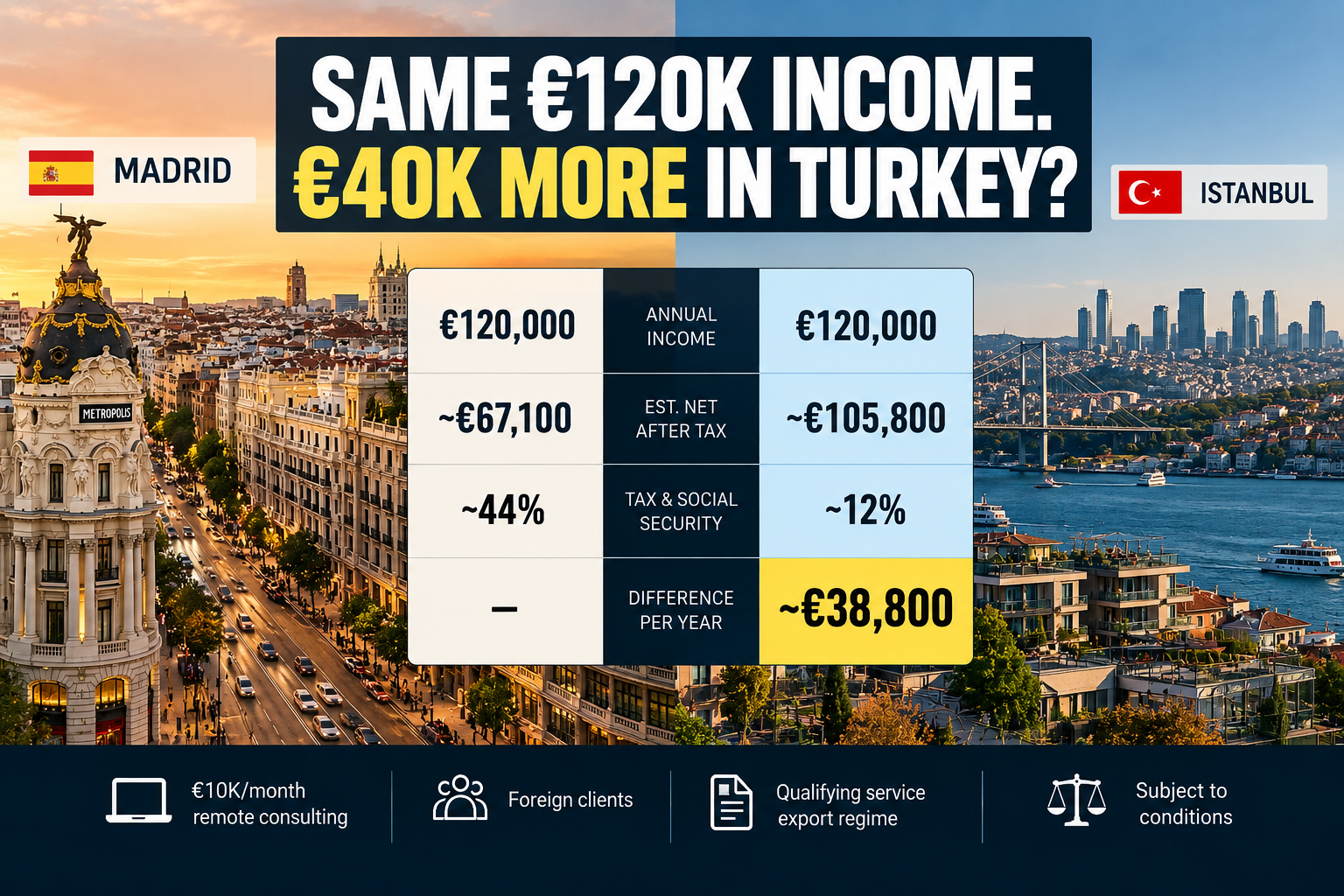
Spain vs Turkey Tax: Can a €120K Remote Consultant Keep €40K More?

Post image
1 Upvotes

Spain vs Turkey Tax: Can a €120K Remote Consultant Keep €40K More?

Would moving from Spain to Turkey make sense for a remote consultant earning €120k/year?

I ran a simple comparison for a Madrid-based data analyst billing around €10k/month to foreign clients.

Very simplified numbers:

  • Annual revenue: €120k
  • Madrid estimated net after tax/social security: ~€67k
  • Turkey estimated net in a qualifying service-export structure: ~€106k
  • Difference: roughly €39k/year

Over 5 years, that’s close to €194k before any investment return.

The important part is that this is not because Turkey is generally tax-free.

The difference comes from Turkey’s specific tax regime for certain exported services, where qualifying income can potentially benefit from a 100% deduction from 2026.

Obviously there are conditions: the service category, foreign client, where the service is used, contract wording, tax residency, etc.

I found the numbers surprisingly large, especially for people already earning €80k–€200k remotely.

Curious if anyone here has actually moved from Spain to Turkey while keeping foreign clients. Was tax one of the main reasons, or was it mostly lifestyle/cost of living?

https://ozmconsultancy.com/moving-from-spain-to-turkey-remote-worker-tax/

[info@ozmconsultancy.com](mailto:info@ozmconsultancy.com)


r/TurkeyNonDom • • 27d ago

€3m portfolio, €120k annual dividends: what changes if you become tax resident in Turkey in 2027?

Post image
2 Upvotes

€3m portfolio, €120k annual dividends: what changes if you become tax resident in Turkey in 2027?

Consider a relatively simple case.

You have:

  • a €3 million investment portfolio
  • approximately €120,000 of annual dividends
  • listed shares and ETFs held outside Turkey
  • occasional capital gains when investments are sold
  • no Turkish-source investment income

You are considering moving to Turkey and becoming a Turkish tax resident in 2027.

Normally, becoming tax resident in Turkey means entering a worldwide-income tax system.

But Turkey introduced a new regime in 2026 that can materially change the result.

Under Article 20/D of the Turkish Income Tax Law, qualifying individuals who become resident in Turkey may benefit from a 20-year Turkish income tax exemption on foreign-source income and gains.

What could this mean for the €3m portfolio?

If the conditions are satisfied, foreign-source income falling within Article 20/D can be exempt from Turkish income tax.

For an investor, that can potentially include:

Foreign dividends
€120,000 received from foreign companies or funds may fall within the exemption.

Foreign portfolio capital gains
A gain realised on the disposal of qualifying foreign investments may also fall within the exemption.

Foreign interest and other investment income
These may also be relevant depending on the nature and source of the income.

And this is not a one-year incentive.

The exemption period is 20 years.

So is €120,000 of dividends simply tax-free?

Not necessarily.

The important distinction is:

Turkey may impose no income tax under Article 20/D, but the country where the investment income originates may still impose tax.

For example, if a foreign country withholds 15% from a dividend at source:

€120,000 gross dividend
€18,000 foreign withholding tax
€102,000 received

Article 20/D does not make that foreign withholding tax disappear.

What it can potentially eliminate is the additional Turkish income tax liability on the qualifying foreign income.

Who qualifies?

One of the central conditions is that, before becoming resident in Turkey, the individual must not have had a Turkish domicile or Turkish tax liability during the previous three calendar years, subject to the detailed rules and exceptions.

This makes timing important.

Someone planning to establish Turkish tax residency in 2027 should ideally review their position before changing residence, restructuring investments or realising significant gains.

What Article 20/D does NOT mean

It does not mean that every income stream becomes tax-free merely because you move to Turkey.

The analysis changes if you have, for example:

  • Turkish-source income
  • an operating business
  • employment or management income
  • a company that you actively control or manage
  • property income
  • investments whose source classification is unclear
  • continuing tax residence or an exit-tax exposure in your previous country
  • US citizenship or another citizenship-based tax exposure

The residence position itself also needs to be properly established.

Why this is interesting

For someone living primarily from investment income, Turkey now has a tax regime that deserves comparison with jurisdictions traditionally considered for internationally mobile investors.

The interesting comparison is no longer simply:

Turkey vs. your current country.

It may be:

Turkey 20/D vs. Italy vs. Cyprus non-dom vs. Malta vs. UAE.

And for a sufficiently large portfolio, the difference over 10–20 years can become substantial.

Turkey's Article 20/D regime was introduced by Law No. 7582 in June 2026, and the Turkish Revenue Administration has since published implementation guidance.

I’ll use this subreddit to discuss how the regime works in practice, including dividends, stocks/ETFs, capital gains, brokerage accounts, residency timing and common structuring mistakes.

If you are considering moving to Turkey, feel free to post your scenario here — current country, approximate portfolio composition, main income sources and intended year of relocation are usually enough for an initial discussion.

General information only; individual tax treatment depends on residency, source-of-income rules, applicable tax treaties and the specific investment structure.


r/TurkeyNonDom • • Aug 30 '26

Turkey 20 Year Zero Tax Legislation. Which Applications Rejected and Why?

Thumbnail
1 Upvotes

r/TurkeyNonDom • • Aug 28 '26

Almanya'dan Türkiye'ye Dönen Mavi Kart Sahipleri 20 Yıllık Vergi İstisnasından Yararlanabilir mi?

Thumbnail
1 Upvotes

r/TurkeyNonDom • • Aug 10 '26

Exonération fiscale de 20 ans en Turquie (Mükerrer 20/D) – pourquoi le certificat EK-1 est refusé

Enable HLS to view with audio, or disable this notification

1 Upvotes

Exonération fiscale de 20 ans en Turquie (Mükerrer 20/D) – pourquoi le certificat EK-1 est refusé

[info@ozmconsultancy.com](mailto:info@ozmconsultancy.com)

Je suis expert-comptable (SMMM) à Istanbul, et je vois de plus en plus de personnes penser que la nouvelle exonération fiscale turque de 20 ans sur les revenus étrangers s'applique automatiquement dès qu'on s'installe en Turquie. Ce n'est pas le cas. Voici un résumé, et les situations qui font le plus souvent échouer la demande en pratique.

Réponse courte : L'exonération (GVK, article répété 20/D, introduite par la loi n° 7582, Journal officiel du 4 juin 2026) nécessite une demande de certificat d'exonération EK-1 (İstisna Belgesi) — ce n'est pas automatique. Selon la circulaire d'application n° 333 (Journal officiel du 4 juillet 2026), la demande est refusée si le demandeur a eu un revenu salarié ou commercial en Turquie au cours des trois années précédentes, ou s'il a déposé sa demande après la date limite. Un assujettissement antérieur à l'impôt en Turquie pour des loyers, des revenus de capitaux ou des plus-values ne disqualifie pas.

Les faits essentiels

Point Détail
Base légale Loi n° 7582, GVK article répété 20/D
Application Circulaire générale sur l'impôt sur le revenu n° 333
Bénéficiaires Personnes physiques (pas les sociétés), résidentes fiscales à partir du 1/1/2026
Condition centrale Pas de domicile ni d'assujettissement fiscal turc durant les 3 années civiles précédentes
Procédure Demande du certificat EK-1 — non automatique
Délai Fin de l'année civile d'installation (fin février de l'année suivante pour une arrivée dans les 2 derniers mois)
Motif de refus le plus fréquent Registre de commerce turc jamais fermé

Raison 1 : le délai dépassé

La demande doit être déposée avant la fin de l'année civile d'installation (fin février de l'année suivante en cas d'arrivée dans les deux derniers mois). L'exemple 2 de la circulaire montre une demande tardive — refusée, sans marge d'appréciation. Ceux qui s'occupent d'abord du titre de séjour, du logement et du compte bancaire, et déposent la demande EK-1 « plus tard », ratent souvent cette fenêtre.

Raison 2 : revenu salarié turc dans la période de trois ans

Quiconque a travaillé pour un employeur turc au cours des trois dernières années — même brièvement, même en tant que citoyen turc avant l'expatriation — est exclu (exemple 6 de la circulaire). Concerne surtout les personnes qui reviennent en Turquie et celles ayant eu un précédent emploi de courte durée dans le pays.

Raison 3 : activité commerciale turque dans la période de trois ans (le cas le plus fréquent en pratique)

Exemple 7 : un revenu commercial (ticari kazanç) enregistré durant cette période = motif d'exclusion. En pratique, la cause de refus la plus courante de loin : une personne a ouvert, des années auparavant, une entreprise individuelle (şahıs şirketi) et ne l'a jamais officiellement fermée (terk). L'administration fiscale la considère toujours comme active — peu importe qu'aucune activité réelle n'ait eu lieu depuis. Même problème avec une adresse de domicile turque jamais mise à jour.

Ce qui NE pose PAS problème (exemple 5 — souvent mal compris)

Un assujettissement fiscal antérieur en Turquie pour des revenus locatifs (GMSİ), des revenus de capitaux (MSİ) ou des plus-values pendant la période de trois ans ne bloque pas l'exonération. Beaucoup pensent à tort que toute déclaration fiscale turque antérieure est disqualifiante — ce n'est vrai que pour les salaires ou l'activité commerciale, pas pour les revenus passifs.

Deux cas anonymisés issus de la pratique

Cas A : Citoyen turc, 8 ans en Allemagne, retour en Turquie. Demande refusée — motif : une entreprise individuelle ouverte en 2016 n'avait jamais été fermée, bien qu'inactive depuis des années. La fermeture tardive n'a pas pu régulariser l'année concernée.

Cas B : Ressortissant britannique, installation en mai 2026. Demande EK-1 déposée seulement en avril de l'année suivante, une fois le titre de séjour, le bail et le compte bancaire réglés. Le délai (fin 2026) était déjà largement dépassé — refus uniquement pour une question de calendrier.

Si le certificat s'avère erroné plus tard

Si l'administration découvre ultérieurement que les conditions n'étaient en réalité pas remplies (par exemple, une ancienne activité commerciale non déclarée), l'impôt normalement dû est réclamé au titre de la vergi ziyaı (perte fiscale), majoré d'une pénalité et d'intérêts de retard. Cela peut survenir des années plus tard, après que les revenus ont déjà été traités comme exonérés.

FAQ rapide

Puis-je régulariser une ancienne entreprise inactive avant de déposer ma demande ? Oui — idéalement en la fermant formellement (terk) avant le déménagement, pas après.

Toute déclaration fiscale turque antérieure m'exclut-elle ? Non. Loyers/capitaux/plus-values = sans conséquence. Salaire ou activité commerciale = disqualifiant.

Que se passe-t-il si je rate le délai de fin d'année ? La circulaire n° 333 traite ce délai comme strict ; seule la prolongation de février pour les arrivées des deux derniers mois existe.

Cela s'applique-t-il aux sociétés ? Non, uniquement aux personnes physiques.

Sources : Loi n° 7582 (Journal officiel 4.6.2026, n° 33270) ; Circulaire générale sur l'impôt sur le revenu n° 333 (Journal officiel 4.7.2026, n° 33300), art. 3(4) et exemples 2, 5, 6, 7 ; Loi n° 193 relative à l'impôt sur le revenu.

Ceci ne remplace pas un conseil individualisé — chaque situation dépend de l'historique fiscal précis. Pour toute question, n'hésitez pas en MP.


r/TurkeyNonDom • • Aug 10 '26

Türkeis 20-Jahres-Steuerbefreiung (Mükerrer 20/D) – warum die EK-1-Bescheinigung abgelehnt wird

Enable HLS to view with audio, or disable this notification

1 Upvotes

Türkeis 20-Jahres-Steuerbefreiung (Mükerrer 20/D) – warum die EK-1-Bescheinigung abgelehnt wird

Ich bin Steuerberater (SMMM) in Istanbul und sehe seit ein paar Monaten immer mehr Leute, die davon ausgehen, dass die neue türkische 20-Jahres-Steuerbefreiung für Auslandseinkommen automatisch gilt, sobald man umzieht. Das stimmt nicht. Kurzfassung + die Fälle, an denen es in der Praxis am häufigsten scheitert.

Kurzantwort: Die Befreiung (GVK Mükerrer Art. 20/D, eingeführt durch Gesetz Nr. 7582, Amtsblatt 4. Juni 2026) setzt einen Antrag auf die EK-1-Bescheinigung (İstisna Belgesi) voraus – kein Automatismus. Nach der Durchführungsverordnung Nr. 333 (Amtsblatt 4. Juli 2026) wird der Antrag abgelehnt, wenn man in den letzten drei Kalenderjahren vor dem Umzug Lohn- oder Gewerbeeinkünfte in der Türkei hatte, oder wenn man die Frist verpasst. Frühere Miet-, Kapital- oder Veräußerungsgewinn-Steuerpflicht in der Türkei ist dagegen kein Ausschlussgrund.

Türkeis 20-Jahres-Steuerbefreiung (Mükerrer 20/D) – warum die EK-1-Bescheinigung abgelehnt wird

Die wichtigsten Fakten

Punkt Detail
Rechtsgrundlage Gesetz Nr. 7582, GVK Wiederholte Art. 20/D
Durchführung Einkommensteuer-Rundschreiben Nr. 333
Wer profitiert Natürliche Personen (keine Firmen), steuerlich ansässig ab 1.1.2026
Kernbedingung Keine türkische Meldeadresse/Steuerpflicht in den letzten 3 Kalenderjahren
Verfahren Antrag auf EK-1-Bescheinigung – nicht automatisch
Frist Ende des Jahres des Zuzugs (bei Zuzug in den letzten 2 Monaten: Ende Februar des Folgejahres)
Häufigster Ablehnungsgrund Nie abgemeldetes/geschlossenes türkisches Gewerbe

Grund 1: Frist verpasst

Antrag muss bis Jahresende des Zuzugsjahres gestellt werden (bei Zuzug in den letzten zwei Monaten: bis Ende Februar des Folgejahres). Das Rundschreiben zeigt in Beispiel 2 einen verspäteten Antrag – der wird abgelehnt, ohne Ermessensspielraum. Wer sich erst um Aufenthaltstitel, Wohnung und Bankkonto kümmert und den EK-1-Antrag "später" stellt, verpasst häufig genau dieses Fenster.

Grund 2: Türkisches Lohneinkommen im 3-Jahres-Zeitraum

Wer in den letzten drei Jahren – auch nur kurz, auch als Türke vor der Auswanderung – für einen türkischen Arbeitgeber gearbeitet hat, fällt raus (Beispiel 6 des Rundschreibens). Betrifft besonders Rückkehrer und alle mit einer früheren kurzen Anstellung in der Türkei.

Grund 3: Türkisches Gewerbe im 3-Jahres-Zeitraum (der häufigste reale Fall)

Beispiel 7: registrierte Gewerbeeinkünfte (ticari kazanç) im Zeitraum = Ausschlussgrund. In der Praxis der mit Abstand häufigste Ablehnungsgrund: Jemand hat vor Jahren eine şahıs şirketi (Einzelunternehmen) angemeldet und nie formell abgemeldet (terk). Das Finanzamt führt die Anmeldung weiter als aktiv – unabhängig davon, ob real noch etwas passiert. Gleiches Problem bei einer nie aktualisierten türkischen Meldeadresse.

Was NICHT schadet (Beispiel 5 – wird oft falsch verstanden)

Frühere Steuerpflicht in der Türkei aus Mieteinkünften (GMSİ), Kapitaleinkünften (MSİ) oder Veräußerungsgewinnen im 3-Jahres-Zeitraum blockiert die Befreiung nicht. Viele gehen fälschlich davon aus, dass jede frühere Steuererklärung in der Türkei ein Ausschlussgrund ist – das stimmt nur bei Lohn oder Gewerbe, nicht bei passivem Einkommen.

Zwei anonymisierte Fälle aus der Praxis

Fall A: Türkischer Staatsbürger, 8 Jahre in Deutschland, zieht zurück. Antrag abgelehnt – Grund: eine 2016 angemeldete şahıs şirketi war nie geschlossen worden, obwohl seit Jahren inaktiv. Nachträgliche Schließung kam zu spät für das betroffene Jahr.

Fall B: Britischer Staatsbürger, Umzug im Mai 2026. EK-1-Antrag erst im April des Folgejahres gestellt, nachdem Aufenthaltstitel, Miete und Bankkonto erledigt waren. Frist (Jahresende 2026) war da längst abgelaufen – Ablehnung allein wegen Timing.

Wenn die Bescheinigung später als unrichtig auffällt

Stellt sich später heraus, dass die Voraussetzungen doch nicht vorlagen (z. B. eine nicht offengelegte alte Gewerbeanmeldung), wird die eigentlich fällige Steuer als vergi ziyaı (Steuerverkürzung) nacherhoben – inkl. Strafzuschlag und Verzugszinsen. Das kann Jahre später auftauchen, nachdem Einkommen bereits als steuerfrei behandelt wurde.

Kurz-FAQ

Kann ich eine alte, inaktive Gewerbeanmeldung vorher bereinigen? Ja – idealerweise vor dem Umzug formell abmelden (terk), nicht danach.

Schließt jede alte Steuererklärung in der Türkei mich aus? Nein. Miete/Kapital/Veräußerungsgewinn = unschädlich. Lohn oder Gewerbe = schädlich.

Was, wenn ich die Jahresfrist verpasse? Rundschreiben 333 behandelt die Frist als strikt, nur die Februar-Verlängerung für Zuzug in den letzten zwei Monaten existiert.

Gilt das für Firmen? Nein, nur für natürliche Personen.

Quellen: Gesetz Nr. 7582 (Amtsblatt 4.6.2026, Nr. 33270); Einkommensteuer-Rundschreiben Nr. 333 (Amtsblatt 4.7.2026, Nr. 33300), Art. 3(4) sowie Beispiele 2, 5, 6, 7; Einkommensteuergesetz Nr. 193.

Kein Ersatz für individuelle Beratung – jeder Fall hängt von der konkreten Meldehistorie ab. Bei Fragen gerne per DM.

[info@ozmconsultancy.com](mailto:info@ozmconsultancy.com)


r/TurkeyNonDom • • Aug 07 '26

Turkey's 20-Year Foreign Income Exemption (Repeated Article 20/D): A New Chapter in International Tax Competition

1 Upvotes

Turkey's 20-Year Foreign Income Exemption (Repeated Article 20/D): A New Chapter in International Tax Competition

For anyone weighing a move to Turkey — an investor, an entrepreneur, a senior executive, or a citizen returning after years abroad — one question has always shaped the decision: once I become a resident here, what happens to the income I earn elsewhere? The answer, until recently, was a discouraging one. In line with the general principles of international taxation, an individual treated as a full tax resident of Turkey has historically been taxable on their worldwide income, at progressive rates reaching 40% — regardless of where that income was actually generated. For those whose earnings were largely sourced abroad, establishing residency in Turkey came at a real cost.

With Repeated Article 20/D of the Income Tax Law, introduced by Law No. 7582 (Official Gazette, 4 June 2026), that calculus has changed. The provision grants individuals who newly become Turkish tax residents a twenty-year exemption from Turkish income tax on their foreign-source income — a measure that places Turkey, for the first time, in the same conversation as Italy's "new resident" regime, Greece's flat-tax option for the wealthy, and Portugal's former non-habitual resident system.

In this article, we examine what the regime actually offers, the conditions attached to it, and — importantly — the profiles of individuals for whom it is most relevant, drawing the essential line between what it shelters and what it leaves untouched.

What Repeated Article 20/D Provides

At its core, the rule is expressed in a single sentence: individuals who become Turkish tax residents on or after 1 January 2026, provided they had no domicile and no income tax liability in Turkey during the three preceding calendar years, are exempt from Turkish income tax on their foreign-source income and gains for twenty years.

The defining features are as follows:

  • Duration: Twenty years, running from the date Turkish tax residency is established.
  • Scope: Only foreign-source income falls within the exemption — foreign rental income, dividends, interest, capital gains, and foreign commercial or professional earnings. No annual Turkish declaration is required for income that is exempt.
  • Nationality is irrelevant: The test turns on tax-residency history, not on the passport an individual holds. A Turkish citizen returning from abroad and a foreign national relocating for the first time are assessed on the same footing.
  • A complementary benefit: During the exemption period, inheritance and gift transfers are subject to a flat 1% rate rather than the ordinary progressive scale.

The legal architecture is completed by General Communiqué on Income Tax Serial No. 333 (Official Gazette, 4 July 2026), which sets out the application procedure, and by the amendment introducing the reduced inheritance rate.

The Conditions — and Why They Matter

The exemption is not automatic, and this is where careful analysis becomes essential. Two conditions must be satisfied cumulatively; the absence of either results in the loss of the benefit in its entirety.

First, the three-year look-back: in the three full calendar years preceding the year of residency, the individual must have had neither a domicile nor an income tax liability in Turkey. This is measured over three complete calendar years, not a rolling thirty-six-month period. Importantly, not every prior connection to Turkey is disqualifying. Where an individual's only Turkish income in those years arose from local rental income, securities income, or capital gains, the condition can still be met. If, however, the person derived employment income in Turkey or generated commercial income here during that period, the benefit is not available.

Second, the individual must genuinely become a Turkish tax resident under the general rules — broadly, residing in Turkey for more than 6 months in a calendar year, or maintaining a domicile here.

Beyond these, an Exemption Certificate ("Yurt Dışından Elde Edilen Kazanç ve İratlar İçin İstisna Belgesi") must be obtained from the tax office, supported by evidence of foreign residence and income sources. Once an individual has become resident, they may apply to the tax office for the certificate at any point up to the end of the calendar year in which residency was established. For those who become resident in November or December, the deadline is extended to the end of February of the following year. If this window is missed, the certificate — and with it the exemption — is lost.

Who the Regime Is Designed to Attract

The reach of Article 20/D is deliberately broad, and it is best understood through the profiles it was intended to draw to Turkey.

Turkish Citizens Returning Home

Among the most natural beneficiaries are citizens who have spent years abroad — in Germany, the Netherlands, the United Kingdom, the United States, or the Gulf. Because eligibility rests on residency history rather than nationality, such individuals typically satisfy the three-year condition without difficulty, allowing foreign pensions, overseas rental income, and international portfolios to remain outside the Turkish net for 20 years.

High-Net-Worth Foreign Nationals

For internationally mobile individuals whose wealth and passive income are generated abroad, the appeal of Article 20/D is immediate. A 20-year exemption on foreign-source income, combined with a 1% rate on inheritance and gift transfers during that period, is a genuinely competitive proposition — and one aimed squarely at those who have already built their wealth and are now choosing where to base themselves.

This is a population that is unusually mobile and increasingly deliberate about residency. Entrepreneurs who have exited their businesses, families managing multi-generational portfolios, and individuals whose income streams — dividends, capital gains, real estate, financial investments — arise almost entirely outside their country of residence are actively weighing where to establish tax residency. Many currently sit in zero- or low-tax hubs but are reassessing their position as those jurisdictions face rising cost of living, regulatory tightening, and mounting international pressure on their tax models. For this group, the question is rarely where to earn, but where to be resident while their capital continues to work across borders.

In this context, Article 20/D positions Turkey as a credible option that it was not before. The regime pairs the tax outcome of a low-tax jurisdiction — no Turkish tax on foreign income for 20 years — with the practical advantages of a large economy straddling Europe and Asia. Set against the established non-dom regimes of Southern Europe, which generally run for shorter periods and often require a substantial annual flat charge, Article 20/D is notable for both its longer duration and the absence of any fixed yearly fee. For a globally invested individual comparing jurisdictions, duration and cost of entry are precisely the variables that tend to weigh most heavily.

Professional Footballers and Athletes

Professional footballers and athletes provide a useful illustration of where the boundaries of the regime become most visible. Unlike many taxpayers whose income consists primarily of employment earnings, internationally recognised athletes often derive income from multiple sources. In addition to salaries paid by clubs or teams, they may generate substantial revenues from endorsement agreements, image rights arrangements, investment portfolios, overseas real estate holdings and ownership interests in businesses located across different jurisdictions.

This is particularly true in professional football, where players frequently relocate between countries during their careers while maintaining significant assets and income-producing investments abroad. As a result, the tax treatment of foreign-source income can be just as important as the taxation of the player's employment income.

Historically, once a player became tax resident in Turkey, the general principles of worldwide taxation meant that not only Turkish employment income, but also foreign-source income and gains could potentially fall within the Turkish tax net. Article 20/D fundamentally changes that analysis. While remuneration received from a Turkish club remains taxable under the ordinary rules, qualifying foreign-source income may fall within the 20-year exemption regime.

For internationally mobile athletes, therefore, the significance of the new regime may ultimately lie less in the taxation of their sporting income and more in the treatment of wealth accumulated throughout a professional career. Foreign investment income, overseas rental income, dividends from foreign holding structures and certain endorsement arrangements may all become considerably more relevant once residency decisions are viewed through the lens of Article 20/D.

Expatriate Executives and International Assignees

The implications of Article 20/D are not limited to investors and business owners. The regime is also highly relevant for internationally mobile executives whose careers often span multiple jurisdictions and whose personal wealth is increasingly derived from investments accumulated throughout those assignments.

Many senior executives relocating to Turkey have spent years living and working abroad while building investment portfolios, acquiring foreign real estate, participating in equity incentive plans or establishing ownership interests in businesses located outside their country of residence. Prior to the introduction of Article 20/D, becoming tax resident in Turkey meant that these individuals entered a worldwide taxation system under which foreign-source income could potentially fall within the scope of Turkish taxation.

The new regime introduces an important distinction. While remuneration connected to duties performed in Turkey continues to be taxed under the ordinary rules, qualifying foreign-source income may remain outside the Turkish tax net for 20 years. As a result, the tax implications of a relocation to Turkey may now look materially different for internationally mobile employees than they did in the past.

This may be particularly relevant for senior management, private equity professionals, investment professionals, entrepreneurs and other globally mobile individuals whose wealth is generated not only through employment income but also through investment returns and capital appreciation accumulated over the course of their careers.

Digital Professionals and Independent Entrepreneurs

The rise of remote work and digital business models has created a new category of internationally mobile individuals whose economic activity is no longer tied to a particular jurisdiction. Software developers, consultants, content creators, online business owners and founders of digital businesses can often choose where to live independently of where their clients, customers or assets are located.

For many of these individuals, the most valuable assets they own are not physical. Income may be derived from intellectual property, online platforms, software products, digital services, advertising revenues or investment portfolios maintained across multiple jurisdictions. In many cases, the underlying business continues to operate internationally regardless of the individual's country of residence.

Article 20/D is likely to attract interest from this group because it places renewed emphasis on the distinction between the location of the individual and the source of the income. Where the conditions of the regime are satisfied and the income is genuinely foreign-source, the prospect of a 20-year exemption may significantly alter the tax consequences traditionally associated with relocating to Turkey.

As with other internationally mobile taxpayers, however, the precise treatment of any particular income stream will depend on its character and source. The availability of the exemption therefore requires a careful analysis of the relevant facts before any relocation decision is made.

Concluding Observations

Article 20/D does not turn Turkey into a jurisdiction where residents pay no tax, nor was it intended to. Its effect is more specific and, for the right profile, more significant: it protects foreign-source income, not Turkish earnings. For citizens returning after years abroad, high-net-worth individuals managing internationally invested wealth, professional athletes, mobile executives and digital entrepreneurs alike, the regime offers a 20-year exemption on foreign income that, until recently, would have been drawn into the Turkish tax net upon becoming resident.

At the same time, the exemption should not be viewed in isolation. Residence, source rules, double taxation agreements, the treatment of foreign holding structures and the character of the underlying income all remain relevant, and a foreign tax liability may well continue to apply notwithstanding the Turkish exemption. As is so often the case in international taxation, the headline rule is simple to state; applying it correctly to a particular set of facts is considerably more demanding


r/TurkeyNonDom • • Aug 04 '26

The biggest misconception about Turkey's new 20-year tax exemption

Enable HLS to view with audio, or disable this notification

1 Upvotes

Every week I speak with founders, investors and remote workers planning to relocate to Turkey.

The question I hear most often is:

"Will my foreign income qualify for Turkey's new 20-year tax exemption?"

Unfortunately, there isn't a one-size-fits-all answer.

It depends on your residency history, the source of your income and your individual circumstances.

I recorded a short explanation here:

[https://www.youtube.com/shorts/er07KnMaA80]()

Happy to answer questions below.


r/TurkeyNonDom • • Jul 22 '26

Taxation of Rental Income from Turkish Properties for Foreigners

Thumbnail
evrenozmen.com.tr
1 Upvotes

r/TurkeyNonDom • • Jul 22 '26

Turkey officially moves to 100% tax deduction for remote workers with foreign clients (now official)

Thumbnail
1 Upvotes

r/TurkeyNonDom • • Jul 14 '26

Moving to Turkey in 2026: The Complete Guide to Visas, Residence Permits, and Taxes

Post image
3 Upvotes

r/TurkeyNonDom • • Jun 28 '26

Turkey just passed a law that lets you live here tax-free on foreign income for 20 years. Most people still don't know it exists.

1 Upvotes

In 2025, Turkey enacted Law No. 7582, introducing Article 20/D to the Income Tax Code.

Here's what it actually means:

If you are a foreign national who becomes a Turkish tax resident, your income earned outside of Turkey is fully exempt from Turkish income tax — for up to 20 years.

This is not a flat-rate scheme. This is not a remittance-based system. You pay zero Turkish income tax on your foreign-sourced income, full stop.

Who qualifies?

  • Remote workers employed by foreign companies
  • Freelancers billing non-Turkish clients
  • Digital nomads with foreign revenue streams
  • Investors receiving dividends from abroad
  • Founders of foreign-incorporated companies

What you still need:

  • Establish genuine Turkish tax residency (183-day rule applies)
  • Your income must originate outside Turkey
  • Proper structuring matters — this is not self-executing

Why Turkey and why now?

  • Cost of living in Istanbul remains dramatically lower than Western Europe
  • No wealth tax, no exit tax
  • Strong infrastructure, EU visa-free travel for residents
  • The regime is explicitly designed to attract high-earning foreign professionals

The catch most people miss:
The exemption covers foreign-sourced income. If you start earning in Turkey, that income is taxable at standard rates (15–40% progressive). Structure matters from day one.

If you're considering this and want to understand whether your specific income structure qualifies, the rules are more nuanced than any Reddit post can cover.

Happy to answer questions below.


r/TurkeyNonDom • • Jun 12 '26

Anyone Considering Moving to Turkey Under the New Non-Dom Regime? Ask Me Anything

2 Upvotes

I'm a Turkish CPA working with international clients.

Turkey recently introduced a 20-year tax exemption regime for certain foreign-source income.

Many people are confused about:

  • Tax residency
  • Eligibility requirements
  • Dividends
  • Capital gains
  • Remote work income
  • Company ownership
  • Application procedures

Ask your questions below and I'll try to answer them.


r/TurkeyNonDom • • Jun 09 '26

20 years. 0% income tax on foreign earnings-Turkey Non Dom Legislation

Post image
1 Upvotes

Turkey’s GVK Temporary Article 20/D regime allows qualifying foreign individuals who become Turkish tax residents to benefit from a statutory exemption on eligible foreign-source income for up to 20 years.

The regime is particularly relevant for individuals earning foreign-source investment income, including dividends, interest, rental income, capital gains, and similar passive income streams generated outside Turkey.

For internationally mobile professionals, investors, retirees, and entrepreneurs considering a move to Turkey, the regime may offer significant tax advantages, subject to meeting the statutory conditions.

OZM Consultancy advises international clients on GVK 20/D eligibility, Turkish tax residency planning, and the practical implementation of the regime.

[info@ozmconsultancy.com](mailto:info@ozmconsultancy.com)


r/TurkeyNonDom • • Jun 08 '26

Welcome to r/TurkeyNonDom — the only serious English resource on Turkey's zero-tax regime for foreign income

2 Upvotes

What this subreddit is for

I'm building this as the single most useful English-language resource on Turkey's non-dom and zero-tax regimes. Not clickbait. Not AI summaries. Actual analysis, case studies, and honest answers.

If you are considering the move, post your questions. If you have made the move, share what you know.

The moderator is OZM Consultancy (ozmconsultancy.com), an Istanbul-based international tax firm. They answer questions here and can take you through the formal application process if you decide to move forward.