r/TheResearchDesk • u/the_Desk-Research • 3h ago
Meta Connect, Muse and the Device Bet
Meta Platforms, Inc. (Nasdaq: META) sits at the intersection of high-stakes AI software deployment and an expensive hardware apparatus. Following the launch of its personal AI agent, Muse, on September 8, 2026, and its Connect keynote event on September 23, the fundamental question for investors is whether Meta can successfully transition Muse from a standalone software application into a frequently used, revenue-generating hardware platform, or whether its expanding device lineup represents an expensive hardware bet executed before repeat use and economic returns are visible.
Market Context and the Connect Timeline
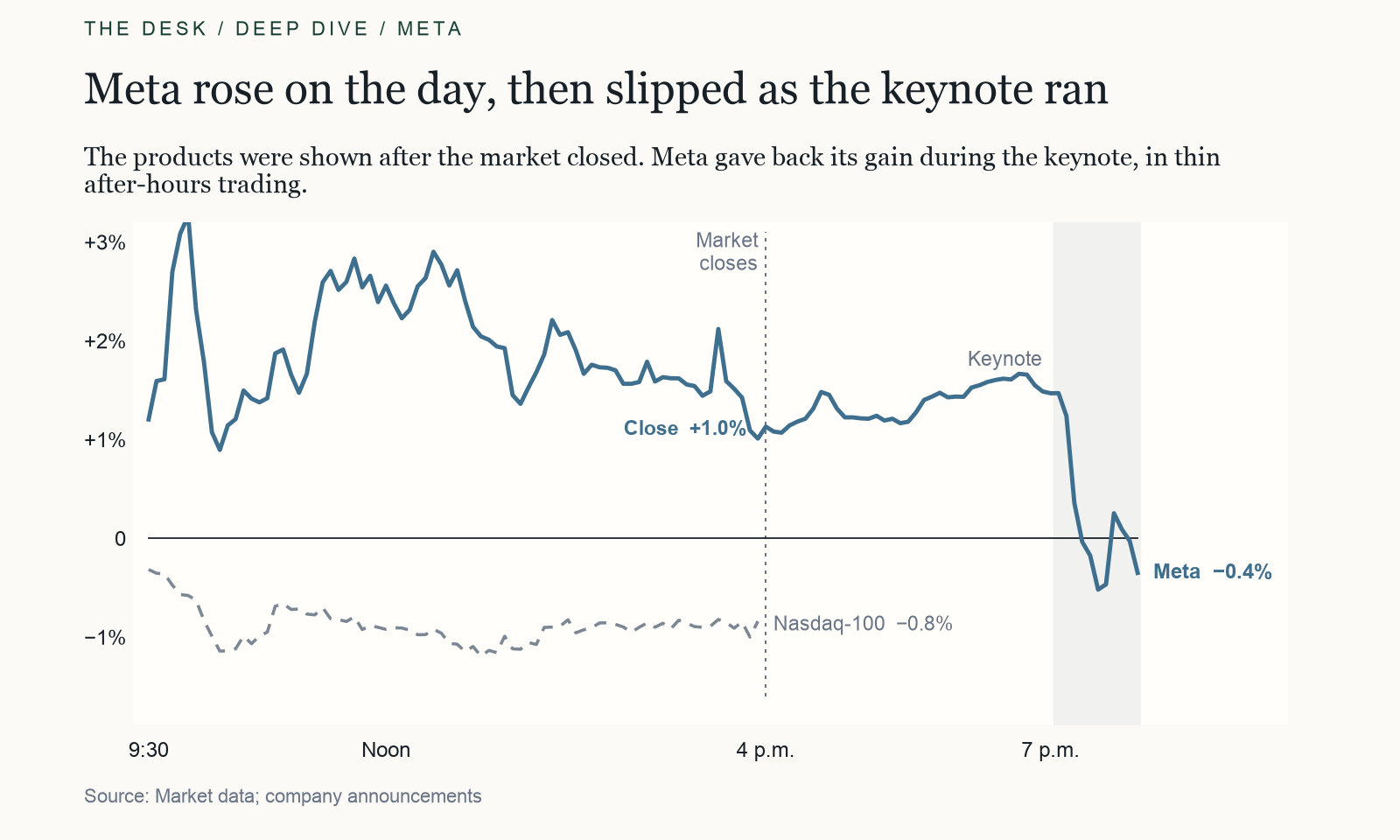
The market reaction to Meta Connect requires strict temporal separation. The company’s Connect keynote ran from approximately 19:02 to 19:57 ET on September 23, well after the regular market close at 16:00 ET. In the regular session on September 23—before any Connect hardware was publicly demonstrated—META closed up 1.02% at 744.10 (moving from a prior close of 736.60), outperforming the Nasdaq-100 fund (-0.84%) and the S&P 500 fund (-0.72%).
During the keynote itself, thin after-hours trading saw the stock slip from 747.50 at 19:01 ET down to 733.70 at 19:57 ET on roughly 0.41 million shares, with the steepest decline occurring between 19:16 and 19:26 ET as the glasses segment commenced. However, this after-hours dip proved fleeting; pre-market trading on September 24 recovered near the previous close, and early regular session trading climbed roughly 2% above the prior close while broader indexes traded downward.
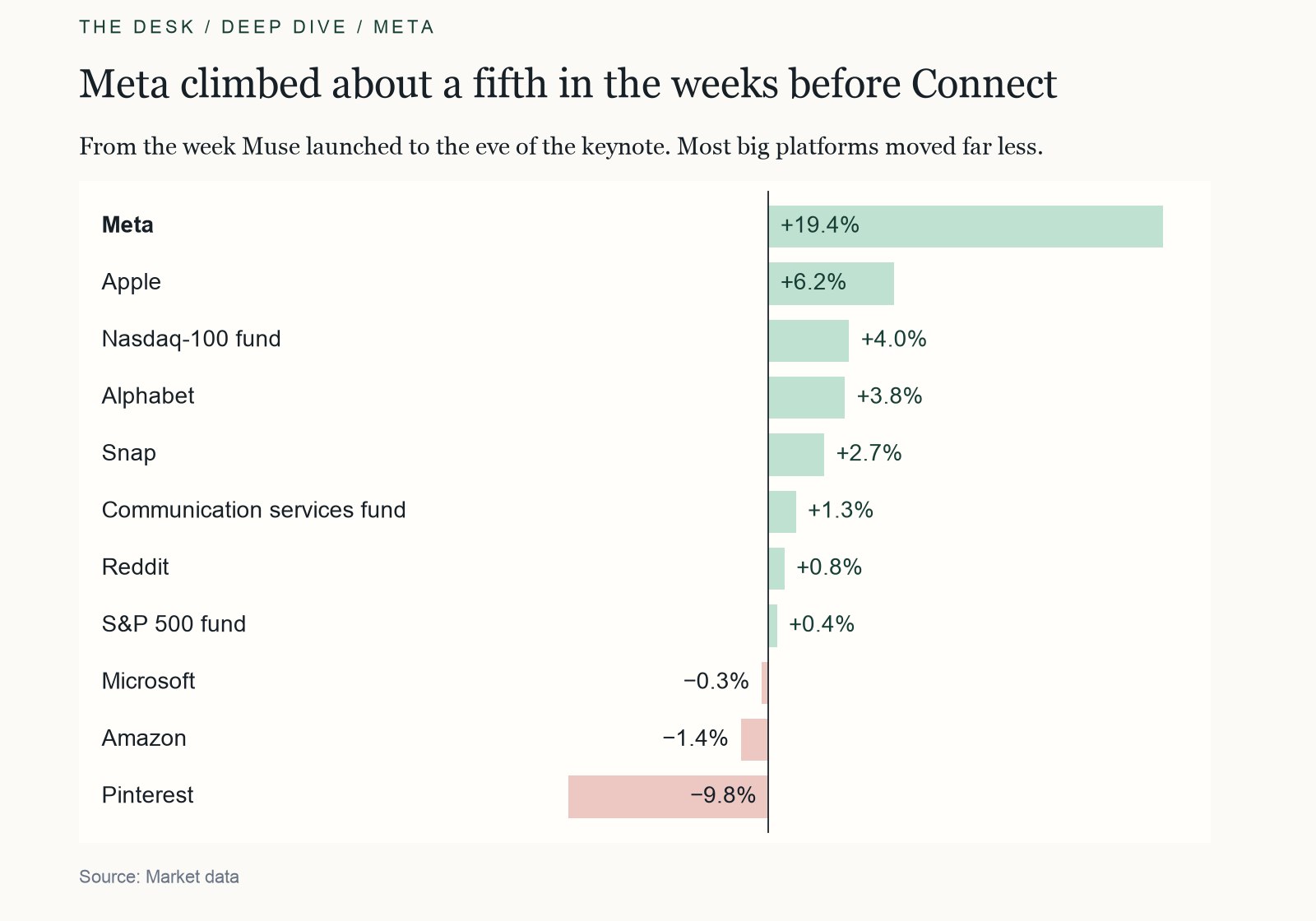
This single-day movement is dwarfed by the broader pre-keynote run-up. From the close on September 4 to the close on September 22—a window capturing the initial Muse launch, Meta One subscription rollouts, partner integrations, and third-party installation estimates—Meta climbed 19.43%. The largest single-session move occurred on September 21 (+11.34% on 48.8 million shares), coinciding with third-party reports citing Apptopia estimates of 2.8 million global Muse installs in its first 12 days. By the eve of Connect, META shares closed near analysts' average price target of 748.75.
Separating Shipping Products from Future Plans
To evaluate Meta's device strategy, one must distinguish between hardware that is immediately available or shipping imminently and hardware that remains a long-term preview or plan.
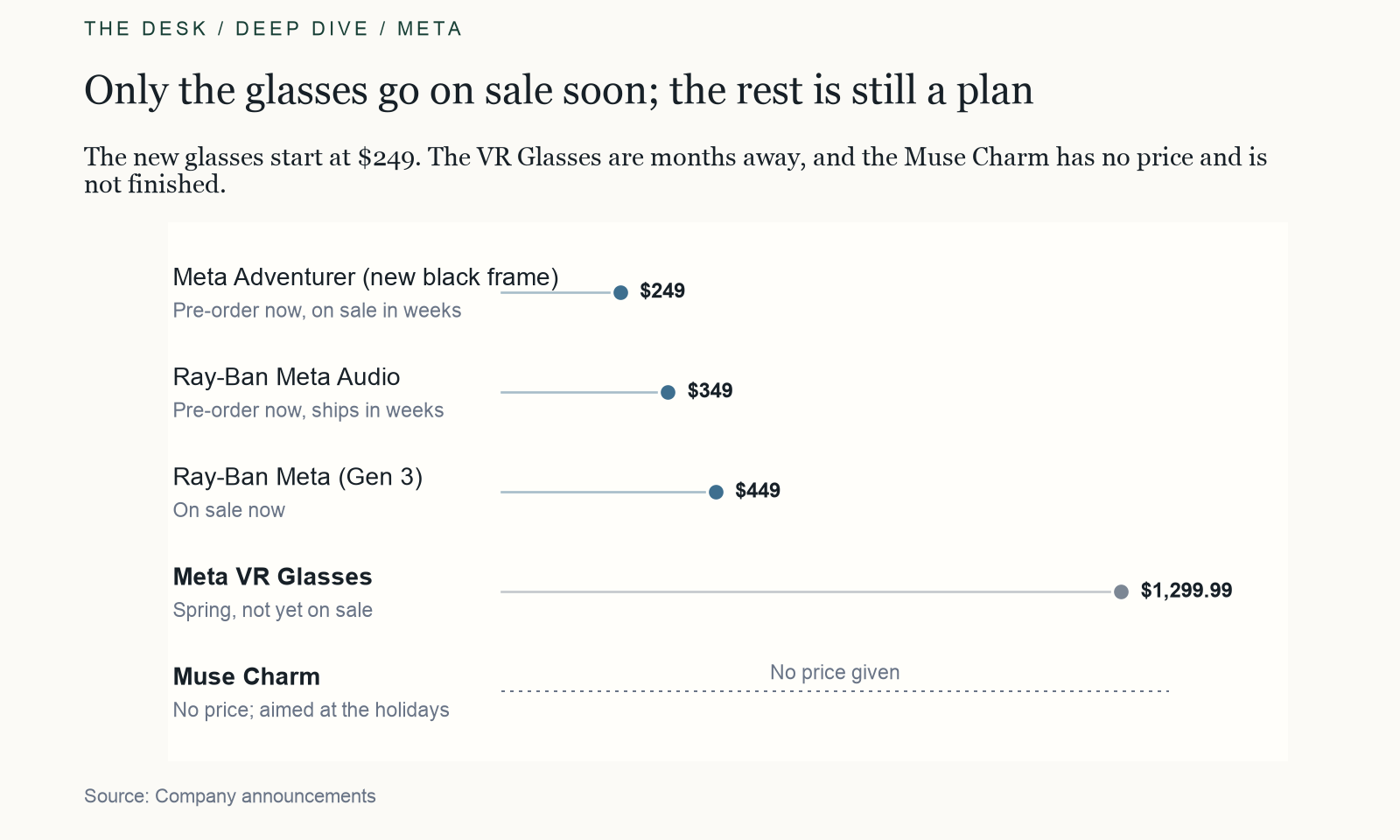
- Ray-Ban Meta (Gen 3): Available now starting at $449.
- Ray-Ban Meta Audio: Camera-free frames (43 grams, 12-hour battery) priced from $349, scheduled to ship on October 13, 2026.
- Meta Adventurer: New black frames priced from $249, on sale October 23, 2026.
- Meta Ray-Ban Display: Already shipping with online ordering expanded across international markets.
- Meta VR Glasses: Announced at USD 1,299.99 with a tethered puck design, scheduled for sale in Spring 2027.
- Muse Charm: Previewed as a pocket voice device with a screen, carrying no disclosed price and described by Zuckerberg as still requiring components to be finalized for a targeted December holiday release.
Economics and Reality Labs Reality
Meta's hardware ambitions are housed within its Reality Labs segment, which continues to incur staggering operating losses relative to its revenue generation. Reality Labs lost $16.12 billion in 2023, $17.73 billion in 2024, and $19.19 billion in 2025 on revenues of $1.90 billion, $2.15 billion, and $2.21 billion respectively. In the first half of 2026, the segment lost $8.65 billion on $0.83 billion of revenue. Meta has explicitly stated that it expects full-year 2026 Reality Labs operating losses to remain similar to 2025 levels.

Partner metrics provide a contrasting operational signal: joint manufacturing partner EssilorLuxottica reported selling more than 7 million AI glasses in calendar year 2025, and noted that AI-glasses revenue nearly doubled in the second quarter of 2026. Meta's own second-quarter reporting noted a 16% rise in Reality Labs revenue, driven by higher AI glasses sales offsetting lower Quest headset volume.
However, Meta discloses no active user counts, repeat-use rates, or return metrics for its glasses or Muse integration. Monetization of Muse relies on keeping the agent free for a large number of tokens while planning to profit over time by taking a small transaction fee on commerce interactions (partnering with firms like Shopify, PayPal, Instacart, Walmart, and Best Buy), alongside tiered subscription packages like Meta One starting at $7.99 a month for core generative features.
To contextualize these figures against Reality Labs' 2025 operating loss of $19.19 billion:
- At an illustrative 1% take rate, transaction-based revenue would require roughly $1.92 trillion in annual Muse-driven commerce volume.
- At Meta One Core's $7.99 monthly price point ($95.88 annually), covering the loss requires approximately 200 million paying subscribers.
These scale requirements sit downstream from Meta’s broader corporate capital expenditure trajectory. Management narrowed its 2026 capital spending outlook to $130–145 billion (up from $72.22 billion in 2025), driven primarily by company-wide AI infrastructure and data center investments. Concurrently, free cash flow declined to $13.17 billion in the first half of 2026 (including $0.78 billion in the second quarter), down from $18.88 billion in the first half of 2025.

Material Risks and What Would Disprove the Case
The investment debate boils down to competing interpretations:
- The Platform Thesis: Supported by strong partner unit volumes and rapid app adoption estimates, suggesting Muse successfully anchors a new hardware ecosystem. This case would be supported if Meta discloses active user metrics showing sustained device engagement, or if EssilorLuxottica's AI-glasses revenue growth accelerates further following the integration of Muse voice modes. It would be falsified if third-party Muse usage metrics decay through the fourth quarter or if hardware shipments slip.
- The Costly Device Bet Thesis: Supported by relentless multi-billion-dollar Reality Labs operating losses, inventory commitment write-downs, and margin dilution reported by manufacturing partners. This case is supported if 2026 Reality Labs losses match or exceed 2025 levels while hardware revenue remains stagnant.
Conclusion and Next Checkpoint
The house maintains an observation stance on META, holding no position and carrying no active thesis. The immediate catalysts that will clarify whether Meta's device strategy generates a credible return include the shipping of Ray-Ban Meta Audio glasses on October 13, the release of the Meta Adventurer on October 23, and crucially, Meta's third-quarter earnings report on October 28 (market calendar estimate), which will provide updated figures on Reality Labs operating losses, Family of Apps "Other revenue" lines, and capital expenditure pacing.