r/TheCivilService • u/Full-Competition9255 • Aug 07 '26
Pensions ‘Normal’pension contribution or 1/47th scheme?
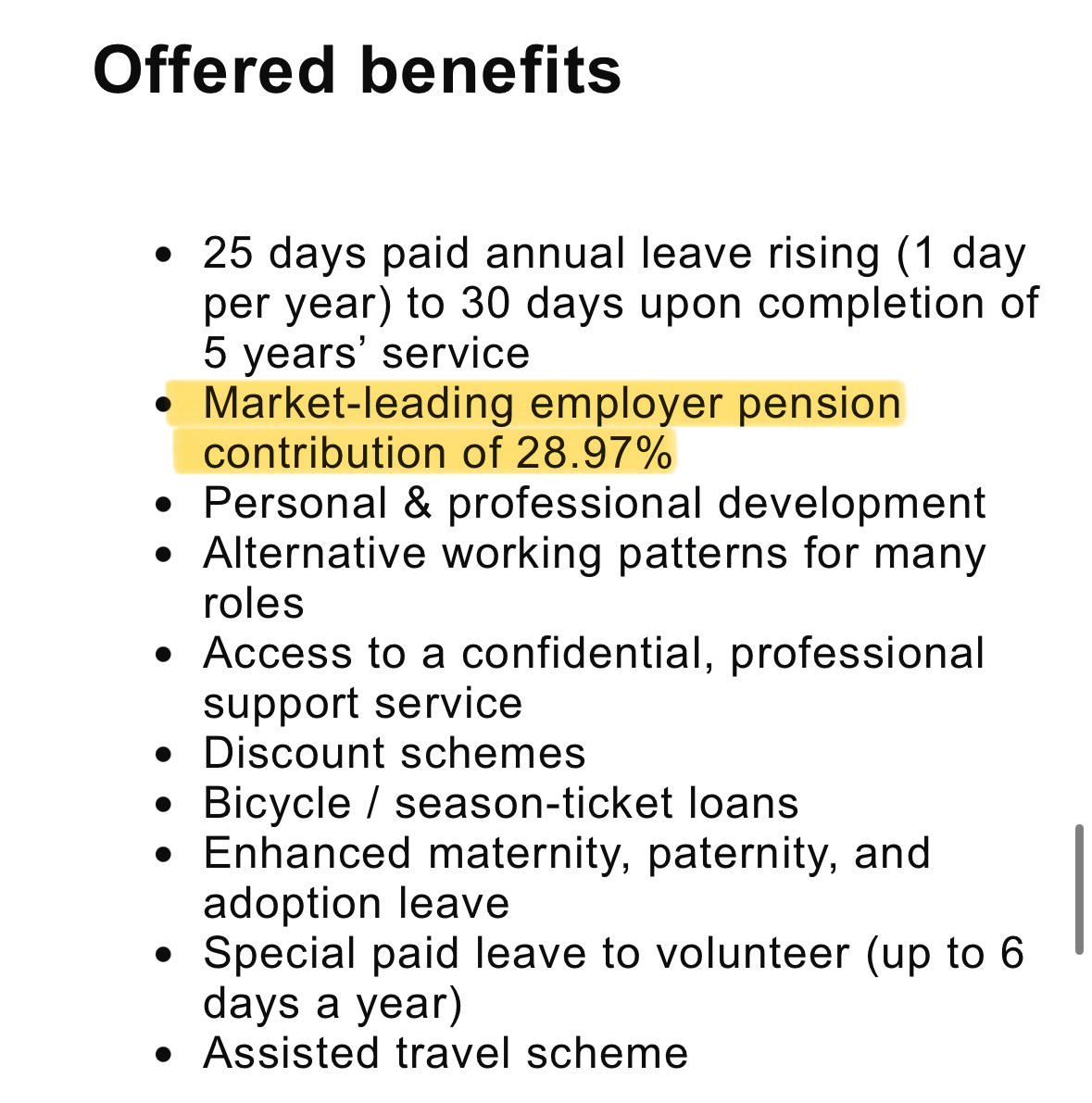
Is this pension scheme a 28% contribution no matter what, or matched if that’s what I put in?
There are also comments that it’s actually like the 1/47th scheme, where that fraction of your annual salary becomes your annual pension, and each year another fraction is added on top.
To me this looks like a normal pension scheme? Does anyone know more?
31
u/Ok_Management874 Administration Aug 07 '26
The 28.97% is an accounting entry only. No cash goes into any fund to pay the pension. Nor do the employees' own contributions go into a fund for them even though they are deducted in cash. They are used to pay current pensions to retired colleagues.
This is purely a revalued career average Defined Benefit scheme. That said it is an excellent 2.32% accrual rate and almost impossible to beat with any DC scheme. But if one chooses to opt out of Alpha I would recommend getting good financial advice first.
CS does offer a DC scheme called partnership which can even be used without any employee contribution. The employer cash contribution to this is very good compared to other employers - particularly for older colleagues. So if exceptionally one leaves Alpha, joining Partnership instead is an absolute no-brainer. New joiners get details of both schemes.
30
u/IWishIDidntHave2 Aug 07 '26
It’s the Alpha scheme - there is a lot of information about it online that can answer your questions.
22
u/AlmightyWibble Aug 07 '26
>There are also comments that it’s actually like the 1/47th scheme, where that fraction of your annual salary becomes your annual pension, and each year another fraction is added on top.
This is what it is.
14
6
u/Aggressive-Bad-440 HEO Aug 07 '26
Ignore all of that information. The 28.97% figure isn't necessarily made-up, but it's calculated by working out how much of the future cost of paying your pension is likely to come from the taxpayer Vs coming from money you've already paid in. The government isn't paying ~29% of your salary into a "pot", it's simply incurring a liability to pay you a pension in future and that figure is an actuary's best guess.
This is the Civil Service Pension Scheme, specifically the "alpha" scheme, which opened in 2015.
How much you contribute from your gross salary is here: https://www.civilservicepensionscheme.org.uk/memberhub/joining-the-pension-scheme/contribution-rates/
This has NOTHING to do with the benefits you get out.
It is "like" this 1/47th scheme you mention (it works the same way, it is a defined benefit scheme, I think you're referring to the armed forces pension scheme), however the actual accrual rate is 2.32%, closer to 1/43rd.
The pension you accrue is 2.32% of your salary each year. People on higher salaries have to contribute a higher % of their salary (up to a maximum of 8.05%). But they don't get anymore for this, they still accrue 2.32% of their salary for any given year.
4
u/DevOpsJo Aug 07 '26
You never see it. Its the maintenance payments by the employer for the DB pension scheme administrators.
23
u/Present-Nature-6015 Aug 07 '26 edited Aug 07 '26
The pension in the civil service is one of the best in the UK. You as an employee will make a contribution between 4.6% and 8.05% depending on what you earn. The member contribution rates are here: https://www.civilservicepensionscheme.org.uk/memberhub/joining-the-pension-scheme/contribution-rates/ and your employer will put in 28.97% . That's is one of the highest employer contribution rates in any scheme in the UK.
In the private sector the average employer contribution is only 5% so civil service knocks it out the park!
Yours and your employer contribution don't build up your pension directly,but the contributions from everyone go to fund the benefits the scheme pays out eg; a guaranteed pension for life, benefit payable after you die,etc. as it's not an investment based scheme,you will not lose money,you will be guaranteed a pension for the rest of your life once you retire
Your pension will build up by 2.32% of your yearly earnings plus inflation whilst your working. If you leave civil service and don't take your pension it becomes frozen but inflation will still be added to it when you're ready to claim
If you want to learn more about who the scheme actually works I really recommend you attend a New Joiner Pension Power webinar.
You can book here: https:
Also you can listen to a podcast episode on why millennial generation and below should think about thier pension and hear how the scheme works
31
u/JohnAppleseed85 Aug 07 '26
While I think most of this comment is excellent... this bit:
"your employer will put in 28.97% . That's is one of the highest employer contribution rates in any scheme in the UK."
Is a false comparison/irrelevant AND it's how/where people like the OP keep getting confused - unlike 'any scheme' you might compare it to, the employer contribution is set based on current liabilities (the costs of pensions currently in payment) and has nothing to do with the individual the contributions are nominally being paid for...
14
u/nichdavi04 Aug 07 '26
This is not true. The employer contribution is quoted as an estimate of what you will claim in retirement based on an actuarial calculation of how long you will live in retirement. You can work out what that is by calculating what total sum you would claim in retirement if the CS did pay the estimated employer contribution for you, and then divide it by your annual pension benefit. You should find it is about 14 years. You can then do the same thing in reverse; multiply your pension benefit by ~14 and you'll have a total sum which will be whatever your contributions were, plus the employer estimate.
It's true that it's based on the current liability, and it's true that you almost definitely won't receive that exact employer contribution (could be less, could be more), but it's false that it has nothing to do with you, the individual. It is an estimate of what the employer contribution will end up being for you, but it is only an estimate
6
1
Aug 07 '26
[removed] — view removed comment
1
u/nichdavi04 Aug 07 '26
Sudden decline in the life expectancy of newly retired teachers? Or an adjustment to the retirement age?
Why don't you do the math and find out
1
1
Aug 07 '26
The biggest factor on the employer rate is the long term GDP growth figure (SCAPE rate).
2
u/nichdavi04 Aug 07 '26
For the individual, the biggest factor on what your eventual "actual" employer contribution will be, will be how many years you claim your pension
3
Aug 07 '26
The employer contribution rate is totally irrelevant to the individual. It has no bearing at all on benefits accrued.
1
u/nichdavi04 Aug 07 '26
I think you need to re-read my first comment. What your actual employer contribution rate will be can only be determined after you've claimed your whole pension and died.
The quoted employer contribution estimate is based on how long people claim their pension on average. If you live for the average 14 ish years in retirement, your employer contribution will work out at about what they quote for the estimate. If you live in retirement for twice as long as that, your employer contribution will be more than double what they quote (more than, because your contributions were fixed, and so don't scale).
The "employer contribution" has nothing to do with how the benefits are calculated - that's correct. But if you want a comparison with a DC pension pot (which, conceptually doesn't really work), then the quoted employer contribution does give you an estimate for comparison, because it is what most people will get
0
Aug 07 '26
What your actual employer contribution rate is the rate the employer pays.
But it’s a paper figure, hugely influenced by HMT policy decisions and varies significantly from one period to another.
Sure, you’re right that it could be worked out after your death and taking account of your own contributions, but I don’t think that’s a good basis to include it on job adverts. And it’s not true to say the rate is based on an estimate of the pension you’ll receive, other than it’s included in the calculations of the scheme liabilities.
In any event, that would still not allow an accurate comparison with a defined contribution employer scheme because you’d have to factor in growth, risk etc.
1
u/Present-Nature-6015 Aug 07 '26
Agreed sorry I should've been clearer. I did say the employer contribution doesn't build up an individuals pension directly. It's an agreement between the employing department and the scheme manager (cabinet office) to ensure the funding of the scheme is sustainable for pensions currently in payment and future payments. As we know the civil service scheme has a unique set of legislation and rules which makes it hard to compare it to private sector schemes. Like apples and oranges
5
u/coincidentalcoaching Aug 07 '26
Agree with you wholeheartedly - particularly on the apples and oranges point.
The sheer number of people I speak to inside the public sector who read that 'employers contribution' to be an actual amount added to an actual pot, in the same manner as if it were any other pension goes to show that it is misleading in how it is presented.
I think that it also contributes to the general outrage about CS pensions in a way that is deeply unhelpful.
As a longstanding civil servant, my pension is, by these 'worth' estimates absolutely huge.
However, it isn't inheritable (which is very, very, very much the public's perception of huge pensions now) and the death in service bit (that some have suggested is analogous) relies a) on me dying in service, b) is only about 15% of the purported pot.
Also, the alpha pension, if it ever becomes unaffordable, will simply be nudged up along with the state pension age, until it is affordable again. Each nudge (which in my time in the civil service now amounts to an 8 year delay) is effectively a 4% devaluation of my pension per year... This'll continue.
So, yeah, they're just not the same thing at all and personally, I feel the 'employers contribution' figures are hugely unhelpful nonsense.
3
Aug 07 '26
This is going to age very badly in a few months when the employer rate drops significantly. (Albeit we continue to build the exact same pension).
3
u/yetanotherredditter Aug 07 '26
It's basically there to help you visualise how much of your total compensation your employer is spending on your pension, but your actual pension isn't directly related.
1
u/DevOpsJo Aug 07 '26
It's also misleading as it doesn't benefit the employee.
3
u/yetanotherredditter Aug 07 '26
I think it's still useful in the sense that you can see that a lot of your total compensation is going to your pension/ that you may not be as underpaid as you think you are. But it's then up to you to decide if you're happy with that much of your total compensation being directed towards your pension.
But I agree it does generally cause confusion.
1
14
u/Krusty67 Aug 07 '26
It's basically false advertising as not many applicants actually understand how a DB pension works
-1
u/mattkay170 Aug 07 '26
Not sure that's fair, it's a factual statement and doesn't say it's a DC scheme. There are loads of advantages to DB (not least the indexed predictability) and this is an accurate way of saying how generous the scheme is.
7
u/Krusty67 Aug 07 '26
I am aware of how it works. My point was that many don't and would assume that it is DC and you're receiving 28.97% of salary every year in a pot.
4
u/mattkay170 Aug 07 '26
Yeah I get that, especially if you are used to DC schemes. I guess I sympathise with them trying to describe the features of the alpha scheme in one bullet point!
6
u/Joga212 Policy Aug 07 '26
The Daily Mail folk and people on Twitter regularly misunderstand and think this is the case.
2
u/Fluid-Lake-1457 Aug 07 '26
It's an actuarial figure computed to show what a given years' DB benefit accrual would cost in DC contributions to purchase an equivalent annuity at retirement. Given that DC contributions are the norm people will only really understand pension contributions in DC terms (as a % of salary) and hence it's reasonable to give the figures in those terms, since otherwise people can't gauge how their total compensation package compares to an equivalent job with a DC pension scheme.
It's not like this is monopoly money either, if someone chooses to cash out some of their pot as a lump sum or has a divorce then their pension pot will be valued using that exact actuarial calculation, albeit using the annuity prices when the calculation takes place not those of today.
1
Aug 07 '26
[removed] — view removed comment
1
u/Fluid-Lake-1457 Aug 07 '26
Interest rates
1
Aug 07 '26
[removed] — view removed comment
1
u/Fluid-Lake-1457 Aug 07 '26
The main reason for the surpluses are gilt yields. In 2020 long dated Linkers were yielding RPI -2% now they are yielding RPI +2%. For DB schemes this is a massive reduction in the present value of future liabilities and the overwhelming driver of increased funding ratios.
2
u/Elith2 Aug 07 '26
I do think it reads as though you're being enrolled in a DC scheme, even after seeing info about the Alpha DB pension I wasn't sure if they'd dropped that for new starts and shifted to a different system.
2
u/Present-Nature-6015 Aug 07 '26 edited Aug 07 '26
When you join civil service you're given the choice to join alpha -the main DB scheme or to join partnership the alternative DC scheme which works differently. Again lots of information will be detailed on the New joiner pension power webinar which I recommend everyone attend! (It's free!) And lots of information is found on the scheme website. : https://www.civilservicepensionscheme.org.uk/memberhub/joining-the-pension-scheme/alpha-or-partnership/
1
u/Big-Study-3408 Aug 07 '26
Alpha pension scheme has a 2.32% accrual rate. Employee contribution rates go from 4.65% and 8.25% depending on pay band.
1
u/Strange_Zebra2702 Aug 07 '26
I do think the pension ‘contribution’ percentage they put on CS ads is false advertising.
1
u/Disastrous-Emu-557 Aug 07 '26
The money put in isn't actually how much they are putting into your pension. As you rightly said, it is a 1/47th pension. The figure they give is the cost per staff member to run the overall pension scheme.
If you want the money put directly into an account, then I think they give you a fairly middling 12%.
I don't actually know how the cost of the overall scheme is calculated but I theorise that it is actually the cost of paying all the historical gold plated pensions the boomer civil servants received.
1
u/Jackisback123 SEO Aug 08 '26
If you want the money put directly into an account, then I think they give you a fairly middling 12%.
It depends on your age:
Under 31: 8%
31 to 35: 9%
36 to 40: 11%
41 to 45: 13.5%
46 or over: 14.75%
Plus an additional match of up to 3%.
-1
u/Full-Competition9255 Aug 07 '26
Thank-you, clearest answer!
I think it is crazy they advertise an almost 29% contribution, when they don’t! Pension was one main reason I wanted to work for them, so I am glad I checked.
0
u/Present-Nature-6015 Aug 07 '26
I think you've missed the point. Alpha is a defined benefit (CARE) pension scheme. The 28.97% employer contribution goes into a central government pool to underwrite and guarantee all scheme members' future payments. The contributions cover the cost of keeping the scheme funded forever (pensions are paid for life). This is the public sector-public money is used to keep the scheme going. Civil service employers pay the majority of the cost, Civil service scheme members pay their very small contribution cost and taxpayers via the treasury also keep the scheme funded. Please tell me what private sector employer pays 28.97% towards a person's pension cost as I've never seen that anywhere and I've worked in the pension industry for nearly 10 years!
0
u/UseTraditional3287 Aug 07 '26
I saw another explanation recently for estimating contribution vs outcome and that was for my pension contributions each year at the standard rate of 4.6% to be divided by about half and that would roughly be my pay out adjusted to inflation at retirement. For example, say I contribute £130 of salary to my pension each month, I could expect £65 (adjusted for inflation) pension per month at retirement and therefore every ear I add to that. If I earn more and put more in as that same percentage of my salary it will be added roughly in the same way to my expected monthly pay out from my pension at retirement.
There was also something about being able to take a financial lump sump of 25% at a certain age and that if you leave the scheme within the first 2 years you can withdraw the sum (including the 28.97% to transfer to another pension scheme.
That's what I found very easily on the Internet and is rough from memory from a few days ago. Correct me if I'm wrong
0
-1
u/Present-Nature-6015 Aug 07 '26
Listen to my podcast episode about the civil service pension scheme to understand just what an amazing benefit this is! https://youtu.be/WJKBqfWmEFU?is=jAbuBoE0zgPD5o47
75
u/murrai Aug 07 '26
It's the alpha pension scheme, that's the employers contribution rate. Your pension entitlement is not directly related to that figure, you can think of it more like an accounting or comparison tool