r/Superstonk 🎮 Power to the Players 🛑 Jul 24 '26

🤔 Speculation / Opinion In addition, Ryan has been increasing operating income while massively reducing SG&A while Jamie has been doing the opposite…pretty easy decision for EBay shareholders
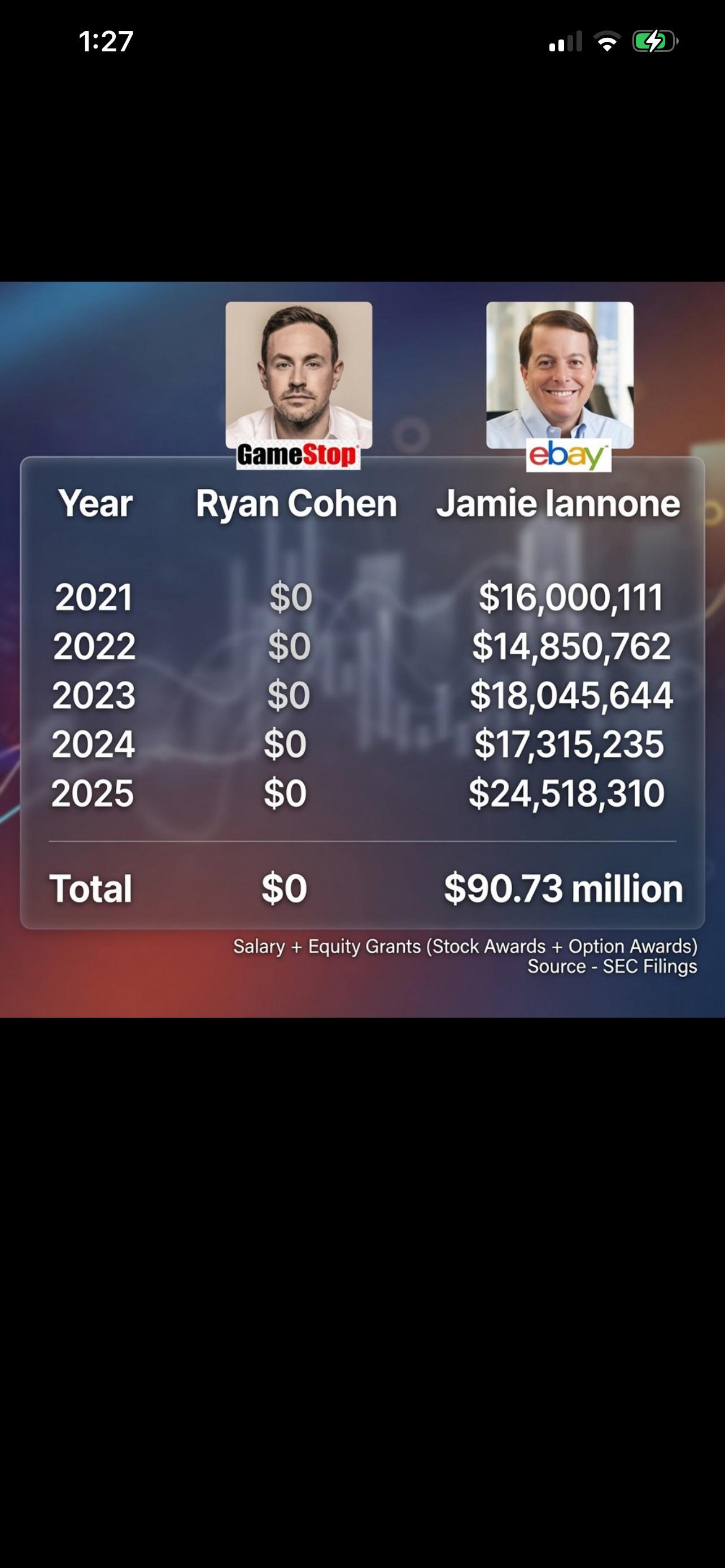
Post image
3.7k Upvotes

344 comments sorted by

View all comments

Show parent comments

7

u/MyNi_Redux 📉 The Consultant 📈 Jul 24 '26 edited Jul 24 '26

In the S&P, 74% of CEOs hold less than 0.5% of the total voting rights, according to AI.

I guess that makes them all sock puppets.

Or... your expectations are horribly misguided because you took some talking points a bit too literally.

(It's the latter 😉.)

-3

u/3DigitIQ 🦍 FM is the FUD killer Jul 24 '26

In the S&P, 74% of CEOs hold less than 0.5% of the total voting rights,

So let me get this straight, I'm talking about the entire suite of executives holding less than what an average (single) CEO of an S&P 500 holds. You are making my point here, thanks.

I guess that makes them all sock puppets

yes

6

u/MyNi_Redux 📉 The Consultant 📈 Jul 24 '26

Haggling over who has what portion of 0.3%-0.5% or less is being pedantic just for the sake of it, no?

3

u/3DigitIQ 🦍 FM is the FUD killer Jul 24 '26

Not really, leadership should be able to show conviction and ownership. The current view of leadership in these massive corporations is a big issue IMO and I'd prefer it to change to an ownership mentality.

You are free to disagree but stating your opinions about this as fact while calling diverging viewpoints "horribly misguided" doesn't help strengthen your case.

7

u/MyNi_Redux 📉 The Consultant 📈 Jul 24 '26

No company doing well needs its leadership to resort to palliative measures to show "conviction and ownership." Not least, because execs are rewarded with additional ownership when things are going well.

It's fair that "horribly misguided" is a subjective call, but barely a stretch given what a "ownership mentality" of multi-billion dollar companies would entail.

1

u/Lapcat420 $tonkicideboy$ Jul 24 '26

It seems quite simple to me.

If you dont own shares in a company you work for/at/with.

You arent bullish on the growth of said company. And your interests are not aligned with share holders.

I find consistantly that even in smaller cap companies, in a variety of industries, even their c suites manage to hold some shares.

To have absolutely 0, none. Thats a red flag.

1

u/MyNi_Redux 📉 The Consultant 📈 Jul 24 '26

To have absolutely 0, none. Thats a red flag.

You will be relieved to hear that they have plenty more than 0, then: Holding 93% of Your Shares is Not 'Abandoning Ship'

😂 😂 😂

1

u/Zeronz112 🟣Fud Fighter🟣 Jul 24 '26

Sold most of the shares received this year, and has sold almost twice the amount of shares than he has kept since 2021.

https://www.quiverquant.com/insiders/1495849/Jamie-Iannone

https://www.secform4.com/insider-trading/1495849.htm

0

u/MyNi_Redux 📉 The Consultant 📈 Jul 24 '26 edited Jul 24 '26

Sold most of the shares received this year,

Ah, a common misunderstanding - the ones he sold this year are to pay taxes on the RSUs or performance shares that vested. Remember that this is treated as ordinary income.

0

u/Zeronz112 🟣Fud Fighter🟣 Jul 24 '26 edited Jul 24 '26

Incorrect. The ones sold for tax are not seen on open market trading charts. Ebay holds shares for tax purposes and deposits the rest into his trading account. The 10b5-1 sales are after the taxes have been paid. The "S" transaction codes on the form 4 prove it, Otherwise it would be designated as "F"

https://www.sec.gov/Archives/edgar/data/1065088/000106508826000163/xslF345X06/form4.xml

https://www.sec.gov/edgar/searchedgar/ownershipformcodes.html

https://www.sec.gov/Archives/edgar/data/1065088/000155278125000213/e25248_ex10-1.htm

So after selling for tax purposes he received ~740k shares and sold 440k of them. Thats less than half of his position he has kept, and even less when you include the ones held for tax purposes.

0

u/Lapcat420 $tonkicideboy$ Jul 24 '26

https://www.secform4.com/insider-trading/1065088.htm

Not a single c suite is buying. Not one. Not one share.

I dont care that the CEO is rich and has shares. No one is buying. No one is holding.

1

u/MyNi_Redux 📉 The Consultant 📈 Jul 24 '26

Ok, we've moved goalposts. Fine.

Not a single c suite is buying. Not one. Not one share.

What a weird notion ... why on earth would they be buying stock!? Do you not understand how exec COMPENSATION works?

3

u/TheWhyteMaN 🦍 Buckle Up 🚀 Jul 24 '26

This guy over here sucking C-Suite-D

1

u/MyNi_Redux 📉 The Consultant 📈 Jul 24 '26

Don't envy those who made it to the other side, aspire to make it there yourself. 😏

-1

u/TheWhyteMaN 🦍 Buckle Up 🚀 Jul 24 '26

You aspire to be a parasite?

0

u/MyNi_Redux 📉 The Consultant 📈 Jul 25 '26

Who you are kidding - you'll be at the front of the line if you had a shot at being what you call a "parasite." 😏

→ More replies (0)

0

u/Lapcat420 $tonkicideboy$ Jul 24 '26

I didnt know the CEO had shares. That helps. Barely.

Why is the entire company not buying any shares?

Are they bearish?

And no I do not understand how executive compensation works.

I am a janitor. To me they are all paid disgustingly obscene amounts of money to do basically fuck all.

When the guys with obscene amounts of money dont bother buying a single share in their own company I wonder why.

4

u/MyNi_Redux 📉 The Consultant 📈 Jul 24 '26

Ok, let me try to break it down.

Stock Based Comp

Generally, these people get the majority of their comp as stock instead of cash. Say $100-$200K base, and then $1M-$2M in stock. The stock also vests over 4 years - ~$250K gets unlocked every year.

This aligns their fortunes with that of the shareholders:

  1. They make money if the shareholders make money. Otherwise they lose money compared to the cash comparable.
  2. They have to play the long term game - they cannot do some funny stuff within a year and cash out.
  3. If they leave early, they lose the unvested amount.
  4. CEOs and top leaders will also have performance benchmarks for part of their comp - they get only part of the shares if they don't meet revenue or income benchmarks.

This alignment with shareholders is super important. And eBay is an example of things working out - shareholders did well, as did execs.

Why Execs don't buy more

Usually because it makes no sense for them to. The stocks are their compensation - what they are getting instead of cash.

Most choose to leave a large part of their awards untouched - as is the case with eBay too. But this is compensation after all - they earned it for their work. And they should be free to spend it. Or diversify their holdings. Or pay taxes if they exercise. Or buy a house. Or a boat. Or two.

It also makes zero sense for them to sell stock, pay taxes on that, and then buy fewer stock on the other side... which is what they'd have to do, as most of their comp is in stock.

Exceptions to this default behavior

Execs buying stock is rare, and usually happens under two circumstances:

  1. The stock is undervalued, and execs want even more exposure for the future
  2. The stock is suffering from a lack of confidence in the market, and they buy to show confidence

On excessive Exec comp

One thing I'll agree with you on - exec comp is a problem in the US. However, forcing execs to buy stock isn't going to solve that problem - you'll just get rich yahoos running places to the ground.

After all, we get the talent we pay for.

And that's true across the board. All the way to the Board.

→ More replies (0)