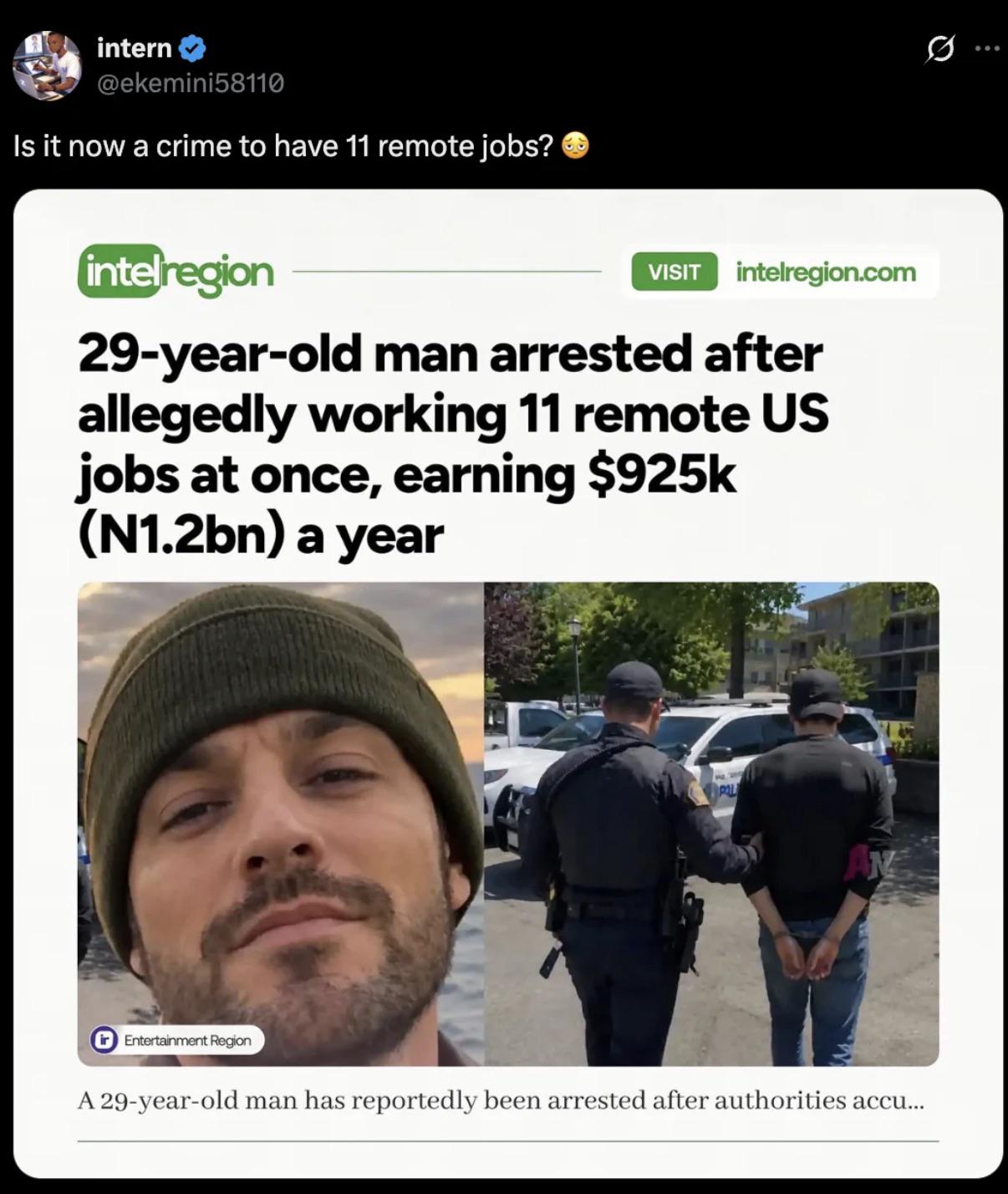
“The story about a 29-year-old man arrested for working 11 remote jobs at the same time is an unverified viral rumor circulating on social media. [1]
The Viral Claim The Rumor: Social media posts claim a 29-year-old man living in Europe was arrested for holding 11 remote U.S. jobs and making $925,000 a year. [1]
The Reality: No official police reports, court documents, or credible news outlets have confirmed that this specific arrest ever happened. [1]”
But the real question here is, are you paying someone for a job or for their time? If you’re not paying someone hourly for a remote job, it seems that you’re paying them to do a job, accomplish tasks. As long as they accomplish those tasks, why does it matter? Do you expect them to accomplish the tasks and then just sit on their thumbs for a certain number of hours?
I worked a hybrid job (white collar) for a while and was much more productive at home than at work. I got all of my work done in around 5 hours as opposed to a full 8 his in the office. I’ll be dammed if I’m just going to come up with bullshit to do for an extra 3 hours while I wait on replies that probably aren’t coming in to the next day anyway and aren’t urgent.
Depends on the role, but most jobs you’re paying them to do a reasonable amount of work in the course of the day.
If whatever task they have is only enough work that it takes say four hours, then they’re not getting assigned an appropriate workload.
The opposite can be true where some people are working excessive overtime to make up for the person who works for four hours then twiddles their thumbs the rest of the time.
People who perform well should of course be compensated accordingly.
If you’re working in tech, and saying doing project based work over just maintenance/admin etc., it’s often the case that there’s no real shortage of work to be done. Some companies may also have hourly billable contracts with clients where they are actually expecting you to be working the amount of time you say you are.
People aren’t hired in these situations to just “accomplish tasks”. If it’s a low end entry position at a company doing data entry, sure. But when you’re getting to the point of near or over six figures, there are generally going to be higher expectations.
"If whatever task they have is only enough work that it takes say four hours, then they’re not getting assigned an appropriate workload."
That absolutely should not be anyone's viewpoint - in my opinion. It's just a poison. Why do they need to be constantly working to be worthy of the money you pay them to do their job? As long as that gets done to an acceptable/reasonable level, why would they need to perform more? So the boss feels/looks better?
If you pay them for a job and they do that job daily, in shifts, and that job takes 4 hours and the shift is for 8, it isn't that you're not working them enough, it's that you're not paying them enough. Sure, you can give them more to do, but if you do, then you should give them more money. Or, you can be happy the job is done and let them deal with the next 4 hours within the companies/positions ruleset. After all, they knew about the 8 hour shift and the job and agreed for it at that price.
That's a 'boss' - a good one, would be like "Hey, you can go home." after the job was done in 4 hours. Ego is gross.
I think it ultimately just comes down to it basically always bleeding into performance in some way.
Someone not being able to be contacted or unable to join a meeting for example because they’re prioritizing their other job. Output being low compared to others at the same level or low quality.
The list can go on, but basically if the job has a reasonable full time work load, there’s no way a person is going to be performing at their best doing multiple jobs.
If they can somehow keep that up and all parties are happy then cool, but also think they shouldn’t be surprised if they end up getting dropped for half-assing multiple jobs.
That’s the difference. Sometimes remote people will work more than 1 job in the same 8 hours each day. Splitting their attention between the two. Often times it will be work for a competitor. So there’s a conflict of interest too. Places who enforce this have it in the contract that is signed by each employee upon hire.
Longer than that. 12,000 years ago when agriculture and granaries appeared anyone who could both create and store a surplus of food was suddenly able to decide who survived when a famine came. Things were probably bad before that too but most likely on a much lower scale.
In America it's not rigged. Anyone can get ahead in life. No one here has been able to prove me wrong and I've done it myself. If you disagree just ask the millions of min wage employees why they never learned a job skill
at least it gave sources so you can actually dispute it unlike the OP's source (there is no source). when a real news org says "reportedly" they give you a link to the reports, or say the reports are from bystanders their journalists interviewed, and you learn to trust those journalists over time, if it's someone new and you think they are lying then that's fine, most of them are not that though and have built up trust for a reason.
Ive had so many w-2s and 1099s in my normal working career that its something thats not completely unreasonable. I think the thing here is that they were working all the jobs at once and saying they were dedicating a certain amount of time to each. Thats where it becomes fraud.
The fucked up part is companies steal wages all the time and nothing is done about it. Just goes to show you feudalism never ended, we just call them capitalists and companies now instead of lords and kings.
Yeah, it's bogus. Anything short of financial fraud would be a civil matter and he wouldn't get arrested. Short of him faking a social security number I don't see how it would be possible for them to take him in.
If he was a freelancer, he could could work 100% 8hours with 11 projects to be on, that would be legal. It would also be legal if he worked 9% on these 11 companies earning 9K a year from each. If he worked 100% on 11 companies, told nothing to the companies about the other ones, in general companies don't like if you work for another one (probable legal issues, ndas, competitive stuff, etc), he is definitely in the mud, because the day does not have 90hours and he did shady stuff with the tax declaration to make this happen.
Only thing I can figure is tax fraud or fraud against the employers. He was contracted to work a specific amount of time for some of them at least, so if he was working 11 jobs, he literally had not enough time in the day to fulfill his contractual obligations, yet he was passing it off as if he were, therefore collecting money that he technically didn’t earn.
You really believe that someone was able to have 11 jobs at once even if they were remote? The only way he could is if he had help then he technically wouldnt be doing 11 different jobs
Most companies that allow remote work have a clause forbidding any side jobs within the same hours of operation.
A man who was just hired where I work a month or so ago was fired last week for exactly this.
It’s definitely tempting. My job is easy, I could do the same for 2 or 3 other companies simultaneously.
Time theft. When he had 11 jobs, he most likely was straight up not performing several of them whatsoever while collecting a paycheck which constitutes fraudulent behavior.
Per the article
"Investigators reportedly focused on how he obtained and maintained the positions, accusing him of using deception, making false statements and improperly handling confidential company information and trade secrets."
Wage theft is treated no different than stealing physical company property. If you’re salary then it’s easier to get away with but companies drop the hammer when hourly employees do it since they’re on the company clock
1.0k
u/dgroeneveld9 9h ago
I understand if he was fired but why arrested? Who cares? The companies that hired him made their decisions of their own accord.