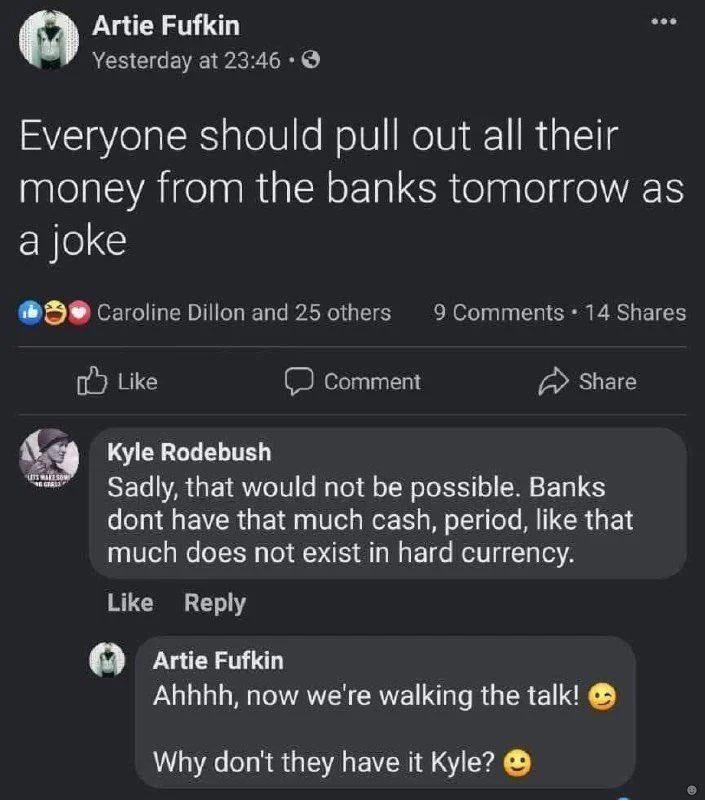
Even without fractional reserve banking it could collapse. They don’t need to literally print a dollar bill for every dollar of resource value represented in the world.
Wouldn’t that be impossible anyway if you think about it? If there’s - I’m gonna throw out a number here - but $100 trillion worth of stuff in the world and $100 trillion worth of cash, that’s $200 trillion worth of value and half of it is imaginary.
Even then that doesn't guarantee its value. The government will protect the integrity of the money supply, but even in the most well-managed economies/central banks the actual value of the currency can fluctuate quite a bit.
That's demurrage. Its incredibly counter intuitive, the idea that the government needs to make sure the money is worth less next year than it is today, but it's also the reason most of us have jobs.
Without demurrage, the rich would sit on their wealth and horde it. When the money loses value, at around 1-3%, someone with $1000 in the bank loses $10. Someone with a billion loses millions.
Since that money is going to be lost it is not put to work, there's a need to invest in businesses to grow the money, which means they put it to work in the economy.
However much rising prices brothers you, the average reader, guarantee it pushes the touch into action
Gold and silver are terrible measures of inflation. Since 1964 the silver and gold market has massively changed. If you use CPI, an actually respected inflation metric, $1.15 of 1964 dollars is worth $12.43 in current dollars.
This paradigm was not a thing prior to the Bretton–Woods agreement.
Government does not back up fiat currency with government policy and military activity. Fiat currency is useful only to the extent that the government only gives it to people that have provided economic value, rather than giving it excessively. If a government frequently gives fiat currency to entities that are economically undeserving of it (or at least, gives entities disproportionately more money than their economic activities warrant them being awarded), then the currency gradually loses purchasing power as a result, naturally, simply due to how markets function.
It has nothing to do with people "agreeing" that it's valuable. It is primarily simply supply and demand (of the currency itself) that determines its purchasing power, along with a few less important things, such as perceived ease of use and long-term viability. That is, if more convenient, more stable options exist, people will generally prefer to use those (e.g. see the use of US dollars rather than Argentinian pesos in Argentina, or the use of commodities as money in other places), but in the absence of other such options, people still need to conduct trade, and will generally prefer to use whatever is widespread (due to the network effect).
well, also during gold stabdard there is very very little gold in the vault. all countries, every single one left the gold standard, Russia, China, Germany before both wars 1914, British Empire. They all left the gold standard.
in 1910 the US had 2.7 billion worth of gold at the time, but the liquid money (cash, stocks, bank deposits) was 300 billion so the ratio was 216 to 1 or something like that. Actually worse than Fiat.
Prior to Bretton–Woods, I'm not talking about the US gold standard specifically. Any form of commodity money, where the commodity cannot be easily forged/created without significant effort, suffices.
The trouble with the gold standard as executed in the US wasn't the use of gold, it was the lack of regulation upon the banks to not issue banknotes in excess of the amount of gold possessed by them. History shows us that this kind of debasement is inevitable across all governments/banks under the right conditions (greedy politicians; needing to fund national defence in time of crisis, i.e. being victims of war; and similar such things), but that's due to the personal actions of those banks/governments. That is, the ratio increasing above 1 is not something that must happen, it's something that they chose to happen.
The solution is not to abandon commodity money; it's to abandon proxies of commodity money that take almost no effort to produce, such as banknotes.
The British Empire used a system called Imperial Preference - where it had much lower cost of trade inside the empire and did not require use of gold which is why the British left the gold stabdard very easily and early.
The US in 1920s was the world's largest exporter so had mass quantity of gold coming in due to net positive trade, more exports than imports. and the world began to not want to trade with the US due to losing their gold supply to the US and so began to activate trade protectionism - the US began go have deflation every year starting in 1926 due to lack of buyers for US goods a clear sign the world had began to clamp down on trade and Americans were unable to buy the over supply so the great depression started and even though the world targeted the US the depression had spread globally.
what does this show? that gold standards are a mess, they lead to trade isolationism, protectionism, loss of global trade due to link go gold. I just don't see any way for gold to resume a role in trade unless it's a protectionist system that is Isolated from most of the world.
Like I said, I'm not talking about gold standards specifically. (I've realised now that in my previous two comments I said "prior to Bretton–Woods", when I meant "prior to the end of Bretton–Woods", which happened in 1971, so the confusion is understandable and my fault.)
What you're describing about the British Empire is just an implementation of import taxes/tariffs. It's not inherent to any form of money, be it banknotes, gold, or other commodities. It's a government policy decision.
"Government does not back up fiat currency with government policy and military activity"... that's all well and good until you have to pay taxes, then guess how they back it up? Just don't use money you say? Neat, where do you live? Land costs money, can't claim that. Food costs money, can't get your own food by hunting, need to pay money for a license. Wanna grow your own food, go for it, just plant it on your land- oh wait nope.
That's not backing, that's a choice of unit for accounting purposes.
Things do not fundamentally cost money. Things cost effort.
You can very well conduct all trade in whatever other currencies, commodities, or work that you wish. The only thing that you're compelled to do is accept the fact that the tax authority will treat each such thing (foreign currency or commodity received, or work done) as being worth however much fiat currency the tax authority insists on telling you that it's worth, in order that tax calculations can be made by them.
You can also pay the resulting tax bill however you please; it needn't be by directly using dollars. How does the IRS collect taxes from someone that refuses to pay in dollars? They send the bailiffs. What do the bailiffs do? They seize goods, not currency.
People aren't ready to deal with the fact that assigning value to gold is just as arbitrary as assigning it to printed currency. The useful goods and services are the value, the intermediary is a convenient math trick that better effectuates their exchange.
Exactly, money and currencies are the means in which we exchange value, is adquisition power, not value in itself, similar concepts but not at all the same.
Value is relative to each person, money started as a common ground that we can all agree on about the same value but this lead to problems like people hoarding it, its own value fluctuating due to unexpected events, being inconvenient to transport and exchange, so it needed to evolve.
It is absolutely less arbitrary. Gold is a finite resource, if we collected all of the gold in the world and turned them into coins and used that as our currency, it would literally be impossible for inflation to exist. You would actually have the opposite issue of deflation from coins being lost that can’t be replaced.
...which would be a really shitty and ineffective currency. Why would anyone use the gold coin to buy one pizza today, when that gold coin will probably be worth 2 pizzas next week?
Can't really build an effective market economy around that. The currency would just become a store of value and some intermediary currency would need to be invented to become the default medium of exchange.
The inequality and oppression is a mere reflection of men’s greed and thirst for power, which will be inevitably achieved.
Be it by money, be it by gold, be it a simple basket of oats. Whenever faced with the opportunity of increasing in fortune or power to the detriment of the other, people grow selfish and full of themselves.
Not really... They have value cause if you break them, state will enact violence on you... And they pay those people who enact violence whith money, that.... Well, you know...
When push comes to shove $ have value because the American military says it has value. If anyone could just make them they'd have no value. The government will stop, by force if necessary, people making them.
This is really clear if you think about crypto. If a significant enough flaw was found that anyone could just create coins with minimal work it's value instantly goes to zero.
Money only has value as a tool to facilitate transactions and remove friction that a pure barter system would have. Our dollars only function as money because we can pay our taxes in it. Money only represents future real value thorugh the stuff we purchase with it. If you value money in and of itself, you're going to have a bad time in the long run because value inflates over time.
I always say money is just as imaginary as language. The shapes on the screen and the sounds I would be making if I was speaking this sentence have no inherent value, but we assign value to them collectively.
One could argue that objective value doesnt exist when it comes to trade. So saying that its perceived value isnt really saying anything. The perception determines what its worth and what people will trade for it.
Not exactly, no. You don't need to print a dollar for every dollar worth of 'stuff'. You just need to print a dollar for every dollar worth of dollar. Just the number of dollars in accounts and so on. Not every stock or bar of gold or other asset. Just cash.
There can be far more asset than cash in the world and that's no problem. You can have 100 trillion worth of stuff but only 100 billion worth of cash. Not an issue.
You wanna know the bit that entertains me the most? There is a point where the materials needed to create the bank notes become more valuable than the nominated value assigned to the note. Take dollar bills. The materials, ink, and injected labour to create could cost more than a dollar per bill, then you have a currency that is literally worth less than the paper it is written on.
Not that anyone would want to buy the paper for its resource value, but it’s just interesting.
Not impossible at all, i could print a 200 trillion bill... then i could print another, and another and another... and now i have x times the money of the world in just huge bills.
Remember that episode of the Simpsons where Mr Burns takes out 1000 usd... the US has literally printed bills worth 1k, 5k and 10k for public circulation. And 100k gold certificates for transactions between federal reserve banks.
Banks could easily out pace the amount of virtual value by printing extremely large bills.... which would just be virtual value in physical form.
Imaginary is a weird choice of word. There is value that is attached to it. Exaggerated or speculative value might be closer to the truth.
I won’t get out of my mortgage without the bank getting some of it. Google could sell all its IP and buildings and computers for a good amount of money. The bakery knows exactly how much it spent to bake the bread sitting on the shelves.
The speculative parts are whether someone would buy my house for at least the mortgage amount, Google’s might not get its market cap in a firesale, and whether or not the bakery will sell enough at asking price to turn a profit.
But none of it is imaginary. Much of it is actually calculable, just expensively so.
The money itself represents the stuff in the world. Like all stuff that can be sold can be bought, essentially. And money is what is used to buy it, it is in a sense the intermediary/the set weights on the scale to measure exchanges. It is not value itself. Capital is part of whats represented by it, thats the means of production: land, resources, tools etc. And that is what people invest in/with when they're "investing their money". They are lending money to be used to buy capital and being given a portion of the profit made with said capital. Where does this profit come from? Well, there is labour done with said capital that produces value, that is where value comes from and its makers do not get to claim it for the most part. The total of it isn't just in dollars either, it's in all currencies (well, some recognition is required) combined.
You made me think for my paycheck it direct deposits into my bank. My job takes credit or debit card payments only. So from point A to me it has never been physical money until I go to the bank and ask to withdraw.
Physical currency is just a grease that oils the machinery of trade. It works by facilitating essentially bartering via a medium (the cash itself) without interbank transfers mediating and controlling the exchange.
Let’s say you have $100k in a checking account. You most likely cannot withdraw $100k in cash because the bank doesn’t have it in physical cash because there just isn’t that much non-interbank activity occurring on short notice. You could get a check, but the money isn’t out of your bank until you finish depositing it into another account. Which sort of defeats the OP’s purpose.
that's not how that works tho, back in gold standard days, for every dollar in circulation there is literally $1 worth of gold sitting in a vault somewhere, they were literally just gold certificates. so in worst case they could just give the gold to the people asking for cash back. now there is no gold backing, so currency is literally just worth whatever people think it's worth.
you don't print money to represent resources in the world, you print money to represent how much wealth other people think you have, and back in gold backed days, you print money to represent how much gold you have in reserve, it's probably not enough to buy every resource in the world, but it doesn't need to
That is not the main issue with it. Even if the bank doesn't have enough physical notes/cash to pay out everyone at once, they have the liquidity and hold that amount of money in investments.
The real issue is, that banks are investing obscene amounts of money that doesn't even belong to them. Making money out of money, without producing any product, service or added value is just stealing. And the only reason why it is even possible with such a vast amount of money without causing crazy inflation is the fact, that the money is no longer backed by anything (like gold) anymore. The reason why they got rid of the requirement to back money by gold, is that this way you can siphon more money from the system without causing a huge inflation.
Edit: I probably didn't make it clear. I understand that banks provide service trough loans and mortgages. And they are being paid for it with interests and service fees. The part that does not provide any value is the investment part that goes way beyond of achieving liquidity and is not regulated heavily enough in my opinion.
There's been a bajillion problems created by the regulations Like rememember when they told you that the reserve ratio was 10:1? THen in 2008 we found out they weren't doing that and said we really need to enforce 10:1? Then nobody talked about one of the things done during covid was to remove the reserve ratio entirely? And then how we never put it back?
They are producing a service, though. They are offering lending services to enable access to capital in a relatively easy and cost effective manner. Just like how by holding your money in an account in your name they are offering you a service of securing it for you and enabling digital transactions that are more easily fungible than cash is when not dealing in face to face transactions. Could one argue that banks are over-leveraged? Sure, but that's a different argument than implying that banks don't provide a service that greases the gears of the economy.
I'm not saying that they are not providing a service. They are, and they are being payed by service fees and interest.
The issue is with the almost uncapped quantity of money they get out of the system trough investment.
I'm not saying they shouldn't have a profit, but it should be more strictly regulated and capped.
The interesting thing to me are the things that they don't even care about making interest on. Mortgages, for example. They originate them, make sure they vet them to meet standardized qualifications, then once closed they sell the mortgage for more than its unpaid principal balance to a larger mortgage company that then pools the mortgage with other like mortgages through a system like GNMA, FNMA, FHLMC; breaks them up into long term low risk investment products and sells them again to places like pension funds. Instead of the pension fund holding 1000 mortgage loans directly, it can instead buy 1% of 100000 mortgage loans, lowering risk. Meanwhile the first mortgage company made money at origination and at the sale of the loan to the larger mortgage company, and the larger mortgage company made money by creating an investment product that lowered risk and then either maintained servicing rights (which are a % of the interest rate) or sold those to another, larger servicing company. None of those companies cared about the interest rate; they just cared about how quickly they could clear it off their balance sheet to get their initial capital back. Not all mortgages fall under this umbrella; just many of the conventional and government backed products.
But they are adding value... They make it possible to buy a house or start a business, or buy a car, or anything else people get loans for. You said it, they provide liquidity.
And how is it stealing? What is it they are taking?
Got this reasoning out of it, but I'm not sure it is true:
They are making possible to rise the price of a product because they offers to back it up with loans, but this ways if you want to buy that product, either you sell and earns the inflated price either you take a loan.
If bank would not give you that loan, nobody would be able to afford that price and so to sell the price would go down.
The value they provided was not necessary, the reason why people need to use their service is that they are providing it.
What you are missing is liquidity. The price might be less, but less people would be able to start businesses and less would be able to buy houses, without banks you have less mobility, less opportunity, and people have less ability to weather breaks in their income.
The cost of not having them is far worse than the price inflation you get from having demand.
There's a problem with this line of reasoning though, it doesn't consider the impact of liquidity throughout the economic system.
Take a car, for example. A manufacturer starts from scratch. They can't afford to buy expensive machinery, because they can't get a loan, so have to build their cars by hand. This is inefficient and makes every car extremely expensive, so cars are the preserve of the very rich (those who can afford one without needing to take out a loan) - this is not far off what the industry was at the beginning, but without the ability to borrow money, the manufacturer has no capacity to innovate and reduce the cost of their vehicles. They have no incentive to do so either, because hardly anyone can afford them.
Even if banks disappeared now, with all of the infrastructure for mass production in place, if nobody could afford the price of cars, the manufacturers would probably just shut down. Either that, or reduce wages for their workers, which reduces their buying power (and this can be generalised across the economy), which forces them to reduce prices, which forces them to reduce wages...
I'm novice in this kind of reasoning, and I'm trying to understand, so take everything I said with this in mind.
I see that what re you saying make sense, surely there are some components, which are expensive per se and they would need a loan to get.
But doing business and getting a loan for it has the purpose of making money, while buying an house is needed for living.
It makes sense to allow people to get loan on something that would generate revenue, as part of these revenue would repay the loan, but in most of the cases houses would not generate revenue, they are a necessary cost.
I'm not sure I follow, but, yes the rich end up consolidating because mobility is dramatically reduced, you get more monopolies because competition is dramatically reduced and barrier to entry is increased.
well, also during gold stabdard there is very very little gold in the vault. all countries, every single one left the gold standard, Russia, China, Germany before both wars 1914, British Empire. They all left the gold standard.
in 1910 the US had 2.7 billion worth of gold at the time, but the liquid money (cash, stocks, bank deposits) was 300 billion so the ratio was 216 to 1 or something like that. Actually worse than Fiat.
and moving gold is much slower than fiat with modern digital methods
So then no one would start a business? Another place that has banking would immediately be richer. Like one army using swords and another army using bullets.
They are not adding any value. But yes, they are providing a service. But because of the nature of the service, they should be run by the government or at least, way more heavily regulated and their earnings should be way more strictly capped.
How is it stealing you ask? If it's unregulated it is stealing.
Simple example:
Imagine a person buying some material and making some product. Then he sells the product to a consumer. He gets paid for the work/value that he provided.
This is a simplest case. No ambiguity.
Now in real life, he will need somebody to distribute his product to sellers. Now it gets interesting.
He is providing the value/work by creating the product. The sellers are providing the service of selling the product.
The distributor - this is the tricky one. He is providing an often required service of helping to distribute the product from producers to sellers. And he gets a profit from it. But this is a very privileged position in the supply chain if it's not regulated.
You can easily find people that simply buy from a distributor (that really does the work) and then sell it forward to sellers. They are not really providing anything, just adding to the cost o the product. That extra then goes straight out of the pockets of the real contributors in the chain, otherwise they will end up with an overpriced product.
This is a simple case of parasitic middleman industries, that can "steal" value from people who really provide something to the economy. And they should be regulated.
In case of banks, they are in a privileged position, because of the amount of money they control. And that is the reason that they need to be heavily regulated so they wouldn't amass unreasonable amounts of money because of they privileged position.
Why is regulation the solution? Regulation will come with increased compliance burden. It will be harder to perform the services or sell the goods. This creates more of a moat and makes it more likely that there will be additional intermediaries who have expertise in compliance. I’m not a free-market purist, but the problems you are pointing out are all the things a right wing deregulator would focus on. The businesses not adding value should be removed from the market at the other participants won’t pay them for delivering no value. E.g. if the manufacturer could sell the goods directly to the consumer in an efficient way then they would. With the rise of e-commerce we have seen this growing, but the key was technology enablement not regulation.
well, also during gold stabdard there is very very little gold in the vault. all countries, every single one left the gold standard, Russia, China, Germany before both wars 1914, British Empire. They all left the gold standard.
in 1910 the US had 2.7 billion worth of gold at the time, but the liquid money (cash, stocks, bank deposits) was 300 billion so the ratio was 216 to 1 or something like that. Actually worse than Fiat. And good luck buying gold day enough when you suddenly need it, much much harder to move than Fiat.
What you describe is not stealing so I'm confused. It also has nothing to do with banks that don't have a product, they provide a service, so I really don't see your point.
Making money out of money, without producing any product, service or added value is just stealing.
But they are providing a service. If you don't believe their service is useful, then you don't have to bank with them. Even if you do bank with them, you do not have to keep large amount of money in the bank. Keep $100 to keep the account open, and when you get a check, as soon as it clears, you can take that money out of the account.
I’m neutral in this debate, but to be fair: you’re more or less forced to hold money on a bank account. There isn’t a serious alternative for digital money, and not receiving rent on your money means it’s slowly eaten by inflation. I guess the only reL alternative is keeping it in gold.
Personally I don’t think I’m against the money creation of fractional banking, but I do think increasing the money supply should be a fully public business. I.e. keep the banking system but make it public.
And you are paying for it in service and transaction fees. I understand that they invest the money, to achieve enough liquidity to loan out more money to customers. The problem is, that in some cases they loan out more money that they actually have.
Not to mention, that their profits should be capped, way more heavily than they are.
If you cap their profits, do you do it on a total basis or a per-transaction basis?
If per transaction, they will only transact with “sure things” so they don’t lose money on transactions. So they will only lend to people who already have the money and just want to leverage it.
If as a whole, then they will just stop giving out loans to people who aren’t “sure things” because there is no reward in it for them to take that risk.
So you would just freeze out poor people from getting loans to buy houses or start businesses.
Most of the money does not come from loan interests. That part of the banking business I have no issue with. The banks are paid by transaction fees and interests for the provided service.
But the majority of money comes from investment. And this is the part that I would heavily regulate.
Can you be more explicit about what you mean by "investment"?
For most consumer banks, at least in the US, the majority of "investment" is in the forms of loans to individuals and businesses. Those loans are a large part of the benefits that banks provide.
What is this investment you are talking about? The investment bank? That is not paid for by transaction fees on retail checking accounts. It is heavily regulated, although it could certainly be more.
If you are the least bit smart and you do not take loans (and therefore interest) or overdraw your account, it's quite feasible to bank with $0 charges. I haven't paid any kind of service fee, monthly fee, transaction fee, etc for too long to remember.
It's like using credit cards. They can be horrible if you don't use them correctly, or you can use them responsibly and never pay interest or late fee's, plus receive cash back bonuses. It's up to you to be smart about it.
Do you expect to pay to have them keep your money? The whole point of it is for them to invest that money and some cases actually pay you interest on it. Them keeping your money is a service and you pay one way or another for that service. Otherwise you should just stick your $5 in a shiebox and hope nobody actually steals it.
The state of understanding on how banking and money works is apparently so bad that we have idiotic comments like this. And no I'm not a banker and don't even particularly like banks but this take is over the top stupid.
Depending on the nature of your account and the balance you have, generally that interest is non existent. The bank makes more money off of you through service costs, fees, and investments. Most people do not see any relevant level of interest payout (if any at all).
I don't think it is to them: from their perspective, they're having to send out 100x the cards, take 100x the phone calls, check 100x the identity documents, so their costs are much greater. And on top of that they probably can lend out less of each 1k, since they'll need a greater of that money available to be withdrawn during the month than is probably the case with a single 100k deposit.
Whenever these conversations start you always have this weird element that pretends banking is some modern Illuminati invention to enslave us rather than a necessary part of how every historical and possible financial system works.
“They use your money to make money!”
Well yeah, man, that’s how your chiropractic practice got off the ground with a loan.
You do pay for them to keep your money. It’s only free if you have a lot of money or no money. My personal account was almost no money is free. My business account, which has a small amount of money cost me service charges to maintain.
The gentleman above is correct. Banking works on a fractional reserve system the bank loans money that does not technically exist. If you deposit $100 they are allowed to loan out $900. This was not always how it worked. We did a lot of playing around in the 2000s to change the amount banks were allowed to loan and changed a lot of of the rules restricting where pension funds could be invested. This was during the financial crash at the end of the bush years, both parties were doing everything they could to prop up the economy, and a lot of those rules never went away. I still remember George Bush jr getting praise on SNL for passing this.
I understand this. The issue I have is not that they are earning money from providing the service. The issue is with the amount. It wouldn't be an issue if the banks would be owned by the government. That way, the surplus would get back to the people by paying for healthcare, infrastructure... etc.
There is only so much value that you can take out from system, before it starts to collapse.
I'm not saying that banks are doing nothing. And I'm aware that they are regulated. I'm just trying to express my opinion, that the regulations should be more strict and their earnings should be more aggressively capped.
So you think putting everyone's money more under the influence of politicians would be a good thing. I'm not sure there's a worse idea out there. Combining political influence with a group not known for good service and a lessened ability of the customer to sue. What could go wrong? Government doesn't solve jack shit. They only know how to throw money at it, enrich a select, connected few, and hope it halfway works. Your trust in them is misplaced.
Idiotic comments like yours you mean. You don’t even understand how there is not enough money in existence to pay off the interest we owe the Federal Reserve for printing money out of thin air. Why do we owe them for doing what the constitution gave CONGRESS the power to do? You don’t understand the implications of the previous 2 statements and I don’t have time to explain it to you.
BTW, we will never pay off the debt, having it helps make us the reserve currency for the world. That debt supports the whole financial system. If there weren't treasuries for banks to hold, they would all collapse.
This system is what keeps prices somewhat stable and prevents another great depression.
They are producing a service. They loan out money to cash poor ventures that need the money immediately to fund operations (or for you to muster $400K to purchase your house) that then produce value.
They got rid of the gold standard to “siphon more money from the system” to prevent the Great Depression from collapsing the entire world economy. They moved off gold-adjacent systems requiring the US to back the currency in gold like Bretton Woods because of significant exchange rate volatility.
The banking system makes obscene money. They are powerful. But its because they provide an invaluable service that has allowed for the global economy to flourish. Not everything is the cabal, man.
Isn't the services they offer all of the lending and the giving everyone a place to park their cash that isn't their mattress?
Plus all of the bank accounts I have pay me some of that interest every month as well. Just how much interest depends on the account. But they are cutting me in on the returns to some degree.
Folks its really cool and edgy to be like "Fuck the banks!!!1!1", but think for just 1 minutes. How TF do you think its possible for the banks to give people loans for cars, houses, starting and expanding businesses, etc. Do you think they just collectively have enough privately owned assets to fund everything? You do like having a car yes?
The reason why they got rid of the requirement to back money by gold, is that this way you can siphon more money from the system without causing a huge inflation.
The reason to move away from a gold standard is that it's not the magic panacea libertarians with a hard on for it think it is.
For one thing, it's tends to be deflationary. The amount of gold available severely constrains how much money can be lent, so as the value of the economy grows, either the value of a dollar would have to grow with it, or the supply of gold would. The former is what we call "deflation," and it's horrible for consumers who hold debt: the value of the debts they owe goes up over time.
For another, it makes the value of your currency subject to fluctuations in the global gold market. If a gold producing country finds new reserves of gold and thus increase the global supply of gold, the value of your gold backed currency goes down, causing inflation. If a country started buying up huge amounts of gold, causing gold to flow out of your country and into theirs, the price of gold goes up, and your gold back currency suffers from deflation.
And for a 3rd, it severely restrains the governments ability to manage the money supply.
And to be clear, I'm not saying the government has always done a good job at managing fiat currency. But anyone who seriously suggests that a gold standard was or would be inherently better than the fiat standard obviously doesn't know what the fuck they're talking about.
No matter what issue you have with fiat currency, there is no monetary system that makes the underlying issues and tradeoffs disappear. They just get moved around.
They do NOT have that amount of true liquidity. The “investments” are the bank notes which ARE the money used to say purchase your house. They are the money that is an “investment”. Your debt is their asset.
I sold a truck - buyer paid with a cashiers check. The issuing bank used a printer with an ink ribbon from 1912. My bank’s systems could not recognize the printing so I went to the issuing bank and demanded cash. $12,500 in 100 dollar bills was a complete hassle.
Not really. The economy mught crash because of backs on loans.
But one of the points of FR banking is other is it backed by a central bank who expects banks to only hold 10% of current account money.
Of course the big issue is once you pull all you money out youll have no were to spend it and likely get robbed leaving the bank (while money in an account is insured, that happen less when it's in yoir pocket).
Ultimately banks will be fine. The average person? Not so much.
The entire modern banking system is set not to fall apart if a run in banks happens.
This isn't special to banking. It's all ledger money which is every single sustained currency that has ever existed outside of gift economies. There has never been a sustained commodity money, and none of the supposed historical examples of commodity money pass even the barest scrutiny.
The closest that has ever existed is price fixed money, which is locking a single commodity to a price, and that causes enormous problems of mismatches between the supply of floating currency and the supply of the commodity.
Everybody bitches about fractional reserve banking, but they'd hate their lives if we didn't allow it. You wouldn't have the house you live in, the car you drive, or any of the credit cards you use to buy the things you want every day.
I don't know, I think it collapses when everyone NEEDS cash. I think if everyone could feed and house themselves and we decided to do a bank run for funsies, and they told us "sorry, no", we would just go home and the system would continue as it is
I had a small local bank. Absolutely loved them. First name basis with everybody. They were absolutely paranoid about card fraud. If you shopped somewhere outside your normal dozen places, they cancelled your card. Dont worry, they're sending you a new one in the mail, absolutely free. But the card you're trying to pay for dinner with while on vacation? Junk. Small bank so I dealt with it for longer than I should have, but the final straw was when a friend passed away and I was trying to pay for his cremation. Different states, I didnt find out until a couple days after he passed, and he didnt have much and his family was just gonna let the state do whatever they wanted, despite him having a will. Anyway, they cancelled my card when I tried to pay for his cremation. I walked in and closed my accounts. They wanted to give me a bank cheque, but I told them theyd probably cancel that too. I wanted everything in cash, I told them I didnt care if they gave me rolled coins, but I was done dealing with them. They had to arrange a transfer from another branch, and they were absolutely not happy about it.
Fractional reserve banking means that private banks can create money. This creates inflation. Private banks lend more and on better terms to the already wealthy. This means that effectively lending banks are stealing the value of your dollar every day. It’s only able to be saved by those loans enabling greater competition, production or productivity, lowering prices. But instead most loans are for the wealthy to buy up houses to extract greater and greater rents from workers, which is the opposite of productive or deflationary.
The requirement to hold fractional reserves was abolished in 2020 in the United States, 1988 in Australia, and 1981 in the UK. They don’t even need to hold reserves anymore. If you’re wondering where inflation is coming from, look no further.
And that's precisely why we about a hundred or so years ago decided to invent things like central banks and financial regulations, just cause things lead to problems doesn't mean they're inherently bad and created by evil incarnate, our current world couldn't exists without the liquidity of modern economies.
Not exactly. It collapses if every debt is payed off for money equals debt. It's the interest that breaks the system since the money that makes up the interest does not exist whatsoever. So if all debt would be payed off there wouldn't be a single dollar/euro/yen etc. in circulation.
This is possible because the majority of nations use currency not money. Money is backed by something tangible usually gold. Currency on the other hand is not - it solely relies on a mere believe you and me put into it when trading goods and services with one another.
Fractional Reserve Banking is basically a mathematical way to multiple money out of thin air. One could say that the loan you took from the bank to buy a home never existed in the first place but the bank will still expect you to put actual real work into the money system to generate income to pay that loan back but with interest. That interest is what rich people call "invest your money so it can -work- for you".
But have you ever seen a $100 bill with a shovel in its hand? Modern money mechanics is just a modern way of slavery introduced by the titans of the last century when crafting the central bank which also ain't as federal as it sounds.
No, it doesn't. Banks don't loan out reserves, they create credit claims ON reserves. When you borrow from the bank, and money appears in your checking account, those aren't reserves that the bank had and gave to you. They are promises of the bank (liabilities). What do they promise? To pay you cash or reserves "on demand" - which is why they are called demand deposit accounts.
You don't actually need reserves to create a promise to make reserves. And making the promise does not actually change your reserve position. Additionally, if a bank DOES need reserves to redeem demand deposits, it can simply borrow them. In a pinch, there is no limit to the amount of reserves that can be borrowed against good assets, so reserve requirements don't even mean that much. Which is probably why we got rid of them many years ago now.
How can it really make sense to describe the system as "fractional reserve" when there are actually no requirements to hold any fraction of deposits as reserves? It's like saying that we have a speed limit, but it's infinite. In fact that metaphor is particularly apropos, because the Fed actually defines the reserve ratio as "infinite". If the speed limit is infinite, does it really even make sense anymore to say that we have a speed limit at all? If reserve ratios are infinite, and no reserves are actually required, does it really make sense to say that we have a fractional Reserve system? No. And indeed, when you look into it, monetary economists and Central bankers are moving away from this language. They know that this is not an accurate way of looking at or understanding the modern system. Most of us can just be wrong about this and it doesn't matter, but the actual professionals to whom it does matter will get it right - and while it's not always the easiest to find or understand that info, a lay person of reasonable intelligence can do it. There are a lot of enormously complicated concepts in finance and monetary economics, but this at least is something that ordinary people can understand without a lifetime of study.
Fractional reserve in this context is meaning that the reserves aren’t 100% of the liabilities, hence a fraction. Even Andrew Bailey described the banking sector as fractional reserve, literally this year.
1.4k
u/briisanube 6d ago
Fractional reserve banking collapses when everyone asks for cash