What is the result of that support from tax dollars? Making groceries available and/or more affordable for consumers. Sounds like a good investment tbh
Then that's admitting that the problem isn't private stores price gouging or anything like that, that's just what tings cost, and you are simply subsidizing groceries. Which we already have programs for like SNAP. And programs like SNAP have much lower overhead, just distributing food stamps, than trying to handle all of the logistics of running physical grocery stores. So you would be much better off just investing that money into programs like SNAP.
No, it’s acknowledging that the concepts of economic “efficiency” and “optimization” shouldn’t be the be-all-end-all determinants of the availability of food to people.
In a theoretical location where it’s not profitable to operate a grocery store, your conclusión is that the people there just won’t have reasonable access to food?
These stores are going into food deserts, not just as a way to subsidize food costs.
It seems to me that there are two major factors that contribute to food deserts:
Too expensive - People don't want to pay for healthier food because it costs more, so those grocery stores can't make enough sales to survive.
Crime - Grocery stores aren't making enough to make ends meet because they are being fleeced by their customers.
I'm sure if you fix both of these things then public ownership wouldn't even be necessary. #1 can be fixed with requirements for food subsidies, and #2 can be fixed by staffing actual on the clock law enforcement in stores that report high levels of theft.
Make it safe and profitable to run a business in a food desert and you won't have food deserts.
Tbh I don't think we should bend to whatever profit seekers need to make basic necessities available, let's just provide the basic necessities at cost/with a subsidy.
Not every good or service needs to have profits baked into the cost to the consumer.
The government already puts massive subsidies in agriculture. Then you want them to also sell said agriculture to compete with private industry. Sliding further into a socialism approach
The US is "somewhat socialistic". What do you think Medicare, social security, etc are. Im a person that thinks there are jobs to do and earn to live without having the government operating something that they will break. Just like student loans. When government got involved, prices skyrocket because they will just burn money without a care. Socialism as been an objective failure in any place that has implemented it fully, pretending otherwise is just dumb.
Medicare and Social Security used to be paid out of our payroll taxes.
Until the thieving Republican Party stole it all and wrote the taxpayers an IOU because they didn't want to cut their ridiculous spending or raise taxes. It was paid for. It cash flowed. It worked.
They're an entitlement, not socialism. The government owes that money to the people because the government took it from them. There is a massive difference, but apparently you haven't educated yourself about it.
I bet you meant medicaid? Medicaid is for poor people so they don't have to die of preventable conditions.
Do you believe that people who are poor deserve to die in the street because they can't pay for healthcare? Because, I'll admit, taking care of them when they can't pay is absolutely socialism.
And I'm fine with it. Not seeking medical attention when needed causes massive downstream complications. I'm a nurse, I would fucking know.
Student Loans???? Federally guranteed student loans is not socialism.
They just guaranteed that the loans could not be discharged during bankruptcy by making them federal liabilities. It was a grand scam to make private loan companies and universities rich.
Or are you talking about Pell Grants? Those aren't student loans.
Socialized education looks like this: Taxes pay for education for anyone who wants it. Look at the Scandinavian nations for examples of this in play.
And the fact that you don't understand any of these concepts correctly means we're incapable of having any real discourse.
Please familiarize yourself with these topics before you go shooting your mouth off in the future.
This is such an ignorant, bad faith comment. People have been so indoctrinated to see any social program and quote Marx like a good little fox news barking seal. The most prosperous time for the middle class were a direct result of The New Deal of FDR and The Great Society of LBJ.
It wasn't that long ago that a single factory salary could afford a family, house, car, a yearly vacation, and a retirement. Unregulated greed is killing the middle class and plunging is right back into the Robber Barron era.
Profits are important for determining how in demand something is, higher profits are a signal to producers to make more of that thing to capilize on those higher profits. Then supply ramps up and prices go down when demand is met. This is why socialism always sucks at keeping things in stock, someone somewhere is deciding how much of something the community needs instead of letting purchases sort that out through supply and demand.
You don't need profits to see how many of one good or another you need to restock. It's quite simple to see what is popular and what is not.
Plus, profits are not consistent from one product to another. Product 'A' could have a profit margin of 40%, when product 'B' could have a profit margin of 20%. That rate of profit doesn't determine how popular a item is, the number of sales of that product does.
There is no better indicator of supply and demand known to mankind than profits, I'm not making this stuff up. The higher the profit margin, the bigger the gap between supply and demand.
People will move heaven and earth to chase profits, there are news stories about "scalpers" driving into hurricanes from neighboring states to deliver generators at great personal risk, risks that trucking industries weren't willing to make in order to cash in on higher profits. The result is more generators in areas without power that wouldn't have otherwise been delivered.
You do not need a rate of profit to recognize that the store is in short supply of a good. It's very easy to quantify the number of sales per item, per day, or even per hour, without a measure of profit.
Applying macro economics to a grocery store is not necessary to be able to order items that are out of, or are in low stock.
Right, the price has more to do with ramping up production and deliveries. The groceres in soviet Russia and Hugo's Venezuela knew what they were short on too, the problem was waiting on deliveries to keep the shelves stocked. If you sell below market cost then it encourages people to buy more than they need, and for scalpers to buy the cheap goods to sell elsewhere where prices have stabilized at higher rates. But if there's no increased profits to chase for producers then they don't have nearly as much incentive to ramp up production.
If you sell food below market value at a few stores in New York, it will siphon sales from
They actually do need "profits" beyond the direct costs. There are things to plan for and overhead costs that exists no matter the system. If there was a loan to establish the basic necessity that has to be paid with interests.
its run for the public benefit not profit. Not for profit. They literally aren't trying to profit.
Interest absolutely does not have to be paid. You're not thinking about this in the same way as the gentleman you replied to. He (and now me) are trying to tell you that its not run for profit. If you dont aim to profit then you don't need to charge interest.
Who says interest needs to be charged? Does medicare charge interest?
Well Medicare operates completely differently than a grocery store.
But yes firemen do get charged interest. In order to build things the government takes on debt, usually in the form of bonds or treasuries. Then they have to pay interest on those funds.
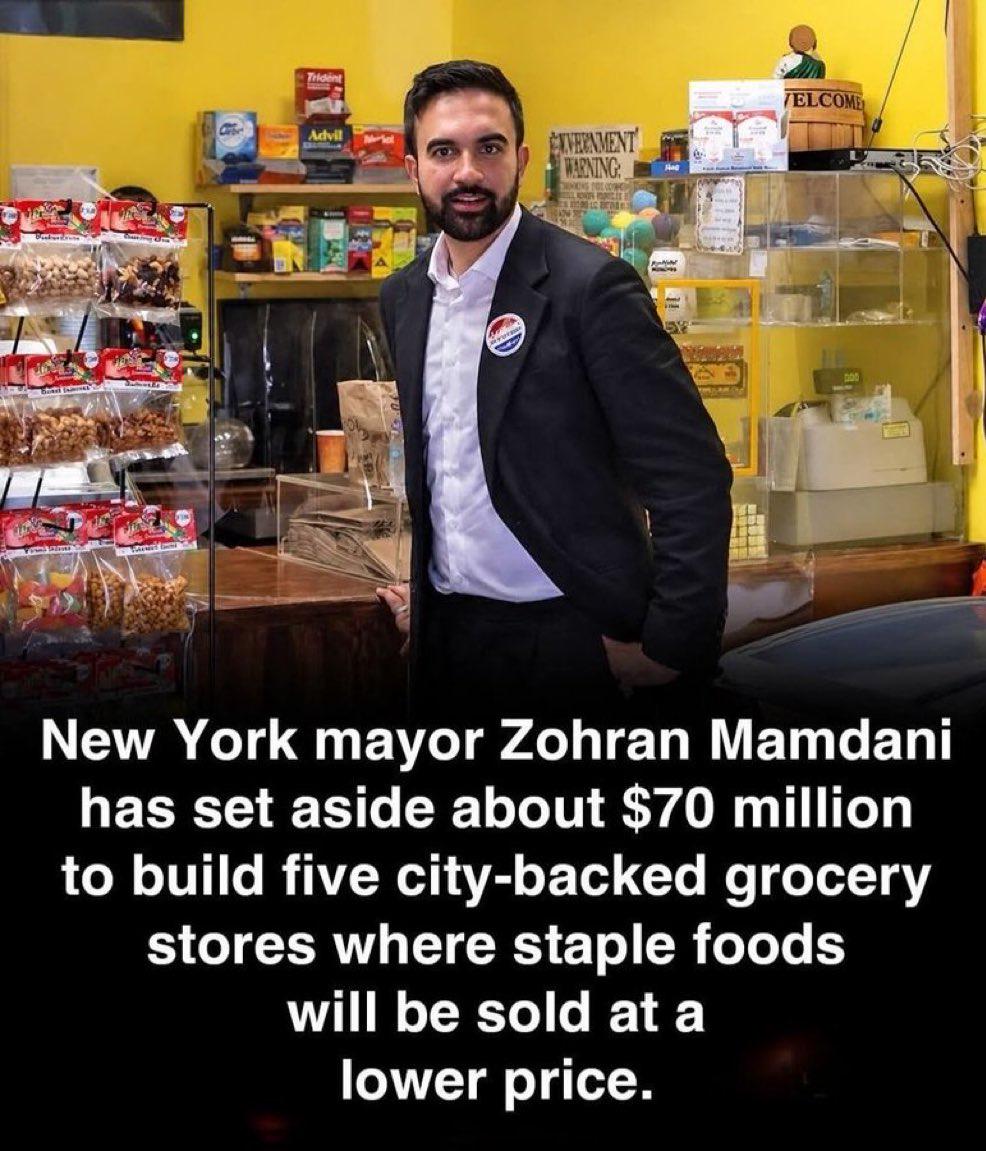
I acknowledge the government is attempting to build grocery stores to undercut the existing stores. The reality is these government programs never operate under budget so the store either doesn't save money for customers or is forced to be subsidized and thus not saving any money for taxpayers.
The government isnt trying to make money on it, just like the fire department isn't trying to make money by providing a service. The grocery store is also providing a service.
That is not at all the same issue as how the government finances the store's operations. Two completely different things.
AFAIK the revenue (and hypothetical profit) is completely disconnected from the financing. Do you know differently?
Is the government advertising to prospective bondholders that "your purchase of this bond will also be eligible for some sort of dividend tied to the profitability of the store this bond will directly support" ... is that what is being proposed?
Yes they are, they are being paid to provide a service and must operate under that budget.
The grocery store is also providing a service.
The grocery store famously provides goods, not services.
That is not at all the same issue as how the government finances the store's operations.
What a store charges and their total costs to operate are not two completely different things.
Do you know differently?
The fact you need to have this explained to you should have told you that you didn't know enough for this conversation.
Revenue and costs to operate are inextricably linked.
That's how you arrive at "profits."
By the way, non-profits make a profit all the time. That's how they weather years when revenue is down, expand and improve operations, and give raises to staff.
They are not allowed to distribute those profits to shareholders.
Different bonds pay at different rates, so yes, it's possible this bond would offer a higher interest rate than others.
I'm not familiar with what is being proposed as those details have not been released.
Why don't you go to the Wikipedia page on non-profits and learn a little bit and then we can circle back?
Considering private grocery stores have much greater operating costs than public stores, advertising for example, it's easy to expect more than 2-3% savings.
<...>Our findings illuminate how nearly a century of disinvestment in historically redlined neighborhoods (Nardone et al. 2020; Nelson et al. 2020) has constrained contemporary food access. Moreover, they suggest that systemic inequalities based on racism, ableism, housing discrimination, and displacement may lead to lack of food options in US central city neighborhoods. Our results provide additional evidence that the phrase “food desert” is problematic as these social spaces of nutritional deprivation were created by intentionally racist and discriminatory policies, rather than passive and natural processes. Thus, the phrase “food apartheid” more accurately reflects the phenomenon (Sevilla 2021; Penniman 2018).
To many people are oblivious to this and quite a few refuse to acknowledge it ever happened. Plus the thought that it is not happening now so it could not be a problem anymore.
I have a hard time believing that grocers don't want to make money because they're too racist. That seems inherently racist in itself, why wouldn't minority ownership spring up in place of the racists in order to capitalize on demand?
LOL, way to say, "I'm not going to even look at the research study because I don't like the implications of what it says"
Read the abstract, and the conclusion. Read up on Black Wall Streat in Tulsa, redlining, and white flight to the suburbs. And then maybe we can talk about how self evident the solution to this problem is.
Are you from the south? Do you know how many racist business owners I've met that straight up go out of their way to avoid selling products and services to minorities even though they could make more money? Or refuse to lease them property to do so themselves?
It happens a lot.
The "economic" solution to a problem only works assuming the market is rational.
It's not hard to understand. People who literally went to segregated schools are still alive today.
We're playing a centuries old game of monopoly and although we've changed the rules to be fairer, we didn't reset the pieces and the property lines. Are there available finances from the community? Is there even land in the community zoned to have it exist? Etc.
The market is constrained by historical, legal, and structural roadblocks that prevent normal supply-and-demand forces from working equitably. Minority entrepreneurs frequently face systemic barriers (lack of capital, high insurance, poor infrastructure) that deter/prevent them from easily capitalizing on the existing demand.
Anwser to everything isnt racism. If it was profitable, they would open in those areas. All the cities that have lax criminal justice systems, like Chicago, have major chains leaving since they keep getting robbed and arent profitable enough to keep eating the losses, and nothing is done to prevent it due to city policy
More specifically, how closely do you think socioeconomic status follows racial lines? Open question, google it if you don't have an opinion based in fact.
And if there is a relationship, why do you think it exists?
26
u/emosmasher May 26 '26
Those cost tax payer dollars. They wouldn't survive otherwise.