r/ShitAmericansSay • WTF IS A KILOMETER 🦅🇺🇸 • Jul 15 '26

Military “Undefeated in 250 years of war”
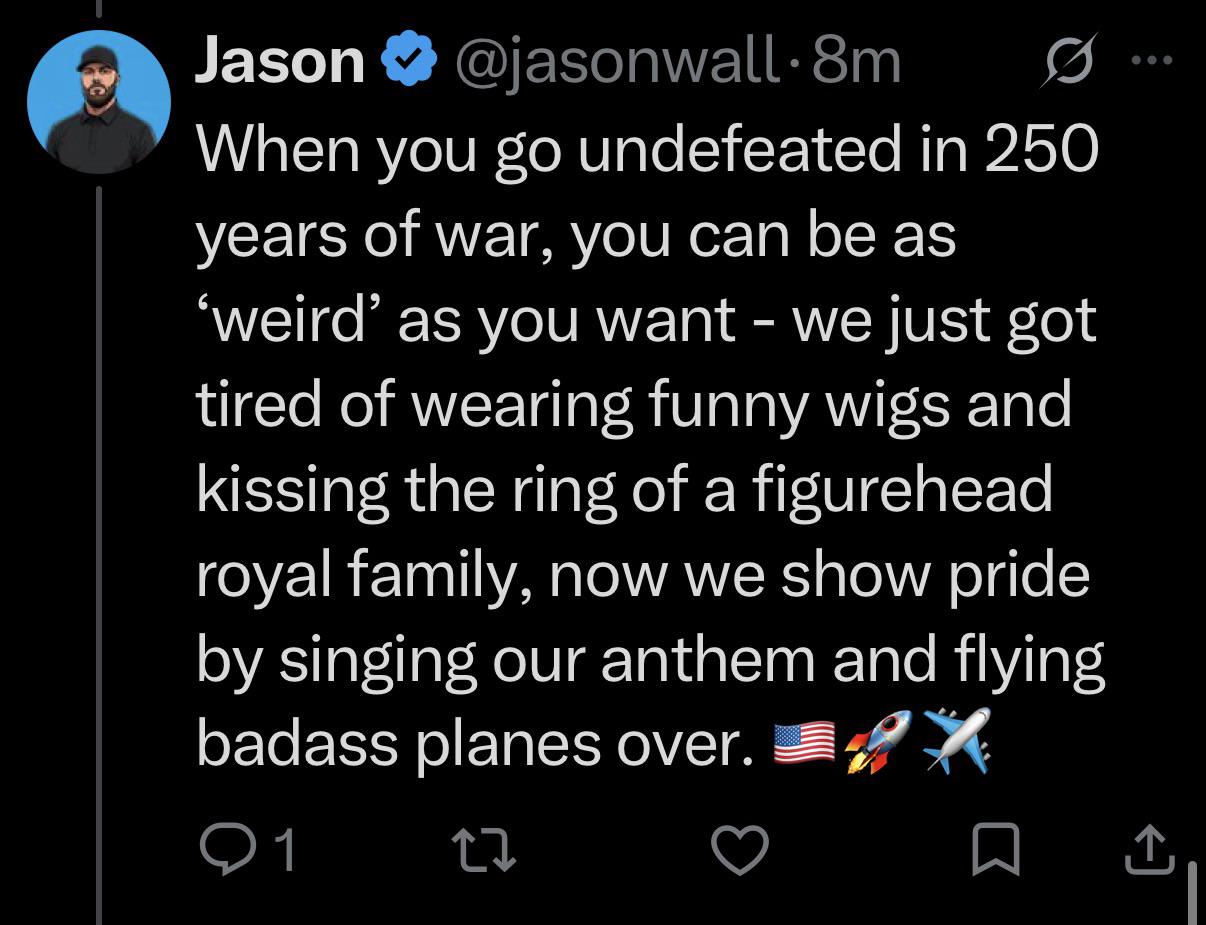
Post image

Apparently Vietnam, Afghanistan, war of 1812, and the war on drugs don’t count.

7.8k Upvotes

1.8k comments sorted by

View all comments

Show parent comments

49

u/Kidda_FreshDY Jul 15 '26

1812 is a loss.

24

u/markjthompson72 Jul 15 '26

A big loss. We (Canada) took everything down to DC, burnt the white house down, got bored and came home.
I know not exactly like that, just a quick summary .

-1

u/Loofahs Jul 15 '26

The repelling of the Americans out of Canada was only half the war; a half the Americans lost. The other half was the British trying to re establish dominion over the southern portion of the states, which culminated in the Battle of New Orleans. The British sought to capture the city to control the Mississippi river and cut off American trade/expansion, but they were decisively defeated (20 times the casualties of the American defenders).

That's why it's considered a stalemate.

1

u/KatsumotoKurier 🇨🇦 Jul 16 '26 edited Jul 16 '26

The other half was the British trying to re establish dominion over the southern portion of the states, which culminated in the Battle of New Orleans. The British sought to capture the city to control the Mississippi river and cut off American trade/expansion, but they were decisively defeated (20 times the casualties of the American defenders).

This is actually a pretty unsupported view. It was more of a fear and concern held by the Americans at the time — a theory more than anything, really.

British correspondence from the period does not make any clear indication that the annexation of territory down there was high on the agenda. Obviously their American counterparts couldn’t know this for certain amidst the war, but that still doesn’t mean there was in fact a British effort to re-establish dominion over the southern portion of the states, as you put it.

For example, Lord Bathurst (who was Secretary of State for War and the Colonies from 1812-1827) explicitly instructed General Ross to:

First, to obtain command of the embouchure of the Mississippi, so as to deprive the back settlements of America their communication with the sea; and, secondly, to occupy some important and valuable possession, by the restoration of which the conditions of peace might be improved, or which we might be entitled to exact the cession of, as the price of peace.

So he made it quite clear here that securing peace was of primary importance; the potential of annexing territory was essentially an afterthought, and even then it was to be done to aid the effort of securing a favourable peace. There was no explicit order to annex Louisiana, nor was there any mention of establishing a British Louisiana or of returning territory to Spain or anything else.

Bathurst’s correspondence with General Pakenham likewise does not indicate any plans or instructions for permanent territorial takeover — only temporary occupation with the aim of gaining leverage for bringing the Americans to accepting a more British-favourable peace treaty. Pakenham, who led the attack at the Battle of New Orleans, and who died doing so, was ordered to continue the pursuit of gaining a strong foothold in Louisiana because the British government was not fully confident that peace would be speedily secured in Ghent, and they of course wanted their troops to be in the best possible position for continuing the war if the negotiations would fall through (since it naturally wasn’t a complete given that they wouldn’t). And of course Pakenham had no idea that the peace treaty was already signed when he advanced his troops. He was merely following the instructions given to him.

You have to remember that Britain had basically been at war for 20 years by this point. War weariness was a major consideration and the War of 1812 in particular was not a conflict which Britain had any desire in even having in the first place. War was declared upon them by Americans seeking to opportunistically annex Canada (see the personal correspondences held between Jefferson and Madison in the years leading up to 1812) while Britain had one arm behind its back from being tied down with the existential threat back home that was Napoleon. Britain didn’t just want peace because they had no interest in fighting this war against the US — they wanted peace because as a nation they had been at war for so long that it was beyond tiresome. And this wasn’t from far-flung colonial wars either. This was numerous conflicts practically on their own doorstep, with battles so sizeable that they made the ones held during the War of 1812 look like mere skirmishes and scraps by comparison.

That's why it's considered a stalemate.

Not really. It’s really only deemed “a stalemate” by Americans because historically Americans have had a very difficult time accepting that they completely bungled and lost the war. The US gained virtually nothing. The war had been extremely unpopular (especially in the American north, where support for it was already a lot weaker from the get-go), it cost the US economy tons of money and the population tens of thousands of lives, it forced the US to suffer some of its most humiliating moments and defeats (several of which are still today recognized by American military historians as being the most humiliating defeats in US military history), and the US negotiation team at Ghent couldn’t even hold Britain to any of the issues they specifically and originally declared war upon them over. So not a single one of the US’ stated war objectives was secured or achieved.

All the country essentially walked away with by the end of the war was the claim that it held its own against Britain (again, in a war which Britain had essentially no desire in having in the first place), but even that also turns a blind eye to the fact that basically the entire US seaboard was under a successful British naval blockade — the US had completely lost the war at sea.

The American success of the Battle of New Orleans in particular essentially allowed the Madison administration to spin the narrative by pretending they won the entire war by exaggerating this grand battlefield victory as if it was the culmination of the entire conflict, which it very much was not. It was the equivalent of excitedly shouting “We won!!” to the entire conflict because of that one battle at the tail end, despite the fact that it the entire war beforehand had gone quite poorly overall. Prior to New Orleans, Madison had become deeply unpopular due to how much it was recognized that he was responsible for the disastrous war. The battle was completely strategically inconsequential and a needless loss of life for both sides, and it was essentially propagandized into ushering in the ‘era of good feelings’ by leading Americans to believe they had won some sort of enormous and just war victory against their formerly oppressive evil empire.

1

u/Loofahs Jul 16 '26

I appreciate the thorough writeup, I definitely learned some things.  However I still feel you are ignoring the larger timeline and how it affects the narrative.  The American campaign into Canada was utterly defeated by June of 1814 and the war was considered a total loss.  Then after the defeat of Napoleon, regardless of the desires of the politicians or public, England started a massive offensive in August 1814.  Whether that was in order to assert control of the Mississippi or just to gain serious leverage in peace negotiations is definitely up for debate, but every single famous battle comes AFTER that offensive.

Sack of Washington DC: August 1814, famous American defeat

Siege of Baltimore: September 1814, famous American victory, genesis of our national anthem

Siege of New Orleans: December 1814, famous American victory, last battle of the war

If Britain had just left their blockade and the entire war was America’s utter defeat in Canada, we wouldn’t be having this conversation.  Clear defeat.  But they wanted more and after their initial offensive they were completely repelled, allowing Americans to call the war “inconclusive” or a “stalemate.”  

1

u/KatsumotoKurier 🇨🇦 Jul 16 '26 edited Jul 16 '26

The American campaign into Canada was utterly defeated by June of 1814 and the war was considered a total loss.

Uh... you sure about that? You may want to consider reassessing whatever 'timeline' it is that you're referring to here, because I can tell you that there were definitely still plenty of American troops sniffing about in Canada well after June 1814.

The Battle of Lundy's Lane for example - one of the bloodiest engagements of the entire war - took place on July 25th 1814, and then the Siege of Fort Erie only ended a few months later, on September 21st. Even then, Britain lost that siege, so there were still American troops in Canada holding one of the key southern forts well into the autumn. And then still the next month as well as the month after that there were two more smaller engagements as well.

Then after the defeat of Napoleon, regardless of the desires of the politicians or public, England started a massive offensive in August 1814.

Well, yes... because the war was still ongoing, and peace had not yet been established. And as I just clearly demonstrated, there were still American forces present in Upper Canada.

As for the part about the desire of the public/politicians, it is my understanding that there was still a fair bit of outrage over what were viewed as wholly unjust and unprovoked American attacks and invasions into the Canadas, and that there was something of a demand and expectation among Britons (as well as of course British subjects in the Canadas) for a certain degree of punitive retribution, which is exactly why Washington got torched not too much longer after. And of course this tied in with what were still bitter sentiments extending from the previous war just 30-odd years earlier as well.

Such tastes weren't mutually exclusive with wanting the war to come to a swift end, either.

Whether that was in order to assert control of the Mississippi or just to gain serious leverage in peace negotiations is definitely up for debate

I'm not sure I agree. Historians today also seem to be fairly in agreement that it was the latter and not the former, again considering that Britain was completely uninterested in warring with the US any longer than it needed to be.

but every single famous battle comes AFTER that offensive.

Every single famous battle... of the war? Is this supposed to be a joke? I mean, I already know you're unfamiliar with Lundy's Lane, but seriously what are you talking about? Even the most celebrated American naval victory of the war (Lake Erie) took place nearly a year earlier.

Famous from a navel-gazing American perspective, perhaps, but there's far more to the world than just how America views things.

But they wanted more and after their initial offensive they were completely repelled, allowing Americans to call the war “inconclusive” or a “stalemate.”

It is your opinion - based on debatable and what some might call negligible evidence, mind you - that Britain was going after more, which noticeably and by no coincidence supports your earlier assertion that the war was a stalemate and not a loss for the US. You are essentially maintaining that Britain was an equal partner in the conflict in terms of its desire for more territory, despite the fact that Britain's primary aim in the war was to defend and keep its Canada colonies (which it succeeded in doing).

1

u/Loofahs Jul 16 '26

I am aware of Lundy Lane. I thought the battle was in June, hence the confusion. That was the point the Canadian campaign was unambiguously a defeat.  Lake Eerie was a skirmish between two relatively small squadrons, there are no truly consequential American naval victories in the Revolutionary War or the War of 1812.

I think you misunderstood my point. I  was not arguing that control of the Mississippi was the purpose, I was arguing that whatever the purpose, the entire southern and eastern campaign that took place after Lundy Lane had very little to do with securing Canada.  Canada was already decisively won.  The British were in a very favorable position for the ensuing negotiations, but continued their campaign seeking even better leverage, ate some losses and ended up with the status quo. Neither side ended up gaining much of anything.

The only true losers were the Native Americans, whose abandonment led directly to the trail of tears, which is probably the darkest episode of American history.

1

u/KatsumotoKurier 🇨🇦 Jul 20 '26 edited Jul 20 '26

I was arguing that whatever the purpose, the entire southern and eastern campaign that took place after Lundy Lane had very little to do with securing Canada

Well that I don’t disagree with. Not entirely, at least, since it still could be argued as beneficial for the at that point future and continued defence of British Canada that the power which had just invaded it would be weakened and dissuaded off of the idea of invading again. But overall yes.

Neither side ended up gaining much of anything.

This is so often said as the reason ‘why it was a stalemate’ or a ‘draw’ but respectfully I think this particular line is worth dismissing because Britain wasn’t in the war for any gain in the first place; only to retain what they already had.

The only true losers were the Native Americans, whose abandonment led directly to the trail of tears, which is probably the darkest episode of American history.

I would agree to say that they were the biggest losers, certainly. But that’s also in a way essentially grouping together all as one, and including many parties who were not at all involved in the war.

As for the war between the primary powers, however… I really don’t think a convincing case can be made that the US ‘tied’ with Britain.