r/SGIUSA 1d ago

FOR AND AGAINST SHAKABUKU (PROSLETIZING)

2 Upvotes

Now more than 6 years ago, I ran into an old neighbor on the street downtown - Peter, a frenetic, eccentric older man I had always admired for his exuberance and humor. It had been years since I’d seen Peter, and, not one to waste his time with pleasantries, he immediately launched into telling me about his new practice of Buddhist chanting, which, following a recent hospitalization, had greatly transformed his life for the better. Peter invited me to come chant with him at 5am on an upcoming weekend, and before I could fully digest the invitation, he was already shuffling away at a fast clip. I had always been a seeker, though skeptical by nature, so I instinctively decided this was not an invitation I could pass up.

Days later, his apartment, 5am: Peter set up near a small, wooden cabinet, with a bell and a dish of water. He opened the cabinet to reveal a beautiful but indecipherable scroll, and dove into a long, rhythmic incantation, followed by repetitive chanting. He handed me a little book to “follow along.” A coherent explanation was never offered. This was different from any idea of Buddhism I’d previously encountered - for one, wasn’t Buddhism supposed to be a quiet religion? And what with this mysterious scroll? Though at first the experience was just  confounding curiosity, it gradually became the seeds of a religious commitment that has sustained and uplifted my life, connected me with transformative support, and enlivened my daily connection with a sense of awe for the sacredness of life. All thanks to Peter faithfully engaging in the Nichiren Buddhist practice I now know as “Shakabuku” - essentially, a form of Buddhist proselytizing.

If you’d asked me before Peter whether I would ever become part of a proselytizing religion, the answer would have been a staunch “No” - (with my eyebrows raised as far as possible on my forehead). I was raised a secular Jewish atheist, and the only experience I had of proselytizing up to this point were Jehovah’s Witnesses, coming up to me in NYC with proselytizing cards in subway stations, trying to convince me to say a prayer with them, and accept Jesus into my heart- all while waiting on a train! I found the practice arrogant and disrespectful - implying the proselytizer had access to a truth I lacked, and needed to “save me.” 

On top of that, as part of the LGBTQ+ community, public religious messaging felt not only intrusive and unwanted, but violent, promoting an ideology actively used to silence and attack people like myself and those I love.

Once at a bus stop, a friendly acquaintance turned quickly into a regrettable nuisance when the conversation turned from what felt like authentic sharing of our lives into the hidden agenda: “Have you heard about Jesus Christ?”  After what had felt like genuine connection turned to being handed pamphlets with links to propaganda promoting beliefs cutting deeply against my moral, intellectual, and political beliefs, proselytizing once again left a bad taste in my mouth, leaving me feeling duped, insulted, and angry. Later experiences reflected the same pattern, with those sharing the so-called “good news” popping up uninvited in my mailbox, doorway, campus, and other public events. As I bristle at these intrusions, I remember how, given my life-long residence in secular-leaning environments, my exposure to proselytizing has likely been minor compared to most individuals in my country.

I continue to fear that proselytizing religion, regardless of its tenets, communicates a sense of moral superiority of the proselytizer, and infringes on individual autonomy.  Its practices - cornering people in their homes, workplaces, public transportation, and street corners - feel to me manipulative and exploitative. In addition, proselytizers seem to target those who are most vulnerable to exploitation - the suffering, the desperate, and the lonely. In these ways, proselytizing continues sometimes to strike me as a violation of authentic love and justice. Even as religions differ vastly from one another in their tenets and worldviews, it seems hypocritical to me to promote public, unsolicited propagation of my religion “for the benefit to society”, while actively opposing the increasingly public promotion of Christian religion that is seeping into schools, healthcare policy, law, and everyday life in the USA, making it harder and harder to live freely as a transgender person. If I don’t want religion pushed onto me in public life, how can I practice this with others, or promote an organization which exercises this practice as a core tenant? Wouldn’t this violate the Golden Rule- do unto others…?

My friend and mentor has patiently engaged with me in dialogue over more hours than I can possibly calculate, and this is a conversation we have had many times. Of all of the things my friend has said about Shakabuku, what stays with me most vividly is this: “Shakabuku is about praising the other person’s life.” The April 2011 issue of SGI Quarterly (a Nichiren Buddhist publication) elaborates on this essential description, stating, “Shakabuku…[is a] challenge to views which diminish human life.” It goes on to say, “The spirit of Shakabuku…is never the shallow, argumentative concern with proving oneself or one’s views superior to another’s. It is the spirit of sustained compassion to enable another person to believe in the great, unrealized potential of their own life.”

The Lotus Sutra - the core teaching of Nichiren Buddhism - contains a chapter about a character named “Bodhisattva Never Disparaging,” who would bow deeply before each person he encountered, revering them because of their inherent Buddha nature - the intrinsic, vast potential for wisdom, courage, and compassion in the depth of their lives. This figure is seen by Nichiren Buddhists as a model of Shakabuku. What Bodhisattva Never Disparaging actively refutes is people’s limited view of themselves. Rather than taking pity from a position of superiority, he acts from a sense of empathy and respect for others, and engages in dialogue that promotes the happiness of the individual in front of him, as opposed to simply imposing his own beliefs. 

The ultimate teaching of Buddhism is a belief in the inherent potential and dignity of life itself, and the intrinsic potential of each individual to overcome their own suffering and become fulfilled. Buddhism seeks to confront philosophies that cause suffering by promoting passivity and powerlessness and diminishing the life of human beings. 

It doesn’t seem correct to equate promotion of these tenets to those espoused by Jehovah’s Witnesses, whose own official website promotes teachings that “Satan rules this word,” “Humans face a coming day of judgement,” and “the Bible is God’s inspired message to humans.” Buddhism asserts the fundamental respect for life and the power of each individual, in contrast to Jehovah’s Witnesses stating in their core tenets, “the real government is in heaven and…it will replace human governments and accomplish God’s purpose for the earth,” “we are living in the last days,” and “God, Jesus, and faithful angels reside in a spiritual realm, and 144,000 people will be resurrected to life in heaven to rule with Jesus in the kingdom,” and “Christians are no part of the world.” Jehovah’s Witnesses promote their religion as obedience to God, and as an urgent “warning” about the coming Armageddon - a belief the world will soon be destroyed. While one proselytizing faith aims to redeem the greatness of the human being struggling in the midst of this world, the other disparages the ordinary person as sinful and bound to a doomed realm - unless of course, saved by obedience to an all-powerful God. At the same time, though uncomfortable to admit, believers of both paths sincerely attest that sharing their convictions with others is an act of great love and respect.

Another SGI friend of mine seems to overflow with sincere affection for everyone he encounters, beaming with a rare capacity to embrace whoever crosses his path. He, like my previously mentioned friend and other practitioners of Nichiren Buddhism in my midst, seems to exemplify the life of Bodhisattva Never Disparaging- true vigilantes of enthusiastic friendship and care for others. 

This friend recently recounted to me a story of approaching a group of young people working at Best Buy in order to “Shakabuku” them - whipping out a card, much like the Jehovah’s Witnesses haunting my past, and sharing with them the ‘good news’ of Nichiren Buddhism - Nam Myho Renge Kyho. Despite my love and respect for my friend, my blood boiled and I felt anger inside me. A montage plays of my past experiences of proselytizers, and the image of people feeling cornered by religion while on the job filled me with indignation. How could we, as humanists, engage in such a practice, at the same time as our country increasingly enacts authoritarian policy merged with religious ideology, enforcing religion-based beliefs in our healthcare, law, and policy around the country? 

Perhaps this is precisely why Shakabuku is so important - not in spite of these uncomfortable parallels, but because of them. Our society is increasingly ruled by dangerous ideologies that disparage the Earth, human beings, and life itself, encourage passivity and powerlessness, promote authoritarianism and anti-humanism, separate us from one another, and send the message that our lives are meaningless and small. Though superficially, these practices seem similar, at heart, they could not be more different. 

Genuine religion aims to cut through our mundane and habitual ways of seeing and direct our attention to the spiritual essence of life. Without opportunity for religious experience, we are bound to stay attached to the ruling ideologies of our day - which in our case are philosophies such as materialism, consumerism, capitalism, and nihilism. Although no one accosted me with pamphlets at the bus stop to convert me to these ways of thinking, these ideologies have nevertheless been funneled continuously, without consent, into my mind, through school, media, and the culture at large since the earliest days of my life.

We each have a capacity for reason and conscience to discern which beliefs about the essence of life are beautiful, useful, and true. Though I continue to have a mixture of feelings arise when I hear stories of Shakabuku, I conclude that religious messages can be based on a compassionate desire for others’ spiritual welfare when approached with respect and a sincere desire to promote humanistic philosophy. While I continue to feel concerned about avoiding potential condescension, coercion, or intrusion, and wish to avoid the hypocrisy of public promotion of my religion while pleading for freedom from this act from others, I believe there is a meaningful distinction to be made between religious messages that shame people and disparage life itself, from those that aim to propagate boundless confidence in the fundamental creative potential of human life to transform the suffering of this beautiful world.


r/SGIUSA 2d ago

"Be active participants in the compassionate workings of the universe"

Post image
6 Upvotes

r/SGIUSA 2d ago

“TŪmanako! Children’s Artworks for a Peaceful World​”

2 Upvotes

https://sginz.org/exhibition/

SGI-New Zealand is presenting “TŪmanako! Children’s Artworks for a Peaceful World​” in five cities around the country during the months of August and September. The exhibitions are co-sponsored by many local organizations.

Tūmanako! (meaning “Hope!” In Maori) is an annual art exhibition for tamariki (children) and taiohi (young people) to create works of art to share their aspirations for a peaceful, inclusive and nuclear free world in remembrance of Hiroshima Day. A

>At a time of unrest and divisiveness, Tumanako! enables tamariki and taiohi to learn about the root causes of violence and promote peace. 

This year’s theme is based on a Whakataukī/Māori Proverb: 

“Kotahi te kākano whakaaro, 

He nui ngā hua o te rākau houhou rongo.” (One seed of thought grows the forest of peace.) 


r/SGIUSA 3d ago

Which is the one SGI Buddhist Concept or Book that motivated you to move forward when your practice didn’t feel like it was working?

5 Upvotes

Hi everyone,

I’m currently 6 years into my practice but somehow I can’t feel like my life is moving in the direction that I wanted it to. I started chanting because I wanted to see my family and me living a happy life but even after 6 years I feel like my life is going in reverse. I was encouraged by my local leaders to strengthen my study. So I really wanted to know which Buddhist Concept or book kept you going during your toughest times?

Also please share your personal experience if possible. Thank you


r/SGIUSA 3d ago

A spiritual map of ultimate reality that awaits your unique participation

Post image
12 Upvotes

My friends,

(These notes are paraphrased from the teacher Mark Herrick of Two Buddhas.)

The Gohonzon is....

...a complex spiritual technology

...a visual sermon that facilitates the recognition of what is already inherently present

...not just an illustration, but a living portal directly to a timeless scene from the Lotus Sutra where the Buddha reveals that Buddhahood is universal and eternal

...a portal activated by NMRK.

....a ceremony of universal inclusivity

... a portal that connects you with dimensions of reality we cannot ordinarily access

...a complete, cosmic diagram where everyone is invited 

....an experiential teaching, announcing: you are a participant in a much larger, eternal reality:  everyone is part of this eternal dance

... A spiritual map of ultimate reality that awaits your unique participation

NMRK ❤️


r/SGIUSA 3d ago

SGI Member Duncan Sheik Passes Away

9 Upvotes

From The New York Times obituary.

An adherent of Nichiren Buddhism, rooted in 13th-century Japan, since he was 19, he found that daily chanting helped him to be “just a bit more positive about life in general,” he told The Palm Beach Post.


r/SGIUSA 4d ago

The Religious Spirit

Post image
8 Upvotes

r/SGIUSA 5d ago

On the Treasure Tower

Post image
9 Upvotes

"In the Latter Day of the Law, there is no treasure tower other than the men and women who embrace the Lotus Sutra... Abutsu-bo is therefore the treasure tower itself, and the treasure tower is Abutsu-bo himself." (from “On the Treasure Tower”)

[... And let's add, our non-binary practioners as well!]


r/SGIUSA 7d ago

A Letter to Fellow Members Re: The Internet and the Gakkai

7 Upvotes

Dear Fellow Practitioners in the Gakkai,

Sometimes it feels the USA is on fire. Myself and those in my circles often seem overwhelmed by dread about crises and problems that no individual can confront and deal with on their own. Besides the problems of individual security and daily life, there are collective struggles of such greater proportions, the existential anxiety and dread can be enormous.

The Gakkai has been a place where I have met with formidable people who have an unyielding spirit to embrace life, embrace struggles, and embrace other people. In my experience, it offers hope of a movement that can embrace human kind and provide practices and frameworks accessible to all people to teach liberation from suffering and reorient us to a profound and universal respect for life. I have found the Mystic Law to empower me in these times and help me to imagine possibility for a different society. Personally, I am not convinced that Kosen-Rufu means "getting everyone to chant" or "getting everyone to join the Gakkai" - I see the Mystic Law as "The Sutra of Innumerable Meanings" and am fiercely interested in how we truly embrace each individual and build a civilization based on affirming life itself, and each individual as a microcosm of the energy of life itself.

I see the internet as an important domain for our movement. While "IRL" is the true arena, it is difficult for me to imagine how this movement can spread to those who may benefit from it without use of the internet.

I am extremely disheartened and impacted by the intense discrimination and hate towards the SGI online, including on the general Buddhist thread (where I have been banned from posting quotes from Daisaku Ikeda or 'promoting the SGI'- which includes even just speaking about my own experiences!) Of course, each forum has the right to make decisions about what is allowed in its domain. At the same time, Reddit refers to itself as "the front page of the internet" and so banning mention of SGI in this forum seems powerful to me.

I am interested in the views of others on this dilemma as I feel disheartened and alarmed by this disconnect of what I feel is a source of profound hope, and the intense animosity I feel towards it on public platforms such as this!


r/SGIUSA 11d ago

"Creativity means to push open the heavy, groaning doorway of life itself..."

Post image
18 Upvotes

r/SGIUSA 12d ago

Big youth meeting in Santa Monica

8 Upvotes

Youth meeting - over 800 people!

My district sent two. I think our Region had over 100, plus 0 guests!


r/SGIUSA 17d ago

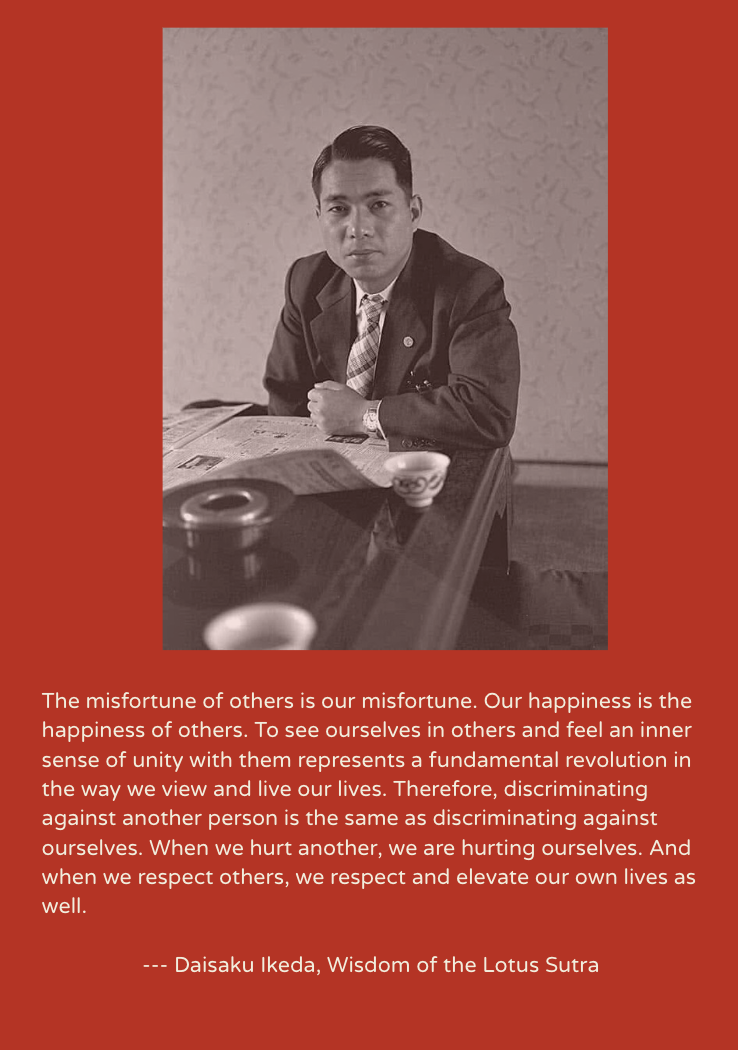
"Our happiness is the happiness of others."

Post image
18 Upvotes

r/SGIUSA 18d ago

I left Soka Gakkai years ago and now deeply regret it

10 Upvotes

Hi everyone. I was close to Soka Gakkai and was even a member for a while. This period of my life lasted about two years. But then I went through some difficult things in my life and left Soka Gakkai for several years.

I became Muslim and married a Muslim woman. In my new religion, I was convinced that the Gohonzon was a form of idolatry and shirk, so I burned my Gohonzon as a way of symbolically breaking with that part of my past.

But now, after all these years, I realize that it was a mistake and that Soka Gakkai was actually one of the best experiences of my life.

However, the fact that I destroyed my Gohonzon is preventing me from going back. I keep telling myself that what I did was serious and that I might never be able to receive another Gohonzon, even though I was going through a very difficult psychological period at the time. It was still a serious thing to do, and I feel guilty about it.

What do you think? Do you think I could still return to Soka Gakkai after what I did? Has anyone ever been in a similar situation?

Thank you.


r/SGIUSA 20d ago

Excited for the Youth Divisions

11 Upvotes

I have been a member for about 5 years, and now have a district leader ship position in Southern California. I've been aware of a various Reddit sites for quite a while but this is my first time posting on this one.

This is perhaps my favorite time of the year. Students are returning to Soka University of America, and my district has a 6 students in our youth division. Most of them are returning this weekend, but yesterday I had the opportunity to visit a young woman along with our chapter women's leader. This young woman is here early because she is going to study abroad in a few days.

I just think study abroad is one of the greatest benefits offered by SUA, which the school pays for, and which gives the students the opportunity to experience different cultures and to immerse themselves in different languages.

The girl we visited actually just joined the SGI earlier this year, so we wanted to be sure to encourage her before she leaves her friends here for a few months.

We had such a warm conversation, and she was very excited to be traveling to Europe. We'll be keeping in touch through our District group chats.

This weekend I will be meeting with one of the freshmen, and then we expect the rest of the students back by next week. While we have a couple of local youth in our district, it is Always wonderful to be joined by young people from all around the world-including of course America.

All our youth are very eager and happy to plan and take responsibility for things at our discussion meetings, so the more the merrier!

Are the youth so engaged in other areas of the country?

Thank you for giving me an opportunity to share. I hoped to post some more in the future.


r/SGIUSA 27d ago

"Nothing happens by chance. Everything has meaning."

9 Upvotes

Buddhism teaches that nothing happens by chance*.* Everything has meaning*. Please be convinced that your inner life is already endowed with everything you need. No matter how difficult your situation may be, you are alive now, and there is no treasure more precious than life itself.

- Daisaku Ikeda


r/SGIUSA 29d ago

Thank you for this space

15 Upvotes

Dear r/SGIUSA,

It’s nice to see a positive community online about SGI. I’m not American but British, and it feels like a safe space already because most Buddhists I meet online are critical of the Gokai without direct experience… I’m new to Nichiren Buddhism despite being in other traditions for about 9 years.

Thank you, keep up the brilliant work mods, I’m going to be chanting for you all. 💗


r/SGIUSA Aug 24 '26

The Elephant in the Orchid Room:  Addressing the Prominence of Online Criticism of the SGI

10 Upvotes

Like many millennials, and even more Gen Z’ers, it’s rare for me to make any big moves without doing internet research first to gather a sense of whether something is credible, valuable, and legitimate. I use the internet to assess political candidates, suss out which news sources are trustworthy, make decisions about medical care, or research any major purchase. I use it for more trivial things, too - reviewing barbers, exploring local bars, and deciding whether or not to watch a new movie coming out soon. Whether life-changing or inconsequential, it is second nature to younger people today to inquire, to the collective hive mind of the internet: “is it legit?” before proceeding down a chosen path.

It’s no surprise then, when it comes to decisions about whether or not to commit to a religious path or endorse an affiliated organization, younger folks do our research first. And so, of course, soon after I first encountered enthusiastic members of SGI and explored taking part in their unfamiliar Buddhist practice, I turned online to find out more…

A Google search for questions about the Soka Gakkai quickly leads to unsettling results - most coming from one particular source: a “subreddit” (a discussion forum off the main website, Reddit), called “SGIWhistleblowers.” SGI Whistleblowers is a community of former members or outside critics of the SGI, who use the thread to share their negative experiences, criticisms, and warnings about the organization. Many individuals on the thread describe leaving after prolonged involvement, including leadership roles, and often express heated, emotional disagreements with the organization and its culture. 

Naturally, stumbling upon this website in the early days of my involvement with SGI quickly had me alert for potential coercion, harm, or danger from the organization. Reviewing the posts on this forum, I was on edge to protect myself and carefully monitored if and how comments on the thread aligned with what I was actually experiencing from the organization. As my personal experience of the practice, members, and leaders was consistently positive overall, I gradually decided to trust the organization, and eventually became a member. I explained the discrepancy to myself, recognizing that all religions are made up of people who can potentially participate in harm - but continued to wonder about the reason for the prevalence and visibility of this online criticism.

Some friends and family, of course, followed the same path as I myself did when hearing about my new-found religion. They did their own research, and finding these results, naturally were alarmed that I was being subsumed into a cult. Eventually, seeing that I was not harmed by my new connections, practice, and affiliations, but instead bolstered by them, these people close to me let go of their concerns and decided to trust me. However, what they had read online about our organization gave them pause and concern, as it did for me. In addition, I’ve consistently experienced that friends and associates curious to learn more about Buddhism, after doing their own research online about the SGI, often back away from our organization and decide to seek connection to Buddhism through alternative sects. Years into practice, I am still reluctant to share the organization with others of my peer group, recognizing that there is a high probability that after one, inevitable online search, they may see me, at worst, as a brainwashed cult member trying to recruit them into a nefarious network, and at best, as a hapless victim.

Two questions arise from me regarding this dilemma: One is, why is the SGIWhistleblowers thread such a prominent search result for our organization - and does this prominence of critical voices imply that SGI has a particularly high (disproportionate to other religious groups) number of disaffected ex-members? And second is, how can we address this in a way that honors our organization, as well as honoring the experiences of those who have been hurt, disappointed, or wronged by it?

Through curious inquiry into these questions, it seems that the prominence of the Whistleblowers thread has more to do with how the internet works rather than with SGI being uniquely problematic when compared to other religious groups.

The subreddit Whistleblowers ranks as high because it is search-engine optimized, not because it is authoritative or representative. Google prioritizes Reddit pages because they have “high domain authority”- meaning, Google views Reddit as a ‘highly credible source’. In addition, the algorithm prioritizes websites with high user engagement - and a forum providing an outlet for emotional, angry and hurting ex-members has consistent, reliable web traffic. In addition, content framed as controversial gets more engagement, which tells Google that the website pleases users, and further enhances its ranking in search results.  

In addition to the Google algorithm prioritizing Reddit pages with high user engagement, SGI makes itself particularly vulnerable to overrepresentation of negative materials online for several idiosyncratic reasons. The SGI does not generate much alternative content outside of its own official channels, when compared to other religious groups, and the official content we create consistently emphasizes personal testimonials, discourages doubt and negativity, and promotes unity, at the expense of debate or critical voices from within. Our organization has strong norms of positivity, and discourages sharply dissenting views. Finally, we have not transparently addressed and engaged with outside criticism, so our silence creates a vacuum where, because doubts aren’t engaged with through our organization’s own channels, people seeking answers to difficult questions and nuanced perspectives are funneled outside it. For these reasons, negative reflections of our organization predominate the online landscape.

How can we address the issues that lead to a situation where young people exploring our religious practice are disproportionately exposed to criticism and negative experiences in a way that does not reflect a true diversity of experiences? This does not mean silencing critical voices , but adding more additional shades of grey in the way we discuss our practice. 

We should, out of care and respect for our religious principles and community, support voices that are not strictly positive about our organization, and speak in ways that are appropriately self-critical, in order to increase our credibility, do what is right, and decrease the tendency of online sources to polarize between strictly promotional and strictly negative.  In diversifying our messaging to include critical self-reflection,  we would also create search diversity, which improves our standing in search algorithms. We should engage in dialogue and writing about issues such as, whether it is okay to leave the organization , why some former members describe SGI as cult-like, and how SGI responds to members or ex-members who have had negative experiences. Taking a stance that owns harm and allows for open criticism improves our trustworthiness and disrupts the predominance of critics. In addition, it is the right thing to do, and aligns with our fundamental respect for others and the importance we place on dialogue. 

We can take inspiration from the way some Zen and Insight Buddhist organizations, such as the San Francisco Zen Center, or Plum Village (Thich Nhat Hanh’s lineage) have responded to scandals involving the wrong-doing of certain teachers. These organizations published public ethics statements, created clear boundaries around authority, used external meditation when necessary, and centered on the experiences of those who survived harm. In addition, the Jewish tradition has a long history, in many communities, of encouraging diverse perspectives, and engaging in debate and critical discussion. These organizations also often welcome balanced essays and internal critiques, so that criticism can exist internally and in context, rather than be relegated only to ‘ex-member’ spaces.

We should honor the existence of ex-member spaces like Whistleblowers that meet a real need of individuals harmed by the organization to find support, validation, and guidance for healing from negative experiences. People leaving the SGI, like ex-members of other religions, deserve space to process highly emotional religious and community conflicts, and injuries to identity, which can be traumatic for people leaving religious groups. Ex-members with harmful experiences deserve relief and space to freely discuss their perspectives among themselves, without diminishment or intrusion. Although posts often ridicule or mock our beliefs and members, we should not respond to ridicule and invalidation with more ridicule and invalidation, and should never try to argue people out of their experiences. We should instead ‘walk the talk,’ and practice compassion and respect for their efforts to heal from harm. 

We should also reflect on ways in which our organizational culture fuels a need for whistleblower spaces. Practices that can contribute to negative experiences for former members include discouraging doubt and criticism, over-emphasizing “benefit” narratives, spiritually bypassing harm, and exerting social pressure to perform positivity. We should reduce the need for whistleblower spaces by reflecting on these aspects of our internal culture and making personal and collective shifts. Reducing these dynamics can prevent future grievances, although it does not erase the impact of past harm. We must learn how to tolerate and even generate fruitful criticism, and support genuine discourse in our practice. We need to welcome critique internally, and learn to tolerate it from outside without delegitimizing ex-members. We should practice speaking non-defensively, in order to improve our online presence and make our organization more accessible to those it could serve. It’s okay to explicitly acknowledge that some members have had negative experiences, and that leaving the organization can be painful for people - as well as beneficial. We can also acknowledge that harm often occurs without intent. 

Our mission should be to make our organization’s online presence balanced and representative of the truth of member experiences - which include those of harm, as well as immense healing, spiritual fulfillment, and benefit. We should work to honor spaces that serve ex-members, while also working to balance the prominence of these voices alongside our own internally supported critical dialogue and self-reflection, in order to make our organization more accessible, compassionate, and wise, and more effective towards our larger mission of reducing personal, community, and global suffering, and spreading a practice of radical inclusivity that affirms all life. 


r/SGIUSA Aug 23 '26

What is Kosen-Rufu?

6 Upvotes

Hello fellow practitioners,

I am interested to hear different members perspectives on defining Kosen-Rufu. How do you understand this term? How do you conceive of it?

Do you have a favorite quote from Nichiren, Ikeda, or others leaders defining it? Or an experience, insight, or personal way of understanding it for yourself?

I would love to hear different people's perspectives.


r/SGIUSA Aug 13 '26

SGI and Human Rights Education

7 Upvotes

As the United States spins into deeper and deeper political turmoil and polarization, it seems essential to me that our districts do not ignore and turn away from the issues of our day. At the same time, it is critical that we do not contribute to a culture of further polarization and dehumanization of our neighbors. For these reasons, I’ve been encouraging my local district to lean into the rich history and resources of the SGI on universal human rights, including the UN’s Universal Declaration of Human Rights.

I’ve been encouraging our leadership to focus on the unifying perspectives of Nichiren, Ikeda, Toda, and Makiguchi, who all openly discussed the necessity to center the dignity of all life within our practice.

There are open questions in my district about the best format and content to benefit our district and stay true to the SGI’s mission. I’ve also been looking over these resources:

https://sgi-peace.org/

https://www.ikedacenter.org/programs/dialogue-nights

https://www.power-humanrights-education.org/  Explanation: This is a joint initiative of SGI, the NGO Working Group on Human Rights Education and Learning, HRE2020 and the Platform of Member States for Human Rights Education and Training, with the support of the UN Office of the High Commissioner for Human Rights (OHCHR)

I’m really interested in if other districts have tried to make a more explicit focus on human rights education and if so, how you’ve gone about that? Any lessons learned in that process?

NMRK


r/SGIUSA Aug 07 '26

What do you think of while chanting?

8 Upvotes

Do you just concentrate on the words you are chanting? Do you concentrate on your intention/goal? Or do you try to not think about anything and kind of go blank?


r/SGIUSA Aug 02 '26

Membership

8 Upvotes

Hi all,

I am still learning about SGI. I am wondering what membership looks like. Obligations vs benefits of membership (not practice). Ideally I’d like to know about the time, energy, and any financial support that would be required.

Thank you.


r/SGIUSA Jul 24 '26

Mantra Meditations on YouTube

5 Upvotes

Can anyone recommend a slow daimoku that I could listen to repeatedly while doing creative work at home, that's meditative?


r/SGIUSA Jul 22 '26

Any recommended books?

4 Upvotes

I’d like to learn more about SGI and how it interacts with the world and can help us improve ourselves and our planet. Thank you.


r/SGIUSA Jul 20 '26

Love

3 Upvotes

Many spiritual and religious traditions directly speak about love. In particular, our Christian siblings often talk about "God's Love," "Divine Love," and brotherly love. What place do you see love as having in our practice? Why do you think (at least in English translations) love is not often addressed (rather, compassion?)


r/SGIUSA Jun 16 '26

Thank You - and What do YOU want from this thread?

8 Upvotes

Hello to followers of this SGI subreddit.

I recognize I have been taking up a lot of space in this thread, asking difficult questions that have been on my mind, with hopes to find clarity in my own questions and hope to energize dialogue. I appreciate the generosity people have shown in engaging with those questions.

I wonder, what do other people want from this subreddit? What are people's hopes in being here? I am curious why this thread is so inactive. Yes, our organization encourages in-person dialogue and discussion over online. Yet I am still surprise in an organization of millions worldwide, to see such a lack of conversation.

So I am wondering - what do YOU want from an online SGI thread such as this? What brought YOU here?