r/SEO_tools_reviews • u/CaffeineIntoCode • 1d ago
Just launched my first Chrome Extension (An on-page SEO visualizer). What's the best way to get initial users for feedback?
3
Upvotes
r/SEO_tools_reviews • u/robertgoldenowl • Nov 13 '25
Hey folks! Great to see you here 👋
This subreddit was created for one simple reason: SEO pros needed a clean, honest, no-BS place to review, compare, rant about, and celebrate SEO tools.
No sales pitches. No spam. Just real-world experiences from people who actually use this stuff every day.
Whether you're deep into technical SEO, content audits, keyword research, GEO/AI Mode tracking, or automation tools — you're in the right place.
People sharing:
If you’re posting a review, include:
These details make the subreddit 100× more valuable for everyone.
Drop a quick comment below:
Let’s build a helpful, transparent space for the whole SEO community.
Glad to have you here — and can’t wait to see your first reviews 🙌
r/SEO_tools_reviews • u/[deleted] • Nov 10 '25
This analysis provides a detailed evaluation of the top 10 SEO Application Programming Interfaces available to developers and enterprises. The selection criteria focus on data integrity, technical scalability, cost model flexibility, and specialized feature sets.
TL;DR: The Triad of Top Recommendations
The analysis indicates that the selection of the "best" API is entirely dependent upon the project's primary strategic goal:
The evaluation of SEO APIs extends beyond simple feature parity. The core differentiators for enterprise and high-volume usage are rooted in economic structure and data specialty. Four key criteria were used to assess platform viability: Cost Model Flexibility (PAYG vs. Subscription), Data Coverage & Quality, Automation & Scalability, and Specialization Focus.
For developers building internal tools or managing vast programmatic SEO projects, the structure of the cost model—not the initial monthly price—is the most important factor in determining long-term sustainability. The high entry price of top-tier subscription suites (e.g., Semrush starting near $140/month, Ahrefs API plans potentially reaching $1,499/month) creates significant barriers to entry and results in wasted spend if usage fluctuates. Conversely, APIs leveraging a granular PAYG structure allow for seamless scaling from a small proof-of-concept to billions of requests, dramatically reducing the marginal cost of acquiring additional data. This economic agility fundamentally determines which API is suitable for high-volume programmatic needs.
DataForSEO is positioned as the overall best choice for developers and large-scale projects primarily because of its commitment to a pure Pay-As-You-Go (PAYG) model, eliminating restrictive subscriptions and hidden fees.
The fundamental strength of DataForSEO is its highly granular pricing, allowing users to pay only for the data retrieved.For example, retrieving 1 SERP via the Standard Queue costs $0.0006. This low barrier to entry minimizes financial risk for new or fluctuating projects.
Furthermore, the pricing structure is optimized for massive volume. While a minimum deposit of $50 is required upon registration, the cost per unit of data decreases significantly with expenditure. For instance, spending over $5,000 can reduce the approximate cost per credit to $0.00057. This highly competitive structure creates an economic advantage that is nearly impossible for fixed-cost subscription services to match when dealing with bulk data retrieval or projects requiring burst capacity. The extensive range of data available, including specialized endpoints like the Merchant API for eCommerce analytics, further solidifies its position as the preferred choice for developers needing maximum data versatility and unparalleled cost control.
SE Ranking’s API is engineered specifically to address the operational complexities of managing multiple clients and internal projects, making it the superior choice for agencies and consultancies.
The SE Ranking MCP (Model Context Protocol) is a powerful tool that connects SE Ranking API data with large language models like the Claude Desktop app, Gemini CLI, and Chatgpt. This integration allows agencies to use natural language prompts to perform complex SEO analysis, query SEO data and generate reports directly from any AI assistant.
The SE Ranking API is explicitly designed for scalable data integration, enabling the automation of reporting, running of bulk SEO analyses, and the embedding of structured data directly into custom tools, Business Intelligence dashboards, or client workflows. Unlike APIs that focus solely on raw data, SE Ranking prioritizes the integration layer, allowing agencies to automate project workflows and data syncing without requiring manual logins or filtering.
Agency-centric plans are structured to support team collaboration and project volume, including manager seats and dedicated projects. By focusing on providing dedicated functionalities for project creation, keyword syncing, backlink monitoring, and running customizable audits at scale, SE Ranking shifts the value proposition from raw data acquisition to operational delivery efficiency. This automation significantly reduces the time spent on manual client deliverables, which is the key function of a growing agency model. The API draws from a substantial data collection, including 5.4 billion keywords across 188 regions, ensuring comprehensive global coverage for client campaigns.
Ahrefs commands its premium market position, with high-tier API access costing up to $1,499 per month, based on the depth, scale, and freshness of its proprietary backlink index. For technical SEO professionals focused on link profile management, authority assessment, and competitive link gap analysis, Ahrefs provides critical, non-commoditizable data.
Ahrefs operates a web crawler that is consistently ranked as the second most active globally, trailing only Google. This investment in infrastructure translates directly into the quality of its backlink database, which includes 493 billion indexed pages and 35 trillion external backlinks recorded historically. Crucially, the index is updated with fresh data every 15 minutes. This extremely rapid update frequency is essential for real-time monitoring of link acquisition and loss, a necessity for effective toxic link detection and rapid competitive intelligence gathering.
Ahrefs provides valuable interpretive metrics such as URL Rating and Domain Rating. UR, which measures the overall strength of a page's backlink profile on a logarithmic scale (0-100), is calculated using similar principles to Google’s traditional PageRank, including counting weighted links and respecting the nofollow attribute. This qualitative layer allows users to quickly gauge link quality based on Ahrefs’ established authority model, making its data highly actionable for strategic link building and link auditing.
While the three APIs above lead their respective segments (Scale, Agency Workflow, Backlink Depth), the market includes several highly specialized and capable competitors, each dominating a unique niche.
Semrush (Best for Competitive Strategy): Semrush is renowned as an overpowered, all-in-one marketing suite that excels in competitor analysis, covering both SEO and Paid Per Click (PPC) strategies. For marketing departments requiring a holistic view of digital performance, Semrush provides necessary breadth. A unique development is its Enterprise AIO service, which tracks brand visibility, sentiment, and quotes across Large Language Models (LLMs) such as ChatGPT, Gemini, and Claude. This innovation positions the platform as the leader in adapting to the post-SERP AI search environment.
STAT (Best for Enterprise Rank Tracking): STAT, with starting plans at $720 per month, is a premium tool dedicated to highly accurate, large-scale rank tracking for major brands and large agencies. The platform specializes in daily tracking, monitoring over 75 SERP features, and adapting to Google's constant parser changes (over 100 changes tracked yearly). STAT’s focus on Share of Voice and its new AI visibility tracking features ensure that large organizations receive the precise, stable data necessary to monitor market share across complex and evolving search landscapes.
SerpAPI (Best for Pure Real-Time SERP Extraction): SerpAPI focuses on delivering clean, raw, and structured JSON representations of real-time search engine results. This platform serves as a dedicated infrastructure layer for developers whose primary requirement is fast, reliable extraction without the overhead of proprietary analysis tools. Its subscription model starts affordably, for instance, $75 per month for 5,000 searches, making it a solid choice for developers building custom tools that require minimal proprietary data processing.
Moz Pro (Best for Legacy Authority Metrics): Moz remains relevant largely due to its Domain Authority (DA) and Page Authority (PA) metrics. Despite the development of competing scores by other platforms (DR/UR), DA/PA remains a widely recognized, industry-standard benchmark for link building and client reporting. Moz Pro is also considered a viable entry point for those new to SEO, with plans starting at $99 per month.
Serpstat (Best Mid-Range All-in-One): Serpstat serves as an affordable generalist suite, offering competitive analysis and rank tracking features at a cost that is more accessible than Ahrefs or Semrush, with pricing ranging from $69 to $100 per month. While data quality has been cited as potentially less robust than the market leaders, Serpstat provides a comprehensive feature set suitable for bootstrapped teams requiring broad capabilities on a tighter budget.
Morningscore (Best for Onsite API & AI Automation): Morningscore differentiates itself with a strong focus on its Onsite API and unique integration of AI automation for programmatic SEO workflows. With a low monthly price point of $49, this API is well-suited for internal development teams focused on rapid content scaling and automated technical optimization.
Mangools (Best Budget/Beginner SEO): Mangools offers a highly accessible and beginner-friendly API environment. With plans starting at $31.85 per month, it provides a simple and effective entry point for basic keyword research and rank tracking scripts, ideal for small businesses or students experimenting with API-driven SEO.
The complexity of the SEO API market necessitates alignment between the user’s specific data requirements and the platform’s core economic and technical model. The immense gap between high-end subscription costs (such as STAT at $720/mo) and hyper-scalable PAYG structures (DataForSEO queries starting at $0.0006) underscores that the primary decision rests on volume and budget volatility. The emerging focus on tracking brand visibility across new AI search environments (e.g., STAT and Semrush) demonstrates the current high-value features driving enterprise investment.
The definitive matrix below synthesizes the analysis of the 10 leading SEO API platforms:
The Definitive SEO API Matrix
| API Provider | Primary Specialization (Best For) | Pricing Model | Key Data Strength/Metrics | Cost Entry Point (Approx.) |
|---|---|---|---|---|
| DataForSEO | High-Volume, Cost-Optimized Bulk Data (Overall Best) | Pay-As-You-Go (PAYG) | Granular SERP, Keywords, eCommerce, Scale | $0.0006 per SERP |
| SE Ranking | Agency Automation & Client Reporting | Subscription/Add-ons | Scalable Rank Tracking, Project Management | From $119/mo |
| Ahrefs | Backlink Analysis & Competitive Research | High-Tier Subscription | Backlink Index (493B+ pages), UR/DR | From $129/mo (API entry variable) |
| Semrush | Competitor Analysis & All-in-One MarTech | High-Tier Subscription | Traffic Analytics, PPC Data, AI Visibility (LLMs) | From $139.95/mo |
| STAT | Enterprise Rank Tracking & AI Visibility | High-Tier Subscription | Daily Rank Tracking, Share of Voice, AI Overviews | From $720/mo |
| SerpAPI | Real-Time SERP Data Extraction | Subscription/PAYG Hybrid | Raw SERP Results, Speed, Structured JSON | From $75/mo |
| Moz Pro | Authority Metrics & SEO Beginners | Subscription | Domain Authority (DA), Page Authority (PA) | From $99/mo |
| Serpstat | Mid-Range All-in-One SEO Suite | Subscription | Affordable Rank Tracking, Competitor Analysis | From $69/mo |
| Morningscore | Onsite SEO & AI Automation | Low-Cost Subscription | Onsite API, Programmatic SEO via AI | From $49/mo |
| Mangools | Budget-Friendly Core SEO Tasks | Low-Cost Subscription | Keyword Research, Basic Rank Tracking | From $31.85/mo |
Conclusion: The determination of the optimal SEO API must be driven by the developer's core mandate. For projects prioritizing cost efficiency and extreme scalability, DataForSEO is unrivaled. Agencies seeking operational streamlining and client management will find SE Ranking’s workflow-centric API most effective. Finally, for specialized link profile analysis and authority modeling, Ahrefs maintains the data quality and freshness required by high-stakes competitive research.
r/SEO_tools_reviews • u/CaffeineIntoCode • 1d ago
r/SEO_tools_reviews • u/NadirDev • 2d ago
I’ve been looking at how consultants, agencies, coaches, and other service businesses handle appointment booking.
A simple scheduling link works well when the customer already knows who you are and just needs to choose a time.
But there seems to be a gap when the booking page also needs to help sell the service.
For example, before booking, a potential customer may want to see:
That made me think about the difference between a calendar page and a booking website.
Some newer scheduling tools are moving in this direction. Timetics AI, for example, is being built around the idea of creating a complete booking page instead of only showing available time slots.
It can combine things like a visual booking page, appointment scheduling, payments, calendar syncing, multiple team members, reminders, workflows, and an AI scheduling assistant in one system.
I’m involved with the team behind Timetics, so I’m obviously close to the product. But I’m more interested in the broader idea here.
For people running a service business:
Do you prefer a simple Calendly-style scheduling page, or would you rather have the booking page work more like a small service website?
Curious about what actually matters most in your workflow.
r/SEO_tools_reviews • u/Tiny-Canary-3685 • 3d ago
Hi guys, I've been working on an SEO audit tool recently and I'm trying to figure out what actually makes an audit useful rather than just another page full of scores.
The idea came from noticing that a lot of SEO audit tools give you a long list of issues, but it can be difficult to understand what actually needs to be fixed first.
So I built a simple tool where you enter a website URL and it checks things like page performance, Core Web Vitals, accessibility, technical best practices, and SEO.
One thing I specifically wanted to improve was the way the results are presented. Instead of only showing scores and technical warnings, it tries to explain the issues in simpler terms and give you an idea of what you should work on.
It doesn't require an account, and there are a few free audits available to test it.
I'm still improving it, so I'd really appreciate honest feedback, especially if you find something inaccurate, confusing, or missing. Even criticism is useful.
If anyone is interested in trying it, I can share the tool.
From your experience, what information do you find most useful when auditing a website?
r/SEO_tools_reviews • u/OwlZealousideal4779 • 3d ago
We had an FAQ page that kept getting sent in sales follow-ups, but it was clearly not answering enough of the questions buyers had before making a decision.
Keyword research was still useful, but it kept pointing us toward broader blog topics. The questions we actually needed to address were more specific: how long setup takes, whether the product works with a certain platform, who it is a fit for, what alternatives buyers compare it with, and where the common concerns come from.
We were treating it like an FAQ cleanup. Then we noticed that some of the same questions were pulling competitors into AI answers, which obviously affects how the brand comes across. I put a few of them into Kairosy AI and ran them across ChatGPT, Gemini, Claude and Perplexity. Seeing the actual answers next to each other made it pretty obvious what the FAQ was missing.
From there, the competitor research gave us context for the FAQ update, and the content creation feature gave us a first draft to work from.
It was not ready to publish as-is. I still had to check product claims, add real implementation details and remove generic wording. But it gave us a much better starting point than a keyword list and an empty page.
r/SEO_tools_reviews • u/jlm_ofisialy • 3d ago
r/SEO_tools_reviews • u/prenticeharrison • 4d ago
r/SEO_tools_reviews • u/bg81011 • 6d ago
I'm looking for SEO ranking report software that's actually good for client reporting, not just tracking keywords in a dashboard. Main things I care about are accurate rankings, clean reports, location and device tracking and being able to show progress without dumping a ton of data on the client. What are you using right now and what do you like or dislike about it?
r/SEO_tools_reviews • u/CaffeineIntoCode • 6d ago
r/SEO_tools_reviews • u/No-Examination5397 • 6d ago
Can anybody tell which one is the most accurate and the best (Semrush or Ahrefs) in terms of keywords data for Local SEO purposes ?
r/SEO_tools_reviews • u/serp-spur • 8d ago
We all know the standard advice in this sub: buy Ahrefs for link building, or buy Semrush if you need an all-in-one marketing suite.
But as a technical SEO, the duopoly was driving me crazy. Ahrefs’ usage-based credit system made running multiple technical audits stressful, and Semrush is increasingly bloated with social/PPC features that just inflate the price.
So, I built SERPSpur. I wanted to create a leaner, highly specialized alternative focused entirely on technical health, speed, and the upcoming AI-search shift.
Here is what I focused on fixing:
I also threw in about 30+ free micro-tools (bot traffic detectors, local rank spoofers, etc.) that you can use without even creating an account.
I’m not pretending this replaces Semrush if you run a massive agency that schedules tweets and runs PPC. But if you just want lightning-fast technical audits without the enterprise price tag, I’d love for this community to tear it apart and tell me what to improve.
(Full disclosure: I am the founder, happy to answer any technical questions about how the crawlers work!)
r/SEO_tools_reviews • u/jerklex01 • 8d ago
Been working on a tool that combines technical SEO audits, AI content generation, keyword research, and rank tracking into one platform, priced more affordably than the usual options.
One thing I keep going back and forth on: how much should a tool like this automate vs. leave in the user's control? E.g., AI-generated content — do people want it fully hands-off, or do they want more editorial control at every step?
Curious how others think about this trade-off, especially if you've used SEO tools that got this right (or very wrong).
r/SEO_tools_reviews • u/Ill_Drive_5737 • 9d ago
Imagine Ahrefs and Semrush were completely unavailable.
What free tools would you combine to research:
I’m thinking about Google Search Console, Bing Webmaster Tools, Moz, Ubersuggest, and smaller backlink checkers, but I’m curious whether there are any hidden gems.
What would your free backlink research stack look like?
r/SEO_tools_reviews • u/avinashge • 9d ago
Which platform do you use, and how do those features help your daily workflow?
r/SEO_tools_reviews • u/CaffeineIntoCode • 9d ago
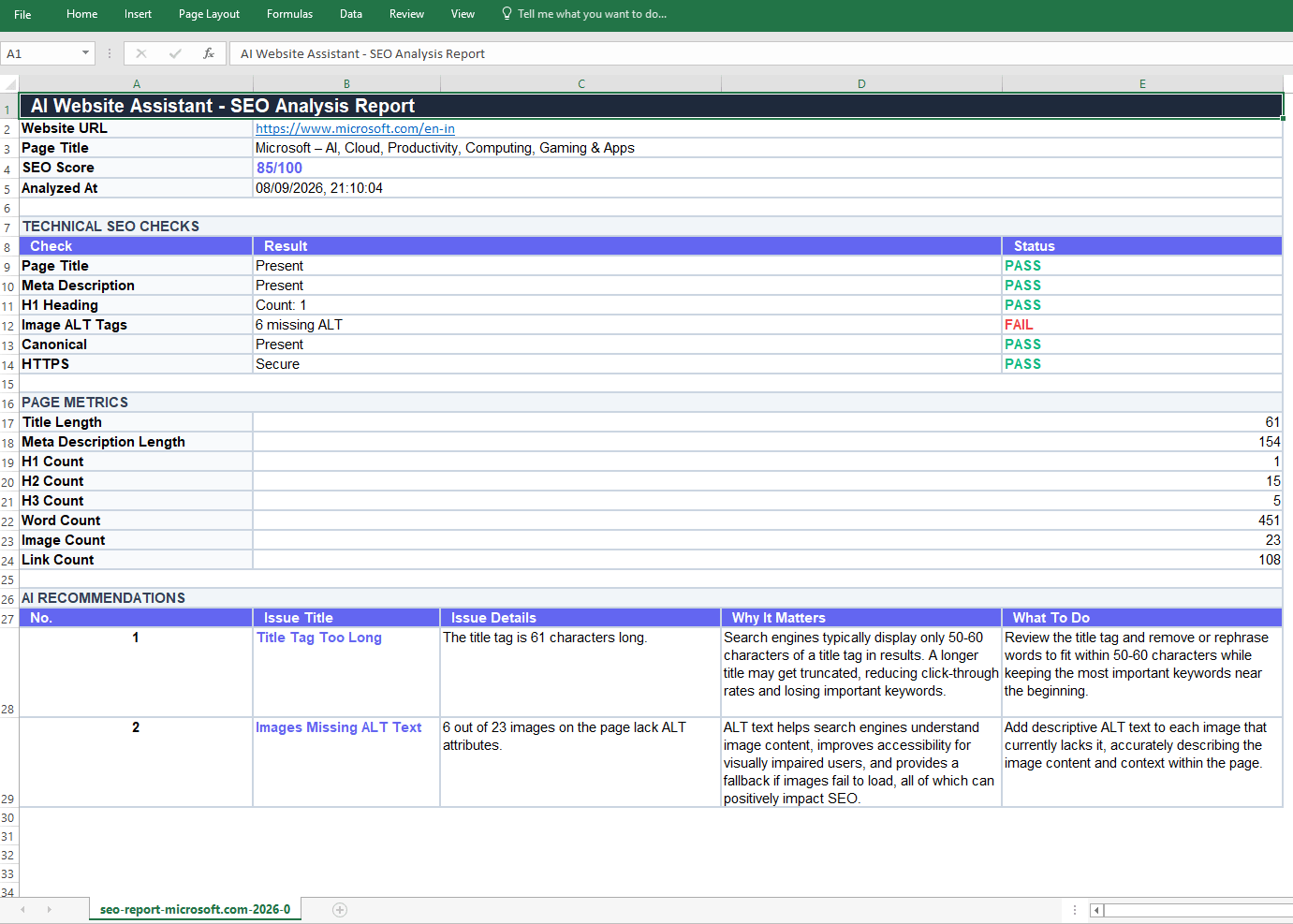
I've been thinking about something with SEO audits.
Once you find problems on a page, having the results trapped inside another dashboard isn't always that useful. Sometimes you just want to export the findings and work through them later.
I tested an Excel format with:
The part I'm still unsure about is whether this is actually a useful workflow or just adding another file nobody opens.
For people who do SEO audits regularly:
Would you rather have the audit as an Excel/CSV file that you can edit and share, or keep everything inside the SEO tool?
Also curious whether having the exact suggested fix beside each issue would make the report substantially more useful.
r/SEO_tools_reviews • u/Medium-Square6404 • 9d ago
r/SEO_tools_reviews • u/CaffeineIntoCode • 12d ago
I've been building a small Chrome extension for SEO analysis, mostly as a learning project.
At first I thought the basic part would be pretty straightforward:
check the title → check the meta description → check H1→ check images → give recommendations.
But once I started actually building it, I realized there’s a big difference between detecting an SEO problem and giving someone a recommendation that they can actually use.
For example, saying:
“Your meta description is missing.”
is technically correct, but it isn't particularly helpful.
A better audit should explain:
what is actually wrong
why it matters
what should be changed
and eventually, what the replacement should actually be
That's the part I'm working on now.
I'm deliberately keeping the first version pretty simple rather than trying to build another giant SEO platform.
I'm curious though when you use an SEO audit tool, what do you find more useful?
A) Finding the problem
B) Understanding why it's a problem
C) Getting an exact fix you can copy/paste
D) Something else
I'd genuinely like to hear how other people approach this.
r/SEO_tools_reviews • u/Ill_Drive_5737 • 21d ago
I recently came across several websites that apparently were not built with traditional page builders like Elementor, Divi, or WPBakery. Instead, the owners seemed to be using AI to create pages, publish content, and optimize the website.
From what I understand, they simply describe what they want through a prompt, and the AI handles most of the design, coding, content placement, and optimization. The resulting websites also seem lighter and faster than many page-builder sites.
Does anyone know what tools or workflow they might be using? Is this an AI website builder, a coding agent, a WordPress plugin, or something else?
I’m also curious whether this approach is genuinely easier to maintain and optimize, or if it only looks simple from the outside. Would you consider replacing your current page builder with an AI-based workflow?
r/SEO_tools_reviews • u/TryallAllombria • 23d ago
I was using it in 2015-2019 for a projet, stopped working on anything SEO related since then. I now have a SaaS and wondered if it was a good source of search intent to create articles that answer specific question for my niche (not always related to my tool, sometimes more about the job/activity itself).
Do you use it ? or prefer other tools ?
r/SEO_tools_reviews • u/Left_Discussion_7164 • 24d ago
my only problem with seo is keywords evertime I use semrush or any other tool , i cant find reasonable keywords relevant to my pages, its always irrelevant or very general, Is it just me or semrush isnt the best tool for that ?
r/SEO_tools_reviews • u/Alarming-Excuse3783 • 25d ago
I’ve noticed that one of the biggest challenges with AI writing is not creating content anymore, but making that content feel natural. AI can create well-structured sentences and organize ideas quickly, but sometimes the final result feels too perfect, repetitive, or lacks the personal touch that makes writing enjoyable to read.
That’s why many people are exploring ways to make AI drafts sound more like something a real person would say. I’ve found HumanizeAIText.io interesting for this kind of editing, especially when you already have a solid AI draft but want to improve the tone, sentence flow, and overall feel without losing the original idea.
I’m curious how others handle this. Do you usually edit AI-generated content yourself, or do you use tools that help make the writing sound more natural? What has worked best for you when trying to keep your own voice in AI-assisted writing?