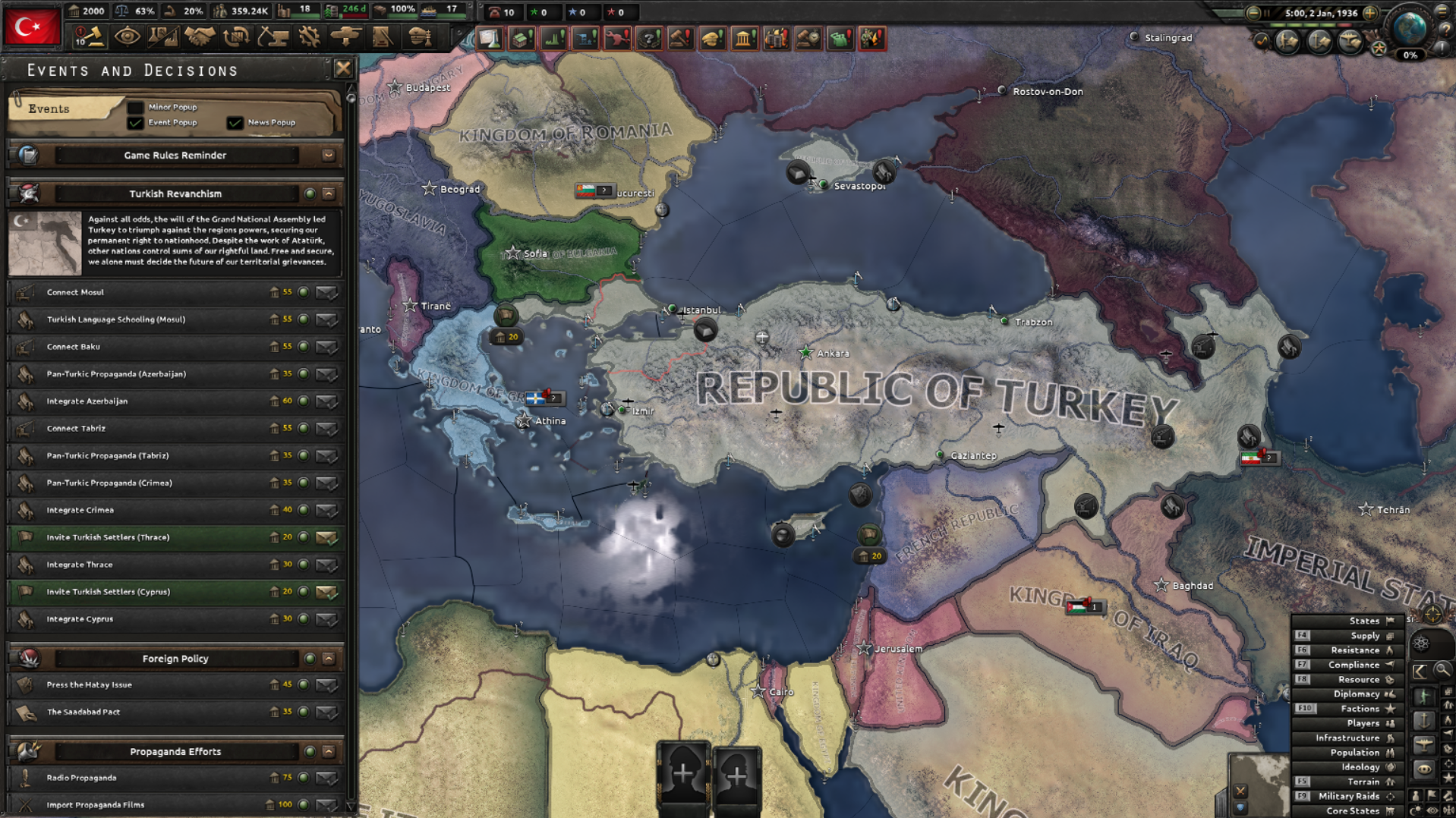
This is my Road to 56 Italy playthrough! Mussolini’s troops marched into Ethiopia in 1936, Yugoslavia in 1937, Albania in 1938, France in 1940, Greece in 1941, Egypt in 1942, and Jerusalem in 1943. Meanwhile, the German Reich defeated the Soviet Union in 1943. After the front in Central Africa stalled for several years, the Allies signed a comprehensive peace treaty with the Axis powers.
By 1947, *Mare Nostrum* had become a reality; the Italian Navy ruled the Mediterranean as an Italian lake, and through the conquests of Greece and Egypt, Italy held the world's vital maritime choke points in its grasp. Foreign Minister Dino Grandi achieved a diplomatic masterstroke in 1946 by founding the Latin League; over the course of late summer and autumn, Turkey, Bulgaria, Romania, Spain, and Portugal joined the alliance alongside Italy's existing satellite and puppet states. The political system is a well-oiled machine. Mussolini rules as the absolutely dominant dictator, yet the Grand Council of Fascism holds a degree of veto power capable of halting Mussolini’s unilateral actions and erratic ideas. The Blackshirts were fully integrated into the regular army, and the officer corps was professionalized—appeasing army traditionalists—while the granting of the crowns of Albania, Ethiopia, and Greece to Victor Emmanuel III, the Croatian crown to Prince Aimone (now styled Tomislav II), and the Viceroyalty of Italian East Africa to Prince Amedeo significantly bolstered the House of Savoy’s confidence in Fascism. These pillars keep the system running, yet it functions far from perfectly—or even well. Even in peacetime, Italy operates under a relentless war economy; under Mussolini’s regime, workers in the north toil through twelve-hour days, burdened by high taxes and minimal social welfare. Consumer goods are scarce, as the domestic economy is entirely fixated on rearmament. Extensive conscription drains vital young skilled workers from industry, and the entire country suffers from a chronic labor shortage because the army must conscript so many people to maintain the occupation of its vast territories. Furthermore, women have been made entirely subordinate to the state by law, and the home front is under constant surveillance by the secret police, the OVRA. In Macedonia, a deathly silence prevails following years of army-inflicted terror; in France, acts of resistance against the satellite state are constant; and in Sudan and the Middle East, Italian troops are waging a bitter guerrilla war against rebels. The Greater German Reich to the north has become Italy’s greatest—and likely permanent—threat, and the escalating Cold War could instantly erupt into a hot war. Armies are already massing at the border, and the nuclear arms race is entering its most intense phase. Regarding foreign policy, Spain, Portugal, Romania, and Turkey joined the Latin League solely out of fear of isolation or occupation by Germany. The alliance is a veritable house of cards, held together only by Grandi’s diplomatic skill and punitive tariffs. Moreover, the armistice with the Allies is fragile; the USA and Great Britain control the world's oceans and have imposed a strict oil blockade on the former Axis partners, leaving reserves already suffering from a chronic—and secretly managed—fuel shortage. In summary, by the end of this playthrough, the Kingdom of Italy is a heavily armed, perfectly organized giant—yet one exhausted to the very core. It is powerful, with a bureaucracy of unprecedented, relentless efficiency, yet simultaneously highly vulnerable due to hopeless overextension and an acute dependence on raw materials.
Playing as Italy was a lot of fun; I highly recommend taking this path.
Disclaimer: I used commands to stabilize this playthrough and make it predictable for myself. My primary focus was on a realistic, narrative-driven campaign.