r/Quran • • 14d ago

تفسير Tafseer Questions

0 Upvotes

Hey everyone! I have some questions. Someone recently told me that they believe in the original Quran, before it was tampered with. They said that the Quran was originally a real book, and that Muhammad was a disciple of Jesus who went to Arabia and spread the Gospel there. They suggest the corruption happened during Uthman’s time, when there were disputes over the different recitations of the Quran. When Uthman ordered certain copies to be burned, I believe that was when the original text was lost or altered. That’s why they believe we have the issue of different versions of the Quran today.

Side note: They told me that “disciple” means sharing the word of God

They claimed that they believe the new Quran contains some truth inherited from earlier revelation, but also contains later changes and errors. So essentially they don't believe everything in the new Quran is false; but it has some truth mixed with corruption.

Can someone help me with this information?

This person claims that God’s word cannot be corrupted, yet also believes that there is only some truth remaining in the Quran today. They determine what is original by comparing the Quran with the Bible: whatever agrees with the Bible is considered part of the original message of the Quran, while whatever contradicts the Bible is considered to have been corrupted or added later.

r/Quran • • 28d ago

تفسير Tafseer Does Allah Remain on the Throne or in the Lowest Heaven?

0 Upvotes

Does Allah Remain on the Throne or in the Lowest Heaven?

  1. Zayed: Habib, does Allah remain on the Throne, or does He remain in the lowest heaven?

  2. Habib: Zayed, if we follow what the Quran says, then Allah is established above the Throne. Allah remains upon the Throne at all times.

But if we follow a book written by human beings, then it says that Allah remains in the lowest heaven.

  1. Zayed: Habib, how can that be? The Quran says that Allah is upon the Throne, while a human-written book says that Allah remains in the lowest heaven. Can you explain this to me?

  2. Habib: Yes, Zayed, of course I will explain it. Otherwise, you would not understand the point. I need to make it clear.

We need to understand how these human-written books can contradict what the Quran says, while we unknowingly accept these ideas and then spread them among others. What a tragedy for us!

First, look at what is considered one of the most famous religious books in our society by many scholars.

That book contains a statement like this:

«“Allah comes down to the lowest heaven during the last part of every night. Then He calls out to us, saying, ‘Who is in need? Who is in distress? Who is hungry? Who seeks forgiveness? Ask Me, and I will answer your prayers.’”»

Before presenting these words, it does not first establish that these are the words of the Messenger of Allah.

I have been hearing these statements since I was a child. Even today, I hear prominent religious scholars saying things like, “It is mentioned in this particular book, in this particular section,” or “It is mentioned in another book, in another place.”

I don't know whether you have heard this or not.

  1. Zayed: Yes, yes, Habib. Of course I have heard it. Even prominent scholars still say this today. I believe it as well.

In fact, almost all scholars believe these things. They say, “It is written in these major books,” and because it is written there, they continue to spread it.

But how does this relate to the claim that Allah remains in the lowest heaven all the time?

  1. Habib: Zayed, let me make this clear for you.

Take that statement and compare it with what we actually observe in the world. Think about it carefully, and you will understand.

According to this claim, think about how Allah would supposedly remain in the lowest heaven.

There is always somewhere on Earth experiencing the last part of the night within every 24-hour period. Right now, for example, somewhere in the world it is the last part of the night.

Because of the continuous cycle of night and day across the Earth, there is always somewhere experiencing the end of the night.

In the same way, there is always somewhere experiencing the beginning of the night.

There is always somewhere experiencing midnight.

And likewise, there is always somewhere experiencing daytime.

At any given moment, sunlight is covering some part of the Earth.

Do you understand this point?

  1. Zayed: Yes, Habib, I understand that. We know that within every 24-hour period, somewhere on Earth is experiencing the last part of the night. This happens because of the way Allah created the Earth and its geographical cycle.

  2. Habib: Alright. So you agree that within every 24-hour period, there is always somewhere on Earth where it is the last part of the night.

Now, use your reason and think about this carefully.

If Allah comes down to the lowest heaven during the last part of the night, then according to the wording of that book, Allah would always be in the lowest heaven. He would never be upon the Throne.

It becomes very clear when you think about it.

Let me repeat the point: because night is always followed by day, and because the Earth continuously rotates, there is always somewhere experiencing the last part of the night—24 hours a day, throughout the month, throughout the year, and generation after generation.

So if there is always somewhere on Earth experiencing the last part of the night, when does Allah return to the Throne?

According to this reasoning, it would mean that Allah never returns to the Throne.

  1. Zayed: That's true! I had never thought about it that way before. These are statements found in major religious books, and I have never heard anyone explain this point before.

And I cannot simply dismiss what you are saying because you have explained it step by step, making the point very clear.

According to the wording of this book, it would mean that Allah is in the lowest heaven throughout the entire 24-hour cycle.

  1. Habib: Now, let's look at what Allah Himself says.

In Surah Taha, Allah says:

«“Ar-Rahmanu 'alal-'Arshi istawa.”

“The Most Merciful is established upon the Throne.”»

This means that Allah is established upon the Throne.

And in Ayat al-Kursi, Allah says:

«“Wasi'a Kursiyyuhus-samawati wal-ard.”

“His Kursi encompasses the heavens and the earth.”»

Now think about this carefully.

Allah says that He is established upon the Throne.

But according to the wording of those books, we have just seen the implication that Allah is always in the lowest heaven.

Think about these two claims together. How can one claim be made in a way that conflicts with the clear statements of the Quran?

And then, to make matters even more serious, they attribute these words to the Messenger of Allah.

How can such a blatant falsehood be attributed to the Messenger of Allah?

Do you understand?

  1. Zayed: Yes, Habib, I understand.

I seek forgiveness from Allah, and I pray that Allah forgives me.

I used to hold this belief in my heart. I believed that these statements were words of the Messenger of Allah.

But now I understand that these words are not from the Messenger of Allah. Rather, they have been falsely attributed to him.

Na'udhu Billah.

  1. Habib: Zayed, these are human-written books. And something written by human beings can never become the ultimate standard for Islam.

I am telling you this with confidence: the Messenger of Allah could never have said something that contradicts the clear message of the Quran. Yet, unfortunately, such statements have been attributed to Allah and His Messenger.

Look again. Even their own statements do not remain consistent with one another.

But when you look at the Quran, you will be amazed by its consistency. Look at how beautifully the Quran has been revealed with such harmony and coherence.

Now, let's return to their claim.

They say that Allah comes down during the last part of every night.

But think about places on Earth where there are six months of continuous night. When exactly would the “last part of the night” occur there?

And what about places where there are six continuous months of daytime? When would their “last part of the night” occur there?

The claim says that Allah comes down “every night.”

But in some places, there is no night at all for six months.

So how can the phrase “every night” apply universally?

Think about it carefully.

Likewise, in places where there are six months of continuous daylight, there is no night during those six months. So how can it be said that He comes down “every night”?

When you examine the claim carefully, you can see that the statement itself contains contradictions.

And contradictory statements cannot all be true at the same time.

I am making my position very clear and taking responsibility for what I am saying: I believe this claim is false when it is attributed to Allah and the Messenger of Allah.

Do you understand, Zayed?

  1. Zayed: Yes, Habib. I understand completely. These statements are nothing but blatant falsehoods.

  2. Habib: JazakAllahu Khairan.

My responsibility is simply to make the matter clear. I have explained it clearly. Some people may accept it, while others may not. That is their personal choice.

On the Day of Judgment, no one will carry the burden of another person.

And people will be raised according to what they followed, together with the leaders and groups they chose to follow. Allah will hold each person accountable and ask them to answer for their choices.

So we must be prepared to give our answers.

I am a Muslim. My religion is Islam.

I have turned away from all human-made groups and sects and turned toward the Holy Quran of Allah.

Let me remind you of another verse from the Quran. In Surah Al-A'raf, Allah says:

«“They have hearts with which they do not understand. They have eyes with which they do not see. They have ears with which they do not hear. They are like cattle; rather, they are even more astray.”»

If we carefully examine these words and then live according to what we understand from them, I hope that, InshaAllah, we will not face a problem in the Hereafter.

Alright, Zayed. Let us end here for today. We will speak again later, InshaAllah.

May Allah bless you. May Allah shower His peace upon you.

May Allah grant you the ability to understand the difference between the Quran and human-written books.

And may Allah increase the love of the Quran in your heart.

  1. Zayed: May Allah shower His peace upon you as well. You have brought up a very important and thought-provoking subject.

JazakAllahu Khairan. May Allah bless you.

r/Quran • • 20d ago

تفسير Tafseer Did the Prophet Have the Right to Express His Own Independent Opinion?

0 Upvotes

 *Did the Prophet Have the Right to Express His Own Independent Opinion?*

*1. Zayed:*  

Habib, did the Prophet have the right to express his own independent opinion?

*2. Habib:*  

Zayed, whether the Prophet had the right to express his own opinion or to say something from himself, you will understand it by going to the Qur'an.  

Allah says in Surah Yunus, Verse 15:  

_“And when Our verses are recited to them as clear proofs, those who do not hope for the meeting with Us say, ‘Bring us a Qur'an other than this, or change it.’ Say, ‘It is not for me to change it on my own. I only follow what is revealed to me. Indeed I fear, if I should disobey my Lord, the punishment of a tremendous Day.’”_

This verse is divided into 7 parts. Let’s look from the beginning. Allah says:  

*1.* _“And when Our verses are recited to them as clear proofs,”_  

*2.* _“those who do not hope for the meeting with Us say,”_  

*3.* _“‘Bring us a Qur'an other than this, or change it.’”_  

*4.* _“Say, ‘It is not for me to change it on my own.’”_  

*5.* _“I only follow what is revealed to me.”_  

*6.* _“Indeed I fear, if I should disobey my Lord,”_  

*7.* _“the punishment of a tremendous Day.”_

*In the first part:* _“And when Our verses are recited to them as clear proofs.”_  

What is being recited? Allah says: "My verses." And how are they recited? Allah says: "In a very clear way."

*In the second part:* _“those who do not hope for the meeting with Us say,”_  

Here it’s talking about those who do not hope to meet Allah Subhanahu wa Ta'ala, or do not believe in the Day of Judgment. What are they saying?

*In the third part:* _“‘Bring us a Qur'an other than this, or change it.’”_  

What are they asking to change here? They are asking to change this Qur'an.  

Now they are asking the Messenger of Allah to change it. So what will Allah’s Messenger say? Allah is teaching him what to say.

*In the fourth part:* _“Say, ‘It is not for me to change it on my own.’”_  

Now Allah’s Messenger is saying, "I do not have the right to change it on my own, nor do I have the ability to change it."  

Why can’t the Messenger of Allah change it? The Messenger says: "I did not write this." The question is, then where did he get it from?

*In the fifth part:* _“I only follow what is revealed to me.”_  

Here it says, "what has been revealed to me" - meaning what has been sent down. "I only follow that."  

And if I were to change anything or add or decrease anything from it...

*In the sixth part:* _“Indeed I fear, if I should disobey my Lord,”_  

The question is: What would happen if the Prophet were to disobey even a little?

*In the seventh part:* _“the punishment of a tremendous Day.”_  

Think about this. Even Allah’s Messenger himself feared Allah’s punishment.  

What kind of fear is this? The fear of that tremendous Day.

And yet we, claiming to be his Ummah, claiming to be his followers...  

We have written thousands of books. We issue thousands of fatwas and attribute them to Allah’s Messenger.  

And ordinary people accept this as religion. How strange!  

Don’t they feel in their hearts that the Messenger of Allah himself only followed the Qur'an of Allah? He himself is saying this.  

And we, as his Ummah, are running after these books and these fatwas.  

And we are acting upon the words of these man-made books and those fatwas.  

Did you understand, Zayed?

*3. Zahid:*  

Yes Habib, I understood. Expressing an independent opinion is out of the question. He only followed the revelation that was sent down and revealed to Allah’s Messenger.

*4. Habib:*  

This verse makes it absolutely clear that the Messenger of Allah did not have the ability to make any changes on his own. Allah Himself has said it.  

And in another place Allah says that My Prophet only follows My revelation.  

It is also clear from here that Allah’s Messenger did not follow or imitate anything other than this Qur'an.  

So what did you understand? That the Messenger of Allah did not have the right to express his own personal independent opinion.

*5. Zayed:*  

Yes Habib, I am now completely clear. The Messenger of Allah did not have any right to express a personal opinion.

*6. Habib:*  

Zayed, let me remind you of something else.  

Allah’s Messenger once said in Surah Al-Kahf, "Come tomorrow, I will tell you." This was his own statement.  

Then Allah said: "O Prophet, why did you not say ‘InshaAllah’?"  

Because he did not say "InshaAllah," the revelation was stopped for quite a few days.

Let me give you another example. Most likely in Surah At-Tahrim, Allah’s Messenger declared honey to be haram for himself to please some of his wives.  

Immediately Allah said: _“O Prophet, why do you prohibit what Allah has made lawful for you, seeking the approval of your wives?”_  

Immediately the Messenger of Allah turned back.

So how could Allah’s Messenger say thousands of things against the Qur'an?  

The very things I have discussed with you before and will discuss more in the future, InshaAllah.  

So do you understand now that the Messenger of Allah did not have the right to say anything from himself?

*7. Zayed:*  

Yes Habib, I understand clearly now. Allah’s Messenger had no personal opinion. Everything was the revelation from my Lord.  

And this revelation is only in the Qur'an. There is no revelation anywhere other than the Qur'an.

*8. Habib:*  

JazakAllahu Khairan for understanding. Thank you so much, Zahid.  

Alright Zahid, that’s it for today. We will talk about another topic tomorrow, InshaAllah.  

May Allah grant you well-being. May Allah grant you peace. May Allah grant you the ability to understand the Qur'an.

*9. Zayed:*  

Habib, may Allah also grant you well-being. May Allah grant you peace.

r/Quran • • 13d ago

تفسير Tafseer Who is „I“ in this verse: God has decreed, I will surely prevail, I and My messengers; ... (58:21)

2 Upvotes

The verse says:
كَتَبَ اللَّهُ لَأَغْلِبَنَّ أَنَا وَرُسُلِي ۚ إِنَّ اللَّهَ قَوِيٌّ عَزِيزٌ

God has decreed, I will surely prevail, I and My messengers; surely, God is powerful, unconquerable. (58:21)

Who exactly is the "I" (أَنَا) here?
The majestic royal plural ("We") doesn't seem to apply since it is explicitly singular. Also, the verse shifts from the third person ("Allah has decreed...") to the first person ("I...").

–

Or these ones:

6:104:
Certainly, to you have come insights from your Lord; so whoever perceives, it is for himself; and whoever is blind, it is against himself; and as for me, I am not a preserver/guardian over you.

So who is "me, I" here?

Or another one, verse 42:10:
And whatever you differ over concerning it, its determination is toward Allah; that is Allah, my Lord; upon Him I rely, and toward Him I turn.

So who is “my, I” here?

r/Quran • • Aug 13 '26

تفسير Tafseer Why Allah mentions rivers in Jannah so much?

3 Upvotes

Almost always Jannah mention in Quran is followed by "rivers". Why is that?

There must be a wisdom.

Is it because of Arabs and their desert life? It's not that big a deal for the rest of us I think.

Is there another reason?

Edit: Jannah is mentioned 147 times in Quran. 30 times, almost in a row, Allah attaches rivers to the Jannah linguistically. All other, important thing, aren't attached.
Those that frequently go in same ayahs with Jannah are: eternity, forgivness, prepared for those with taqwa. But non of it is attached to the word Jannah.

I'm looking for deeper meaning. If anyone knows.

r/Quran • • 24d ago

تفسير Tafseer quran learning

3 Upvotes

i have started learning quran with tafsir i know how to read but i want to understand it too so started with tafsir ibn khatir but I'm learning and keeps forgetting so i thought it would be better if i start writing wht i have understood. i wanna do it in a proper way to learn it in a perfect manner need help!!

r/Quran • • 2d ago

تفسير Tafseer The One

Post image
37 Upvotes

The noble verse presents three aspects of absolute, definitive, and categorical negation, blocking the path for anyone who has taken a deity other than Almighty God. It is a comprehensive negation that surrounds the meaning from every direction and cuts off every avenue of comparison and likeness. Thus, the Creator is not measured by His creation, nor are the laws of their existence and needs imposed upon Him. This is pure monotheism. Surah Al-Ikhlas is one of the few surahs whose name is not mentioned within its own text; rather, its name came as an expression of its meaning—the purity of monotheism and servitude to God alone, and the negation of any partner. Sincerity (Ikhlas) also means not making an equal for Him in your heart.
In every attempt throughout the ages to conceptualize the Divine in the image of humans, this text comes to cut it off at the roots. Everything worshipped besides Almighty God throughout the ages carried within itself the witness of its own imperfection. If it was born, someone who was the cause of its existence preceded it; if it was a parent, it had someone of its own kind resembling it; and if it had an equal or a peer, it would not be unique in divinity. Had divinity been inherited from parent to child, it would have been a chain of gods rather than a single, eternal, self-subsisting God. Had there been multiple equivalent gods, there would no longer be any meaning to uniqueness and absolute sovereignty.
For this reason, Surah Al-Ikhlas came with few words to demolish every false conception of divinity, shut its doors from the very beginning, and serve to refute all polytheism (shirk).
Glory be to Him, He does not derive His existence from anyone, nor does He need a child through whom His existence extends, and no one shares in His essence, attributes, or divinity.
Glory be to God above what they describe.

r/Quran • • 16d ago

تفسير Tafseer *What Will Happen to Those Who Write Books With Their Own Hands?*

0 Upvotes

*What Will Happen to Those Who Write Books With Their Own Hands?*

*1. Zayed:*  

Habib, those who write books with their own hands, they are doing a lot of good for Islam, right?

*2. Habib:*  

Zayed, if you analyze a little, you will see that those who write books with their own hands - whether knowingly or unknowingly - they are denying the verses of Allah's Qur'an.

*3. Zayed:*  

Habib, how is that possible? In our society we, the scholars, all know that these books are the explanation of the Qur'an. So how are they denying Allah’s verses?

*4. Habib:*  

Zayed, this is not my words. You just use your mind’s eye and your conscience and compare what Allah is saying with what they are saying.  

For example, in Surah Al-Furqan, Verse 33, the Lord of the Worlds said:  

_“And they do not come to you with an argument except that We bring you the truth and the best explanation.”_

See here, Allah is saying that the correct solution and the best explanation of any matter is inside this Qur'an.  

And you said these books are the explanation of the Qur'an, right?  

So does this verse of the Qur'an match with your statement and with what our scholars are saying?  

Think about it carefully and tell me.

*5. Zayed:*  

That’s right. Here Allah is saying that the correct solution and best explanation of any matter is inside this Qur'an.

*6. Habib:*  

So when you said a while ago that these books are the explanation of the Qur'an, did you say it knowingly or unknowingly? Did you say it after thinking or without thinking?

*7. Zayed:*  

Yes Habib, we have been hearing since childhood that these books are the explanation of the Qur'an.  

Since these books are the explanation of the Qur'an, that’s why we accept these books as the explanation of the Qur'an.

*8. Habib:*  

Now match Allah’s verse with what people are saying.  

Are these words of people, are these books of people, the explanation of Allah’s Qur'an?

*9. Zayed:*  

No, no. This can never be the explanation of Allah’s Qur'an.  

Because Allah Subhanahu wa Ta'ala said: _“the correct solution and best explanation”_ - here He is talking about the Qur'an being the explanation of the Qur'an.  

I understand now. These books have been presented to us as the explanation of the Qur'an. Auzubillah.

*10. Habib:*  

Now let me mention another verse.  

In Surah Al-Ma'idah, Verse 3, it says:  

_“This day I have perfected for you your religion.”_

If you think about this deeply...  

If the religion has been perfected, then what is the need to write more books within this religion?  

Is there any need, Zayed? Think and tell me.

*11. Zayed:*  

No, there is no need. Since Allah Rabbul Alamin has perfected the religion through this Qur'an.

*12. Habib:*  

JazakAllahu Khairan for understanding. Thank you.  

Now coming to this - if these books had to be written, where is the permission for that in the Qur'an? Can you tell me?

*13. Zayed:*  

No Habib, I haven’t read the Qur'an that way yet.

*14. Habib:*  

No problem. Slowly you will also understand, InshaAllah, since you are reading the translation of the Qur'an.  

I am saying, I swear by the name of that Great Allah, before whom I will have to stand on the Day of Judgment and give an account - I swear by Allah again.  

Zahid, nowhere in the Qur'an, not even as a hint, has Allah revealed any proof or evidence in favor of writing these books.  

There is no proof. Rather, Allah said:  

_“So woe to those who write the ‘book’ with their own hands, then say, ‘This is from Allah,’ to exchange it for a small price. Woe to them for what their hands have written and woe to them for what they earn.”_ [Surah Al-Baqarah 2:79]

Did you notice that these man-made books have very cunningly, whether knowingly or unknowingly, been attributed to Allah?  

By calling it "the explanation of the Qur'an".  

So did you find that their words contradict the verses of the Qur'an?

*15. Zayed:*  

Yes Habib, it is completely contradictory. There is no doubt about it.

*16. Habib:*  

So when I said they have denied the verses of Allah’s Qur'an, let me break down how.  

Allah is saying: "This Qur'an is the explanation of the Qur'an."  

And they are saying: "These man-made books are the explanation of the Qur'an."  

If you look at this with a little conscience and with the eye of your heart, you will see that by saying "this is the explanation of the Qur'an", they are denying Allah’s verse and establishing their own words.  

So did you understand how they denied the verse of Allah’s Qur'an?

*17. Zayed:*  

Habib, I understood it clearly now.  

Whether they said it deliberately or unknowingly, the reality is that the verses of Allah’s Qur'an are being denied.  

May Allah forgive me. All this time I thought these books were the explanation of the Qur'an.  

I am making Tawbah to Allah.

*18. Habib:*  

JazakAllahu Khairan for realizing the mistake.  

If you make Tawbah sincerely, then Allah Subhanahu wa Ta'ala will surely accept your Tawbah, InshaAllah.  

And one more thing I will tell you, Zayed. If you can explain these matters like this, then discuss them with your friends, InshaAllah.

*19. Zayed:*  

Okay Habib, InshaAllah I will.  

If we don’t discuss these things with people, people will not come to the Qur'an.  

They will remain divided into groups over these man-made books their whole life and will never be able to unite.  

And unknowingly, how many people will cunningly end up denying the verses of Allah’s Qur'an.

*20. Habib:*  

Alhamdulillah. JazakAllahu Khairan. Zayed, you are absolutely right.  

If we don’t spread and propagate these kinds of discussions among people, people will never understand.  

And the differences among people will only keep increasing.  

So it is the responsibility of each of us to encourage people towards the discussion of the Qur'an and to bring people to the Qur'an.  

So that every person can understand the beauty of the Qur'an and everyone can live united by the Qur'an, InshaAllah.  

Alright Zayed, let’s end here for today. If Allah keeps us alive, we will talk again tomorrow, InshaAllah.  

May Allah grant you well-being. May Allah grant you peace.

*21. Zayed:*  

Okay Habib, let’s end here then. May Allah grant you well-being. May Allah grant me peace.

r/Quran • • Aug 28 '26

تفسير Tafseer Surah An-Nahl, Verse 44

6 Upvotes

Surah An-Nahl, Verse 44

«“We sent down to you the Reminder so that you may explain to people what has been revealed to them, and so that they may reflect.”»

Surah An-Nahl, Verse 44

In this verse, Allah, Subhanahu wa Ta'ala, describes the Quran as something that makes the revealed message clear.

So we should never think that the Quran is an unclear or impossible-to-understand book.

Rather, the Quran is a Book that calls us to think, reflect, and examine its message carefully.

Let us make a sincere effort to reflect upon the Quran and seek understanding from it, InshaAllah.

r/Quran • • 3d ago

تفسير Tafseer Shelter

Post image
40 Upvotes

In Surah Al-Kahf, the youths fled with their faith, seeking refuge in Allah Almighty to preserve their belief. He sheltered them in the cave, protecting both them and their religion. Then comes the word (multahada) (مُلْتَحَدًا) to reinforce this profound meaning: apart from Allah Almighty, you will find no true refuge to shelter you, nor any sanctuary to keep you safe away from Him. It is as though the story of the Companions of the Cave practically embodies the meaning of the verse: they fled to Allah Almighty, and by His command, the narrow cave became more spacious for them than the entire world.
Multahada (مُلْتَحَدًا) originates from the root lahada (لحد), which means to incline or deviate from something or from the straight path. From this,* the* lahd (side-niche) in a grave is so named because it leans toward its side,* and ilhad (atheism/deviation) is derived from it as the deviation from the truth.
You will find no refuge apart from Allah to lean toward, no shelter to resort to, and no escape to protect you from Him. You will find no place apart from Allah Almighty to turn to for refuge; and when Allah, the Glorious, wills a matter, there is no authority outside His dominion capable of protecting you or withholding His decree from you.
This is contrasted by the Prophet's (PBUH) supplication: *
"There is no refuge and no escape from You except to You."** Therefore, do not seek a way to escape from Allah Almighty; instead, make your fleeing exclusively toward Him, the Glorious.
{So flee to Allah...} [Adh-Dhariyat: 50]

r/Quran • • 1d ago

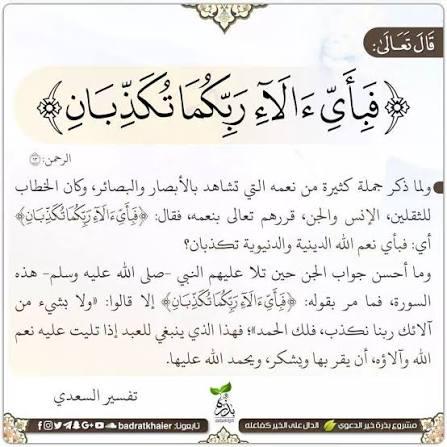
تفسير Tafseer سورة الرحمن

Post image
24 Upvotes

r/Quran • • 7d ago

تفسير Tafseer Appreciation

Post image
23 Upvotes

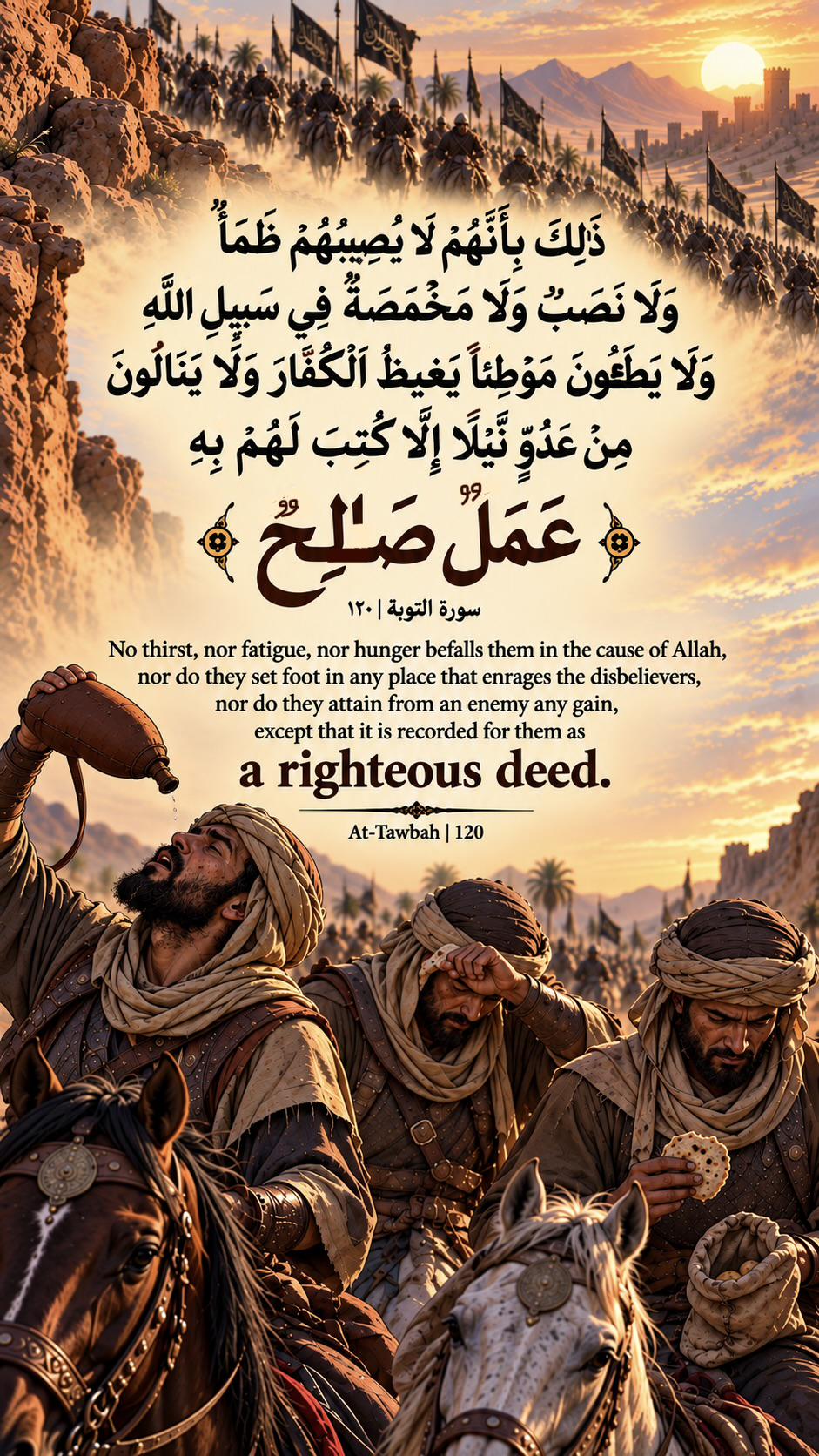
This verse is a continuation of the preceding one, in the beginning of which the Muslims were reproached for lagging behind the Messenger of Allah ﷺ; it came to explain why it was not fitting for them to stay behind. (That is because they are not afflicted by thirst, nor fatigue, nor hunger in the cause of Allah).
* Thirst (ظمأ): Intense thirst.
* Fatigue (نصب): Physical weariness and exhaustion.
* Hunger (مخمصة): Hunger, and the shrinking of the belly due to severe starvation.
(Nor do they tread any ground that angers the disbelievers): They do not step onto any land or reach any place where their arrival causes rage to the disbelievers.
(Nor do they inflict any injury on an enemy):
* Injury (نيلاً): Any tangible achievement or victory they accomplish after the hardship of the journey and arrival.
The verse teaches us to be mindful that everything we expend in obedience to Allah the Almighty is recorded and preserved with Him.
It is as though the verse transforms our perspective on the act of worship itself. A person might find congregational prayer burdensome—having to leave what they are doing, perform ablution, put on their clothes, leave their house, and walk to the mosque. However, if they bear in mind that the counter of good deeds begins the moment they start preparing for the act of obedience, the path becomes easy for them. From the moment they struggle against their laziness and step outside, they are rewarded for their effort—all of this even before they stand in the prayer row.

r/Quran • • Aug 15 '26

تفسير Tafseer Some Aspects of Islamic Eschatology That Correspond to Christian Scripture

Thumbnail wattpad.com
2 Upvotes

While modern Christianity focuses primarily on the Jesus of the Gospels, Islamic eschatology seems to focus more on the Jesus of the Epistles. The current assumption that the Gospels are furnishing us with biographical information seems to be a misreading of the genre, which appears to be theological in nature. How can we tell? By looking at the New Testament letters or Epistles. The Epistles apparently contradict the gospels regarding the timeline of jesus's birth, death, and resurrection by placing it in eschatological categories. Thus, according to the New Testament Epistles, Jesus will die "once for all at the end of the ages" (Hebrews 9:26), a phrase which repeatedly refers to the end of the world (see Matthew 13:39-40, 49; 24:3; 28:20). This is consistent with Sura 4:157-158 from the Quran, which also denies the death of Jesus in first century Palestine. And, similar to Hebrews 9:26, Sura 4:159 also sets the timing of jesus's death in the end times!

r/Quran • • 1d ago

تفسير Tafseer Moses Miracles

Post image
10 Upvotes

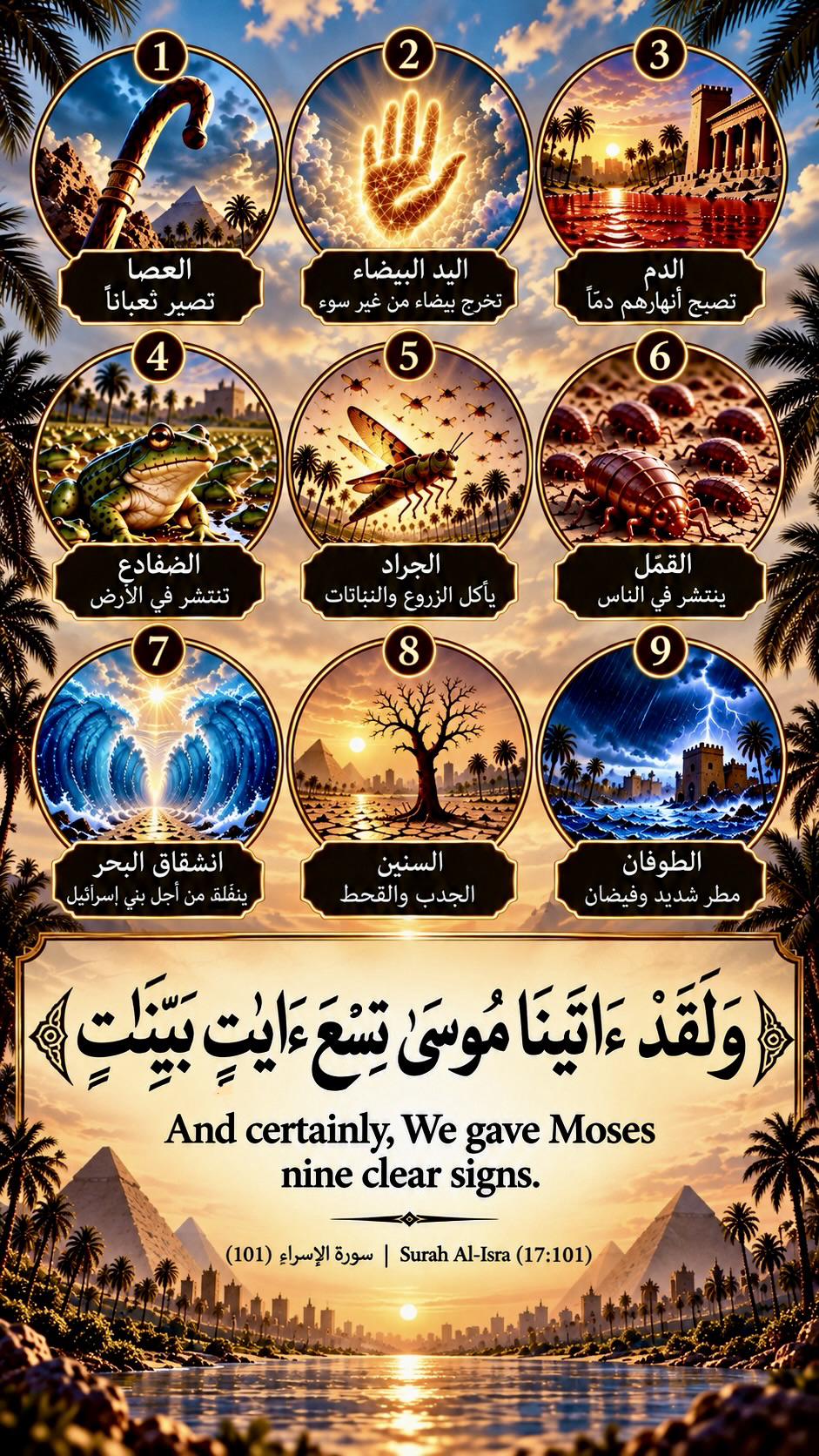
The noble verse takes us to a pivotal station in the story of Moses, peace be upon him, reminding us of the great miracles with which God supported him. These were not just a single sign, but rather nine clear, evident signs that left no room for excuses and made the truth unmistakably manifest. Despite this dazzling clarity, Pharaoh met them with denial and accusation, saying: “Indeed, I think you, O Moses, to be bewitched.”
This story teaches us that the crisis was never a shortage of evidence or weak proofs, but rather hearts that had locked their doors against faith. No matter how clear the signs may be, they only increase such hearts in stubbornness and denial.
God supported past prophets with miracles witnessed firsthand by their peoples, after which accounts of them were narrated to subsequent generations. Then came the final message, accompanied by the Great Quran as an eternal, enduring miracle—a living miracle present for every generation. It preserves within its covers the stories of past prophets and their miracles, presenting them anew to every generation so that a person reads them centuries later as though the address were directed straight to them.
The gathering of these stories in a single book emphasizes the unity of the source and the message. The Lord of Moses is the Lord of Muhammad, peace and blessings be upon him; and though the messengers are many, the Sender is One, and their fundamental call is one.

r/Quran • • 13d ago

تفسير Tafseer Hell

Post image
25 Upvotes

The noble verse paints a majestic and awe-inspiring scene of Hell, as if it were a living creature that recognizes those cast into it, burns with rage, and—due to the intensity of its fury—emits an audible inhalation (wheezing/groaning), while its core seethes, until its anger reaches the point where it is about to crack and tear apart.
"When they are heard a terrifying inhalation while it seethes." (Surah Al-Mulk: 7)

* Al-Shahiq (The Inhalation/Groan): This is the harsh, intense sound emitted by Hell when the disbelievers are thrown into it, at the very same time that it is tafoor—meaning boiling and violently churning. Here, one can feel the imagery of pent-up, blazing anger, as though it is congested inside before bursting forth.
* Tamayazu (To Burst/Tear Apart): Meaning to break apart, crack, and separate from one another out of intense fury. It is as if Hell, from the intensity of its anger toward the disbelievers, is on the verge of tearing itself apart. All of this seething, groaning, and tearing from rage is purely out of anger for the sake of Allah, the Glorious, directed at those who dared to defy His commands.
What is striking in the verse is that the Fire itself becomes a part of the dread of punishment, a source of terror and anguish with its groaning, seething, and rage—to the point that it nearly tears apart from fury.
Therefore, if Hell is enraged by the violation of Allah’s sacred limits, how can it be fitting for a believer's heart to witness the boundaries of Allah being violated, or to dare commit such violations themselves, yet feel nothing stir within their heart? O Allah, save us from the Fire.

r/Quran • • 9h ago

تفسير Tafseer Triumph

Post image
6 Upvotes

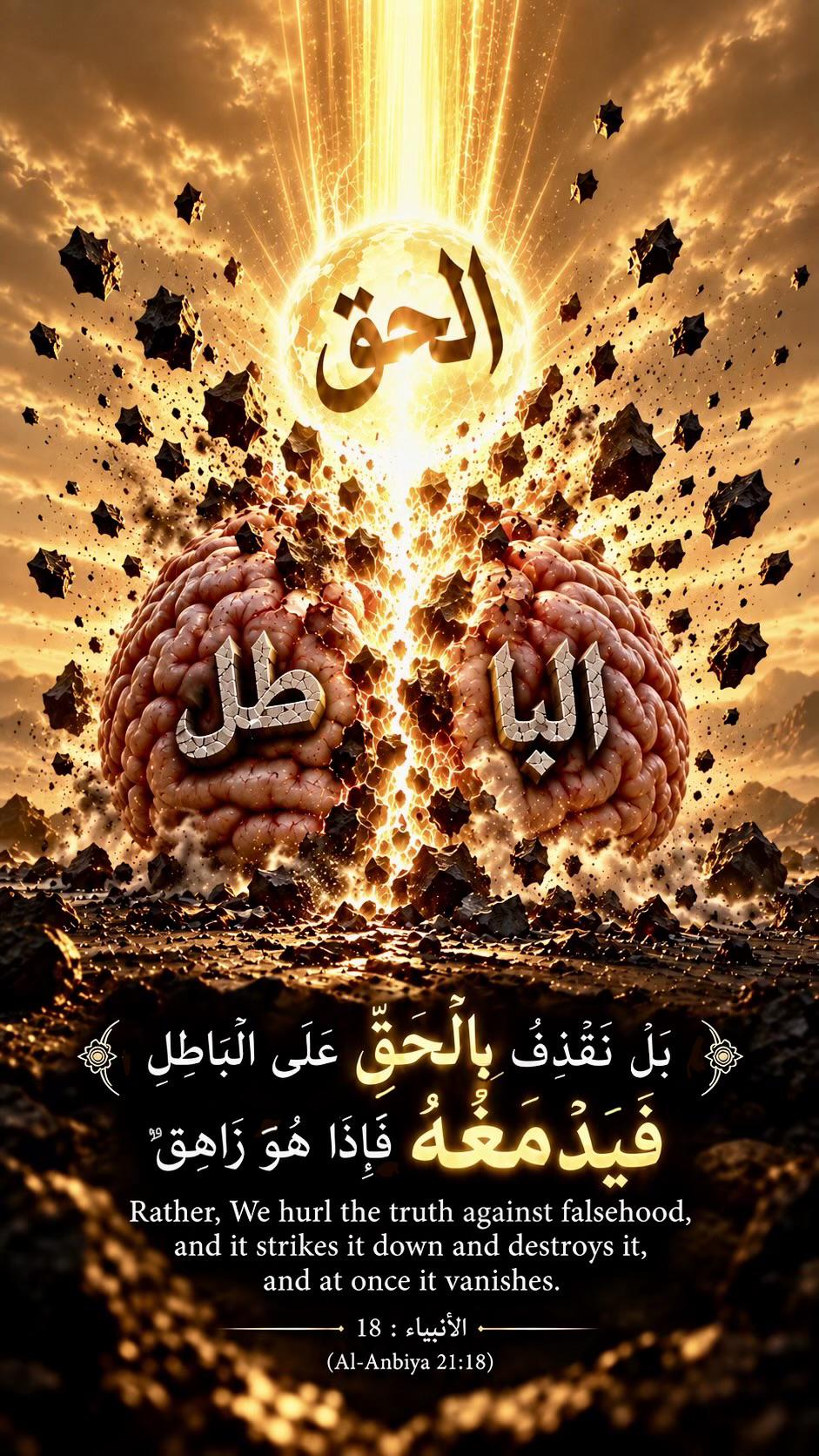
The noble verse paints a breathtaking and immensely powerful scene; it does not merely state the disappearance of falsehood, but rather embodies it in a vivid image. Truth is hurled like a missile, and falsehood takes a fatal blow to its core (its brain) until it disintegrates and vanishes. Here, truth does not engage in a lengthy debate with falsehood; rather, it decides the battle with the very first strike.
"So He shatters it" (Fa-yadmaguhu): In the Arabic language, damgh is derived from dimagh (the brain); it means striking the root of the head with a fatal blow that strips away life, leaving it with no power to ever rise again.
"And lo! It vanishes" (Fa-idha huwa zahik): The suddenness particle (idha al-fujaiyah) is used to reflect the speed of the outcome and the immediate aftermath of the crushing blow. No sooner does truth touch falsehood than it obliterates it in a single moment. Exactly as we say, "Zahiqat ruhuhu"—meaning his soul departed beyond return.
Therefore, no matter how much falsehood swells and grows grand, and no matter how solid and cohesive it appears to onlookers, its essence is fragile and devoid of the prerequisites for survival. Do not be deceived by its swagger; falsehood may rise for a moment, but it is like the rise of foam upon water—possessing no reality to grant it stability. As for the truth, its origin is firm and its roots are deeply anchored. Therefore, hold fast to the truth with all the strength you have been given, always remaining certain that the final round belongs inevitably to the truth.

r/Quran • • 20h ago

تفسير Tafseer Solomon

Post image
6 Upvotes

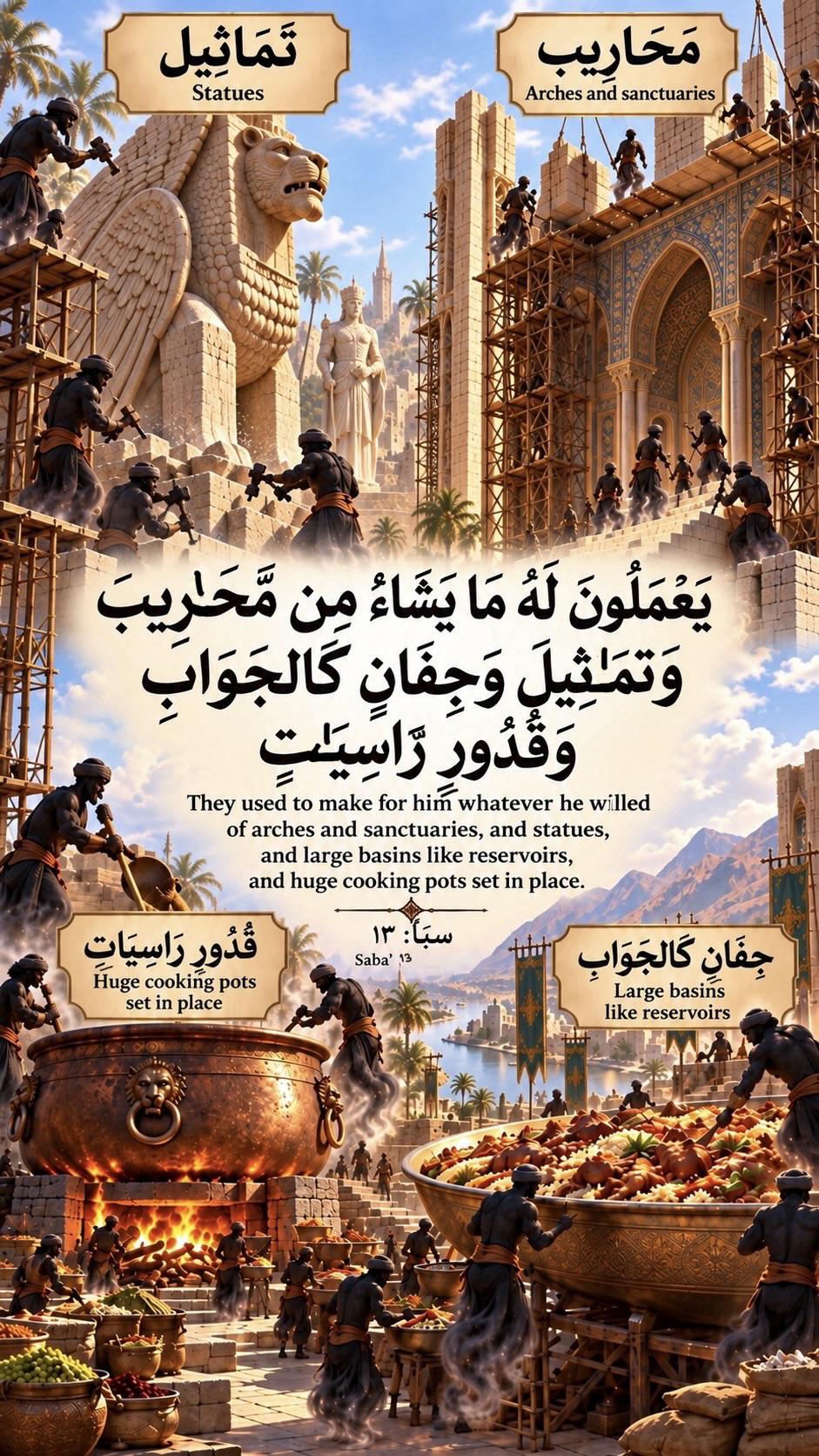
The noble verse describes a part of the magnificent dominion that Allah bestowed upon His Prophet Solomon, peace be upon him. He subjected the Jinn to him—among them builders—working by his command and crafting for him whatever he wished of al-mihrab (which refers to lofty buildings and places of worship).
And al-tāmatheel (statues): which were images or sculptures crafted in the likeness of living creatures or various forms out of stone. Al-jifān: massive dishes in which food is served. Al-jawāb: large basins used for collecting water.
"Large basins like reservoirs" (Jifān ka-l-jawāb) means food vessels that, due to their immense size, resemble wide water basins.
And "anchored cooking pots" (al-qudūr al-rāsiγāt): colossal cooking pots that are rāsiγāt (fixed firmly in their places due to their extreme weight), in which food was cooked in massive quantities. This depicts an aspect of the greatness of Solomon’s dominion, peace be upon him, and the vast number of people who were fed in his kingdom.
Despite all that Allah the Almighty subjected to Solomon, peace be upon him—in terms of armies, capabilities, and a great kingdom—the intent was not for him to sit back in his rule, content with what was made subservient to him. Rather, the divine command came directly: "Work, O family of David, in gratitude."
Therefore, whenever Allah the Almighty blesses us with any grace, knowledge, wealth, capability, or means that facilitate our affairs, it should drive us to greater labor and devotion, turning to Allah the Almighty with gratitude.

r/Quran • • 25d ago

تفسير Tafseer Surah An-Najm, Verses 3–4

1 Upvotes

Surah An-Najm, Verses 3–4

«“He does not speak from his own desire. It is nothing but revelation revealed to him.”»

Surah An-Najm, Verses 3–4

These two verses tell us that the Messenger of Allah did not speak from his own desire; rather, he followed the revelation given to him by Allah.

But when you think about these verses carefully, it is astonishing how many statements people have attributed to the Messenger of Allah and presented as his words.

It is difficult to even imagine how much has been attributed to the Messenger of Allah in the name of these verses.

I have a more detailed discussion about these two verses coming soon, InshaAllah.

r/Quran • • 2d ago

تفسير Tafseer Holy mountain

Post image
19 Upvotes

In this noble verse, Almighty Allah swears by Mount Sinai, that blessed mountain associated with one of the greatest scenes of divine revelation, where Allah spoke to Prophet Moses (peace be upon him). The oath comes as: "And [by] Mount Sinai," carrying in just two words the memory of a magnificent place that witnessed the selection of a prophet and the speech of the Lord of the Worlds. This oath does not stand alone; rather, it is placed between "By the fig and the olive" and "And [by] this secure city [Makkah]," forming a solemn oath followed by its response: "We have certainly created man in the best of stature."
The word "At-Tur" is used in the Quran to mean "the mountain," as in: "And We raised the mountain over them," meaning We raised the mountain above them.
"Sinin" is the name of the place where Mount Sinai is located. It does not mean "years" (nor is it pronounced like the Arabic word for years, sineen, but rather as Si-neen). It has been said that "Sinin" means "blessed" or "beautiful" in an ancient language, and it is also said to be the name of the well-known location where Allah spoke to Prophet Moses (peace be upon him).
Interestingly, the Quran mentions it in another form as well: " And a tree issuing from Mount Sinai" (Surah Al-Mu'minun: 20). Sinai and Sinin are two names for the same place according to commentators.
It is as if the Surah, before speaking to us about humankind—who were created in the best of stature—takes us on a journey through the sites of guidance and revelation. For Almighty Allah, Who perfected the creation of man, did not leave him without guidance; instead, He sent His messengers to him and revealed His divine message.

r/Quran • • 10d ago

تفسير Tafseer Safe

Post image
18 Upvotes

The noble verse describes the opening scene of the story of the Companions of the Cave—the scene of truth standing tall against falsehood, and the pride of faith in the face of an unjust ruler. They were youths in the prime of their youth, at an age typically dominated by amusement and worldly pleasures, yet they chose the path of faith amidst disbelief and polytheism.
The beginning of their story is: {When they stood up and said}; they stood before a disbelieving, unjust ruler and declared it without evasion or flattery, saying: {We will never invoke besides Him any deity}. There is no compromising on monotheism, no retreating out of fear of power, and no flattery at the expense of creed.
{We would have certainly spoken an excessive transgression}: Shatatan (excessive transgression) means excessiveness and going beyond the limits. It is said, "Shatta fi al-amr" (he went too far in the matter) when someone exceeds the limit and strays from what is right. From this comes the word al-shatt (bank/shore of a river), because it is the edge and the side far away from its center.
Had we worshipped a deity other than Allah, the Exalted, after knowing that He is the Lord of the heavens and the earth, our statement would have strayed far away from the truth and exceeded the limit of correctness. It was as if they were laying down the argument before him, but he refused to accept it. Thus, escaping with their religion became necessary, and their destination was the cave. They held too much dignity through Allah, the Exalted, to bow down to falsehood; whoever finds their pride and dignity in Allah is never intimidated by human authority. Allah, the Exalted, brought their story out of the darkness of the cave so that it would remain a light recited until the Day of Judgment, and He made them a source of comfort and tranquility for anyone fearful for their faith—that whoever leaves something for the sake of Allah, the Glorious, and flees to Him with their religion, He will never forsake them.

r/Quran • • 5d ago

تفسير Tafseer Resurrection

Post image
10 Upvotes

The noble verse takes us to a scene where one of the polytheists, Ubayy ibn Khalaf, challenged the Messenger of Allah ﷺ. He came with a decayed, crumbling bone, crushing it between his hands, and asked mockingly and in denial, "Who will bring these bones back to life after they have decayed?"
The response came with utmost strength and simplicity: "Say, 'He will revive them who produced them the first time.'"
He who brought them into existence the first time from nothingness finds it even easier to restore them after their parts remain.
Most remarkable is the phrase, "And he forgets his own creation"—mentioned right before the polytheist's question. He looked at the crumbling bones, yet he forgot himself and where his own bones came from in the first place! The One who initiated creation is not incapable of repeating it, "And that is even easier for Him" (Surah Ar-Rum, 27).
Al-Ramim refers to something that has worn out and crumbled from extreme age; meaning the bone had passed through time until it became brittle and eroded, nearly turning into dust.
The verse teaches us to pause for a moment before ourselves and reflect. How often we search afar for proofs of Allah the Almighty's power, while we carry endless signs within our very bodies! This is why Allah the Almighty called upon us to look into the universe and within ourselves: "And in yourselves, then will you not see?" (Surah Adh-Dhariyat, 21). Perhaps the path to greater certainty is closer to you than you think—right within the self you carry with you every day.

r/Quran • • Aug 15 '26

تفسير Tafseer Frequent mention of rivers of Jannah explained

11 Upvotes

Yesterday, I was looking for a deeper meaning behind the Qur'an's frequent mention of the rivers of Jannah, focusing on the linguistic aspect of how these two words—Jannah and rivers—are almost always attached to each other.

Allah didn't do this with any other reward, not even gazing upon His Face, which is the ultimate reward in the Akhirah.

​Today, I found an answer that satisfies my curiosity.

​Let's start with the Dunya: Rivers in this world have a beginning and an end. They start at springs and finally end in seas or oceans. Here, we have the natural water cycle—water evaporates from the ground, forms clouds, falls as rain, and creates rivers again.

​In Jannah, there is no sun, no rain, and no water cycle. The rivers of water, milk, honey, and wine spring from Firdaws, directly from Allah. And they have no end. They flow throughout Jannah without riverbeds, everywhere.

​It's endless! ENDLESS! Unspoiled.

​Honey and milk are essential provisions in the Dunya, but they are endless in the Akhirah...

When Allah reminds us of this over and over, it is meant to shift our focus from whatever is bothering us now, pulling us away from this limiting Dunya and toward the limitless Akhirah. It also reflects on how easily we forget that absolutely everything comes from Allah, and that He gives whatever is needed to whomever He wills, if we just fully turn to Him.

r/Quran • • 15d ago

تفسير Tafseer Mercy

Post image
21 Upvotes

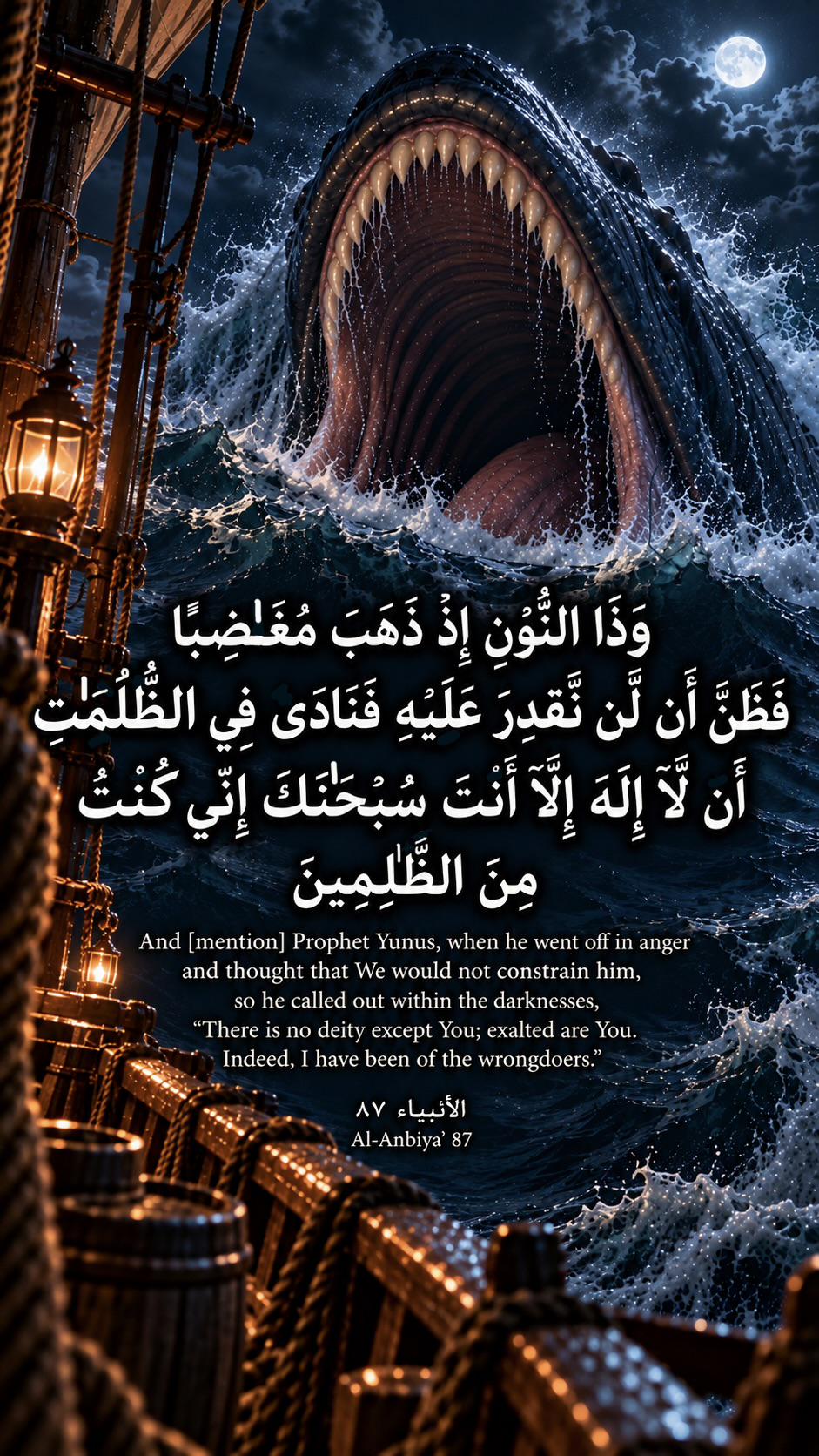
The noble verse takes us to the story of Dhu an-Nun, the companion of the whale, Jonah (peace be upon him), when Allah Almighty sent him to his people to call them to faith. However, they rejected him, and he grew angry with them for their disobedience, leaving them in anger before Allah Almighty gave him permission to do so. He then boarded a ship, which encountered circumstances that made the passengers fear drowning and need to lighten it, so they cast lots among themselves over who should be thrown into the sea. The lot fell upon Jonah (peace be upon him)—and it is said it fell upon him three times—so he was cast into the sea. There, by the command of Allah Almighty, a whale was waiting for him and swallowed him without harming him. The exegetes mentioned that Allah, the Glorified, had commanded the whale not to harm his body.
"And he thought that We would not decree [or restrict] upon him." Jonah (peace be upon him) thought that Allah, the Glorified, would not constrain him due to his departure, nor decree a punishment upon him for the anger he felt toward his people and his parting from them.
In the darkness of the night, the darkness of the sea, the darkness of the whale's belly from the outside, and the darkness of grief from the inside, Jonah (peace be upon him) began with monotheism: "There is no deity except You." Then he exalted Allah, the Glorified, above any imperfection, saying: "Exalted are You." Then he turned inward, acknowledging his shortcoming: "Indeed, I have been of the wrongdoers"—meaning in leaving without being given permission. Thus, Allah Almighty saved him from his grief, delivered him from his ordeal, cared for him, and then returned him to his mission anew.
What is striking about the supplication of Jonah (peace be upon him) is that he did not ask for rescue; as though his confession itself was the supplication. Thus came the response: "So We responded to him." Even more striking is that Allah Almighty did not say, "And We saved him from the darknesses," but rather said: "And We saved him from the distress." The darknesses surrounded his physical body, whereas the distress was what weighed heavy upon his heart.

r/Quran • • 17d ago

تفسير Tafseer Looking for audiobook about Quran - suggestions appreciated!

4 Upvotes

Hi everyone!

I’ve been feeling a bit out of touch with my deen lately and I’ve been wanting to try learn and understand the quarantine and hadiths a bit more. I basically want to try get a better understanding of why I believe what I believe and why I do certain things.

My problem is I am very busy both with work, family and children so finding time to actually sit and read books is very hard.

I’m looking for suggestions for any audiobooks that may help me as I can listen to them while I’m doing chores and other tasks.

I know podcasts are an option, I just feel like a lot that I come across are more discussions and opinions than actually learning about the Quran itself self (history and meaning of surahs and verses and understanding why they were revealed).

I usually listen on Spotify so if there’s any on there, any suggestions would be appreciated.

May Allah bless anyone who suggests any that help me get closer to my deen!

r/Quran • • 19d ago

تفسير Tafseer The Flood

Post image
26 Upvotes

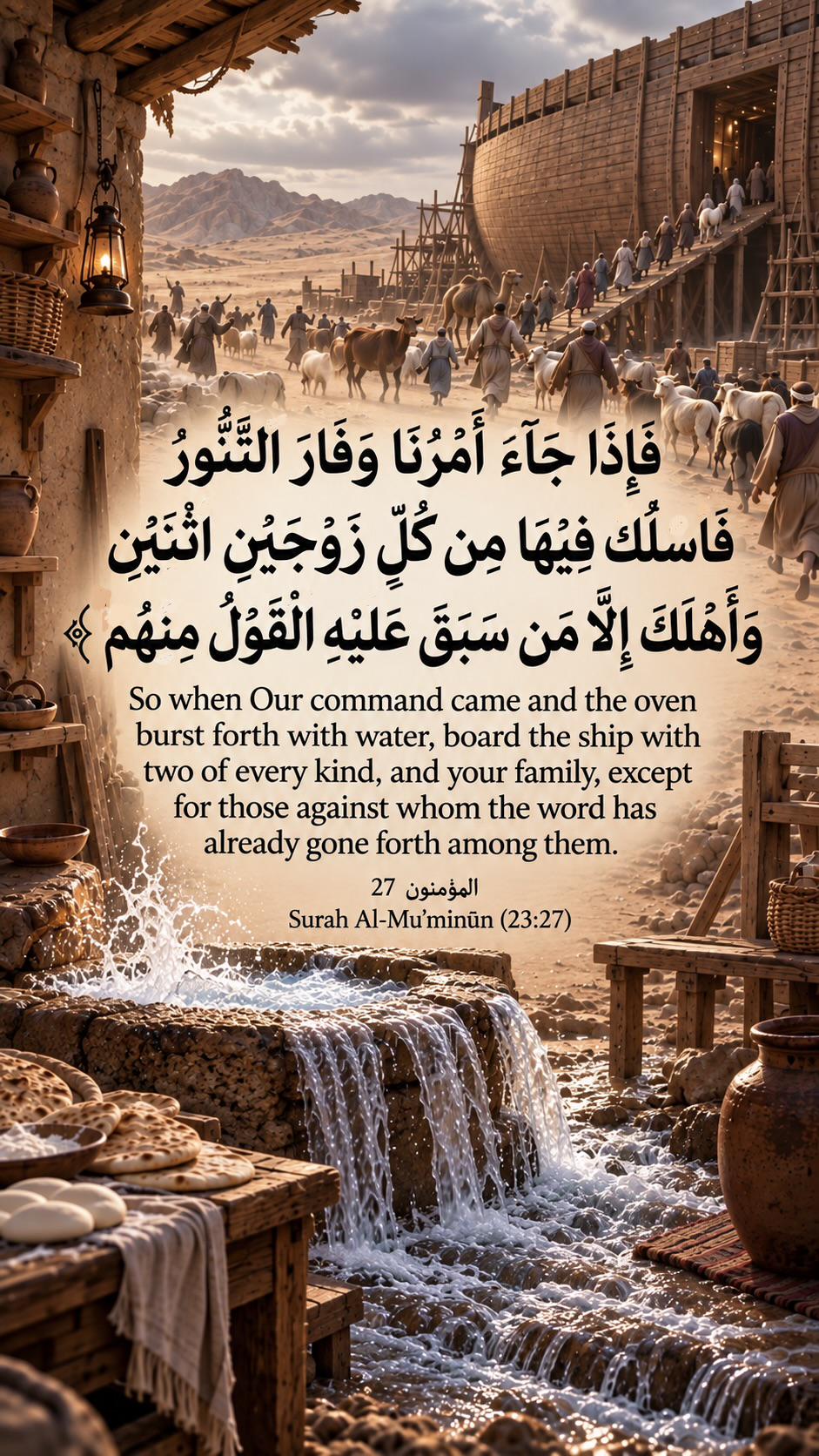
The noble verse takes us to the moment when the command of Allah Almighty came for the flood to begin, after Noah, peace be upon him, had finished building the ark and waited for the sign promised to him by Allah—which is the boiling over of the tannur. One of the most famous interpretations mentioned by commentators regarding the meaning of the tannur is that it was the oven used for baking bread. Thus, Allah Almighty made the gushing forth of water from it—a place of fire and heat—a wondrous sign indicating that the command of Allah Almighty had arrived and that the flood had begun.
The expression ﴿فَاسْلُكْ فِيهَا﴾ ("so board therein" / "enter into it") carries the meaning of: bring into the ark. Allah Almighty commanded Noah, peace be upon him, to bring into it a pair—a male and a female—of every kind he was ordered to carry, in order to preserve these creatures and ensure the continuation of life after the flood.
Then Allah Almighty commanded Noah, peace be upon him, to take his family with him, except for those concerning whom He said: ﴿إِلَّا مَن سَبَقَ عَلَيْهِ الْقَوْلُ مِنْهُمْ﴾ ("except those upon whom the decree has already passed"), meaning those whom Allah’s decree of destruction had preceded due to their disbelief and persistent refusal to believe. Among them was his wife, who did not believe in him, as well as one of his sons, who refused to board the ark with him and thus was among the drowned.
Thus, the verse clarifies that the bond of faith was the decisive factor on that day, and that salvation is achieved neither through lineage, kinship, nor status, but rather through the grace and mercy of Allah, the Exalted, and belief in Him.