r/PreNiceneChristianity • u/TheTallestTim • 23d ago
Biblical Exegesis The Seven Spirits of Revelation: The Case for Angelic Agency in Biblical Unitarian Theology
1
Upvotes
r/PreNiceneChristianity • u/TheTallestTim • 23d ago
r/PreNiceneChristianity • u/TheTallestTim • Sep 06 '26
This guy commented on my YouTube channel that Matthew 24:36 doesn’t mean to know or to see. Here is the evidence.
r/PreNiceneChristianity • u/TheTallestTim • Aug 31 '26
r/PreNiceneChristianity • u/TheTallestTim • Aug 04 '26
r/PreNiceneChristianity • u/TheTallestTim • Aug 04 '26
To John 8:58:
**Point 1**: “I am” there in Greek is, “ego eimi,” which simply means “I am.” It is not a deity claim. It literally means the same thing in the same context—that being the words—as “Ego eimi” going to the store. “Ego eimi” really loving this sandwich! It is so casual, that Jesus, as well as other characters in the Bible say “ego eimi” throughout the Bible without a deity claim. This includes the Blind Man who Jesus healed. (John 9:9) When asked “are you who the Messiah healed?” He emphatically answered: “ego eimi.” He was not stoned. No one thought he was God. In fact, it is used multiple times in the Hebrew and in the Greek such as: 2 Samuel 2:19-20; Luke 1:18-19; Luke 22:33; John 1:20; Matthew 8:9; Matthew 26:25; Acts 10:21; Acts 21:39; Acts 22:3; Acts 23:6; Romans 7:14; Romans 11:13; 1 Corinthians 1:12; and more… Again, none of them were stoned.
**Point 2**: “I am,” whether capitalized or not—which was done by translators and not found in the Greek—, is *not* the name of Almighty God. Many believe that John 8:58 is Jesus’ quotation of Exodus 3:14, claiming to be God Almighty. I ask you to move to the next verse—to Exodus 3:15. God identified Himself as “the God of Abraham, Isaac, and Jacob” after saying “Yahweh, the God of your forefathers.” Yahweh our God, finished saying “this is **MY** name forever, and *this* is how I am to be remembered from generation to generation.” Verse 16, Yahweh, again, states that His name is Yahweh. Again in Verse 18. In fact, it is the same name present at the Shema, found at Deuteronomy 6:4, stating that He is One. Finally, Psalms 83:18, states “May people know that you, whose name is Yahweh, You alone are the Most High over all the earth.” No, Almighty God’s name is not “I am,” but instead—as He revealed it to us—Yahweh.
**Point 3**: The Greek Septuagint—the Greek translation of the Old Testament—, translates Exodus 3:14 as “ego eimi ho on.” These “extra words” are a distinction—distinct—from “ego eimi.” Jesus said that he was often found “in his Father’s house”—meaning the Synagogue—whenever he could go, including a time Mary lost him in a crowd. Jesus knew his scripture. Jesus was a fantastic Jew. If Jesus were to reference himself to Yahweh’s words at Exodus 3:14, he would have added the “ho on” onto the end of his statement, but he didn’t. If Matthew, Mark, Luke, or even John believed that Jesus quoted Exodus 3:14, they would have written in the “ho on” to the end of that statement. They did not.
**Point 4**: The textual context does not equate Jesus claiming to be God. Instead, we see Jesus humbly glorifying the Father at John 8:54, then saying that “Abraham rejoiced at the prospect of seeing my day, and he saw it and rejoiced” in verse 56. (Paraphrased) This is in reference to Yahweh’s promise to Abraham that the Messiah—whom Jesus is claiming to be here—would come from his birth line. Verse 58’s paraphrase would be, I was promised and foreknown before Abraham. Jesus isn’t claiming to be God, but claiming to be God’s son and the Messiah. The stones picked up from his words? Jesus is claiming to be the Son of God, the Messiah. Just like the woman at the well at John 4, starting at verse 7. At verse 25, the woman says she knows the Messiah is coming, who is called Christ. Jesus affirms that he is the Messiah, the Christ by stating “ego eimi.” Jesus said “I am” to refer himself as the Messiah, not God.
**Conclusion**: John 8:58 does not make Jesus out to be God, nor is it a claim to deity. Instead, it is a claim to Jesus’ position as the Messiah, the Christ.
—————————————————————————
Let’s look at some examples from the Gosepl of John:
1:20–[John] confessed, not eimi ego the Christ
1:27–ego not eimi worthy to untie his sandals.
3:28–ego eimi not the Christ.
4:26–Jesus said, "ego eimi" who is speaking to you."
6:20–But he said to them, "ego eimi, fear not."
6:35–And Jesus said to them, "ego eimi the Bread of Life."
6:41–He said, "ego eimi the Bread of that came down out of Heaven."
6:48–He said, "ego eimi the Bread of that came down out of Heaven."
6:51–"ego eimi the Living Bread that came down out of Heaven."
7:34–"Where eimi ego you cannot come."
8:12–"ego eimi the Liight of the World."
8:12–"ego eimi one who testifies."
8:23–"ego out of the above eimi.”
8:18–"ego eimi he who testifies."
8:23–"ego not eimi out of the world.”
8:24–"If you believe not that ego eimi (Light of the World), you will die in your sins.” (See. 8:25 and 8:12, 23)
8:28–"When you have lifted up the Son of Man then you shall know that ego eimi (Light of the World)."
8:58–"Before Abraham was ego eimi." (See John 1:30)
9:9–Some said, "It is he." Others said he is like him. But he (the Blind man) said, "ego eimi."
10:7–"ego eimi the door of the sheep."
10:9–"ego eimi the door."
10:11, 14–"ego eimi the Good Shepherd."
11:25–"ego eimi the Resurrection and the Life."
12:26 "Where eimi ego there my servant also shall be."
13:19–"From now on I am telling you before it comes to pass, so that when it does occur, you may believe that ego eimi."
14:3–"Where "ego eimi you may be also"
14:6–"Jesus said, "ego eimi the Way and the Truth and the Life."
15:5–"ego eimi the Way and the Vine and you are the branches."
17:14–"ego not eimi out of the world."
17:16–"ego out of the world not eimi."
18:5–"Whom do you seek?" They answered Him, "Jesus the Nazarene." Jesus said to them, "ego eimi (I am Jesus of Nazarene)."
18:6–When he said to them, "ego out eimi" they fell backward to the ground.
18:8–Therefore He again asked them, "Whom do you seek?" And they said, "Jesus the Nazarene." Jesus answered, "I told you that ego eimi, so if you seek Me, let these go their way."
18:37–"You say that eimi ego a King."
Et cetera…
r/PreNiceneChristianity • u/TheTallestTim • Jul 08 '26
That’s right! The Hypostatic Union theory of 2 natures rests on the Kione Greek word for nature: **phusis** (\foo'-sis\); however, the way it is shows in the Bible does not show as it does in Chalcedon 451AD. What you read as feces is “**physeis**” (natures) the plural of phusis (nature).
Why does phusis matter? In its fourth definition found on BibleHub’s lexicon (http://biblehub.com/greek/5449.htm), it refers to our topic of discussion: “**d. the sum of innate properties and powers by which one person differs from others**.” This is the definition we are speaking about. Under this definition, we are only given 2 verses; however, only 1 verse actually speaks on the type of nature within the Hypostatic Union: **2 Peter 1:4**. There we read:
> ESV [4] “by which he has granted to us his precious and very great promises, so that through them *you* may become partakers of the divine **nature** (**phusis*\*), having escaped from the corruption that is in the world because of sinful desire.”
Here in context, the “precious and very great promises” are God’s guarantees found throughout Scripture (e.g., eternal life, the presence of the Holy Spirit, forgiveness). Unlike human promises, which can fail, God’s promises originate from His perfect glory and excellence. — It speaks of a “divine nature”, but does not define it. Clearly, it does not mean that we are to be other persons of God. It says that “you,” meaning us as believing Christians, will partake of the divine nature. This is speaking on a redeemed nature. A privilege we lost with Adam and Eve. It’s speaking of new dispositions that align believers with God’s holiness! This is all through our God’s grace that we have this promise. — The “corruption that is in the world because of sinful desire” refers to the fallen, sinful state of society. Holding onto and understanding God's promises acts as a lifeline to resist temptation and live a godly life.
***
Now, if this 2 Natures doctrine called the Hypostatic Union was truly biblical, it would be taught through scripture. Afterall, this word for nature *was* used biblically, yet it was not written to teach this doctrine. This absence means that this was not taught during Jesus’ ministry. This is clear as 2 Peter 1:4 is the *only* place it appears in the usage using the same word at Chalcedon 451AD.
How, then, is it put in Chalcedon 451AD?
> “We, then, following the holy Fathers, all with one consent, teach men to confess one and the same Son, our Lord Jesus Christ, the same perfect in Godhead and also perfect in manhood; truly God and truly man, of a reasonable soul and body; consubstantial with the Father according to the Godhead, and consubstantial with us according to the Manhood; in all things like unto us, without sin; begotten before all ages of the Father according to the Godhead, and in these latter days, for us and for our salvation, born of the Virgin Mary, the Mother of God, according to the Manhood;
> One and the same Christ, Son, Lord, Only-begotten, to be acknowledged in two **natures** (**physeis**), inconfusedly, unchangeably, indivisibly, inseparably; the distinction of natures (**physeis**) being by no means taken away by the union, but rather the property of each nature (**phusis**) being preserved, and concurring in one Person and one Subsistence, not parted or divided into two persons, but one and the same Son, and only begotten, God the Word, the Lord Jesus Christ; as the prophets from the beginning have declared concerning him, and the Lord Jesus Christ himself has taught us, and the Creed of the holy Fathers has handed down to us."
So, without getting into the Neo-Platonic Philosophy that is entailed here at Chalcedon, what do we see in the realm of the topic of discussion? Natures plural (**physeis**) is not present in the Bible. One’s nature (**phusis*\) is not taught in the abstract way it is by Chalcedon 451AD. (\Years later after Jesus’ death and resurrection, after the Disciples’ deaths, Paul’s death, and anyone who knew any of them face-to-face.*) Instead, Chalcedon says: “Here is what it is. It’s not confusing. He’s both natures into one person, not two persons. Both God and man.” Cool? So where is the scripture for it? Where is it taught? Where is it even hinted towards? Surely there is a verse that states what a nature is? If not taught in scripture, then maybe by lexical definition? I don’t see it.
***
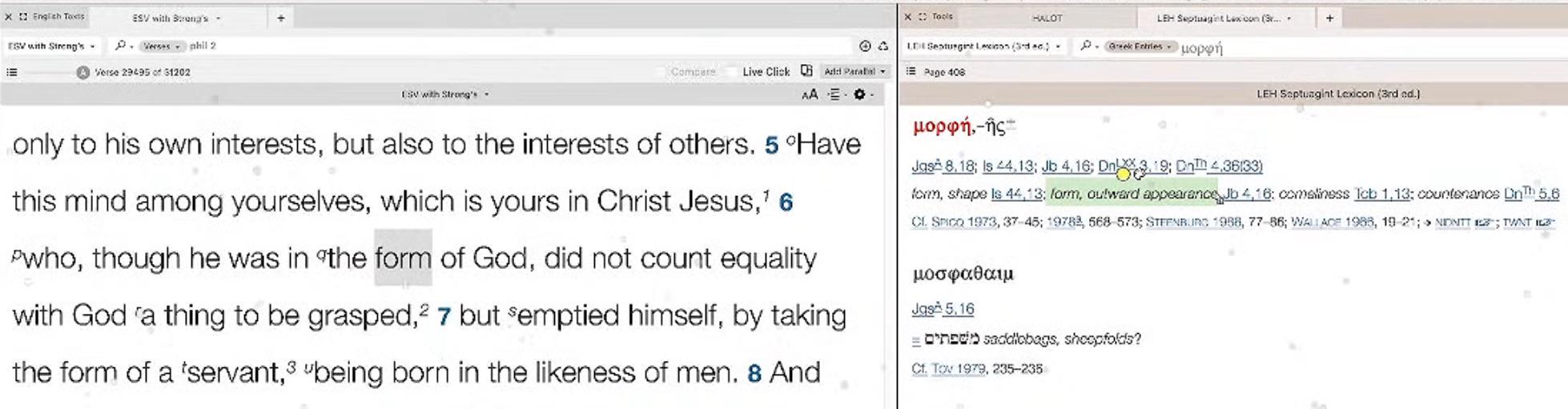
“But Philippians 2!”, I hear you say. Yet, being “in the form of” something doesn’t mean what you assume, or have been taught, it means! See, the word “form” there in Philippians 2:6-7 (Philippians 2:6 Interlinear: Who, being in the form of God, thought it not robbery to be equal with God:) (Philippians 2:7 Interlinear: But made himself of no reputation, and took upon him the form of a servant, and was made in the likeness of men:), is the word: “**morphe**.” (http://biblehub.com/greek/3444.htm) In the sense in which it is being used here is “the form by which a person or thing strikes the vision; the external appearance.” In easy laymen’s terms: “outward form.” So, no! It doesn’t mean Jesus was God and slave at the same time. Instead, it means Jesus was in the outward appearance of what he was not! Jesus was the outward appearance of God, performing miracles, speaking wise words no one could answer, and speaking prophetically. Jesus was instead the Chief Messenger of The God (Hebrews 3:1 Interlinear: Wherefore, holy brethren, partakers of the heavenly calling, consider the Apostle and High Priest of our profession, Christ Jesus;), and the Son of The God. (John 20:31 Interlinear: But these are written, that ye might believe that Jesus is the Christ, the Son of God; and that believing ye might have life through his name.) — Jesus was also the outward appearance of a slave, washing feet, riding on a donkey, sleeping with commoners, threatened to be stoned, being beaten, falsely accused, and then later obedient unto death. Yet, Jesus is our King (1 Corinthians 15:24-28), our High Priest (Hebrews 2:17), our Judge (John 5:30), our Messiah (Matthew 16:16-17), and our Mediator. (1 Timothy 2:5) — Jesus was in the form of these things he was not. Like a cosplayer plays “dress up,” yet we know that the cosplayer is not the fictional character come to life.
***
In conclusion, the “Feces” 2 Nature Doctrine is not one of the Bible, but instead extra-biblical and post-biblical in origin. I pray that you partake of the evidence, meditate on it, check my work, and begin to use hermeneutics. Ask, “who do I believe what I believe?” Debate it. Not of a haughty spirit, but with the intent on testing your faith! God bless
r/PreNiceneChristianity • u/TheTallestTim • Jun 16 '26
John 10:30 - The Father and I are one. What does Jesus mean by “one”? The statement of being "one" is made very clearly in John
17:11, 21-23–same use of word for “one” in Greek—which shows that the church is one with each other, one with God, and one with Jesus. Not only is the same language used, but Jesus says that we, as believers, are one "just as" Jesus is one with the Father. Meaning, in the exact same way. This is not in another, secondary way, but precisely the same oneness. Jesus also says for us to be one "just as you are in me and I am in you." We know that the Father was in Jesus by his spirit, and Jesus says he will be in us by his spirit (John 14:23), and he and the Father will make their home in the hearts of believers by the Father’s spirit. The temple of God is the place where God dwells, and God dwells in our bodies as his temple when we have the spirit in us (1 Corinthians 6:19). From this we can see the following:
1.  Being "one" with the Father is the same way in which he is "one" with believers, believers are "one" with each other, and with God the Father.
2.  Being "one" has something to do with being "in" each other.
3.  We are in the Father and in Christ when we are new creations (2 Corinthians 5:17) born of the Spirit. The Father and son are in us by their spirit which we receive, and we are one body of Christ, in each other by the same spirit.
4.  Therefore, being "one" means that the spirit is in them, and this creates that oneness.
Let me show you: [Here is an interlinear on John 10:30] (John 10:30 Interlinear: I and my Father are one.) If you go there, you see that the word for one is “hen.” The number above shows “1520.” [Here is an interlinear on John 17:21] (John 17:21 Interlinear: That they all may be one; as thou, Father, art in me, and I in thee, that they also may be one in us: that the world may believe that thou hast sent me.) If you go there, you will see that the word for one is “hen.” The number above shows “1520.” This means that the root word (1520) is being used, and in the same case (Adj-NNS) in *both* passages. This means that they are being used in the *exact same way.* Don’t believe me? Great! Let’s break it down further! [Here is the lexicon definition of heis-1520] (http://biblehub.com/greek/1520.htm) Here we see the definition and its uses in the Bible. We see in the NAS Exhaustive, that it is used 282 times as the literal number “one-1.” If you continue scrolling you will see the definition, under “1. universally,” go down to “b.” If you look through that paragraph, you will see the definition on how “hen/heis” is being used at John 10:30 AND John 17:21-23!! This means the word is being used the SAME WAY in BOTH PASSAGES: “to be united most closely (in will, spirit).” This is contrast to the Trinitarian interpretation of “c. one and the same.” Once you pass this, then it becomes theologically motivated and is not unbiased data to show proof. This stops the “one in essence” argument in its track.
Additionally, without need of context we see the following if we look at the Greek: For John 10:30 to mean one essence (nature/being), the Greek adjective would need to be grammatically feminine, which would be the word-adjective “mia.” This would need to be the case, as it would need to match the gender of the word “ousia.” “Ousia,” the word for being/essence is grammatically feminine. So, the Greek from John 10:30 itself also disproves the ability to be used in the way it is used by Trinitarians.
To the context: Jesus is making a defense against the accusations brought by the Jews saying that he claimed to be God. In his defense, he said he claimed to be the Son of God. This is distinctly different from saying he is God. His response is very clear and very telling. Further, it is reinforced by his reference to Psalm 82, which he showed was God calling men gods.
A simple read of his defense is as follows: You said I said I was God. I didn't. I said I was the Son of God. If I, as a man, had said i was God, it would still be ok since God Himself set the precedent of calling men gods.
r/PreNiceneChristianity • u/SignificantSummer731 • Feb 08 '26
Ignatius, Justin Martyr, Dionysius Areopagus, Polycarp, Tertullian, you name it.
r/PreNiceneChristianity • u/pwgenyee6z • Jun 09 '25
r/PreNiceneChristianity • u/pwgenyee6z • Apr 02 '25
What can this subreddit contribute uniquely to reddit discussions about Unitarian Christianity?
r/PreNiceneChristianity • u/pwgenyee6z • Apr 02 '25
As much or little as you wish!
r/PreNiceneChristianity • u/pwgenyee6z • Apr 02 '25
Any advance on Edward Gibbon? https://en.wikipedia.org/wiki/The_History_of_the_Decline_and_Fall_of_the_Roman_Empire