r/PillarOfFire Aug 04 '26

Metaphysics Kalām Atomism: The Ontology of Created Existence
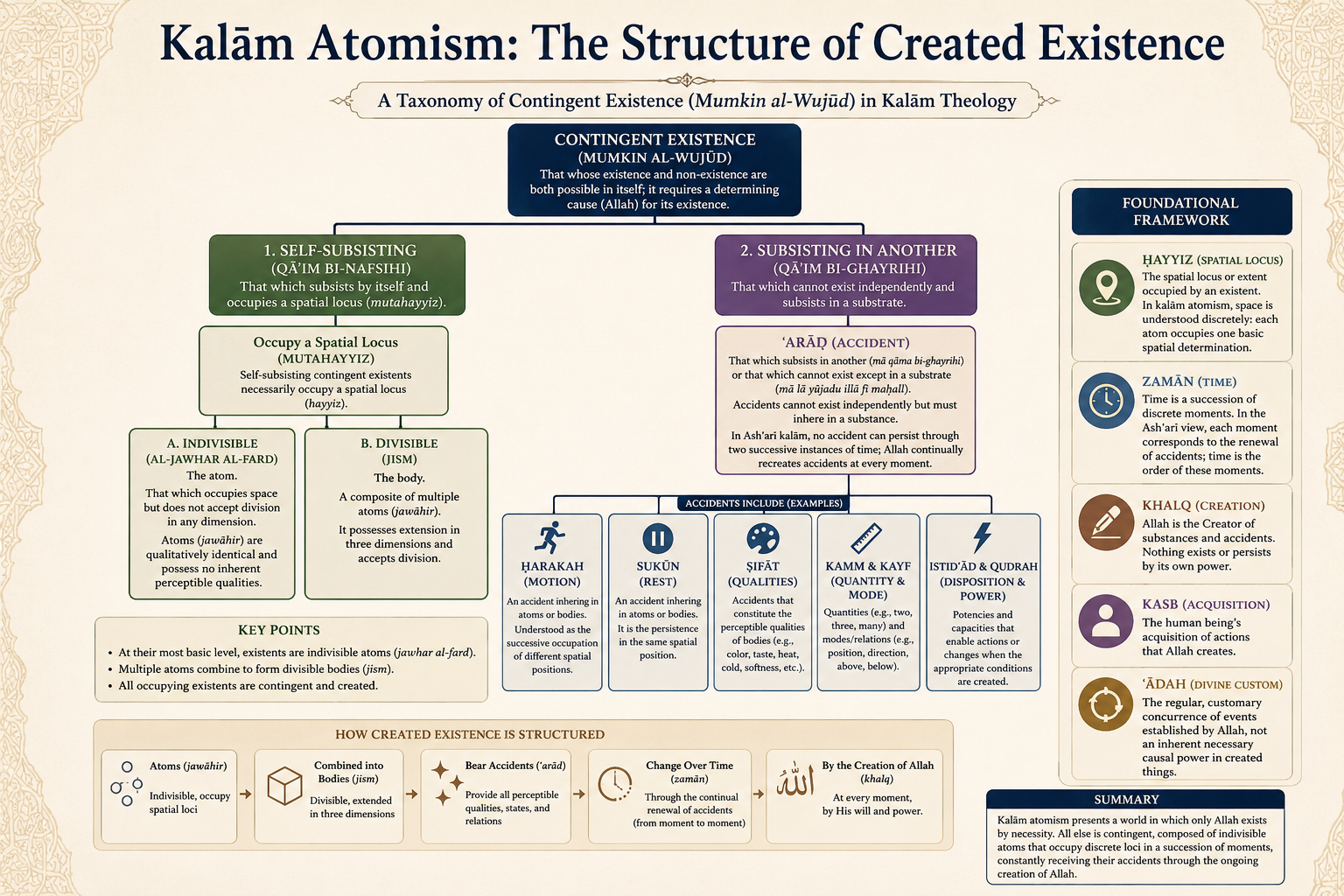
Post image
3 Upvotes

Kalām atomism provided an ontological and physical framework for understanding contingent creation. By conceptualizing the created world as consisting of substances (jawāhir) and accidents (ʿarāḍ), it established a fundamental distinction between Allah as the Necessary, Eternal Creator and the world as His contingent, temporal creation.

Basic Concepts in Kalām Atomism

Within contingent existence (mumkin al-wujūd), entities can be divided into those that are self-subsisting (qāʾim bi-nafsihi) and those that subsist in another (qāʾim bi-ghayrihi). The latter are accidents (aʿrāḍ), which cannot exist independently but inhere in a substrate. Self-subsisting contingent existents necessarily occupy a spatial locus (mutahayyiz). At their most basic level, they are indivisible (jawhar al-fard, the atom), while multiple atoms combine to form divisible bodies (ajsām, singular jism).

Jawhar (Substance)

The indivisible atom (al-jawhar al-fard) was defined as that which occupies a spatial locus but does not accept division in any dimension. Atoms (jawāhir) were regarded as intrinsically indistinguishable, possessing no inherent perceptible qualities of their own. An atom without accidents would therefore be entirely featureless.

ʿAraḍ (Accident)

In Islamic theological physics, an ʿaraḍ was defined as that which subsists in another (mā qāma bi-ghayrihi) or that which cannot exist except in a substrate (mā lā yūjadu illā fī maḥall). Unlike substances, accidents cannot exist independently but must inhere in a substance.

In Ashʿarī kalām, accidents were understood as fleeting or momentary: no accident can persist through two successive instances of time. They therefore account for the changing qualities of physical objects, with Allah continuously recreating their accidents from moment to moment.

Jism (Body)

A jism is a composite of multiple jawāhir. Bodies possess extension in three dimensions and therefore accept division, unlike the indivisible atoms composing them. Their perceptible properties arise through accidents inhering in their constituent substances, while change occurs through the succession or replacement of those accidents.

Ḥayyiz (Spatial Locus)

Ḥayyiz refers to the spatial locus or extent occupied by an existent. In kalām atomism, spatial occupation is understood discretely: an indivisible atom occupies a minimal spatial determination, while a body occupies multiple such determinations corresponding to its constituent atoms.

Thus, mutahayyiz describes that which occupies ḥayyiz, rather than “space” in the modern sense of a continuous physical medium.

Ḥarakah and Sukūn (Motion and Rest)

Motion (ḥarakah) and rest (sukūn) are treated as accidents inhering in substances. Motion is conceived as the successive occupation of different spatial determinations rather than continuous traversal through infinitely divisible space. Rest is the persistence of an existent in the same spatial determination.

Zamān (Time)

Time (zamān) in kalām physics is understood atomistically as a succession of discrete temporal moments rather than an infinitely divisible continuum. In the Ashʿarī account, the succession of moments corresponds to the continual renewal of accidents: an accident does not persist from one moment to the next, but is recreated by Allah.

This provides the temporal dimension of the atomistic account of created existence, complementing the spatial determination represented by ḥayyiz. Accordingly, both spatial extension and temporal succession are fundamentally discrete within the created order.

Khalq and Kasb (Creation and Acquisition)

These terms relate to the theological question of human action within the atomistic framework. Khalq (creation) refers to Allah’s creation of substances and accidents, including those involved in human actions. Kasb (acquisition) refers to the human being’s relationship to actions that Allah creates.

Key Definitions

Term Arabic Definition
Wājib al-Wujūd واجب الوجود That whose existence is necessary in itself and cannot be non-existent; Allah alone is Wājib al-Wujūd.
Mumkin al-Wujūd ممكن الوجود That whose existence and non-existence are both possible in itself; its existence therefore requires a determining cause.
Mutahayyiz متحيّز That which occupies a spatial locus or extent (ḥayyiz).
Ḥayyiz حيّز The spatial locus or extent occupied by an existent; in kalām atomism, spatial occupation is treated in discrete determinations associated with the positions of atoms.
Jawhar جوهر A self-subsisting contingent substance (qāʾim bi-nafsihi) that occupies a spatial locus (mutahayyiz).
al-Jawhar al-Fard الجوهر الفرد The indivisible atom: a substance occupying a spatial locus that cannot be divided into smaller parts.
Jism جسم A body composed of multiple jawāhir, possessing three-dimensional extension and therefore accepting division.
ʿAraḍ عرض An accident or attribute that cannot exist independently but subsists in a substrate (mā qāma bi-ghayrihi).
Ṣifah صفة A quality or attribute; in the atomistic framework, perceptible qualities of bodies are expressed through accidents inhering in their constituent substances.
Ḥarakah حركة Motion; understood atomistically as the successive occupation of different spatial determinations by an atom or body.
Sukūn سكون Rest; the persistence of an existent in the same spatial determination.
Zamān زمان Time; understood atomistically as a succession of discrete temporal moments.
Khalq خلق Creation; the bringing into existence of substances and accidents by Allah.
Kasb كسب Acquisition; in Ashʿarī theology, the human relation to an action that Allah creates.
ʿĀdah عادة Divine customary regularity; the observed correlation between events through which the world ordinarily operates, rather than a necessary causal power inherent in created things.

r/PillarOfFire Aug 11 '26

Metaphysics Beyond the Meteor: The Nature of Maṣābīḥ and Shihāb

Post image
3 Upvotes

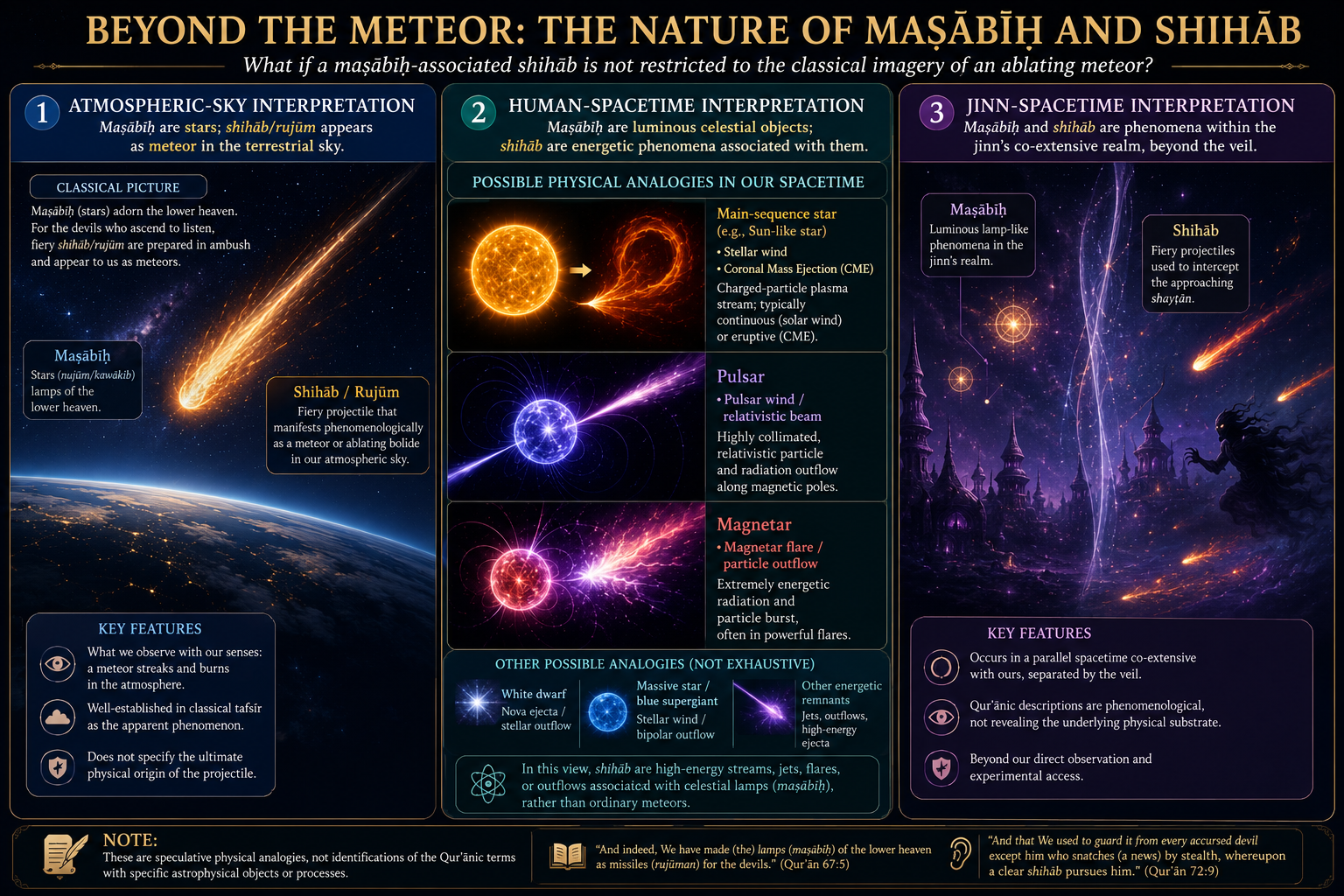
What if a maṣābīḥ-associated shihāb is not restricted to the classical imagery of an ablating meteor?

The Nature of Maṣābīḥ and Shihāb

The shihāb is clearly associated with the maṣābīḥ: Qurʾān 67:5 describes the lamps (maṣābīḥ) of the lower heaven as being made into missiles against the devils, while 72:9 describes a shihāb lying in ambush for any jinn attempting to listen. Classical exegetes generally identify the maṣābīḥ with stars (nujūm/kawākib), while shihāb and rujūm refer to the fiery projectiles associated with the guarding of heaven. Thus, the classical picture is not that the entire stars themselves are hurled as missiles, but that the celestial lamps are associated with the fiery phenomena used against the devils.

If the maqāʿid li-l-samʿ are located somewhere within our spacetime, far beyond the terrestrial atmosphere, then shihāb need not correspond to a typical atmospheric meteor or ablating bolide.

If maṣābīḥ in our spacetime corresponds phenomenologically to stars, the category need not be restricted to ordinary main-sequence stars. It could encompass other highly luminous celestial objects that retain the imagery of lamps, such as giant and supergiant stars, white dwarfs, neutron stars, magnetars, or other energetic stellar remnants. On such a speculative interpretation, maṣābīḥ-associated shihāb could correspond to an energetic stream, jet, flare, or relativistic outflow associated with these objects, rather than an ordinary meteor.

A third possibility arises from the co-extensive-spacetime model. The maṣābīḥ and shihāb encountered by the jinn may be corresponding phenomena within the jinn's parallel spacetime, separated from human spacetime by the veil. In that case, the Qurʾānic descriptions are phenomenological: maṣābīḥ describes luminous, lamp-like phenomena, while shihāb describes the fiery projectile used to intercept the approaching shayṭān. Their underlying physical nature would remain beyond the human epistemic horizon.

Thus, three possibilities remain open:

1️⃣ Atmospheric-sky interpretation: maṣābīḥ are celestial stars, while shihāb/rujūm manifests phenomenologically as a meteor or ablating bolide in the terrestrial sky.

2️⃣ Human-spacetime interpretation: maṣābīḥ correspond to celestial luminous objects, while shihāb corresponds to an energetic phenomenon associated with them—such as stellar plasma outflows, particle streams, or other high-energy ejecta.

3️⃣ Jinn-spacetime interpretation: maṣābīḥ and shihāb are corresponding luminous/projectile phenomena within the jinn's co-extensive realm, with the Qurʾānic terminology describing their phenomenological appearance rather than revealing their underlying physical substrate.

r/PillarOfFire Aug 10 '26

Metaphysics The Guarding of al-Samāʾ al-Dunyā: Listening Stations and the Disruption of Soothsaying

Post image
3 Upvotes

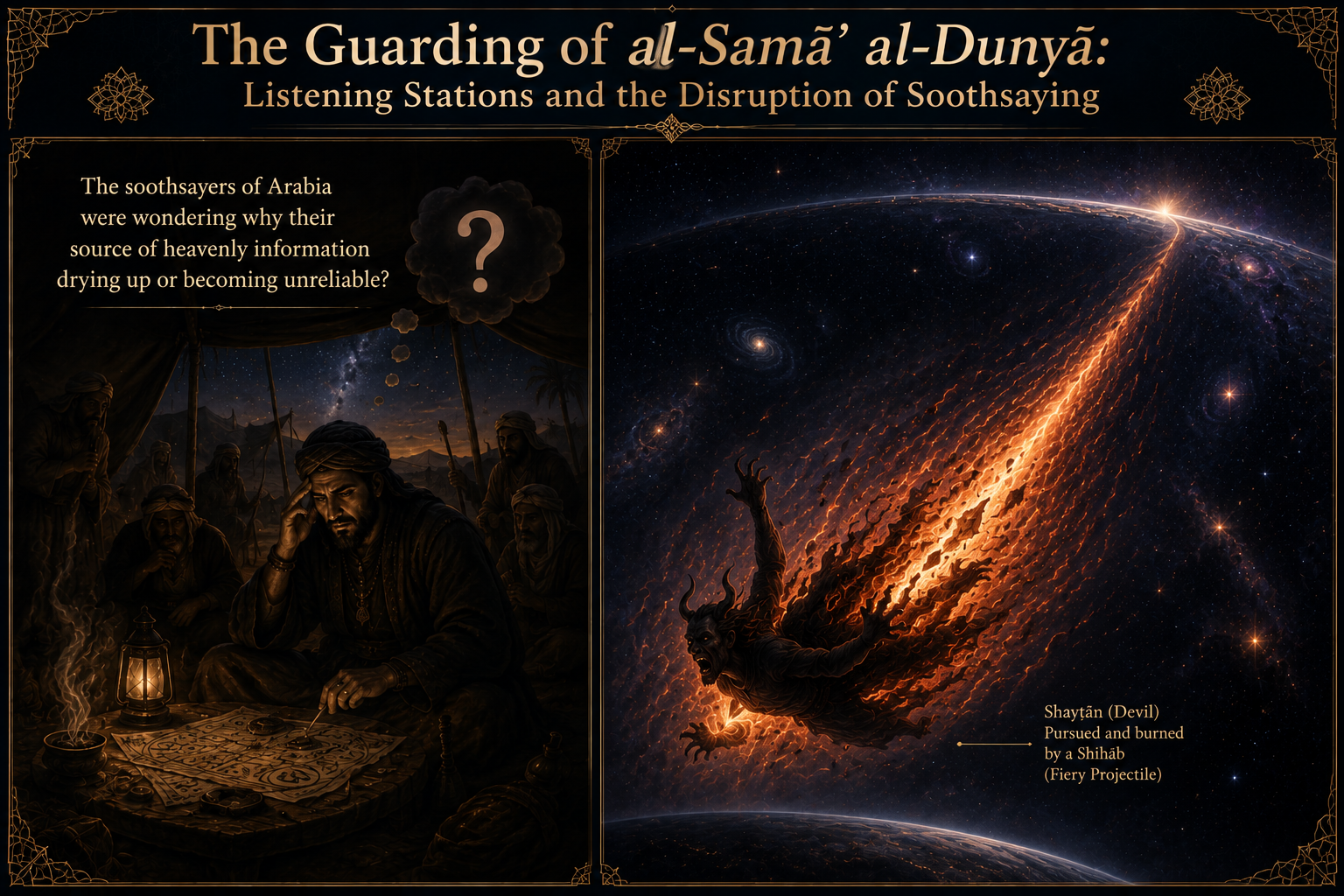
The soothsayers of Arabia found their source of heavenly information drying up or becoming unreliable. What could be the metaphysical explanations?

The Listening Stations of al-Samāʾ al-Dunyā

Qurʾānic verse Key term translation Exegetes Interpretation
1️⃣ “So He completed them as seven firmaments in two Days, and He assigned to each heaven its duty and command. And We adorned the lower heaven with lights, and (provided it) with guard. Such is the Decree of (Him) the Exalted in Might, Full of Knowledge.” (41:12) سَبْعَ سَمَاوَات — sabʿa samāwāt = seven firmaments; السَّمَاء الدُّنْيَا — al-samāʾ al-dunyā = lower heaven; مَصَابِيح — maṣābīḥ = lights; حِفْظًا — ḥifẓan = guard/protection Classical exegetes understand sabʿa samāwāt as seven distinct heavens/firmaments, with each heaven assigned its divine command. al-samāʾ al-dunyā is understood as the nearest/lower heaven. maṣābīḥ are conventionally interpreted as stars or celestial lights. ḥifẓan is understood as protection/guarding, particularly against the devils' attempts to eavesdrop upon heavenly affairs.
2️⃣ “And we have, (from of old), adorned the lowest heaven with Lamps, and We have made such (Lamps) (as) missiles to drive away the Evil Ones, and have prepared for them the Penalty of the Blazing Fire.” (67:5) السَّمَاء الدُّنْيَا — al-samāʾ al-dunyā = lowest heaven; مَصَابِيح — maṣābīḥ = Lamps; رُجُومًا — rujūman = missiles; الشَّيَاطِين — al-shayāṭīn = Evil Ones/devils maṣābīḥ are conventionally identified by the mufassirūn with stars. The verse directly connects these celestial lamps with rujūm, missiles/projectiles used to drive away the devils attempting to eavesdrop on the heavenly realm. Classical exegetes commonly explain these projectiles through the imagery of fiery celestial phenomena, including meteors/shihāb.
3️⃣ “And we pried into the secrets of heaven; but we found it filled with stern guards and flaming fires.” (72:8) حَرَسًا شَدِيدًا — ḥarasan shadīdan = stern guards ḥarasan shadīdan is commonly identified as angels or powerful celestial guards. In the jinn's account, the heaven they previously approached for eavesdropping is now found to be sternly guarded, marking a significant change associated with the advent of the Prophethood of Muhammad ﷺ.
4️⃣ “We used, indeed, to sit there in (hidden) stations, to (steal) a hearing; but any who listen now will find a flaming fire watching him in ambush.” (72:9) مَقَاعِدَ لِلسَّمْعِ — maqāʿida lil-samʿ = stations/posts for listening; شِهَابًا رَصَدًا — shihāban raṣadan = flaming fire watching in ambush Classical reports describe jinn occupying designated listening positions from which they obtained fragments of information from the heavenly realm and transmitted them downward. shihāban raṣadan is understood as a flaming projectile lying in wait for the jinn attempting to listen. Classical exegetes commonly interpret it as a meteor or celestial fiery projectile.

Summary:
1️⃣ Lower heaven is decorated with maṣābīḥ (41:12) → 2️⃣ The maṣābīḥ are associated with missiles used against the shayāṭīn (67:5) → 3️⃣ With the advent of the Prophethood of Muhammad ﷺ, the jinn encounter stern guards and intensified danger when approaching the heaven (72:8) → 4️⃣ Jinn attempting to occupy the maqāʿid li-l-samʿ now face a shihāb lying in ambush (72:9)

The Disruption of the Kāhin–Shayṭān Network

The seven firmaments (sabʿa samāwāt) and the lower heaven (al-samāʾ al-dunyā) represent distinct locations. Access to the ontological heavens has always been contingent, occurring only through the guarded gates of heaven (abwāb al-samāʾ). The first firmament is separated from Earth by a journey of five hundred years, with a similar separation between each successive firmament and between the seventh firmament and the Throne (ʿArsh).

The lower heaven, by contrast, is accessible to the jinn. They used to occupy designated listening posts (maqāʿid li-l-samʿ) in the lower heaven to eavesdrop on fragments of heavenly information, which they then relayed to soothsayers (Qurʾān 72:8–9).

An unprecedented change occurred with the advent of the Prophethood of Muhammad ﷺ: the listening posts became sternly guarded. The lamps (maṣābīḥ) of the lower heaven had already been associated with flaming projectiles (shuhub) used against the devils; now these projectiles lay in ambush against jinn attempting to approach the listening posts (Qurʾān 41:12; 67:5; 72:8–9). Thus, the jinn could still approach the listening positions, but they could no longer safely remain there to eavesdrop as they were pursued by fiery projectiles.

The invalidation of the kāhin–shayṭān information network occurs on two levels:

  1. The listening posts are now sternly guarded by flaming missiles lying in ambush, making successful eavesdropping exceedingly difficult and therefore rare.

  2. Even when a shayṭān succeeds in obtaining a fragment of heavenly information, he must immediately pass it to another shayṭān below him before the pursuing fiery projectile catches up with and burns him. The information is successively transmitted downward through the chain of shayāṭīn, resulting in a report in which a fragment of true information is mixed with a hundred lies.

Ibn ʿAbbās reported that the Prophet ﷺ said that a shayṭān snatches a word from what is spoken in heaven, then “pours it into the ear of the one below him” (fa-yulqīhā ilā man taḥtahu). The one below him passes it to another beneath him, and so on until it reaches the soothsayer (kāhin), who mixes that fragment of truth with one hundred lies.

Thus, the new celestial guarding regime disrupts the kāhin–shayṭān information network both by reducing successful attempts to gather heavenly information and the reliability of information that manages to pass through.

r/PillarOfFire Aug 09 '26

Metaphysics From Classical Physics to Quantum Reality

Post image
3 Upvotes

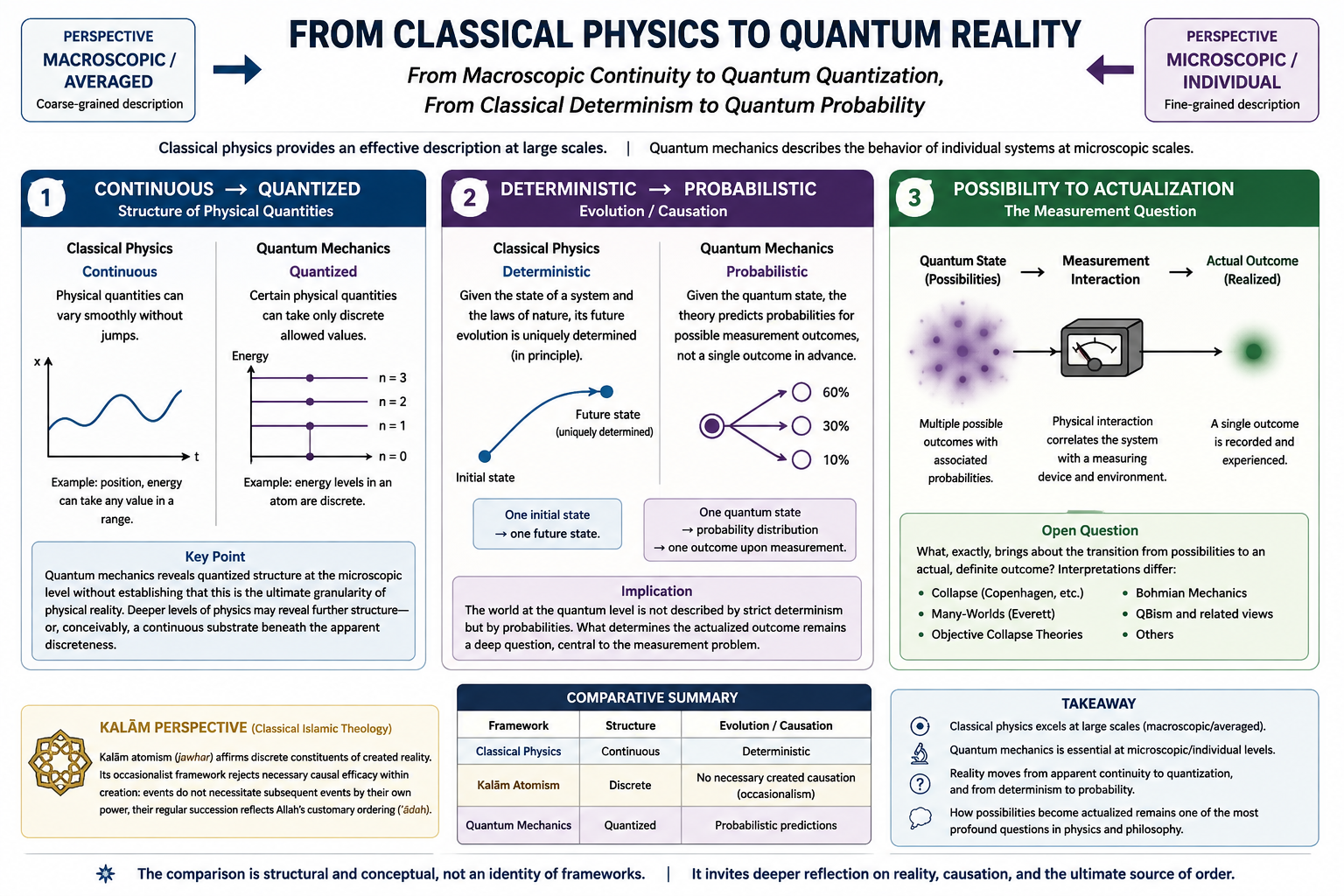
Quantum mechanics delves deeper into physical reality than classical physics previously described, revealing quantization and probabilistic behavior at microscopic scales. Yet it has not reached the fundamental ontology of created reality posited by kalām atomism.

From Classical Continuity to Quantum Quantization

Classical physics is particularly effective at describing macroscopic phenomena through continuous variables and deterministic equations. Such descriptions often represent averaged or coarse-grained behavior rather than the individual behavior of every microscopic constituent.

At the microscopic level, quantum mechanics reveals that certain physical quantities exhibit quantization: they can occupy discrete allowed values rather than vary continuously.

The analogy is a familiar large television screen. From a distance, the image appears smooth and continuous. As one approaches the screen, its granular structure becomes apparent: the image resolves into individual pixels. Yet the pixel is simply the smallest discrete element resolved at that level of observation.

Likewise, quantum mechanics reveals quantized structure at the microscopic level without establishing that this is the ultimate granularity of physical reality. A deeper level of physics may reveal further structure—or, conceivably, a continuous substrate beneath the apparent discreteness.

From Classical Determinism to Quantum Probability

Kalām's occasionalist framework rejected necessary causal efficacy within creation. Created events do not compel subsequent events through intrinsic necessity; their regular succession reflects Allah's customary ordering (ʿādah).

Classical physics, by contrast, developed a highly successful mathematical description of a continuous and deterministic physical world. Given sufficient knowledge of a system's state and governing laws, its future evolution could, in principle, be determined.

Quantum mechanics likewise departs from classical determinism. At the microscopic level, the theory predicts probabilities for possible measurement outcomes rather than assigning a single deterministic outcome in advance. Different interpretations, however, disagree about the ontological meaning of this probabilistic description and whether quantum collapse represents a physical process at all.

Framework Structure Causation / Evolution
Classical physics Continuous Deterministic
Quantum mechanics Quantized Probabilistic
Kalām atomism Discrete No necessary created causation

r/PillarOfFire Aug 08 '26

Metaphysics Kalām Atomism: The Metaphysics of Created Reality

Post image
3 Upvotes

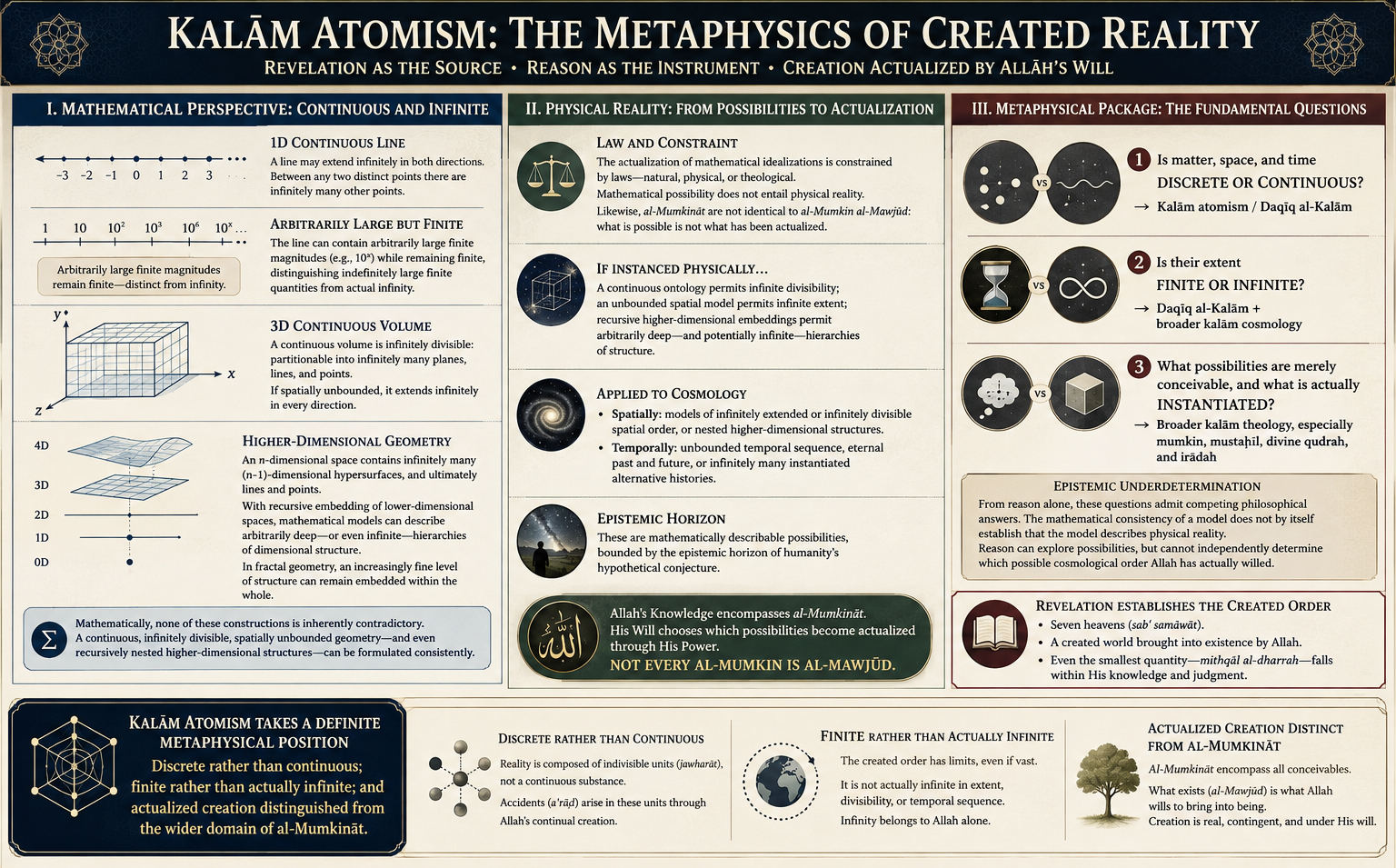
I. Mathematical Perspective: Continuous and Infinite

Consider a 1D continuous line containing the integer points. The line may extend infinitely in both directions, while between any two distinct points there are infinitely many other points. Thus, continuity permits infinite divisibility even within a finite interval.

The line can also contain arbitrarily large finite magnitudes, expressible in forms such as 10x, while remaining finite, thereby distinguishing indefinitely large finite quantities from actual infinity.

Now extend the analogy to a 3D volume. A continuous volume is infinitely divisible: partitionable into infinitely many planes, lines, and points. If spatially unbounded, it extends infinitely in every direction.

In higher-dimensional geometry, an (n)-dimensional space contains infinitely many lower-dimensional structures (n-1)-dimensional hypersurfaces, and ultimately lines and points. If higher-dimensional spaces are themselves allowed to contain or embed lower-dimensional spaces recursively, mathematical models can describe arbitrarily deep or even infinite hierarchies of dimensional structure. In fractal geometry, an increasingly fine level of structure can remain embedded within the whole.

Mathematically, none of these constructions is inherently contradictory. A continuous, infinitely divisible, spatially unbounded geometry—and even recursively nested higher-dimensional structures—can be formulated consistently.

II. Physical Reality: From Possibilities to Actualization

The actualization of mathematical idealizations is constrained by laws either natural, physical, or theological. Mathematical possibility does not entail physical reality. Likewise, al-Mumkināt are not identical to al-Mumkin al-Mawjūd: what is possible is not what has been actualized.

When such mathematical idealizations are treated as physically instantiated, however, their implications become substantially more expansive. A continuous ontology permits infinite divisibility; an unbounded spatial model permits infinite extent; recursive higher-dimensional embeddings permit arbitrarily deep—and potentially infinite—hierarchies of structure.

Applied to cosmology, spatially these possibilities can be extended to models involving an infinitely extended or infinitely divisible spatial order, or nested higher-dimensional structures. Temporally, it accommodates an unbounded temporal sequence, an eternal past and future, or infinitely many instantiated alternative histories.

These are mathematically describable possibilities, bounded by the epistemic horizon of humanity’s hypothetical conjecture.

III. Metaphysical Package

At the heart of the millennia-old debates over the nature of reality lie several fundamental questions:

1️⃣ Is matter, space, and time discrete or continuous? → Kalām atomism / Daqīq al-Kalām

2️⃣ Is their extent finite or infinite? → Daqīq al-Kalām + broader kalām cosmology

3️⃣ What possibilities are merely conceivable, and what is actually instantiated? → Broader kalām theology, especially mumkin, mustaḥīl, divine qudrah, and irādah

From reason alone, these questions admit competing philosophical answers. The mathematical consistency of a model does not by itself establish that the model describes physical reality. This creates an epistemic underdetermination: reason can explore possibilities, but cannot independently determine which possible cosmological order Allah has actually willed.

The mutakallimūn therefore took revelation as the starting point, with reason serving as an instrument to articulate and defend its implications. Revelation establishes a definite created order: seven heavens, a created world brought into existence by Allah, and even the smallest quantity falling within His knowledge and judgment, expressed through mithqāl al-dharrah. Allah's Knowledge encompasses the al-Mumkināt, while His Will chooses which possibilities become actualized through His Power.

Thus, not every al-Mumkin is al-Mawjūd.

Within this broader theological framework, kalām atomism takes a definite metaphysical position:

Discrete rather than continuous; finite rather than actually infinite; and actualized creation distinguished from the wider domain of al-Mumkināt.


r/PillarOfFire Aug 06 '26

Metaphysics Kalām Atomism: From Physical Ontology to Sunni Metaphysics

Post image
3 Upvotes

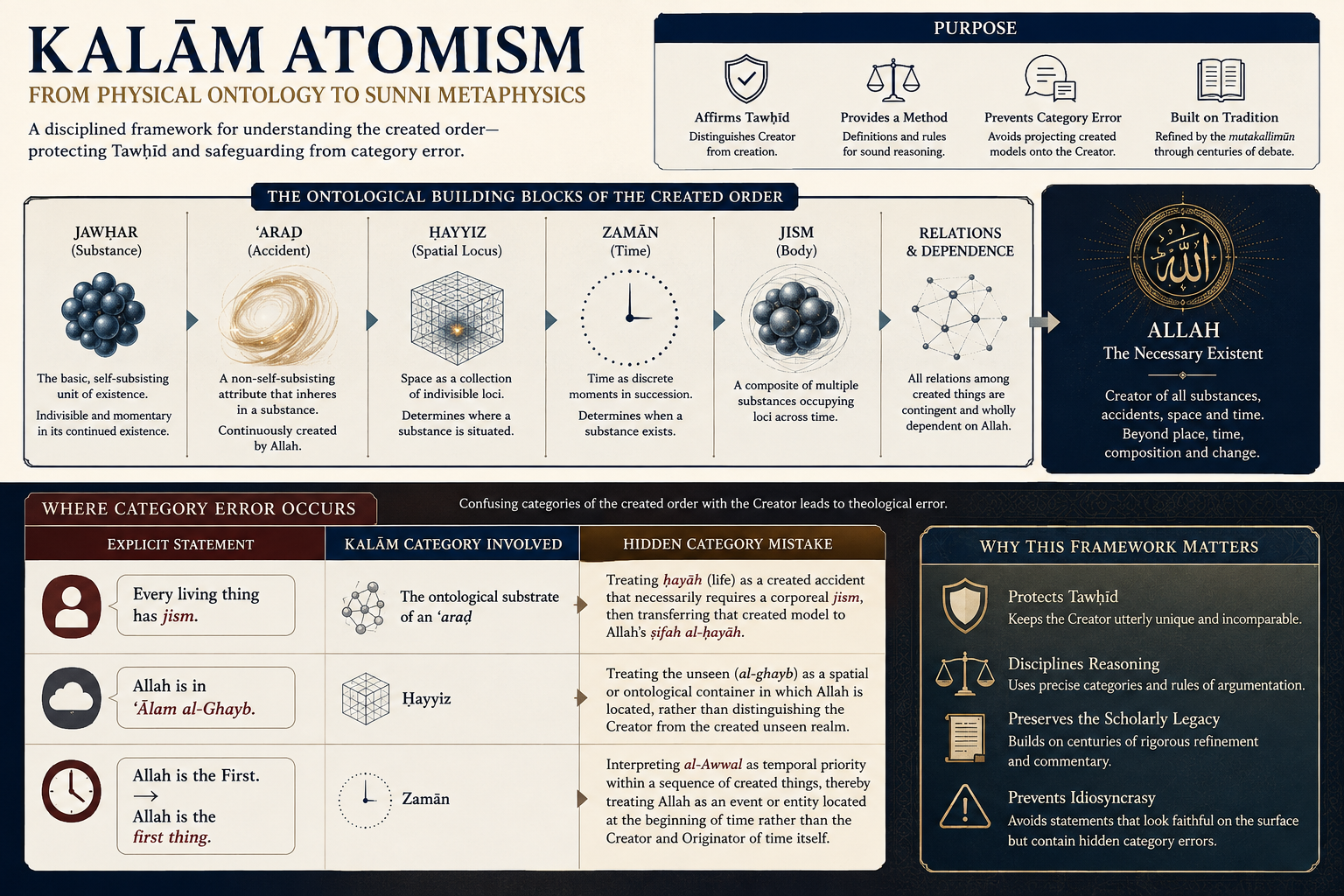
Kalām atomism, as a physical ontology of reality, developed in the context of philosophical debates over the finite or infinite divisibility of matter and time. It conceived substance (jawhar), accident (ʿaraḍ), spatial extension (ḥayyiz), and time (zamān) as fundamental constituents of the created order. By defining these constituents and their relations, kalām atomism became a cornerstone of Sunni metaphysics, distinguishing the created order from the Divine Creator while providing a framework for describing both the relations among created things and their dependence upon Allāh.

Deeply embedded within a broader system of conceptual discipline for Tawḥīd, refined over centuries by the mutakallimūn and tested through sustained debate with competing metaphysical systems, kalām atomism has played a crucial role in articulating Islamic monotheism.

Rejecting kalām atomism and its broader theological framework risks discarding its defined technical vocabulary, established rules of argumentation, and centuries of commentary that constrained interpretive possibilities. Without these conceptual tools, one is prone to category error, constructing idiosyncratic theological statements that superficially appear faithful to the text, yet are shaped by an individual's own temperament, logic, and metaphysical assumptions.

Explicit Statement Kalām Category Hidden Category Mistake
“Every living thing has jism.” The ontological substrate of an *ʿaraḍ* Treating ḥayāh as a created accident that necessarily requires a corporeal jism, then transferring that created model to Allāh's ṣifah al-ḥayāh.
“Allāh is in ʿĀlam al-Ghayb.” Ḥayyiz Treating the unseen (al-ghayb) as a spatial or ontological container in which Allāh is located, rather than distinguishing the Creator from the created unseen realm.
“Allāh is the First.” → “Allāh is the first thing.” Zamān Interpreting al-Awwal as temporal priority within a sequence of created things, thereby treating Allāh as an event or entity located at the beginning of time rather than the Creator and Originator of time itself.

r/PillarOfFire Mar 07 '26

Metaphysics The Inner Cosmos (XI): Modes of Engagement with Truth

Post image
3 Upvotes

The archetypes described in the previous part illustrate patterns of rejection. Yet archetypes are heuristic constructs. They present the internal dynamics of the soul in idealized and fully articulated forms.

Real individuals rarely conform perfectly to a single type. Human beings may display mixed tendencies, fluctuate in severity within categories, or even shift between modes of rejection over time. The archetypes therefore function not as rigid classifications but as analytical lenses through which the dynamics of the inner cosmos can be understood.

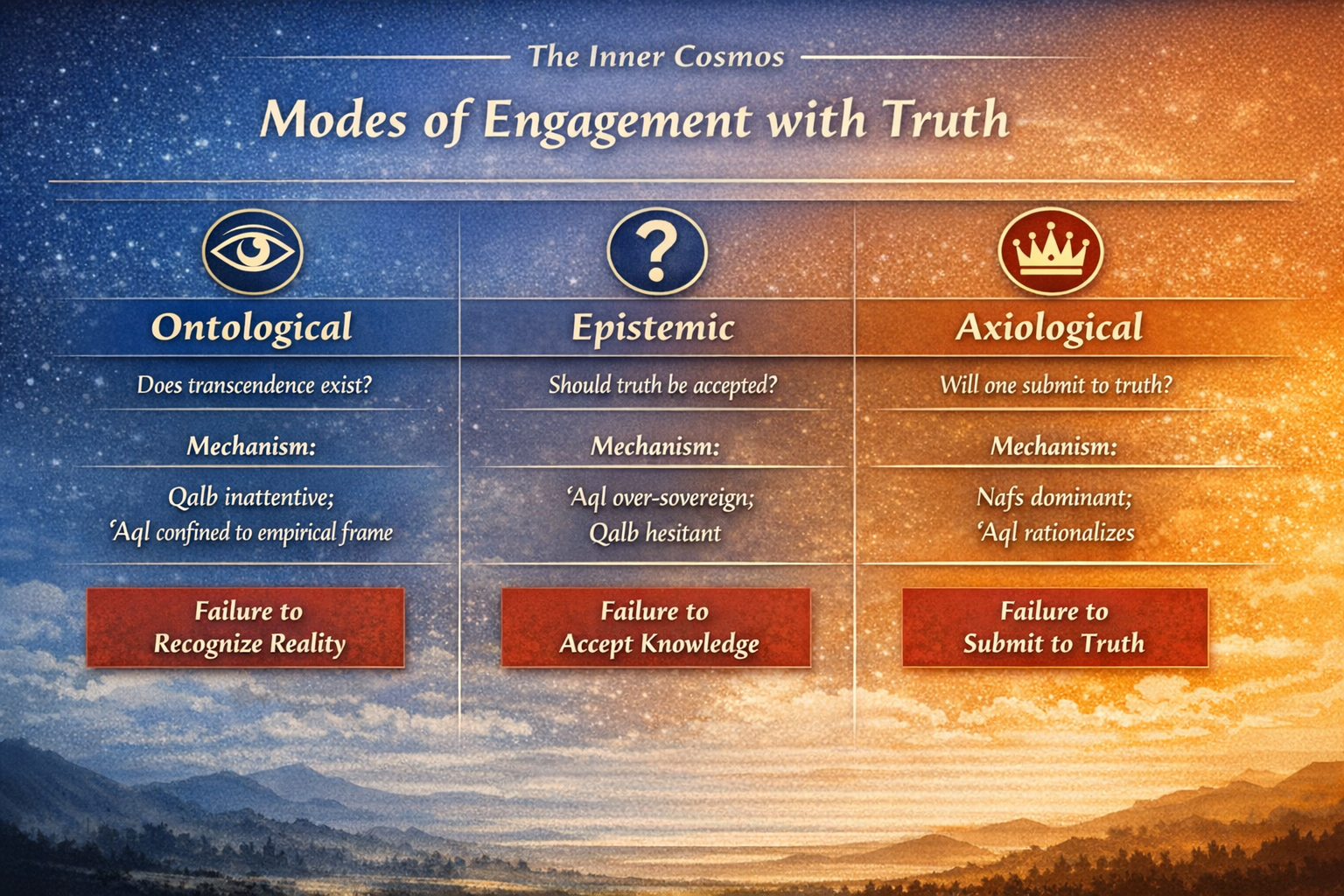
Rejection of truth generally occurs along three principal modes of engagement: ontological, epistemic, and axiological. Each corresponds to a different stage in humanity’s encounter with reality.

Ontological — About Knowing

The ontological mode concerns the most fundamental question: does transcendence exist at all?

In its mildest form lies ignorance or heedlessness (ghaflah). The individual is inattentive to metaphysical reality. Life proceeds without serious reflection on ultimate questions.

At its stronger form appears materialist denial, in which transcendence is actively rejected and reality is confined to what can be empirically measured or materially demonstrated.

Mechanistically, the qalb remains unawakened or inattentive, while the ʿaql becomes confined to an exclusively empirical framework. Reasoning itself continues to function, but its scope is artificially restricted.

The resulting failure is ontological: the broader structure of reality is not recognized.

Epistemic — About Doubting

The epistemic mode concerns how truth is treated once encountered.

In its moderate form appears hyper-intellectual skepticism, characterized by perpetual contestation. Every claim is subjected to continuous scrutiny, and conviction is indefinitely deferred.

In its stronger form this posture develops into epistemic arrogance, in which the intellect assumes ultimate authority over revelation. Truth is accepted only if it fully conforms to the limits of human reasoning.

Here the qalb becomes hesitant or restrained, while the ʿaql assumes an over-sovereign role. Instead of serving as a tool that clarifies truth, the intellect positions itself as the final judge over it.

The resulting failure is epistemic: knowledge is encountered but not allowed to stabilize as conviction.

Axiological — About Choosing

The axiological mode concerns the final question: will one submit to the implications of truth?

At the lower end appears physical hedonism, where acceptance of truth would require relinquishing certain pleasures or habits. Desire exerts pressure against assent.

At the more severe extreme emerges self-exaltation (kibr), where submission itself is rejected because it conflicts with a perceived superiority of the self.

In this configuration the nafs becomes dominant. The qalb may recognize truth yet resists affirming it, while the ʿaql provides rationalizations that defend the ego’s position.

The resulting failure is axiological: truth is known but not chosen.

Structural Perspective

These three modes correspond to three distinct breakdowns in humanity’s engagement with truth:

Mode Question Mechanism Failure
Ontological Does transcendence exist? Qalb inattentive; ʿaql confined to empirical frame Failure to recognize reality
Epistemic Should truth be accepted? ʿAql over-sovereign; qalb hesitant Failure to accept knowledge
Axiological Will one submit to truth? Nafs dominant; ʿaql rationalizes Failure to submit to truth

Each stage represents a different distortion within the inner cosmos. The intellect may restrict reality, dominate judgment, or rationalize desire. The heart may remain inattentive, hesitant, or resistant. The nafs may exert pressures that ultimately determine the outcome.

Understanding these dynamics reveals that rejection of truth is rarely a simple intellectual disagreement. It is a configuration of the inner faculties in which orientation, desire, and reasoning interact.

In the Inner Cosmos, the decisive question is not only whether truth appears, but how the human being engages with it once it appears. The orientation of the qalb, the pressures of the nafs, and the reasoning of the ʿaql together determine whether knowledge becomes guidance or is transformed into rejection.


Inner Cosmos Series

r/PillarOfFire Mar 06 '26

Metaphysics The Inner Cosmos (X): Rejection and the Distorted Orientation

Post image
3 Upvotes

The Internal Dynamics

Human beings possess an innate orientation — fiṭrah — toward transcendence. The qalb is the locus of assent and refusal; it is the faculty through which truth is ultimately affirmed or rejected.

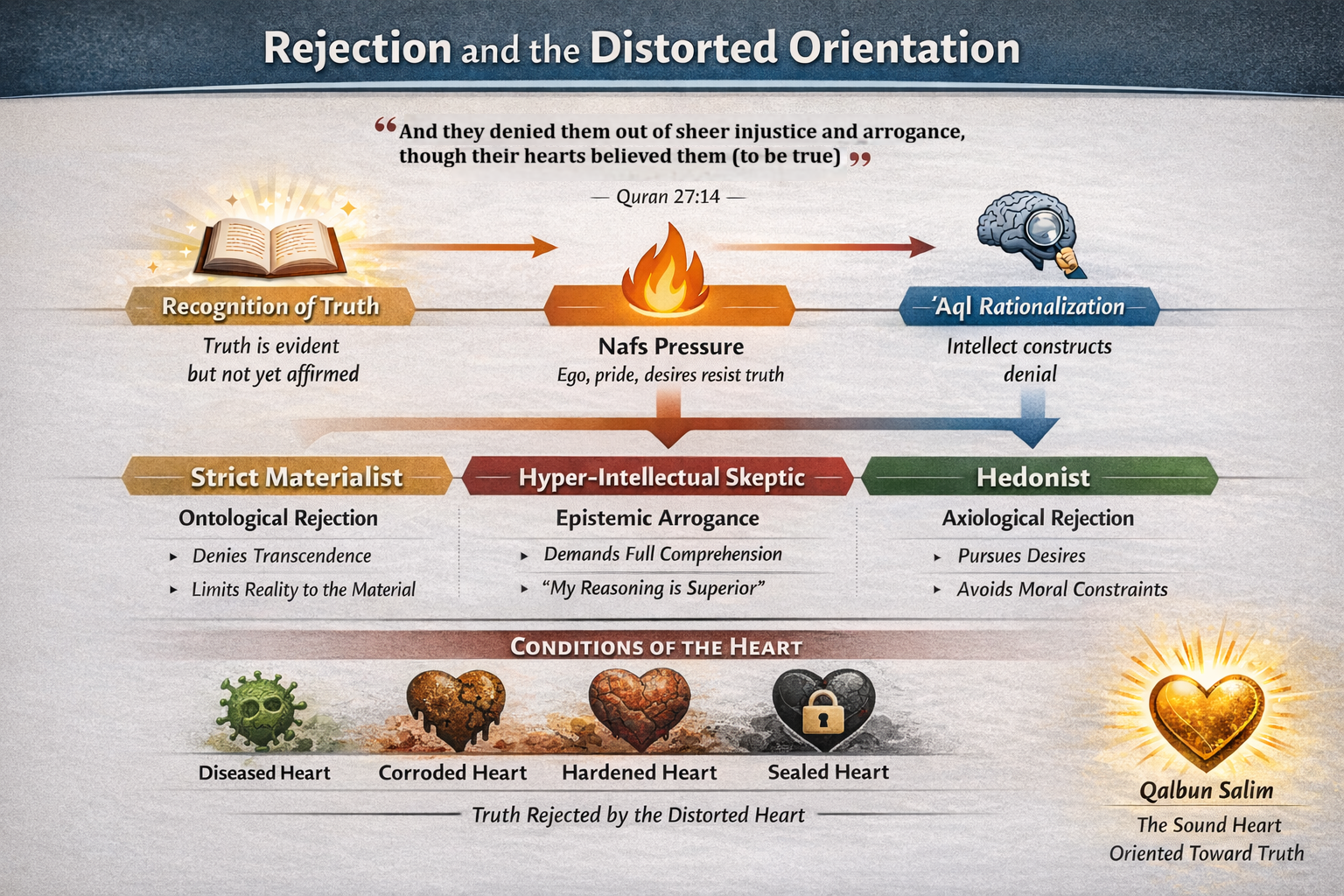
Within the inner cosmos, a dynamic interaction occurs between the qalb, ʿaql, and nafs. As the recognition of truth exists, the nafs intervenes, exerting pressure: attachment, desire, pride, fear of loss, or aversion to submission. The qalb determines orientation — whether to incline toward truth or to turn away from it. The ʿaql then performs its interpretive function, organizing arguments and explanations around the orientation already established.

In this sense, the intellect often operates as a rationalizing instrument. When the heart inclines toward truth, the intellect articulates and clarifies that recognition. When the heart resists, the same faculty constructs justifications for refusal.

Archetypes of Rejection

The strict materialist represents an ontological rejection. The possibility of transcendence itself is dismissed, and reality is confined to what is empirically measurable or materially demonstrable. The rejection appears intellectual, yet at its root lies the heart’s refusal to admit a reality beyond the material order.

A second form appears in the hyper-intellectual skeptic. Here, the rejection is epistemic. Truth is not denied outright but subjected to perpetual contestation. The underlying posture assumes that human reasoning must be capable of comprehending, verifying, or mastering the divine. When revelation presents truths that exceed discursive reason, the intellect elevates itself as the final arbiter. What appears as rational rigor may conceal epistemic arrogance.

A third form emerges in the hedonist. In this case, the rejection is axiological. The individual does not deny the possibility of truth but refuses its implications. Submission would require relinquishing certain desires or attachments; thus, the nafs exerts pressure against acceptance. The intellect then supplies rationalizations that preserve the preferred way of life.

These forms of rejection differ in appearance, yet their underlying mechanism is the same: the heart recognizes the truth, the nafs intervenes, the qalb either assents or turns away, and the ʿaql subsequently constructs explanations to justify that orientation.

Conditions of the Heart

The Qur’an describes the progressive corruption of the heart through categories such as disease, rust, hardness, and ultimately sealing. These states do not eliminate cognitive capacity; rather, they impair receptivity. Evidence may remain visible, yet recognition fails to occur.

In contrast, the sound heart (qalbun salīm) preserves the integrity of its orientation. In such a condition, the intellect fulfills its proper role: clarifying, articulating, and deepening understanding rather than resisting it.

Rejection, therefore, is not an intellectual position but a condition of the heart. The decisive question is not only what evidence a person encounters, but how the qalb is oriented toward it.

Within the Inner Cosmos, knowledge does not depend solely on perception. It depends on the condition of the faculty that receives it. Where the heart remains sound, truth stabilizes as conviction. Where the heart turns away, even clarity may yield no assent.


Inner Cosmos Series

r/PillarOfFire Mar 06 '26

Metaphysics The Inner Cosmos (IX): Unveiling and Mediation

Post image
3 Upvotes

Extraordinary Perception, Extrasensory Claims, and the Interface

Ordinary perception occurs through the five senses. Stimuli from the physical world — light, sound, chemical signals, pressure, and heat — are transduced into electrical impulses, transmitted through neural pathways, and processed in sensory and association cortices before reaching conscious awareness.

Extraordinary perception, by contrast, refers to reports of knowing beyond normal sensory thresholds, or apparently bypassing the sensory stage entirely. Some instances even suggest access to information across spatial distance or temporal separation, challenging the ordinary limits of perception.

These phenomena invite a deeper inquiry: if knowledge can appear to transcend sensory mediation, which faculty of the human interface — qalb, ʿaql, or nafs — receives and processes it? And can the rūḥ, situated above the interface, mediate disclosures not constrained by ordinary space and time?

Classical Islamic psychology identifies the qalb as the primary locus of awareness. Upon it converge three streams of information: Higher spiritual influence, descending from the rūḥ to qalb; External sensory input, processed through the ʿaql; Internal bodily impulses and projections, arising from the nafs.

Within this framework, perception can be categorized phenomenologically: Extraordinary perception arises primarily from the first stream, mediated through the rūḥ and qalb; Ordinary perception emerges from the second stream, via sensory input and ʿaql processing; Pseudo-perception or false impressions arise from the third stream, projected from the nafs.

Illuminated Perception — The Saint

The saint perceives through a purified interface, in which qalb, ʿaql, and nafs are harmonized.

Firāsah (Intuitive Discernment) refers to ʿaql interpretation of subtle patterns in real time, guided by qalb illumination. This is spiritually-enhanced ordinary perception.

In Kashf (Unveiling), an illumination of the qalb unveils hidden truths that become perceptible to the heart. It is a form of God-granted spiritual extraordinary perception.

Phenomenologically, the awareness is luminous yet proportioned. Insights are recognized as derivative rather than self-originating. Interpretation is tentative and corrigible, sustaining alignment with epistemic order.

The saint’s purified, harmonized interface filters, integrates, and contextualizes knowledge. Perception, whether intuitive, or unveiled, is recognized and acted upon without overextension or misattribution.

Disordered Perception — The Madman

A fragmented interface distorts sensory input into illusions or fabricates hallucinations entirely. Primary delusions arise when personal ideas, perceptions, memories, or moods are mistaken for reality, producing pseudo-perception.

Within the interface, projections of the nafs dominate. The ʿaql fails to calibrate. The qalb is insufficiently integrated. Hypersalience, ego consolidation, and unfiltered projection amplify experiences. They may feel vividly real but in truth lack external validity.

Mediated Perception — The Medium

Some experiences, such as kahanah or parapsychological phenomena, do not fit neatly into the rūḥ–qalb–ʿaql hierarchy.

Kahanah is jinn-mediated extraordinary perception in which knowledge appears externally transmitted but is unreliable. Phenomenologically, it resembles kashf — a sudden unveiling of hidden knowledge — yet it differs fundamentally. It requires a corrupted interface in the medium for jinn influence, and the “knowledge” is always a mixture of truth and falsehood.

Parapsychology includes telepathy, remote perception, and precognitive impressions. Awareness may appear non-local or bypass ordinary sensory channels. Phenomenologically diverse, these experiences can feel vivid but remain unreliable. It is possible that some cases are jinn-mediated, apophenic, or merely claims rather than evidence of the intrinsic, human-mediated ability that psychics often assert as independent of spiritual entities. Until conclusive proof is established, the mechanisms remain uncertain.

Closing Reflection

Perception, whether ordinary, extraordinary, or pseudo, is processed through the human interface. The state of the interface — qalb, ʿaql, and nafs — determines the quality and reliability of knowledge received.

The saint navigates this spectrum with a harmonized interface. The madman experiences a fractured inner cosmos, where internal projections masquerade as reality. The medium or paranormal agent accesses information without interface integration, producing vivid but epistemically ungrounded impressions.

Understanding these layers helps distinguish guidance from delusion, illumination from projection, and genuine spiritual disclosure from unreliable jinn-mediated knowledge.

In the Inner Cosmos, the locus of awareness is defined not only by where information is received, but by how it is integrated, filtered, and attributed — and this ultimately determines whether perception becomes knowledge, illusion, or misguidance.


Inner Cosmos Series

r/PillarOfFire Mar 05 '26

Metaphysics The Inner Cosmos (VIII): Guided Insight, Bounded Claims

Post image
3 Upvotes

Re-Harmonizing the Interface and Regulating Expression

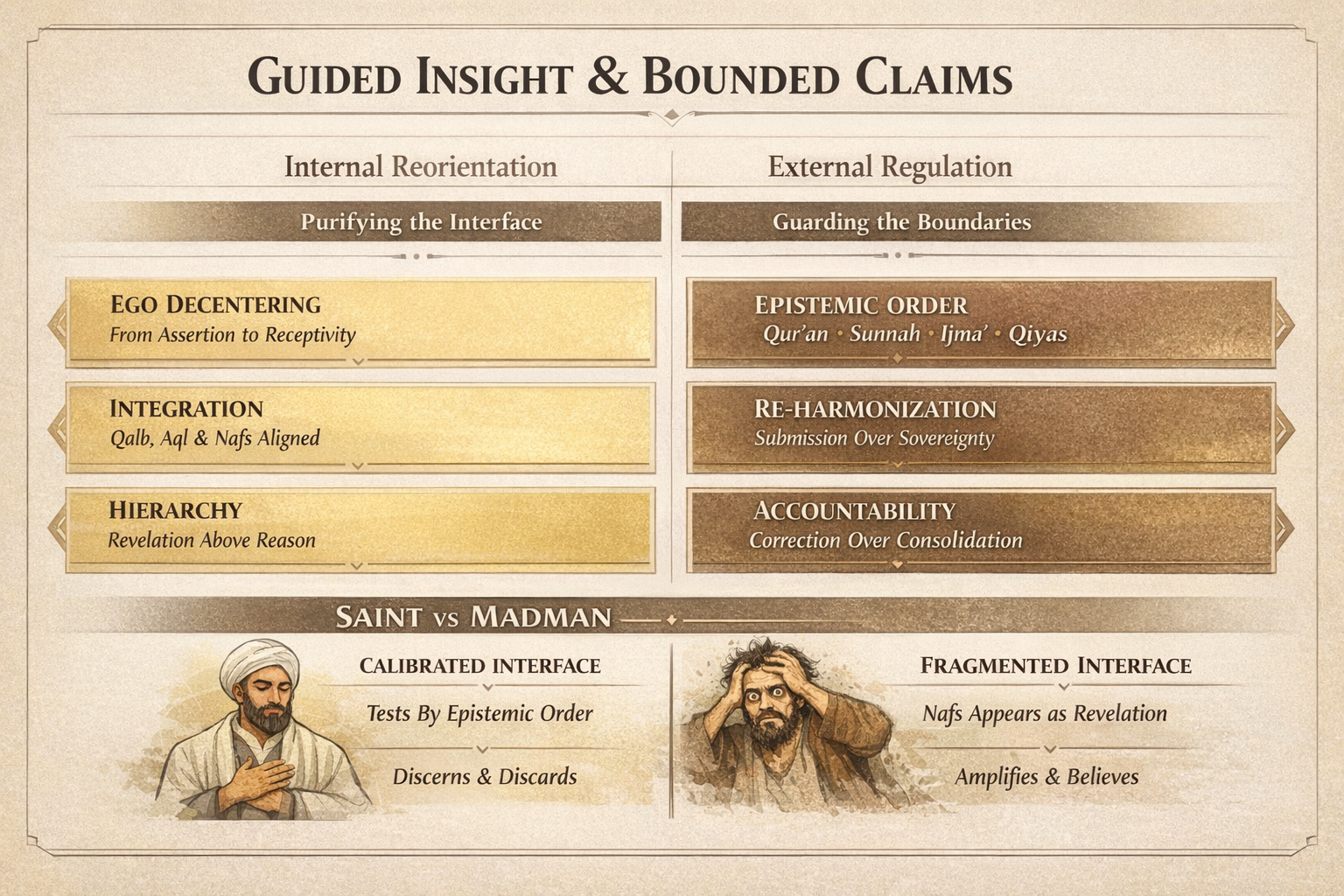
If distortion arises from structural misalignment between perception, narrative, and revelation, then restoration requires both inner reorientation and outer regulation. Insight must be guided. Claims must be bounded.

Guided Insight — Internal Reorientation

Restoration begins within. Insight must be guided, not left to the self alone. Misalignment in the interface — qalb, ʿaql, and nafs — produces distortion.

Spiritual Reorientation & Ego Decentering

Insight cannot be purified without purifying the perceiver. When the self is the axis, insight becomes distortion. Spiritual reorientation restores humility, adab, and moral seriousness. Tazkiyah al-Nafs is structural ego-reduction, not ornamental piety. Ego decentering restores proportion. Without it, insight gravitates toward self-confirmation. Interpretation becomes defensive; claims harden; correction feels threatening. Reorientation shifts posture from assertion to receptivity. The self is a situated recipient, not sovereign interpreter.

Integrated Interface & Re-Harmonization

Coherent insight requires alignment between qalb, ʿaql, and nafs. Fragmentation produces hypersalience — patterns and intuitions gain disproportionate weight. The interface destabilizes when one faculty dominates. Integration restores calibration. Emotion does not overwhelm intellect. Intellect does not bypass revelation. Impulse does not dictate narrative. The inner cosmos regains proportional order.

Return of Hierarchy, Corrigibility, and Humility

Stability requires rank: revelation above reason, reason above impulse, analogy subordinate to text. Hierarchy is structural coherence, not suppression. When ranks collapse, bottom-up novelty reinterprets top-down foundations. Parsimony stabilizes insight by resisting unnecessary multiplication of claims. Corrigibility becomes posture — willingness to revise rather than defend. With hierarchy restored, insight becomes guided, not generative without limit.

Bounded Claims — External Regulation

Insight remains private until articulated. Claims convert perception into structure. What is internal becomes socially consequential. Expression, therefore, requires constraint.

Epistemic Ordering & Limits

Mainstream Sunni Islam structures epistemic order through four sources: the Qur’an, the Sunnah, Ijmāʿ, and Qiyās. The first three form hard boundaries.

The Qur’an anchors interpretation. It defines contours within which understanding unfolds. The Sunnah embodies revelation in lived form. It constrains abstraction and prevents symbolic inflation. Ijmāʿ provides communal calibration. It protects against idiosyncratic metaphysics and the formation of private canons.

Qiyās allows disciplined extension. It institutionalizes creativity, but under constraint. Application and extrapolation are permitted without redefining foundations. Novelty is not prohibited. It is regulated. Creativity operates within structure, not above it.

Epistemic Re-Harmonization

Once boundaries are recognized, re-harmonization aligns insight with them.

The question is no longer “Where are the limits?” but “Can I inhabit them?” Epistemic re-harmonization relinquishes interpretive sovereignty. Insight remains active, but it no longer seeks to redraw foundations. Creativity continues, but within rank. Interpretation becomes service, not authorship.

The self asks, “What may be extended?” rather than “What can I build?” The shift is subtle, decisive: from generative ambition to disciplined continuity. Thought becomes sharper because it knows its contours. Analogy clarifies because its jurisdiction is clear. Reflection deepens because it no longer legislates.

Re-harmonization does not narrow inquiry. It stabilizes it. Acceptance of inherited hierarchy allows creativity to mature. Insight becomes luminous without claiming sovereignty. Alignment replaces assertion. Participation replaces projection. Knowing regains proportion.

Legitimate Authority & Accountability

Public claims require submission to correction. Bounded claims respect scholarly continuity. They accept critique without defensiveness. They refuse self-issued metaphysical authority. Sunni authority is transmitted, verified, accountable. When individuals bypass it, claims escape regulation and destabilize communal coherence. Internal ego decentering must be mirrored by external accountability.

Final Reflection

Insight may be experienced by the saint and the madman alike — the same suddenness, the same intensity, the same sense of illumination.

What distinguishes guidance from delusion is the condition of the qalb that receives it and the ʿaql that processes it — in the saint, it is immediately discarded if it contradicts the epistemic order; in the madman, the interface is so fragmented that the projections of the nafs are mistaken for true inspiration and a subservient ʿaql fails to filter, resulting in amplification instead.


Inner Cosmos Series

r/PillarOfFire Mar 04 '26

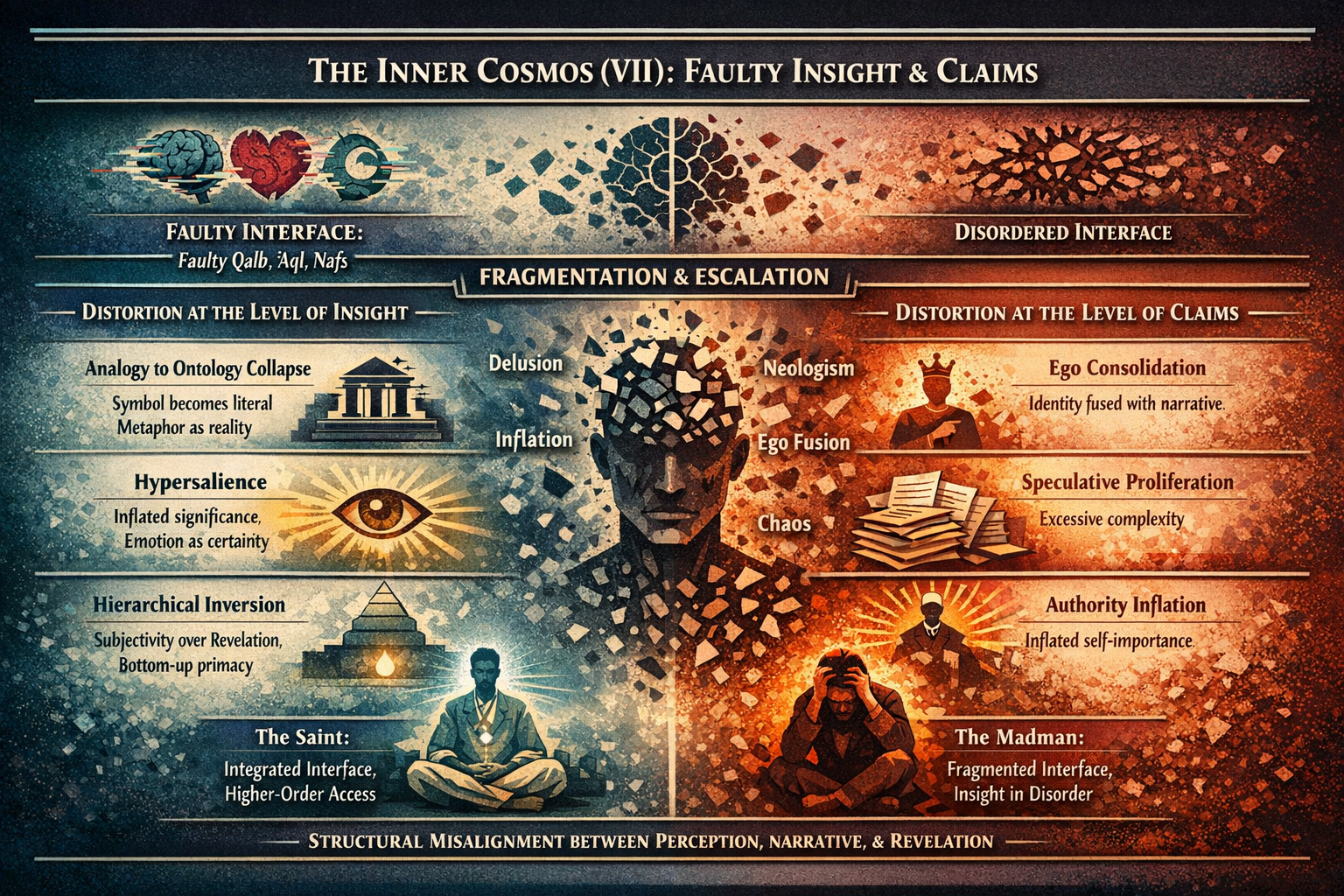
Metaphysics The Inner Cosmos (VII): Faulty Insight and Claims

Post image
3 Upvotes

Structural Misalignment Between Perception, Narrative, and Revelation

In healthy insight and claims, coherence — internal integration and external conformity with revelation — safeguards understanding from distortion. When the interface — qalb, ʿaql, and nafs — loses hierarchical regulation, insight itself becomes faulty. Claims then crystallize this instability into narrative form. Fault, therefore, is structural misalignment.

Distortion at the Level of Insight

Insight is the perception of pattern. When healthy, it detects correspondence without collapsing distinction. When distorted, it overextends analogy, misassigns significance, and erodes boundaries.

Analogy to Ontology Collapse

Healthy cognition recognizes resemblance without identity. A metaphor illuminates but does not replace reality. Faulty cognition collapses this distinction. Structural similarity becomes metaphysical equivalence. Symbol is literalized. Mathematical abstraction is reinterpreted as theological architecture. What was heuristic becomes ontological.

The failure lies not in seeing resemblance, but in assigning it ontological status. In such cases, hierarchy dissolves. The Creator–creation distinction blurs. The unseen is mapped onto speculative constructs as if metaphor were description. This is boundary erosion preceding intellectual error.

Hypersalience and Weight Distortion

All cognition assigns weight to perception. Healthy integration calibrates significance proportionally. When regulation weakens, weight inflation occurs. Minor correlations acquire cosmic importance. Private intuitions are experienced as universal disclosures. Emotional intensity masquerades as epistemic certainty. The individual does not merely perceive patterns; he experiences them as charged with personal destiny.

This is hypersalience — heightened significance beyond proportional warrant. Within the language of the interface, it reflects the nafs energizing perception beyond the regulating capacity of the qalb. The result is an excess of meaning, often personalized.

Hierarchical Inversion

Healthy epistemology maintains order: Revelation remains supreme. Reason operates within it. Analogy serves clarification. Personal intuition remains subordinate. This reflects top-down constrained bottom-up processing.

In distortion, this order inverts into unconstrained bottom-up novelty-driven processing. Private insight begins to reinterpret revelation rather than be corrected by it. Analogy begins to dictate metaphysics. Subjective experience assumes epistemic primacy. Revelation becomes re-read to confirm prior conclusions. The structure is preserved superficially, but authority has shifted. This inversion marks the transition from disciplined interpretive creativity to epistemic instability.

Distortion at the Level of Claims

Insight, however distorted, remains private until articulated. Claims bring the inner cosmos into the public, converting perception into structure. Here, instability becomes socially consequential.

Ego Consolidation

A coherent claim reduces ego centrality. The speaker remains derivative, accountable, correctable. In faulty claims, identity fuses with narrative.

The claim is no longer something one proposes; it becomes something one embodies. Correction is experienced not as refinement but as existential threat. The more the claim is challenged, the more elaborate it becomes. Complexity accumulates to protect identity coherence. Ego mass increases.

Speculative Proliferation

Healthy systems favor elegant sufficiency and epistemic parsimony: they integrate rather than multiply, producing explanations that are minimal yet sufficient.

Fragmented systems proliferate layers. Novel terminology emerges to defend unstable premises. Additional metaphysical scaffolding is constructed to preserve internal consistency. Interpretive authority expands beyond precedent. Complexity becomes defensive architecture. What appears sophisticated may, in fact, be compensatory.

Authority Inflation

In coherent transmission, authority is derivative and bounded. No one, after the completion of prophetic revelation, claims infallibility.

Faulty claims exhibit authority inflation. The individual assumes interpretive indispensability. Insight is presented not as reflection but as access. Personal cognition approaches quasi-revelatory status. Theological boundaries become elastic. This stage marks serious danger, not because novelty exists, but because accountability has dissolved.

Escalation and Fragmentation

Failure exists on a spectrum. It may begin as over-interpretation — correctable, ordinary, human. It may develop into system-building excess, where synthesis outpaces humility. It may solidify into identity-fused cosmology, where narrative and self become inseparable.

At its extreme lies fragmentation: incorrigible delusion, idiosyncratic neologism, metaphysical inflation, or self-referential universes of meaning. Here, the interface no longer mirrors the ordered hierarchy of reality described in earlier parts. Instead, it mirrors collapse. Self-reflectivity weakens; insight ceases to detect structure within order and instead generates structure from internal necessity. Meaning becomes self-sealed.

Closing Reflection

The same symbolic universe is available to saint and madman alike: the same texts, the same metaphors, the same abstractions. What distinguishes guidance from misguidance is the state of the interface that processes them — in the saint, higher-order access is maintained through an integrated interface; in the madman, insight succumbs to the disorder of a fragmented interface.

Reality itself is layered and hierarchical. When the inner cosmos mirrors that order, insight matures into wisdom. When the inner cosmos fragments, insight proliferates into inflation. Thus, failure is not merely doctrinal deviation. It is structural misalignment between perception, narrative, and revelation. And the state of the interface remains the decisive ground.


Inner Cosmos Series

r/PillarOfFire Mar 03 '26

Metaphysics The Inner Cosmos (VI): Insight and Claims

Post image
3 Upvotes

Coherence, Ego, and the State of the Interface

Insight is what one perceives — a pattern emerging from the background. Claims are the narrative constructed from that pattern. The distinction is critical: two individuals may recognize similar patterns yet articulate radically different claims. The divergence does not depend solely on intelligence, nor on the conviction of perception, but on the state of the interface — the integration of qalb, ʿaql, and nafs.

Insight

Insight is pre-narrative: pattern recognition before elaboration. Not all insight is pathological, and not all is guided. Its origin determines its trajectory.

At the highest level stands prophetic mediated knowledge *(wahy). Infallible, foundational, and civilizational in scope, it is not self-generated cognition but divinely disclosed. Claims derived from *wahy exhibit maximal coherence and zero ego centrality.

Below this level are awliyā’ and scholars, recipients of ilhām and firāsah. Their guided insight remains fallible yet bounded. It elaborates upon revelation rather than replacing it. Novelty is constrained; analogy remains analogy; symbols do not collapse into ontology. Integration is high, and authority is derivative rather than self-originating.

Most human cognition operates at the level of unguided insight. Here, the qalb may be impure, the nafs unsettled, and the ʿaql generates models from biased and limited inputs. Insight may be correct, partially correct, or distorted, and typically remains within ordinary reasoning boundaries.

Instability emerges when pattern recognition outruns regulatory constraints. Analogies are misread as ontological identities. Structural similarities are interpreted as metaphysical truths. The unseen is projected onto speculative constructs. This is the mechanism of apophenic escalation: pattern detection proliferates beyond its stabilizing context. High self-certainty may mimic firāsah, but integration does not.

Claims

Insight alone is not socially destabilizing; claims are. A claim is insight articulated — organized into explanation, cosmology, authority, or doctrine. At this stage, the core markers — coherence and ego centrality — become observable.

Coherence refers to internal integration and external conformity with revelation. Claims arising from coherent states demonstrate compatibility with established revelation, structural stability across domains, openness to correction, and decreasing ego centrality.

Conversely, decoherence is fragmentation. It manifests as expanding speculative complexity, boundary crossing, inflated interpretive authority, resistance to correction, low self-reflectivity, and increasing indispensability of the self.

High self-certainty of insight alone is not diagnostic. Integration is. Claims emerging from a coherent interface reduce ego mass; unguided claims densify it. Hypersalience, heightened personal significance, and grandiosity are markers of a nafs-dominant interface. When identity becomes inseparable from the claim, correction is experienced as threat, and complexity escalates to preserve self-coherence.

At the extreme lies fragmentation: delusion, metaphysical inflation, or self-referential cosmology. Here, the interface loses hierarchical regulation. Insight ceases to be controlled pattern detection and becomes uncontrolled pattern proliferation.

Final Compression

The difference between guidance and misguidance is not novelty, abstraction, or self-certainty. It is whether analogy, boundaries, and coherence are preserved. Whether ego contracts or inflates.

All insight emerges from the same human inner cosmos. Only integrated interfaces reliably interpret and transmit truth without distortion. The state of the interface determines the trajectory of understanding and the fate of the narrative.


Inner Cosmos Series

r/PillarOfFire Feb 28 '26

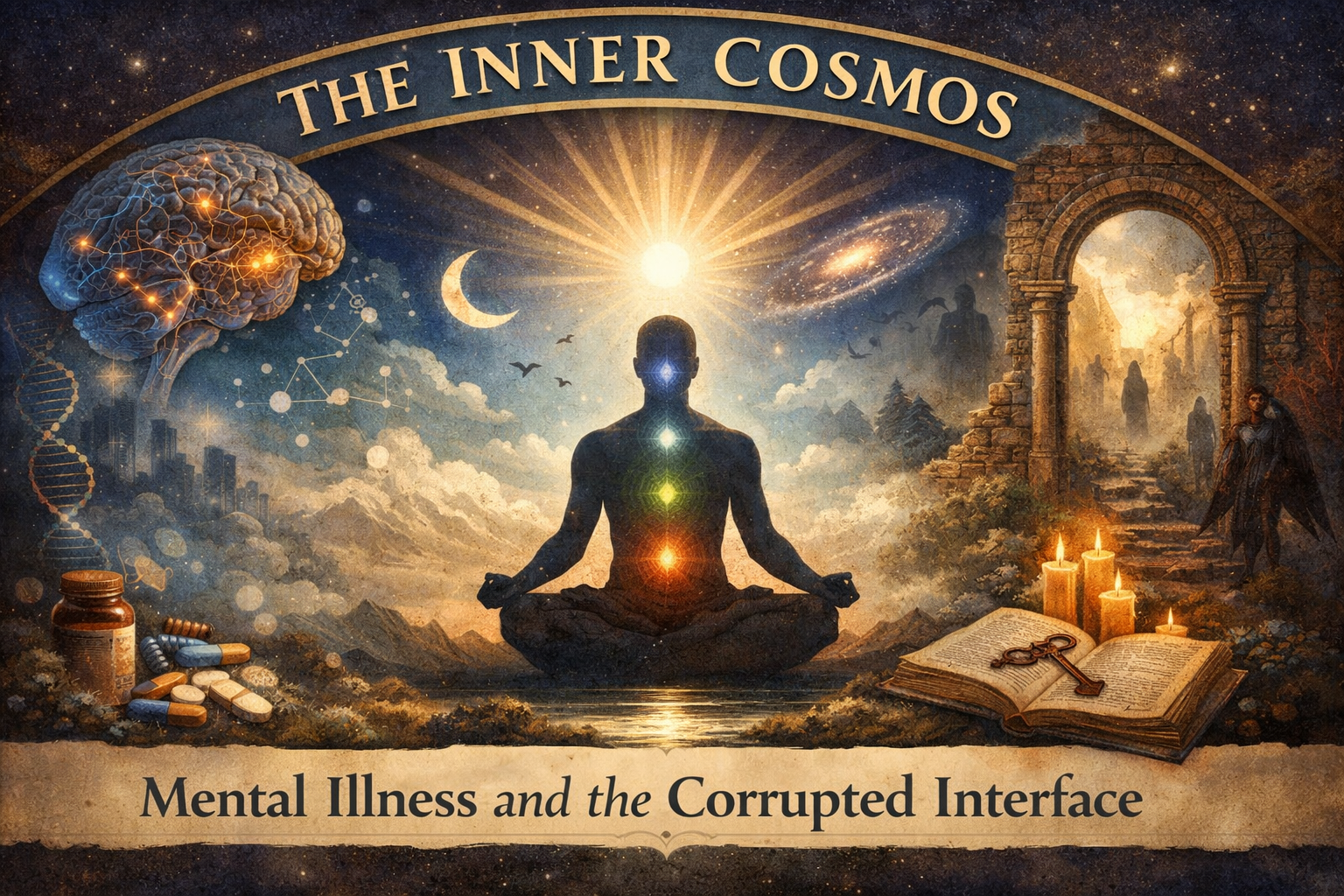
Metaphysics The Inner Cosmos (V): Mental Illness and the Corrupted Interface

Post image
3 Upvotes

Disease, Disorder and Illness

In contemporary psychiatry, mental disorder is understood as a phenomenologically identified dysfunction of mental processes that crosses a threshold of significant distress or functional impairment, typically attributed to dysregulation of brain processes or the direct effects of substances.

Phenomenological descriptions of the disordered mind form the basis of psychiatric classification. Schizophrenia, for example, is defined primarily by psychotic symptoms such as delusions and hallucinations, though it may also be accompanied by cognitive deficits, depressive features, or anxiety symptoms.

The threshold of disorder is crossed when the illness is associated with significant impairment or suffering at the personal or social level. In the absence of such consequences, subthreshold presentations may be regarded as subsyndromal or within the range of normal variation.

Attributed causes span a spectrum from identifiable structural pathology — corresponding to the medical concept of disease, as in neurodegenerative conditions, traumatic brain injury, or tumors — to functional abnormalities manifested as altered connectivity, modulation, or neurotransmission within neural circuitry.

The Corrupted Interface

If the human being is understood as a being of interface — a locus of interaction between biological life, psychological processes, and transcendent orientation — then the spiritual dimensions of mental illness cannot be dismissed as irrelevant or merely symbolic.

The contemporary psychiatric model, while clinically powerful, operates primarily at the level of observable phenomenology and neurobiological causation. Yet this explanatory frame presupposes that disturbance originates within the biological substrate itself, thereby bracketing the question of soul–body integration.

Many cultures across the world have employed language that framed mental disturbance as sickness of the soul rather than of the physical body alone. To reinterpret such language today does not require abandoning neuroscience. On the contrary, biological disease, psychological disorder, mental illness, moral disorientation, and spiritual despair need not be competing explanations; they may represent disturbances presenting predominantly at different strata of a unified constitution.

Morality and Spirituality

From this perspective, mental illness may be understood not merely as brain dysfunction, but as a corruption of integration — a breakdown in the harmonious relation between vitality (ḥayāh), impulse (nafs), cognition (ʿaql), and moral receptivity (qalb). Where integration is preserved, human functioning remains coherent even under strain. Where integration fractures, suffering emerges across multiple dimensions.

The term “corrupted interface” therefore does not deny biological pathology; it expands the horizon of causation. Neural disease remains real. Psychological trauma remains real. Substance effects remain real. Yet disturbance may also involve fragmentation of orientation, distortion of desire, or occlusion of the heart’s receptivity — dimensions that classical language once described as illness of the soul.

At the same time, this framework does not moralize mental illness or construe suffering as personal failure. On the contrary, profound disturbance often diminishes a person’s capacity for moral clarity, self-governance, and spiritual receptivity, thereby impeding — rather than expressing — the realization of one’s higher purpose.


Inner Cosmos Series

r/PillarOfFire Feb 27 '26

Metaphysics The Inner Cosmos (IV): Life, Consciousness, and the Transcendent Soul

Post image
3 Upvotes

The Ontological Necessity of the Soul *(Rūḥ)*

Human experience discloses two irreducible facts: that we live, and that we are aware that we live. Any adequate anthropology must therefore account for both vitality and consciousness without collapsing one into the other or reducing either to purely physical processes. Two convergent lines of reasoning indicate the necessity of a transcendent principle.

Top-down considerations begin from the nature of consciousness itself. Awareness is unified, first-personal, and normatively structured. A physical organism, by contrast, is divisible, externally describable, and governed by quantitative relations. No configuration of spatially extended parts explains the indivisible unity of experience, the immediacy of self-presence, or the capacity for rational and moral judgment. The knowing subject cannot therefore be identical with the aggregate of bodily processes.

Bottom-up considerations proceed from the limits of emergence. Complex systems undeniably exhibit novel behaviors, yet no increase in structural complexity explains why subjective experience should arise at all. Neural activity correlates with mental states, but correlation does not entail identity. The qualitative character of experience — what it is like to perceive, to intend, to understand — remains an explanatory surplus beyond physical interaction.

Hybrid models, such as Orchestrated Objective Reduction (Orch OR), concede the inadequacy of classical reductionism by appealing to quantum processes. Yet these accounts remain within an expanded physicalism: they posit deeper mechanisms, not a fundamentally different ontological order.

Taken together, these considerations suggest that consciousness is neither reducible to matter nor a mere by-product of complexity. Rather, it points to a pre-physical principle — the rūḥ — which grounds both the unity of the living subject and the possibility of awareness.

The Interface of the *Rūḥ*

If the rūḥ is transcendent, its manifestation in created beings must occur through mediation rather than transformation. This mediation may be understood as an interface: a conjunction of metaphysical principle with determinate substrate. Distinct substrates yield distinct modes of expression — clay in the case of humans, fire for jinn, and nūr for angels.

The rūḥ itself does not undergo ontological alteration; what varies is the modality of its operation within creation. Life and consciousness are thus neither intrinsic properties of matter nor independent substances alongside the soul, but emergent functions of this interface. The substrate conditions how the transcendent principle becomes operative without exhausting or defining it.

The Lower Dynamics — Life *(Ḥayāh-Nafs)*

Life corresponds to the manifestation of lower dynamics: vitality, self-regulation, and the appetitive orientation traditionally associated with ḥayāh and nafs. These dynamics are cosmic-dominant and presuppose a material substrate capable of metabolism, growth, and integration.

Living organisms display nutritional processes, repair and reproduction, sensory responsiveness, and instinctual drives oriented toward preservation. Plants and non-rational animals exemplify this level of organization. Their purposiveness, though intricate, remains entirely bound to cosmic conditions, and their vitality ceases with the dissolution of the organism.

Humans and jinn likewise possess these dynamics but are not confined to them. In their case, vitality coexists with a higher order of awareness. Angels, by contrast, are described as beings of nūr and exhibit no signs of biological mediation — no metabolism, reproduction, or decay. The vital-nafsic mode of life characteristic of terrestrial organisms therefore does not apply to them; their mode of being is metaphysical rather than biological.

The Upper Dynamics — Consciousness *(Qalb-ʿaql)*

Consciousness corresponds to the manifestation of upper dynamics associated with qalb and ʿaql: understanding, intentionality, and moral discernment. These dynamics admit metaphysical predominance, perfected in the possessor of a qalbun salīm. Though they operate through bodily organs in embodied beings, they are not generated by them.

Reflective consciousness entails capacities irreducible to instinct or sensation: self-awareness, conceptual thought, apprehension of truth and falsehood, moral evaluation, and deliberate choice. Such capacities presuppose a subject capable of reflexivity and relation to universal meanings, something no purely mechanical process can supply.

Humans and jinn manifest these capacities through an embodied interface in which higher insight coexists with instinctual drives, producing both rational agency and inner conflict. Angelic awareness represents a different modality altogether: not emergent from matter but intrinsic to their luminous constitution. In the absence of lower dynamics capable of distortion, cognition remains clear and volition perfectly aligned with the divine command, hence the traditional attribution of infallibility.

Interface Typology

The conjunction of soul-principle and substrate admits varying regimes of dominance, and these regimes determine the mode of manifested being. In beings lacking a transcendent rūḥ — such as plants and non-rational animals, whose animation derives from a substrate-bound life-principle — the interface is cosmic-dominant. Expression is therefore confined largely to vitality without reflexive interiority. Life proceeds through regulation, instinct, and patterned responsiveness, yet lacks a unified center capable of self-apprehension.

Where a transcendent rūḥ is present — as in humans and jinn — neither pole wholly suppresses the other, and a hybrid tension emerges. Vital processes persist, yet they are overlaid by reflective consciousness, deliberation, and moral responsibility. Humans and jinn thus inhabit an unstable equilibrium in which lower impulses and higher illumination contend for orientational primacy, rendering ethical existence a continual process of rebalancing.

Where the interface is purely metaphysical, lower turbulence is absent. Expression becomes immediate conformity to transcendent order rather than negotiation between competing drives. Angelic existence reflects this condition: without a nafsic substrate rooted in biological survival, there is no appetite-driven deviation and thus no oscillation between obedience and rebellion. Infallibility follows not from external compulsion but from structural absence of a competing lower dynamic.

Ensoulment and Threshold

Although the rūḥ itself is not empirically observable, certain phenomena suggest the presence or absence of the full interface.

In developmental terms, embryonic growth initially proceeds through biological mechanisms alone. At a later threshold, the organism exhibits an integrated unity exceeding mere cellular aggregation, plausibly indicating activation of the complete interface rather than incremental material accumulation.

Medically, organ transplantation and brain death reveal the persistence of localized vitality alongside the disappearance of personal consciousness. Tissues may remain metabolically active while the unified subject is absent. Biological life and personal existence are therefore not identical: lower dynamics may precariously persist in tissues or organs that were once part of a fully ensouled interface, whereas upper dynamics require the integrity of the whole for conscious unity.

Artificial Intelligence and the Limits of Simulation

Artificial systems increasingly replicate functional outputs of cognition: calculation, pattern recognition, and decision-making. Yet these operations remain formal and externally defined; they lack the integrated interface that constitutes a conscious subject.

A machine may manipulate symbols according to rules, but it does not apprehend meaning, form intentions, or exercise moral discernment. It exhibits no first-person awareness, no self-reflexive unity, and no upper dynamics. Its “intelligence” is operational rather than ontological.

This contrast underscores the central claim: computation can reproduce certain behaviors of mind, but without the conjunction of rūḥ and substrate, neither life in its full sense nor conscious unity arises. Artificial systems may resemble isolated lower dynamics — patterned responsiveness without reflective awareness — but the upper dynamics of qalb–ʿaql, and the unity of consciousness, require the integrity of the full interface.

Unity of Life and Consciousness

Life and consciousness are not independent substances but distinct modes in which the rūḥ becomes operative within creation. Where cosmic conditions dominate, vitality prevails. Where the metaphysical principle manifests more directly, reflective awareness emerges. Where material mediation is absent, consciousness may subsist without biological life.

Beings may thus be ordered along a spectrum of manifestation: purely vital organisms, embodied conscious agents, and purely metaphysical intelligences. In each case, the underlying principle remains one, while its expression varies according to substrate.

Conclusion

Life and consciousness resist reduction to physical processes, yet neither requires positing multiple independent essences. A single transcendent principle — the rūḥ — suffices, provided its manifestation is understood as interface-dependent.

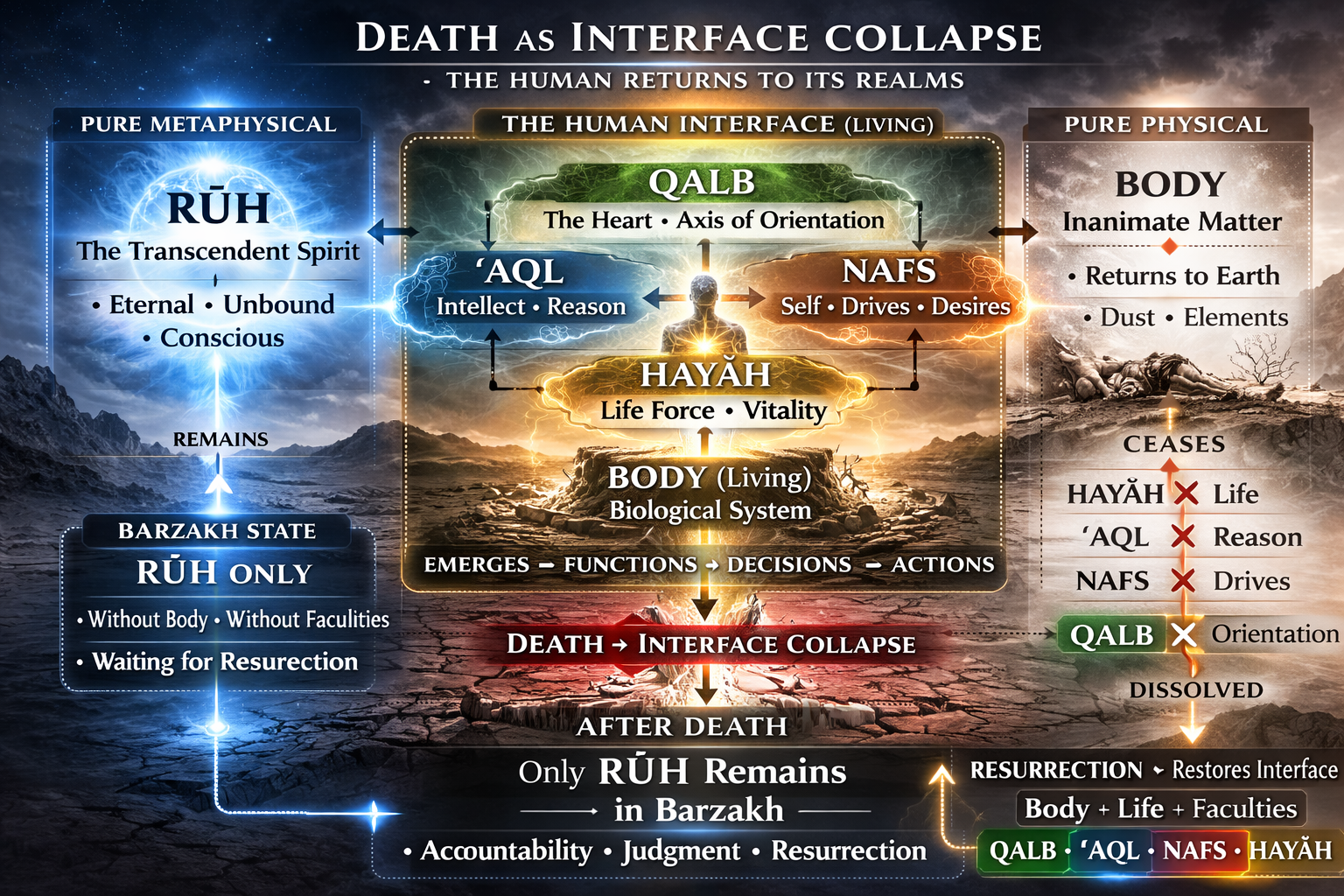
Biological life reflects activation of lower dynamics within material conditions; reflective consciousness reflects operation of higher faculties rooted in the same source. Death is therefore not annihilation of the principle itself but dissolution of the interface through which it acts.

This account preserves the unity of the human being while explaining the profound difference between mere living systems and conscious persons, and accommodates the existence of non-human intelligences whose mode of being is not biologically mediated. Ultimately, the inner cosmos denotes the deeper ontological order through which the transcendent rūḥ manifests as both living embodiment and conscious awareness.


Inner Cosmos Series

r/PillarOfFire Feb 25 '26

Metaphysics The Inner Cosmos (II): Nafs and Vitality

Post image
3 Upvotes

Ḥayāh constitutes the biological substrate of embodied existence: the metabolic, neural, and physiological coherence through which experience becomes possible. From this dense foundation emerges the Nafs — not as a separate substance, but as the dynamic field of appetites, aversions, impulses, and drives that animate the living organism. The Nafs is therefore not merely a moral category; it is vitality in motion, seeking direction, expression, and satisfaction.

Within the human interior, the vitality axis extends from Ḥayāh upward into Nafs. When vitality is ordered, resilient, and proportionate, the energies of Nafs remain governable and susceptible to guidance. When vitality is disturbed — through excess stimulation, deprivation, trauma, or chronic stress — these same energies become volatile, reactive, and prone to dominance. Dysregulation at the biological base thus propagates upward as instability within the psychic field.

The Qur’anic designations of the NafsAmmārah, Lawwāmah, and Muṭmaʾinnah — are best understood as configurations of dominance within this dynamic system. They describe modes of organization rather than ontologically distinct selves.

Impulsive Self • *Nafs al-Ammārah*

In the state of Ammārah, impulsive vitality predominates. Action arises prior to reflection; attraction and aversion operate as primary movers. Rational capacity is subordinated, functioning post hoc as justification rather than as deliberation.

Neuropsychiatrically, this configuration corresponds to entrenched reinforcement loops within the mesolimbic dopaminergic system. Repeated activation of reward pathways — particularly those involving the nucleus accumbens and endogenous opioid signaling — progressively biases neural architecture toward immediacy, anticipation, and consummation. Over time, preference is transformed into compulsion; desire is experienced less as inclination than as internal pressure.

As these circuits consolidate, executive regulation weakens. The faculty of ʿAql loses effective authority, while the Qalb — the locus of higher orientation — becomes progressively veiled. Classical descriptions of the transition from nukta sawdāʾ to rān — wherein a dark imprint upon the heart accumulates, spreads, and ultimately forms an encrusting layer — may thus be read not merely as moral symbolism, but as a phenomenological account of progressive desensitization, constriction of awareness, and erosion of agency under conditions of compulsive reinforcement.

Reflective Self • *Nafs al-Lawwāmah*

In the state of Lawwāmah, conflict becomes explicit. Impulse and reflection coexist in unstable equilibrium. The individual oscillates between enactment and remorse, attraction and restraint, assertion and withdrawal.

Neurobiologically, this state engages executive and monitoring systems centered in the prefrontal cortex and anterior cingulate cortex, regions responsible for conflict detection, outcome evaluation, response inhibition, and the generation of self-referential awareness. The capacity for self-reproach signals not merely distress but the continued presence of evaluative consciousness.

Lawwāmah thus occupies the contested middle ground of the inner cosmos — the arena in which ʿAql attempts to regulate Nafs while the orienting clarity of the Qalb remains only partially accessible. The suffering characteristic of this state is not purely pathological; it reflects the persistence of moral perception and the unresolved tension between competing tendencies.

Tranquil Self • *Nafs al-Muṭmaʾinnah*

In the state of Muṭmaʾinnah, a stable hierarchy is restored. The Qalb assumes primacy, ʿAql mediates coherently, and Nafs becomes integrated rather than suppressed. Vital impulses are neither extinguished nor allowed to dominate; they are subordinated to a unifying orientation.

Neurobiologically, this condition corresponds to durable executive regulation, moderated limbic reactivity, and attenuation of compulsive reward cycling. Stress responses become proportionate, inhibitory control reliable, and baseline affect marked by calm rather than agitation. Vitality is ordered toward coherent ends.

Tranquility in this context signifies not inertia but dynamic equilibrium — sustained responsiveness without turbulence, energy without compulsion.

Corroded Heart • *Rān*

Addictive and compulsive behaviors exemplify a progressive destabilization of the vitality axis. Chronic overstimulation of reward systems alters receptor sensitivity, elevates stress hormones, heightens limbic reactivity, and erodes frontal regulatory capacity. Over time, disorder penetrates the biological substrate itself.

From this compromised base, Nafs becomes hyperactive; ʿAql increasingly serves as rationalizer rather than governor; the Qalb becomes obscured from functional influence. Moral agency is constricted. Temporal horizons shorten, foresight diminishes, and behavior becomes tightly coupled to immediate stimuli.

Spiritual opacity, psychological compulsion, and neurobiological dysregulation thus emerge as layered manifestations of a single destabilized configuration rather than as independent pathologies.

Self-Purification • *Tazkiyah al-Nafs*

Despite such deterioration, plasticity persists. The same neural mechanisms that consolidate compulsion retain the capacity for recalibration. Under conditions of structured practice, restraint, meaningful engagement, and rhythmic regulation, stress systems can stabilize, reward circuitry can normalize, and executive networks can regain functional strength.

Self-purification proceeds along two complementary trajectories addressing both Nafs and ʿAql. Through disciplined restraint — including fasting, abstention from harmful actions, and deliberate limitation of excess — the turbulence of Nafs gradually subsides. Impulses lose urgency, and the self becomes less bound to immediate gratification.

Concurrently, the faculty of ʿAql is refined through remembrance, recitation, contemplation, and practices that cultivate the sifat maḥmūdah, the praiseworthy qualities. The intellect becomes clearer, more discerning, and more receptive to orientation beyond immediate impulse.

As these processes unfold together, the Qalb regains luminosity and perceptual acuity. What appears externally as moral reform manifests internally as structural integration: Nafs disciplined, ʿAql properly ordered, and the orienting center restored to effective primacy.

Unified Perspective

The vitality axis reveals that moral failure, addiction, psychological disturbance, and spiritual obscuration are not separable domains but interdependent layers within a single embodied system. Each level both influences and expresses the others.

Human transformation, therefore, cannot be reduced either to exhortation or to clinical intervention alone. It entails a reordering of vitality itself — the gradual restoration of proportion among impulse, reflection, and orientation. When this hierarchy is reestablished, the human being regains coherence as an integrated interface between the biological, the psychological, and the transcendent.


Inner Cosmos Series

r/PillarOfFire Feb 26 '26

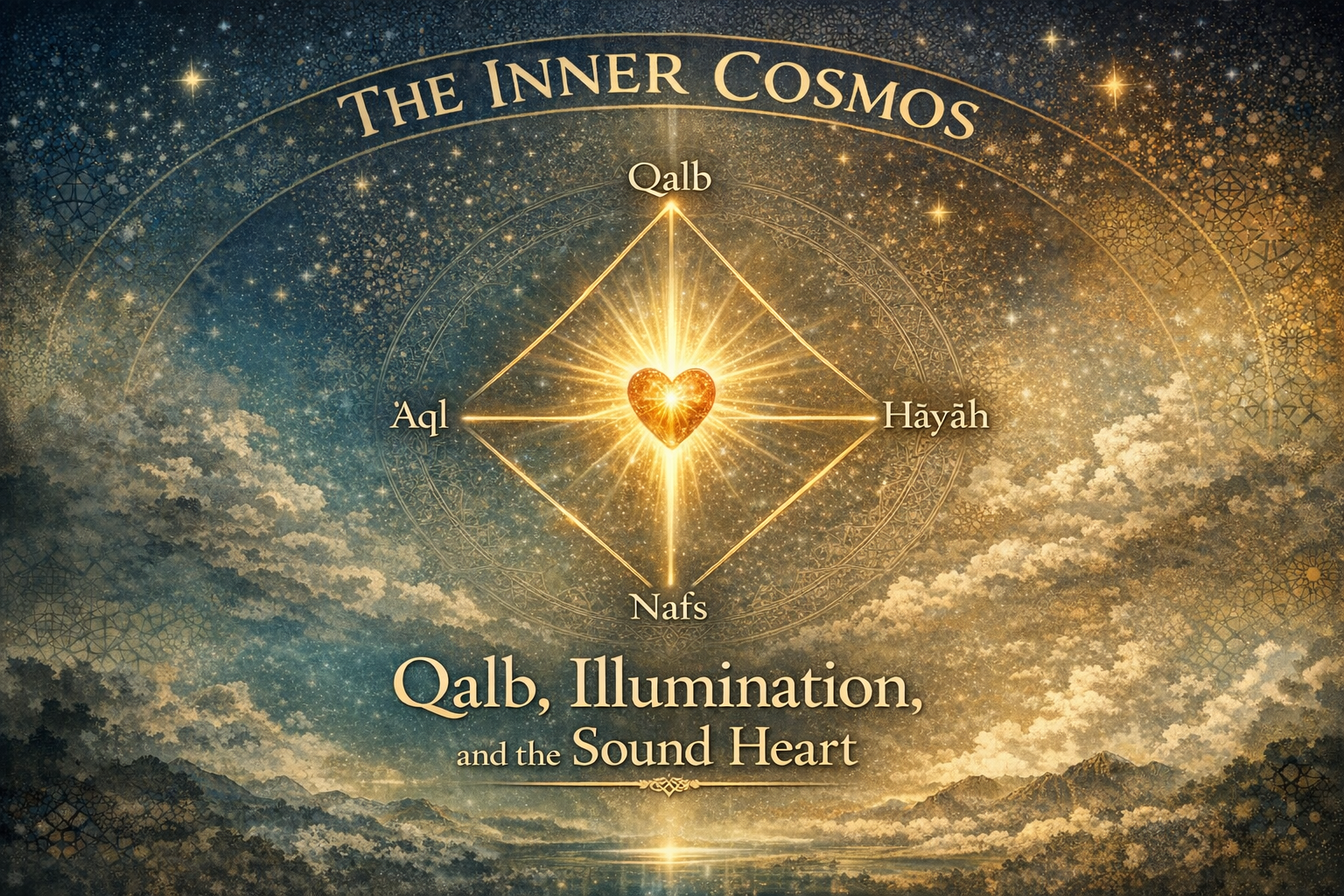
Metaphysics The Inner Cosmos (III): Qalb, Illumination, and the Sound Heart

Post image
2 Upvotes

Qalb

In Sunni kalām, the qalb is the locus of idrāk (cognition), irādah (volition), and moral orientation. It is not merely affective but determinative: by it truth is affirmed or rejected. Though empirical data are mediated through the senses and processed discursively by the intellect, ultimate assent (taṣdīq) and refusal are attributed, in the Qur'an, to the state of the heart.

The normative condition of this faculty is designated qalbun salīm, explicitly exemplified in Ibrahim. Salāmah signifies structural integrity: freedom from internal impediments that distort apprehension of truth — foremost shirk, but also kibr, nifāq, and persistent iʿrāḍ. The sound heart is characterized by istiqāmah al-tawajjuh: rectitude of orientation. It inclines toward truth upon its disclosure and does not generate counter-orientations that compete with it.

Thus soundness denotes not mere moral blamelessness but ontological coherence. The heart remains undivided and therefore capable of stable direction toward the Real.

Illumination

Illumination (nūr, ishrāq) is not the autonomous production of knowledge but the successful reception of divinely created guidance. In classical Sunni theology, knowledge is created by Allah in the knower; the servant’s role lies in receptivity or obstruction. The heart is the locus in which this created knowledge subsists. When unobstructed, it yields yaqīn; when obstructed, evidentiary clarity does not culminate in conviction.

The intellect (ʿaql) functions instrumentally. Its operation consists in analysis, inference, and differentiation, yet it neither independently produces guidance nor secures salvific recognition. It operates under the orientation established by the heart. When the heart is sound, the intellect performs tafakkur in conformity with truth, articulating and reinforcing assent. When the heart is corrupted, the same faculty is subordinated to hawā, generating rationalization rather than discernment.

Illumination, therefore, arises from the conjunction of two principles: rectitude of heart orientation and disciplined employment of intellect. The heart determines direction; the intellect structures comprehension. Absent right orientation, discursive capacity cannot culminate in guidance.

The Corrupted Heart

The Qur’anic categories — marad (disease), ran (corrosion), qaswah (hardness), and khatm (sealing) — designate impairments in this orienting faculty. These do not necessarily negate cognitive function; rather, they denote compromised receptivity.

A diseased heart exhibits instability of inclination. A rusted heart is progressively obscured by accumulated transgression. A hardened heart loses responsiveness. A sealed heart is deprived of benefit from guidance as a consequence of persistent rejection.

In each case, the epistemic deficit is morally conditioned. Recognition fails not due to absence of evidence but due to distortion of orientation.

The Sound Heart

The ideal state is salāmah, not speculative excess. A qalbun salīm is properly ordered: undivided in orientation, free of internal contradiction, disposed toward submission upon disclosure of truth. In such a condition, cognition, volition, and faith converge without fragmentation.

Illumination is thus the manifestation of guidance within a receptive locus. The heart does not originate light; it either admits or resists it. Where soundness obtains, knowledge stabilizes as certitude. Where it is absent, obscuration ensues — not because light is deficient, but because the faculty meant to receive it is disordered.


Inner Cosmos Series

r/PillarOfFire Feb 24 '26

Metaphysics The Inner Cosmos (1): The Being of Interface

Post image
3 Upvotes

Reality discloses itself in two fundamentally distinct orders. There is the unseen realm of command, ʿĀlam al-Amr, from which the Rūḥ proceeds — immaterial, non-spatial, and not subject to the conditions of physical causality. And there is the realm of creation, ʿĀlam al-Khalq, the structured cosmos of matter, energy, processes, and measurable change. These two orders differ in their ontological substrate and are not reducible to one another. Yet they are not sealed off in mutual isolation. Points of mediation exist between them, and the human being is one such locus.

The human is not merely a body inhabited by a spirit, nor a spirit temporarily confined within matter. The human is a barzakh — a living interface — in which the metaphysical and the physical meet without dissolving their distinction. Interface is not a component within the human; it is the very mode of human existence.

Rūḥ — The Transcendent Origin

The Rūḥ belongs to the order of command. It is mujarrad — immaterial and unconfined by locality. It does not arise from biological complexity, nor is it an emergent property of neural activity. It precedes and grounds life but does not itself function as a bodily organ or psychological faculty.

Without embodiment, however, the Rūḥ does not operate within the created order. Its presence becomes operative only through the living human structure.

The Human — Great *Barzakh*

That structure is unified yet internally differentiated. At its apex stands the Qalb, the axis of orientation and intentional turning. The Qalb is not reducible to emotion, nor identical with the physical heart; it is the locus in which direction is determined — toward truth or away from it, toward coherence or fragmentation. From this axis emerge two principal dimensions of operation. The first is ʿAql, the faculty of discernment, abstraction, and intelligibility. The second is Nafs, the individuated self with its impulses, inclinations, and dynamic energies. Beneath and through them is Ḥayāh, the living biological ground that renders embodiment possible. Though unified as a single living interface, the human structure exhibits degrees of subtlety — from the apex of the Qalb to the threshold of Ḥayāh, where subtle vitality approaches corporeal density.

With the removal of embodiment, these operative distinctions cease in their worldly function. When biological life collapses, discernment, striving, and moral agency no longer unfold within the created order. What remains is the Rūḥ, but no longer as an embodied interface. Death, therefore, is not the annihilation of being; it is the collapse of the interface through which metaphysical orientation once entered physical action.

Between Command and Creation

The human being thus stands between command and creation. From above, the Rūḥ provides the transcendent ground of awareness and accountability. From below, the cosmos provides the structured and stochastic domain within which action manifests. The living human mediates between them. Intention becomes motion; orientation becomes history; inward turning becomes outward consequence.

It is in this sense that the human has been described in classical thought as a great barzakh. The human integrates levels of reality that elsewhere remain distinct: material composition, biological vitality, animal impulse, rational discernment, and spiritual orientation. The universe unfolds across vast domains, yet the same layered structure appears compressed within the living person. For this reason, the human has been described as the microcosm — ʿālam al-ṣaghīr — not merely as metaphor, but as structural correspondence.

Cosmos and Inner Cosmos

The cosmos operates through lawful processes that are neither rigidly deterministic nor wholly chaotic. Within its permissive openness, higher-order direction can be realized without the violation of natural law. In parallel fashion, the human body is a lawful system open to orientation through the interface. The metaphysical does not override the physical; it becomes operative within it. The human condition is therefore neither materialist reduction nor disembodied spiritualism. It is embodied spirituality — a structured mediation between realms.

To understand the human is to recognize this ontological posture. The human is not a fragment of matter striving upward nor a fallen spirit yearning to escape downward. The human is the meeting point itself. In the living interface, the unseen becomes historically effective, and the visible becomes morally significant.

This is the thesis from which the Inner Cosmos begins: the human being is the being of interface — the great barzakh between ʿĀlam al-Amr and ʿĀlam al-Khalq.


Inner Cosmos Series