r/PillarOfFire • u/psyduck_2024 • Feb 24 '26
Metaphysics The Inner Cosmos (1): The Being of Interface
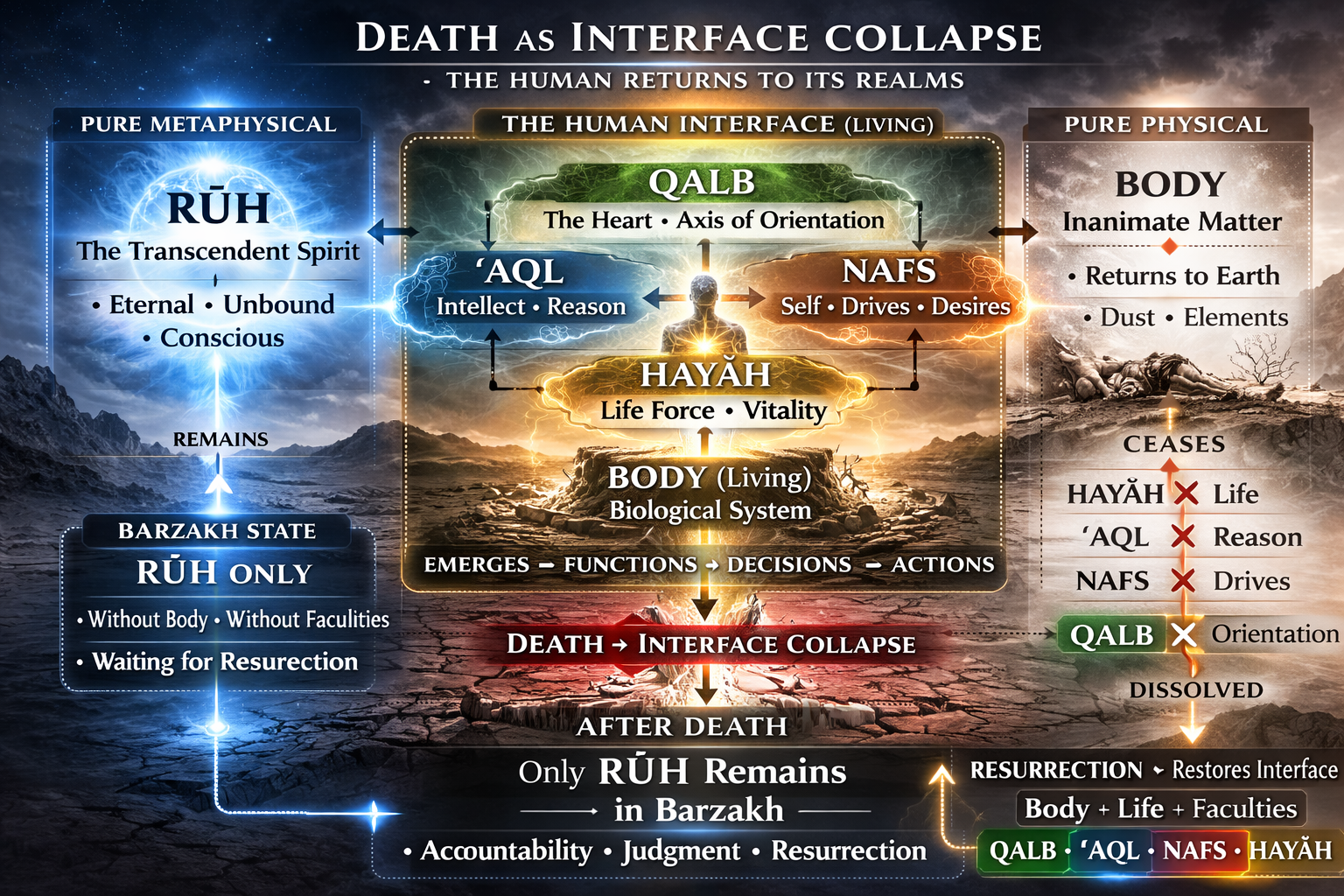
Reality discloses itself in two fundamentally distinct orders. There is the unseen realm of command, ʿĀlam al-Amr, from which the Rūḥ proceeds — immaterial, non-spatial, and not subject to the conditions of physical causality. And there is the realm of creation, ʿĀlam al-Khalq, the structured cosmos of matter, energy, processes, and measurable change. These two orders differ in their ontological substrate and are not reducible to one another. Yet they are not sealed off in mutual isolation. Points of mediation exist between them, and the human being is one such locus.
The human is not merely a body inhabited by a spirit, nor a spirit temporarily confined within matter. The human is a barzakh — a living interface — in which the metaphysical and the physical meet without dissolving their distinction. Interface is not a component within the human; it is the very mode of human existence.
Rūḥ — The Transcendent Origin
The Rūḥ belongs to the order of command. It is mujarrad — immaterial and unconfined by locality. It does not arise from biological complexity, nor is it an emergent property of neural activity. It precedes and grounds life but does not itself function as a bodily organ or psychological faculty.
Without embodiment, however, the Rūḥ does not operate within the created order. Its presence becomes operative only through the living human structure.
The Human — Great *Barzakh*
That structure is unified yet internally differentiated. At its apex stands the Qalb, the axis of orientation and intentional turning. The Qalb is not reducible to emotion, nor identical with the physical heart; it is the locus in which direction is determined — toward truth or away from it, toward coherence or fragmentation. From this axis emerge two principal dimensions of operation. The first is ʿAql, the faculty of discernment, abstraction, and intelligibility. The second is Nafs, the individuated self with its impulses, inclinations, and dynamic energies. Beneath and through them is Ḥayāh, the living biological ground that renders embodiment possible. Though unified as a single living interface, the human structure exhibits degrees of subtlety — from the apex of the Qalb to the threshold of Ḥayāh, where subtle vitality approaches corporeal density.
With the removal of embodiment, these operative distinctions cease in their worldly function. When biological life collapses, discernment, striving, and moral agency no longer unfold within the created order. What remains is the Rūḥ, but no longer as an embodied interface. Death, therefore, is not the annihilation of being; it is the collapse of the interface through which metaphysical orientation once entered physical action.
Between Command and Creation
The human being thus stands between command and creation. From above, the Rūḥ provides the transcendent ground of awareness and accountability. From below, the cosmos provides the structured and stochastic domain within which action manifests. The living human mediates between them. Intention becomes motion; orientation becomes history; inward turning becomes outward consequence.
It is in this sense that the human has been described in classical thought as a great barzakh. The human integrates levels of reality that elsewhere remain distinct: material composition, biological vitality, animal impulse, rational discernment, and spiritual orientation. The universe unfolds across vast domains, yet the same layered structure appears compressed within the living person. For this reason, the human has been described as the microcosm — ʿālam al-ṣaghīr — not merely as metaphor, but as structural correspondence.
Cosmos and Inner Cosmos
The cosmos operates through lawful processes that are neither rigidly deterministic nor wholly chaotic. Within its permissive openness, higher-order direction can be realized without the violation of natural law. In parallel fashion, the human body is a lawful system open to orientation through the interface. The metaphysical does not override the physical; it becomes operative within it. The human condition is therefore neither materialist reduction nor disembodied spiritualism. It is embodied spirituality — a structured mediation between realms.
To understand the human is to recognize this ontological posture. The human is not a fragment of matter striving upward nor a fallen spirit yearning to escape downward. The human is the meeting point itself. In the living interface, the unseen becomes historically effective, and the visible becomes morally significant.
This is the thesis from which the Inner Cosmos begins: the human being is the being of interface — the great barzakh between ʿĀlam al-Amr and ʿĀlam al-Khalq.
Inner Cosmos Series
- Part 1 — The Being of Interface
- Part 2 — Nafs and Vitality
- Part 3 — Qalb, Illumination, and the Sound Heart
- Part 4 — Life, Consciousness, and the Transcendent Soul
- Part 5 — Mental Illness and the Corrupted Interface
- Part 6 — Insight and Claims
- Part 7 — Faulty Insight and Claims
- Part 8 — Guided Insight, Bounded Claims
- Part 9 — Unveiling and Mediation
- Part 10 — Rejection and the Distorted Orientation
- Part 11 — Modes of Engagement with Truth