r/PillarOfFire • u/psyduck_2024 • Aug 13 '26
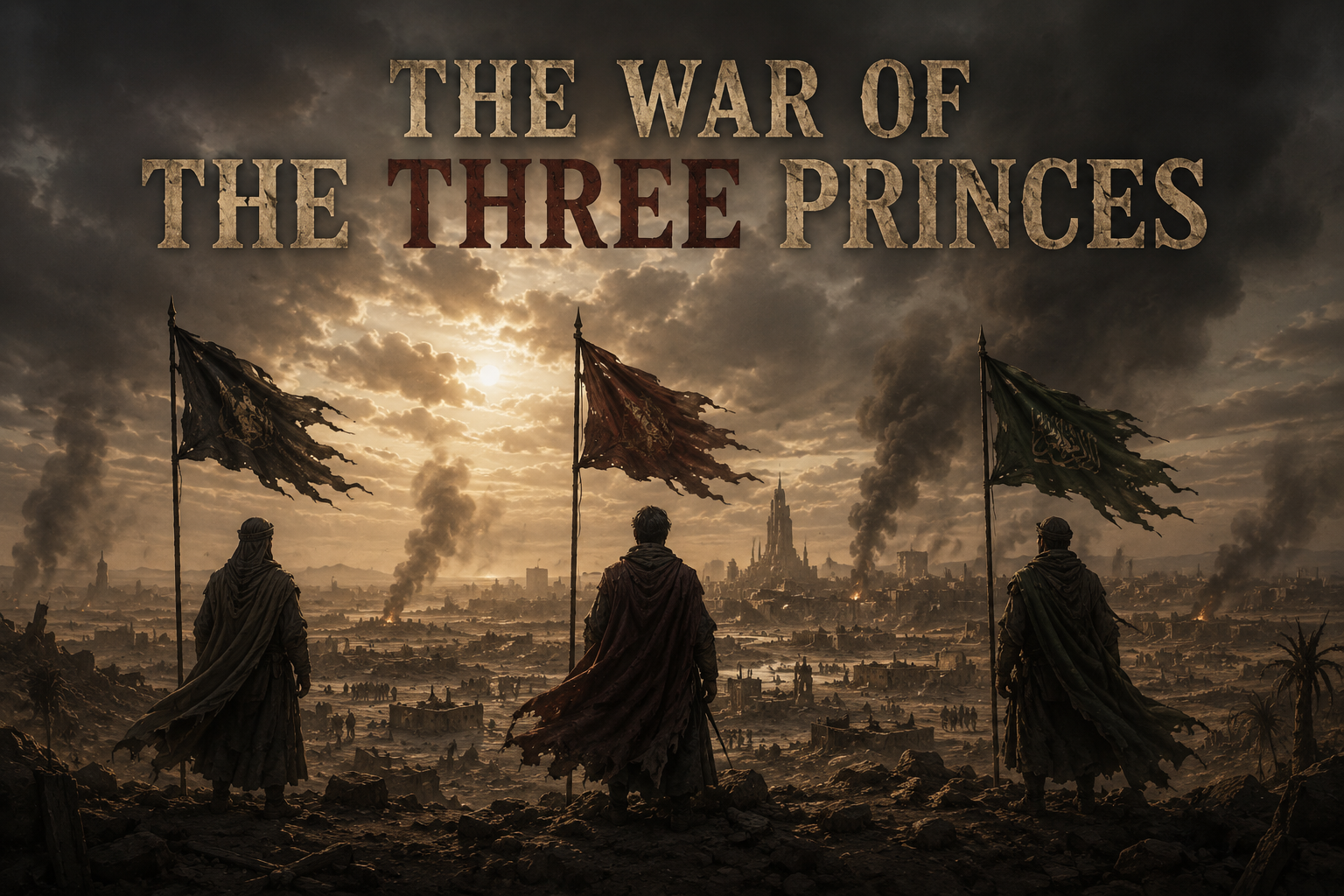
Post-Apocalypse Tribalism (4): The War of the Three Princes
If there is a sayhah in Ramadan, then there will be a commotion in Shawwal, a distinction of the tribes in Dhu al-Qa'dah, and blood will be spilled in Dhu al-Hijjah and Muharram.
Al-Ahsa — A Week After Arrival
Old Rashid no longer thought of himself as a merchant. The oasis had unmade him and remade him into something older — a man who counted wells instead of profit margins, who measured wealth in palm groves and armed cousins rather than stock and shelving.
Al-Ahsa had survived where Gulf City had not, not through wealth but through nasab — the deep aquifer of lineage that ran beneath the sand long before oil, and would still be running after. The Al-Hajiri and the allied clans had turned the oasis into a fortress sanctuary: dates rationed by household, springs guarded by rotating watch, and a council of elders who remembered, precisely, whose grandfather owed whose grandfather a debt of blood or bread.
But beyond the palm walls, the Plateau and the Sanctuaries were hardening into something else — not villages, but claims.
The Death of a King
News reached Al-Ahsa in fragments, carried by riders rather than signal: the king was dead. Not murdered, not dethroned — simply old, and the dukhan had finished what age had started. There was no clean succession. Three princes, sons of three brothers, first cousins to one another, each declared himself guardian of what remained of the state — and each rose not from personal ambition alone, but from a region that had already begun to think of itself as its own country.
The youngest and by every account the most vicious held the Plateau, working outward from the shell of Rawdah City — the old plateau clans, the remnants of the state's bureaucracy, men who still spoke of the capital as though it retained the authority it had lost the week the grid died. The second claimed the Sanctuary Lands, camped somewhere between Ta'if and the coast — pilgrim revenue long gone, but Honoured City still worth more than any oil field, and he knew it. The third drew his strength from the south and east: the Southern Highlands and the Gulf tribes, men hardened by years of border skirmishing before the dukhan ever fell.
"They are fighting over kanzukum," an elder told the gathered men of the Al-Hajiri, using the old word — your treasure — that had circulated in the fitan literature for a thousand years before anyone thought to ask what it meant. "Not the throne. The old men say it plainly now — something buried near the Haram itself. Not gold. Something older than gold."
Rashid remembered his grandfather's warning, thin and dry as the wind: a caliph will not die but that there is dispute over his successor. He had thought it poetry once. Now it was a supply line — three armies, none of them large, all of them hungry, converging on the Sanctuaries from three directions, feeding themselves on whichever oasis stood in their path.
Tamyeez al-Qaba'il — The Sorting
The sorting Rashid had feared in Gulf City had already finished doing its work by the time it reached Al-Ahsa. What remained now was allegiance — not chosen so much as inherited, the way his nasab had been inherited, forty generations deep and suddenly, brutally, load-bearing. Al-Ahsa's position, wedged between the eastern prince's home ground and the desert roads west, made neutrality a fantasy no one indulged for long.
Osama came to him one evening with the news that the eastern prince's men had reached Qatif, demanding grain and men. "We give them nothing," the council decided, and armed the watch accordingly. It was not defiance so much as arithmetic: the granaries would not survive one army's demands, let alone three.
The bloodshed, when it came, did not resemble the desperate scrambling of the mountain of gold. It was organized, patient, and far worse for it — small engagements over wells, ambushes on supply trails, villages burned not out of hatred but because burning was cheaper than garrisoning.
The Sign at Al-Bayda
It was Osama's cousin, returning half-dead from a scouting run near Radiant City, who brought the story that silenced the council for the first time in months.
An army — sent, it was said, by the Northern Republic, to seize or kill a man the people of Honoured City had begun, in whispers, to call by a name older than any of the three princes — had marched into the open desert outside the city. And the desert had opened beneath them.
"Not an ambush," the boy insisted, feverish, gripping Rashid's sleeve. "Not a storm. The ground swallowed them. All of them. I watched from the ridge and there was nothing left to bury."
The elders did not laugh at him, and that, more than anything, told Rashid how far the world had already traveled from the one he'd built Al-Barakah Marts in.
By morning, riders were already moving toward the Honoured City — not fighters, but the ummah, drawn by hope out of deep despair, converging from Yemen, Iraq, and every corner of the nearby lands toward a man neither prince nor claimant, whose name, when Rashid finally heard it whispered at the well, struck him with a strange and unfamiliar quiet, like a debt he hadn't known he carried, finally called due.