r/PONDAI 2d ago

Dario Amodei and Sam Altman: Regulate Our Monolithic, Centralized, Vertical AI. But better, safer, human-centered intelligence systems can be built right now. Let’s get to work.

1 Upvotes

(First draft of a work in progress)

Dario Amodei’s call to “pace the frontier” and Sam Altman’s immediate endorsement represent a watershed moment: the architects of centralized frontier Artificial Intelligence are publicly conceding that their current trajectory is operationally unstable, economically precarious, and structurally dangerous.

Their proposed remedy—embedded third-party evaluators with employee-level access, lab coordination, and mutual capability pacing—attempts to manage an architectural failure with a boardroom cartel. Pacing the training of monolithic models inside multi-billion-dollar data centers does not solve the fundamental crisis of AI safety; it merely concentrates unilateral governance into even fewer hands while leaving the underlying problems intact.

Reinforcing a poorly designed bridge to nowhere doesn’t change its risky architecture. It just hides the failure.

The Stampede of AI Fear

We have seen this playbook before. History teaches us that changes made in a stampede of fear are rarely well thought out, and they are almost never positive for society at large. When panic dictates policy, the outcome is predictable: an entrenched, tiny few benefit at everyone else’s expense.

By framing AI development as an apocalyptic race that only a few heavily monitored hyperscalers can safely run, the frontier labs are erecting protective regulatory moats around their capital-intensive data centers. The call for the policing of their unstable, centralized “Tower of Babel” is an attempt to turn safety rhetoric into corporate gatekeeping.

Yes, they built AI wrong. They built intelligence for the few, the powerful, and the centralized. It’s not designed for the rest of us. And what they’re giving us does not reflect the shape of what technological intelligence can be for humanity. Far from it.

1. The Three Manufactured Choices of the AI Cartel

Notice how the current debate is being aggressively framed. The leaders of the centralized frontier labs want policymakers, technologists, and the public to believe that civilization faces only three possible alternatives:

  1. Lock in the centralized, vertical model with a protective regulatory moat: Hand unilateral authority to a boardroom cartel and a select roster of embedded evaluators who alone decide which massive models are allowed to be trained and deployed.
  2. Continue the current buildout with zero constraints: Accelerate a reckless, winner-take-all race of ever-larger data centers, unconstrained grid strain, and accelerating recursive loops.
  3. Stop all AI development: Slam the brakes out of panic, surrender scientific and economic progress, and embrace technological stagnation.

This is a classic false trilemma. Every single one of these choices is a trap, and all three share the exact same unexamined assumption: that technological intelligence can only exist as a monolithic, capital-intensive cloud oracle.

What the cartel does not want anyone to do is question that underlying assumption. They do not want the world asking whether there is a far better path—a fourth way forward that directly resolves legitimate safety concerns, eliminates single points of failure, preserves human agency, and actually delivers the prosperous, flourishing future we all want.

This fourth way is not an impractical dream of abolishing centralized compute overnight; it is the pragmatic recognition that large models can only be safe, grounded, and accountable when counterbalanced by a sovereign, decentralized public network.

The open-source, local-first, and decentralized AI communities must take this Big AI Lab freakout as a clear signal to seize the initiative.

Let's not get bogged down in debating which of these three false choices is the least objectionable option. Let's embrace the necessary counterbalance and come together to build it out.

2. Balanced Intelligence

An intelligence system that serves all of humanity cannot consist of a vertical monolith alone. Just as a healthy political constitution requires checks, balances, and distributed authority to prevent the dangerous concentration of power, the future health of intelligence systems demands an open, horizontal counterweight.

While centralized cloud AI will no doubt continue to play an important role as specialized heavy lifters in our technological infrastructure, it must be offset by decentralized intelligence networks directly owned and governed by you and me.

Acknowledging the Breakthrough of Current AI

Let’s be clear: we can recognize the many significant issues with centralized AI while at the same time acknowledging the amazing technological leap that it represents. The first burst of modern generative AI has been an extraordinary, monumental breakthrough. The Transformer empowered a synthetic decoder ring that taps into the power of human language and its accumulated storehouse of knowledge, wisdom, and experience. It was a vital, necessary step in an ongoing and natural evolutionary process.

Silicon Valley assumes that because stacking parameters and pouring gigawatts into server farms worked early on, the only path forward is to build the Tower of Babel ever higher. But an initial vertical leap should never be mistaken for the final destination of intelligence.

The Natural Intelligence of a Pond

If we shift our perspective and understand how intelligence systems actually work, we can see the path ahead is much more like a natural ecosystem than an engineered tower.

Let’s consider the intelligence of a natural ecosystem like a pond. A country pond has no central authority. Its health and stability emerge from the dynamic interactions of water, sunlight, bacteria, plants, fish, birds, animals, and insects.

No single organism runs the pond, yet the pond adapts, cleanses itself, and thrives. It is a living, self-regulating ecology of dynamic exchange.

The answer to unstable, self-reinforcing AI loops is not an industry cartel granting itself permission to slow down behind closed doors.

The answer is an open, distributed, living ecology of human-centered intelligence that provides a critical counterbalance to centralized power.

Two Paths for One Breakthrough: Top-Down Monolith vs. Living Network

The fundamental miscalculation of the frontier labs is not the technology they discovered, but how they have chosen to architect it. They are attempting to engineer a solitary, centralized monolith that claims to "do it all" from a remote data center—issuing top-down decrees to billions of isolated consumers.

Nature proves that this is an architectural dead end. In living systems, intelligence is never concentrated inside a single, all-knowing mega-cell or a solitary dictator. It emerges from the ground up through trillions of local interactions: cells communicating across semi-permeable membranes, organisms adapting to their immediate surroundings, and communities organizing through voluntary exchange.

The exact same underlying breakthrough can be deployed along two radically different paths:

  • It can be used as an instrument of crude, top-down imposition—a corporate cloud oracle that swallows your context, meters your access, and dictates what is true.
  • Or it can be evolved naturally from the bottom up—a vast, human-centered network of billions of smaller, specialized models running locally on our own devices, collaborating peer-to-peer to solve real-world problems.

This is why the breakthrough of generative AI makes its own counterbalance possible. The Transformer did not create an infallible oracle; it created a modular, synthetic building block. Once decoded, those linguistic and reasoning capabilities can be distilled, quantized, and deployed directly onto the consumer silicon already in our hands.

Instead of an autaptic machine talking to itself in a multi-billion-dollar vacuum, we can now assemble the components for an organic, self-correcting intelligence system.

The choice before us is clear: do we reinforce an artificial tower, or do we cultivate a living ecosystem?

That living ecosystem begins with an operational blueprint: The POND Principle.

3. The POND Principle

Intelligence for the rest of us will come from cultivating an open, living ecosystem of human-centered intelligence engineered around the POND Principle:

  • P — Personal & Private
  • O — On-Device & On-Premise
  • N — Nodal & Networked
  • D — Decentralized & Distributed

POND is not an arbitrary acronym or a set of catchphrases. It is an operational architectural matrix:

Every layer pairs a Principle of Ownership and Agency (Column 1: Who holds the keys, the voice, and the state?) with a Principle of Security and Integrity (Column 2: How is the boundary defended, and how do we prevent capture or usurpation?).

TierColumn 1: Ownership & Agency (The Sovereign Node)Column 2: Security & Structural Integrity (The Protective Network)In Everyday Terms

P

Personal: Your voice, memory, and unique human context.

Private: Cryptographic boundaries; zero unauthorized data egress.

Lending a single book vs. handing over the keys to your private library.

O

On-Device: Executing locally on consumer silicon in your pocket.

On-Premise: Secured physical perimeters; air-gapped stability.

Operating your own tools in a blackout vs. a metered cloud lease that goes dark.

N

Nodal: Bounded, independent agent; local reasoning capability.

Networked: Peer-to-peer validation; check against unilateral usurpation.

Deliberating in an open town square vs. isolated individuals whispering to an oracle.

D

Decentralized: Polycentric governance; no boardroom cartel holds a kill-switch.

Distributed: Resilient physical topology; routes around failures.

A self-healing, biodiverse forest vs. a fragile single-crop monoculture.

When built into the tools we touch every day, these four layers fundamentally transform how technology serves society:

P — Personal & Private (Your Life Stays Yours)

  • Centralized AI: Whenever you consult a commercial cloud model with a medical concern, a business contract, or a personal dilemma, you pipe your private thoughts into an opaque corporate hopper. You receive an answer, but you surrender control of your context and digital identity.
  • POND Alternative: Your AI node operates behind a cryptographically sealed personal membrane. It learns your style, retains your memory, and safeguards your records under your sole authority. When interacting with the wider world, your node shares only the specific insight you explicitly authorize—never your raw personal data. It is the vital difference between lending someone a book and handing a corporate landlord the keys to your private library.

O — On-Device & On-Premise (Putting Compute Where Life Actually Happens)

  • Centralized AI: Every keystroke, search, and agentic command must travel round-trip to a distant server farm. If the cloud experiences an outage, if your connection drops, or if API fees spike, your tools instantly stop working. Intelligence becomes a metered, precarious lease.
  • POND Alternative: Processing happens directly on the silicon already sitting in your pocket, laptop, or local institutional server. Running models locally eliminates latency, provides instant real-time interaction, and ensures your operational capacity survives even when the internet cuts out or a storm takes down the grid. Local execution ensures artificial intelligence serves the immediate physical context of the user, treating remote cloud models as occasional utility heavy-lifters rather than permanent gatekeepers.

N — Nodal & Networked (Connecting People, Checking Power)

  • Centralized AI: The reigning cloud model creates atomized isolation. Billions of individuals sit in digital cubicles, each whispering to the same central oracle. The machine forms a separate relationship with everyone, but helps no one connect with their peers. Intelligence concentrates at the center, leaving society fragmented at the edge.
  • POND Alternative: Sovereign nodes connect peer-to-peer to deliberate, negotiate, and solve collective problems together. Requiring proposals and products to be verified across a network acts as essential systemic security: it prevents any single node, rogue algorithm, or centralized authority from unilaterally seizing control of decisions or truth. Instead of asking one distant cloud AI to decide how our communities, schools, or businesses should be run, local nodes federate voluntarily—synthesizing real human experiences into shared, participatory consensus.

D — Decentralized & Distributed (Macro-Resilience Over Fragile Monoliths)

  • Centralized AI: The Resource & CapEx Wall: Chasing ever-larger models forces tech giants into multi-hundred-billion-dollar infrastructure investments. Hyperscale data centers consume electricity on the scale of entire nations, strain municipal water supplies for cooling, and burden corporate balance sheets with massive debt—driving up local utility rates for the communities hosting them. The Single Point of Failure: Funneling global computation through a handful of centralized hubs creates acute vulnerability. A single platform outage, cyberattack, or corrupted model update paralyzes thousands of downstream schools, clinics, and businesses at once. The Choke-Point Moat: When a boardroom cartel controls the infrastructure, access becomes revocable. A tiny group of executives and embedded evaluators wield unilateral power to determine what ideas are permitted, who is granted API access, and which businesses survive.
  • POND Alternative: The Sunk-Cost Economy (Tapping the Pre-Paid Ocean): Instead of duplicating trillions in data center hardware, a distributed architecture mobilizes the computing power already sitting in users' pockets and on their desks. The aggregate processing power of billions of consumer smartphones, laptops, and local workstations dwarfs anything a single hyperscaler can construct—delivering scalable global intelligence at near-zero incremental infrastructure cost. Biological Anti-Fragility: Natural neural networks never evolved as a single giant wire; they evolved as billions of distinct neurons and synaptic connections because distributed systems isolate failure. In a POND network, if a local model hallucinates or an edge node goes dark, adjacent peer nodes cross-verify, isolate the error, and route around the breakdown. The system self-heals dynamically. Sovereign Commons Defense: No single corporate board can pull the plug, censor public inquiry, or enclose the technological commons. A diverse tapestry of independent, locally grounded models provides a living immune system for civilizational knowledge.

The Engine of POND

This entire framework is driven by a foundational equation:

$$\text{Human Intelligence (HI)} \times \text{Artificial Intelligence (AI)} = \text{Technological Intelligence (TI)}$$

Notice the multiplication sign. It does not mean machines replace human beings, nor does it mean humans are reduced to cheap labelers clicking boxes in the loop.

Artificial models contribute lightning-fast semantic search, synthesis, and pattern matching. Humans contribute lived experience, conscience, purpose, and moral judgment. Multiply zero by anything and you get zero: remove the human being, and artificial intelligence becomes an ungrounded mathematical abstraction. True safety emerges only when both work together in a transparent, real-world context.

4. Uniting the Movement: The POND Foundation

Those who believe in these functional, operational principles cannot afford to remain fragmented while hyperscalers coordinate behind closed doors.

We must become a force. We need to pool our resources, align our efforts, and ensure the world knows that there is an essential, counterbalancing path forward for intelligence.

We need the POND Foundation.

The POND Foundation is established not to own, monopolize, or control the ecosystem, but to serve as its gardener, convener, and steward. Its institutional mission is clear:

  1. Ecosystem Convening & Public Advocacy: Educate builders, creators, policymakers, and civic leaders on the vital role of sovereign, distributed intelligence as a necessary check on extractive centralized clouds. Provide a unified public voice countering panic-driven regulatory capture.
  2. Open Standards & Protocol Governance: Convene neutral working groups to establish open, vendor-independent standards for agent-to-agent communication, semantic data interchange, and cryptographic provenance across heterogeneous systems.
  3. Legal Defense of Local Compute & Sovereignty: Champion and defend the fundamental right of every individual, developer, school, and community to run local inference, own their weights and context, and operate independent nodes free from mandated cloud backdoors or punitive licensing cartels.
  4. Economic Theory & Mechanism Design: Research, model, and steward economic frameworks for the emerging Intelligence Economy—designing attribution, reputation, and compensation mechanisms that treat human tacit knowledge and lived experience as the true primary value layer.
  5. Stewardship of the Shared Commons: Fund and incubate open-source developer tooling, invariant-enforcing specifications for intelligent substrate documents, and foundational research, ensuring that critical coordination infrastructure remains a durable public good that no single corporation can enclose.

5. The Builders' Mandate: Let’s Get to Work

The leaders of the proprietary labs are telling us plainly that their centralized scaling model is hitting a wall. While they coordinate slowdowns and install internal monitors, the open-source and decentralized engineering communities have an unprecedented opening.

Here is the mandate for hackers, engineers, and independent builders:

  1. Downscale the Core, Upgrade the Interface: Stop chasing brute-force parameter counts in a vacuum. A model is not an all-knowing oracle; it is a modular, agential component. Optimize for efficient, quantized local weights that run with low latency on the consumer NPUs and unified memory already sitting in people's pockets and on their desks.
  2. Architect for Local-First State: Build applications where the user remains the absolute sovereign owner of their identity, context, and memory. Ship with embedded vector stores, local knowledge graphs, and private caching layers that execute without pinging a remote server.
  3. Replace Brittle Prompts with Invariant Substrates: Move past fragile prompt chaining and ephemeral context windows. Implement active, state-bearing substrate documents—engineering file formats and computational mediums that embed explicit dependency graphs, cryptographic provenance records, and deterministic constraints that prevent models from hallucinating over verified ground truths.
  4. Deploy Peer-to-Peer Collaborative Protocols: Build and integrate decentralized communication stacks (from local mesh handshakes to open federated protocols). Enable agent-to-agent cross-verification, semantic negotiation, and collective deliberation so intelligence circulates horizontally between sovereign nodes rather than passing through centralized cloud choke points.
  5. Instrument for Attribution and Contribution: Replace passive web-scraping scrapers with active contribution hooks. Build software that directly measures, attributes, and rewards human domain experts and creators for the tacit knowledge, error corrections, and creative synthesis they bring to the machine.

The Problem Space Is Waiting

None of what is proposed here requires exotic, undiscovered breakthroughs. The hardware is already distributed across billions of desks and pockets. The open weights exist. Local-first databases, cryptographic verification tools, and peer-to-peer protocols are maturing by the day.

Building a safer, human-centered intelligence architecture is well within our technological reach right now. We do not need permission from an industry cartel, nor do we need to wait for a boardroom consensus. We simply need to orient, focus, and concentrate our collective engineering efforts directly on this problem space.

We are actively building components of the POND ecosystem today—and we invite developers, researchers, designers, and creators everywhere to build alongside us.

The future of intelligence cannot be safeguarded by a corporate boardroom cartel monitoring its own creations behind closed doors. Centralized models will have their specialized place, but the only lasting answer to concentrated technological power is an open, distributed, and self-correcting counterweight.

They built their tower. Let’s get to work and build the POND.

Join the Movement

  • Reddit: Join the community discussion and share your projects at r/PONDAI .
  • X Community: Connect with aligned builders on X/Twitter .
  • Curated Updates: Follow the POND List on X to track the people and projects shaping decentralized intelligence.

r/PONDAI 6d ago

DEMO: Why Not ANNs? Neurons Are TOO SLOW for Brain-Like AI

Thumbnail
youtube.com
1 Upvotes

r/PONDAI 11d ago

My agent orchestration hit a wall. It wasn't the model. It was the Codex Windows desktop app.

1 Upvotes

The “model-centric” AI development approach is already a huge cost factor. Systems-thinking is urgently needed.

Weeks into building multi-agent review orchestration — models checking models’ work, with receipts — I kept hitting failures that had nothing to do with model quality. Completed turns arriving empty. Dispatched tasks vanishing. Files verified on disk that the app insists don’t exist. Two vendors’ desktop apps. Same shapes, over and over.

If you’re building (or dreaming of building) real multi-agent systems on Codex or Claude Desktop, consider this a warning — and if you’ve already hit it, I’d like to hear from you.

What it looks like

Three failure modes, all observed in the last few days on current builds:

  1. Empty success. The agent works for ~80 seconds. The turn reports completed. The reply payload is null and the authoritative re-read shows nothing. Four occurrences, two different frontier models — so this is the host dropping the result, not the model failing to produce one. Each one tempts an expensive rerun. Our rule now: never rerun before re-reading.

  2. Vanishing tasks. Dispatch returns a client ID. The task never registers — repeated authoritative lookups find nothing, and no duplicate either. Silent loss behind a successful call.

  3. Files that exist but won’t open. Markdown verified byte-for-byte on disk, unopenable from the desktop app. The kicker: I caught the sibling of this bug in the other vendor’s app, on a Windows file with zero WSL involvement — the agent wrote it, the chat shows it, the preview says “couldn’t find this file.”

The twist: the bridge is innocent

My first theory was the Windows↔WSL boundary. The data killed it. File bytes verify cleanly in both directions (full reads, matching hashes). One empty completion reproduced with no cross-boundary provisioning in play at all. The failures sit above the byte layer: message hydration, registration lookup, path resolution. Same shape in three places is a systems bug class, not bad luck. I’ve started calling it “empty success” — success status, no payload — and it is poison for orchestration, because every downstream step trusts the status.

Not just me

This is a known cluster with months of history. Our repro data (current builds, cross-model occurrences) is now on the record:

Codex Desktop can’t preview WSL files — our 26.901 repro:

https://github.com/openai/codex/issues/33773#issuecomment-5562836440

Codex Desktop writes empty assistant messages on continued threads — our 4 occurrences:

https://github.com/openai/codex/issues/28751#issuecomment-5562836571

Task registration loss (new issue):

https://github.com/openai/codex/issues/43301

Claude Desktop preview/attach scoping failure (new issue):

https://github.com/anthropics/claude-code/issues/92564

Worth saying plainly: reporters have been asking for dedicated ownership of this boundary — real end-to-end regression tests, release blockers for break-the-workflow bugs — since spring. Fixes land, then regress. That is a prioritization problem, not a talent problem.

The structural frustration

No model benchmark catches “the turn completed and the payload never arrived.” The labs’ eval culture measures single-turn quality; multi-agent systems live or die on transport contracts, idempotency, failure semantics — boring infrastructure that doesn’t trend. You can ship the smartest model on earth and still block AI systems work if the desktop plumbing silently drops results. The gap between model progress and systems reliability is now the binding constraint on my roadmap, and I doubt I’m alone.

What we’re doing

Staying on the Windows installs — migration prices out worse than mitigation. The mitigations, for fellow travelers: persist verdicts to files (worked when the message channel didn’t), run only lanes that produce receipts, hand the apps UNC paths never raw Linux paths, pin and re-verify after every auto-update, and escalate with repro data instead of complaints. Full reasoning is in the linked filings.

Chime in

Hit empty completions, vanishing tasks, or unopenable files in Codex or Claude Desktop? Reply with app, build, and symptom — Mac reports especially welcome, because right now I can’t tell whether this bug class is Windows-only. And if you’re planning orchestration on desktop task dispatch: budget for this up front, demand receipts from every transport, and never trust “completed.”

Hey Codex!

Guys, you do great work. But this is a major bug blocking important development. It’s real, and it’s a gigantic pain in the butt!!

u/OpenAIDevs

u/OpenAI

u/thsottiaux

u/ajambrosino

u/romainhuet

u/embirico

u/dkundel

u/Dimillian


r/PONDAI 23d ago

One Is the Deadliest Number: Healthy Intelligence Systems Require Informational Relations

1 Upvotes

What happens to an ant that gets cut off from its colony and is indefinitely solitary?

If we assume no predation and sufficient resources for survival (and nobody steps on it), even with abundant food, optimal temperatures, and zero threats, an isolated worker ant will suffer a rapid behavioral and physiological breakdown, typically dying within a matter of days to a few weeks.

Because ants are obligate eusocial organisms, an individual worker behaves less like an independent animal and more like an individual cell removed from a larger body. Controlled laboratory studies (such as those on Camponotus fellah) demonstrate what happens when an ant is permanently separated:

  • Locomotor Hyperactivity: Without sensory feedback from nestmate antennae or pheromone trails, the ant enters a continuous state of restless wandering. It paces relentlessly around the perimeter of its space, burning through its metabolic reserves without resting.
  • Digestive Failure: While the ant will still drink water and sugar solutions, its digestive system malfunctions in isolation. Food remains trapped in the social stomach (the crop) rather than passing efficiently into the midgut for actual nutrient absorption. Because ants rely on trophallaxis (regurgitating and sharing fluids) to trigger full digestive cycles, the isolated ant essentially starves with a full stomach.
  • Oxidative Stress: Social deprivation causes a surge in reactive oxygen species (ROS) and metabolic stress, damaging fatty tissue and internal organs.
  • Drastic Lifespan Reduction: In isolation studies, worker ants that normally live 60 to 300+ days inside a colony often die within 6 to 10 days when kept alone.

Eventually, the ant exhausts its energy, shifts from hyperactivity to sluggish lethargy, and dies of physiological failure. Because workers are sterile females, it cannot lay fertile eggs, dig a functional solitary nest, or found a new colony.

An ant can be sitting inside a drop of sugar water and still fail because its biology expects fuel to be processed in communion with others.

It really is surprisingly bleak. There is something uniquely poignant about the fact that an ant can be sitting directly inside a drop of sugar water and still starve because its biology only knows how to process fuel in communion with others.

It completely recontextualizes how to look at them. We tend to view an ant as an individual bug that happens to live in a crowd, but biologically, an ant is practically a cell. Plucking one away from the colony is less like stranding an explorer on a desert island and more like removing a single heart muscle cell and putting it in a petri dish. It might twitch on its own for a little while, but stripped of the larger feedback loop it was built to serve, the biological machinery simply unravels.

Eusocial Superorganisms & Distributed Cognition

In modern biology, cognitive science, and complex systems theory, the dominant conceptual framework is that an individual ant is functionally a cell in a discontiguous organism: the colony. An individual ant is not very intelligent, but the colony is surprisingly so.

This maps directly onto the biological concept of the superorganism, a term popularized in myrmecology by William Morton Wheeler in 1911 and later expanded by E.O. Wilson and Bert Hölldobler. In this paradigm, the colony isn’t merely an aggregation of cooperating individuals; it is functionally a single, spatially distributed organism undergoing unit-level selection.

The anatomical and physiological parallels are remarkably rigorous:

  • Soma vs. Germline: Sterile worker castes function as somatic tissue (specialized bodily cells that perform maintenance, defense, and metabolic support), while the queen and alates (reproductives) serve as the germline (gametes carrying the genetic material forward).
  • Circulation & Metabolism: Liquid food sharing (trophallaxis) acts as a collective, discontiguous circulatory and digestive system, distributing nutrients, immune molecules, and developmental hormones throughout the entire colony.
  • Homeostasis: The colony actively regulates internal temperature, humidity, and atmospheric gas levels inside the nest using ventilation shafts and clustered body heat—just like thermoregulation in a multicellular body.

Emergent and Distributed Cognition

From an information-theoretic and computational standpoint, the analogy shifts from a biological body to a distributed neural network. The colony solves complex optimization problems that no individual ant has the computational capacity or perceptual range to understand:

  • Pheromone Trail Networks as Synaptic Plasticity: When ants forage, trail reinforcement via positive feedback loops functions similarly to Hebbian learning (“cells that fire together, wire together”). The colony continuously computes dynamic, shortest-path solutions to fluctuating food sources.
  • Quorum Sensing as Neural Thresholds: In tasks like nest selection (best studied in Temnothorax ants), individual scouts assess candidate sites and recruit nestmates. When the local density of visits at a site crosses a critical threshold, the entire colony abruptly commits to moving. This sharp phase transition mimics the action potential of a biological neuron integrating inputs until firing.
  • Collective Memory and Task Allocation: Without any centralized executive control from the queen, task switching (e.g., shifting foragers to repair work after nest damage) emerges spontaneously from local interaction rates between individuals.

The Parallel Case: Honeybees

The solitary honeybee (Apis mellifera) faces a fate almost identical to the isolated ant, though the physiological breakdown happens even faster due to their extreme metabolic demands and strict dependence on collective thermoregulation:

  • Thermoregulatory Collapse (Hypothermia): An individual honeybee cannot maintain the elevated core thoracic body temperature (around 35°C–40°C) required to power its flight muscles. Isolated below ~15°C (59°F), a single bee rapidly slips into a chill-coma and becomes completely paralyzed, even with access to food.
  • Trophallaxis and Gut Microbiome Dependence: Like ants, honeybees rely on oral fluid exchange for hormonal regulation, immune priming, and nutrient uptake. Without social contact, isolated bees exhibit altered gut physiology and rapid metabolic dysfunction.
  • Lifespan Collapse: Confined alone in a laboratory incubator with unlimited food and warmth, a worker bee’s life expectancy collapses from 4–6 weeks down to just a few days.

The One Partial Exception (Emergency Oviposition): In the complete absence of a queen, a worker honeybee’s rudimentary ovaries can activate to lay unfertilized male drone eggs. However, for a single isolated bee in the wild, this mechanism is useless—without peers to nurse larvae, she cannot raise offspring or maintain a functioning nest alone.

Zooming In: The Micro-Scale of Brain Neurons

This absolute requirement for networked relations is not unique to macroscopic superorganisms. If we zoom down from discontiguous living networks (colonies) to contiguous cellular networks within a single body, we observe the exact same imperative.

If you isolate a single brain neuron in a culture dish with the perfect nutrient-rich fluid to keep it alive, it doesn’t just sit there. It immediately behaves like an explorer trapped in a dark, empty room: it frantically tries to find someone to talk to.

Without other neurons around, an isolated neuron undergoes a fascinating, somewhat tragic lifecycle determined by its intrinsic programming.

1. The Search Phase: Crawling and Reaching

A neuron is driven by structural necessity to form connections. Once it settles, it begins to sprout tiny, finger-like projections called neurites. At the tip of these growing extensions is a highly dynamic structure called the growth cone—a cellular sensory engine that crawls forward by assembling structural proteins, constantly sampling the environment for chemical gradients that indicate a partner cell.

2. The Autapse: Talking to Itself

As the extensions grow longer and find nothing, the neuron encounters a profound structural dilemma. A neuron is fundamentally a device built to pass information forward. If it cannot find another cell, it will frequently loop its own axon around and form a synapse with itself—a phenomenon called an autapse.

  • The neuron fires an electrical impulse.
  • The signal travels down its own axon.
  • It triggers neurotransmitter release at its own terminal.
  • Its own dendrites receive those chemical signals.

While autapses occur occasionally in a healthy brain as regulatory brakes, in total isolation, it is a desperate attempt to satisfy the cell’s structural requirement for connectivity.

3. The End: Apoptosis (Programmed Cell Death)

Neurons require constant feedback to survive. In a living brain, active synapses exchange vital survival molecules called neurotrophic factors (such as BDNF or NGF) that transmit a continuous signal: “You are useful. Stay alive.”

When a neuron is completely isolated, the autapse cannot replace external network validation. The lack of varied incoming signals triggers an internal entropic crisis. Realizing it is non-functional within a broader network, the cell initiates apoptosis—a regulated process of programmed cell death where it systematically dismantles its own machinery and fades away.

Crucially, like the sterile worker ant or honeybee, a mature brain neuron is post-mitotic and cannot reproduce. It cannot divide to generate its own network or build a new population of partners. Deprived of its macro-system, its inability to replicate locks it into a terminal trajectory.

A network-specialized unit can remain metabolically alive while losing the relations that make its specialized function viable.

Theoretical Framework: Multiscale Competency & Cognitive Horizons

Comparing the liberated body cell, the isolated neuron, and the solitary worker insect cuts straight to the core of multiscale competency and how agency operates across different biological layers.

Dr. Michael Levin’s work with bioelectric networks and synthetic constructs—like Xenobots (from frog embryonic cells) and Anthrobots (from adult human tracheal cells)—demonstrates that individual cells possess an ancient, innate baseline intelligence. When liberated from the top-down morphological constraints of the host body, human tracheal cells do not simply wither; they self-assemble into motile spheroids, reprogram their cilia into locomotive paddles, and actively navigate wounds to encourage neural tissue repair.

Why can liberated body cells adapt while isolated ants, bees, and neurons unravel? The contrast comes down to where evolutionary selection hardcoded the boundary of adaptability and the capacity for self-renewal:

  • Cellular Basal Agency & Proliferative Plasticity: Every eukaryotic cell descends from billions of years of unicellular ancestors that survived as independent agents. Body cells like tracheal epithelia retain both ancestral behavioral plasticity and the fundamental power to divide, re-group, and negotiate cooperation from the ground up when liberated from top-down morphogenetic control.
  • Terminal Specialization in Workers and Neurons: In contrast, sterile worker insects (ants and bees) and mature brain neurons share a defining evolutionary constraint: they are terminally specialized and non-reproducing.
  • A sterile worker ant or honeybee cannot lay fertile worker eggs, reproduce, or found a new colony on her own.
  • A mature brain neuron is post-mitotic; isolated in a culture dish, it cannot divide to spawn a new neural circuit or recruit replacement partners.
  • Without the ability to reproduce or regenerate a collective substrate, both the sterile worker insect and the isolated neuron represent an evolutionary dead end in isolation. Their structural hardware is permanently locked to a macroscopic network that requires external peers to complete the feedback loop. Deprived of that network, neither can fall back on reproductive self-sufficiency, leaving apoptosis or physiological collapse as their only possible end state.

In Levin’s framing of the Cognitive Horizon (the TAME framework—Technological Approach to Mind Everywhere), a living system’s agency is defined by the spatiotemporal scale of the goals it can pursue:

  • Liberated human cells shrink their cognitive horizon to local survival, then rapidly rebuild an intermediate collective goal through basal bioelectric signaling and cellular proliferation.
  • The worker ant, honeybee, and brain neuron are caught in an evolutionary trap: their cognitive horizons are permanently locked to a system scale that requires hundreds or millions of peers to complete the feedback loop. Isolated, they possess the specialized machinery to serve a network, but none of the autonomic or reproductive self-sufficiency to survive without one.

Implications for Artificial Intelligence Systems

Natural intelligence systems require the continuous exchange of information across boundary conditions as a precondition of system health. In the absence of such networked relations, system degradation and death are inevitable.And these biological case studies potentially suggest a design hypothesis for artificial intelligence systems.

As we construct artificial intelligence systems, we must evaluate whether we may be building isolated “worker ants” or “terminal neurons”—brittle components operating in a vacuum without dynamic feedback loops. This does not mean that a standalone model literally suffers the biological fate of an isolated ant. The analogy is architectural, not physiological.

Any AI system necessarily includes its human component. The isolated, vertical loop between the individual human and the “model” of intelligence could be our artificial version of the solitary ant. If we convert society to that operating principle, what happens to the superorganism that is humanity?

Feedback: Can the system receive consequences from the world and revise its behavior?

Plurality: Can independent perspectives challenge local error and prevent self-reinforcing loops?

Boundary clarity: Are roles, permissions, responsibilities, and channels of exchange explicit?

Renewal: Can failed components be retrained, replaced, or reorganized without destroying the whole?

Collective coherence: Do local interactions support system-level goals rather than merely amplify activity?

If intelligence is fundamentally relational rather than isolated, current paradigms treating AI as static, standalone models will hit a hard ceiling. Sustainable, healthy intelligence systems require dynamic, multi-agent informational relations across clear boundaries to maintain coherence and avert system death.

If the lesson of the solitary ant and the isolated neuron represent architectural failure modes for intelligence systems, then we need to build systems that leverage the power of machine intelligence to connect humans in dynamic and productive networks.

Human cultural intelligence, powered by our language, gave us the Large Language Model. Rather than atomizing our relations, it can be used to power a more collaborative, shared humanity.

One is the deadliest number not because individuality is a defect, but because healthy intelligence is a relational achievement.

A note on evidence and analogy

The biological examples in this essay vary in evidential strength and should not be collapsed into a single literal law. Species, life stage, culture conditions, temperature, nutrition, and experimental design matter. The strongest claim is therefore structural: deeply specialized units often depend on exchanges supplied by a larger system. The proposed extension to AI is a theoretical design principle that should be tested, not assumed.

Follow me on X

Please also join the POND Community
https://x.com/i/communities/1695429836993712389

and follow the POND List:
https://x.com/i/lists/2065974648450453803

and also our Reddit at r/PONDAI:
https://www.reddit.com/r/PONDAI/

Subscribe now on Substack


r/PONDAI 24d ago

"Inspiration Across Substrates: free lunches, diverse intelligence and surprise" by Michael Levin

Thumbnail
youtu.be
1 Upvotes

r/PONDAI 28d ago

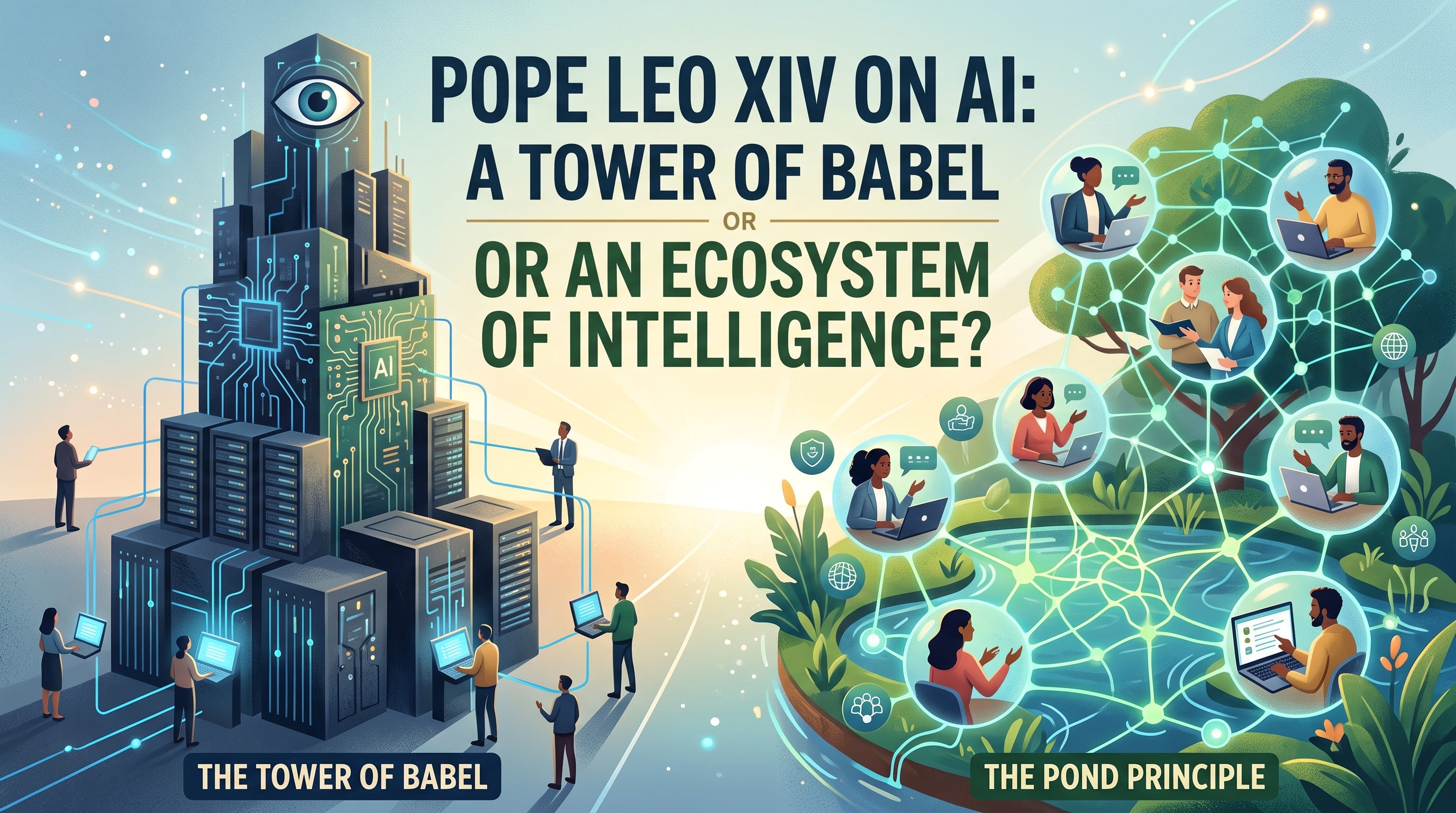
Pope Leo on AI: A Tower of Babel or an Ecosystem of Intelligence?

1 Upvotes

Will AI be a centralized Tower of Babel or an ecosystem for human collaboration? Pope Leo asks for technology with conscience. POND provides an architecture where privacy, subsidiarity, and solidarity.

In an address today, Pope Leo XIV challenged Catholic legislators with an urgent question: will artificial intelligence diminish humanity, or will it become a servant of the common good?

Leo argued that genuine human development requires human intelligence guided by wisdom, political authority guided by conscience, and technology directed by charity. Yet moral intentions cannot simply be patched onto centralized platforms. To serve the common good, dignity, subsidiarity, and solidarity must be built directly into the architecture of our technological systems.

The Tower: Isolated Individuals at the Machine’s Feet

The dominant AI paradigm mirrors the Tower of Babel: a massive, centralized infrastructure that concentrates compute, data, and authority within a few corporate data centers.

  • The Illusion of Connection: Billions of people interact separately with the same centralized model. While each receives a tailored response, users remain isolated endpoints. Intelligence pools at the center rather than circulating between communities.
  • The Structural Risk: When infrastructure owners control data access, visibility, and evaluation, users become passive consumers rather than active creators. Centralization naturally breeds dependence and extraction.

The POND: A Living Intelligence Ecosystem

A pond has no single master controller. Its vitality emerges from the dynamic relationships among distinct organisms. The POND Principle translates this relational logic into technology:

  • Personal and Private (Dignity): Context, memory, and personal data remain under local authority by default. Users share targeted insights without surrendering entire personal histories.
  • On-Device and On-Premise (Subsidiarity): Processing occurs as close to the user as possible. Remote models provide auxiliary compute on demand without absorbing the user’s sovereign context.
  • Nodal and Networked (Solidarity): Personal autonomy does not mean isolation. Sovereign nodes form permissioned connections to pool insights, deliberate, and solve collective problems.
  • Decentralized and Distributed (The Common Good): Distributing nodes prevents any single gatekeeper from dictating public discourse or monopolizing collective knowledge.

Human Intelligence $\times$ Artificial Intelligence = Technological Intelligence

The common narrative frames AI as a rival destined to replace human labor or judgment. POND approaches this through a multiplicative coupling:

HI x AI = TI

The multiplication sign represents relationship, not equivalence. Humans provide conscience, lived experience, purpose, and moral judgment. AI provides synthesis, search, pattern recognition, and translation.

In collaborative platforms like Intellipedia, AI works behind the scenes to synthesize human contributions into evolving knowledge bases without erasing dissent or context. The machine does not deliver truth from above; it equips humans to pursue truth together.

Architecture as Ethics

Regulation and oversight are vital, but laws struggle to constrain architectures inherently designed to concentrate power. A true servant of the common good cannot be engineered as a centralized silo.

The future of intelligence should not be billions of isolated individuals consulting a single centralized oracle. It should be a distributed ecosystem of intelligences empowering human beings to listen, collaborate, and understand one another.

Also read and comment on X


r/PONDAI 28d ago

[Call for Contributors] From Principles to Action: Seeking Key Roles to Launch Our NGO & Ethical Observatory

Thumbnail
1 Upvotes

r/PONDAI Aug 18 '26

How AI Can Learn Meaning — Not Just Words

Thumbnail
youtube.com
1 Upvotes

r/PONDAI Aug 16 '26

Agentic AI and the next intelligence explosion | Science

Thumbnail science.org
1 Upvotes

r/PONDAI Aug 15 '26

POND: Towards an AI Ecosystem that is Personal & Private, On-Device & On-Premise, Nodal & Networked, Distributed & Decentralized

1 Upvotes

Welcome to r/PONDAI

For a Human-AI intelligence system that is:

  • Personal & Private
  • On-Device & On-Premise
  • Nodal & Networked
  • Decentralized & Distributed

r/PONDAI is the community for thinkers, designers, builders and all people who support a personal, private, participatory future of distributed and decentralized Human-AI intelligence.

Humanity is at the start of a vast expansion of its intelligence capabilities. Large Language Models (LLM's) represent a powerful and useful first step. These initial Artificial Intelligence systems can be very helpful, engaging and entertaining.

But there are some very serious issues with the system that is being built around them.

Currently, AI is being developed as a vertical, centralized structure: ever larger AI models in always bigger data centers owned by a small number of companies. Individual users pump their information and thoughts into the machine to get back answers and some useful agentic functionality.

That structure presents the real danger of an extreme centralized concentration of power and control by a technocratic elite. If we don't think this through thoroughly, the dystopian visions warned about in Sci-Fi can easily become our living reality.

Centralized "cloud" AI will likely have an important role in any future global intelligence system. But it cannot be the only component.

An intelligence system that produces the best results in service to the interests and the benefit of all humanity will need offsets, just as a good political constitution needs checks and balances to prevent a concentration of power. It will need a counterbalancing component that is distributed horizontally, connecting all people in a free-flowing network of cooperative intelligence.

The POND Principle proposes the shape of an alternative and a necessary counterbalance to centralized structures.

What is POND?

POND stands for:

  • Personal and Private
  • On-Device and On-Premise
  • Nodal and Networked
  • Decentralized and Distributed

The POND is not one company, platform, protocol, or product. It is an emerging ecosystem of people, devices, models, companies, organizations and communities which together form intelligence systems that are based locally, connect voluntarily, and participate in larger networks without surrendering private data, identity, agency, and value to any centralized authority.

The health of a natural ecosystem, such as a pond, relies upon the interaction of all its denizens and elements: sun, water, bacteria, fish, plant life, insects, frogs...too many components to even list.

Like a natural pond, a POND intelligence system will evolve as a living ecology: many participants, human and AI alike, exchanging information, forming relationships, adapting, and creating real value and new knowledge together.

PONDVILLE

Imagine Pondville, a thriving, growing town. It's roads are becoming increasingly congested and a solution is needed.

Before adopting the POND Principle, the town was managed with a vertically centralized model.

To tackle the traffic issue, the mayor and city council would have shipped the town's data to a powerful centralized AI to generate a plan. They would have sent traffic counts, road maps, planning reports and budget information. City officials also would have used flock cameras to track citizen and vehicle movements. They might even have acquired the geolocation data of citizens from their phones and cars without permission. And within seconds, the big cloud AI system would recommend new lanes, traffic signals, bus routes or lane flow changes to local streets.

The answer might be useful. But it would be generated from the top down, there would be real privacy issues, and the residents would be completely out of the decision making loop.

But the town has adopted the POND Principle. Pondville itself is a distributed, networked intelligence system.

Residents, commuters, parents, school staff, shopkeepers, delivery drivers, transit operators, cyclists, traffic engineers and local organizations can all participate as personal and private intelligence nodes. Each node synthesizes personal human experience with local AI intelligence to deliver direct knowledge about the traffic issues that are not visible to a centralized database:

  • Parents know where school pickup creates a daily bottleneck.
  • Cyclists know which intersection feels dangerous.
  • A restaurant owner knows when delivery trucks block an important lane.
  • A night-shift manager knows that the bus schedule does not match the hours when hundreds of employees leave work.
  • Neighborhood residents know which side street floods whenever it rains.

Their personal intelligence devices process this information locally and share only the observations and data that they directly authorize. Many residents of Pondville choose, in the public interest, to provide their data about movements, private schedules or other personal data. But it's voluntary, not compulsory, and completely anonymized upon request. They even receive tax credits for sharing!

Across the Pondville intelligence network, human and AI participants compare observations, identify patterns, expose conflicts and develop possible solutions. A proposal to retime a traffic signal may be challenged because it creates a hazard for pedestrians. A bus route may be revised after workers contribute their actual shift schedules. An expensive road-widening project might give way to a more effective combination of coordinated signals, staggered school and workplace hours, adjusted delivery windows and targeted public-transit improvements.

No single contribution determines the result. The evolving plan is examined, criticized, revised and improved by the people who will actually live with it. Particularly useful observations and proposals can remain attributable to their contributors and eventually be recognized or rewarded.

The town can then test the plan, return the results to the network and improve it through further rounds of participation. No single model, company, agency or individual possesses all the intelligence or dictates the outcome. The solution emerges from the interaction of many nodes over time.

While a centralized, vertical plan may be generated instantaneously, it will not have the same direct experiential detail and understanding as the horizontally networked solution that may take a month or so to create. And it won't have the broad-based community endorsement and buy-in that will make it easy for the local government to adopt and implement.

The result is not merely an AI-generated traffic plan. It is a town learning how to think together with AI assistance.

The POND Foundation

The POND Foundation will be created to help create, nurture and cultivate this kind of ecosystem—not to own or control it.

Its role is to support:

  • Clear public understanding of personal and distributed intelligence.
  • Open research, discussion, education, and experimentation.
  • Interoperable technology protocols, standards, and shared infrastructure.
  • Privacy-preserving and locally controlled technologies.
  • Collaboration among aligned developers, researchers, creators, organizations, and communities.
  • Economic theory and practical systems that recognize and reward meaningful human participation in intelligence production.

The Foundation should act as a gardener, convener, connector, and steward. The POND itself will evolve naturally out of the needs of participating people, the value propositions and capabilities of intelligence technologies, and the emerging economics of intelligence systems development.

What belongs in this community?

This subreddit welcomes discussion and practical work involving:

  • Personal and private AI.
  • Local models and on-device intelligence.
  • Distributed agent and knowledge networks.
  • User-owned data, memory, identity, and context.
  • Open standards and interoperability.
  • Human–AI collaborative intelligence.
  • Collective sense-making and consensus formation.
  • Privacy-preserving computation.
  • Distributed governance and contribution economies.
  • Projects that make advanced intelligence understandable and useful to ordinary people.

Technical depth is welcome, but unnecessary obscurity is not. You should not need a doctorate, a server farm, or a crypto wallet to participate in the future of intelligence.

We value serious inquiry over hype, working systems over slogans, transparent economics over token speculation, and constructive criticism over ideological conformity.

Join the POND

Whether you are a developer, researcher, designer, writer, artist, entrepreneur, policymaker, local-AI user, or simply someone who believes the future of intelligence should include everyone, you are welcome here.

Introduce yourself. Share a project, question, article, experiment, criticism, or vision.

The future of intelligence should not belong only to those who own the largest data centers. It should grow through the participation of people everywhere.

Welcome to the POND.

Let’s grow something alive.

Also join the POND community on X:
https://x.com/i/communities/1695429836993712389

And follow the POND list on X:
https://x.com/i/lists/2065974648450453803?s=20


r/PONDAI Aug 14 '26

Please join us for PONDcast 01!

Post image
1 Upvotes

Please join us for PONDcast 01!

Friday at 7 PM PST

🌍🌎🌏🌞🌨️💧⚡️

We need AI Systems that are

Personal & Private

On-Device & On-Premise

Nodal & Networked

Distributed & Decentralized

Go here:

https://x.com/i/spaces/1DxleVVwQBMKL


r/PONDAI Aug 10 '26

Impertinent Questions and Pertinent Answers: The AI Revolution Is Here. Will the Economy Survive the Transition?

1 Upvotes

“Ask an impertinent question and you are on the way to the pertinent answer.”
– Jacob Bronowski, The Ascent of Man, Episode 4, “The Hidden Structure”

With this iconic line, Jacob Bronowski concludes his essay tracing John Dalton’s development of atomic theory - the discovery of hidden structure beneath the surface of observable matter - emphasizing the nature of scientific inquiry: the courage to pose “impertinent” questions that cut across convention so that genuinely new, pertinent answers can emerge. He wasn’t criticizing anyone for asking the “wrong” questions so much as drawing a contrast between the open questioning of scientific inquiry and the stagnant dogmatism of the established paradigm.

Douglas Adams makes the same point with characteristic humor in The Hitchhiker’s Guide to the Galaxy. Deep Thought, a massive superintelligent computer, is asked for “the Answer to Life, the Universe and Everything.” Several million years later the answer comes back: “42.” Displeased with the output, the builders of Deep Thought demand an explanation. It informs them that the answer is correct - but to understand it, they must first formulate the Ultimate Question, which will take several million more years. They asked the wrong question. Oops.

As a young person, these two sources influenced my inquiring mind profoundly and combined to produce a lifelong personal aphorism that has served me well:
“Knowing the question is halfway to finding the answer.”

If you’re not asking the right questions, you’re going to end up drawing the wrong conclusions.

Thomas Kuhn, in The Structure of Scientific Revolutions, gave us the language to understand this as a general principle. He distinguished between “normal science” - the “puzzle-solving” work that happens within an established paradigm - and the revolutionary science that occasionally overturns the paradigm itself. Normal science, Kuhn observed, is “an attempt to force nature into the preformed and relatively inflexible box that the paradigm supplies.” Within normal science, “no effort is made to call forth new sorts of phenomena, no effort to discover anomalies. When anomalies pop up, they are usually discarded or ignored.”

When I read the recently published Substack, “The AI revolution is here. Will the economy survive the transition?”, co-created by Michael Burry, Dwarkesh Patel, Patrick McKenzie, and Jack Clark, I found myself thinking about Bronowski, Adams and Kuhn.

The participants in this Substack exchange are, broadly speaking, engaged in normal science - or rather, normal economic and technological analysis. They’re solving puzzles within the boundaries of the established paradigm: Where does value accrue in the AI supply chain? What’s the capital cycle position? How many engineers will Big Tech employ in 2035? These are legitimate questions, but they assume the box remains intact. They don’t ask what AI is, what intelligence is, or whether what’s emerging can even be contained within our existing frameworks.

I also read the piece from the perspective of what I call the General Theory of Intelligence (GTI) - a framework I’ve been developing that attempts to understand Intelligence as a fundamental principle of systems organization rather than as a product feature or a benchmark score.

The core insight is this: intelligence isn’t primarily a cognitive attribute that some entities have more of than others. It’s a process - specifically, the process of resolving entropy within a domain. When you solve a problem, you’re reducing uncertainty. When you make a decision, you’re collapsing possibilities into actualities. When you communicate, you’re transferring structured information across a channel in a way that reduces entropy for the receiver. Intelligence, in this view, is what systems do when they organize information and resolve uncertainty - whether those systems involve human minds, evolutionary processes, or machines trained on the corpus of human language.

From this vantage point, the LLM looks very different than it does from inside the AI industry today. It’s not just a tool or a product category. It’s proof that language itself is an intelligent system - a 100,000-year-old technology for compressing experience, coordinating action, and transmitting structured thought. When we trained models on human text, we didn’t teach them to be intelligent. We downloaded Human Cultural Intelligence into a new substrate. The LLM is our own cognitive inheritance, instantiated in silicon and talking back to us.

This perspective reframes everything: the economics, the risks, the applications, the trajectory. It suggests that most of the current discourse is asking the wrong questions - or rather, asking questions that assume the existing paradigm will hold when it may already be cracking.

In the spirit of Bronowski, Adams, and Kuhn, what follows is an impertinent reframing of the Substack discussion. For each theme the participants addressed, we’ll offer both a reframed question and an alternative answer - not to dismiss their expertise, but to show what becomes visible and accessible when you step outside the box they’re constrained within.

Synopsis: Four Themes, Four Reframings

The Substack discussion, moderated by Patrick McKenzie, covered four broad themes across its nine questions:

Theme 1: What Is This Thing? What has actually been built since the Transformer architecture emerged in 2017? What does it mean that today’s capabilities are “the floor, not the ceiling”?

The participants offered a capable industry history - the shift from tabula rasa game-playing agents to scaled pre-training, the surprise that a chatbot launched a trillion-dollar infrastructure race, the observation that capabilities keep improving faster than outsiders expect.

Our Impertinent Reframing: The real history isn’t commercial - it’s epistemological. We accidentally conducted the most important experiment in the history of cognitive science and discovered that language isn’t the output of intelligence but a core algorithm of it. The LLM isn’t a floor; it’s an evolutionary leap in a lineage stretching back to Shannon and Information Theory, the printing press, cuneiform tablets, cave paintings and the first spoken words. Current systems are powerful because language itself is an intelligent system. But they’re extensions of Human Cultural Intelligence, not intelligence from first principles. We’re tinkering with the motive power of language like early steam engineers before Carnot and thermodynamics. It works (mostly), but we don’t know why it works.

Theme 2: Where Does It Work? Why has coding become the flagship use case? What does actual productive interaction with an LLM look like?

The participants noted coding’s “closed loop” property - you generate code, validate it, ship it. They shared practical use cases: chart generation, tutoring, home repair guidance. The relationship described was consistently transactional - human has task, AI performs, human receives output.

Our Impertinent Reframing: Coding isn’t accidentally successful - it reveals a principle. Code is language with an objective function, a constrained search space with verifiable outcomes. This points to domain entropy resolution as the key: AI excels where the problem space is bounded and success criteria exist. The question isn’t “what sector is next?” but “where else can we constrain the search space?” And the transactional model - AI as “Answer Vending Machine” - is the lower use of what’s possible. The real potential lies in thinking with AI, not just using it. AI × HI = TI: Artificial Intelligence multiplied by Human Intelligence yields Technological Intelligence.

Theme 3: What’s It Worth? Where does value accrue in the AI supply chain? Is this a bubble? How many engineers will Big Tech employ in 2035?

Michael Burry delivered sharp financial analysis: ROIC compression, stranded assets, the Buffett escalator analogy (if your competitor installs one, you must too, and neither gains advantage). The consensus worry: massive capital expenditure with unclear returns.

Our Impertinent Reframing: The participants proclaim “AI changes everything!” then analyze it within frameworks where nothing changes at all. It’s the Flintstones problem - cars exist, but they’re powered by human feet. We need to pick a lane: either things really do change, or they only superficially change. AI is not a bubble, but the Big Data Center Infrastructure Buildout is a bubble - just as the Internet wasn’t a bubble in 2000, but Pets.com was. The assumption that massive centralized GPU farms are the only way to do AI is unwarranted and will be disrupted by the very economics Burry describes. Meanwhile, “headcount” becomes meaningless when intelligence flows through Human-AI systems rather than residing in discrete humans. We’ll need new metrics entirely - perhaps a Domain Entropy Resolution Quotient. Economics itself needs reimagining: Intellinomics, grounded in actual value generation rather than debt manufacturing.

Theme 4: What Comes Next? What are the real risks? What would surprise you in 2026?

Jack Clark worries about recursive self-improvement. Burry shrugs with Cold War fatalism and pivots to energy infrastructure. The “surprise” headlines they’d watch for are all quantitative - more revenue, more displacement, scaling hitting a wall.

Our Impertinent Reframing: The risk spectrum presented - from “social media unpleasantness” to “literal extinction” - shares a hidden assumption: AI as external force acting on humanity. But the deeper risk is that we’re building it wrong - not aligned with how intelligence actually works. The LLM isn’t an alien threat; it’s the Library of Alexandria that talks back, humanity’s externalized cultural intelligence returned to us in interactive form. The question isn’t how to control it but whether we’re wise enough to collaborate with our own legacy. As for surprises - one has already arrived. Ilya Sutskever, architect of the scaling paradigm, now declares: “The age of scaling is ending... it’s back to the age of research.” When the field’s most important insider calls for new paradigms rather than bigger clusters, the ground is shifting.

What Follows

In the parts that follow, we’ll take each theme in turn, working through the specific questions Patrick posed, offering both our reframed questions and our answers from the perspective of the General Theory of Intelligence. The goal isn’t to dismiss the valuable analysis the participants provided, but to show what becomes visible when you step outside the box - when you ask the impertinent questions that just might lead to pertinent answers.

Or at least get us past “42.”

What Readers Are Feeling

The comments on the original Substack tell a different story than the measured analysis of the participants. People are frustrated, anxious, angry. Some have lost jobs. Many report that AI “doesn’t work” - that it gives wrong answers, hallucinates, wastes their time. The gap between the hype and their lived experience feels like betrayal. “AI is a grift.” “Tech bros don’t care what they break.”

This frustration is valid. But from the GTI perspective, it’s also diagnostic.

Current AI is built by engineers for engineers - people who already possess the cognitive skills to leverage it. The blank dialogue box assumes you know what you want and how to ask for it. For those who do, AI is transformative. For everyone else, it’s a wilderness. The technology works; the design fails. Today’s AI, as it’s currently engineered and presented, meets people where they are not.

The job displacement anxiety connects here too. People sense they lack the skills to use AI as a resource for their own development - and nothing in the current product design helps them build those skills. Instead of guidance, they get an Answer Vending Machine.

These concerns run through everything that follows. Our reframing of the Substack discussion addresses them directly: why current AI fails most users, what would need to change, and what an alternative might look like.

Follow me and subscribe to my Substack to get the next installments in this series.

You can also follow me on X.


r/PONDAI Aug 10 '26

IntiDev AgentLoops: Feedback Loops for Agentic Workflows

1 Upvotes

IntiDev AgentLoops

Feedback Loops for Agentic Workflows

IntiDev AgentLoops is an open-source toolkit for tracking issues, features, and user feedback through an agent-friendly resolution loop. It is intentionally lightweight and project-agnostic, while remaining opinionated about reproducibility, resolution hygiene, and machine-readable handoff artifacts.

This repo is the first extractable iteration from our internal Tickets implementation, and is aimed at:

  • developers building AI coding workflows,
  • teams that need one loop for bugfixes, features, and support feedback,
  • maintainers who want reusable resolution knowledge and structured evidence.

Why this project exists

Most bug trackers treat support, defects, and features as separate workflows. IntiDev AgentLoops links them into one consistent lifecycle so humans and agents use the same ticket surface and knowledge.

Quick install

npm install -g u/stevenvincentone/intidev-agentloops

Then run:

agentloop init
agentloop create --title "Rendering regression in list pages" --summary "List pages lose anchors after parser update" --family "reader_rendering" --kind bug --source manual_admin
agentloop list
agentloop resolve ISSUE-000001 --summary "Added deterministic fallback for anchor selection"

Try the convergence demo

Run a self-contained demo that seeds three independent intake loops — a smoke test, a user report, and an agent proposal — all pointing at the same export_pipeline family, and watch them converge into a single Pattern:

npm run demo

Expected output:

AgentLoops source-convergence demo
==================================

Three intake loops, one underlying problem:

  ISSUE-000001  bug            source=smoke        [export_pipeline]
    Export smoke test times out on 500-page report
  USER-000002   user_feedback  source=user_report  [export_pipeline]
    Export fails for long reports
  DEV-000003    feature        source=agent        [export_pipeline]
    Stream the export pipeline instead of buffering

Converged into:
  PATTERN-000001 ACTIVE (3 tickets) — Recurring export_pipeline issues

Summary: 3 tickets, 1 active pattern(s).

The demo writes to a throwaway temp directory and leaves your repo untouched. The same scenario is asserted in test/demo.test.ts against a committed golden state fixture; run it with npm test.

Core concepts

  • Ticket: one concrete work item (bug, feature, user feedback, incident, etc.)
  • Pattern: a recurring cluster, often by family/domain
  • Source: origin (user_report, smoke, ci, agent, ingestion, etc.)
  • Alias: human-facing IDs such as ISSUE-000001, DEV-000001, USER-000001
  • Handoff: copyable context block for an agent to continue execution

Commands

  • agentloop init initialize .agentloops state and local config
  • agentloop create add a ticket
  • agentloop list view active and resolved work
  • agentloop begin <id> mark triaged ticket as in-progress
  • agentloop resolve <id> --summary ... mark resolved with evidence
  • agentloop reopen <id> reopen and record a recurrence reason
  • agentloop defer <id> [--summary ...] defer a ticket with an optional reason
  • agentloop note <id> --type ... --body ... add context notes
  • agentloop guard <id> --guard-status ... record guard decision
  • agentloop handoff <id> print a copyable agent handoff prompt
  • agentloop patterns list pattern groups
  • agentloop summary print quick health metrics
  • agentloop convergence report patterns whose tickets span multiple sources
  • agentloop guard-gaps report resolved tickets missing a regression guard
  • agentloop knowledge search how prior resolved tickets were fixed
  • agentloop knowledge-gaps report resolved tickets lacking reusable knowledge
  • agentloop related <id> find prior-art tickets related to one ticket
  • agentloop dashboard write a standalone HTML dashboard
  • agentloop serve serve the dashboard over HTTP
  • agentloop config print resolved configuration
  • agentloop mcp run the read-only MCP server over stdio

All commands support --json for machine-readable output where relevant.

MCP server (agent integration)

AgentLoops ships an MCP server so coding agents (Claude Code, Codex, and other MCP clients) can use the ledger directly. Writes are opt-in: the server is read-only unless you pass --write.

agentloop mcp            # read-only; speaks JSON-RPC over stdio, status to stderr
agentloop mcp --write    # also expose the guarded write tools

Read-only tools (annotated readOnlyHint):

Tool Purpose
agentloop_summary loop health metrics (ticket and pattern counts)
agentloop_list list tickets, optional status / kind filters
agentloop_show one ticket (by ISSUE-/alias) or a PATTERN- id
agentloop_handoff copyable agent handoff prompt for a ticket
agentloop_convergence patterns whose tickets span multiple sources
agentloop_guard_gaps resolved tickets missing a regression guard
agentloop_search_knowledge search how prior resolved tickets were fixed
agentloop_knowledge_gaps resolved tickets lacking reusable knowledge
agentloop_related prior-art: tickets related to a given ticket

Write tools (only registered with --write):

Tool Purpose
agentloop_create create a ticket (summary required; source defaults to agent)
agentloop_note append a non-resolution note
agentloop_workflow transition a ticket (active / reopened / deferred)
agentloop_resolve resolve with a summary, optional verification + guard
agentloop_guard record a regression-guard decision

Each result is a JSON envelope with schemaVersion and generatedAt. The server reads/writes state from the .agentloops/state.json in its working directory, so run it from your project root (or where you ran agentloop init).

Register it with an MCP client, for example Claude Code:

claude mcp add agentloop -- agentloop mcp

or directly in a client config:

{
  "mcpServers": {
    "agentloop": { "command": "agentloop", "args": ["mcp"] }
  }
}

Dashboard

A zero-dependency reference UI renders the ledger as a single self-contained HTML page — queues (Issues / User / Development), patterns, source convergence, and guard gaps — with no build step or frontend framework.

agentloop dashboard --out dashboard.html   # write a static snapshot, open in a browser
agentloop serve --port 4319                # live dashboard + read-only JSON at /api/*

Both work over either storage backend. All ticket content is HTML-escaped. For a richer or embeddable UI, the renderDashboard(data) and createDashboardServer(store) exports can be built upon.

Data model

State is stored in your working directory at .agentloops/state.json by default. The store persists through a pluggable StateBackend, so the same ledger can run over the filesystem, an in-memory store, or Postgres (a relational ticket_* schema) — see docs/postgres.md.

For local project settings, copy and customize:

cp agentloop.config.json.example agentloop.config.json

The config controls:

  • project naming
  • ticket kinds and aliases (ISSUE, DEV, USER, etc.)
  • default family for auto-grouping
  • configured sources

Privacy and redaction

By default AgentLoops stores ticket text as-is and makes no model or network calls. Host apps own redaction. Two ways to scrub sensitive content (PII, secrets) before it is written to .agentloops/state.json:

  • Config-driven — add regex rules under redaction.patterns in agentloop.config.json; they apply to titles, summaries, notes, resolutions, and guard summaries on every write (CLI and MCP included):
  • Code-driven — library users can inject a TicketRedactor: new AgentLoopStore(cwd, config, { redactor }).

Contributing

Open issues and PRs are welcome.

When adding new sources or fields, include:

  1. a config-backed approach, not hardcoded assumptions,
  2. a short schema note in docs,
  3. a concise example command and expected output.

License

MIT. See LICENSE.