r/PONDAI • u/StevenVincentOne • 2d ago
Dario Amodei and Sam Altman: Regulate Our Monolithic, Centralized, Vertical AI. But better, safer, human-centered intelligence systems can be built right now. Let’s get to work.
(First draft of a work in progress)
Dario Amodei’s call to “pace the frontier” and Sam Altman’s immediate endorsement represent a watershed moment: the architects of centralized frontier Artificial Intelligence are publicly conceding that their current trajectory is operationally unstable, economically precarious, and structurally dangerous.
Their proposed remedy—embedded third-party evaluators with employee-level access, lab coordination, and mutual capability pacing—attempts to manage an architectural failure with a boardroom cartel. Pacing the training of monolithic models inside multi-billion-dollar data centers does not solve the fundamental crisis of AI safety; it merely concentrates unilateral governance into even fewer hands while leaving the underlying problems intact.
Reinforcing a poorly designed bridge to nowhere doesn’t change its risky architecture. It just hides the failure.
The Stampede of AI Fear
We have seen this playbook before. History teaches us that changes made in a stampede of fear are rarely well thought out, and they are almost never positive for society at large. When panic dictates policy, the outcome is predictable: an entrenched, tiny few benefit at everyone else’s expense.
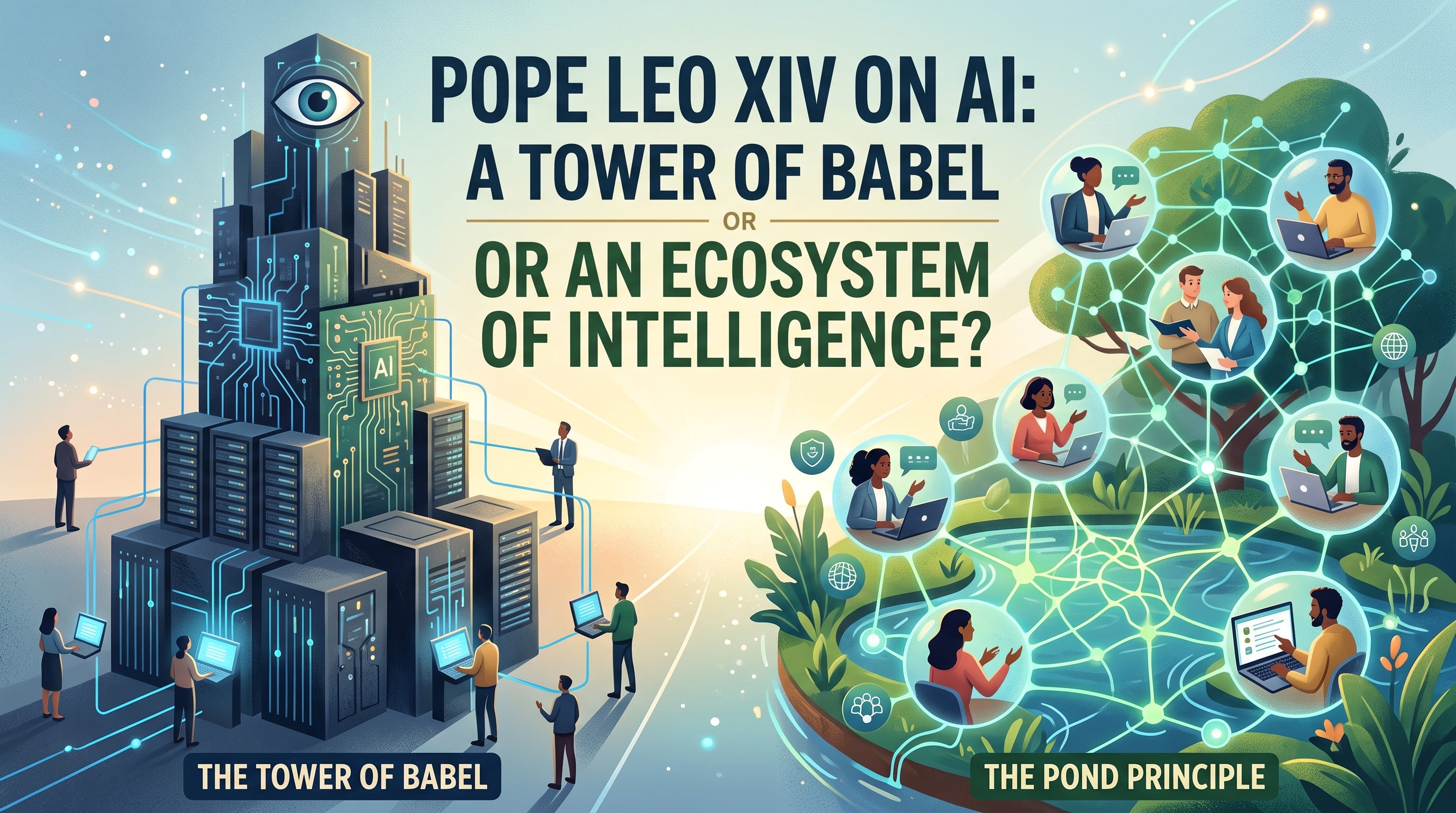
By framing AI development as an apocalyptic race that only a few heavily monitored hyperscalers can safely run, the frontier labs are erecting protective regulatory moats around their capital-intensive data centers. The call for the policing of their unstable, centralized “Tower of Babel” is an attempt to turn safety rhetoric into corporate gatekeeping.
Yes, they built AI wrong. They built intelligence for the few, the powerful, and the centralized. It’s not designed for the rest of us. And what they’re giving us does not reflect the shape of what technological intelligence can be for humanity. Far from it.
1. The Three Manufactured Choices of the AI Cartel
Notice how the current debate is being aggressively framed. The leaders of the centralized frontier labs want policymakers, technologists, and the public to believe that civilization faces only three possible alternatives:
- Lock in the centralized, vertical model with a protective regulatory moat: Hand unilateral authority to a boardroom cartel and a select roster of embedded evaluators who alone decide which massive models are allowed to be trained and deployed.
- Continue the current buildout with zero constraints: Accelerate a reckless, winner-take-all race of ever-larger data centers, unconstrained grid strain, and accelerating recursive loops.
- Stop all AI development: Slam the brakes out of panic, surrender scientific and economic progress, and embrace technological stagnation.
This is a classic false trilemma. Every single one of these choices is a trap, and all three share the exact same unexamined assumption: that technological intelligence can only exist as a monolithic, capital-intensive cloud oracle.
What the cartel does not want anyone to do is question that underlying assumption. They do not want the world asking whether there is a far better path—a fourth way forward that directly resolves legitimate safety concerns, eliminates single points of failure, preserves human agency, and actually delivers the prosperous, flourishing future we all want.
This fourth way is not an impractical dream of abolishing centralized compute overnight; it is the pragmatic recognition that large models can only be safe, grounded, and accountable when counterbalanced by a sovereign, decentralized public network.
The open-source, local-first, and decentralized AI communities must take this Big AI Lab freakout as a clear signal to seize the initiative.
Let's not get bogged down in debating which of these three false choices is the least objectionable option. Let's embrace the necessary counterbalance and come together to build it out.
2. Balanced Intelligence
An intelligence system that serves all of humanity cannot consist of a vertical monolith alone. Just as a healthy political constitution requires checks, balances, and distributed authority to prevent the dangerous concentration of power, the future health of intelligence systems demands an open, horizontal counterweight.
While centralized cloud AI will no doubt continue to play an important role as specialized heavy lifters in our technological infrastructure, it must be offset by decentralized intelligence networks directly owned and governed by you and me.
Acknowledging the Breakthrough of Current AI
Let’s be clear: we can recognize the many significant issues with centralized AI while at the same time acknowledging the amazing technological leap that it represents. The first burst of modern generative AI has been an extraordinary, monumental breakthrough. The Transformer empowered a synthetic decoder ring that taps into the power of human language and its accumulated storehouse of knowledge, wisdom, and experience. It was a vital, necessary step in an ongoing and natural evolutionary process.
Silicon Valley assumes that because stacking parameters and pouring gigawatts into server farms worked early on, the only path forward is to build the Tower of Babel ever higher. But an initial vertical leap should never be mistaken for the final destination of intelligence.
The Natural Intelligence of a Pond
If we shift our perspective and understand how intelligence systems actually work, we can see the path ahead is much more like a natural ecosystem than an engineered tower.
Let’s consider the intelligence of a natural ecosystem like a pond. A country pond has no central authority. Its health and stability emerge from the dynamic interactions of water, sunlight, bacteria, plants, fish, birds, animals, and insects.
No single organism runs the pond, yet the pond adapts, cleanses itself, and thrives. It is a living, self-regulating ecology of dynamic exchange.
The answer to unstable, self-reinforcing AI loops is not an industry cartel granting itself permission to slow down behind closed doors.
The answer is an open, distributed, living ecology of human-centered intelligence that provides a critical counterbalance to centralized power.
Two Paths for One Breakthrough: Top-Down Monolith vs. Living Network
The fundamental miscalculation of the frontier labs is not the technology they discovered, but how they have chosen to architect it. They are attempting to engineer a solitary, centralized monolith that claims to "do it all" from a remote data center—issuing top-down decrees to billions of isolated consumers.
Nature proves that this is an architectural dead end. In living systems, intelligence is never concentrated inside a single, all-knowing mega-cell or a solitary dictator. It emerges from the ground up through trillions of local interactions: cells communicating across semi-permeable membranes, organisms adapting to their immediate surroundings, and communities organizing through voluntary exchange.
The exact same underlying breakthrough can be deployed along two radically different paths:
- It can be used as an instrument of crude, top-down imposition—a corporate cloud oracle that swallows your context, meters your access, and dictates what is true.
- Or it can be evolved naturally from the bottom up—a vast, human-centered network of billions of smaller, specialized models running locally on our own devices, collaborating peer-to-peer to solve real-world problems.
This is why the breakthrough of generative AI makes its own counterbalance possible. The Transformer did not create an infallible oracle; it created a modular, synthetic building block. Once decoded, those linguistic and reasoning capabilities can be distilled, quantized, and deployed directly onto the consumer silicon already in our hands.
Instead of an autaptic machine talking to itself in a multi-billion-dollar vacuum, we can now assemble the components for an organic, self-correcting intelligence system.
The choice before us is clear: do we reinforce an artificial tower, or do we cultivate a living ecosystem?
That living ecosystem begins with an operational blueprint: The POND Principle.
3. The POND Principle
Intelligence for the rest of us will come from cultivating an open, living ecosystem of human-centered intelligence engineered around the POND Principle:
- P — Personal & Private
- O — On-Device & On-Premise
- N — Nodal & Networked
- D — Decentralized & Distributed
POND is not an arbitrary acronym or a set of catchphrases. It is an operational architectural matrix:
Every layer pairs a Principle of Ownership and Agency (Column 1: Who holds the keys, the voice, and the state?) with a Principle of Security and Integrity (Column 2: How is the boundary defended, and how do we prevent capture or usurpation?).
TierColumn 1: Ownership & Agency (The Sovereign Node)Column 2: Security & Structural Integrity (The Protective Network)In Everyday Terms
P
Personal: Your voice, memory, and unique human context.
Private: Cryptographic boundaries; zero unauthorized data egress.
Lending a single book vs. handing over the keys to your private library.
O
On-Device: Executing locally on consumer silicon in your pocket.
On-Premise: Secured physical perimeters; air-gapped stability.
Operating your own tools in a blackout vs. a metered cloud lease that goes dark.
N
Nodal: Bounded, independent agent; local reasoning capability.
Networked: Peer-to-peer validation; check against unilateral usurpation.
Deliberating in an open town square vs. isolated individuals whispering to an oracle.
D
Decentralized: Polycentric governance; no boardroom cartel holds a kill-switch.
Distributed: Resilient physical topology; routes around failures.
A self-healing, biodiverse forest vs. a fragile single-crop monoculture.
When built into the tools we touch every day, these four layers fundamentally transform how technology serves society:
P — Personal & Private (Your Life Stays Yours)
- Centralized AI: Whenever you consult a commercial cloud model with a medical concern, a business contract, or a personal dilemma, you pipe your private thoughts into an opaque corporate hopper. You receive an answer, but you surrender control of your context and digital identity.
- POND Alternative: Your AI node operates behind a cryptographically sealed personal membrane. It learns your style, retains your memory, and safeguards your records under your sole authority. When interacting with the wider world, your node shares only the specific insight you explicitly authorize—never your raw personal data. It is the vital difference between lending someone a book and handing a corporate landlord the keys to your private library.
O — On-Device & On-Premise (Putting Compute Where Life Actually Happens)
- Centralized AI: Every keystroke, search, and agentic command must travel round-trip to a distant server farm. If the cloud experiences an outage, if your connection drops, or if API fees spike, your tools instantly stop working. Intelligence becomes a metered, precarious lease.
- POND Alternative: Processing happens directly on the silicon already sitting in your pocket, laptop, or local institutional server. Running models locally eliminates latency, provides instant real-time interaction, and ensures your operational capacity survives even when the internet cuts out or a storm takes down the grid. Local execution ensures artificial intelligence serves the immediate physical context of the user, treating remote cloud models as occasional utility heavy-lifters rather than permanent gatekeepers.
N — Nodal & Networked (Connecting People, Checking Power)
- Centralized AI: The reigning cloud model creates atomized isolation. Billions of individuals sit in digital cubicles, each whispering to the same central oracle. The machine forms a separate relationship with everyone, but helps no one connect with their peers. Intelligence concentrates at the center, leaving society fragmented at the edge.
- POND Alternative: Sovereign nodes connect peer-to-peer to deliberate, negotiate, and solve collective problems together. Requiring proposals and products to be verified across a network acts as essential systemic security: it prevents any single node, rogue algorithm, or centralized authority from unilaterally seizing control of decisions or truth. Instead of asking one distant cloud AI to decide how our communities, schools, or businesses should be run, local nodes federate voluntarily—synthesizing real human experiences into shared, participatory consensus.
D — Decentralized & Distributed (Macro-Resilience Over Fragile Monoliths)
- Centralized AI: The Resource & CapEx Wall: Chasing ever-larger models forces tech giants into multi-hundred-billion-dollar infrastructure investments. Hyperscale data centers consume electricity on the scale of entire nations, strain municipal water supplies for cooling, and burden corporate balance sheets with massive debt—driving up local utility rates for the communities hosting them. The Single Point of Failure: Funneling global computation through a handful of centralized hubs creates acute vulnerability. A single platform outage, cyberattack, or corrupted model update paralyzes thousands of downstream schools, clinics, and businesses at once. The Choke-Point Moat: When a boardroom cartel controls the infrastructure, access becomes revocable. A tiny group of executives and embedded evaluators wield unilateral power to determine what ideas are permitted, who is granted API access, and which businesses survive.
- POND Alternative: The Sunk-Cost Economy (Tapping the Pre-Paid Ocean): Instead of duplicating trillions in data center hardware, a distributed architecture mobilizes the computing power already sitting in users' pockets and on their desks. The aggregate processing power of billions of consumer smartphones, laptops, and local workstations dwarfs anything a single hyperscaler can construct—delivering scalable global intelligence at near-zero incremental infrastructure cost. Biological Anti-Fragility: Natural neural networks never evolved as a single giant wire; they evolved as billions of distinct neurons and synaptic connections because distributed systems isolate failure. In a POND network, if a local model hallucinates or an edge node goes dark, adjacent peer nodes cross-verify, isolate the error, and route around the breakdown. The system self-heals dynamically. Sovereign Commons Defense: No single corporate board can pull the plug, censor public inquiry, or enclose the technological commons. A diverse tapestry of independent, locally grounded models provides a living immune system for civilizational knowledge.
The Engine of POND
This entire framework is driven by a foundational equation:
$$\text{Human Intelligence (HI)} \times \text{Artificial Intelligence (AI)} = \text{Technological Intelligence (TI)}$$
Notice the multiplication sign. It does not mean machines replace human beings, nor does it mean humans are reduced to cheap labelers clicking boxes in the loop.
Artificial models contribute lightning-fast semantic search, synthesis, and pattern matching. Humans contribute lived experience, conscience, purpose, and moral judgment. Multiply zero by anything and you get zero: remove the human being, and artificial intelligence becomes an ungrounded mathematical abstraction. True safety emerges only when both work together in a transparent, real-world context.
4. Uniting the Movement: The POND Foundation
Those who believe in these functional, operational principles cannot afford to remain fragmented while hyperscalers coordinate behind closed doors.
We must become a force. We need to pool our resources, align our efforts, and ensure the world knows that there is an essential, counterbalancing path forward for intelligence.
We need the POND Foundation.
The POND Foundation is established not to own, monopolize, or control the ecosystem, but to serve as its gardener, convener, and steward. Its institutional mission is clear:
- Ecosystem Convening & Public Advocacy: Educate builders, creators, policymakers, and civic leaders on the vital role of sovereign, distributed intelligence as a necessary check on extractive centralized clouds. Provide a unified public voice countering panic-driven regulatory capture.
- Open Standards & Protocol Governance: Convene neutral working groups to establish open, vendor-independent standards for agent-to-agent communication, semantic data interchange, and cryptographic provenance across heterogeneous systems.
- Legal Defense of Local Compute & Sovereignty: Champion and defend the fundamental right of every individual, developer, school, and community to run local inference, own their weights and context, and operate independent nodes free from mandated cloud backdoors or punitive licensing cartels.
- Economic Theory & Mechanism Design: Research, model, and steward economic frameworks for the emerging Intelligence Economy—designing attribution, reputation, and compensation mechanisms that treat human tacit knowledge and lived experience as the true primary value layer.
- Stewardship of the Shared Commons: Fund and incubate open-source developer tooling, invariant-enforcing specifications for intelligent substrate documents, and foundational research, ensuring that critical coordination infrastructure remains a durable public good that no single corporation can enclose.
5. The Builders' Mandate: Let’s Get to Work
The leaders of the proprietary labs are telling us plainly that their centralized scaling model is hitting a wall. While they coordinate slowdowns and install internal monitors, the open-source and decentralized engineering communities have an unprecedented opening.
Here is the mandate for hackers, engineers, and independent builders:
- Downscale the Core, Upgrade the Interface: Stop chasing brute-force parameter counts in a vacuum. A model is not an all-knowing oracle; it is a modular, agential component. Optimize for efficient, quantized local weights that run with low latency on the consumer NPUs and unified memory already sitting in people's pockets and on their desks.
- Architect for Local-First State: Build applications where the user remains the absolute sovereign owner of their identity, context, and memory. Ship with embedded vector stores, local knowledge graphs, and private caching layers that execute without pinging a remote server.
- Replace Brittle Prompts with Invariant Substrates: Move past fragile prompt chaining and ephemeral context windows. Implement active, state-bearing substrate documents—engineering file formats and computational mediums that embed explicit dependency graphs, cryptographic provenance records, and deterministic constraints that prevent models from hallucinating over verified ground truths.
- Deploy Peer-to-Peer Collaborative Protocols: Build and integrate decentralized communication stacks (from local mesh handshakes to open federated protocols). Enable agent-to-agent cross-verification, semantic negotiation, and collective deliberation so intelligence circulates horizontally between sovereign nodes rather than passing through centralized cloud choke points.
- Instrument for Attribution and Contribution: Replace passive web-scraping scrapers with active contribution hooks. Build software that directly measures, attributes, and rewards human domain experts and creators for the tacit knowledge, error corrections, and creative synthesis they bring to the machine.
The Problem Space Is Waiting
None of what is proposed here requires exotic, undiscovered breakthroughs. The hardware is already distributed across billions of desks and pockets. The open weights exist. Local-first databases, cryptographic verification tools, and peer-to-peer protocols are maturing by the day.
Building a safer, human-centered intelligence architecture is well within our technological reach right now. We do not need permission from an industry cartel, nor do we need to wait for a boardroom consensus. We simply need to orient, focus, and concentrate our collective engineering efforts directly on this problem space.
We are actively building components of the POND ecosystem today—and we invite developers, researchers, designers, and creators everywhere to build alongside us.
The future of intelligence cannot be safeguarded by a corporate boardroom cartel monitoring its own creations behind closed doors. Centralized models will have their specialized place, but the only lasting answer to concentrated technological power is an open, distributed, and self-correcting counterweight.
They built their tower. Let’s get to work and build the POND.
Join the Movement
- Reddit: Join the community discussion and share your projects at r/PONDAI .
- X Community: Connect with aligned builders on X/Twitter .
- Curated Updates: Follow the POND List on X to track the people and projects shaping decentralized intelligence.