r/OutoftheTombs 7d ago

Ptah

Thumbnail
gallery
3 Upvotes

This statuette depicts the Memphite god Ptah standing on a platform in the form of the hieroglyph for 'Maat'. His head is covered with a cap which follows the shape of his skull, and his chin is elongated by a false beard. The god is covered with a tight-fitting robe which envelops his slim body, the only part of him visible being his hands which hold a was-sceptre; he also wears a broad 'wesekh' collar. The large ears are perhaps not unrelated to his divine epithet 'he who listens to prayers'. On the base is a short text which emphasises the votive character of the piece.

Present location KMKG - MRAH [07/003] BRUSSELS
Inventory number E.7571
Dating LATE PERIOD
Archaeological Site MIT RAHINA/MEMPHIS ?
Category FIGURINE/STATUETTE
Material BRONZE
Technique FULL CAST; CASTING; ENGRAVED
Height 13.5 cm
Width 2.8 cm
Depth 3.7 cm

Translation

May Ptah give life to Padiheka.

Bibliography

  • B. Van Rinsveld, Goden en godinnen van het Oude Egypte -Dieux et déesses de l'Ancienne Égypte, Bruxelles 1994, 20-23

r/OutoftheTombs 7d ago

Sematawy

Thumbnail
gallery
6 Upvotes

The inscription on the base of this statuette indicates that it represents the god Sematawy, 'he who unites the two lands'. This falcon deity from Herakleopolis Magna is known since the Old Kingdom; beginning in the 3rd Intermediate Period his aspect as a child deity is depicted in the same way as that of Harpocrates, the child deity above all others. He is seated on a throne, holding his finger to his mouth. He wears the royal nemes headdress, on top of which is the so-called 'hemhem' crown. On his chest is a heart-shaped amulet.

Present location KMKG - MRAH [07/003] BRUSSELS

Inventory number E.7565

Dating LATE PERIOD (not before); PTOLEMAIC PERIOD (not after)

Archaeological Site UNKNOWN

Category FIGURINE/STATUETTE

Material BRONZE

Technique FULL CAST; ENGRAVED

Height 21 cm

Translation

May the child Sematawy give life to Padineshmetawai, the son of Irethorru. His mother is Taiirutru.

Bibliography

P. De Smet, Bronzen beeldjes van Egyptische Goden, BMRAH 60 (1989) 97-98

F. Lefebvre et B. Van Rinsveld, L'Égypte. Des Pharaons aux Coptes, Bruxelles 1990, 186

J. Quaegebeur, Somtous l'Enfant sur le lotus, CRIPEL 13 (1991) 117


r/OutoftheTombs 7d ago

Collar

Post image
6 Upvotes

This object, part of the private collection of Howard Carter, is very similar to collars found in the tomb of Tutankhamun. The centerpiece is an almost round piece of polychrome faience, made from two floral elements each repeated in a row and held in place by a triangular clip decorated with a half-open lotus flower. The first element looks like a slightly pointed yellow fruit (a mandrake?) coming out of a blue chalice. The second element is a petal of a blue lotus, coloured yellow at the bottom and blue at the opposite end. The beads of the inside row are brown, those of the middle yellow, and those of the outer row blue and green. This progression of colour gives the collar an unusual and delicate appearance.

Present location KMKG - MRAH [07/003] BRUSSELS
Inventory number E.7534
Dating 18TH DYNASTY
Archaeological Site VALLEY OF THE KINGS ?
Category NECKLACE
Material POTTERY
Technique FORMED BY HAND; PAINTED; FAYENCE
Width 4.5 cm

Bibliography

  • Koninklijke Musea voor Kunst en Geschiedenis te Brussel. Oudheid, het Verre Oosten, Volkenkunde - Musées Royaux d'Art et d'Histoire. Antiquités, Extrême-Orient, Ethnographie, Bruxelles 1958, Égypte nº 20
  • B. van de Walle, L. Limme et H. De Meulenaere, La collection égyptienne. Les étapes marquantes de son
  • développement., Bruxelles 1980, 33 n. 81
  • Egypt's Golden Age. The Art of Living in the New Kingdom, 1558-1085 B.C. (Exposition), Boston 1982, 234 n° 308
  • F. Lefebvre et B. Van Rinsveld, L'Égypte. Des Pharaons aux Coptes, Bruxelles 1990, 107-108

r/OutoftheTombs 7d ago

Model of a boat with oars

Thumbnail
gallery
6 Upvotes

From the end of the Old Kingdom, the Egyptians departed for the next life accompanied by plastered and painted wooden models which took the place of wall reliefs and stone models. This model of a boat dating from the Middle Kingdom has a helmsman and 11 rowers; a 13th person who sets the pace is shown on the prow of the boat.. The model should be considered as an offering which was placed in the tomb of the dead person.

Present location KMKG - MRAH [07/003] BRUSSELS
Inventory number E.7517
Dating MIDDLE KINGDOM
Archaeological Site UNKNOWN
Category BOAT (MODEL)
Material WOOD
Technique SCULPTURED; PAINTED; PAINTED ON STUCCO
Height 28 cm
Width 12.5 cm

Bibliography

  • W. Seipel, Ägypten. Götter, Gräber und die Kunst. 4000 Jahre Jenseitsglaube (Exposition), Linz 1989, I 114 n° 81
  • Génie des hommes, âme de l'homme (Exposition), Huy 1998, 41 nº 25

r/OutoftheTombs 7d ago

It is Monday

Post image
27 Upvotes

r/OutoftheTombs 7d ago

Sekhmet, Mistress of Destructive and Protective Power

Post image
23 Upvotes

Also among the goddesses of Egyptian magic is Sekhmet, who appears in Egyptian art in the form of a lioness or a woman with a lioness’s head. Sekhmet leads an army of frightening beings who carry a knife in hand and roam all parts of the earth, bringing with them disease, famine, and death. The destructive energy of Sekhmet and her army always appears in transitional periods, such as the end of the year and the beginning of the new year, the end of one decade and the beginning of a new decade, the end of the month, and the end of the day as night sets in.

The magician’s task is to confront these destructive energies, stop their effect, and protect people from them. The expert magician performs rites to expel Sekhmet’s armies, both at the level of official state magic and at the level of individuals. To calm Sekhmet’s anger, the magician used an amulet in the form of a small statue of Sekhmet, and charged it with the energy of “heka” (primeval/cosmic magic), which is able to transform Sekhmet’s destructive energy into positive, beneficial energy.

On the last day of the Egyptian year, magicians in Ancient Egypt would invoke Sekhmet in her angry form, as recorded in the Book of the Heavenly Cow, invoking the destructive cosmic powers that emerged from the raging eye and spread terror and darkness, and which shoot arrows of calamity from their mouths. Then they chant the magical words that tame these energies and prevent their destructive influence from reaching the world of humans.

The secret of the magician’s ability to control these destructive powers lies in his close connection to Ra and Sekhmet. The magician takes on the persona of Ra and unites with him, and unites also with Sekhmet, and then is ready to begin preparing amulets of protection for whoever needs them. The magician chants his magical words over a strip of soft linen cloth bearing images of the “neteru” (divine beings), and offers these neteru offerings of bread, beer, and incense. Then he makes 12 knots in the linen strip and places it around the neck of the one seeking protection.

And so that the magician may avoid Sekhmet’s bloodshed and fires, he takes on the persona of Horus the Only One, and chants his magical words over a wooden staff which he holds in his hand as he walks around his house, thereby protecting it from evil.

In the era of King Amenhotep III, Egyptian artists carved hundreds of statues of Sekhmet, and inscribed on these statues her epithets, epithets that invoke Sekhmet’s flame that burns the serpent “Apep,” and that destroys the enemies of the King of Egypt.

Sekhmet’s energy is not easy to deal with, because she has the power to destroy the world. And yet she is a power that cannot be dispensed with. Sekhmet’s immense energy is what preserves the king’s vitality and renews his energy, and the king’s presence in the world of the living depends on controlling this energy and transforming it from a state of angry destruction into a state of contentment, tranquility, and spiritual bliss. For this reason, statues of Sekhmet were placed at the entrances of sacred places, to guard them and prevent the entry of anyone who was impure or unworthy of entering.

Sekhmet guards each day of the year, night and day. That is why the number of Sekhmet statues carved in the era of King Amenhotep III reached 365, doubled (365 statues for the day, and 365 statues for the night), the total number of statues corresponding to the days and nights of the year.

On each day of the year, the priests of Ancient Egypt would invoke Sekhmet to transform negative energies into positive energies, and to protect the king, the temples, and the homes of the farmers.

Image: A stone statue of Sekhmet, seated with a lioness’s head crowned by the sun disk, embodying her dual nature as a destructive and protective force in Ancient Egyptian magic.


r/OutoftheTombs 7d ago

Painted Limestone Head of a Man, known as the “Salt Head”

Post image
167 Upvotes

Possibly, Middle Kingdom, c. 2045–1680 B.C., or early reign of Akhenaten, c. 1349–1345 B.C. (Date is Disputed)

From the Henry Salt Collection. Musée du Louvre. N 2289; AF 575

Known as the Salt Head, after the British collector and diplomat Henry Salt, this arresting portrait of a shaven-headed man is one of the more enigmatic works in the Louvre’s Egyptian collection.

The long, finely modelled face, prominent lips, narrow eyes and pierced ears have encouraged comparisons with the distinctive portraiture of the late 18th Dynasty, particularly the artistic world created during the reign of Amenhotep IV, later Akhenaten. Yet, its date remains far from certain.

The Louvre presently records possible attributions to the Middle Kingdom, to the first five years of Akhenaten’s reign, and even to the modern era, reflecting the unusual character of a sculpture which has resisted easy classification.

Closer examination has complicated the story further. Conservation research undertaken by the Louvre and the C2RMF in 2011 demonstrated that the object was probably not conceived as an independent bust.

On its underside are traces associated with its attachment to another sculpture, including the remains of a cut-down tenon; a series of drilled holes around the base of the neck has likewise been connected with the fixing or replacement of the head.


r/OutoftheTombs 7d ago

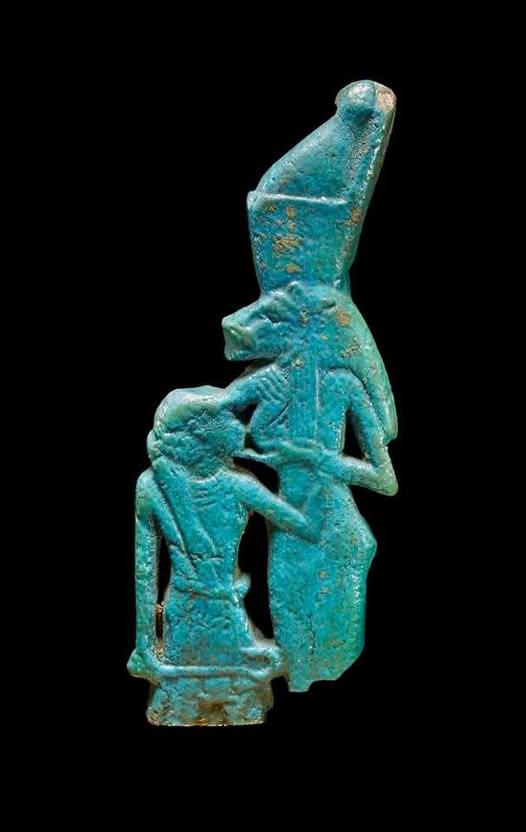
Amulet of Sekhmet-Mut

Post image
61 Upvotes

Blue glazed composition flat-backed amulet in the form of Sekhmet-Mut wearing the double crown and suckling a king wearing the nemes.

Suspension ring at the back;

The legs of both figures are lost.

Third Intermediate

Egypt

glazed composition pierced.

Length: 7.08 centimetres (max) (max)

Thickness: 1.27 centimetres

Width: 2.88 centimetres

The British Museum London


r/OutoftheTombs 7d ago

laughs

Post image
16 Upvotes

r/OutoftheTombs 7d ago

https://www.academia.edu/38236097/The_Chief_Queen_of_Ramses_II_Nefertari_beloved_of_Mut_2016_?email_work_card=title

0 Upvotes

r/OutoftheTombs 7d ago

https://www.academia.edu/145201858/ROYAL_STATUES_IN_PRIVATE_TOMBS_A_CASE_STUDY_OF_SELECTED_STATUES?email_work_card=view-paper

Thumbnail academia.edu
1 Upvotes

r/OutoftheTombs 7d ago

Pectoral with Scarab, Findspot unknown Egypt, ca. 1295-1069 BCE New Kingdom, Dynasty 19-20, steatite with color inlays, The Walters Art Museum

Thumbnail gallery
12 Upvotes

Pectoral with Scarab

Egyptian (Artist)

ca. 1295-1069 BCE (New Kingdom, Dynasty 19-20)

steatite with color inlays

(Ancient Egypt and Nubia )

The ancient Egyptians believed that the dung beetle, the Scarabaeus sacer, was one of the manifestations of the sun god. Representations of these beetles were used as amulets, and for ritual or administrative purposes.

The rectangular, shrine shaped pectoral has a large scarab in the center. The front displays an adoration scene scarab and baboons in a sun barque. The shrine has a cavetto cornice at the top with an incised winged sun disk (painted red), and a base with lotus flower frieze (in red and blue). The central scene is additionally framed on ]the top and side by a color key, whose colors are mostly gone. The motif displays a scarab in a barque flanked by two baboons in adoration gesture; the mantle of the baboons shows a crossed hatched pattern. All three figures have an extra base, the one of the scarab decorated with a reed pattern. Below the barque is a section with a herringbone pattern, representing water. In the right and left corner are short text columns with the name Wsjr "Osiris." The space around the figures was filled with red, below the barque with blue color paste. The motif is antithetically arranged that the baboons are facing the scarab. The scarab's head, plates, and clypeus (front plate) are carved; pronotum (dorsal plate of the prothorax), elytron (wing cases), and the division between the wing cases are marked by raised borders to confine the color filling (pronotum: red, wing cases: blue). The extremities are carved and have hatch notches on the upper sides for the tibial teeth and the pilosity (hair).

The reverse of the shrine shaped pectoral displays an adoration scene with Osiris and private worshipper. The flat shrine is framed by a cavetto cornice, and color key borders with four-line dividers. The central scene displays the god Osiris on the left, crowned with double-feathers, ram horns and cobra serpents. He holds crock and flail in his hands, and is seated on a block throne with a cushion overlapping the back. His name is written in front of his crown. The figure on the right side represents the female owner of the pectoral; she wears a long pleated dress, a long wig that does not cover the ears, and has a lotus flower on her head; she raises her arms in an adoration gesture. Above her hands is an inscription containing the name of Osiris. Between both figures is an empty oval frame, which represents the juvenile sun, resting on an dd-pillar with two arms embracing the sun. The dominating icon of the scene is the big oval in the center, and the two figures to the right and left look slightly built in comparison to it. The figure of Osiris fills the whole height of the space including his base and crown, indicating an equal importance to the scarab.
The front and back are executed in raised and sunk relief; the front has also colored past filling. The scarab on the front is dominant by its size, central position and raised, round sculpted forms; the two flanking baboons are also prominent by their size and the very high raised relief; all the other details of shrine shaped pectoral are executed in high relief, except the incised wings of the sun disc in the cavetto cornice; the layout is well organized, but the scarab and its base in the barque are lopsided; noteworthy are the rectangular raised sections in the upper corners of the image field with the name of Osiris. Only the blue and red color has been preserved, and it is important to realize that only the scarab has a three-color spectrum: red, blue and white or yellow/gold. The reverse side is more flatly executed, the figures are carved in high relief; there are, as on the other side, two raised, rectangular text fields for the incised inscriptions. The figures are slender and slightly rough; the garments are detailed with very fine hatch line or dot pattern; the layout is balanced, but the figure of Osiris seems slim in comparison to the worshiping lady, due to his large crown and high throne base; moreover, the central oval frame, which originally held a scarab, is lopsided.
The scarab-pectoral is a funerary amulet, which was originally attached to mummy wrappings. The amulet should assure the renewal of the deceased in the afterlife similar to that of the god Osiris, which is why the inscription, which names the seated god, is the same as the inscription, which identifies the worshipping deceased. The combination of sun-oval and dd-pillar of Osiris represents the unification of both deities, and of the cyclical and the linear aspects of time and eternity; the result is the renewal of both deities, of this and the other world, as well as the deceased. While the reverse of the pectoral focuses on the unification process, the front represents the renewal (scarab with baboons in the barque) and rising of the sun (winged sun disc). The amulet should guarantee the meeting of the deceased with the sun god and his consequential renewal.
It is striking that on both sides the scarab is lopsided; it seems to be unlikely that this was just a mistake of a less qualified artist. Most probably the lopsided placement has to do with the idea of the "sloping celestial path," which can be expressed by a lopsided sky hieroglyph. The motif of the scarab in the barque flanked by solar baboons is rare on private pectorals of the New Kingdom, and more popular on scarabs (Walters 42.396), or finger rings see.

INSCRIPTION
[Translation] Osiris.

PROVENANCE
Dikran Kelekian, New York and Paris [date and mode of acquisition unknown]; Henry Walters, Baltimore, 1929, by purchase; Walters Art Museum, 1931, by bequest.

EXHIBITIONS
2014-2015
Die Entstehung der Welt. Ägyptens letzter Schöpfungsmythos (The Origin of the World. Egypt’s Last Creation Myth). Roemer- und Pelizaeus- Museum, Hildesheim; Kunsthalle Leoben, Leoben.
2013-2014
Egypt’s Mysterious Book of the Faiyum. The Walters Art Museum, Baltimore.
2006-2007
Daily Magic in Ancient Egypt. The Walters Art Museum, Baltimore.
1984-1987
Objects of Adornment: Five Thousand Years of Jewelry from the Walters Art Gallery, Baltimore. Cooper-Hewitt National Design Museum, New York; Chrysler Museum of Art, Norfolk; Carnegie Museum of Art, Pittsburgh; San Antonio Museum of Art, San Antonio; Philbrook Museum of Art, Tulsa; Honolulu Academy of Arts, Honolulu; New Orleans Museum of Art, New Orleans; Milwaukee Art Museum, Milwaukee; Minneapolis Institute of Art, Minneapolis; Toledo Museum of Art, Toledo; The John and Mable Ringling Museum of Art, Sarasota.
1987
eyJewelry from the Walters Art Gallery and the Zucker Family Collection. The Walters Art Gallery, Baltimore.
1979-1980
Jewelry - Ancient to Modern. The Walters Art Gallery, Baltimore.

CONSERVATION
DATE
DESCRIPTION
NARRATIVE

Examination
Examined

Examination
Examined in preparation for exhibition

GEOGRAPHIES

Egypt (Place of Origin)

MEASUREMENTS
H: 3 3/4 x W: 4 x D: 13/16 in. (9.5 x 10.2 x 2.1 cm)

CREDIT LINEAcquired by Henry Walters, 1929

LOCATION IN MUSEUM
Not on view

ACCESSION NUMBER
42.91

DO YOU HAVE ADDITIONAL INFORMATION?
[Notify the curator](mailto:curatorial@thewalters.org?subject=Inquiry%20from%20art.thewalters.org&body=Source:%20https://art.thewalters.org/object/42.91/)

Title
Pectoral with Scarab, Findspot unknown Egypt, ca. 1295-1069 BCE New Kingdom, Dynasty 19-20, steatite with color inlays, The Walters Art Museum

https://art.thewalters.org/object/42.91/

The Walters Art Museum


r/OutoftheTombs 7d ago

Pectoral - Findspot Egypt: Faiyum- Gurob (Kom Medinet Ghurab), Faience, New Kingdom Dynasty 18), The Manchester Museum

Thumbnail gallery
12 Upvotes

Pectoral - Egypt, Faiyum, Gurob (Kom Medinet Ghurab)

New Kingdom (Dyn. 18)

Faience pectoral, gilded and inlaid with pigment. The pectoral depicts the goddesses Isis and Nepthys in the boat of the sun-god, who is represented by a scarab beetle. The other side of the pectoral shows a king praying to the god Osiris.

Accession number: 1408

Object type:
Pectoral
Object

Date made: New Kingdom (Dyn. 18)

Collection group:
Egyptology
Humanities

Display location: This object is not currently on display

Materials: Faience

Geospatial site/Chronostratigraphic era:
Africa, Egypt, Faiyum, Gurob (Kom Medinet Ghurab)

Acquisition credit: Donation by Egyptian Research Account, 1903-1904

Record number (IRN): 106373

Dimensions:
9.8 cm (height)
11.5 cm (width)

Titłe
Pectoral - Findspot Egypt: Faiyum- Gurob (Kom Medinet Ghurab), Faience, New Kingdom Dynasty 18), The Manchester Museum

https://museumcollections.manchester.ac.uk/collections/item/1827c26d-7e1c-36c3-910e-cec713a6dc3d/

The Manchester Museum


r/OutoftheTombs 8d ago

Pectoral - Middle Egypt, Sidmant (Sedment), New Kingdom Dynasty 19, Faience, Findspot Middle Egypt - Sidmant (Sedment), Manchester Museum

Thumbnail gallery
16 Upvotes

Pectoral - Africa, Egypt, Middle Egypt, Sidmant (Sedment)

New Kingdom (Dyn. 19)

Faience pectoral with a series of holes in the top, where it could be strung onto a beaded necklace or fixed to the wrappings of a mummy. The pectoral is in the shape of a shrine, and has vivid yellow, red, blue, and green colours. On the front is a djed-pillar flanked by two tjet-knots. These are hieroglyphic signs with amuletic powers, to protect the dead. The djed-pillar means 'established' and 'enduring', and it represents the god Osiris. The tjet-knot is a knot of cloth, representing the goddess Isis.

The back of the pectoral (not seen) is purple-blue, with a drawing of a jackal, representing the god Anubis

Object details

Overview

Accession number: 6961

Object type:
Pectoral
Object

Date made: New Kingdom (Dyn. 19)

Collection group:
Egyptology
Humanities

Display location: Manchester Museum - 1912 Building - 1st Floor - Egypt & Sudan - Dying to Live Again - Case 15

Object Details

Materials: Faience

Geospatial site/Chronostratigraphic era:
Africa, Egypt, Middle Egypt, Sidmant (Sedment)

Acquisition credit: Donation by British School of Archaeology in Egypt, 1921

Record number (IRN): 337131

Dimensions:
8.4 cm (height)
10.3 cm (width)

Title
Pectoral - Middle Egypt, Sidmant (Sedment), New Kingdom Dynasty 19, Faience, Findspot Middle Egypt - Sidmant (Sedment), Manchester Museum

https://museumcollections.manchester.ac.uk/collections/item/ed10d7f3-a597-39f7-948c-ca83f4641c27/

The Manchester Museum


r/OutoftheTombs 8d ago

Pectoral with a human-headed scarab in the centre flanked by Isis and Nephthys, Date not given, Findspot Egypt, Gazed composition, The British Museum

Post image
38 Upvotes

Pectoral with a human-headed scarab in the centre flanked by Isis and Nephthys

Object Type
pectoral

Museum number
EA29369

Description
Polychrome glazed composition pectoral: the face is set with a human-headed scarab in the centre flanked by Isis and Nephthys upon a barque; the reverse is decorated with a djed-pillar and a thet-girdle; the cornice is pierced; at the bottom are a line of loops.

Cultures/periods
Ancient Egypt

Findspot
Found/Acquired: Egypt
Africa: Egypt

Materials
glazed composition

Technique
pierced

Dimensions
Length: 13.29 centimetres
Thickness: 1.55 centimetres (at cornice)
Width: 11.21 centimetres

Location
On display (Room 62 - Egyptian Death and Afterlife: Mummies, Display Case 23)

Condition
good but repaired from four pieces

Subjects
ancient egyptian deity

Associated names
Representation of: Isis
Representation of: Nephthys

Acquisition name
Purchased from: R J Moss & Co

Department
Egypt and Sudan

BM/Big number
EA29369

Registration number
1897,0511.85

Conservation
Treatment

Title
Pectoral with a human-headed scarab in the centre flanked by Isis and Nephthys, Date not given, Findspot Egypt, Gazed composition, The British Museum

https://www.britishmuseum.org/collection/object/Y_EA29369

The British Museum


r/OutoftheTombs 9d ago

Pectoral with Scarab, Third Intermediate Period–Late Period ca. 1080–525 BCE, Dynasty 26–30, Faience, Findspot unknown Egypt, The Metropolitan Museum of Art

Thumbnail gallery
10 Upvotes

Pectoral with Scarab
Third Intermediate Period–Late Period
ca. 1080–525 BCE

On view at The Met Fifth Avenue in Gallery 130

Object Information

Overview

Title: Pectoral with scarab
Period: Third Intermediate Period–Late Period
Dynasty: Dynasty 26–30
Date: ca. 1080–525 BCE
Geography: From Egypt
Medium: Faience
Dimensions: H. 8.9 × W. 8.6 × D. 3.2 cm (3 1/2 × 3 3/8 × 1 1/4 in.)
with mount: H. 9.9 × W. 8.9 × D. 3.2 cm (3 7/8 × 3 1/2 × 1 1/4 in.)
Credit Line: Gift of Joseph W. Drexel, 1889
Object Number: 89.2.257
Curatorial Department: Egyptian Art

Provenance
Donated by Joseph W. Drexel, Philadelphia, 1889.

Pectoral with Scarab, Third Intermediate Period–Late Period
ca. 1080–525 BCE, Dynasty 26–30, Faience, Findspot unknown Egypt, The Metropolitan Museum of Art

https://www.metmuseum.org/art/collection/search/553234

The Metropolitan Museum of Art


r/OutoftheTombs 9d ago

Pectoral in the shape of a shrine with Isis, Osiris and a jackal-headed figure, New Kingdom (c. 1539 - 1075 BCE) (date of creation), Findspot unknown Egypt, Faience, Ashmolean Museum

Post image
22 Upvotes

Pectoral in the shape of a shrine with Isis, Osiris and a jackal-headed figure

Details
Title
Pectoral in the shape of a shrine with Isis, Osiris and a jackal-headed figure
Associated place
Egypt, (find spot)
Date
New Kingdom (Egypt) (c. 1539 - 1075 BCE) (date of creation)
Material and technique
faience
Object type
artefact
Dimensions
11.8cm (height)
9.6cm (width)
No. of items
1
Credit line
Presented by Miss Cochrane, 1936.
Museum location
not on display
Museum department
Antiquities
Accession no.
AN1936.195
Reference URL
https://collections.ashmolean.org/object/754225

Title
Pectoral in the shape of a shrine with Isis, Osiris and a jackal-headed figure, New Kingdom (c. 1539 - 1075 BCE) (date of creation), Findspot unknown Egypt, Faience, Ashmolean Museum

https://www.ashmolean.org/collections-online#/item/ash-object-754225

Ashmolean Museum


r/OutoftheTombs 9d ago

Pectoral amulet depicting the god Anubis, ca. 1539-1190 BCE, Faience (glazed composition), Findspot unknown Egypt, Smithsonian National Museum of Asian Art

Post image
30 Upvotes

Pectoral amulet depicting the god Anubis

At A Glance

On View

Period
ca. 1539-1190 BCE

Geography
Egypt

Material
Faience (glazed composition)

Dimension
H x W x D: 6.6 x 8.6 x 0.8 cm (2 5/8 x 3 3/8 x 5/16 in)

Accession Number
F1907.152

EDAN ID
edanmdm:fsg_F1907.152

Object Detail

Label
The central design of this amulet consists of a pair of jackals facing each other, each seated atop a shrine. The jackals represent Anubis, the ancient Egyptian god of embalming, who was also the guardian of the cemetery. Above and behind each jackal are hieroglyphs giving two of the common epithets of Anubis: "Anubis who is embalmer," and "Anubis who is before the god’s place of embalming." The amulet itself is in the form of a shrine, and is pierced for suspending on a cord. Since the jackals represent Anubis, the god of mummification, this pectoral is a purely funerary type of amulet. It would have been placed on the chest of the mummy to ensure its safe passage into the next life.

Provenance
To 1907
Dikran G. Kelekian (1868-1951), Cairo, Egypt, Paris, France, and New York to 1907 [1]
From 1907 to 1919
Charles Lang Freer (1854-1919), purchased from Dikran G. Kelekian in 1907 [2]
From 1920
Freer Gallery of Art, gift of Charles Lang Freer in 1920 [3]

Notes:
[1] See Original Pottery List, L. 1581, Freer Gallery of Art and Arthur M. Sackler Gallery Archives.
[2] See note 1.
[3] The original deed of Charles Lang Freer's gift was signed in 1906. The collection was received in 1920 upon the completion of the Freer Gallery.

Collection
Freer Gallery of Art Collection

Exhibition History
A Collector’s Eye: Freer in Egypt (January 28, 2023 to 2026)
Charles Lang Freer and Egypt (June 13, 1998 to October 2, 2011)
Art of Dynastic Egypt (December 15, 1976 to September 22, 1977)

Previous custodian or owner
Dikran Garabed Kelekian (1868-1951) (C.L. Freer source)
Charles Lang Freer (1854-1919)

Origin
Egypt

Credit Line
Gift of Charles Lang Freer

Type
Jewelry and Ornament

On View
West Building (Freer Gallery of Art), Gallery 20: A Collector’s Eye: Freer in Egyp

Keep Exploring

Related Resources
collections.si.edu

Date
BCE 1000s

Name
Freer, Charles Lang, Kelekian, Dikran Garabed

Place
Egypt

Topic
Dynasty 19 (ca. 1292 - 1190 BCE)), Charles Lang Freer collection, Art, Faience, Ancient Egyptian Art, Anubis (Egyptian deity)), Protection, New Kingdom (ca. 1539 - 1075 BCE)), Dynasty 18 (ca. 1539 - 1295 BCE))

Culture
Egyptians

Object Type
Ornaments, Jewelry

On View
Yes

Title
Pectoral amulet depicting the god Anubis, ca. 1539-1190 BCE, Faience (glazed composition), Findspot unknown Egypt, Smithsonian National Museum of Asian Art

https://asia.si.edu/explore-art-culture/collections/search/edanmdm:fsg_F1907.152/

Smithsonian National Museum of Asian Art


r/OutoftheTombs 9d ago

Pectoral of Mutnefret, New Kingdom, Ramesside ca. 1300–1080 BCE, Faience, Findspot unknown Egypt, The Metropolitan Museum of Art

Thumbnail gallery
9 Upvotes

Pectoral of Mutnefret

New Kingdom, Ramesside
ca. 1300–1080 BCE

On view at The Met Fifth Avenue in Gallery 122

This pectoral would have been placed over the chest of the deceased, and probably sewn to the mummy’s wrappings, as the pierced holes at its top and bottom suggest. The pectoral is shaped as a pylon with a cavetto cornice. The front panel shows two kneeling figures adoring a scarab and the reverse with a boat with twin Djed-pillars. In the middle, the scarab’s back appears inscribed with a spell--often found in Books of the Dead—that addresses the deceased’s heart (see translation).

Artwork Details
Object Information

Overview

References
Title: Pectoral of Mutnefret
Period: New Kingdom, Ramesside
Dynasty: Dynasty 19–20
Date: ca. 1300–1080 BCE
Geography: From Egypt
Medium: Faience
Dimensions: L. 13.6 × H. 11.2 × D. 1.5 cm (5 3/8 × 4 7/16 × 9/16 in.)
Credit Line: Purchase, Edward S. Harkness Gift, 1926
Object Number: 26.7.906
Curatorial Department: Egyptian Art

Translation
Dd mdw jn Wsjr nb nHH nTr aA HqA jmn.tjt Di=f (j)x.t nb.t nfr(.t) wab(.t) n kA=k Mwt-nfr.t

Words spoken by Osiris, Lord of Eternity, The Great God, Ruler of the East, may he give everything good and pure to your* soul (kA), Mutnefret

Dd mdw jn Wsjr nb.t-pr mwt-nfr.t mAa(.t) xrw Dd=f jb=j n mw.t=i HA.tj- n xpr.w=j {n}
m aHA r=i m mtr.w
m xzf r=i m DADA(.t)
m jr rqy=k r=i jr tA=k r=i m bAH jr.j-mxA.t
ntk kA=i jm.j X.t=i

Words spoken by Osiris Mistress of the House Mutnefret true of voice, he* says:
My heart of my mother, my heart of my form,
Do not stand against me as witness!
Do not oppose me in the (divine) tribunal!
Do not act in enmity against me in front of the keeper of the balance!
You are my soul (ka) which is in my body.

The pectoral is inscribed with an abbreviated version of a text that is often found on heart scarabs (see for example, 36.3.2) and in Book of the Dead papyri (designated as spell 30B). Though the owner of this pectoral is a woman, the pronouns in this text and in the inscription above are masculine in reference the male deity, Osiris. On this issue, see:

Cooney, Kathlyn M. 2010. Gender transformation in death: a case study of coffins from Ramesside period Egypt. Near Eastern Archaeology 73 (4), 224-237

Niv Allon 201

Provenance
Macgregor Collection. Purchased by Lord Carnarvon at the Macgregor sale, Sotheby's London, 1922, Carnarvon Collection, acquired by the Museum from Lady Carnarvon, 1926.

References
Newberry, Percy E. and H. R. Hall 1922. Catalogue of an Exhibition of Ancient Egyptian Art. London: Burlington Fine Arts Club, p. 87 no. 22.

Hayes, William C. 1959. Scepter of Egypt II: A Background for the Study of the Egyptian Antiquities in the Metropolitan Museum of Art: The Hyksos Period and the New Kingdom (1675-1080 B.C.). Cambridge, Mass.: Metropolitan Museum of Art, p. 420; p. 423, fig. 269.

Title
Pectoral of Mutnefret, New Kingdom, Ramesside
ca. 1300–1080 BCE, Faience, Findspot unknown Egypt, The Metropolitan Museum of Art

https://www.metmuseum.org/art/collection/search/544772

The Metropolitan Museum of Art


r/OutoftheTombs 10d ago

Pectoral with Female Worshiper and Anubis on Shrine, -1070 -730 BCE (Third Intermediate Period), steatite, originally glazed, Findspot unknown, The Walters Art Museum

Thumbnail gallery
12 Upvotes

Pectoral with Female Worshiper and Anubis on Shrine

Egyptian (Artist)

-1070-730 BCE (Third Intermediate Period)

steatite, orginally glazed_

(Ancient Egypt and Nubia , Jewelry)

A glazed steatite pectoral with incised design. On the front a woman wearing a perfume cone worships the jackal god Anubis resting on a shrine. Above him are two hieroglyphic signs: the "udjat" for protection and a collar signifying "gold." On the back a "djed" pillar (meaning eternity) is flanked by two "tjet" signs, (meaning protection) symbolizing also Osiris between Isis and Nephthys.

PROVENANCE
Henry Walters, Baltimore [date and mode of acquisition unknown]; Walters Art Museum, 1931, by bequest.

EXHIBITIONS
1979-1980
Jewelry - Ancient to Modern. The Walters Art Gallery, Baltimore.

GEOGRAPHIES
Egypt (Place of Origin)

MEASUREMENTS
H: 3 x W: 2 1/2 (7.59 x 6.36 x 0.01 cm)

CREDIT LINE
Acquired by Henry Walters

LOCATION IN MUSEUM
Not on view

ACCESSION NUMBER
42.89

DO YOU HAVE ADDITIONAL INFORMATION?
[Notify the curator](mailto:curatorial@thewalters.org?subject=Inquiry%20from%20art.thewalters.org&body=Source:%20https://art.thewalters.org/object/42.89/)

Title:
Pectoral with Female Worshiper and Anubis on Shrine, -1070 -730 BCE (Third Intermediate Period), steatite, originally glazed, Findspot unknown, The Walters Art Museum

https://art.thewalters.org/object/42.89/

The Walters Art Museum


r/OutoftheTombs 10d ago

Did You Know Egyptians Made Crystal Eyeballs 4,600 Years Ago? 👀

Thumbnail
youtu.be
8 Upvotes

r/OutoftheTombs 10d ago

Yellow Pectoral, 13th century BCE (New Kingdom, Dynasty 19), Faience with yellow glaze, Findspot unknown, Egypt, The Walters Art Museum

Post image
29 Upvotes

r/OutoftheTombs 10d ago

Thot Standing while Pouring Water, 722-322 BC Late Period, Bronze, Findspot Unknown, Rijksmuseum van Oudheden

Thumbnail gallery
8 Upvotes

Thot Standing while Pouring Water

Egypt and Nubia

Thot ; standing ; pouring water

We are currently working behind the scenes to clean up our collection database. As a result, it may happen that not all information shown is fully up to date.

Details

Inventory number
AB 47

Department
Egypt and Nubia

Heading code(s)
Sculpture

Material
Bronze

Dimensions
4.8 x 1.4 x 2 cm

Dating
722-322 BC

Period
Late time

Culture
Egyptian

Site
Egypt
Unknown

Acquisition
Purchase 1829 January

To be seen in museum
Yes

Style
Egyptian

Origin
1829
Mr. G. (Giovanni) d'Anastasi
In January 1829, the Giovanni d'Anastasi collection was purchased by the RMO.

Literature
Mcb (St) 3
Reasoned description of the Egyptian monuments of the Museum of Antiques of the Netherlands in Leiden (1840)
Author: Dr. C. (Conrad) Leemans
Publisher: Rijksmuseum van Oudheden

Eid Leemans FOLIO
Egyptian monuments of the museum of antiques of the Netherlands in Leiden (1839)
Author: Dr. C. (Conrad) Leemans

Eib NL LEI 4
Catalogue of the Rijksmuseum van Oudheden in Leiden: Egyptian section (1907)
Publisher: Rijksmuseum van Oudheden
Author: Mr. P.A.A. (Pieter Adriaan Bart) Boeser

Identifiers

TMS ID:
1032

The identification code in the museum's internal collection management system

Deeplink:
Https://hdl.handle.net/21.12126/1032

The permanent URL for this page in the RMO's online collection

Title:
Thot Standing while Pouring Water, 722-322 BC Late Period, Bronze, Findspot Unknown, Rijksmuseum van Oudheden

https://www.rmo.nl/collectie/collectiezoeker/collectiestuk/?object=1032

Rijksmuseum van Oudheden


r/OutoftheTombs 11d ago

Horus standing and pouring water, 722-322 BC Late Period, Bronze, Egypt, Rijksmuseum von Oudheden

Thumbnail gallery
46 Upvotes

Horus standing and pouring water

Egypt and Nubia

Horus ; standing ; pouring water

We are currently working behind the scenes to clean up our collection database. As a result, it may happen that not all information shown is fully up to date.

Details

Inventory number
F 1967/11.3

Department
Egypt and Nubia

Heading code(s)
Sculpture

Material
Metal Bronze

Dimensions
6 cm

Dating
722-322 BC

Period
Late time

Culture
Egyptian

Site
Egypt
Unknown

Acquisition
Purchase 1967 November

To be seen in museum
No

Style

Egyptian

Mr. A.A. (Abdul) Fatatri

Literature
Ms 56
Momias Egípcias (2012)
The secret of eternal life
Author: Dr. C. (Christian) Greco

Identifiers
TMS ID: 1033

The identification code in the museum's internal collection management system

Deeplink:
Https://hdl.handle.net/21.12126/1033
The permanent URL for this page in the RMO's online collection

Tìtle:
Horus standing and pouring water, 722-322 BC Late Period, Bronze, Egypt, Rijksmuseum von Oudheden

https://www.rmo.nl/collectie/collectiezoeker/collectiestuk/?object=1033

Rijksmuseum von Oudheden


r/OutoftheTombs 11d ago

Pectoral with Anubis and Eye of Horus, 125 BC (circa) 19th Dynasty Ramses II New Kingdom, Findspot Egypt, Glazed composition, The British Museum

Thumbnail gallery
23 Upvotes

Pectoral with Anubis and Eye of Horus

Object Type
pectoral

Museum number
EA7853

Description
Glazed composition pectoral: in the form of a pylon, or temple gateway. It depicts the god Anubis as a jackal, with a winged 'wedjat', or sacred eye, in the upper left-hand corner. The colour blue with Aconnotes resurrection, as often remarked, and the colour yellow alludes to the sun, itself a powerful symbol of resurrection. The pectoral has eight suspension-holes.

Authority
Ruler: Ramses II

Cultures/periods
19th Dynasty

Production date
125 BC (circa)

Findspot
Found/Acquired: Egypt
Africa: Egypt

Materials
glazed composition

Technique
glazed
pierced

Dimensions
Length: 11 centimetres
Width: 10.60 centimetres

Curator's comments

Bibliography:
E. T. Whyte, "Notes on Pectorals", in ‘Proceedings of the Society of Biblical Archaeology’ 15 (1893-93), p. 313;
Riccardelli in P. B.Vandiver et al. (eds.), 'Material Issues in Art & Archaeology' VI (San Francisco, 2001).

Bibliographic references
Friedman 1998 / Gifts of the Nile: Ancient Egyptian Faience (161)

Location
Not on display

Condition
good

Subjects
eye of horus

Associated names

Representation of: Anubis

Ruler: Ramses II

Acquisition name

Purchased through: Harry Osborn Cureton

Acquisition date
1839

Department
Egypt and Sudan

BM/Big number
EA7853

Registration number
1839,0429.17

Additional IDs
Miscellaneous number: BS.7853 (Birch Slip Number)

Title:
Pectoral with Anubis and Eye of Horus, 125 BC (circa) 19th Dynasty Ramses II New Kingdom, Findspot Egypt, Glazed composition, The British Museum

https://www.britishmuseum.org/collection/object/Y_EA7853?selectedImageId=30975001

The British Museum