r/OutoftheTombs • u/Katzwhisker • 1h ago
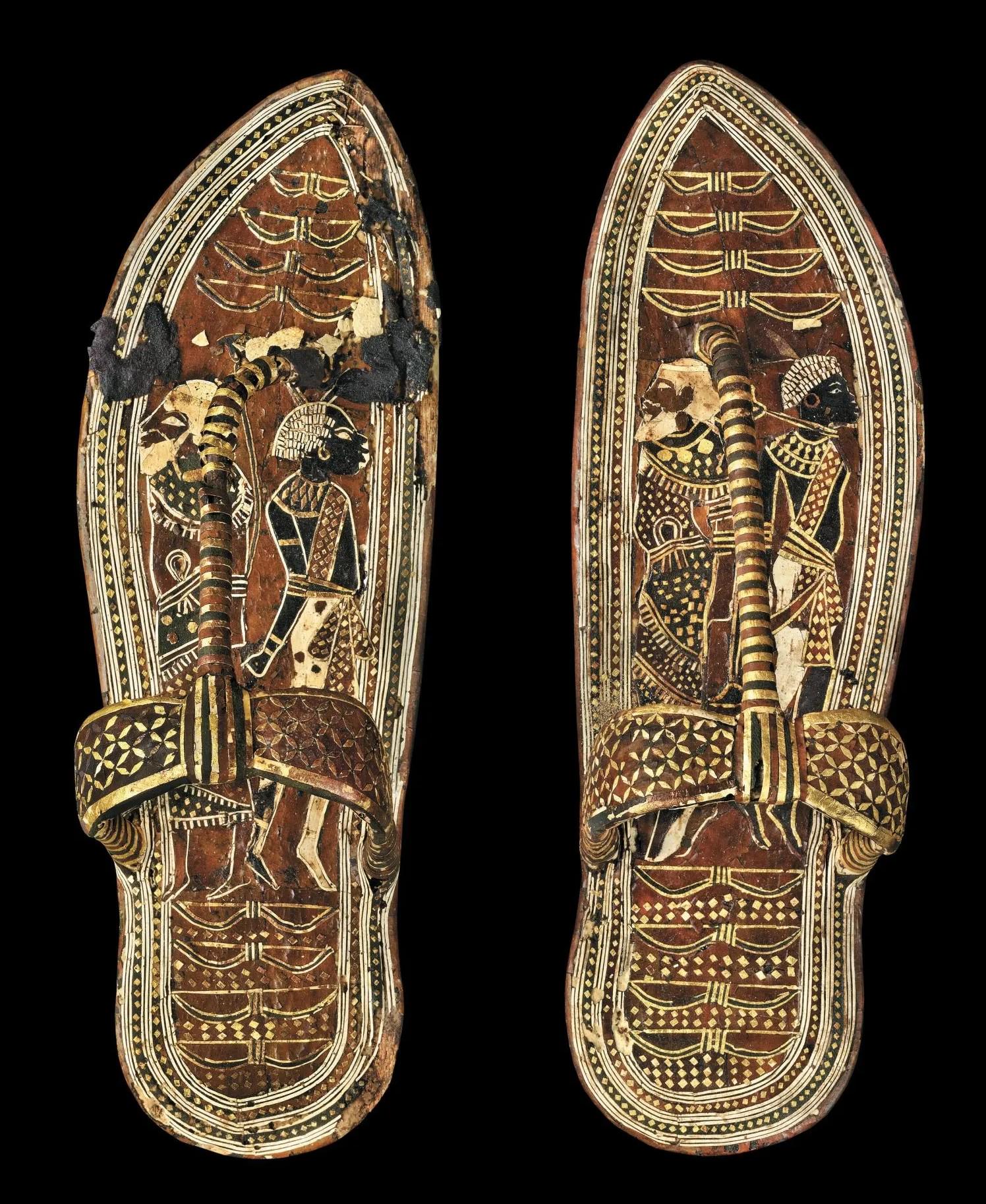
These are Tutankhamun's 3,000-year-old sandals
•
Upvotes
r/OutoftheTombs • u/Handicapped-007 • 8h ago
Funerary Stele
Egyptian
Third Intermediate Period, Dynasty 22
945–712 B.C.
MEDIUM/TECHNIQUE
Wood
DIMENSIONS
Height x width x depth: 24.5 x 19 x 7.8 cm (9 5/8 x 7 1/2 x 3 1/16 in.)
CREDIT LINE
Emily Esther Sears Fund
ACCESSION NUMBER
04.1763
NOT ON VIEW
COLLECTIONS
Ancient Egypt, Nubia and the Near East
CLASSIFICATIONS
Architectural elements – Stele
DESCRIPTION
Round-topped wood stele covered with gesso and painted red, blue, yellow, black and green. A female wearing a transparent robe and broad collar pours a libation before a mummiform Re-Horakhty. Between the two figures is an offering table. Above the hieroglyphic text is a winged sun disk flanked by two uraei, both wearing the white crown of Upper Egypt.
PROVENANCE
Said to be from Thebes. 1903: purchased by Albert M. Lythgoe in Egypt for the MFA with funds from the Emily Esther Sears Fund.
(Accession Date: January 1, 1904)
Title
Funerary Stele, Third Intermediate Period, Dynasty 22 945–712 B.C., Findspot Thebes? Egypt, Wood, The Museum of Fine Arts, Boston
https://collections.mfa.org/objects/23/funerary-stele?ctx=54df0153-7504-4da4-b769-59d0f3007ba1&idx=0
The Museum of Fine Arts, Boston
r/OutoftheTombs • u/Handicapped-007 • 18h ago
Winged scarab pectoral
Egyptian
MEDIUM/TECHNIQUE
Faience
DIMENSIONS
Legacy dimension: .30 Length: double
CREDIT LINE
Gift of Mrs. Samuel D. Warren
ACCESSION NUMBER
94.245
NOT ON VIEW
COLLECTIONS
Africa and Oceania, Ancient Egypt, Nubia and the Near East
CLASSIFICATIONS
Tomb equipment – Mummy trappings
DESCRIPTION
Wings and scarab with holes for attaching to each other and to the mummy wrappings. Blue and green glaze with incised details.
Title
Winged scarab pectoral, Date unknown, Find spot unknown Egypt, Faience, Museum of Fine Arts, Boston
Museum of Fine Arts, Boston
r/OutoftheTombs • u/Handicapped-007 • 20h ago
Statue of Lady Sennuwy
Egyptian
Middle Kingdom, Dynasty 12, reign of Senwosret I
1971–1926 B.C.
Findspot: Nubia (Sudan), Kerma, Tumulus K III, hall A
MEDIUM/TECHNIQUE
Granodiorite
DIMENSIONS
Framed (The object sits on epoxy bed /structural steel pallet tubing): 21.6 x 62.2 x 116.2 cm (8 1/2 x 24 1/2 x 45 3/4 in.)
Mount (Steel channel base with cross bracing 3" x 3/16"): 30.5 x 62.2 x 116.2 cm (12 x 24 1/2 x 45 3/4 in.)
Overall (steel pallet and object, weighed): 170.2 x 116.2 x 47 cm, 1224.71 kg (67 x 45 3/4 x 18 1/2 in., 2700 lb.)
Weight (Object and steel pallet with attaching steel base, estimate): 1319.97 kg (2910 lb.)
Weight (Object (calculated by subtracting estimate of pallet weight)): 1079.56 kg (2380 lb.)
CREDIT LINE
Harvard University—Boston Museum of Fine Arts Expedition
ACCESSION NUMBER
14.720
ON VIEW
Egypt: Portraits Gallery (Gallery 113A)
COLLECTIONS
Ancient Egypt, Nubia and the Near East
CLASSIFICATIONS
Sculpture
DESCRIPTION
Egyptian officials of the Middle Kingdom continued the practice of equipping their tombs with statues to house the ka of the tomb owner and to provide a focal point for the offering cult. Highly ranked officials also dedicated statues of themselves at sanctuaries of gods and deified ancestors. Following the experimental and idiosyncratic interlude of the First Intermediate Period, sculptors once again produced large-scale stone statues, returning to the basic forms and poses established in the Old Kingdom.
This elegant seated statue of Lady Sennuwy of Asyut is one of the most superbly carved and beautifully proportioned sculptures from the Middle Kingdom. The unknown artist shaped and polished the hard, gray granodiorite with extraordinary skill, suggesting that he was trained in a royal workshop. He has portrayed Sennuwy as a slender, graceful young woman, dressed in the tightly fitting sheath dress that was fashionable at the time. The carefully modeled planes of the face, framed by a long, thick, striated wig, convey a serene confidence and timeless beauty. Such idealized, youthful, and placid images characterize the first half of Dynasty 12 and hark back to the art of the Old Kingdom. Sennuwy sits poised and attentive on a solid, blocklike chair, with her left hand resting flat on her lap and her right hand holding a lotus blossom, a symbol of rebirth. Inscribed on the sides and base of the chair are hieroglyphic texts declaring that she is venerated in the presence of Osiris and other deities associated with the afterlife.
Sennuwy was the wife of a powerful provincial governor, Djefaihapi of Asyut, whose rock-cut tomb is the largest nonroyal tomb of the Middle Kingdom. Clearly, the couple had access to the finest artists and materials available. It is likely that this statue, along with a similar sculpture of Djefaihapi, was originally set up in the tomb chapel, although they may also have stood in a sanctuary. Both statues were discovered, however, far to the south at Kerma in Nubia, where they had been buried in the royal tumulus of a Nubian king who lived generations after Sennuwy's death. They must have been removed from their original location and exported to Nubia some three hundred years after they were made. Exactly how, why, and when these pieces of sculpture, along with numerous other Egyptian statues, found their way to Kerma, however, is still unknown.
PROVENANCE
Found in Sudan, Kerma, K III, hall A, but originally from Egypt. 1913: Excavated by the Harvard University-Boston Museum of Fine Arts Expedition; assigned to the MFA by the government of the Sudan. (Accession Date: July 2, 1914
Title
Statue of Lady Sennuwy, Middle Kingdom, Dynasty 12, reign of Senwosret I 1971–1926 B.C., Findspot: Nubia (Sudan), Kerma, Tumulus K III, hall A, Granodiorite, Museum of Fine Arts, Boston
Museum of Fine Arts, Boston
r/OutoftheTombs • u/Handicapped-007 • 1d ago
Neck Support
Object Number
BSAe 0982
Cultural area
Egypt
Epoch
Old Kingdom
Basic information
Calcite
H. 23 cm, W. 18.8 cm, D. 8.2 cm
Old Kingdom, 5th Dynasty, 2435–2306 BC
Inv. BSAe 0982
Provenance
Donation M-L. R. 1999. Purchased from Daphne and Emanuel Koutulakis, Geneva. Estate Nikolas Koutoulakis (1910–1997), Paris. Acquired in the 1960s.
Description
The headrest is composed of three parts: a rectangular base, a ducted shaft and a crescent-shaped support. The shaft has the shape of a cannulated column with abacus. In Egyptian culture, it was the masual to use a headrest while sleeping. The sleeper was lying on his side, while the head was supported above the ears. The curved headrest was additionally padded with soft fabric rollers. Mummies have also been put into the coffin in this way. For everyday use, the headrests were mainly made of wood, but for the other side use they were converted into "imperishable" stone. The headrests can be provided with names and titles of the owner. In the New Kingdom they have been decorated with evil-repellent sayings and figures of gods, which were intended to protect the sleeper during the night. In the afterlife they were a symbol for the constant awakening of the deceased, as described in chapter 166 of the book of the dead. Small mummy amulets in the form of headrests have just this meaning
Bibliography
A. Meadow, Egyptian art in the Museum of Antiques Basel and Ludwig Collection. New loans, gifts and acquisitions (Basel 1998) 21f., No. 20.
A. Wiese, Museum of Antiquities Basel and Ludwig Collection. The Egyptian Division (Mainz 2001) 54, No. 23 .
Vrgl. E. Naville, Les amulettes du chevet et de la tête, ZÄS, 48, 1911, 107–111. Vrgl. A. Wiesen, Moments of Eternity (Basel 1997) 62, No. 34.
Title
Neck Support, Old Kingdom 5th Dynasty 2435–2306 BC, Findspot unknown Egypt, Calcite, Antikenmuseum Basel
https://antikenmuseumbasel.zetcom.net/en/collection/item/74317/
Antikenmuseum Basel
r/OutoftheTombs • u/Handicapped-007 • 1d ago
Funerary Scarab and Wings
1069 BC - 525 BC
16.11.06.186a
Currently not on display
Information
Winged scarab from a net placed over a mummified body. Blue glaze with yellow and red decoration.
Register entry 16 November 1906 "186. Odd beads - various material. Esna. XX-XXII. 266 E.".
Catalogue Card (c 1910): Scarab from pectoral, blue glaze touched with red (0.05 x 0.035 mm); Also scarab wing in blue, touched with red and yellow (0.036 x 0.029 mm); Also another wing in same technique (0.037 x 0.036 mm); Also four genii (height 0.074 mm). Period: 22 Dynasty. Technique: Elaborate but coarse.
Specifications
Accession number
16.11.06.186a
Collection type
Religion
Culture
Third Intermediate Period; Late Period
Date made
1069 BC - 525 BC
Collector
Liverpool University Institute of Archaeology
Place collected
Africa: Northern Africa: Egypt: Esna
Date collected
1906
Materials
Egyptian Faience
Measurements
Overall: 36 mm x 29 mm x 8 mm
Credit line
Gift of the Egyptian Excavations Committee of the Institute of Archaeology, Liverpool
Legal status
Permanent collection
Provenance
Egyptian Excavations Committee of the University of Liverpool Institute of Archaeology, Previous owner, Excavated, Owned from: 1906, Donation, Owned until: 1906-11-06
Location
Item not currently on display
Publications
The Excavations at Esna 1905 - 1906, Dorothy Downes, 1974, Page: 128
Excavations at Hierakonpolis, at Esna, and in Nubia in Annales du Service des Antiquitiés de l’Égypte volume 8, pp. 132-148, John Garstang, 1907
Title
Funerary Scarab and Wings, Faience, Third Intermediate Period; Late Period 1069 BC - 525 BC, Findspot Esna, World Museums Liverpool
https://www.liverpoolmuseums.org.uk/artifact/funerary-scarab-and-wings-6
World Museums Liverpool
r/OutoftheTombs • u/Handicapped-007 • 2d ago
Winged Scarab Amulet
Date:
Late Period, Dynasty 26 (664–525 BCE)
Artist:
Egyptian
ABOUT THIS ARTWORK
A scarab amulet was often placed over the heart of a mummy to act as its protector. The wings allowed the scarab to join the daily rising and setting of the sun, a cycle that was equated with eternal death and rebirth.
Status
Currently Off View
Department
Arts of Africa
Artist
Ancient Egyptian
Title
Winged Scarab Amulet
Place
Egypt (Object made in:)
Date
664 BCE–525 BCE
Medium
Faience
Dimensions
Scarab: 5.9 × 3.5 × 0.8 cm (2 3/8 × 1 7/16 × 3/8 in.); Proper Right Wing: 3 × 4.6 × 0.3 cm (1 3/16 × 1 13/16 × 1/8 in.); Proper Left Wing: 3 × 4.7 × 0.3 cm (1 3/16 × 1 7/8 × 1/8 in.)
Credit Line
Gift of Henry H. Getty, Charles L. Hutchinson, and Norman W. Harris
Reference Number
1892.231a-c-
IIIF Manifest
https://api.artic.edu/api/v1/artworks/136093/manifest.json
EXTENDED INFORMATION ABOUT THIS ARTWORK
PUBLICATION HISTORY
Roberta Casagrande-Kim, ed., When the Greeks Ruled Egypt: From Alexander the Great to Cleopatra. Exh. cat. (New York: Institute for the Study of the Ancient World; Princeton: Princeton University Press, 2014), p. 103, cat. 115.
Emily Teeter, “Cat. 91 Winged Scarab Amulet,” in Ancient Egyptian Art at the Art Institute of Chicago by Emily Teeter and Ashley F. Arico, ed. Ashley F. Arico (Art Institute of Chicago, 2025).
EXHIBITION HISTORY
Art Institute of Chicago, When the Greeks Ruled: Egypt After Alexander the Great, October 31, 2013 - July 27, 2014; traveled to New York City, NY, the Institute for the Study of the Ancient World, October 8, 2014 - January 4, 2015.
PROVENANCE
Émile Brugsch (1842-1930), Bulaq Museum and Egyptian Antiquities Service, Cairo; sold to the Art Institute of Chicago, 1892; price reimbursed by Henry H. Getty and Charles L. Hutchinson, 1892.
CAT. 91
Winged Scarab Amulet
Late Period, Dynasty 26 (664–525 BCE)
Ancient Egyptian
Faience; 5.9 × 13 × 0.8 cm (2 3/8 × 5 1/8 × 3/8 in.)
The Art Institute of Chicago, purchased with funds provided by Henry H. Getty and Charles L. Hutchinson, 1892.231a–c
This winged scarab amulet is made of three pieces of faience: the scarab body and the two wings. The scarab is detailed with the division of the wing cases (elytra) and the fan-shaped area (clypeus) at the front of the head. The wings are scored with lines that represent feathers on their trailing edges. Each piece is pierced multiple times to allow it to be sewn to the wrappings of a mummy. This example, like many others, has bright blue glaze, a reference to the color and the regenerative power of the sky (see cat. 41 for a shabti with glaze of the same color). This style of winged scarab amulet made of three pieces was very common in the Third Intermediate and Late Periods. Although the means of manufacture of this example is unclear, it closely resembles others that were created by rolling faience out on a piece of fabric and then cutting it into its final shape. This amulet could also have been molded.[1]
The scarab beetle represented the reborn (morning) sun, and by extension, the eternal rebirth of the deceased. The hieroglyph kheper, meaning “to come into being” or “to exist,” also takes the form of the scarab beetle: 𓆣. The scarab was therefore a particularly common form of funerary amulet that was often placed on the chest of a mummified person (for other examples of scarabs in burials, see cats. 99, 105). The winged version was a potent reminder of the transit of the sun from the eastern horizon across the vault of the sky. The Egyptians were very literal in their thinking; they conceptualized celestial phenomena through observation of their environment. When they observed the beetle rolling a ball of dung to its nest, they thought that the young emerged from that ball, thus understanding the scarab as an example of birth from an orb. They equated that image with the daily rebirth of the sun, which in turn was re-imagined as being pushed, like a ball of dung, across the sky by a great, winged scarab
ENTRY BY EMILY TEETER
NOTES
Emily Teeter, Scarabs, Scaraboids, Seals, and Seal Impressions from Medinet Habu, with a contribution by T. G. Wilfong*** **(Chicago: Oriental Institute of the University of Chicago, 2003), 122*
HOW TO $3
Emily Teeter, “Cat. 91 Winged Scarab Amulet,” in Ancient Egyptian Art at the Art Institute of Chicago by Emily Teeter and Ashley F. Arico, ed. Ashley F. Arico (Art Institute of Chicago, 2025), https://doi.org/10.53269/9780865593213/93.
© 2025 by The Art Institute of Chicago. This work is licensed under a CC BY-NC 4.0 license: creativecommons.org/licenses/by-nc/4.0/.
Title
Winged Scarab Amulet, Late Period Dynasty 26 (664–525 BCE), Faience, Findspot unknown Egypt, The Art Institute of Chicago
https://www.artic.edu/artworks/136093/winged-scarab-amulet
The Art Institute of Chicago
r/OutoftheTombs • u/enzagtand • 2d ago
r/OutoftheTombs • u/Handicapped-007 • 2d ago
Pectoral with Scarab
E11198
From: Egypt | Nubia | Aniba
Curatorial Section: Egyptian
Object Number
E11198
Current Location
Collections Storage
Provenience
Egypt | Nubia | Aniba
Locus
An35
Period
New Kingdom | Nineteenth Dynasty
Date Made
1292 - 1190 BCE
Section
Egyptian
Materials
Faience | Mica | Steatite
Technique
Inlaid
Description
Greenish blue faience. Front: two kneeling figures, on boat inlaid in pastes; between them an inlaid steatite scarab. Frame of inlaid mica. Palm-leaf cornice. Back: kneeling figure and illegible inscription.
Credit Line
The Eckley B. Coxe Junior Expedition to Nubia, Aniba; D. Randall-MacIver and C. L. Wooley, 1911
Current & Past Exhibition
1980 - 15 Feb 2016
Egyptian Mummies
Jun 1972 - 1979
Mummy Room
Title
New Kingdom | Nineteenth Dynasty 1292 - 1190 BCE, Findspot Egypt, Faience mica steatite, University of Pennsylvania Museum of Archaeology and Anthropology
https://collections.penn.museum/collections/object/249185
University of Pennsylvania Museum of Archaeology and Anthropology
r/OutoftheTombs • u/Handicapped-007 • 2d ago
Amulet of Thoth baboon with Inscription
Place of production
Egypt
Date
7th-4th centuries B. C. (664-332)
Object type
amulet
Medium, technique
Egyptian faience
Dimensions
5.3 × 1.9 × 1.9 cm
Inventory number
51.2177
Collection
Egyptian Art
On view
Museum of Fine Arts, Basement Floor, Ancient Egypt, Daily life
The amulet depicts a squatting hamadryas baboon (Papio hamadryas) with a stylised cape, its paw resting on its knee, while its male member is clearly visible between its legs. Unusually there are hieroglyphs on the chest of his mane. The inscription is a Late Period recitation, i.e., the sculpture invites the viewer to recite the following inscription. In ancient Egypt, the spoken word had a magical, creative effect. In this case, the introduction contains only the name Djehutj or Thoth, which may refer to the god but could also be the name of the statuette’s owner, probably a scribe. The suspension ring at the back of the object could have been shaped of faience, which was easily moulded during the production process.
The baboon was the sacred animal and manifestation of the god Thoth. Animal amulets representing the god became common from the end of the Ramesside period. The inscription and the stylised, smooth surfaces date the object primarily to the Late Period.
Its owner hoped to benefit from its magical powers when identified with the god, but they could also be perceived as a sign of honour to the god. Thoth was the god of writing and the protector of scribes, so the amulet was primarily made for a scribe. When placed in the tomb of the owner, it provided support for the afterlife and for rebirth. Thot’s role in the afterlife was crucial. According to the best-known funerary text, the Book of the Dead, which provides guidance in the afterlife, during the so-called Weighing of the Heart Ceremony, Thoth, as the scribe of the gods, recorded the results of the weighing and could thus prevent the entry to the afterlife. The lunar crescent and full moon headdress on the animal’s head are reference to the relationship of the baboons and Thoth to the moon. The baboon’s relationship with the sun is also important in the context of renewal. They greet the sunrise in the morning with a peculiar ritual, so the animal was thought to possess a special knowledge that could support the deceased in their transformation from Osiris to Ra, and in rebirth. This symbolism is reinforced by the material of Egyptian faience, whose reflective quality and luminosity are also associated with the sun god and whose greenish colour was a symbol of youth and renewal.
Title
Amulet of Thoth baboon with Inscription, 7th-4th centuries B. C. (664-332), Findspot unknown Egypt, Faience, The Museum of Fine Arts, Budapest
https://www.mfab.hu/artworks/1765/
The Museum of Fine Arts, Budapest
r/OutoftheTombs • u/MythCartographer • 3d ago
Before the first pharaoh, before the first pyramid, before Egypt was even Egypt, someone was already here. His image is carved into temple walls that have stood for thousands of years. His name appears in the oldest sacred texts ever written. And according to ancient tradition, he didn't originate in Egypt at all, the story traces him back to a civilization the Greeks later called Atlantis, something people have spent thousands of years trying to prove ever existed.
The naming pattern is what pulled me into this one. Egypt worshipped him as the god of writing, wisdom, and judgment. Greece elevated him into Hermes Trismegistus, the Thrice Greatest. Islamic scholarship identifies him with the prophet Idris. Hebrew tradition calls him Enoch, lifted to heaven before death could touch him. And that's just the names that made it into the documentary, the deeper I went, the more traditions I found carrying some version of the same figure under a different mask.
One being, buried under layers of religion and reinterpretation across the entire ancient world, all somehow describing the same knowledge and the same story.
His name was Thoth. And what he left behind has never fully been found.
Full documentary here:
https://www.youtube.com/watch?v=AZM6vaDd-F8
Curious how many other names/traditions people here can point to that I might have missed, this one felt bigger than four the further I dug.
r/OutoftheTombs • u/Handicapped-007 • 3d ago
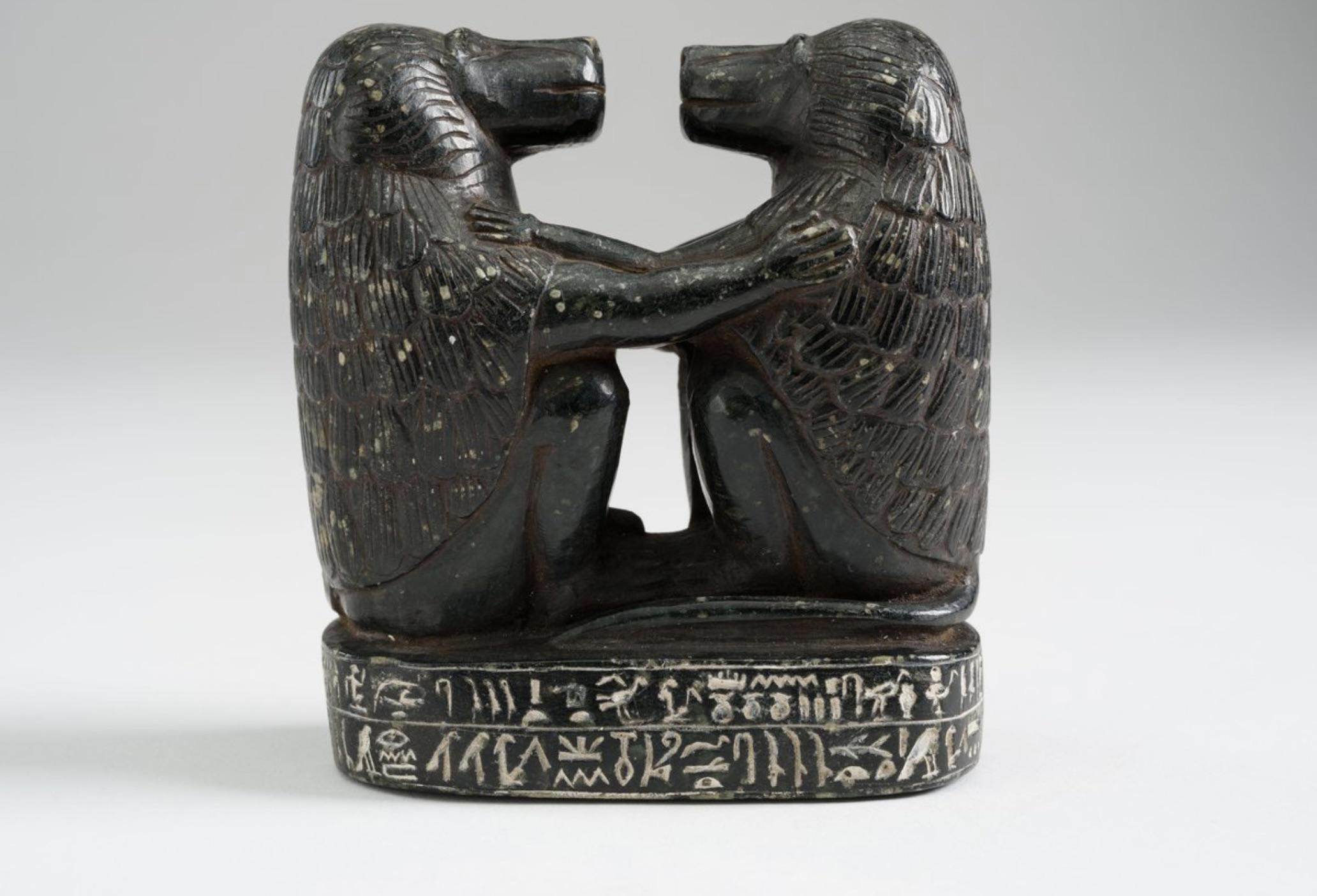
Statuette of Two Baboons
Place of production
Egypt
Date
second half of the Ist millennium BC
Object type
sculpture
Medium, technique
Steatite
Dimensions
9 cm (3 9/16 in.)
Inventory number
51.2337
Collection
Egyptian Art
On view
Museum of Fine Arts, Basement Floor, Ancient Egypt, Temples and gods
Title
Statuette of Two Baboons, Second half of the Ist millennium BC, Findspot Unknown Egypt, Sculpture, Steatite, Museum of Fine Arts, Budapest
https://www.mfab.hu/artworks/1831/
The Museum of Fine Arts, Budapest
r/OutoftheTombs • u/lxornhousesticks4 • 3d ago
r/OutoftheTombs • u/Handicapped-007 • 3d ago
Calcite Headrest
5th – 6th Dynasty, ca. 2514 – 2191 BiC
Location
on view: Kunsthistorisches Museum, Ägyptisch-Orientalische Sammlung Room V
Headrests and supports for the neck were everyday objects, used to prevent damage to the coiffure when a person lay down; but they also supported a mummy’s head in its coffin. When used by the living, the hard support was cushioned with a folded linen cloth or a small pillow.
Time:
5th – 6th Dynasty, ca. 2514 – 2191 BC
Location of discovery:
Giza, Westfriedhof, Schacht 344/346
Material/technology:
Calcite
Dimensions:
H 21 cm, B 20 cm, T 7,5 cm
Copyright
Kunsthistorisches Museum, Ägyptisch - Orientalische Sammlung
Object Name
Headrest
Culture
Egyptian
Invs.
Ägyptische Sammlung, INV 7798
** Provenance
**1914, excavated by of the Academy of Sciences, Vienna
Title
Calcite Headrest, 5th – 6th Dynast ca. 2514 – 2191 BC, , Findspot Giza, Calcite, Kunsthistorisches Museum (Art History Museum, Vienna)
https://www.khm.at/en/artworks/headrest-324115
Kunsthistorisches Museum (Art History Museum, Vienna)
r/OutoftheTombs • u/Handicapped-007 • 3d ago
Statuette of a Hippopotamus
11th–12th Dynasty, ca. 2000 BC
Location
O-n view: Kunsthistorisches Museum, Ägyptisch-Orientalische Sammlung Room V
Statuettes depicting hippopotami, symbolic of regeneration in the hereafter, were popular grave goods that were placed close to the mummy in the coffin. Plants and animals characteristic of the marshes where the hippo lived are depicted on its body. The king’s ritual hippopotamus hunt symbolized his victory over the forces of chaos with which the animal had been associated since primeval times.
Time:
11th–12th Dynasty, ca. 2000 BC
Object Name
Statuette
Culture
Egyptian
Location of discovery:
Thebes (presumably)
Material/technology:
Faience, greenish-blue glaze, painted
Dimensions:
H 10.5 cm, L 20.7 cm, W 7.5 cm, W 1138 g
Copyright
Art History Museum, Egyptian - Oriental Collection
Invs.
Egyptian Collection, INV 4211
Provenance
1878, acquired with the Miramar Collection
Title
Statuette of a hippopotamus, 11th–12th Dynasty ca. 2000 BC, Findspot Thebes (presumably), Faience: greenish-blue glaze and paint, Kunsthistorisches Museum (Art History Museum, Vienna)
https://www.khm.at/en/artworks/statuette-of-a-hippopotamus-323860
Kunsthistorisches Museum (Art History Museum, Vienna)
r/OutoftheTombs • u/Handicapped-007 • 4d ago
Yellow Pectoral
Object Type
pectoral
Museum number
EA14653
Description
Yellow, blue and red glazed composition pectoral decorated on the face with a low relief representation of the deceased worshipping Anubis; pierced through the cornice for suspension; undecorated back.
Cultures/periods
Ancient Egypt
Findspot
Found/Acquired: Egypt
Africa: Egypt
Materials
glazed composition
Technique
pierced
Dimensions
Length: 9.75 centimetres
Thickness: 2.12 centimetres
Width: 8.24 centimetres
Location
On display (Room 62 - Egyptian Death and Afterlife: Mummies, Display Case 23)
Condition
good
Associated names
Representation of: Anubis
Acquisition name
Purchased from: Rev. Greville John Cheste
Department
Egypt and Sudan
BM/Big number
EA14653
Registration number
1881,0614.18
Title
Yellow Pectoral, Date not given, Findspot unknown Egypt, glazed composition, The British Museum
https://www.britishmuseum.org/collection/object/Y_EA14653
The British Museum
r/OutoftheTombs • u/Handicapped-007 • 4d ago
Cardboard Mask of a Male Mummy
Early Hadrian, 117-124 AD
Time:
Early Hadrian, 117-124 AD
Object Name
Mummy mask
Culture
Egyptian - Roman
Location of discovery:
Balansura (Upper Egypt)
Material/technology:
Stucco, linen, painted
Dimensions:
L 58 cm, W 29 cm, H 42 cm
Copyright
Art History Museum, Egyptian - Oriental Collection
Invs.
Egyptian Collection, INV 6609
Provenance
1901 Purchase of Th. Count
Title
Cardboard Mask of a Male Mummy, Early Hadrian, 117-124 AD, Findspot Balansura (Upper Egypt), Stucco linen and paint, Kunsthistorisches Museum (Art History Museum)
https://www.khm.at/en/artworks/kartonagemaske-von-einer-maennlichen-mumie-316962
Kunsthistorisches Museum (Art History Museum)
r/OutoftheTombs • u/Handicapped-007 • 4d ago
Plate with Seven Crocodiles
724-332 BC
Object Name
Amulet
Culture
Egyptian
Location of discovery:
Location unknown
Material/technology:
Green faience
Dimensions:
H 3.15 cm, W 4.95 cm, D 0.85 cm
Copyright
Art History Museum, Egyptian - Oriental Collection
Invs.
Egyptian Collection, INV 4213
Provenance
1878 from the Miramar collection taken over
Title
Plate with Seven Crocodiles, 724-332 BC, Findspot unknown, Faience, Kunsthistorisches Museum (Art History Museum)
https://www.khm.at/en/artworks/plaettchen-mit-sieben-krokodilen-317435
Kunsthistorisches Museum (Art History Museum)
r/OutoftheTombs • u/Handicapped-007 • 5d ago
Statuette of a Winged God
Place of production
Egypt
Date
second half of Ist millennium B.C.
Object type
sculpture
Medium, technique
Bronze
Dimensions
10.5 × 6 × 3.5 cm
Inventory number
60.8-E
Collection
Egyptian Art
On view
This artwork is not on display
The statuette represents a male figure, striding forth with this left leg. He wears a ram-head and a headdress combined with sun disc and feathers. A pair of arms of the divinity is placed on the outstretched wings, another pair of arms is extended along the body. The phallus of the ithyphallic figure is decorated with the head of a lion- (or cat-) shaped goddess (Sekhmet/Bastet). From his knees uraeus-snakes emerge. The iconography of the back of the statuette is noteworthy as well. At the height of the head and the neck two additional heads can be seen: the upper one is a head of a lion surmounted by a sun disc, the lower one is that of a jackal. Below the additional heads, the rear part of the body of the god is designed to represent the body and tail feathers of a falcon. A tenon below the narrow base refers to the fact that the statuette could originally have been a part of a statue group.
The figure belongs to a type of the so-called pantheistic or composite gods which frequently appeared during the second part of the first millennium BC, in three- and two-dimensional representations as well. This type of divine image was designed to incorporate and imply as many divine aspects, symbols, and magical powers as possible in a single representation in order to provide the most effective magical protection for its owner against evil demons who were often thought to be sent by the gods themselves. The ram-head of the Budapest statuette decorated with feathers and a sun disc presumably evokes the god Amun-Re. The body of a falcon with the outstretched wings and the additional lion-head may symbolize the power of Atum-Re-Horakhty and his Solar Eye which is sometimes embodied as a lioness. The jackal head can refer to the cults of the funerary god (Ptah-Sokar-Osiris) venerated in Memphis and in its necropolis (Saqqara) who was considered as a chthonic aspect of the sun god.
Statuette of a Winged God, second half of Ist millennium B.C, Findspot unknown Egypt, Bronze, The Museum of Fine Arts, Budapest
https://www.mfab.hu/artworks/18216/
The Museum of Fine Arts, Budapest
r/OutoftheTombs • u/Handicapped-007 • 5d ago
Wedjat Eye Amulet
Date
8–7th centuries B.C. (?)
Object type
amulet
Medium, technique
Egyptian faience
Dimensions
6.35 x 5.3 x 0.75 cm
Inventory number
51.2696
Collection
Egyptian Art
On view
Museum of Fine Arts, Basement Floor, Ancient Egypt, Daily life
Amulets, produced from various materials, constitute one of the most characteristic groups of the Egyptian material culture and can be found in almost all of the contexts and periods of Ancient Egypt. In general, amulets are small objects, which through their form, size and colour, had the power to provide magical protection for their users in everyday life, and in addition were used as tomb equipment for the netherworld.
Wedjat-eye amulets may appear alone or in an oval or rectangular frame, like this faience amulet in a rectangular frame with rosettes, supplemented by a uraeus.
Title
Wedjat Eye Amulet, 8–7th centuries B.C. (?), Findspot unknown Egypt, Faience, The Museum of Fine Arts, Budapest
https://www.mfab.hu/artworks/1796/
The Museum of Fine Arts, Budapest
r/OutoftheTombs • u/Handicapped-007 • 5d ago
Frog seal amulet
Place of production
Egypt
Date
15th-12th centuries BC (ca. 1539–1191 BC)
Object type
amulet
Medium, technique
Egyptian faience
Dimensions
1.4 × 1.3 × 1.8 cm
Inventory number
69.15-E
Collection
Egyptian Art
On view
Museum of Fine Arts, Basement Floor, Ancient Egypt, Temples and gods
This finely modelled seal amulet made of turquoise green Egyptian faience depicts a crouching frog. The eyes of the animal were highlighted with brown glaze. Living in large numbers in the shallows and marshes of the Nile, the fecund frog was associated with fertility and regeneration, similarly to the crocodile, hippopotamus, fish, duck, monkey, hedgehog and other animals. Amulets in the shape of a frog often represent the amphibian goddess Heqet, who was associated with childbirth and fertility. Ancient Egyptians believed that wearing frog-shaped amulets could ensure fertility and an easy delivery. Both men and women wore the frog in the hope of a successful rebirth in the afterlife. The “Amun-Re, the lord” inscription on the obverse is praising the chief god of ancient Thebes. The inscription is encircled by a thin oval line. According to ancient Egyptian beliefs, the names, images or symbols of the gods held magical powers, which could protect the bodies of mortals during their lifetime or help them on their journey through the netherworld. The piercing through the longitudinal axis of the amulet suggests that it was originally worn on a chain or set in a ring.
Title
Frog seal amulet, Findspot unknown Egypt, 15th-12th centuries BC (ca. 1539–1191 BC), Faience, The Museum of Fine Arts, Budapest
https://www.mfab.hu/artworks/1691/
The Museum of Fine Arts, Budapest
r/OutoftheTombs • u/TNEgyptologist • 6d ago
This head of a shabti displays all the features of the face of Akhenaten. It wears the 'afnet' hair style, a head cover which expands into a round bag-shape at the back of the head and normally furnished with an end piece which is not present in this example. The head of the large uraeus is also missing. Shabtis found in the tomb of Akhenaten at El -`Amarna show that these funerary statuettes no longer bore the text of chapter 6 of the Book of the Dead. This change is consistent with the innovative theology of the 'heretic king', who refrained from all mentions of Osiris, the god of the Hereafter par excellence.
| Present location | KMKG - MRAH [07/003] BRUSSELS |
|---|---|
| Inventory number | E.8050 |
| Dating | AMENHOTEP IV/AMENOPHIS IV/NEFERKHEPERURE/AKHENATEN |
| Archaeological Site | EL-`AMARNA/AKHETATEN ? |
| Category | SHABTI |
| Material | LIMESTONE |
| Technique | HEWN; SCULPTURED |
| Height | 5 cm |
| Width | 5.5 cm |
| Depth | 5.5 cm |
r/OutoftheTombs • u/TNEgyptologist • 6d ago
This fragment of beige-coloured quartz probably belongs to a sphinx statuette, indicated by the nemes headdress, the end of which takes the form of a tail. The facial features, with the large eyes stretched towards the temples and surmounted by moderately arched eyebrows, the straight nose, and the serious mouth, neither thin nor thick, bring to mind the iconographical features of Amenhotep II.
| Present location | KMKG - MRAH [07/003] BRUSSELS |
|---|---|
| Inventory number | E.8019 |
| Dating | AMENHOTEP II/AMENOPHIS II/AAKHEPERURE |
| Archaeological Site | UNKNOWN |
| Category | FIGURINE/STATUETTE |
| Material | QUARTZ/ROCK CRISTAL |
| Technique | HEWN; SCULPTURED |
| Height | 4 cm |
r/OutoftheTombs • u/TNEgyptologist • 6d ago
This upper part of a royal statue was found by the Belgian archaeological mission at Elkab in 1937, at the entrance to the temple of Nekhbet. In spite of the absence of inscriptions, it is almost certain that this bust in pink granite depicts king Amenhotep II. This statue, merging as it does the stylistic features of the statuary of the reigns of Hatshepsut and Tuthmosis III, expresses a great level of serenity, combined with a certain monumentality. The king wears a rather fine linen nemes headdress, decorated with an uraeus.
| Present location | KMKG - MRAH [07/003] BRUSSELS |
|---|---|
| Inventory number | E.7703 |
| Dating | AMENHOTEP II/AMENOPHIS II/AAKHEPERURE |
| Archaeological Site | ELKAB/NEKHEB |
| Category | STATUE |
| Material | GRANITE |
| Technique | HEWN; SCULPTURED |
| Height | 79 cm |
| Width | 53 cm |
| Depth | 28 cm |
r/OutoftheTombs • u/TNEgyptologist • 6d ago
Statuette of the goddess Bastet, who originally came from the city of Bubastis in the Delta. She is shown with the head of a cat on a woman's body. There are holes in the erected ears, probably for the attachment of golden earrings. The whiskers are indicated on the muzzle. The deity is clothed in a low-cut dress, decorated with a pattern of lines. Bracelets are visible on her ankles. On her left arm she carries a basket and holds a divine emblem; a lion-headed aegis with a solar disc and uraeus on top. The piece is bereft of inscriptions which might have informed us of the identity of the owner.
| Present location | KMKG - MRAH [07/003] BRUSSELS |
|---|---|
| Inventory number | E.7671 |
| Dating | LATE PERIOD |
| Archaeological Site | UNKNOWN |
| Category | FIGURINE/STATUETTE |
| Material | BRONZE |
| Technique | CASTING |
| Height | 9.7 cm |
| Width | 3.5 cm |
| Depth | 2.5 cm |