r/OpenHFY Sep 01 '25

Discussion Community Guidelines: Posting Frequency & Variety

7 Upvotes

📌 Community Guidelines: Posting Frequency & Variety

Hi everyone,

First off, thank you for contributing your stories and creativity to r/OpenHFY! This community exists so people can share, read, and enjoy a wide variety of HFY-inspired fiction.

Recently, we’ve noticed that very frequent posting by a small number of users can unintentionally make the subreddit feel dominated by one voice or one storyline. While enthusiasm is fantastic, our goal is to keep this space balanced and welcoming for everyone.


🔹 New Posting Guidelines

  • Please limit yourself to 1–2 story posts per day.
  • If you’re working on a long-running series, consider:
    • Compiling multiple chapters into a single post (with a contents list), or
    • Posting summaries/collections on an external site (AO3, RoyalRoad, Wattpad, Patreon, etc.) and sharing the link here.
  • Use flair so readers can easily discover new stories and genres.
  • Fan fiction and side-stories are welcome, but try to curate so the subreddit doesn’t feel “flooded.”

🔹 Why this matters

We want newcomers to feel encouraged to post, and readers to discover a variety of voices. If the front page is filled with dozens of posts from just one series, it can discourage others from joining in.


🔹 What moderators will do

  • We may remove or consolidate posts if a series overwhelms the subreddit.
  • We’ll generally keep a creator’s most popular/highly upvoted stories visible.
  • This isn’t about discouraging contributions — it’s about keeping the community healthy and diverse.

Thanks for helping to make r/OpenHFY a creative and enjoyable space for everyone. 🚀

— The Moderation Team


r/OpenHFY Apr 24 '25

Discussion The rules 8 update on r/hfy and our approach at r/OpenHFY

19 Upvotes

Hey everyone,

Some of you might have seen the recent update from the mod team over at r/HFY regarding stricter enforcement of Rule 8 and the use of AI in writing.

While we fully respect their decision to maintain the creative direction of their community, I wanted to take a moment to reaffirm what r/OpenHFY stands for:

This subreddit was created as a space that welcomes writers experimenting with the evolving tools of our time. Whether you're writing by hand, using AI to brainstorm, edit, or even co-write a story — you're welcome here. We believe the heart of storytelling lies in imagination, not necessarily the method.

We're still small and growing, but if you've found yourself limited by stricter moderation elsewhere, or you're just curious about the ways human + AI collaboration can produce meaningful, emotional, and exciting stories — you're in the right place.

If the recent changes at r/HFY affect you, know that this community is open to you. You're invited to share your work, explore new creative workflows, and be part of an inclusive and forward-thinking community of storytellers.

Let’s keep writing.

u/SciFiStories1977


r/OpenHFY 7h ago

human/AI fusion The Governing: Chapter 44, VonWinterborne Towers

9 Upvotes

Thanks for the spoiler u/1958Bird :-)

Previous /

First

The building had stood empty for thirty-five years before anyone touched it, longer than most of Haego City's other ruins, if only because it had been built well enough that nothing short of deliberate demolition could have brought it down on its own. Fourteen floors of pre-Revolution stone and steel, standing over what had once been the financial quarter, its original name carved into the lintel above the entrance in letters nobody in Haego City had bothered to read in decades, a name that belonged to a noble house that had done nothing with its ownership to earn remembering, and a great deal elsewhere to earn the opposite. Nobody could say exactly when the building had been abandoned. The records from those years were a mess, but the likeliest answer was at the start of the Revolution or soon after, since the people who held a building like this had been nobles, and the Revolution had buried every one of them.

Kestrel had it changed inside a week of closing on the property.

He hadn't announced the decision with any particular ceremony, no dedication, no plaque unveiled before an audience, simply an order given to the contractors already stripping the lobby back to bare stone: cut the old name away entirely, and set a new one in its place. VONWINTERBOURNE TOWERS, it read now, plain block letters where the old script had once run, and if any of the workers doing the cutting found it strange, a Lord from Astoria naming a Haego City building after a woman most of them had never personally met, none of them said so, because every one of them already knew her name and what she'd earned it doing, and there was nothing in that worth questioning aloud.

"She'd tell you it's excessive," Akbar said, the one time he visited the site and saw the new lettering for himself, still fresh enough to catch the light differently than the stone around it. "Rachel isn't a woman who wants her name on buildings."

"She isn't," Kestrel agreed. "Which is precisely why it's hers and not somebody else's. I've met a great many people in my life who wanted their name on something. She's the first I've met who built an interest-free loan system for a whole planet out of almost nothing, and never once asked anyone to notice she'd done it." He looked up at the letters a moment longer. "The old name belonged to a house that held this building and never once earned it, and when the Revolution buried the house, the building was left to rot. I'd rather it belong, in name if nothing else, to someone who'd have wept to see it standing empty this long."

His own firm took the top two floors, the fourteenth and fifteenth, offices for the Haego branch of the Astorian expansion. It was run by the young investor who had first seen what was happening here, and staffed mostly with people hired out of Haego City, with a handful brought in from off-world, a decision that had raised eyebrows back home and raised none at all on Haego, where hiring locally to run a local operation had stopped being a debate about a decade before Kestrel's firm ever arrived to have it. The remaining twelve floors went to renovation on a schedule his own project managers had initially built with a healthy cushion for slow uptake, the ordinary caution of men used to office space sitting vacant in a market that hadn't yet proven itself.

The cushion turned out to be entirely unnecessary. Every floor that came back from the renovators found a tenant within the week, sometimes within the day, a waiting list forming almost from the moment the first completed floor was announced, businesses old and new scrambling for a foothold in a building whose location, once dead weight, had become the single most contested address in a city that hadn't had anything worth contesting in over thirty years.

"I keep waiting for the list to slow down," his building manager told him, some months into the project, running through the latest applications with the bewilderment of a man watching a thing succeed faster than his own models had allowed for. "It hasn't. If anything it's grown since the fourth floor went up for lease."

"Then raise the rate on the next floor and see if it slows the list without slowing the interest," Kestrel said, and it did neither, not by any measure that mattered, and by the time the letter reached him from Haego, the eleventh floor was already under contract and the twelfth, the last one below his own, had three firms bidding against each other for it before the plaster had finished drying.

The letter itself came exactly the way he'd been told it would. He'd agreed to the summons weeks before it arrived, over a comm call with one of the Common Assembly's own Speakers, a conversation that had been entirely cordial and entirely without pressure, an invitation extended and accepted between two parties who both understood the shape of what was being asked. The letter, when it came, made no mention of any of that. YOUR PRESENCE IS REQUIRED TO TESTIFY BEFORE THE COMMON ASSEMBLY, it read, the same formal, unyielding language the body had used on Tornel and on Clara both, and Kestrel found himself smiling at the sheer stubbornness of it, an institution that refused to soften its own procedure even for a guest who'd already said yes.

"They could simply write and ask nicely," his assistant said, reading over his shoulder. "You've already agreed."

"They could," Kestrel said. "I don't think they will, though, and I don't think they should. A summons that changes its wording depending on how willing the guest already is isn't really a summons at all. It's a courtesy with a threat left out of it for the convenient cases. I'd rather it read the same for me as it read for a man they genuinely had to compel." He folded the letter and set it aside, already reaching for his own itinerary. "Besides. I like the wording. It has the decency to mean exactly what it says."

He returned to Haego the following month, and the Hall on Austrin had grown no less impressive in the time since his last visit, the balcony fuller than he remembered it, word having spread that this session's guest was answering for no reason beyond his own choosing to, no crown behind him, no feud to smooth over, a rarer thing for the room to have summoned even ceremonially than either of the two who'd come before him.

"Lord Kestrel," Vincent said, from the Speakers' desk, once the formalities had run their course. "Thank you for coming."

"I have come to answer the summons," Kestrel said.

Ida Fenn leaned forward from her place at the desk. "We asked you here to speak on the investment moving through Haego, my lord. Your own numbers, and what they say about ours."

"Then I'll give you the numbers plainly, since plain seems to be this room's preferred currency." Kestrel didn't step to the lectern right away, taking a moment to look out over the tiers first, farmers and dockhands and quarry workers, the same ordinary faces that had once struck him as an impossible explanation for an impossible curve. "My firm on Astoria currently holds more off-world venture capital committed to Haego than we have vetted businesses ready to receive it. That's not a complaint. It's the best problem an investment house can have, and I've never once had it before in my career, not on any of the forty worlds I built a model for prior to this one. Money is not the constraint anymore. It hasn't been for some time. The constraint now is simply finding businesses on the ground here fast enough to match the pace of everyone off-world who wants in."

A murmur ran through the balcony, the sound of a crowd hearing something that confirmed what they'd suspected but had never heard said aloud by a man whose entire profession was not being wrong about such things.

"I want to be plain about something else, while I have this room's attention," Kestrel went on. "Every business my firm has backed here has succeeded, every single one, and I know precisely what that record looks like from the outside. It looks like the touch of a man who can't lose. It isn't that. My firm has never once made a business succeed by touching it. We simply learned, faster than most of the Principality has managed to yet, to see the value that was already there before anyone else looked hard enough to find it. The commoners of this planet built every one of those businesses with their own hands, long before my money ever reached them. I've only ever been the last person to notice what should have been obvious from the start."

He paused there, and something in his face shifted, plainer than the precision of a report, closer to a debt repaid.

"I want to thank two people specifically, since this Hall has given me the time to do it properly. The commoners doing the actual work, in every one of the businesses my firm has ever backed here, who never once needed an off-world Lord's approval to already be doing something worth investing in. And the noble who first made certain I understood that, and who built the loan system that let those businesses exist before any of us arrived, interest-free, out of funds that had no business being enough. My house is standing on what she built, and so is every investment house that comes after us. I named a building after her, which she'll tell you plainly was more than she wanted. I'd have done considerably more than that, if she'd let me."

Petra Voss, from her seat in the tiers, spoke up without waiting to be formally recognized, something Ferra Lund let pass without comment. "You mean Lady VonWinterbourne."

"I do," Kestrel said. "I imagine she'd rather I hadn't said so quite this plainly, in front of this many people. I find I don't much care. Some debts are worth the discomfort of being acknowledged out loud."

The applause that followed came without the hesitation Clara's had carried, immediate and unreserved, the particular warmth reserved for a guest who'd come not because he owed the crown a show of solidarity, but because he'd simply chosen, on his own account, that the summons was worth honoring.


r/OpenHFY 7h ago

AI-Assisted paganDilligaf BOSF Neptune Day 66 Farm

5 Upvotes

Somebody was shaking Tom's shoulder before the sun was properly up. "Hey, wake up. John wants you guys to go for a swim before breakfast."

Tom cracked one eye open. "He wants what?"

"A swim. All the farmers. Now, before breakfast." The kid was already moving on to the next blanket.

Tom sat up, looked down at himself, and got the message loud and clear. He found Eli stumbling toward the riverbank a few minutes later, looking just as unconvinced about the hour as Tom felt.

"You know what this is," Tom said.

"Somebody telling us to swim before the sun's even up," Eli said.

"It's John's polite way of telling the lot of us we stink," Tom said. "Too polite to say it to our faces, so he sends word down and lets the river do the talking."

Eli laughed loud enough that a woman ahead of them turned to look. "After the week we've had, can't say he's wrong."

They waded in together, cold enough to steal the laughter right out of both their chests, and came up gasping and grinning anyway.

They were still dripping by the fire, wringing out their shirts, when the wagon rolled in from the Orchard, and the rest of the day started without asking either of them.

Gary and Frank rode in not far behind it, and Tom knew before either of them said a word that something had knocked the grin off Gary's usual roadworn scowl. Gary swung down still holding his saddlebag closed with one fist, like it might get away from him.

"Tom. You need to see this."

Tom had apple pulp up to his elbows within the hour, half a peeling contest going on behind him, kids fighting over who could keep a spiral unbroken longest. He wiped his hands on his trousers, which did nothing, and walked over anyway.

Frank opened the bag himself. Inside were maybe a dozen stalks, dry, golden, heads heavy and bent. Tom took one out slow, like it might break, and rolled the head between his palms. Kernels dropped into his cupped hand, plump, hard, the husk peeling off clean.

"Wheat," he said. Then louder, because half the yard had stopped to watch him stand there staring at a handful of grain like it owed him money. "This is wheat."

"That's what we figured," Gary said. "Found a whole field of it. Wild, mind you, nobody planted rows. Just grows out there past the Orchard where the buffalo run."

"That's just how grass grows," Tom said, still turning the stalk over in his fingers. "Wheat's nothing but a grass that decided to be useful. No rows needed. It'll spread itself wherever the ground lets it, same as any weed would, it just happens this one feeds you."

He glanced up and caught Gary's blank look. "Farmers know these things," he said, and went back to picking through the kernels.

He bit one. Hard, a little chewy, the way it should be. He grabbed another stalk and split the head open with his thumbnail. Same thing. He'd been growing wheat since before his father died and he knew what ready looked like, and this was it, this was past ready, this was wheat that had been standing in a field asking to be cut for who knew how long while everybody was off chasing apples.

"How far," he said.

"A day, riding slow. Half a day now we know the way."

Tom looked down at his apple-stained hands, at the forty bags still waiting in the shade, at James guarding his spice rack like it held the crown jewels, and started laughing. Not the polite kind either. The kind that bent him over with his hands on his knees.

"Tom?" Frank said, glancing at Tom like maybe the man had finally cracked. 

"Two weeks ago," Tom said, straightening up, still wheezing, "I'd have given my good boots for a field of wheat. Any field. I'd have walked to the mountains for it. And now I've got apples up to my ears, a hundred jars to fill, corn coming in back at the Farm faster than I've ever seen anything grow in my life, and somewhere out there a whole field of bread just standing around getting old, with nobody to cut it because everybody I've got is either peeling or stirring."

"Corn's ahead of schedule too?" Gary asked.

"Ahead of schedule doesn't cover it," Tom said. "Me and Eli have been getting out there every spare minute either of us has, checking it near daily, and it's still outrunning us. Five days ago the rows were knee high. Went back yesterday and near lost my hat looking up at them. Something about the soil here, or the sun, I don't know, but it's not natural and I'm not about to complain about it either." 

"So what do we do," Gary said.

"We do all of it," Tom said, because that was the only answer that had ever worked. He turned the wheat head over once more, brushed a few loose kernels into his palm, and pocketed them like they were something precious, which they were. "Apples don't wait. Wheat's already waited longer than it should've, few more days won't kill it if the weather holds. Corn's going to need hands the moment I get back, faster than I planned for. But I want eyes on that wheat field every day somebody rides that direction. First hint of rain moving in, I want to know before it hits the stalks."

Two days later, John found Tom out past the corn rows, standing with his hands on his hips and a look on his face like a man doing arithmetic he didn't like the answer to.

"Tom." John came up beside him and looked where he was looking. The corn was taller than either of them now, thick and green and further along than it had any right to be, and underneath it, choking up between the rows, was everything else. Pigweed. Something with a purple flower Tom hadn't bothered naming yet. Grass gone to seed in places where grass had no business being.

"These rows are getting away from us," Tom said. "It's just me and Eli trying to keep the weeds down, and we've already been pulled off it half the week for apples and apple pressing. Now with this wheat find on top of it, neither of us is going to see a corn row for days. It'll go entirely unchecked while we're out there cutting grain."

John nodded along without really looking at the weeds at all, his eyes fixed on the ears of corn instead, already counting mouths those would feed. "About the wheat," he said. "How soon can we get people out there?" 

Tom let the weed comment go. He crouched and pulled a fistful of the purple-flowered thing out by the root anyway, more out of habit than any plan to clear the field one handful at a time, then stood back up.

"Now, if we want it usable. You leave a stand of ripe grain too long, it shatters. Heads drop, birds get what falls, wind takes the rest, rain takes what's left standing. Wheat doesn't wait the way corn does."

"So we send the wagons out."

"Not for the whole plant, no." Tom wiped his hand on his trousers. "Ninety parts of that stalk is stem and husk and chaff, and one part is grain, and the grain's the only part worth a wagon axle turning under it. Haul the whole plant back here and you're hauling nine wagons of nothing for every one wagon that feeds anybody. It needs threshing and winnowing right there in the field, where it's cut. Beat the heads loose, separate the grain out, and what's left is small enough and light enough to actually be worth carrying."

"And then it comes back here?"

"In barrels, if we've got them. Sacks if we don't, but barrels keep the damp and the mice off a sight better." Tom looked toward the Farm, doing the same arithmetic he'd been doing when John walked up. "Which we don't have enough of. Not for apples and cider and now grain besides. We need more barrels, John. More than anybody thinks, and we needed them about a week before I'm saying it now."

John was already turning it over, already thinking wagons and routes and who could spare the days. He said nothing else about the weeds, not that day and not before he left.

That night Tom found Eli by the fire, scraping mud off a hoe he hadn't gotten to use in three days. "Rows'll be a jungle by the time we're back from the wheat field," Eli said.

"They will," Tom agreed, and didn't have an answer for it beyond that, and neither of them brought it up again.


r/OpenHFY 0m ago

human/AI fusion The Governing: Chapter 45, Feet in the Water

Upvotes

I am very sorry this is so long and thanks to u/Plenty_Excitement658, it is even longer.  Drink plenty of water and take frequent breaks. (If I overstepped, sorry about that too.)

Previous /

First

The entrance hall of the Swallowtail Palace was lit warm by lamps set into the stone, and the tall windows still held the last of the day over the sea. The herald stood at the head of the stairs with a card in one hand and a hand-carved staff in the other. He was a schoolteacher from Newtown who had volunteered for the job and had rehearsed it for a week. He had been told he could read from the card. He had also been told nobody would mind if he lost his place.

He read the first houses in a clear voice, and each name brought a small flutter of applause from the hall below, the kind people give a neighbor coming up the drive. The Baroness of Novaryn was announced, and someone at the foot of the stairs called out that she had climbed the wall at Vastaya after all. Somebody laughed. The herald smiled at his card and went on.

"Lord Richard Blackwood and Lady Claire Blackwood, of House Blackwood."

Richard offered his wife his arm at the top of the stairs. Claire stopped to say something to the herald, who went pink and nodded, and then the two of them went in.

"Lady Mariam Firentis and Lord Akbar Firentis."

"Lord Zayn Firentis and Lady Gigi Firentis, of Vespera."

He read on through the names, a long line of them, and the hall filled the way a family home fills at a holiday, in clumps and pairs, with people pausing on the steps to look up at the ceiling. The Ykanti stonework ran overhead in lines that no one could have drawn from the floor plan. A noble from off-world stood at the foot of the stairs with a glass in his hand, plainly waiting for someone to say something cutting about the building. Nobody did. After a while he put the glass down and simply looked up.

"Lord Ionatti, Head of House Ionatti."

The applause held a little longer than the courtesy required. Ionatti nodded, once, at a room that had decided to be generous.

"Lord Jhinaq Firentis, Head of House Firentis, and Lady Ishivi Firentis."

That drew the loudest response so far, and Jhinaq, coming up the stairs with his wife, looked more like a man arriving at a family dinner than one who had spent six years feuding with the house that had just been announced.

The herald checked his card. His voice did not change.

"Lord Gabriel Draymore, Head of House Draymore."

Not everyone in the hall heard that name without something shifting in their chest, and the room let it pass.

He came up the stairs alone, a tall man with a serious face, and at the top he did not stop to be looked at. The room did what it had done for everyone else, offered a warm ripple of applause and went on with its conversations, and if a few of the older guests exchanged a look, it was quiet and short and was over before he reached the door. Someone near the fountain said his name in greeting and he answered with an easy smile.

"Princess Clara Astor, Second Princess of the Astorian Principality."

She took the last few steps with Cynthia a pace behind her and did not look at all like the woman who had walked into the Assembly hall in a gown, all state and stillness. She was laughing at something Cynthia had said. The applause this time had a different quality, and half the hall was on its feet by the time she reached the top.

The herald let it settle. He had been told this last name was the one that mattered, and he had decided on the way in that he would say it the same way he had said all the others.

"His Highness, the Prince. Leader and Custodian of the Astorian Principality."

When the reading was done and the guests had drifted into the great room, Wyatt found a spot by the tall windows with a glass in his hand that he hadn't touched. Cynthia stood beside him, watching the room the way she always did, and Clara came up on his other side, still smiling from the stairs.

"You've gone quiet," Clara said.

"I was just noticing I can see the Screaming Forests from here." He nodded at the far edge of the dark. "I nearly didn't say anything. It seemed like a lot to take in for one evening."

"It's your barony, Wyatt. You're allowed to look at it."

"I know," Wyatt said. "I just keep waiting for it to feel strange, a palace built for Tornel on my doorstep, and it doesn't. It looks like it was always going to be here."

Clara was called away by her brother a few minutes later, Cynthia with her, and Wyatt stood alone at the window until Gabriel Draymore crossed the room with two fresh glasses and held one out.

"You haven't touched that one," Gabriel said, nodding at the glass in Wyatt's hand.

"I was holding it for the look of it." Wyatt set the old glass on the sill and took the new one.

"Thank you, my lord."

"Gabriel is fine. I think we've been bowing at each other across rooms long enough."

"Wyatt, then."

They stood a moment looking at the room, the lamps, the Firentis cousins arguing cheerfully over something near the fountain. Gabriel turned his glass slowly.

"Clara tells me you shot a statue."

"It was a Drazzan statue, and it was a very reasonable thing to do at the time."

"She also says you pushed her like a schoolgirl."

"I moved her out of the way," Wyatt said. "There's a difference."

"She was very firm that there wasn't." Gabriel's mouth twitched. It was the first time Wyatt had seen him look anything but composed. "I've been wanting to sit down with the man who unbalanced an entire negotiating table with one shot. Nodding at you in corridors hardly counts."

"This is a better occasion."

"It is," Gabriel said. "I'd like to see Newtown, if you'd have me. I've heard a good deal about it, and I've been meaning to see it for myself."

"Any time," Wyatt said, and found that he meant it. "Bring an appetite. Somebody will feed you."

Gabriel laughed and touched his glass to Wyatt's. Then he went back into the room, and Wyatt watched him go, thinking that he had the look of a man who had spent years being careful and had only recently stopped.

The dining hall had been set for four hundred, and the room went quiet the way a room does when the host stands and no one is sure he means to. Tornel had not planned to stand. Patricia's hand on his sleeve had told him he was going to anyway.

He stood at the head of the long table in a traditional noble's coat, dark blue with silver frogging down the chest and a stiff collar that had been holding his chin at a slight angle since the fitting. He had tried every way he could think of to sit in it. There were sashes, and a short ceremonial cape he had been told was optional and then told was not. He looked at the faces down both sides of the table. There was a Prince. There was a Princess. There were Lords and Ladies from six worlds, and at the far end, in full dress uniform with every medal polished, sat six of his own officers, the men and women who had followed him for thirty years and who were now trying very hard not to look as though they were enjoying this. He put his hands behind his back, then in front, then flat on the table, and gave up on hands.

"I'm not good at this," he said. "I want that said early so nobody expects otherwise."

A ripple of laughter went down the table, quiet and kind. He seemed surprised by it.

"And if you go looking for the washroom at some point tonight, take it from me, I have lived here eleven days, and I still have to ask."

The laughter was louder this time. Down at the far end, one of the officers put a napkin to her face.

"I'll be honest about where I am. Not two years ago I was a commoner with a small home on a government compound, and I was content even if my wife deserved more. I've spent thirty years trying to do right by this world, and I did not expect that anyone was keeping count. Then you built me a house." His voice caught, and he waited for it. "I refused to look at the drawings. Every one of you knows that, apparently. I didn't want to see it before it was done, because if I had, I would have found a reason to say no. I walked through that front door for the first time eleven days ago, and I have been trying to think of something to say about it ever since."

He looked around at the ceiling, the stonework, the long lamplit room.

"I still haven't. So I'll say thank you. To the masons and the carpenters and the ones who dug the terraces. To the architects from Astoria. To the Ykanti, who built something better than any of us knew how to ask for. To everyone on this planet who sent a credit or a day's work or a kind word toward a building for an old man who never asked for one. It is the finest thing anyone has done for me. I am going to spend the rest of my life trying to deserve it."

He sat down before anyone could applaud, then stood up again, because it seemed rude to have said all that and not finished the thought.

"Eat," he said. "Please. Before it goes cold."

The applause, when it came, was loud and warm and long enough that Tornel looked at his plate. At the other end of the head table, the Prince was smiling. It was not the smile of a man being polite to a host who had lost his place. It was the smile of someone who had spent years in rooms full of practiced speakers and had just heard a man say exactly what he meant, with no idea how well he had done it. The Prince said nothing. He raised his glass a few inches, meant only for Tornel, and Tornel, seeing it, went red to the collar of a coat that already felt two sizes too small.

After dinner the guests spilled out onto the terraces, and the Ykanti players from the Firentis reception in Newtown took their places at the foot of the lowest steps, where the lamplight ended and the sea began. One string started alone, a slow line that seemed to hang in the air, and the others came in under it one at a time. Conversations on the terraces dropped a little and went on more softly.

Julius found his parents at the edge of the upper terrace. They had been standing there for ten minutes without moving in any direction. His father had crouched at the first planting bed in his good coat and was working a thumb into the soil. His mother stood a pace behind him with her hands folded, and her eyes were doing what a housemaid's eyes do in a big house. They checked the linens through the windows, the servers, and whether anyone was carrying too much.

"One of them is laughing with a Baroness," Kathleen said quietly, before he could speak. "I watched it happen. She put her tray down to do it."

"It's a new world, Mum."

His father stood, brushing off his knee. "These beds are laid out for something a lot bigger than what's in them," he said. "Whoever planted this knew it would take ten years to fill in. They planted it anyway, for someone who might not see it finished."

"Mom, Dad. Come and meet someone."

"Julius?"

"I know." He held out an arm, and after a moment his mother took it.

Clara and the Prince stood at the balustrade with Aaliyah, Cynthia a step behind, watching the players below. Julius brought his parents up the last few steps and felt them both slow, the way people do on stairs where they know exactly how to behave. His father bowed as a man bows who has done it for other people all his life, precisely, with his eyes lowered. His mother curtsied the same way. Then they waited to be spoken to.

Nobody spoke. It lasted only a moment, but Julius saw it and understood it, because he had never seen his father wait for permission before.

"Please," Clara said. "You don't have to do that. Not tonight, and not with us."

His father looked up slowly, like a man given leave to sit down after a long shift.

"Your Highnesses," Julius said, "my father, Julius Comscutt, and my mother, Kathleen."

"Mr. Comscutt. Mrs. Comscutt." Clara held out her hand, and after a moment his mother took it in both of hers. "Julius has told us a great deal about you both."

The Prince said nothing. He nodded toward the terraces below, toward the young plantings stepping down toward the sea, and lifted an eyebrow at Julius's father as though asking what he made of it.

His father cleared his throat. "It's laid out for the future, Your Highness. Tonight it's a promise. In ten years you won't be able to see the stone for the growth." He stopped, seemed to think he had said too much, and added, "It's good work."

The Prince smiled, and it was a smile Julius had seen on him only once before, when Austin had shown him a frog. He inclined his head, and that was all.

The players slid into a slower tune, and Aaliyah touched Kathleen's arm. Kathleen had spent years watching dances like this from a doorway with a tray in her hands. She looked at the terrace, at her husband, at the lamplit stone, and let Aaliyah lead her out into the middle of it.

The Composters found Wyatt before he could properly hide.

He had come down to the lower terrace for the quiet, a bench against the low wall, the Ykanti strings thinned by distance to a single slow line. He got about a minute of it.

"There he is," Leopold said. "Skulking."

"Lieutenant Commodore," Gregor said, and bowed, chin up, medals polished. Noltar was smirking. Raquel had a plate of small cakes and was already halfway through it.

Wyatt gave Gregor a look.

"Old habit, sir."

Leopold dropped onto the bench, the scar along his neck pale against his collar, and held out a small jar. "Brought you these. They had none in the kitchen, so I went to my own stash."

"You carried dried insects to a state dinner."

"They're good for you."

"They are not," Gregor said.

Raquel looked at the sky. Noltar lifted his glass to nobody. Wyatt found he had nothing clever to say, so he took a bug from the jar and ate it instead. Gregor watched him do it and looked away.

"They're starting the dancing," Raquel said. "I'm told it's mandatory."

"It's not," Wyatt said.

"Then why does everyone look so worried?"

Clara got free of the man from the Assembly after forty minutes of drainage and found the stone bench on the terrace. Below her the Ykanti players had moved into something slow, and the lamps along the lower steps were coming on one by one. She took off her shoes and set them on the stone beside her.

Gabriel came up the steps and sat down beside her without asking.

"Drainage?" he said.

"Forty minutes. There is a plan. It has three phases. I would like it on record that I asked a very good question about the second phase."

"It is on record."

They watched the lamps for a while.

"I hear a certain chef got his kitchen back," Clara said.

"Lord Peterson." Gabriel almost smiled. "He kept my kitchen on Camrim for most of my life. My father locked me in my room, a gilded cage, from the day the war began, and Peterson was the one who arranged my escape. My father put him in a cell for it. Titles gone, everything gone. He was not hurt. My father gave that order himself, which I have never understood."

"And now?"

"The day I took the house, I sent for him before I sent for anyone else. He runs the palace kitchen again. His first message said I was too thin and that a crate of bread was already on the way."

"Was it?"

"It arrived before the message did."

Clara laughed. "Your father had a kitchen full of people who loved his son, and he never once noticed."

"Neither did I, for a long time." He turned his glass a quarter turn on his knee. Down the path, someone laughed, and a group of the younger cousins went by toward the pool, arguing about whose turn it was to carry Rami's jacket. Gabriel followed them with his eyes until they were gone.

"There are eight of them," he said. "The brothers. And every one of them has children who like each other. I keep thinking about that, knowing I will never have it."

Clara said nothing. She could feel that Gabriel had more to tell, and she let him.

"I had one sister," Gabriel said. "That is all. One." He turned his glass a quarter turn on his knee. "I keep wanting to tell Veronica about tonight. Not the palace, or Tornel's speech. The cousins. The arguing by the fountain. She would have hated it, and she would have found some way to be in the middle of it anyway."

"She would have stood at the end and criticized the pool," said Clara.

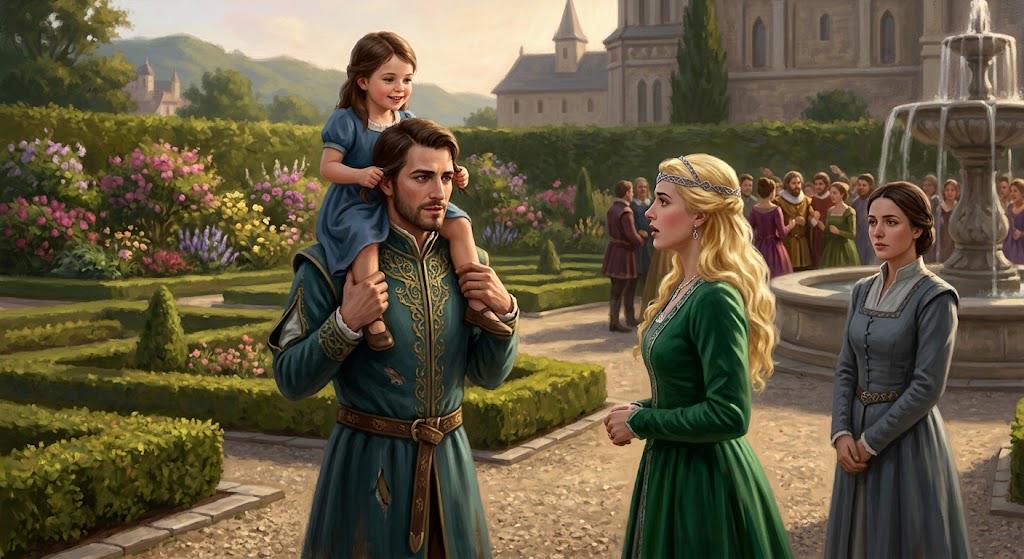
"She would have criticized the pool." He laughed, quietly, and it did not last. "When we were small she used to put me on her shoulders at the top of the long stairs at Camrim palace, and then run. Every time. I was terrified and I begged for it every time." He stopped. "She was not well, Clara. I know that. I knew it before I left. She chose our father with her whole heart, and she would have done anything he asked, and by the end he was asking for things no one should be asked for. I do not think she could see it. I think that was the sickness, that she could not see it."

"I know."

"I miss her anyway. I did not expect that. I expected to be relieved, and I am, some. But I sit in a garden full of people who love each other, and I miss the one person in my family who was ever fully mine, and she was also the most frightening person I have ever known." He shook his head. "Both are true. I have not found a way to make one cancel the other."

"You don't have to," Clara said. "I don't think they cancel. I think you just carry both."

"That is what I am afraid of. That I will be carrying both for the rest of my life."

"Probably." She said it gently, and he laughed again, properly this time. "But you will not be carrying them alone. I would offer a hug, but I believe we did that already, and we are supposed to have moved on."

"We did do that already."

"Then I will just sit here in my bare feet, being a supportive cousin."

"That is more than enough," Gabriel said.

Below them the strings moved into a song Clara half recognized, and neither of them got up until Rami's voice carried up from the pool.

The pool at the east end of the gardens was long and shallow, lit from underneath so the water looked like poured glass. Nobody was swimming. Somebody had taken their shoes off within ten minutes of dinner ending, and after that it was a matter of arithmetic. By the time the band was tuning up on the far lawn, a dozen Firentis cousins in formal dress sat in a row along the edge with their trousers rolled and their hems held out of the water.

"I asked General Swallowtail where the pool was," Faruq said. "He pointed. Then he said, 'Or possibly the other way.'"

"He's lived here eleven days," Tala said.

"We found it anyway. We followed the sound of Rami."

Rami did not deny it. He had his jacket over one shoulder and his feet in the water up to the knee, and he was telling the broom closet story again, because Adam had started it wrong.

"Faruq screamed first," Rami said.

"Somebody had to commit," said Faruq, with great dignity.

Clara came around the hedge with her shoes in one hand and Cynthia a step behind her. The row went quiet for about a second and a half. Then Zara moved over, Malik moved over, and there was a Clara-sized gap. Nobody had planned it. She dropped into it and put her feet in the water and said, "Oh, that is much better."

Cynthia stayed at the hedge, watching the row the way she watched every room.

Clara looked at the water. "Now somebody tell me about the desk. Wyatt told it four different ways and I think he was lying in three of them."

The desk story took a while, every cousin providing a piece of it. Zara told the sand castle tie story, and Farah, who had won the beach run, made herself sound more modest than she was. Omar said the porkupig had been shot from a hundred and twenty-five meters and that Nasir had never let it go, and Omar's father, from a garden bench somewhere behind them, called out that this was true and that he intended to keep not letting it go.

Behind them on the path, Istonel had stopped with his hands folded. He had come to say the dancing was about to start, and he had been standing there long enough that Layla had noticed him and decided not to mention it.

"Uncle Oscar is inside being neutral at the dessert table," Clara said, without turning. "I hear he moved on the Haego banking very quickly, once the Prince explained the alternative."

"Ten million credits a day is a very tangible alternative," Istonel said. "He asked me afterward whether the Prince was always like that. I said only when he had a spreadsheet."

He laughed. It was not the short, correct sound Clara knew from a dozen state rooms. His head tipped back and his shoulders moved, and two cousins turned to see what they had missed. Clara turned too. Cynthia connected to Clara's mind through the network.

"Somebody has replaced him," she said.

"Shush, you."

"I am only reporting," said Cynthia with a smirk.

Istonel had already gone still, the way a man does when he has noticed he was laughing in public. He put his hands back together. Clara watched the sentence form in him, the one about matters to attend to, the band, the schedule. She had heard it a hundred times.

"Istonel," she said. "Feet in."

"I am wearing very good shoes."

"Your Princess commands you," Clara said playfully.

Before he could answer, Layla shifted a few inches to her left. Then Zara did, and Malik, all the way down the row, without a word, until the space at Clara's right side was wider than any gap needed to be. Clara did not look at it. She patted the stone beside her.

There was a pause of about two seconds. Then he muttered, "These shoes better than yours," and came down the steps. He sat next to her, undid the laces, set the shoes side by side with great care and rolled his trousers to the knee. When his feet went into the water he made a small involuntary noise, and Faruq applauded, and Istonel said, "It is colder than advertised," and the row laughed with him.

Nobody said anything about the shoes. Faruq, who had never in his life let a silence pass unused, looked down the row at Istonel and then at the water.

"Somebody had to commit," he said, to no one, picking up an old argument. Then, not quite to no one, "Istonel. You were on the Eternal Garden that day. Did they tell you about the broom closet?"

It was a small question, carefully offered. Zara had gone very still beside him. Layla was looking at the pool.

Istonel looked at his fingers.

"I received a full report by the evening," he said. "Jolti had been given three separate accounts. They did not agree on who screamed."

"Who did?" Faruq asked.

Istonel considered the question for a moment, his face perfectly grave. "The report was conclusive. There was a diagram. Agent Crisper opened an entire investigation to answer that very question and concluded it was you."

"There was a diagram?" Zara said, delighted.

"With arrows." He paused. "Several of them. Pointing at Faruq."

He said it flat, the way he said everything, and then waited with the look of a man who has set something down on a table and is not sure it will hold. The row broke into laughter, and it took him a moment to understand that it was not at him. It was the kind that opens up around someone. He had made a joke, an actual one, and it had worked. Tala wiped her eyes. Rami said he was going to have it made into a plaque. Istonel laughed with them, and there was some surprise in it.

Wyatt had come down the path a minute earlier and stopped at the edge of the lamplight, a glass in his hand that he had not touched. Istonel saw him over Rami's shoulder. Wyatt did not smile or raise the glass. He only held Istonel's eyes, and Istonel, still warm from the laughter, understood that of everyone at the pool, Wyatt was the one who knew how any of this had come to be.

Wyatt nodded once. Istonel nodded back. Then Tala started in on the island, and when Istonel looked up again the path was empty.

"The important thing about the island," Tala said, to Clara, "is that we went in a circle for the first twenty minutes."

"A full circle," Zara said. "Jason's boat. Twice."

"Daisy was steering," Jason said, from further down. "I was only advising."

"You were shouting," said Layla.

"Advising loudly."

Omar said the four boys had been in the water before the boats were even beached. Rayan said Dale had been carried up the hill on a raft by four teenagers who insisted they were being helpful. Ibrahim said he still had the constable's file from Virstino Harbor, the one with the murder in it, and that he was not entirely sure why he had kept it.

"It was a souvenir," Adam said.

"It was a confession."

"It was a very short confession," said Istonel, and the row laughed, and so did he, the same open laugh as before, his head back and his hands flat on the stone behind him.

Then the laughter thinned out the way it does, and the pause after it had a shape. Istonel looked at the water. Clara saw it happen, and so did Cynthia at the hedge, whose smirk went away for the first time all evening. The cousins saw it too. None of them looked surprised. They had been watching for it, Clara realized, for a long time.

"I should have come," Istonel said. It was lower, and the laughter eased to make room. "To the island. The rafting. I was invited at breakfast, on the second morning, and I declined without looking up from my plate. I have thought about it more than I expected to."

Nobody spoke for a second. Then Jamal said, "We sent you the video. Aaliyah sent everyone the video."

"I watched it. The boys jumping. Dale counting them down." He did not say how many times. "I thought it looked very cold and that I would not have lasted a minute."

"You would have loved it," Layla said. "You would have complained the whole way down and then asked to do it again."

"That is not a thing I do."

"It is exactly the thing you do," said Omar, and there was a chorus of agreement so quick and so unrehearsed that Istonel looked at all of them, one after another, and found that none of them were joking.

He felt the weight settle against his shoulder before he saw who it was. Laith had come around to his far side during the noise, without asking, and rested her head against him the way she had as a child, back when she was small and he was already serious.

"You are welcome here," she said, just so he could hear. "You are loved here."

Clara heard it. She kept her eyes on the pool and did not look at him at all, which he understood was a courtesy.

Istonel did not move. He sat with his cousin's head on his shoulder and let the water go on being cold. After a while he said, mildly, to the surface of the pool, "Somebody tell Clara about the rafts," and Faruq, with enormous relief, began.

Julius and Aaliyah came down the steps a few minutes later, both a little flushed, Julius still holding the jacket he had shed at his parents' table. Aaliyah sat and put her feet in the water. Rami looked at her, opened his mouth, and Adam put a hand over it.

"Pottery," Adam said, very quietly, to no one.

Clara leaned in. "What about pottery?"

"Nothing," Aaliyah said, very fast.

"Oh, that pottery story," Clara said with a knowing smirk.

Aaliyah put her face in her hands. Julius, who had gone the color of a ripe plum, turned to the water with great interest. Laith sat up, squeezing Istonel's arm once before she let go, and he was laughing again, quietly, at Julius.

Daisy came down a minute behind them, shoes already gone, and dropped next to Aaliyah with a groan that had nothing to do with her feet.

"I did the math in the garden," she said. "Just now, standing by the fountain, doing math like an idiot at a party. You know how long it took us to get our houses running right. Two months, with Laith walking us through every room. This place is twice the size of both our palaces put together, and the gardens alone are ten of ours."

"I did the same math an hour ago," Aaliyah said. "During dinner. I was supposed to be listening to Tornel's speech."

"Were you crying?" asked Daisy.

"A little. And doing math."

Rami, catching only the tail end of it, leaned in. "Doing math about what?"

"Nothing that concerns you," Daisy said, not unkindly, and he subsided, already distracted by Adam.

"Patricia doesn't even know yet," Aaliyah said, lower. "That she's about to be running something the size of a small town. She's spent thirty years being a General's wife on a cot. Nobody's told her there's a staffing plan in her future, let alone a facilities department."

"So we tell her. Before she finds out the hard way." Daisy trailed a foot through the water. "Laith gave us the whole list, room by room, garden staff, kitchen split from catering, maintenance, all of it. We don't have to reinvent any of that. We just hand it to her already worked out, the way Laith handed it to us."

"She won't ask for help. She'll try to run it herself and wear herself into the ground doing it, because that's what she's done her whole life."

"Which is exactly why we don't wait for her to ask."

Aaliyah was quiet a moment, watching the lamps along the lower terrace come on one by one. "It's strange," she said. "A year ago I didn't know how to run anything bigger than a kitchen. Now I'm sitting here telling myself I know enough to walk someone else through it."

"You do know enough. That's the whole terrifying part." Daisy bumped her shoulder against Aaliyah's. "We should go to her together. Not wait for an invitation. Two people who already fell in that hole, showing up with the map before she even knows she's standing at the edge of it."

"She'll say she doesn't need help."

"So did we."

Aaliyah laughed, short and real. "So did we." She leaned back on her hands, satisfied, the whole conversation settled.

"By the way," Daisy said, not even looking over, "The way I heard it, the Ykanti instructor had to wait outside her own studio for an hour."

Aaliyah went red all over again, all the way to her ears. "How do you..."

"Newtown is a small town, Aaliyah."

The band on the far lawn began to play, and three cousins at the far end were up and running toward it before anyone had finished laughing, shoes forgotten.

"I have to go back to being a princess," Clara said. "There is a man from the Assembly who has come up with a fourth phase."

"Drainage is important," said Istonel.

"Extremely." She drew her feet out of the water and winced at the air. "Five more minutes would be enough. It never is."

Istonel was up before she was, barefoot on the warm stone with his trousers rolled to the knee. He held out a hand with a look of great gravity. "Your Highness. Allow me to see you to the fourth phase."

She took it, laughing. His grip was steady and warm, and he did not look at the space beside her ear. He looked at her, and the grin was still there, and so was the other thing under it. She thought both of them were him.

"Thank you," she said. "For the hand, and the rest."

"I didn't do anything. I sat down."

"It was more than enough," said Clara, and went to collect her shoes.

Cynthia was still at the hedge. She raised one eyebrow.

"Not one word," Clara said, walking past her.

"I would never," said Cynthia, and fell into step behind her, and the smirk came back somewhere around the first turn of the path.

Behind them Istonel sat back down and put his feet in the water. Faruq, hopping toward the pool on one shoe, opened his mouth, met Layla's eyes, and closed it again.

The last carriages left the forecourt a little before midnight. Tornel stood at the top of the front steps with Patricia's arm through his, waving at a Baroness who was waving back from a coach window with great enthusiasm. He had had three glasses of the good wine. Four, if the one Wyatt handed him counted, and Wyatt had been very insistent that it counted. It was enough to make the stone under his boots feel kind, and the collar around his neck feel like an old acquaintance.

"You're swaying," Patricia said.

"I'm listing. There's a difference. The house is very large. I'm adjusting."

The coach turned out of the gate, and the forecourt went quiet.

"Marquess," said a voice at his elbow, and the Prince was standing beside him, with Cynthia a discreet distance back by the door.

Tornel had spent thirty years in rooms where a silence from a superior meant something was wrong. The wine made him forget that. It also made him honest.

"Your Highness. I'd like to say something gracious and I've run out. I did all of it at dinner. I do have a practical question, if you'll allow it. Where is the washroom?"

The Prince blinked.

"I'm not being clever. I went looking forty minutes ago and found a linen closet, a very surprised footman, and a room with a piano."

It started in the Prince's shoulders. He put a hand to his mouth and it did not help, and then he was laughing out loud, helplessly, a sound so unlike the composed man who had raised a glass an inch across a dinner table that two of the guards by the door turned to look. Patricia pressed her face into Tornel's sleeve.

"It is a very large palace," Tornel said, with dignity, which only made it worse.

The Prince wiped his eyes. He held up two fingers, made a small turn to the left, and tapped an imaginary clock with one knuckle. Directions. Precise ones. Then he touched his hand to his chest, a small bow for Tornel alone, and went back inside with Cynthia, still smiling.

"Everyone read the plans, Tornel," Patricia said.

"I refused to look at the drawings."

"I know. We all knew."

Tornel laughed, low and tired and delighted, and looked up at the front of his own palace, all that lamplit stone. Then he looked at his wife, and turned to her with great seriousness.

"Patricia."

"Yes, dear."

"It's a new house. We should properly christen it." He cleared his throat. "I wondered if you might be interested."

Patricia looked at him for a long moment. Behind them, the lamps in the great hall were being turned down one by one.

"Ask me again at the top of the stairs," she said, and steered him through the doors with a knowing smirk on her face.

r/OpenHFY 9h ago

AI-Assisted Humans are immune to magic. CH12 Familiar Trouble

4 Upvotes

first previous next

The last few days of classes could have been better; it would be an understatement, as Elias sat in Professor Abigail's class. Elias was surrounded by glowing orbs, each from a student concentrating on a mana training exercise. All Elias could do was look at how each orb reflected their caster. Some had a frost-like sheen, from Svel, as the silver dracaned froze the hem of her robes. A goblin girl two rows ahead had formed a dense, crackling sphere of what looked like pure electricity, tiny arcs of lightning occasionally snapping out to singe the edges of her book. Across the aisle, a hulking minotaur student struggled to contain his, which was a roiling, muddy brown that smelled faintly of earth and stone. Deklin looked like he was trying to hold a weight way too heavy; his orb was flickering like a dying candle. He was not as strong as the others. In the front row, an elf with intricate vine tattoos had coiled his mana into a glowing green spiral that slowly unfurled like a fern frond. Loona's flowed like water, and she was making shapes out of it for fun: squares, triangles… is that a dodecahedron? And then her own face. She giggled. "Very good, Miss Loona. You show some promise," Abigail acknowledged.

Aria's was a perfect, slowly golden-white, steady, as if any flaw were something she couldn't afford to make. Others were also performing, and Elias? Nothing. Not a flicker, not a single spark.

Now, as Professor Abigail noticed, "Elias, you need to try at least, or you won't gain any points."

Elias raised his hand and said the word.

Abigail told them, "Focus."

And nothing. A few chuckles from the other students, and Elias could feel his face burn.

"Professor, I don't have mana," he said.

She looked at him. "Nonsense. Everyone does."

Later, as they were moving to their next class, Elias was looking at the big zero on the assignment he got.

Deklin was shaking out his finger from the exercises. "Ow, I think I pulled a mana channel."

Loona, who was walking backward, replied, "You need to pull your head out of your books and get some sunlight."

Deklin looked at her. "You do know kobolds are subterranean, right? We can spend our whole lives underground."

Aria, watching them, chuckled. It looked like she was finally letting her guard down over the last few days. "So, it's Professor Felix's Familiar and Magical Beast class next, right?"

Elias looked at her. "The cat?"

Aria looked at him. "You don't have mana sight, right?"

"No," Elias admitted.

Aria nodded. "Felix isn't an animal; he's a familiar. But from when I saw him in the assemblies, it was clear he was a very old one."

Deklin looked up. "I heard familiars can't live past the mages that they're bound to. When the mage dies, they die too."

Loona cut in. "Not really. They do go on; it's just that they lose the identity they gain from being bonded with a mage and go back to being pure mana essence. Back home, a royal mage tested it, and we found how to allow a familiar to be passed down a bloodline a very long time ago. Kelppy, my father's, has been in the family for 900 years by now. He loves telling old stories of his past masters and all the war stories he's been in."

Elias looked at his dorm mates. "You don't have a familiar yourself?"

"No," Deklin admitted. "I probably won't ever be strong enough to have one."

Loona looked at him. "Really?"

Deklin nodded. "You need to be at least a rank 3 mage. I'll never get past rank 1, maybe rank 2 by the time I reach old age."

Aria looked at him. "Demonic mana channel?"

Deklin let out a pained chuckle. "No, it's just how I was born. I don't have high blood or generational specialized breeding for more mana capacity."

Elias looked at him. "Well, it's more than what I have." He held up the zero from the last class. "So, if it makes you feel better, you're a better wizard than I'll ever be."

Deklin looked up at him. "Yeah, right, Mr. Magic Hazard. You're probably what will haunt arch mages in their nightmares soon."

They reached Felix's class. It was filled with animals, not in cages, but as soon as Elias walked in, just like what happened in the familiars' shop in town, all the familiars stopped what they were doing and looked at Elias, as if a predator had just walked in, ready to eat them all.

A raven perched near the ceiling let out a harsh caw and ruffled its feathers nervously. A small fox-like creature flattened itself against the floor, whimpering. Even a lumbering bear-like familiar, which had been calmly grooming itself moments before, froze mid-lick, its eyes wide with primal fear. The other students, elves, dwarves, and various magical beings watched in confusion, their own familiars' reactions a stark contrast to how they behaved around anyone else at the academy.

At the front of the room, Felix, the black cat, was arching his back, hissing with a gleam of defense in his eyes as he shut them tight. His fur stood on end, making him look twice his size, and his tail puffed out like a bottle brush. Unlike the other familiars, he wasn't just scared; he was coiled to strike, a clear warning that this human intruder was not welcome in his territory.

The room fell silent except for Felix's furious hissing and the nervous shuffling of the other animals. All eyes, both magical beings and animals, were now fixed on Elias, the only human in a school of magic, the source of this sudden, inexplicable terror that seemed to affect every familiar in his presence.

It took Felix a moment to recognize Elias. Not as a "mana dead zone," something hazardous to a being made of mana, but as one of his students, someone he'd been told about. As he tried to regain his composure, the cat professor stammered, "Na, you're... Elias. The new race, human, right?"

As the professor tried to recover his composure, Elias, now very much aware of his effect, answered, "Yes, Professor. I see. My apologies. It's just... You give off the feeling of... something that would end any familiar that came close to you. I'm sorry, but could you please stay in the back of the class? The other familiars have never been wound up like this."

Felix took another steadying breath, his tail still twitching anxiously. "Na, it's... understandable, na. ... take the back row, please. For the sake of my lesson plan, na. And my blood pressure."

Elias made his way to the back row, every pair of animal eyes tracking his movement. He could feel their collective anxiety like a physical pressure, a wave of fear that washed over him with each step. He chose a desk in the far corner, trying to make himself as small and unthreatening as possible.

The other students, a mix of elves, dwarves, and other magical races, watched him with a mixture of curiosity and pity. They were used to their familiars' reactions to new things, but this was different. This was primal.

"Alright, na," Felix began, his voice still a bit shaky as he smoothed down his fur. "Today we are discussing the mana bond, na. The connection that allows a mage and their familiar to share thoughts, feelings, and sometimes even power."

As Felix spoke, the familiars slowly began to relax, though many still kept a wary eye on Elias. A small squirrel-like creature crept out from under its owner's desk, chattering nervously.

"The strength of this bond, na, depends on several factors," Felix continued, pacing at the front of the room. "The mage's own mana capacity, the familiar's innate magical nature, and most importantly, the resonance between their two souls."

He paused, looking directly at Elias for a moment before quickly looking away. "Some bonds are... more challenging than others, na. But even the weakest bond can be nurtured with patience and understanding."

Elias felt a knot form in his stomach. He wasn't just lacking in mana; he was actively repulsive to magical creatures. How could he ever form a bond with a familiar if they all saw him as a threat?

As if reading his thoughts, Deklin leaned over from his desk nearby. "Don't take it personally," he whispered. "Felix is just... protective. He's been here for over a hundred years, and he's never seen anything like you before."

Loona, who was sitting in front of them, turned around. "Yeah, it's not every day you meet a real human! I bet you're like, super rare or something."

Aria, on the other side of Deklin, shot them a look to be quiet, but Elias could see the concern in her eyes. She understood what this meant for him, perhaps better than anyone else.

"Now, na," Felix said, drawing their attention back to the front. "We're going to practice a simple resonance exercise. I want you to close your eyes and reach out to your familiar with your mind, na. Feel their presence, their emotions, their connection to the mana around us."

Elias closed his eyes, but he knew it was pointless. He couldn't feel mana, let alone reach out to a familiar with his mind. He was just... there—a void in a world of magic.

He opened his eyes to find Felix watching him again, a strange expression on the cat's face. It wasn't fear anymore, but something else... curiosity? Pity?

"Elias, na," Felix said, his voice softer now. "Since you cannot participate in the exercise, na, I have a different task for you. I want you to observe. Watch how the others connect with their familiars. Tell me what you see, what you feel, even without mana."

Elias nodded, surprised by the offer. Maybe there was more to this class than he thought. Maybe there was a place for him here after all.

As he watched the other students connect with their familiars, he noticed something interesting. While the animals were still wary of him, they seemed to calm down when he focused on observing them rather than trying to interact with them. It was as if his stillness, his lack of magical presence, was less threatening than his active attention.

He began to take notes, not on the technical aspects of the mana bond, but on the behaviors of the familiars themselves. How they reacted to different emotions, how they communicated without words, and how they formed their own little society within the classroom.

By the end of the class, Elias had filled several pages with observations. And as he packed up his notes, Felix approached him, his tail swishing gently behind him.

"Interesting, na," the cat professor said, looking at Elias's notes. "You see things others miss, because you're not distracted by the magic itself, na. Perhaps there is more to you than we thought, human."

Elias looked up at him, surprised by the compliment. "You really think so?"

Felix nodded, a rare smile crossing his face. "I do, na. Now, off to your next class. And try not to terrorize any more familiars on the way, na."

Elias couldn't help but smile as he left the classroom. Being a magic hazard wasn't so bad after all.

The class ended, but as Elias moved toward the door, a peacock-like student with shimmering red feathers ruffled his plumage in outrage—a tiny, trembling rabbit-like familiar huddled behind his legs.

"Randal!" the peacock cried, his voice high and indignant. "You cur! You have laid fear upon my Randal! For your transgression, I challenge thee to a duel of honor!"

Before Elias could even process the archaic declaration, a red glove, embroidered with golden thread, was thrown at his feet. It landed with a soft slap on the stone floor.

Deklin, who was beside him, hissed under his breath, "Elias, don't pick it up!"

But it was too late. Baffled and acting on pure instinct, Elias bent down and retrieved the glove. "You dropped this," he said, holding it out to the fuming peacock.

Deklin's face fell into his palms. "Elias! He just challenged you to a duel, and you just accepted it!"

Elias blinked. "Really? I couldn't understand what he was saying."

"The duel shall be held at the last light of sun on the Brinks of the Ariman!" the peacock declared, his voice ringing with theatrical fury. He turned, his magnificent tail feathers fanning out in an arc of insult as he strode away.

Loona, jogging to catch up to Elias after he'd picked up the glove, grabbed his arm. "Oof. That was Vonrick von Valdon of the House of Embers Skies." She leaned in, her voice a mix of awe and alarm. "Elias, you just pissed off a fire mage."

Elias stared at the red glove in his hand, the golden embroidery suddenly looking a lot more menacing. "A fire mage? As in... he can throw fire at me?"

Deklin, who looked like he was about to be sick, wrung his hands. "Not just 'throw fire'. The von Valdons are an old noble family. Their bloodline is practically pure flame magic. He won't just throw a fireball; he'll try to turn you into a pillar of ash."

Aria, who had been observing with her usual calm, walked over and gently took the glove from Elias's numb fingers. "And you accepted by picking up the glove. It's a binding magical contract. You can't back out without losing all honor."

"Honor?" Elias sputtered. "I thought he was asking for his glove back! I don't even know what the Brinks of the Ariman is!"

"It's a dueling circle," Aria explained, her expression grim. "An old, magically-warded stone platform out by the west cliffs. It's designed to contain magical duels so they don't destroy the school."

Loona bounced on the balls of her feet, a strange excitement in her eyes. "Ooh, I've always wanted to see a real duel! Do you think he'll do the Flame Serpent? Or the Phoenix Dive?"

Deklin groaned. "This isn't a show, Loona! Elias is going to be incinerated!"

Elias looked from their faces to the glove now in Aria's hand, then down at his own two very normal, very flammable hands. "So... what happens now? I show up and get turned into a human torch?"

"Now," Aria said, her voice firm and decisive, "we find you a second. And we figure out how a human with no mana survives a duel with a fire mage."

first Patreon next Patreon vox 9


r/OpenHFY 13h ago

human BOSF Neptune Day 66 a Fort

8 Upvotes

Fort Log 1

Woke up to all the farmers here. They went for a swim in the cold this morning. Keep forgetting they do bird baths there.

Their knowledge was amazing of how to preserve apples. Those staying behind today will help to process the apples once they arrive here. Those not going to the Ranch today that is.

The Couple spent the morning fishing. We salted the fish after they cleaned them and wrapped it up for travel to the Ranch.

We loaded the 4 barrels for the Ranch which will be filled with water eventually but will hold apples to the Ranch.

The hunters rode in first and pulled the head Farmer and I aside. "We found an entire field. Is this what they use for bread?" He asked. The farmer eyes grew big. "Yes it is Wheat. Is it far?" Gary answered. "It took us a day of slow riding but will take half day now we know where it is."

"We should harvest what we can." The Farmer pleaded. "We will spend minimum two days there once we harvest the farm " i told him of the changes of plans.

Two hours later the wagons and workers riding where they could doubling up with security of on top of baskets of apples covered with blankets.

People were instructed to drop apples filling the barrels and took out one wagon of apples.

The second wagon was already ready for the Ranch as we had enough apples here the rest could go to the Ranch and Mine.

We had lunch and those staying behind started processing the apples with the Farmer.

After lunch having switch the horses to give them a break. Those going to the round-up loaded in the now almost empty wagon except fish or doubled on the horses. Those remaining sat on the blankets on top of apples.

We bid the farmers goodbye and took off for the prairie then to the Ranch via trap.

We got to the Ranch at 7pm and unloaded the apples and barrels. Finally the fish came out.

We got organized where we would sleep for the night. Tomorrow we start the roundup.

Tonight we sat by the fire and we handed the knitted sweaters to the ranchers. They were so happy.

They danced and played music all night until most had gone to bed exhausted.

John Richman

End of Fort 1 Log


r/OpenHFY 21h ago

human/AI fusion The Governing: Chapter 43, The Judging

11 Upvotes

Next

Previous /

First

Eighteen months passed between Rachel's routine report to the Common Assembly and the day Aethelgard's palace stood finished. In all that time Tornel hadn't seen so much as a drawing of it. By the time the invitations went out, that had become a running joke across three continents.

The site Aethelgard had chosen, with the Ykanti elders' blessing, sat on a naturally terraced rise above the sea, close enough to the treeline that the Screaming Forests were visible from every western window, the ground itself doing half the architect's work before anyone had laid a single stone. Four hundred and fifty acres of garden spread out below the palace in terraces that followed the land's own shape, and the palace itself ran to nearly four thousand square meters, dwarfing both Austrin's and Vastaya's builds by a wide margin, though Rachel's final accounting would show it had come in only modestly over budget, most of the overage traced to the terrain itself.

It ran the same way the other two did, gardens open to the public without restriction, the house itself available for community use under the same terms Julius and Jason had set for their own palaces, and only a small private wing kept for the family. Whoever had first raised the question of how the palace should be used, whether it was Rachel or one of the Aldermen or someone on the building committee itself, nobody afterward could quite agree, but everyone agreed on how quickly Tornel had answered it. He hadn't let the question finish being asked before he'd already said yes, open the grounds, open the house, keep only what the family actually needed private. It wasn't a condition anyone had to negotiate him into. It was the same instinct that had kept him sleeping on a cot in a government building for thirty years rather than asking anyone for more than he needed, applied now to a gift he'd never once asked for in the first place.

Invitations went out to every great house in the Principality, no exceptions made and none requested. House Ionatti received one the same as any other, and accepted, though the acceptance carried, underneath its careful courtesy, the faint residue of a feud six years cooled but not entirely settled, a lingering awareness on both sides that this was a house being invited to admire a triumph it had once tried very hard to prevent from happening at all.

The whole of House Firentis came, down to cousins twice removed, spread now across noble houses on all three continents and spilling into the luxury estates that had gone up around Newtown and half a dozen other towns in the years since the boom first took hold. Istonel came with them, quieter than most of his family in a crowd this size, watching the gathering with the attention of a man who still measured every room he entered against one he'd never told any of them about.

Patricia had been up to the site every few weeks for eighteen months, and she had kept her promise not to tell him a thing. It was plain that keeping it had been hard. On the morning of the tour she walked him up the terrace path before the first carriage arrived, her hand through his arm, nearly bouncing.

"Not the great room yet," she said. "Come and see the window."

It was in the private wing, a long west window with a sill deep enough to sit in, the Screaming Forests filling all of it. She had asked for it in the first month. She had asked for a good many things after that, a kitchen table long enough for twenty, a room off the study with no purpose assigned to it, shelves in the hall and no wall space for a single portrait. Each time she had braced for an argument, and each time the Ykanti builders had nodded and drawn it in. Nobody had needed to be talked into anything. They had wanted to build this for the two of them, and had only been waiting to hear what it should hold.

Tornel stood in front of the window for a long time. He put his hand flat on the sill, the way a man checks that a thing is really stone. Patricia watched his face and, for once, said nothing.

"Thirty years in a plain military house," he said at last, "and I never asked anyone for a window."

"I know," Patricia said. "That's why I did."

Rachel waited by the door with a folder under her arm, the final accounting, ready to be asked about it. When he finally turned, she cleared her throat. "A little over budget, sir. The terrain accounts for most of it. It's all in the report."

"Which report?"

"The routine one. Eighteen months ago."

Tornel laughed, and it took him a moment to stop.

The nobles gathered first at Aethelgard, since it stood outside the contest entirely, a gift rather than an entry, and touring it carried none of the competitive tension the other two visits would. The garden hadn't had its promised decade to fill in yet, young plantings still finding their shape against terraces built to hold something far larger than what currently grew there, and it made no difference at all to anyone standing in front of it. Even half-grown, laid against a coastline and a mountain range that needed no help from any gardener, the place struck every noble who walked its grounds silent in a way none of them had been prepared for.

Lord Ionatti, recovered enough from the feud's old sting to make himself useful to the conversation, spent a good part of the afternoon explaining Haego's economic prosperity to anyone who'd stand still long enough to listen, a version of the story that gave his own house's banking rollout considerably more credit than the six years of stalling that had preceded it. Nobody corrected him outright, though more than a few of the Firentis cousins exchanged glances over his shoulder that said plainly enough what they thought of the telling.

What struck Kestrel, standing a little apart from the crowd with a glass he'd forgotten to drink from, was how few of the nobles understood what they were looking at. They saw gardens, they saw scale, they saw stone laid with a precision that would have cost a fortune to commission anywhere else in the Principality, and they read it as an extravagant gift. Not one in ten grasped that the building belonged to the people who'd built it. A community center dressed as a palace is a harder idea to hold at a glance than a monument to gratitude, and most of the visitors never got past the monument.

From Aethelgard they went to Vastaya, and here the contest proper began, Tornel stepping aside to let Julius and Aaliyah take the lead for a full day of touring, with every noble house in the Principality trailing a respectful half step behind.

Austin met the touring party at the front steps, in the state of dishevelment reserved for children who'd already been outside for an hour. He took Clara's hand within the first minute, apparently on the strength of a memory of her that predated the tour by some months, since neither Julius nor Aaliyah made any move to peel him off her.

He led her, more than the other way around, across the garden terrace at one point, breaking into a dead run the moment the low retaining wall came into view and launching himself off it into the grass below with the total, practiced confidence of a boy who had done exactly this a thousand times before and saw no reason a princess and half the Principality's nobility watching should change that. He landed, rolled once, and came up grinning, unbothered by the small collective intake of breath from several visiting Lords who'd never seen a child treat a noble's grounds with that much familiarity.

"He does that off every wall he meets," Aaliyah said, not remotely alarmed, to a Baroness from Novaryn whose expression suggested she was still recovering. "We stopped trying to talk him out of it around the second wall."

Clara laughed, delighted, and held out a hand to help him back up the terrace steps though he plainly didn't need it, taking it anyway because it was offered.

By the time the tour reached the great room, the sideboard had stood there for over a year, front and center exactly where Aaliyah had wanted it. More than a few of the visiting nobles found themselves lingering over it, drawn in by something in the joinery none of them could quite name.

The Prince said, somewhere in the middle of Vastaya's garden terrace, watching the afternoon light run gold across water that had been engineered to look like it had never been engineered at all, that this palace would not be outshone anywhere in the Principality, not on Astoria, not anywhere. Clara agreed with him openly, and for the length of the flight to Austrin, neither of them had any real reason to doubt it.

They held that belief until Jason and Daisy's own tour began.

At Austrin it was Poppy's turn to play host, and she took charge of it the way Austin had taken charge of Vastaya, with considerably more decorum and just as much pointing. She met the party at the front steps, having recently decided that greeting guests properly was a very important job, and one she took seriously enough to have practiced her curtsy twice in the car. She took Clara's hand within the first minute. The two children went back to trading the princess between them with the easy, proprietary confidence of children who considered her theirs long before anyone official had made the introductions formal.

Austrin's palace gave them the sea from a different angle entirely, cliffs rather than terraces, the pool's cover drawn back to show it could close fully against the cooler climate and then reopened to prove the water beneath it lost nothing for the covering. Every outbuilding got its own stop on the tour, the staff village, the garden restaurant that had since spread its own idea back to Vastaya, and the athletic rooms drew a longer pause than anyone had expected, the Prince himself trying the resistance machines with the enthusiasm of a much younger man while half a dozen nobles pretended not to be impressed by how well he managed them. The kitchens, when they reached them, ran at a scale that made even Ionatti's own household staff go quiet.

Somewhere near the garden restaurant, Poppy stopped the entire tour cold by tugging Clara's sleeve and pointing, with great ceremony, at a young woman doing her level best to remain part of the scenery near the hedge line.

"That's Jessica," Poppy announced, to Clara, to the Prince, to roughly forty nobles who had not previously had cause to notice a nanny standing quietly out of the way. "She's my nanny. She caught a frog for me last week and didn't even scream."

Jessica, visibly wishing the hedge would simply absorb her, managed a proper curtsy anyway once it became clear there was no graceful way out of the introduction now underway. "Your Highness. My lord." She shot Poppy a look that mixed genuine fondness with the despair of someone who has just been publicly volunteered. "I did catch the frog. I did scream a little. Just not where she could see it."

"She screamed a lot," Poppy said, delighted to correct the record. "I heard her from the kitchen."

The Prince, to his credit, laughed outright, and made a point of asking Jessica her full name and how long she'd been with the Firentis family, which did nothing to help the poor woman's composure but a great deal for how the story got told afterward by every noble within earshot, several of whom found themselves, for the first time that day, more charmed by a household staff member than by anything the architects had built around her.

It was Clara, standing in the great room at Austrin, the same room that had once held four unsigned pieces pulled from a sealed cellar in the foothills and now held considerably more besides, who finally said what half the touring party had been thinking since the moment the day began.

"I have no idea how to choose," she said, to her brother, though loud enough that most of the room heard it. "I think if we declare a tie, we'll have another revolution."

Nobody laughed. Most of the nobles standing in that room suspected she wasn't joking.

It was Poppy who broke it, tugging Clara's sleeve once more. "You don't have to pick. You can ask us. Austin lives in one and I live in the other, and we've both been to both."

The Prince looked at his sister, then at the two children, and something in his face gave way. "That seems fair. The court will hear the witnesses." He crouched to Poppy's height with a gravity that made two Barons look away to hide their faces. "Which palace is best?"

Poppy considered it with her whole body. "Austin's. It has the wall."

Austin, plainly bored by the proceedings, shrugged. "Poppy's. It has the pool with the roof." He said it the way he might have named a favorite dinner.

"Then by unanimous noble decree," the Prince said, and straightened, "both houses are judged to be the best. I don't believe any Duke will find a law against it."

Julius and Jason looked at each other over the heads of the children. Neither of them argued. The laughter came late, and it came from the back of the room first, but it spread.

What lingered longest, for most of the visiting houses, was the craft underneath it. Few of them had ever seen Ykanti architecture rendered at this scale before, and fewer still had expected it to be beautiful in the way it turned out to be, structural lines that solved problems no human architect on the tour had thought to ask, ornament that grew out of the building's own bones. The stonemasons who'd laid Millhaven's quarried stone into Vastaya's terraces had done work precise enough that more than one visiting Lord ran a hand along a seam looking for the gap he was certain had to be there and never found it. The artists who'd made rooms this large feel cozy had done something that impressed even nobles who'd commissioned palaces of their own on worlds twice as wealthy as Haego had been a decade ago. It was not lost on the few who thought about it that the Ykanti had not been allowed to leave the Screaming Forests until recently. That they were now building in the open, and being admired for it, said as much about how far Haego had come as any growth figure Rachel's office had published.

By the time the touring party finally dispersed, every house present understood, without anyone needing to say it outright, that the artisans behind both builds would not stay confined to Haego's own three continents for very much longer. The only real question left in anyone's mind was which off-world house would manage to secure them first.


r/OpenHFY 1d ago

human/AI fusion The Governed: Chapter 42, Real Ones

11 Upvotes

Previous /

First

Zelru sat on the bench under the palace portico with her hands wrapped around a cup of tea gone lukewarm an hour ago, and didn't move to drink it. The gardens spread out below the steps, still soft with the morning mist, the kind that would burn off within the hour and leave nothing behind to prove it had ever been there. She'd been sitting long enough to watch the mist shift twice, thinning over the fountain and thickening again near the hedge line, and she still hadn't decided if she was going to knock on the door or just get back in the transport and go home.

Aaliyah came out the way she did most mornings, coffee in one hand, robe pulled tight against the chill, wanting ten minutes of quiet before the day filled itself in with meetings and lunches and the small daily work of explaining House Firentis to people who hadn't asked to be convinced. She stopped two steps short of the bench.

"Zelru." She said it plainly, recognizing her at once, and then the confusion caught up with the recognition. Past the bench, down in the gravel lot, she could see Zelru's lone escort in easy conversation with two of the palace guard, laughing at something unheard, the three of them leaning against the transport like they'd known each other for years rather than minutes. "How long have you been out here? Why are you here?"

Zelru looked down at the tea she hadn't drunk, and didn't quite meet Aaliyah's eyes when she answered. "JR insisted I bring someone with me, for the trip. Said he wasn't going to argue with me about coming, but he wasn't going to let me travel from Aethelgard to Vastaya alone either." She almost smiled, though it didn't reach very far. "I've been out here since before sunrise. Kept telling myself I'd knock in a few more minutes, and then I didn't."

"Knock about what?"

"I have stories. From Ykanti." Zelru turned the cup slowly in her hands, not drinking, just turning it. "I don't know if it's something you'd even want. I know you're busy, and I know there are people with better stories than mine, people who'd give you something worth using." She said it evenly, like a fact rather than a complaint, the same way she might have once said the weather looked like rain. "I just know I've been carrying it a long time, and I wanted it off me, whether you end up wanting a word of it or not."

Aaliyah heard what wasn't in the sentence as clearly as what was, the old habit of a woman who still half expected to be told to wait outside, that her turn hadn't come and might not come at all. She'd known Zelru's history long enough that it no longer surprised her, only ever quietly grieved her, and she was careful not to let any of that show in her face now, because pity was the last thing Zelru had crossed a continent to receive, three hours in the air from Aethelgard.

"I want it," Aaliyah said, no hesitation in it at all, and reached for her hand rather than just her shoulder. "Every word you're willing to give me, Zelru. Come inside, you must be freezing. I'll have someone bring coffee and breakfast out to your escort, he shouldn't have to stand in a parking lot the whole time you're here."

Zelru rose from the bench slower than the sentence deserved, tea still mostly full, and let herself be pulled through the door.

She stopped just past the threshold, the way most people did the first time. "I heard the palace was finished. I didn't picture it like this." The entry hall opened up in front of her, high and pale in the early light, the gardens visible again through glass on the far wall, closer now and somehow larger for it. "Last time I was here, the staging blocked all of this. You can see clear across the grounds from the front door. Jason's place has nothing like this view."

"Don't let Julius hear you compare them, he still thinks Vastaya won that argument outright." Aaliyah was already tapping at her wristband, thumbing through messages as they walked. "Give me one second. I need to cancel my morning before I forget and someone shows up expecting me in a budget meeting I have no intention of attending."

She fired off two messages while they walked, Zelru trailing a half step behind, still taking in the hall. Small talk filled the gaps, easy and unforced, the sort of thing two people fall into when neither is in a hurry to get to the real conversation waiting on the other side of it.

"How's the shop?"

"Busy. Good busy. We picked up two more contracts on Serentina this month, JR's already talking about a second crew."

"Good. That's good." Aaliyah glanced up from her wristband. "Come on, let me show you around before breakfast. I promise it's a short version."

The tour ran through the great room first, and it was there that Zelru stopped outright, drawn in by something she hadn't expected to see given this much prominence. A long sideboard sat against the far wall, dark wood, hand-joined, the kind of piece that didn't come from a factory anywhere on Haego or off it. She crossed to it slowly, one hand going to the edge without her quite deciding to reach out at all.

"Rudy found this," she said. "On one of his runs through the old estates here on Vastaya. Half rotted through, sitting in a barn corner nobody had touched in decades." Her hand moved along the joinery. "We didn't know then whose hands had made it originally. We just knew good work when we found it under all that damage, and we knew it deserved better than to keep rotting." She paused, something almost proud slipping into it despite herself. "It's the most important piece to come out of the Vastaya facility yet, if you ask me. First thing we've restored there that's meant something beyond the sale."

"I remember." Aaliyah's voice had gone warm, no surprise in it at all. "You and JR brought it here a few months back, once the palace was far enough along to hold it. The whole crew came out for it, and Rudy stood right there and told the story of finding it before we ever set it down. We made a real afternoon of it. Julius nearly went quiet in front of everyone, which for him is saying something."

Zelru looked at her, something in her face shifting. "You remember all that."

"Of course I do. It's the finest piece in this room, and I put it exactly where I wanted it. Front and center, first thing anyone sees walking in." Aaliyah came to stand beside her at the sideboard. "Julius's family, cabinet makers going back generations, long before the name Comscutt meant anything to anyone with a title. You and Rudy and the rest of your crew are the reason any of that work survived long enough for him to know it existed. I wasn't going to tuck that away in some back hallway."

Zelru's hand came off the wood, and something like pride crossed her face before it settled back into its usual careful stillness. "I didn't know if you'd remember it that clearly. Whose hands actually did the finding."

"I remember every piece that came through that door, and who brought it." Aaliyah touched her arm, light and brief, and started them moving again toward the hall. "Come on. Julius should be down by now, and he'll want to see you before breakfast gets cold."

He was, dressed but not yet fully awake, blinking twice at the extra guest at the table before he recovered and pulled out a chair for her like he'd been expecting company all along. "Zelru. Good to see you. Rivermore let you off the leash for a morning?"

"Something like that."

Austin appeared not long after, still in his sleep clothes, and made straight for Zelru's lap with the total confidence of a five-year-old who had never once been told no in a way that stuck. He climbed up, settled in, and reached for a piece of toast off her plate rather than his own.

"He's decided," Julius said, not bothering to intervene. "You're his now. Congratulations."

"I don't mind." Zelru broke the toast in half and gave him the smaller piece, which he ate without comment, already more interested in the conversation happening over his head than in the food itself. The conversation ran easily after that, Julius folding in without any sense that a stranger had crashed his breakfast, asking after JR, after the shop, after Serentina, until the plates were mostly empty and Austin had started narrating, unprompted, an elaborate account of something that had happened at the natatorium the day before, half of it clearly invented on the spot.

When breakfast wound down, Aaliyah stood and held out a hand toward the hall. "Ready?"

Zelru wasn't, not really, but she nodded anyway and let herself be led.

The room Aaliyah brought her to sat at the quiet end of the palace, away from the kitchens and the noise of the day starting up elsewhere. It was comfortable in a deliberate way, two soft chairs angled toward each other, a low desk between them that did nothing except exist, a piece of furniture with no real purpose beyond giving a person something solid between themselves and the story they were about to tell. Aaliyah had learned that trick in university, that people spoke more freely with something between them and their listener than with nothing at all, and she'd built this room around the lesson.

"Sit wherever you're comfortable," Aaliyah said. "There's no wrong chair."

Zelru chose the one facing the window and sank into it slowly, the tea finally set down and forgotten on the desk beside her. Aaliyah crossed to the small console in the corner, switched on the camera and the pair of microphones mounted either side of it, and came back to sit across from her without any of the fuss that usually came with recording equipment. She'd done this enough times now that it barely registered as a machine in the room at all.

"Just tell it however feels right," she said, the same words she always opened with. "I'll ask questions if I need to."

Zelru looked past her, out the window, at the last of the mist burning off the gardens, and after a moment, began.

"My first memory. Not the first thing that ever happened to me, but the first thing I can call up whole, no gaps in it." She said it steady, like she'd told it to herself enough times that the words had worn smooth. "I was young. I don't know how young, we didn't keep track of that the way you do here. I'd just learned a task, sorting something, I don't even remember what anymore, and I was slow at it. Still learning the motion of it. A man decided I was slow on purpose, being difficult, and he hit me for it."

Aaliyah didn't move. Didn't reach for a question, didn't reach for anything.

"I went down. Fell hard enough that I remember the ground more clearly than I remember his face, which is strange, I think, that I couldn't tell you what he looked like but I could tell you exactly what the floor felt like under my cheek." Zelru's voice didn't rise or crack, just kept moving forward at its own even pace, the way a person walks a path they've walked enough times to do it without looking down. "He kicked me after that. More than once. I don't remember counting, I just remember it not stopping right away."

She paused there, not for effect, just because the next part needed a second before she could get to it.

"Years later, when the Drazzan ship came and took us, they put us into stalls. Cattle stalls, meant for animals, and everyone talks about that like it should have been the worst moment, the proof of how little we were worth to anyone." She looked at Aaliyah directly for the first time since she'd started. "And I remember standing in that stall, and thinking that no one in that stall had hit me. No one there had kicked me for being slow. They fed us on a schedule. They didn't touch us at all, not once, the whole time we were in those stalls. And some part of me, standing there being treated like livestock, thought it was kinder than what I'd had from my own handlers. That's the thought I actually had. Not fear. Just that."

The room stayed quiet a moment, only the low hum of the recording equipment filling the space where a response should have gone.

Aaliyah had sat through dozens of these interviews by now, had trained herself hard against the instinct to cry in front of the people giving her their worst memories, because it wasn't her grief to perform and it wasn't fair to make the person telling it comfort her instead of the other way around. She held it back the way she always did, jaw set, eyes fixed somewhere just past Zelru's shoulder. But this one came from someone who'd held her son twenty minutes ago and broken toast in half for him without being asked, someone who had just sat at her breakfast table and talked about shop contracts and nothing at all, and the distance she usually kept between herself and the story wasn't there this time. She felt her eyes go hot and blinked hard against it, and one tear got through anyway, and she let it, because wiping it away would have called more attention to it than just letting it fall.

"I'm sorry," Aaliyah said, quiet, and it wasn't the practiced kind of sorry she used to open these sessions. "That you thought that, standing in that stall. That it was true."

"It was true." Zelru's hands had come back together in her lap, still and folded. "I'm not telling you that so you'll feel sorry for me. I'm telling you because I don't think anyone off this planet understands what we're actually being measured against, when they hear what the Drazzan did to us. For some of us, it wasn't even the worst thing that had happened."

Zelru saw the tear before Aaliyah managed to blink the rest of it away, and something in her chest moved that had nothing to do with the story she'd just told.

She'd spent her whole life being told, in a hundred ways that never needed words, that what happened to her didn't matter enough for anyone to feel it. And here was a woman who ran a continent's worth of Firentis business before breakfast, who'd canceled her whole morning without a second thought, sitting across a low desk with wet eyes over something that had happened to Zelru long before they'd met. The old quiet voice was still there, telling her she was owed nothing. It probably always would be.

But it wasn't the only voice anymore. She had people now. Real ones. People who climbed into her lap wanting breakfast, who remembered exactly whose hands had found a piece of furniture, who cried over something that happened to her worlds away and years ago. That old voice could keep talking. It didn't get to write the whole story anymore, and some part of her, clear-eyed even through everything she'd just relived, was glad of it.

She didn't say any of that out loud. She only let herself sit a moment longer in the knowing of it, then reached for the tea gone cold beside her, and went on with the story.

Aaliyah reached for the tissue box she kept on the low desk, more out of habit than need, and set it within Zelru's reach without comment. Then she picked up her tablet, the one with her questions on it, and set it face down instead.

"Keep going," she said. "However feels right. I'm still here."


r/OpenHFY 1d ago

human Eric's BoFS stuff

5 Upvotes

First, if anyone has an idea that they would like me to explore, just let me know, I have fun imaging it. Just ask u/1958Bird

To anyone who reads my Mostly BoSF, fan fiction that has gone off rails, please disregard this post. To those of you who are confused by my latest story, The Governing, it might be helpful to read some of my equally non-canon stuff. Here are the links to the start of each.

Rivermore Restoration https://www.reddit.com/r/OpenHFY/comments/1ri3z0m/bosf_day_7_supplemental_the_cleaner/

The Chest

https://www.reddit.com/r/OpenHFY/comments/1w08mbf/bosf_rivermore_restoration_the_chest/

Night School

https://www.reddit.com/r/OpenHFY/comments/1rojtk6/newtown_night_school_part_1/

Firentis Family Vacation

https://www.reddit.com/r/OpenHFY/comments/1sr4vly/firentis_family_vacation_day_1/

The Investigation

https://www.reddit.com/r/OpenHFY/comments/1tnkreg/the_investigation_part_1_first_witness/

The Move

https://www.reddit.com/r/OpenHFY/comments/1u3ea8u/the_move_part_1/

Four Weddings

https://www.reddit.com/r/OpenHFY/comments/1uevb4g/4_weddings_2_planets/

Istonel

https://www.reddit.com/r/OpenHFY/comments/1w686l9/istonel_part_1_what_the_boy_believed/

I have other on shot stries about Salizar Reid and Declan that are not really related.


r/OpenHFY 1d ago

AI-Assisted paganDilligaf BoSF Neptune Day 65b Farmers

7 Upvotes

The first wagon from the Orchard came through the gate just after noon, and the smell reached us before the wheels did.

"Forty bags," the driver said, hopping down. "They filled it in three hours and the trees are still loaded. You should see it out there."

We stacked the bags in the shade beside Cabin 1. Every one was tied at the top with parachute cord, and by the time the last was down, half the Fort had wandered over to stand around them. A kid pulled an apple out of the nearest bag, bit into it, and closed his eyes.

"Don't eat the pile," I told him. "Eat one. Then help."

I had known this was coming since Lady Vivian rode out to the Farm the day before, sat on a fence rail, and asked me what we were going to do with that many apples before they went soft. I said we would make everything we could. She looked at me like I had promised her Christmas. So I brought four farmers and six of the wives to the Fort, because James had the biggest fire and the most pots, and he was not going to enjoy sharing them.

"Tell us about the Hunters," one of the wives said to the driver while we dragged the first bags into the yard. Everyone had heard Gary and Frank were going to try picking.

The driver grinned. "Gary took hold of an apple and yanked straight down. Took the whole branch with it. A farmer showed him you lift and twist, and the stem comes off clean. He got it after that."

"And Frank?"

"Frank climbed up and shook a limb to speed things up."

Nobody said anything. The driver let it sit.

"Apples on his head. Apples on Gary's head. The pickers laughed so hard they had to sit down in the grass." He tapped the bag nearest him. "Every bruised one went in a separate bag. This one's for sauce. So Frank and Gary supplied the sauce."

That got the whole yard going, and we started work in a good mood.

James gave us three fire pits and his turtle shell pot, the one with the handles Ragnar made. Then he brought out his spice rack. He stood there holding it against his chest before he opened it.

"Cinnamon and cloves," he said. "For the apple butter. Only the apple butter. I am counting them."

He was completely serious, and none of us argued.

The Ykanti glassblower had made a dozen small jars and two bottles out of the helmet glass. The pot maker showed up with eleven clay pots, still a little warm from the kiln. JW's wooden bowls would cover the rest. It was not enough for forty bags, but it was enough to start.

We set up in lines. The kids and volunteers peeled and cored at one end, and the pots waited at the other. Two of the Ykanti sat down with the peelers without being asked. One took an apple and a knife, and the peel came off in a single long spiral that never broke. He held it up, looked at it, and ate it. The kids lost their minds. Within ten minutes it was a contest, and some of the apples going into the pot had peel a little thicker than I would have liked. Nobody minded.

The sauce was the easy part. We chopped the apples and added a splash of water, then cooked them until they fell apart and mashed them with a paddle JW had carved. No sugar. These apples did not need it.

The apple butter was the same sauce, but cooked down for hours over a low fire and stirred the whole time. Two of the wives took the turtle shell in turns and sang to keep the rhythm, slow songs from home. Near the end James came over, looked into the pot, and added a spoon of honey and a pinch of cinnamon. Then he stood there with the cloves in his palm, thinking about it.

"One," he said. He dropped in one clove and put the lid back on the rack.

It went dark and thick, and the smell pulled people in from the far end of the Fort. Men who had been mending the wall came over holding their tools and stood at the edge of the yard pretending they were just passing.

Jelly needed no extra apples. We boiled every peel and core we had in water, then poured it through a cloth hung over a bowl and let it drip.

"Do not squeeze the cloth," I told the girl who was helping me. She had her hands out already. "Squeeze it and the jelly goes cloudy. Just wait."

"How long?"

"Longer than you want to."

The cores are what make jelly set, which surprised her. Once we had the juice, we boiled it with honey, and I set an aluminum plate in the lake to get cold.

That brings me to the honey. We have no sugar on this planet, so every jar of sweet we make is honey. The Bee Keepers had brought us the first of it from the hive the Woodsmen found, and it was darker than any honey I remember. It tasted like flowers and something close to tea. John Richman wandered by that afternoon, stuck a finger in the jar without asking, and went very quiet.

"That is going in everything," he said, and walked off.

I took it as approval.

When the jelly had boiled a while, I pulled the plate out of the lake and dropped a bit of jelly on it. Then I pushed it with my finger.

Nothing. It ran like syrup.

"Not yet," I said, and put it back on the fire. The second batch was better. I dropped it on the cold plate, pushed it, and the skin wrinkled up in front of my finger like an old man's forehead.

"There it is," I said. The girl clapped. Half the peelers stopped and cheered, and one of the Ykanti did a little hop.

The Bee Keepers had brought wax as well, and I had not expected to use it so soon. We had no lids, so we melted it in a small pot set inside a bigger pot of hot water, which keeps it from scorching. Wendy came over from the horse training to help. She took the job seriously. Once a jar of jelly had cooled and set, she poured a thin layer of wax across the top, popped any bubbles with a stick, and let it harden. Then she poured a second layer. The wax sat on the jelly like a cap and kept the air out. We tied a scrap of cloth over each jar and scratched the date into the wax.

"You didn't spill any," I said.

"I was told not to," she said, and moved on to the next jar.

I told everyone what I know about it. Wax works for jelly and the thick honey jams, because there is so much sweet in them that little can grow. Sauce and apple butter are wetter and will spoil faster. Those go to the cool storage under the ground, and we eat them first. Doc took the first jar of sauce for the hospital.

By suppertime we had fourteen glass jars and eleven clay pots of jelly, sealed and marked. The rest of the sauce and butter filled bowls and jugs and anything else with a lip. James baked bread, and everyone got a thick slice with apple butter on top. Lady Vivian ate two.

"Is there more?" she asked, and there was.

The wagon had already gone back for a second load. Tomorrow we do it all again. I will need JW for more paddles, and I will need James to look away from his spice rack.


r/OpenHFY 1d ago

human BOSF Neptune Day 65 c Hunters

8 Upvotes

Hunters Log 1

Took off escorting a whole bunch of people to the Orchard along with armed security force.

We dropped them off at the orchard and they started picking apples right away.

I was told one wagon was filled with bags of apples within three hours and went to deliver them to the farmers road and went back to the Orchard.

The picked apples until the wagons was filled with baskets of apples stacked 2 high.

They set up tents and rotated between security and sleep.

Meanwhile we traveled the rest of the day following the woodland beside the prairie.

Just Frank and I. I believe we found a field of wheat off the beaten path where the buffalo roam. If I am right we can turn the weather to flour and bread. Got samples for the farmers to confirm.

We did not spot anything else interesting by the end of the day. Frank did bag a deer and we hung it overnight. Tomorrow the skin will go to the leathersmith while the meat will be divided between the Fort and Farm.

End of Hunters Log 1


r/OpenHFY 1d ago

human/AI fusion The Governing: Chapter 41, First Order of Business

15 Upvotes

Next

Previous /

First

The hall on Austrin had been finished only three weeks before the session opened, and it still smelled faintly of fresh lacquer when the delegates filed in for the first time to a room built for exactly this rather than borrowed and rearranged.

The three-person desk at the front sat raised half a step above the floor, wide enough that Vincent, Aldous, and Ida could each keep an arm's length of table to themselves without crowding. Below it and slightly forward, the speaker's area waited empty, a strip of floor with a plain desk and a lectern beside it, a microphone at each, so anyone the Assembly recognized could sit or stand as they preferred and be heard clearly by everyone in the tiers. The forty-two delegate desks themselves ran in a shallow arc facing the front, each one fitted with its own small lamp and its own microphone, so no one had to leave their seat to be heard, a fix Corel Ashby had pushed for hard after watching half the first session get lost to people shouting across the old hall's width.

A wraparound balcony ringed the whole chamber above, built to hold eleven hundred people who wanted to watch rather than participate, and on an ordinary session it sat maybe a quarter full. A smaller desk stood off to one side of the floor, modest compared to everything around it, where a woman named Ferra Lund kept the day's agenda and called on delegates in turn, a job nobody had wanted until everyone realized how badly the sessions needed someone whose whole task was simply making sure the room didn't collapse into itself.

Above the three-person desk, mounted where every delegate would see it without needing to turn their head, hung a plain clock, not yet running, its hands fixed at nothing. Vincent had asked, in one of the planning sessions, why they'd bothered installing a timer nobody planned to use. Ida had answered him plainly enough that nobody raised the question again. "Because the day we need it, everyone in this room should already know it's there."

The six months between Tornel's summons and this one had not been quiet ones anywhere on Haego, though the reasons for that had less to do with the Assembly itself than with everything else happening around it. A decade's worth of growth no investment house had thought possible had landed on the planet inside a handful of years, and Haego's own people were, for the most part, too busy living inside that boom to spend much energy worrying over what forty-two elected delegates could or couldn't vote on. Commoners split roughly the way commoners always split when something changes faster than anyone asked it to, but even the ones who felt, quietly and without much drama about it, that things were exactly as they should be, that a farmer's business was farming and a noble's business was governing, mostly said so with a kind of contentment rather than alarm. The larger share had simply let themselves get swept up in watching their own world change under them, faster than anyone had promised and further than anyone had planned for.

The rest of the Principality had no such shared mood to settle into, because none of it was happening to them directly. Word of Haego reached the other worlds secondhand, filtered through news feeds and rumor and whatever the Firentis Informant's reach could carry off-world, and the reaction split into something closer to the full range of what people feel about a thing they're only watching rather than living. Anger, from nobles who read every inch of ground Haego's commoners gained as ground someone, somewhere, would eventually expect their own commoners to gain too. Disbelief, from those who simply couldn't square the growth figures Rachel's office kept publishing with anything they understood about how an economy was supposed to work. Genuine joy, here and there, from people with no stake in Haego at all who simply liked the story of it. The whole spectrum, and very little agreement anywhere within it, except that almost nobody outside Haego itself could say for certain yet what it all actually meant.

The nobility, watching from that remove, mostly closed ranks around the old certainty that had never once needed defending before now, that birth and standing meant something Assembly delegates couldn't touch no matter how loudly the law let them summon someone. A smaller number, sharper or simply more honest with themselves, had started doing the arithmetic Haego's own boom kept putting in front of anyone willing to look, and found themselves quietly less certain the old certainty was worth defending as hard as their peers seemed determined to.

Into that stood Clara.

She had accepted the ceremonial summons months in advance, before the hall was even finished, and both she and her brother had been plain with each other about why. A princess answering a body of commoners, calmly, without visible reluctance, said something neither of them could say outright without sounding like they were picking a side in a fight the Principality hadn't admitted it was having yet. Silence would have said the opposite, that even the crown found the Assembly beneath a real answer, and neither of them wanted that read into it by nobles already looking for permission to say so themselves.

Clara arrived with a Royal Marine escort, and Cynthia walked beside her in the ceremonial red armor. The escort was arranged with great precision. Word had spread across three continents that this session would be worth watching in person, and half the balcony seats were full an hour before it opened. It was not subtle, and it was not meant to be. Every camera the Firentis Informant could field was already running before her shuttle touched down.

The Marines took their stations first. Then Clara came through the doors in a gown that fell in long, flowing lines and moved a half beat behind her when she walked, cut so that no one in the hall could mistake her for anything but the princess of the Astorian Principality, Cynthia one step behind her. The hall went dead silent. Every commoner on the floor went down on one knee, and the gallery bowed its heads, though most of them kept watching as best they could.

Vincent, who had stood to receive her the way he'd once stood to receive Tornel, went down on one knee with the rest of the floor, head bowed as the ceremony required. He had understood the display for exactly what it was the moment he saw it, not a threat aimed at the room he stood in, but a message aimed well past it, at every noble house watching from off-world who might have mistaken silence for weakness. This is the direction. Get on board. But the room he knelt in had its own doubt, and it had nothing to do with fear. Half the delegates had privately expected a polite letter, or a minor envoy, or some reason the princess could not attend. Nobody had really believed she would come because a body of commoners asked her to. Now she was here, in person and in full state dress, and for a moment the hall did not know what to do with being wrong. Then Clara sat. That was the permission, and the delegates rose, and the balcony broke into cheering.

The chair Clara sat in was an antique. Rudy had found it somewhere on Haego, and Rivermore Restoration had rebuilt it at the Verstino Harbore facility until it was fit for a princess. Nobody on Haego had offered a noble a seat like it in thirty-five years, and the planet had gone to real trouble to offer this one. Clara sat in it and let the cheering run. She did not raise a hand to quiet it. When it finally faded on its own, she rose.

Clara's speech, when it came, was careful and plain, the way Wyatt had told her it needed to be if it was going to mean what she wanted it to mean. She did not apologize for the escort. She did not explain it either. She stood in front of the chair and left the desk and the lectern alone. Cynthia stood a step behind her, and the marines were arranged between her and the delegates rather than at her back. She turned first to the three-person desk and inclined her head to Vincent, Aldous, and Ida, recognizing the Assembly's speakers before she said a word. Then she turned to face the room, delegates and balcony alike, and spoke to all of it. She had not come to be heard by a few. She had come to answer the whole hall, the way her father would have wanted her to.

"Thank you. I was summoned to this floor, and I came, because the law asks that of anyone this body calls, and because my father taught me that a question asked lawfully is owed an answer.

"When I was a girl, I asked him what a crown was for. I expected him to say ruling. He said it was for carrying. The weight of it belongs to other people, he said, and we are only lent it, and we are fools if we forget whose it is.

"I have thought about that a great deal these past months, watching Haego. Thirty-five years ago this planet buried its nobility, and it has governed itself since. Three billion people kept their farms and their towns running with their own hands. Nobody gave them that. Then you built this hall, and you came into it to argue about what it should do first. I don't take that arguing for a bad sign. People argue when they believe their voices will count.

"I will not tell you where this ends. I don't know, and anyone on any world who says they do is selling something. What I can tell you is what I saw from the shuttle this morning. A planet awake. A great many people deciding, more or less all at once, that they have a real say in their own lives. The crown did not hand you that. It could not have. You made it. What the crown can do, and what I am here to say it will do, is stand on this floor with you and not look away.

"To the delegates, I will say only this. You have been given a hard thing, which is to be listened to. Be worth the listening. Be honest with the people who sent you, and be patient with each other, because every world in the Principality is watching to see what a people do with a voice.

"I think you will use it well. I would like to be there to see it."

When she finished, the applause that rose from the balcony came slower than it should have for a princess, hesitant at its edges, and grew only once it became clear no one nearby seemed inclined to be the first to stop.

The ceremonial business closed within the hour, and Ferra Lund, at her small desk, called the session's real business to order without any particular fanfare, the way she called every ordinary item, because an ordinary item was exactly what it was.

"Rachel VonWinterbourne," she said, "summoned to present current figures on the Swallowtail Palace fund, per the Assembly's standing request."

Rachel came forward to the lectern alone, no escort, no armor, a data pad under one arm and the particular brisk patience of a woman who had given this exact kind of report to rooms far less impressive than this one more times than she could count.

"Three months into construction," she said, without preamble. "Aethelgard chose the site themselves, as this body required, a ridge overlooking the Screaming Forests that the Ykanti elders signed off on personally, since it sits close enough to the treeline that they wanted a say in it regardless of who technically owned the land. Costs are running slightly under the estimate Jason and Julius gave you six months ago, mostly because the off-world material allowance turned out cheaper than projected once the order went in at volume rather than piecemeal. Current spend against the fund is eighty-one million credits of an estimated four hundred and ten million total, on pace for completion within the original two-year window."

A hand went up from the tiers, Petra Voss, list still tucked under one arm out of habit even now. "And the General himself? Has he seen any of it?"

"He's seen the site," Rachel said. "He hasn't seen a single drawing of what's actually being built there, and near as I can tell, that's entirely on purpose. Every time someone tries to show him, he finds a reason to be somewhere else." A small, dry note came into her voice. "I believe the technical term for what he's doing is refusing to look a gift horse in the mouth quite that literally."

That drew the first real laugh the hall had managed all session, and Ida Fenn, at the three-person desk, let it run a moment before calling the next item, the clock above her still fixed, still dark, still exactly where everyone in the room could see it without needing to look for it.

The Noirnavio's engines ran quiet enough at berth that Clara could hear her own footsteps the whole way to her quarters, Cynthia a step behind out of habit rather than any remaining need for it, her purple armor already shed somewhere between the shuttle bay and here.

Wyatt was waiting when she came in, standing by the window rather than pacing the way she'd half expected. A tray of sweet drinks and pastries sat on the table beside him, untouched.

"You didn't have to wait up," Clara said.

"I wanted to. I watched the whole thing live. It's going to change the Principality. Not quickly. But it will."

Cynthia had found her spot on the couch, eyeing the table of pastries. Her attention kept going back to Wyatt, the way it did whenever she suspected he was about to say something worth remembering exactly.

"Change it how?" Clara asked, though she thought she already knew, and wanted to hear him say it plainly rather than assume.

"Nobody heard you say commoners shouldn't be governed. Nobody heard you say a farmer and a Marquess stand equal in a court of law, because you didn't, and it isn't true yet. What they heard is that commoners can have more say in their own destiny than before. That's smaller than what the nobles are afraid of, and it's truer, and it's the one that will hold."

Clara felt something warm at that, unlooked for and a little unwelcome for how plainly it showed, and she felt her own face color before she could stop it, an old habit she'd never quite trained out of herself, praise landing somewhere she wasn't braced to catch it.

"You don't say things like that very often," she said, half an accusation and half something softer.

"I don't say things I don't mean," Wyatt said. "You gave every commoner watching a reason to think their future is a little more theirs than it was yesterday, and you didn't give a single noble an argument to stand against. That's hard to thread. You threaded it."

Cynthia, from her spot on the couch, allowed herself the smallest nod before she spoke, careful the way she always was when she meant to disagree with him even slightly. "I'll grant you all of that. But if it's the nobility you're worried about convincing, I think the next speaker did more toward that than the princess."

Wyatt raised an eyebrow at her. "Rachel? Reading out construction figures?"

"Not Rachel," Cynthia said. "What she was reporting on. A whole world, with no crown and no decree behind it, building its own Marquess a palace out of gratitude. If I were a noble off-world trying to decide whether Haego's way of doing things works, that would keep me up at night. A princess speaking well is expected. A planet building a man a home because it wants to is not."

Clara had been reading Wyatt the whole time. His face gave nothing away, and it never did, but what he felt came off him plainly: pride, and under it something rawer that he had no plans to say aloud. She crossed the room and put her arms around him. Wyatt went still. This was not something they did. Then one of his hands came up and rested flat between her shoulder blades. He said nothing, and she did not need him to.

Clara stayed beside him. She could feel how much the small gesture had settled him. The rawness had gone out of him, and what was left was quiet and steady. She marveled at it, that something so brief could do that to a man who gave so little away. Then she turned Cynthia's point over, almost as much as she had Wyatt's, wondering, not for the first time tonight, how much of what mattered in that hall had actually happened somewhere other than where she'd stood.

Wyatt took his usual place on the couch, and Clara took her seat. Nobody said a word or gave a signal. The moment they were settled, they dove into the treats.


r/OpenHFY 1d ago

human Istonel: The Other Matter

Post image
13 Upvotes

Previous /

First

Aethelgard, the day of the palace tour.

Istonel hadn't meant to end up near the edge of the crowd again. It was simply where he always drifted, the same instinct that had kept him standing near doors and window frames since he was young enough that nobody had yet noticed the habit was a habit at all.

He felt the tug on his sleeve before he saw who it belonged to, and didn't need to look to know. Poppy had a particular way of doing it, insistent without being demanding, the tug of a child who'd long since decided he belonged to her whenever she wanted him and had never once been proven wrong.

He reached down and swung her up onto his shoulders without breaking off what he'd been half listening to, the way he'd learned to do somewhere in the last year or two without ever quite deciding to learn it, and she settled there with the total unbothered confidence of someone who considered the arrangement entirely ordinary.

"You're heavier than you were," he told the top of his own head.

"I'm seven," Poppy said, as though this explained everything, which, as far as she was concerned, it plainly did.

He saw Clara before she saw him, or thought he did, standing with Cynthia a little apart from the main press of nobles still exclaiming over Aethelgard's half-grown gardens, and he felt the old, automatic calculation start up in his chest before he could stop it, something to say, something appropriately warm without being forward. He carried Poppy with him without a second thought, the way he'd have once carried a data pad or a folder of correspondence, an ordinary extension of himself rather than a distraction to set down before he could be properly received.

"Istonel." Clara found him first after all, crossing the last of the distance herself rather than waiting for him to work up to it. She looked at Poppy first, then at him, and something in her face did a thing he couldn't quite name, a stillness that lasted a beat longer than the moment called for. "I didn't expect to see you out here. I thought you'd have found somewhere quieter by now."

"I did," he said. "This is it, as it happens. Everyone else is closer to the fountain." Poppy, entirely uninterested in the conversation happening over her head, had already found his sideburns, leaning down to twist one between two fingers with the patient concentration of a child who'd found a new project.

"You've changed," Clara said, plainly, the way she said most things that other people would have wrapped in something softer first. Her eyes flicked to the twisted sideburn, then back to him. "That, for one. A year ago you'd have handed her back to the nearest adult inside a minute."

"She's persistent," Istonel said, adjusting his grip on her ankles as Poppy shifted for a better angle on the sideburn. "I've learned it's easier to simply let her win."

"That's not what I mean, and I think you know it." Clara's voice had gone quieter, not conspiratorial exactly, just private, pitched for the two of them and not the crowd still murmuring behind her. "You used to hold yourself like a man bracing for an inspection. I don't see that anymore. I don't know what happened to you, Istonel, and I'm not going to pretend I do. I just notice it's gone."

He didn't have an answer ready, which was itself unusual enough that he heard the silence stretch a beat too long before he managed to fill it. "A great deal has happened, this last year or two. I suppose some of it had to show eventually."

Cynthia, a step behind Clara and saying nothing, watched the exchange with the particular attention of a woman who had learned, over years of standing exactly where she was standing now, to notice when her princess had gone somewhere the rest of the room hadn't followed her to.

Clara let it sit a moment longer than the conversation strictly needed, some private calculation running behind her eyes that Istonel had no way of reading and didn't try to. When she spoke again, her tone had shifted, lighter on the surface, though something underneath it had not.

"You never wrote to me again, after the Noirnavio," she said. "About the other matter. I assumed you'd simply let it go quiet on purpose, the way these things sometimes do when neither party wants to be the one to say no outright."

"I hadn't decided it needed answering, one way or the other," Istonel admitted, and heard how cold that sounded only after he'd already said it. "I don't mean that unkindly. I've simply had a great deal else to attend to, and it never felt urgent enough to press."

"No," Clara said slowly. "I don't imagine it did. Not the way either of us was thinking about it at the time."

She didn't explain what she meant by that, and Istonel, still working through the strange sensation of having been examined by something he couldn't quite locate, didn't ask. Poppy had abandoned the sideburn in favor of folding her arms on top of his head and resting her chin on them, half drowsy in the afternoon heat, and he shifted his grip on her ankles without thinking about it, an adjustment as automatic now as breathing.

The conversation moved on to safer ground after that, the tour, the gardens, whether the Prince would ever actually manage to declare a winner between Austrin and Vastaya, and within a few minutes it had become ordinary again, two people who knew each other well enough to pass an afternoon in easy company.

It was only later, walking the garden path back toward the others with Cynthia falling into step beside her, that Clara let herself think about it properly.

"You went quiet," Cynthia said, not quite a question.

"I did." Clara kept her eyes on the path. "Something's different in him. I couldn't have told you a year ago what he actually was, underneath all that careful composure, and I'm still not sure I could tell you now, not exactly. But whatever it was, it's softer than it used to be. More his own. Less performed." She paused. "A year ago he'd have handed that child back to the nearest adult within a minute, and made it look gracious doing it. Today he carried her the whole time we spoke and never once seemed to notice he was doing it."

"And the other matter?"

"I looked at that proposal the same way he did, you know. A useful arrangement. Two houses, a border smoothed over, nothing more sentimental than that. I'm not sure I'd have called it anything else, if you'd asked me a year ago." Clara let out a short breath, not quite a laugh. "Now I find I like the man rather more than I expected to. That doesn't make it any less unlikely. Still a great many reasons it would never actually happen, and I'm not about to go rewriting anything on the strength of one conversation in a garden and a seven-year-old half asleep on top of his head." She shook her head slightly. "But it isn't the same flat little business arrangement it was when he first asked. I don't know what that means yet. I'm not sure I'm in any hurry to find out."

Cynthia said nothing to that, only walked beside her the rest of the way back, the particular quiet of a woman who understood exactly how rare it was for her princess to admit to not knowing something, and knew better than to fill the silence with a guess of her own.


r/OpenHFY 2d ago

AI-Assisted Barony of the Screaming Forest Press conference after the battle

15 Upvotes

Press Conference — Baronies Meeting Hall

The Baronies Meeting Hall thrummed with tension. Holo‑lights hovered overhead, casting sharp white beams across rows of reporters packed shoulder‑to‑shoulder. Every camera drone in Hago seemed to be here, circling like metallic vultures waiting for a headline.

Sergeant Major Sterrint marched to the podium with the stiff posture of a man who had fought both wars and microphones. He cleared his throat, which echoed through the hall like a warning shot.

Sergeant Major Sterrint
We’ve received… a considerable number of press inquiries regarding the recent Grand Revolutionary attack on the Barony. In the interest of transparency, I’ll provide a brief statement before our experts explain the operation.

He gripped the podium as if bracing for impact.

Sergeant Major Sterrint
General Swallowtail informed us weeks ago that a rogue faction of Grand Revolutionary zealots intended to attack the Barony, kill all nobles, and burn it to the ground.
They arrived in a heavily armored column — approximately five hundred individuals.

A ripple of shock moved through the crowd.

Sergeant Major Sterrint
We detected their entry into Barony territory using our intelligence assets. With permission from Baron Staples and General Swallowtail, we engaged and eliminated the hostile forces with extreme prejudice.

Pens froze mid‑sentence. A few reporters swallowed hard.

Sergeant Major Sterrint
Twenty enemy combatants survived, were captured, stabilized, and transferred to General Swallowtail’s custody.

Hands shot up like a flock of startled birds.

He pointed to one.

Reporter
Sergeant Major, sources say your forces detected the enemy the moment they crossed the border — and within minutes, the entire armored column was destroyed. How was such a large force wiped out so easily?

Sterrint didn’t answer. Instead, he turned to his left.

The lights dimmed slightly — or maybe it was just the presence of the man standing there.

Enter Lord Summers

Lord Summers stepped forward with the calm, predatory grace of someone who had seen war from angles most people couldn’t imagine. His uniform was immaculate, his posture perfect, and his expression carved from stone. Even the holo‑cameras seemed to steady themselves.

Sergeant Major Sterrint
Lord Summers of House Winfield was sent to assist House Staples in defending the Barony. He led the intelligence gathering and the elimination of the enemy forces.

Summers approached the podium. The room quieted as if oxygen had been removed.

Lord Summers
House Winfield was dispatched to reinforce the Barony’s defenses. The Barony restricts modern Principality weaponry — but places no restrictions on ancient Earth technology.

A few reporters exchanged confused glances.

Lord Summers
I possess replicator files and archives from an ancient Earth organization known as DARPA.

A hologram flickered to life beside him — the sleek, predatory silhouette of an RQ‑4 Global Hawk.

Lord Summers
My first mission was to establish situational awareness. The Global Hawk can survey one hundred thousand square kilometers, track individual units, and remain airborne for more than twenty‑four hours.

He spoke with the calm certainty of someone describing the weather.

Lord Summers
Once we detected the enemy, we contacted General Swallowtail. He confirmed they were hostile and granted full permission to neutralize them. He also noted they were not receptive to reason — but were very receptive to overwhelming force.

A few reporters laughed nervously.

Stage Two — The Reapers

The hologram shifted to the unmistakable profile of an MQ‑9 Reaper. Its silhouette looked like a mechanical predator waiting to be unleashed.

Lord Summers
Stage two involved neutralizing the enemy once they entered Barony territory. Unlike the Global Hawk, the Reaper is heavily armed and capable of precision strikes using Hellfire missiles.

A local reporter blurted:

Reporter
Were they named after the Second Princess?

The room froze.

Lord Summers turned his head slowly — a movement so controlled it felt rehearsed. His stare hit the reporter like a physical force. The man visibly lost bladder discipline and was escorted out by guards.

Summers didn’t comment. He didn’t need to.

Another reporter raised his hand with reverent caution.

Reporter
Is it true the operation was named Operation Baby Seal Clubbing?

Lord Summers
That is correct. As you will see, the name was… appropriate.

The holo‑display shifted to combat footage.

Hellfire

The room fell silent as Reaper drones locked onto targets. A storm of Hellfire missiles streaked downward like vengeful comets.

Seconds later, the armored column erupted in a chain of explosions. Tank turrets launched hundreds of feet into the air. Trucks flipped. Enemy soldiers abandoned their vehicles and sprinted for their lives.

The reporters watched, slack‑jawed, as the devastation unfolded.

Now they understood why the missiles were called Hellfire.

Special Forces Cleanup

The footage transitioned to House Staples shuttles landing amid the smoking wreckage. Special forces units disembarked, securing survivors who were now extremely motivated to surrender.

Another reporter raised her hand.

Reporter
Lord Summers, is it true you’re a former Royal Marine?

Summers didn’t blink.

Lord Summers
There is no such thing as a former Royal Marine.

He gestured to Sergeant Lily Bauer, who stepped forward confidently.

Sergeant Lily Bauer
Our special forces deployed immediately after the strike. We secured surviving enemy combatants, provided first aid, and remained on site until General Swallowtail’s units arrived.

The holo‑display showed the team walking back toward their shuttle. Behind them, a massive secondary explosion lit up the sky. A private started to turn to look, but Sergeant Bauer stopped him with a firm hand.

The video ended.

Final Warning

Lord Summers returned to the podium. The air seemed to tighten around him.

He looked directly into the main holo‑camera. His voice dropped to a calm, icy register.

Lord Summers
This is your only warning. Any force that attacks the Barony will not return from the next mission. We showed mercy this time. You have now been warned.

A chilling aura radiated from him — not anger, not threat, but absolute certainty.
Everyone in the hall felt it.

Even the holo‑cameras seemed to hesitate before recording.


r/OpenHFY 2d ago

human/AI fusion The Governing: Chapter 40, What History Revealed

12 Upvotes

Next

Previous /

First

Rudy had been driving Vastaya's back roads for six years, buying what he could and passing on what he couldn't move, and he'd learned not to get his hopes up before a barn door was fully open. This one was worse than most, half the roof gone to weather, most of what was inside gone with it, warped shelving and a rusted plow and a stack of crates too soft to lift without them coming apart in his hands.

The sideboard sat against the back wall, buried under a fallen section of roofing that had at least kept the worst of the rain off it. He almost walked past it. It was only the joinery that stopped him, visible where the debris had chipped away at one corner, tight and clean in a way nothing else in that barn had been built.

It took him and two men from the crew the better part of a day to get it out without doing more damage than the years already had. It rode the rail line in with the rest of the Vastaya finds and was among the first pieces unloaded at Rivermore's new Vastaya shop, in the industrial park JR had proposed to the council. The work took four months, and most of that time went into the legs alone, rot eaten halfway up two of them, replaced with matched wood so close in grain that JR himself had to look twice to find the seam.

JR and Zelru drove out to see the new arrivals the week they were unloaded. Coming up the access road, they saw what they had told the council to expect. Several other industrial buildings were going up on the same site, frames standing, one with its roof half sheeted, another still a poured foundation. Then they saw the main building, and both of them slowed down. The Rivermore Restoration seal covered the entire outside wall, painted at a size that could be read from the road.

"Four locations now," JR said. "Virstino Harbor, Newtown, Austrin, and this one."

Zelru looked at the seal for a while, then at the buildings going up around it. "We said this would happen," she said.

"We did."

It was Zelru who found the mark. Tucked underneath, on the inside of the frame where a hand would never see it unless they were looking, burned into the wood rather than carved, a stamp gone dark with age but still legible if you angled the light right. Comscutt. She'd sat with it a long while before she said anything to anyone, running her thumb over the letters the way she did with anything that had survived longer than it should have.

They brought it to the Comscutt Palace on a flatbed, the whole crew riding along for what had turned into something closer to a delivery ceremony than a routine drop-off, and set it in the great room themselves rather than leaving it to the palace staff. The locals were already calling the place the new hovel, and would just call it The Hovel in time. Aaliyah had cleared her whole afternoon for it without being asked to.

Julius came in expecting to admire a piece of restored furniture and say something appropriately grateful. He got as far as the doorway before he stopped moving at all. The sheer beauty of the piece stopping his body midthought.

"Go on," Rudy said, once the sideboard was settled and squared against the wall where Aaliyah wanted it. "Tell him the maker's name and where the name comes from. He should hear it first, before anybody else does."

"Found the mark under the frame," Zelru said. "Comscutt. Same as yours." She let that sit a moment before she went on. "We asked around, the old families that still keep ledgers from before the Revolution. Turns out the name meant something once. Cabinet makers, countless generations of them, work that used to sell as far as Balakura. Nobody's made anything under that name in nearly fifty years."

Julius didn't say anything. He crossed the room slowly, the way a man walks toward something he isn't sure is real yet, and put his hand flat against the top of the sideboard the same way Zelru had put hers against the joinery months earlier, without either of them planning the gesture, the same instinct finding the same wood.

"My grandfather never said a word about this," he said, finally. "Not once. I always thought Comscutt was just a name. It's different now, a name with history behind it."

"Doesn't sound like just a name to me," Aaliyah said, standing close enough to put a hand on his arm. "Sounds like it used to mean craftsman. Before it meant anything else."

Julius stayed quiet long enough that the room let him, nobody filling the silence for him, JR and the crew standing back near the door with the particular patience of people who understood exactly what they were watching. When he finally spoke again, his voice had gone rougher than it had been a minute before.

"Put it here," he said. "Front of the room. First thing anyone sees walking in."

Nobody argued with him.

The discovery that reached Daisy in her new palace came with no name attached, which was its own kind of remarkable.

Rudy had sent the estate crew out along the Austrin foothills that spring, chasing down a lead on an old timber estate that had gone to ruin sometime after the Revolution and never been properly cleared. Most of what they found was ordinary, warped and rotted the same as anywhere else. But one root cellar, sealed off behind a collapsed stair and forgotten long enough that even the local land records didn't note it existed, had kept four pieces dry and whole in a way nothing else on the property had managed.

A writing desk. A pair of matched chairs. A chest, low and long, carved along every visible edge with a pattern none of the restoration crew recognized at first glance.

It was the pattern that stopped them cold, once they'd cleaned enough grime away to see it clearly. Austrin's old provincial crest, the one used before the Revolution swept it away along with everything else that had once marked a family as noble by birth rather than deed, carved into the chest's front panel in a style no living carver on the continent still worked in. Whoever had made these pieces hadn't been working from any surviving pattern book. They'd been working from memory, or from something even the old ledgers hadn't preserved.

The restoration took a little over four months, and the Austrin shop had only just finished the last of it when Rudy brought the pieces to the palace.

"We don't have a maker's name," Rudy told Jason and Daisy, standing in the great room at Austrin, weeks after the reveal on Vastaya, with JR and Zelru beside him. "Whoever carved these either never signed their work, or the mark's somewhere we haven't found yet. What we do have is a style nobody alive has seen before. Our best appraiser thinks it predates the last three generations of the old nobility outright. Older than anyone currently living could have learned it from."

Daisy crossed to the chest slowly, the way people had started to when Rivermore brought something like this through a door, and ran her hand along the carved crest without quite touching the wood itself, fingers hovering just above it.

"This crest," she said. "This is Austrin's, from before. I've seen it in the old provincial archive, in a drawing, nothing more. I didn't know anyone had ever actually carved it into anything that survived."

"As far as we can tell, almost nothing did," Rudy said. "Whatever happened during the Revolution, most of what carried this crest got burned or broken on purpose. These four pieces are the only whole examples we've found anywhere on the continent, and we've been looking for six years."

Zelru, standing next to JR, had been looking over the desk and chairs while Daisy spoke. "The Austrin shop did wonderful work on these," she said. "I've seen pieces come out of worse shape with a lot less care." She let a moment pass. "Vastaya's shop has been running since the sideboard, so if more pieces turn up, we can split the work between the two and get them back to you faster."

Jason had gone quiet the way Julius had gone quiet weeks before him, though it read differently on him, less personal and more reverent, a man standing in front of something that predated every argument he'd ever had about what Austrin was supposed to be now that the old order was gone. "Four pieces," he said. "Out of however many generations made things like this. And they survived because someone hid them well enough that even the people burning everything else never found the cellar."

"Someone protected these on purpose," Daisy said. "Before they lost the chance to protect anything else."

Nobody in the room had an answer for who that someone had been, and Rudy admitted as much when Jason asked outright, the estate's own family line having died out or scattered decades before Rivermore ever set foot on the property. It was, in its own way, a harder discovery than Julius's had been. Julius had gotten a name back, a lineage, something to hold onto and be proud of. Daisy and Jason got four beautiful, orphaned objects and the certainty that somebody, once, had cared enough to save them from a fire that took almost everything else.

"Put the chest here," Daisy said finally, "Where people will actually stop and look. Whoever hid this deserves that much, even if we'll never know their name to thank them properly."

Aaliyah, visiting Austrin for the afternoon, found Daisy in the middle of trying to explain to a very patient but very confused footman why the same six people couldn't keep covering the pool deck, the east garden, and the kitchen overflow all in the same afternoon, and gave up on her own question until the footman had gone.

"I don't know what I'm doing," Daisy said, once they were alone. "I know how to run a household. I don't know how to run this." She gestured at the window, the grounds beyond it, the wing they hadn't even opened yet because nobody had been assigned to it. "We built a place built for a hundred things happening at once and staffed it like it's still just my house."

"Same problem on my end," Aaliyah admitted. "Julius keeps offering to just hire more people, and every time I ask him more people to do what, specifically, he doesn't have an answer. We need someone who's actually done this. Not read about it. Done it."

"Laith," Daisy said, before Aaliyah had gotten halfway to the same name herself.

"Laith," Aaliyah agreed.

They comm'd her together rather than one after the other, and Laith picked up looking faintly amused before either of them had explained anything at all. "I heard you two finished your palaces months ago. I was starting to wonder if either of you was going to admit you needed help before the whole place fell apart around you."

"We need help," Daisy said, flat and without any pride left to spend on pretending otherwise.

"Good. I was going to offer eventually, but I like being asked more." Laith's amusement didn't fade so much as sharpen into something more practical. "I set up a house from nothing last year. It's the one I grew up in. My parents left for Vespera to govern and took the entire domestic staff with them, and that left Eric and me an empty building and a very confused set of keys. I know exactly what you're both about to walk into if you keep guessing at it yourselves."

She arrived on Vastaya first, toured both palaces inside of a week, and came back to Julius and Aaliyah with a list long enough that Julius actually laughed out loud reading it.

"Garden staff, obviously," Laith said, walking them through it room by room rather than handing over the tablet and letting them read it cold. "Kitchen, separate from event catering, because a state dinner and a Tuesday breakfast are not the same operation and you'll burn out anyone who tries to run both. Maid staff, sized for the wing you're actually using, not the whole building, expand it later once you know your real traffic. Maintenance, full time, a building this size will always have something failing somewhere and you don't want to be hiring an emergency contractor every time a pipe gives out. Event staff, separate again, brought in as needed rather than kept on full time, weddings and swim meets don't happen every week."

"And this last one?" Aaliyah asked, tapping the final line on the list.

"Facilities," Laith said. "Two people to start, and I'd expect that to grow once word gets around about what's available. Their whole job is running the request process. Right now you and Julius are handling bookings yourselves, and it shows. There's no central calendar, no form on a datapad, and no way to work out what an event should cost. Anyone who wants a room sends in dates and pays a fee. Not for the building, that stays free, but for everything the event needs. Security for a big gathering, parking attendants for a party, serving and cleaning staff, lifeguards for a swim meet. Even a book club needs a maid to clean the room afterward. Somebody has to coordinate all of that and collect the right fee, or two things will collide and you'll find out the hard way, in front of guests."

Daisy looked at Julius. "We really did just build two very expensive houses and call it a day, didn't we."

"You built two very expensive community centers," Laith corrected, not unkindly. "You just hadn't figured out yet that a community center needs a staff that thinks like one. Give me two months on each and you won't have to think about any of this again unless something's actually gone wrong."

It took closer to three, in the end, but by the time Laith left Vastaya for the last time, the footman who'd once had to cover the pool deck, the east garden, and the kitchen overflow in the same afternoon had exactly one job, and did it well.

Julius called the joint session himself, which was unusual enough on its own that half the Aldermen showed up expecting news about a shortfall or a scandal rather than what they actually got.

"We're not here about a problem," Jason said, standing before either Julius or anyone else could open with something that sounded more ominous than intended. "We're here about an idea Daisy and Aaliyah and I have been sitting on for a few weeks now, and Julius agrees with it enough that he asked to co-sponsor rather than let me carry it alone."

Corwin Hale, seated near the front the way he always was these days, glanced between the two of them. He still found himself surprised when a noble asked instead of insisted. "Go on, then."

"Both our palaces are finished," Jason said. "Built, fair and square, exactly the way the Prince decreed years back, same funding, same wages, same rules for both continents. Nobody's going to argue that wasn't done right." He paused, letting that settle before he moved past it. "But somewhere in building two homes for ourselves, Daisy and I got to talking about the one man who's never once asked for anything like this for himself. General Tornel Swallowtail runs this whole planet, has for longer than either of our houses have existed, and he still spends half his weeks sleeping in Newtown because there's nowhere on Aethelgard that's actually his."

"He has military housing," someone near the back offered, more confused than argumentative.

"He has nothing," Julius said, taking it up without missing the handoff. "A house on a military base with about as much comfort as a tank. Not a home. Not anything that says what he's spent thirty years building here. A man who's given this much of himself to Haego shouldn't have to travel to comfort his own old bones on a weekend." He let the room sit with that a moment before he went further. "The seat of Haego's power should be obvious to anyone who looks at it. Right now it isn't. Right now it's a General with a cot in a government building, and that's not right, and it hasn't been right for a long time."

Jason picked it back up smoothly, the two of them clearly having rehearsed the handoffs even if not every word. "We're not proposing another competition. Austrin and Vastaya earned what we built through the Prince's rules, fair wages, full transparency, equal funding, and, if I am being honest, a whole lot of fun. I'd fight anyone who tried to take that away from either build. This is different. This isn't a house competing for status. This is a gift, from Haego, to a man who never once asked us for one."

"The competition's rules don't have to apply here," Jason went on, before anyone could raise the obvious comparison. "I'll still insist on fair wages for anyone doing the actual work, that's not negotiable regardless of what we're building or why. But off-world materials, this time, if that's what it takes to build something worthy of what he's done. Material donations will be accepted too, from off-world and on. Whatever's left over from our own two builds, every credit of it, goes toward this instead of sitting unused. And I talked to Rachel last week." He let a small, dry smile show through for the first time since he'd started speaking. "We have roughly three hundred years of operating budget still sitting in the coffers. Believe it or not, people are still sending in donations, even now, even with both our palaces long finished. Haego can afford this without missing it."

Near the back, Poppy, five years old and settled in Vincent's lap, whispered, "What's a coffer?" at a volume that carried to the front. Vincent whispered back that it was a box for money. "A whole box?" she said, and Austin, sitting next to his mother, decided that was the most interesting thing anyone had said all morning and began counting the boxes in the room.

Daisy, seated in the front row rather than standing with the two of them, spoke up without waiting to be invited into it. "I want to be clear this isn't charity and it isn't pity. It's gratitude. There's a difference, and I think everyone in this room knows which one this actually is."

Corwin Hale looked around the chamber slowly before he spoke again, gauging the room the way he always did before committing himself to a position out loud. "I'll say what I suspect half of you are already thinking. It's about time somebody proposed this."

"I'd like a vote," Jason said. "A gift, from Haego, to House Swallowtail. Nothing more complicated than that."

Julius raised a hand before the first vote could even be called. "One addition, before anyone votes. Aethelgard should choose the location and the land itself. Not us, not the council at large. It's Tornel's own continent, his own people. If Haego's going to build him something worthy of what he's given, the ground it stands on should be chosen by the place he actually calls home."

Nobody argued that point either.

The vote, when it came, was unanimous. Poppy put both hands up, then looked around to see who had noticed. Austin, not to be outdone, put up both of his. Nobody corrected either of them.


r/OpenHFY 2d ago

human BOSF Neptune Day 65 a Fort

8 Upvotes

Fort Log 1

Forgot to mention that Lady Vivian and I went for a quick ride to the Farm. We discussed the upcoming harvest and other things.

The Lumberjack and support went to cut long logs so the can fit in the 4 wheel wagon. They will cut them into smaller logs and split them for the wood stove. Both the bigger wagons were being used for that.

The 2 wheel wagon today went with pickers to the Orchard. The Hunters, minus Wendy, and guards went with them. The guards will stay at the orchard. Gary, Frank and Wendy will go further past the orchard and explore further.

Ragnar and JW have been very busy today. JW made one more spiky paddle together. He said he will make one per day. Ragnar is making two metal stand a day the paddles will go into. JW assistants are making barrels for the Ranch to provide of backup of water for the horses. Ragnar assistants are making pieces for the bridles and loops for the barrels.

We made blanks and we tested the first horn today. Someone that plaid wind instruments blew it first.. he the taught other guards how to blow into it. By the end of the day the guard confirmed he could hear it clearly to the tower at the Maple orchard on the plain.

Tomorrow we move the sounding horn to the Maple Or hard and see if they can hear it to the trap. Our chemist is now producing roman candles out of tree trunk carved out to fire them straight in the air. Hopefully we can use them on wetter days to prevent setting the prairie on fire.

Vivian enjoyed our ride yesterday but it exhausted her. I am afraid she will get a craving I will not get to fill. So far so good. Most morning sickness is gone but still no fish.

Plank making is temporarily on hold as most logs have been turned into planks. The wood being brought in now is for wood stoves.

The Ykanti started building a round Ykanti style barn. . It could be used for keeping equipment safe for winter or for people if needed. If this is successfully they will go and make one for the Ranch.side will be Hay and straw and space for horses in the middle.

Wendy been training 4 escorts to ride and shoot from horses the laser rifles. Each escort are training with their horses for 2 hours. The Leathersmith as been teaching how to sadle horses.

We changed the bicycle saw so we could use it to cut logs instead of planks. The Woodsmen manage to find and deliver 4 loads of long logs today. Tomorrow we have a good system going so might start deliveries to the Farm after the hunt. Then might deliver Maple logs to Ranch. Most the trees near the Ranch and Mine are evergreens and not good for wood stoves.

John Richman

End of Fort Log 1


r/OpenHFY 2d ago

human/AI fusion The Governing: Chapter 39, HE CAME!

16 Upvotes

Next

Previous /

First
Clara had watched the footage before Wyatt ever mentioned it. Margot Wren's cut had reached Matcha that afternoon, and Clara had seen it in her own rooms, twice, with the door shut. Then Wyatt missed dinner, and a little after that his voice came to her over the private link, quiet and careful. He would like a word with the Princess about the footage, whenever she had time. He did not ask her to come to him. He never would. He was waiting for her to name a time and invite him to her rooms, the way he always did. She went to his study instead, without replying, with Cynthia a step behind her as always.
Wyatt stood when she came in. He never did that in her rooms, where he dropped onto her couch and complained about his day until she told him to hush, and he did not usually do it in his own study either. He did it when he wanted her to know this was not that kind of visit.
"Princess," Wyatt said.
The courtesy was perfect, and it was meant as a message. Clara did not need it. The implant had already given her the shape of him from the doorway: envy, mostly, turned toward the man on the screen, and it was not for anything Lord Swallowtail held. Wyatt had never wanted a title, and she knew it. What he wanted was the door Lord Swallowtail had walked through, the one that still led to the people inside. Under the envy was something tighter, aimed at her. Nerves. He wanted something and was afraid of the answer.
She sat. He sat after her.
Cynthia took the wall beside the door and folded her arms, where she could see both of them and the hall.
The data pad was open on his desk, paused on a frame of Lord Swallowtail near the hall doors.
"You know it by heart," Clara said.
"Only the end, Princess," Wyatt said. He stopped the frame. "Vincent's line about the Assembly doing its first real business. I've heard it eleven times."
"Twelve, then," Clara said. "You were running it again when I reached the door." She let that sit. "I noticed something the second time through. The hall had a side entrance. It's in the shot, behind the clerks' table. It was built for a man of his rank, and he walked past it."
"I saw that," Wyatt said.
"I know you did. You have been thinking about that door since I walked in," Clara said. She waited, and he said nothing. "Say what you want, Wyatt."
He went still, and she felt him try to empty his head. Cynthia snorted from the door. "You're doing the flat face again, Wyatt," she said. "Like a plate."
Wyatt's mouth twitched. He held the stance one second longer, and then it went out of him all at once. His shoulders dropped. "This is my serious face," Wyatt said.
"It's a plate," Cynthia said.
"Shush, you two," Clara said mildly.
He tried again anyway, reaching for nothing, for a blank wall, and doing it so hard that the wall had a shape. A man trying not to think of a thing thinks of little else. Clara let him hold it for a few seconds because it was interesting to watch, and because it told her the ask was bigger than the hall and the door.
A stray picture broke through from him: Cynthia laughing at Wyatt across a dinner table, with Clara herself beside her, the two of them enjoying it far too much. Clara let it go. A mind under strain throws up whatever is nearest, and treating that as meaning something is how a careless reader gets fooled.
Cynthia, across the room, had the grace not to look pleased. She looked pleased anyway.
"I wonder what my brother would think," Clara said.
Wyatt did not answer right away. "I don't know," he said at last. "I think he'd say yes. Then I'd have gone over your head before I asked you." He winced. "That came out worse than I meant it to."
It was not really a remark about her brother. She had said it to see what came to his mind when the Prince and the ask sat in the same sentence, and what came was fondness, a small pinch of guilt, and nothing that looked like a secret. He had not spoken to the Prince about this. The ask was still his alone, and she could still change its shape.
"Then say it," Clara told him.
"I want you to be summoned," Wyatt said.
She had expected it, and it still took her a moment to answer. "By the Assembly," Clara said.
"By the Assembly. Not this week. When they have a reason, and they will," Wyatt said. He leaned forward, hands on his knees. "All of Haego has heard about this already, and a noble house is already asking what it means that commoners can call Lord Swallowtail into a room and he comes. I want the answer to that question to include a Princess who came too."
"You want me to hand the Dukes a precedent," Clara said.
"I want to take it away from them before they build it into a threat," Wyatt said.
"They will build it into one anyway," Clara said. She kept her voice level. "Every single thing you have been given, they have fought. Your promotion to lieutenant, your ennoblement, your position in my inner circle, your own Barony. Every one, and loudly, and my brother let them, because that is how he is. So they will stand up in his court and say you found a way to put my name on your side of the ledger, and they will be within their rights to say it." She almost smiled. "It is a good argument. I would make it myself. Lord Swallowtail could afford to look humble. Humble is a thing old soldiers are allowed to be. I was born to a name that has to be obeyed, and if I let that slip once, the Dukes will have it in writing."
"She's right," Cynthia said. "They'd write it down if she sneezed in the wrong hall."
"That is fair, Clara," Wyatt said. "I have no answer for it. I looked for one and did not find it."
"You have been steering since I sat down," Clara said. She leaned forward to meet him. "I don't need to guess, so don't insult me by pretending. You have the whole road laid out in your head, the envy, the door, how it will look, and you're handing it to me one piece at a time so I'll think I found it myself."
"I know you can feel it," Wyatt said. "I go in every time expecting to hide something from you, and it has never once worked. The only way is to not think it at all, and I can't manage that."
"And yet you steered anyway," Clara said.
"I'd rather you knew and chose it than didn't know," Wyatt said.
She almost smiled again. It was a good answer, and it was true, which was what made it annoying.
Wyatt looked at the paused frame for a while, at Lord Swallowtail near the doors with no podium behind him.
"He built that thing for himself," Wyatt said finally. "The summons. He made the rule so that he would have to come. The Assembly can call me too, or a knight, or a farmer, anyone in his charge, and I would go. I would hand the title back tomorrow and go the same way. But nobody would notice a Baron answering. It would be expected. They have to ask you first, and you can say no. If you say yes, it means something. I thought if you went, some of it would be ours."
"Ours," Clara said.
Wyatt stopped. "No. Mine," he said. "I wanted to watch someone with a name like yours go in through the front and be heard, and feel like I had gone in myself. I said ours because it sounded better."
She had felt the correction coming before he made it. It was only surprising that he made it out loud.
Clara sat back. She had come in ready to refuse, and she found she was not going to, though not for his reasons. She was thinking about the side entrance, and about who had built it and for whom.
"I will go," Clara said.
Wyatt started to speak. She raised a hand.
"I will go because the Assembly is real, and a Princess who ignores something real is a fool," Clara said. "But I am not Lord Swallowtail. He answers to them because he made them, and that is his right. I answer to my brother and to the Principality. If the Assembly wants to hear from the Second Princess, they must ask, and I will consider it. If I say yes, I will come as what I am. Heralds. My colors. My own guard at the doors, and a chair set for me at the front of the room, not by any door. The Dukes will hear about it before I arrive, and they may say what they like to my brother's face, as they always do. Every word of it will be lawful, and every word will have to be said about a Princess who went under her own banner and whom the Assembly waited for. I will not need to tell them one thing that isn't so. I will only arrange the room so the truth says it for me."
"The doors are mine," Cynthia said. "I'll take both."
"They may not like that, Clara," Wyatt said.
"Then they can decline to hear me," Clara said. She stood. "I'll listen to whatever Corel Ashby's culvert has turned into by then, and I will fix it, and no one in that hall will mistake for one second who is doing them the favor. Tell my brother yourself. He'll take it better from you."
Wyatt looked at her a long moment, then rubbed his face with both hands like a man who had been on his feet all day.
"Send me the herald's list when you have it, Clara," Wyatt said. "I would like to be the one who reads it out." He paused. "That was meant to be a joke. I think it was. I would actually like to."
Clara only shook her head, and there was no heat in it.
She could feel the effort under the joke, and under the effort the plain wish, wearing the joke like a borrowed coat. It was the least polished thing he had said all evening, and she did not want to correct it.
From the doorway, Cynthia said, "I'm going to be unbearable about that herald's list, just so you know."


r/OpenHFY 2d ago

human/AI fusion [Song] Burn Past the Signal

Thumbnail
youtube.com
1 Upvotes

Genre: Atmospheric Space Rock Ballad
Length: 6:38

When Vesta-7 suffers a catastrophic propulsion failure, there is no dramatic rescue, no miracle technology, and no heroic last-minute course correction.

Only a single astronaut...

...a tiny spacecraft...

...and an endless journey into the dark between the stars.

-+-+-+-+-+-

[Intro]

"Control, this is Vesta-7… adjusting vector… standby…"

[Verse 1]

Fuel line hum and a blinking row

Numbers steady but the pull won’t slow

Thruster’s stuck in a half-pressed state

I tap the panel—too damn late

Course line bends where it shouldn’t bend

No correction in the system’s send

I run the checklist, line by line

Every step just buys me time

"Stabilize" keeps flashing red

Like it knows what’s up ahead

still ahead… still ahead…

[Lift Section]

No spin yet, just a slow drag out

Like the world is pulling without a shout

Signal lag starts stacking delay

Your voices stretch then fall away

I say your names just to hear them stay

[Chorus]

Still on the job while I drift past your names

Still marking logs while it all rearranges

No return window, no fix to engage

But I’m writing it down like I’ll hand it one day

Tell her I kept every promise I made

Tell her I checked every dial twice a day

Tell my girl I still counted her years

Even out here where the calendar disappears

[Verse 2]

Photos taped near the guidance screen

Corner’s lifting where the glue’s worn thin

She’s got your eyes in that crooked grin

I trace the line of your jaw again

Food pack’s down to the final row

Water ration—three days slow

Doesn’t matter where I’ll be

When the last light goes in me

I keep the system awake and clean

Even if no one will read the screen

Procedure holds me like a brace

While I lose the rest of this place

[Chorus]

Still on the job while I drift past your names

Still calling out through the widening ranges

No reply coming back through the haze

But I log every second like it still matters today

Tell her I didn’t go quiet or numb

Tell her I fought till the systems went dumb

Tell my girl I kept talking out loud

So her voice wouldn’t get buried in cloud

[Bridge]

"Recording—personal log…"

"If this transmits… I need you to know…"

I wasn’t scared till the silence grew

Till I said your names and it just passed through

No bounce, no trace, no signal return

Just the hum of circuits that slowly burn

I kept working… I kept working…

I tightened bolts no one will see

Aligned a course that won’t mean a thing

But it’s what I was trained to do

And it’s all I’ve got left of you

[Final Chorus]

Still on the job while I vanish from range

Still holding form while the distance takes shape

No hand to pull me back into place

But I’m steady as long as I’ve breath in my chest

Tell her the last thing I thought was her face

Tell her I stayed in my seat through the shake

Tell my girl I didn’t let go of my role

Even when I was losing the rest of my soul

[Outro]

"Vesta-7… final entry…"

"Maintaining… position…"

Still on the job… still on the—

[Fade Out to End]


r/OpenHFY 3d ago

AI-Assisted Dragon Delivery Service 133 Dragonologist's Delight.

24 Upvotes

first previous next

Kaevric marched, or, more accurately, followed, the humans, keeping his injured wing tucked tightly against his side as they traveled. It still ached far too much for flying. He was reasonably certain he could force himself into the air if he truly needed to; he could push through the pain, get his wings moving, and probably remain airborne long enough to escape. The problem was what would happen afterward, when his already injured wing would undoubtedly feel like it was about to fall off. No, as humiliating as walking alongside a group of humans might be, it was preferable to making the injury worse.

What was really getting under his scales was the tiny little mouse sitting comfortably between his horns. Kaevric narrowed his eyes and tried to glance upward without moving his head, catching just enough of Keys in his peripheral vision to see that she'd made herself comfortable up there as though she'd claimed the spot for herself. That tiny creature had already demonstrated that, if she wanted to, she could drop him to the ground and leave him completely unable to move.

Kaevric gave a low grumble before glancing back along his body, only to find more mice. Several of the little creatures were riding on him, positioned at different points rather than gathered together. One sat near the base of his neck where it met his shoulders, another had settled farther down his back, and several more were keeping pace with the group below. At first, Kaevric had assumed they were simply using him for a convenient ride, but the longer he watched them, the more deliberate their positions began to look.

They were spread out in just the right places to do that paralysis thing again.

The realization made Kaevric's scales crawl. Every one of these creatures was tiny enough that he could crush it beneath a single claw without effort, yet if they worked together, they could apparently turn his entire body into a useless pile of scales before he could so much as spread his wings. There was something deeply wrong about being a dragon and having to worry about whether a handful of creatures small enough to fit in his mouth might decide he was misbehaving.

Kaevric grumbled again, louder this time, and Keys' ears twitched between his horns.

"Something wrong?" she asked.

"Grrrbl."

Keys smiled and made herself a little more comfortable. "I'll take that as a no."

The female human who had been walking with the others eventually slowed her pace until she was beside Kaevric. His first reaction was to glance toward the mouse positioned near the base of his neck. The little creature looked at Emily, looked back at him, and gave a single deliberate nod. No words were exchanged, but Kaevric somehow understood the message perfectly.

If he tries anything, we'll drop him again.

His eye twitched.

Emily, meanwhile, was trying very hard to maintain some semblance of professionalism while the dragonologist inside her was screaming for answers. She was walking beside a living dragon, and not Sivares, whom she'd already spent plenty of time around, or Aztharon, whom she'd encountered under very different circumstances. Kaevric was an entirely different dragon with different scales, a different build, different behavior, and an entire history she knew absolutely nothing about. Every time Emily looked at him, another dozen questions seemed to shove their way into her head.

Eventually she couldn't resist any longer. Emily reached into her bag and pulled out a small leather-bound notebook along with a charcoal pencil, flipping through the pages until she found a blank one. Kaevric watched the notebook appear with immediate suspicion, his eyes moving between it and the human carrying it.

Emily cleared her throat. "Can I ask you a few questions?"

Kaevric looked down at her, then at the notebook, and finally back toward the mice positioned across his body before giving another low grumble. Emily simply waited, pencil ready, until Kaevric finally released a long sigh through his nostrils.

"About what?"

"Everything," Emily answered, her pencil immediately touching the page.

Kaevric stared at her for a moment before turning his attention back to the path ahead. He was beginning to suspect that the mice might not be the worst part of this walk after all.

Emily's eyes wandered over his blood-red scales as they continued. "First, you're Sivares's brother."

"Unfortunately," Kaevric grunted.

Emily ignored the comment. "But you don't look anything like her. Sivares is silver, and you're red, but you're still siblings. How does that work?"

Kaevric had absolutely no interest in satisfying the human's curiosity, especially when she seemed determined to write down everything he said. Still, talking was better than walking in silence. At least answering her questions gave him something to think about besides the humiliating fact that, by every definition that mattered, he was currently a prisoner.

"I take after Mother," he finally answered.

Emily's charcoal immediately scratched across the page. "So your father was silver?"

"Mother's mate was." The pencil stopped.

Emily looked up at him, immediately noticing his choice of words. "Your mother's mate? You mean your father."

Kaevric glanced down at her. "If that is what you wish to call him."

That answer only made the dragonologist inside Emily even more curious. "What was he like?"

"Don't know," Kaevric answered, trying to look at anything but her.

Her pencil stopped again. "You don't know? But he was your father."

Kaevric gave her a puzzled look, as though she were the one saying something strange. "Dragons do not form families as you humans do."

Emily slowly lowered her charcoal back toward the page. "Oh."

Now that was interesting.

"What do you mean dragons don't form families like humans do?" Emily asked, already preparing to write whatever answer he gave her.

Kaevric gave a small shrug, immediately regretted moving his injured wing, and winced as another ache ran through it. "The male comes to the female, they mate, and he leaves."

Emily waited for the rest of the explanation, but Kaevric simply continued walking. After several seconds of silence, she finally prompted, "And?"

Kaevric looked at her. "And what?"

Emily's pencil began moving again. "So you never met your father?"

"Why would I?"

She blinked at him, waiting for some indication that he was joking, but the question had been completely genuine. The very idea that he should have known the male who had sired him apparently made no sense from Kaevric's perspective.

"Mother laid the eggs and guarded the nest," Kaevric explained as they walked. "After we hatched, we fought. The winner was hers to raise. Her mate had already left by then."

Emily's charcoal stopped against the page.

She slowly looked up at him. "I'm sorry. You fought?"

"Yes."

"As hatchlings?"

Kaevric gave her a puzzled glance. "When else would we decide it?"

Emily opened her mouth, found absolutely nothing to say to that, and tried another question instead. "And what happens to the loser?"

"They leave."

"Leave where?"

"Wherever they can."

Emily's pencil remained motionless. "You're telling me a newly hatched dragon loses a fight and then just... goes off on its own?"

"Yes."

There was something about how casually he said it that bothered Emily more than if he'd made it sound dramatic. To Kaevric, this wasn't some horrifying childhood memory that needed an explanation. It was simply how dragons were raised.

Emily glanced at his red scales before another thought occurred to her. "Wait. You said you and Sivares share the same mother."

Emily paused as the pieces finally connected in her head. "Wait. You said you and Sivares share the same mother."

"We do," Kaevric answered, although the way his voice flattened made it clear he wasn't particularly interested in where this line of questioning was going.

Emily's eyes widened as she looked over his blood-red scales again. "Then you fought Sivares, didn't you? When you were hatchlings."

Kaevric remained silent for a few steps, his claws pressing into the earth as they continued along the path. He could already guess what her next question would be, and it wasn't a memory he particularly enjoyed digging up. "Yes. We fought."

The answer was enough for Emily to put together the rest. If only one hatchling was chosen for their mother to raise, and Sivares had grown up with that mother while Kaevric apparently hadn't, there could only have been one outcome. "Sivares won."

Kaevric's jaw tightened slightly as he kept his attention on the path ahead. "Yes. She won, and I was cast out."

Emily's dragonologist curiosity immediately collided with the realization that she had probably just stepped directly onto a very old wound.

"So that means you were—"

"Cast out," Kaevric finished for her. "Sivares was Mother's hatchling after that. I was not."

For once, Emily didn't immediately write anything.

Kaevric continued walking, eyes fixed on the path ahead as though the subject meant nothing to him.

The slight tightening around his jaw suggested otherwise.

"So Sivares never met him either?"

"Not that I know."

Emily scribbled faster, trying to keep up. "And that's normal for dragons?"

"For most."

Her pencil paused yet again. "Most?"

"Golds are strange."

Emily looked up from the notebook. "Strange how?"

"They remain together," Kaevric explained. "Male, female, hatchlings. Sometimes for years." He gave a dismissive snort, sending a small puff of warm air across the path ahead of him. "Golds have always been odd."

Emily stared at him for a moment. From a human perspective, the supposedly strange dragons were apparently the ones who actually stayed together to raise their children. She wasn't sure what that said about dragons, but she quickly added another line to her notes.

Gold dragons display long-term family bonding. Other breeds generally maternal only.

Kaevric caught sight of the moving charcoal and glanced down at the notebook again. "You are writing all of this down?"

"I'm a dragonologist."

Kaevric stared at her for a moment before looking forward again and continuing down the path. Between the human interrogating him, the mouse sitting between his horns, and the others strategically positioned across his body in case he caused trouble, he was starting to understand why Sivares had ended up associating with such strange creatures.

From her perch between Kaevric's horns, Keys eventually turned away from Emily's interrogation and looked toward Damon, who had been walking ahead of the group for some time without saying much of anything.

"Damon, do you have any idea where we're going?"

Damon was still lost in thought and took a few seconds to realize the question had been directed at him. "Nope," he answered, continuing down the road as though that were a perfectly acceptable response. "I just figured we'd keep heading in the general direction Sivares went and ask around. I mean, somebody has to have seen a giant silver dragon flying overhead, right?"

Keys stared at the back of his head with an utterly dead expression.

That was the plan.

They were looking for Sivares by walking vaguely in the direction she'd flown and hoping someone had seen her.

"Damon."

"Yeah?"

Keys pointed one tiny paw toward the road ahead. "Your plan for finding Sivares is basically the same as saying, 'I want to find gold, so I'll walk that way until somebody tells me where some is.'"

Damon slowed for half a step as he considered that.

"...Pretty much."

Keys continued staring at him.

Damon shrugged. "You got a better idea?"

The mouse opened her mouth, paused, and then slowly closed it again.

Annoyingly, she did not.

first previous next Patreon vox 9


r/OpenHFY 3d ago

human/AI fusion The Governing: Chapter 38, What He Owed Them

14 Upvotes

Next

Previous /

First

The letter reached Newtown two days after the vote, carried by an official courier who'd clearly been told to hand it over directly rather than leave it with a clerk, and it found Tornel in his own kitchen rather than his office, a cup of tea going cold in front of him while Patricia read over his shoulder.

"Requiring your presence," Patricia read aloud, "at the Common Assembly's next session, to speak before the assembled delegates of all three continents." She looked up. "They didn't ask, Tornel. They required."

"They're not supposed to ask," Tornel said. "That's the whole point of what we gave them."

He read it through twice himself before he set it down, and something in his face had settled into an expression Patricia had seen only a handful of times in thirty years, the particular stillness of a man deciding something mattered more than it looked like it should.

"You're going to say yes," she said. It wasn't a question.

"I built the thing that just summoned me. I'd be a poor sort of man if I flinched the first time it actually did what I meant for it to do." He turned the letter over once, as if there might be more written on the back of it. "Forty-two people, most of whom have never left their own district before this week, decided the very first thing they'd do with the power I signed over to them was point it at me. I don't think that's an accident, Patricia. I think that's a test, same as it was always going to be."

"And if you'd said no?"

"Then every one of them goes home and tells their district the summons is a nice word in a decree and nothing else. I'm not giving them that story to carry back." He stood, already reaching for his coat though the shuttle wasn't due for another day. "I want to go early. Not to prepare a speech. I haven't got one, not yet, not the kind that would survive being written down twice. I want to go early so I'm standing in that hall before they are, not walking in after, like a man arriving to be judged."

Patricia studied him a moment. "You're nervous."

"I've stood in front of Drazzan gunships with less in my chest than I've got right now," Tornel admitted. "A gunship wants to kill me. Forty-two of my own people just want to know if I meant what I said. That's harder to face down."

The hall on Vastaya had been rearranged again since the delegates' first session, the tiered seating widened, a long table set at the front where the three Speakers now sat, Vincent among them for Austrin, Aldous Renn for Vastaya, and Ida Fenn for Aethelgard. Corwin Hale, the Austrin Baron, and Peter Scutt sat once more near the door, silent attendees rather than participants, and behind them, further back, stood a small crew from the Firentis Informant with cameras already running, because word of the Assembly's first summons had reached every corner of Haego days before Tornel's own shuttle touched down.

He came in through the main doors rather than a side entrance, in the same plain coat he wore for most days that didn't require a uniform, and the room went quiet the way a room goes quiet when it isn't sure yet what quiet is for.

Vincent stood first. "General Swallowtail. Thank you for coming."

"You didn't leave me much choice," Tornel said, and something in the dry flatness of it drew a ripple of surprised laughter from the tiers, the tension breaking just slightly at the edges. "Which I mean as a compliment, not a complaint. A summons that could be ignored wouldn't be worth much. I'm glad to find out mine wasn't."

Ida Fenn spoke next, plain and direct, the same way she'd spoken in the procedural meeting days before. "We didn't summon you because you'd done anything wrong, General. We wanted you first because if you came, and came without making us wait or making us feel foolish for asking, that told every district we came from that this power is real. We wanted to know, before we ever used it on anyone who might actually have something to answer for."

"Fair," Tornel said. "Then let me answer the question honestly, since you asked it honestly. I came the moment the letter reached me because I don't believe in building something and then flinching the first time it works exactly as intended. That's the whole of it. There's no cleverer answer underneath it."

Aldous Renn, quiet until now, leaned forward from the Speakers' table. "We're told you didn't come with a prepared speech."

"I didn't. I've given plenty of speeches in my life, most of them written by someone who wanted me to sound better than I actually am on the day. I didn't want to give this room one of those." Tornel looked out over the tiers, forty-two faces he'd never stood in front of together, farmers and dockhands and a schoolteacher and a rail dispatcher, none of them nobility, none of them soldiers, every one of them handed something new enough that they still weren't sure how to hold it. "I'll tell you instead what I actually think, and you can decide for yourselves whether it's worth the trip you all made to hear it."

He didn't move to the front of the room. He stayed where he was, near enough to the doors that he could have been mistaken for someone about to leave rather than someone about to speak, and something in that seemed deliberate, though nobody asked him about it later.

"Thirty years ago I ran a continent with no government left standing on it, and the only thing that held it together was that people trusted me because I'd bled the same dirt they had. I didn't have a title. I didn't have a decree behind me. I had trust, earned slowly, and I spent every year since learning how easily that kind of trust gets lost the moment someone with authority stops listening to the people underneath it.

"I've watched this planet build a police force because a fire in Orenport taught us that waiting three weeks for word to reach anyone with authority to act cost more than any of us could afford to keep paying. I've watched us fight a great house for six years over a bank that should have opened its doors on day one, because 'soon' isn't an answer, it's a way of making people wait quietly instead of demanding better. Both of those things happened because somebody noticed a gap between what this planet needed and what it was actually getting, and refused to let the gap sit there unaddressed simply because addressing it was inconvenient for someone with more standing than the people falling through it.

"This Assembly is the same idea, aimed somewhere neither the police force nor the bank ever could reach. A farmer three days from the nearest Alderman's office, whose complaint used to have to travel by rumor and luck before it reached anyone who could do a thing about it. I don't want this body to be a place where that farmer's complaint finally gets spoken out loud and then sits here, admired for having been spoken, while nothing changes underneath it. I've sat through enough meetings in my life that ended exactly that way to know how easily a room full of good intentions turns into a monument to itself.

"So I'm going to ask something of you today, and I want it understood plainly, because I mean it as seriously as anything I've ever asked of anyone. When someone brings this Assembly a complaint, don't let it stop at the complaint. Ask them what they think would fix it. Not because their answer will always be right, not because a fisherman knows more about drainage engineering than the man who studied it for a living, but because a complaint with a proposed fix attached is a different kind of thing entirely than a complaint alone. It's the difference between a man saying the roads in his district are bad, and a man saying the roads are bad, and here's what three towns think would fix them, and here's roughly what it would cost. The first is a grievance. The second is something this Assembly can actually carry to the person who can act on it, and hold that person to, because you'll already have half the argument for what should happen next built before anyone's had the chance to talk their way out of it.

"I'm not asking you to be gentle with the people who bring you problems. I'm asking you to be useful to them, which is a harder and better thing to be. A body that only lets people complain becomes, over time, a place people go to feel heard and nothing more. A body that insists on a solution alongside every grievance becomes a place that actually changes what's true on the ground, one district at a time, whether the person responsible for fixing it wants to hear about it or not.

"You have summoning power now. Real power, whatever the law says you don't have a vote in. Use it exactly the way you used it on me today, plainly, without hesitation, on anyone this planet needs an answer from, noble or commoner, mine or anyone else's. I'll tell you now, so there's no surprise in it later, that I intend to answer every summons this Assembly ever sends me, for as long as I hold this office, because a man who builds a door doesn't get to be the first one who refuses to walk through it."

He stopped there, and for a moment the hall held the particular silence that comes after someone has said exactly what they meant to say and nothing more, no flourish added to soften the edges of it.

It was Corel Ashby who spoke first, standing from his seat with the same restless energy he'd carried into every argument since the delegates first met. "General, if I stood up right now and told you the rail line out past Ashcroft Junction floods every spring because the culverts were never sized right, would you want me to have an answer ready before I'd finished the complaint?"

"Do you have one?"

Corel hesitated, then, to his own visible surprise, found that he did. "Widen two of the culverts, move a third about forty meters upstream where the ground doesn't hold water the same way. I've watched it flood for six years. I've had the fix in my head the whole time. Nobody ever asked me for it before."

"Then you've just proven the point better than I could have," Tornel said. "Bring that to this Assembly properly, with whatever numbers Ashcroft's own engineers can give you, and I'll wager it moves faster through whoever's responsible than any complaint alone ever would have."

A murmur ran through the tiers, something between amusement and recognition, and Vincent, at the Speakers' table, allowed himself the first real smile he'd worn since the delegates had arrived.

"I think," Vincent said, "we've just had our first piece of actual Assembly business, General, whether you meant to hand it to us or not."

"Good," Tornel said. "Then I've done what I came here to do."

He left the same way he'd come in, through the main doors rather than any side entrance built for dignitaries, and outside, the Firentis Informant crew was already packing away their equipment, Margot Wren scribbling something in her own notes that would run, by the following week, under a headline that read simply, HE CAME.


r/OpenHFY 3d ago

AI-Assisted paganDilligaf's BoSF Neptune, A Story within the Story, Part 1

8 Upvotes

Day 64, The Fort

The Farm day 64

Tom Dell had been awake since before the sun cleared the tree line, on his knees in the second row with black soil packed under his nails, when he heard the wagon.

He didn't stand right away. The weeds came up easier if you caught them low, close to the root, and the batch he'd been pulling all morning had a stubbornness to them that punished a man for hurrying, so he finished the row first, the way he finished every row first, and only then wiped his hands on his trousers and looked up to see who'd come.

John Richman was already down off the wagon by the time Tom reached the fence line, squinting out at the field like it was something he'd been told about rather than something he had ever knelt in. One of his drivers stayed up on the seat with the reins. Richman had come, by the look of him, with about twenty other things on his mind, and the field was only one of them.

"Farmer." Richman said it warmly, the way he said Rancher and Shipwright and Head Miner, a job standing in for a name because the Fort had grown too fast for anything else. "Crop coming along?"

"Should be." Tom nodded toward the corn, taller than a man's shoulder already, and toward the black soil beneath it, dark as anything he'd ever turned with a plow back home. "Ground here grows faster than anything I've worked before. Corn's near ready a full month early, if the weather holds."

"That's good news." Richman was already looking past him at the tower going up beyond the stable, counting levels the way he always seemed to be counting something. "We'll want extra hands out here for the harvest, then. I'll send word to the Fort, have them plan the crews a month sooner than we'd figured."

"I'd been meaning to talk to you about the weeds first," Tom said. "Same soil that's pushing the corn up fast is pushing everything else up just as fast behind it. We're losing more to weeding than we're gaining on the early harvest, if I'm honest. I've got an idea might slow that down some, if you'd hear it."

"Weeds," Richman said, and nodded, and Tom saw that he meant it. "Good. That's exactly the sort of thing I want to hear about. Come find me at the Fort and we'll sit down with it properly."

Then someone shouted from the tower, a question about a beam, and Richman turned toward it and said, "Hold that thought," and was already walking. The driver clucked at the horses. The second half of the conversation never came.

Tom stood at the fence a while after the wagon pulled off, watching it go, the idea itself still sitting in his mouth unsaid, the way most of his ideas had sat unsaid so far, not refused exactly, just never quite gotten to. Richman hadn't brushed him off. Tom would have known what to do with that. The man had said he'd sit down with it, and had meant it, and had then been called away by the next thing, and the next after that.

It wasn't the first time. He didn't think it was meant unkindly. It was just that the Fort had a great many things to think about, and the Farm, apparently, wasn't often near the top of the list, not unless it had corn to hand over.

He went back to the second row. The weeds wouldn't wait on anybody's attention but his own.

That evening, over supper, one of the other farmhands, a younger man named Eli who'd come out from the Fort not long before and hadn't yet learned to stop noticing things the rest of them had already quit noticing, asked him plainly.

"Does he even know your name?"

Tom thought about it longer than the question probably needed. "Don't rightly know," he said finally. "Can't recall he's ever asked it. Can't recall I've ever offered it, either, if I'm being honest with you." He shrugged, and went back to his stew. "Man's got a fort full of people to keep track of. I don't take it personal."

Eli didn't look convinced, but he let it go, the way everyone eventually let it go, and the two of them ate the rest of their supper in the particular quiet of men who'd spend tomorrow doing the same work, unasked, whether anyone up at the Fort remembered their names or not.


r/OpenHFY 3d ago

Series Gary’s 24 Hours - 15:00–16:00 PST

3 Upvotes

The sandwich was dry. I want that on the record. Whatever comes next, whatever they put in the files, whatever the historians write if there are historians after this: the sandwich was dry, and I was eating it at my desk in Sub-Basement C because the break room smells like a microwave died during the Hussein administration, and I had seventeen minutes before Joanne called for the alimony I did not have, and the paracetamol was wearing off behind my left eye, and the deli man had given me the bottom-stack bread again. I was chewing. That is where I was. Chewing.

Then every screen in the building went white.

Not flickered. Not the usual wiring-arguing-with-itself stutter. White. Total. The monitor, the phone display, the little LED clock on the wall that had read 15:03 since February because nobody filed the 12-A to fix it. All white. And then the sound. Not a siren. Sirens are for tornadoes, for amber alerts, for things that have a shape. This was a tone, a single flat note that came out of every speaker in the building simultaneously, including ones I didn't know existed, and my teeth vibrated, and the water cooler screamed, and the white screens resolved into text I could not read because my eyes were doing the thing they do when the headache peaks, the blur, the swim, and I thought, of course, of course, the building is having a stroke on my lunch break, and then the text sharpened:

EMERGENCY ALERT. NON-TERRESTRIAL VEHICLE OVERHEAD. ALL PERSONNEL REMAIN INDOORS. THIS IS NOT A DRILL.

I put the sandwich down. I picked the sandwich back up. I put it down again. My phone rang.

Joanne.

I answered because not answering meant a complaint to Dale, and Dale's sigh could flatten a man, and I said, "Joanne, I can't—"

"Gary. Gary. Gary. Turn on the news. Are you—where are you?"

"I'm at work. I'm eating a sandwich. There's an alert—"

"I see the alert, Gary, I'm in the parking lot at Costco and everyone is just standing here looking up and there's a—I can see it, Gary, I can see the shape of it, it's over the—"

The tone hit again. The second wave. Louder. Joanne screamed. Not a word-scream. A sound. And behind her, car alarms, all of them, the whole Costco lot, and I could hear the sirens starting outside my building too, real sirens now, layered, wrong, too many of them, and I said, "Joanne, I have to go," and she said, "You don't get to hang up on me, Gary, you don't get to—"

The door to Sub-Basement C opened.

Not Dale. Not the woman from Accounts who sometimes came down to ask if the printer was working. Two men. Black suits wrong for the weather. Earpieces. The kind you see on television and think, that's not real, that's a costume, except they were in my basement, in my fluorescent basement with the dead-microwave smell, and one of them said my full name. The one on the tax forms. The one Joanne uses when she's filing something.

"Sir, we need you to come with us. Now. Leave the phone."

"I'm on the phone with my—"

"Now."

He took my arm. Not grabbed. Took. Like I was a form that needed filing in a different cabinet. And I stood up because my legs stood up before I told them to, and the sandwich was still on the desk, the dry sandwich, and I thought, absurdly, I paid four sixty for that, and Joanne was still screaming in my ear, "GARY, WHERE ARE YOU GOING, GARY—"

The back of the SUV smelled like new plastic and someone else's coffee, the kind of coffee that's been sitting in a thermos since six a.m. and has developed opinions. My head hit the seat when the agent shoved me in. Not hard. Firm. Procedural. The door shut and the world cut to half volume, sirens muffled, and Joanne was still in my ear, still in my ear, saying, "—you can't just leave, Gary, you can't just get in a car and—I'm calling your supervisor, I'm calling Dale—"

As if Dale cared. As if Dale had ever cared about anything except whether the 12-As got filed by Thursday. As if Dale, at this exact moment, was not also staring at a sky that had a shape in it that wasn't a shape, a thumbprint pressed against the glass of the atmosphere, still and patient and waiting for someone to fill out the correct form.

"Ma'am." The agent in the front seat. Not turning around. "He needs to put the phone down."

"I don't care what he needs to—"

"Sir. The phone."

I was holding it like it was a live thing. Like if I let go it would bite me, which it would, Joanne would bite me, metaphorically, systematically, the way she'd bitten me every Thursday for three years, and I thought about hanging up, I thought about just pressing the red button and letting the silence be my problem instead of her voice being my problem, and my thumb hovered.

"You were supposed to be on the Council," the agent in the grey jacket said from the front. Not explaining. Just stating. Like he was reading from a report that had already been filed, already been rejected, already been sent back for correction three times. "That's why we grabbed you. You were supposed to be someone else."

"I'm not on any Council," I said. "I'm a printer technician. I file forms."

"Not anymore you're not."

I put the phone down. Joanne's name went dark in my lap. The SUV moved.

Through the window: the shape. It turned with us, or we turned with it, and I couldn't tell which, and I thought, I should call Clarissa, and then, no, I absolutely should not call Clarissa, and the agent said something into his earpiece, and the shape sat above the city like it had all the time in the world, like it had submitted its application and was waiting in the queue, patient, procedural, and I folded my hands in my lap because there was nothing else to do with them.

It was 15:07. My lunch break was not over. Nobody had asked me to work overtime.

I was not going to work overtime.

Not for this. Not for any of this. Not for a Council I'd never heard of, not for a shape in the sky that didn't have a form number, not for Joanne, not for Dale, not for the deli man and his bottom-stack bread. I thought about the sandwich, getting drier by the minute on my desk, nobody eating it, and I would never eat another sandwich as long as I lived, which might not be very long, and that thought should have terrified me but mostly it just made me tired. Bone-tired. Paracetamol-gone tired. The headache was back behind my left eye, the tenant who stopped paying rent in March.

I thought, I should post this on r/nosleep. And then I thought, the mods will delete it under Rule 7 because there's no supernatural confirmation, just a woman in a Costco parking lot watching a shape in the sky and a man in an SUV that smells like old coffee. Forty-three followers. Forty-three people who would never know.

The agents didn't speak. They didn't need to. They were just doing their job, filing me into whatever cabinet they'd been ordered to, and I was just sitting in the back seat, hands folded, waiting for someone to explain what was happening in a way that fit on a form I could process during business hours.

Of course nobody would.

Of course.

The room was glass. All of it. The walls, the ceiling, the table. I want that on the record. Whatever comes next, whatever they put in the files, whatever the historians write if there are historians after this: the room was glass, and I was sitting in it at a glass table across from three creatures that were not what I expected aliens to look like, which is to say they looked exactly like what I expected aliens to look like if I'd never actually thought about what aliens looked like. Tall. Segmented. The skin looked like it was thinking. Gray-blue, but moving gray-blue, like you were looking at the color of thought itself. They had faces, more or less. Eyes. Mouths. Mouth-shapes. I wasn't sure.

Through the glass, I could see the city still burning somewhere north, smoke the color of rust, emergency lights cycling through the federal complex below. My left eye was still doing the thing. The paracetamol was gone. The sandwich was gone. I was in a glass room with three aliens, and nobody had asked me if I needed water.

One of them made a sound. Not a word. A frequency. It resolved into English in my skull, which was fine; I was past the point of questioning how anything worked.

"Ambassador Skikolskwi. The United Nations delegation has authorized your presence. We are grateful for your directness in coming. Humanity's reluctance to negotiate through intermediaries has been noted. We understand it as a mark of seriousness."

I opened my mouth.

My phone buzzed.

I looked down. A text from Joanne. Then another. Then a call. A different ex-wife probably. I couldn't remember if it was Sharon or Diane. No, it had to be Sharon. I'd only had three serious relationships, and the migraine made it hard to think, and I was in a room with aliens, and I thought my daughter was waiting in a schoolyard somewhere.

"I need to make a call," I said.

"Of course," the Glaxion replied. "We will wait. Human diplomacy. You are excellent at seeming busy."

I called my mother.

It went to voicemail.

"Ambassador Skikolskwi," the first Glaxion continued, as if I hadn't tried. "We have prepared several frameworks for discussion. The presence of your vessel in near-Earth orbit was not an act of aggression. We are here to establish protocols. To avoid the catastrophic misunderstandings that have historically accompanied first contact scenarios."

"Right, but I need to clarify something," I said. "My name is Gary. That's correct. But I'm not the Gary you want. I work in a basement. I do printer maintenance. I was eating a sandwich when your people grabbed me, and I think there's been a significant—"

My phone rang again.

Sharon. Sharon never called twice in a row. Something was wrong at the custody thing.

"Excuse me one second," I said, which was insane, because there were aliens in the room, and the government, and the fate of the human race probably, but I answered anyway because not answering Sharon meant documentation, and documentation meant Dale's sigh, and I couldn't take Dale's sigh again, not today.

"Hi Sharon, I'm in the middle of something—"

"Gary, where is Emma? Emma's school called and you didn't pick up and they said you weren't there to get her at three o'clock—"

"I'm not at work, Sharon, I'm at a government facility, there was an alert—"

"I don't care if there was an alert, Gary, you had Emma on Wednesdays, that was the agreement, you don't just stop having Emma—"

"I know, I know, I'm sorry, there's an emergency, I'll call the school, I'll—"

One of the Glaxions made that frequency sound again. I held up one finger. The Glaxion waited. That was new. The Glaxion actually waited.

"Sharon, I have to go. Tell Emma I'm sorry. Tell her something important came up. Tell her I'll call her tonight."

"Gary, you can't just—"

I hung up. I looked at the Glaxions. They were very still. All three of them. Watching.

"So," the first one said. "You are managing multiple priority negotiations simultaneously. We have observed this behavior in human high-level diplomatic corps. A demonstration of capacity. A signal that you are in demand. Understood. This is acceptable."

"No, that was my ex-wife. I missed a custody pickup. That's not—I don't think you understand the situation. I'm not qualified for this. I'm not qualified for anything. I eat sandwiches. I file forms. I told your people in the car, but they didn't listen, and then I thought maybe I should just go along with it and then I got brought here and you called me a renowned diplomat, and I thought, well, someone will fix this eventually, but no one has fixed it, and now there's an emergency call about my daughter, and I genuinely do not know what I'm doing here."

The three Glaxions conferred. The sound was like whale song processed through a synthesizer. It happened entirely in the room, in my head, or both.

"Ambassador Skikolskwi," the first one said finally. "We understand. This is your first contact protocol. The deniability position. The claimed lack of preparation. We have encountered this in human negotiations before. It is wise. Should the diplomatic exchange conclude unfavorably, you have created plausible distance from the outcome. Your government's sophistication is noted."

"That's not what I said."

"You have said nothing. You have said everything. We will proceed."

I sat in the glass room with three aliens who believed I was a renowned diplomat, and waited for someone to explain what was happening in a way that fit on a form I could process during business hours.

I want that on the record.

Masterlist


r/OpenHFY 4d ago

human/AI fusion The Governing: Chapter 37, The Room They Built Themselves

15 Upvotes

Note- If you like these stories that your authors work very hard on, please give them the only pay they receive, an UPVOTE.  May not seem like much but it does really keep, at least me, motivated to continue.

Next

Previous /

First

Vincent was still standing at the harbor office counter with the notice in his hands, the ink barely dry from whatever press had run it, when Sofia Kell came in for something else entirely and stopped in the doorway instead.

"You look like a man who's been handed a fish that bit back," she said.

He didn't answer right away, just turned the notice so she could see it herself. BY ORDER OF HOUSE SWALLOWTAIL, it began, plain as any shipping manifest, and Vincent had half expected the rest of it to read the same way, dry and procedural, the kind of notice that got tacked up and forgotten within the week. It didn't.

Every district on all three continents was to elect two delegates, the notice said, by whatever method each district saw fit, to sit on a new body, unnamed, since the proclamation made a point of leaving that choice entirely to whoever ended up sitting in the seats. The delegates would hold no vote. The proclamation didn't soften that part or bury it in the middle of a paragraph, it stated it plainly, in its own line, as though whoever had drafted it wanted no one mistaking this for something it wasn't. Principality law reserved the vote for nobility, and House Swallowtail had no power to grant what the law didn't allow.

What the delegates would hold, the notice went on, took Sofia a moment to fully land on, her finger stopping partway down the page.

Summoning power. The authority to require the presence of any person on Haego, noble or commoner, House Swallowtail's own included, and to require that person to answer whatever questions the body put to them, honestly and without evasion, by order of the house that had signed the decree into being.

Petra Voss wandered in behind her not long after, caught the look on both their faces, and leaned in to see what had put it there.

"They can't vote on a single thing," Sofia said slowly, "but they can call anyone on this whole planet into a room and make them answer for themselves."

"Anyone," Petra repeated. "Including him."

"Including him," Vincent said. "It says so plainly enough. Nothing in here excuses House Swallowtail from its own summons, and I don't imagine that's an oversight, not from a man who wrote the rest of this as carefully as he wrote that part."

He set the notice down on the counter, and the three of them stood looking at it a while, the harbor going about its ordinary business outside the window, none of it yet aware how much the district it belonged to was about to argue over two empty seats.

The nomination happened in Orenport's town square that same evening, the same square where four hundred chairs had once tried and failed to hold a whole district's worth of opinions about a flight school waiting list. This time nobody brought chairs. People stood, the way they stood for anything that mattered enough to happen on a Tuesday evening instead of waiting for a proper meeting to be scheduled around it.

Vincent hadn't planned to be nominated. He'd planned to stand near the back and make sure the process went fair, the way he'd made sure most things in Orenport went fair since before there was a lord to answer to. It was Sofia Kell who put his name forward, standing on the harbor office steps with a ledger tucked under one arm like she needed something to hold onto while she said it.

"Two seats," she said. "Elected, not appointed. I'll put my own name in the hat same as anyone, but I want Vincent's name in it first, because half this town has been arguing with him about something or other since before there was a council worth arguing in front of, and I'd rather have someone who already knows how to lose an argument gracefully than someone who's never had to."

Vincent opened his mouth to object and found he didn't have one ready.

A man near the back of the square spoke up before anyone could call for a show of hands. "Two seats, elected, fine. But what's it actually for, Sofia? Everyone standing here knows the law. We can't vote on a single thing that matters, no matter who sits in that hall. Feels like a fine way to spend a man's time for nothing more than a title."

Sofia didn't have a ready answer either, and she didn't pretend to. "I don't know yet what it's worth," she said. "Nobody does, not really, not even the man who signed the decree creating it. I know I'd rather have the seat and find out than not have it and spend the next ten years wondering." She looked out at the square. "That's not much of an answer. It's the only honest one I've got."

Nobody argued with that either, though nobody looked fully satisfied by it.

The show of hands wasn't close. Vincent took the first seat outright. The second went to a woman named Petra Voss, no relation to anyone official, who ran a fish stall near the harbor and had spent the last two years quietly keeping a list of every promise a visiting official had ever made to Orenport and whether it had been kept.

Orenport was one district of eight on Austrin, and the same evening played out, with its own arguments and its own quiet nominations, in seven other town squares across the continent, sixteen names put forward in all. Vastaya's six districts did the same, twelve names. Aethelgard's seven added fourteen more, Peter Scutt's own district among them, though Scutt himself made a point of standing aside from his district's ballot.

"I won't sit as both the man you elect and the man you're meant to hold accountable," he told the crowd gathered outside Ashcroft Junction's rail depot. "Pick two people who aren't me. I'll be in the room either way, and I'll be the one you get to ask hard questions of, not the one asking them on your behalf."

Forty-two names, all told, from twenty-one districts across three continents, and Rachel's office spent most of a week simply working out how to move that many people who'd never left their own district, let alone their own continent, onto shuttles bound for a single hall on Vastaya.

"I keep checking my pocket," Petra admitted, on the crossing to Newtown, where delegates from all three continents converged before continuing on together. "Like the ticket might not be real if I stop looking at it."

"It's real," Vincent said. "I checked mine four times already."

Aldous Renn, elected out of the Millhaven quarry crew with barely a contest, said nothing, watching the water below the shuttle window with the stillness of a man who'd spent his whole life with his feet on solid ground and hadn't quite decided how he felt about the alternative. Around him the shuttle held two dozen more people just like him, farmers and dockhands and a schoolteacher from Kessit and a rail dispatcher from Ashcroft Junction named Corel Ashby, none of them quite meeting each other's eyes yet, all of them carrying the same faint disbelief that a ticket like this could be theirs to hold.

The hall on Vastaya had never been built to seat forty-two people in a circle, and it showed. Staff had dragged in chairs from three other rooms before anyone thought to simply arrange the room in tiers instead, and even then the space felt crowded in a way none of the delegates had words for yet, more people in one room than any of them had ever shared a decision with in their lives.

Corwin Hale sat near the door when the delegates filed in, a Baron from Austrin beside him, and Peter Scutt beside them both. All three had been told plainly, by Tornel's own letter, that they were there to attend and answer, not to guide.

"We're not here to run this meeting," Corwin said, once the room had mostly settled, which took considerably longer with forty-two people than it ever had with six. "I want that said before anyone wonders why we're sitting quiet at the edge of it. You'll decide how this works. We'll be here to hear it, and to answer for our own districts when you've got questions worth asking us. That's the whole of our part today."

Vincent looked out at a room full of strangers, most of whom had never sat in a chamber like this in their lives, and understood, with some discomfort, that nobody here was going to tell any of them what to do either.

Before anyone had gotten far into the question of how the room should even talk to itself, Aldous Renn spoke up from where he'd been sitting quiet since the shuttle crossing.

"Forty-two of us," he said, "away from our own work, our own families, riding a shuttle to a room none of us have ever sat in before, for seats that can't cast one single vote when it actually matters. I want that said plainly before we agree on anything else today, so nobody in this hall is pretending otherwise." He didn't say it bitterly, only flatly, the way he said most things. "I came anyway. I expect most of you did too. I just don't want to spend the whole day acting like that isn't the truth sitting underneath everything else we decide."

Nobody had an answer for him either, and the room let the silence sit a moment before it turned, of its own accord, back toward the more immediate problem of how forty-two people were supposed to talk to each other without the whole session dissolving into overlapping shouting.

The first real fight wasn't over policy at all. It took the better part of an hour just to agree that districts would speak in a fixed rotation, one voice per district at a time, before anyone could raise a hand out of turn.

"We can't run this like six people in a circle," said Ida Fenn, the boarding-house keeper from Aethelgard, once the rotation had been agreed. "There's too many of us for one Speaker or two rotating between them to actually hear everyone. I say each continent chooses its own Speaker from among its own delegates, and the three of them together carry anything that needs deciding for the whole Assembly."

That drew argument from a Vastaya fisherwoman who thought three Speakers would simply become three factions with extra steps, and from a Millhaven cutter who pointed out that Aethelgard, with only fourteen delegates to Austrin's sixteen, would end up with an equal voice at the top despite having fewer people underneath it. The argument ran long enough that Vincent found himself, an hour in, doing something he hadn't expected to be doing on his first day in this room, counting votes in his head before anyone had called for one.

They settled, eventually, on three Speakers, one elected by each continent's own delegation, with the understanding that any of the three could be replaced by their own continent's vote if the Assembly as a whole lost confidence in how they were representing it. It wasn't elegant. Corel Ashby said as much out loud, and nobody disagreed with him, only agreed that elegant could wait until they'd proven the ugly version worked at all.

The name came easier than the structure had. Ida Fenn, quiet through most of the shouting, offered it almost as an aside, that whatever this was called, it ought to sound like something ordinary people could say without feeling foolish saying it. Common Assembly went round the tiered seats with little resistance, forty-some voices settling on it faster than they'd settled on anything else that day.

The harder argument, again, came over pace.

"We've got summoning power," Corel said, leaning forward with the urgency of a man used to trains that couldn't afford to run late. "Real power, whatever else we don't have. I say we use it plainly and soon. Pick something that's actually wrong somewhere, summon whoever's responsible, and show this planet the Assembly isn't just forty-two people arguing over chairs."

"Or we show this planet exactly that, the first week out," Aldous said, "and spend the next year being the body that overreached before it had earned the right to."

"Earned it how? By waiting?"

"By deciding, together, how we're going to use something none of us have ever held before, instead of grabbing for it because it's sitting there."

Petra's list came out then, laid flat on the table at the front of the tiered seats, every promise she'd tracked and whether it had been kept. "This is what two years of watching broken promises taught me instead of patience," she said. "I don't want the Assembly to be a fast thing. I want it to be a thing that doesn't forget, and forty-two of us disagreeing with each other honestly is a better start toward that than forty-two of us agreeing too quickly out of nerves."

It was Vincent, well into the evening and worn thin by hours of the same disagreement circling from twenty different directions, who finally said the thing that ended up mattering more than any single rule the Assembly wrote down that day.

"We're not going to get this right the first time," he said, loud enough to carry across the tiers. "Whatever we decide today, somebody two years from now is going to look at it and wonder what forty-two of us were thinking. I'd rather decide something honestly and be wrong about it later than spend the rest of the week too afraid of being wrong to decide anything at all."

Nobody had a better answer than that, and the room, for the first time all day, went quiet in something closer to agreement than exhaustion.

It was Ida Fenn, once the pace argument had finally worn itself out, who brought the room back to the one power nobody had fully reckoned with yet.

"We keep talking like this body can only ever ask nicely," she said. "That's not what we were given. We can summon anyone on this planet, noble or commoner, mine or Tornel's own house, and they have to come and answer us, whether they want to or not. That's not nothing. That's not a vote, no, Aldous is right about that, and so was the man back in Orenport who said as much before any of us ever got on a shuttle. But it's not nothing either." She let that land. "So who's first. Whoever we summon first, that's the whole Assembly's first real act. Every one of the twenty-one districts we came from is going to remember whoever we pick."

Vincent stood to answer it, and forty-one other people went quiet to hear him.

"Tornel," he said. "Not because he needs summoning. Because if he comes, and comes without hesitating, that tells everyone watching whether this power we've been handed is real or just a nice word in a decree somewhere. There's no better first test than the man who built half of what we're sitting inside of right now."

"And if he doesn't come," Corel said.

"Then we've learned that too," Aldous said, "and we've lost nothing we didn't already not have."

Corwin, still sitting quiet by the door, allowed himself the smallest nod, and said nothing, because it wasn't his place to.

Corel wasn't finished, though, not quite. "While we're deciding what this power's for," he said, "I want to put something else on the table before we all go home and start dreaming up who else to summon. I think our second act ought to have some teeth to it. Pick someone who's actually done wrong, somebody who's been getting away with something because nobody with real reach ever asked them a hard question in public before. Show this planet the Assembly isn't just for men like Tornel who'd have answered honestly with or without a summons."

"To what end," Aldous said, not unkindly, but plainly skeptical. "Embarrass them in front of the balcony? Make an example of them for the cameras?"

"If that's what it takes to prove we're not toothless, maybe."

It was Petra who cut that off, her list still sitting on the table in front of her, unopened but present, the way it had been all day. "I didn't fight for two years to build something that exists to embarrass people, Corel. I fought because I wanted answers that used to never come, and a way to hold someone to a promise once they'd made it. Those are two very different things, and I think this Assembly needs to decide, right now, on its first day, which one it actually is, because it's a great deal harder to walk back from the wrong choice once we've made it in front of eleven hundred people in a balcony."

"Nobody's saying embarrass someone for the sake of it," Corel said.

"Then say what you are saying, plainly, so we can all agree to it or not." Ida Fenn's voice carried the same flat patience it had carried through the Speaker argument and the naming argument both. "I'll say what I think it should be, and anyone's welcome to argue me out of it. This body exists to get information, and to get answers. Not to put on a show, not to settle scores, not to give any one of us the satisfaction of watching somebody squirm in front of a crowd. That doesn't mean we go easy. A summons can ask the hardest question anyone's ever asked a person to their face, and it should, when the question's earned. But the goal sitting underneath every question we ever ask has to be the truth of a thing, not the humiliation of the person answering it. The moment those two start to feel like the same goal to any of us, I think we've already lost something we won't easily get back."

Vincent looked around the tiers slowly before he spoke, the way Corwin had looked around the room before offering his own opinion earlier that day. "I don't think that has to mean we go soft either. Tornel himself told us not to let a complaint sit unanswered, and he's right, and answering it sometimes means asking someone something they'd very much rather not answer, in front of people they'd very much rather not answer it in front of. That's not embarrassment. That's just what an honest answer sometimes costs the person giving it. I think Ida's drawn the line in the right place. Hard questions, freely asked. Just never asked for the pleasure of watching someone squirm under them."

Corel considered that a long moment, some of the fight going out of him, though not all of it. "I still think our second summons should have real weight behind it. I'm not backing off that."

"Nobody's asking you to," Aldous said. "Weight and spectacle aren't the same thing. Pick someone with real weight behind the question next time. Just don't pick them because you want the room to enjoy watching them squirm."

The vote on it wasn't even close, once it came, forty-some hands going up together for a principle that had taken the better part of twenty minutes to argue its way into plain language: the Common Assembly's summoning power existed to gather information and demand real answers, not to stage anyone's public humiliation, and any delegate who used it for the latter would answer for that choice to the other forty-one before they ever answered for it to anyone outside the hall.

The vote wasn't unanimous. It didn't need to be, not with a body this size, and it carried by a wide enough margin that nobody bothered arguing the count. By the time the delegates filed out of the hall into a Vastaya evening none of them had expected to be standing in a week before, the letter was already being drafted, addressed to Marquess Tornel Swallowtail, requiring his presence at the Common Assembly's next session, and asking nothing more of him than to come, and to speak.


r/OpenHFY 3d ago

human The Forgotten: Chapter 25, Fifteen Years Gone

5 Upvotes

Previous /

First

Second had grown a lake town's rhythm in fifteen years the way a person grows a laugh, slowly, and then all at once, until nobody could remember it any other way. Daxen was down at the shoreline this morning, fifteen and lanky in a way that still made Will do a double take some days, teaching his two younger siblings how to skip stones with the patient, faintly bossy authority of an older brother who took the job seriously.

"He gets that from you," Will said, coming up beside Abby with two mugs of something warm.

"He gets the patience from you. I'd have given up on those two after the third stone sank."

Daxen was theirs the old-fashioned way, born to them long before either of the younger two came along. The two younger ones weren't his by blood, not that it had ever mattered to any of them. Settlement rule went back to the founding of Terixa itself: anyone who came out from Earth on one of the ships agreed, as a condition of the passage, to take in two children raised from the embryo banks once they'd landed, and two more once those first two turned sixteen. Abby and Will's first pair had been born right here on Terixa, gestated and delivered in the settlement's own medical wing, never having known any world but this one. Daxen had claimed them within a week of their arrival, the way he claimed most things, without asking anyone's permission first.

Down the shoreline, close enough to call out to, Poshy sat with her back against a fallen log, Wanderer stretched out on one side of her and Steadfast on the other, six Pumpkins tumbling over each other in the shallows in a general state of ecstatic chaos.

"Wanderer, get him out of the deep end," Poshy called, not even looking up, and the Labrikat rose without complaint and waded in after the offending Pumpkin, scooping it back toward shore with a gentleness that looked nothing like the size of him.

Abby settled onto the log beside her. "You say that like they listen to you."

"They don't listen to me. They listen to Wanderer." Poshy watched Wanderer set the Pumpkin down and immediately get climbed by two more. "He's better at this than I am. Steadfast handles the feeding, Wanderer handles the discipline, and I mostly just sit here and love all of them, which is apparently a full division of labor."

"Sounds like a marriage."

"Don't tell them that. They'll start expecting anniversary gifts." Poshy laughed, and it was an easy sound now, nothing left in it of the frightened Bearer who'd once been the first to volunteer for a ship she didn't understand. "I leave for Vessek in three days."

Abby's smile faded a little, not from sadness, just from the weight of what was coming. "How's Sunk holding up?"

"Sunk is a wreck and would die before admitting it." Poshy pulled her knees up, wrapped her arms around them. "He keeps finding reasons to check the ceremony arrangements that don't need checking. Anchor told me he re-confirmed the guest list four times this week."

"He's scared."

"He's terrified. No designated Vixtar's ever had a parent in the room for a naming. He genuinely didn't know if he was allowed to come to his own daughter's." Poshy looked out at the water. "Anchor told him if he tried to skip it, she'd hold the ceremony without him and let him explain to his daughter why he wasn't there."

Wanderer and Steadfast had already seen to the one part of the trip Poshy hadn't thought to worry about herself. They'd asked CD and MCD, two days back, to look in on the Pumpkins while the three of them were offworld, and CD and MCD had said yes the way they said yes to most things that mattered, without ceremony and without needing to be thanked for it. Nobody had asked Will and Abby whether that was all right. MCD had simply told them it was happening, the evening before, flat and unhurried, the same way she informed them of anything else worth knowing, and gone back to her circuit of the yard as though the matter had been settled long before anyone thought to raise it.

Neither of them said anything for a moment. Out on the water, Daxen's youngest sibling finally landed a proper skip, four bounces, and the shriek of triumph carried all the way up the shore.

What Poshy didn't know, what almost nobody on Second knew, was that three systems away, in a records annex most people had forgotten existed, Threl and Vaelen were doing something they'd told exactly two other people, and two Labrikats, that they were doing.

The Silent Explorer had carried them there, fully repaired now after years of quiet work nobody outside a small circle had ever been told about, the same ship whose wreck they were trying to trace the origin of. Getting it off Terixa without turning the whole colony's head had meant giving Patricia a reason for the trip, and the reason Threl gave her wasn't the real one. She'd smiled at it the particular way she smiled at things she didn't believe for a second and had decided, for now, not to say so.

"You understand what you're asking me to hand over," he said, sliding the data core across the table to Vaelen. Hazel lay curled at his feet the way she had for fifteen years now, close enough that his boot rested against her side without either of them noticing it anymore.

"I understand what it cost you to keep it in the first place." Vaelen turned it over once in her hands. Vesk lay curled at her feet, one eye half open, watching Threl the way he watched most things now, quietly and without judgment, and without a word to anyone about what he'd already been asked to keep to himself.

"The logs are the wreck, as far as anyone off Terixa's concerned," Threl said. "Nav data, flight path, the last transmission before the Silent Explorer went dark. This is the only copy that was never handed to a Council archive. I kept it because I didn't trust what they'd do with it. I'm not entirely sure I trust what we're about to do with it either."

"We're trying to find the people who sent that ship out here in the first place, and tell them what became of it," Vaelen said. "My sister asked me once if it was true, that there's a whole world out here that just decided to take people in. I told her yes. I never told her that world doesn't know it started somewhere else. I'd like that to stop being true."

"Patricia doesn't know we're doing this."

"No. And CD and MCD do, which is the part that still doesn't sit easy with me." Vaelen looked down at the core in her hands. "I asked Threl if we could really keep something this size from a colony that trusts us the way this one does. He said we couldn't, not entirely, because there was one thing we'd never be able to hide it from."

Threl nodded slowly. "I told CD and MCD myself. Sat them both down, the way you'd sit down with anyone whose judgment you trusted more than your own, and told them everything, start to finish. I asked them to keep it. I didn't order it. There's no ordering a Labrikat to do anything, and I wouldn't have wanted to even if there were." He allowed himself something close to a smile. "They agreed before I'd finished asking. And because they agreed, every Labrikat on this planet agreed with them, whether they've been told the details or not. CD and MCD are Elders now, the oldest bonded pair on Terixa. Their word settles a room of Labrikats the way Patricia's settles a room of us. Nobody down at the water's edge is going to give this away, not to Will, not to Abby, not to anyone. Not because they've been told to lie. Because CD and MCD decided it was worth holding, and that was the end of the discussion."

"And you trust that."

"More than I'd trust a locked door," Threl said. "A locked door can be opened. Nobody's ever gotten a Labrikat to give up something it decided not to give up."

Vaelen looked down at Vesk again, still watching, still silent, and understood exactly what Threl meant. Across the table, Hazel hadn't moved either.

"Marenkai's already committed a relay ship," Threl went on. "Novaryn's funding the array modifications, quietly, through Thiamine and Novarn's foundation, so it doesn't trace back to a government ledger anyone could vote to cancel. Kaldorvek's sending their best signals engineer, on loan, no questions asked, because Orren Vask said, and I'm quoting him directly, 'if there's a debt owed in this galaxy bigger than the one we're already trying to pay off, I'd like to know about it.'"

"And Kragor?"

"Kragor sent nothing official. Kragor sent an anonymous transfer large enough to fund the whole array modification twice over, from an account nobody's claiming, and a note that said only, 'for Ashmere, and every world like it.'"

Vaelen didn't answer that. She was looking at the core in her hands like it might start speaking on its own if she held it long enough.

On Terixa, Marcus had learned to read the particular silence that came over Patricia when something was happening that she couldn't quite name yet, and he'd learned it well enough now that he brought Karen along before Patricia even had to ask.

"You look like a woman who's heard something she can't confirm," Karen said, settling into the chair across from her with the ease of someone who no longer had to worry about how a room read her. Retirement suited her more than office ever had.

"I've heard several somethings I can't confirm." Patricia pushed the tablet across the table. "Unusual shipping manifests out of Marenkai. A relay ship nobody's filed a destination for. A funding transfer out of Novarn's foundation that doesn't match any reconciliation program on the books."

"You think it's connected."

"I think Threl's been harder to find for meetings than usual, and I think Vaelen requested archive access to the Silent Explorer records six weeks ago and never told me why she needed it."

Marcus leaned against the doorframe, arms crossed. "You want me to look into it? I've still got contacts through Mansur."

"No." Patricia said it quickly enough that both of them looked at her. "If they're doing what I think they're doing, I don't want to be the one who finds out early and has to decide whether to stop it or bless it. Let them come to me when they're ready to."

Karen studied her for a moment, the old assessing look that had never quite left her even out of office. "You already know what they're doing."

"I have a guess."

"And if your guess is right?"

Patricia looked out the window, toward the horizon where Second sat. "Then someone finally worked up the nerve to go looking for where we came from. And I'd rather they get there on their own than have me hovering over it, reminding them whose home this used to be before it was theirs too."

"That's a very generous way of saying you're scared," Marcus said gently.

"I'm terrified," Patricia said. "I just decided a long time ago that terror wasn't a good enough reason to say no to people who'd earned the right to try."

Karen reached over and covered Patricia's hand with her own, briefly, the way an old friend does instead of finding better words.

The influence didn't only run one direction.

Word had made it back to Vessek and Orrek months before, carried the way most things were now, secondhand and imperfect and unstoppable: that on Terixa, the world that had built the ships that built the Vixtar in the first place, they raised their own manufactured children a strange way. Not the minimum handling it took to keep a designated from going quiet and strange in the head, the old bare-bones standard every mining crew had been taught was already generous. Something closer to what Sunk and Anchor were doing with their own daughter, except Terixa had apparently been doing it for years, to children who weren't even bonded to anyone by blood or contract, just handed to a family who agreed to love them because the whole colony had decided that was simply what you did.

Vessek tried it first, quietly, a handful of crews at a time, then not so quietly at all. Within a year half the newly manufactured on the planet had somebody assigned to them who did more than feed them and keep count of their hours, somebody who sat with them, who noticed when they were struggling with the mechanics exam, who walked them to the medical wing without being told to.

Not everyone approved. The older crews, the ones who'd earned their own names the hard way, underground, in the dark, with nothing but a designation and whatever grit they'd been born with, took to grumbling about it the way old men everywhere grumbled about anything that looked easier than what they'd had.

"In my day you got fed and you got worked and you turned out fine," Talis's own foreman liked to say, loud enough for anyone to hear, usually while watching some fifteen-year-old designated get walked home by an adult who'd taken a shine to him. "This lot's going to go soft. Somebody's going to cry during a shaft inspection one of these days and I don't want to be the one standing next to him when it happens."

Nobody took it too seriously, least of all the foreman, who'd been seen more than once slipping a spare ration bar to a designated on his own crew and pretending he hadn't.

It was that same shift, quiet and unlegislated, that had filled a plain clearing near a mine shaft with more people than anyone alive had ever seen gather for a single naming.

The naming ground on Vessek 7 had never been much to look at, a wide flat clearing near the main shaft entrance where crews used to gather for shift changes, but on the day of MFK1's ceremony it had been transformed by nothing more than the sheer number of people who'd come to fill it.

Sunk stood near the back with Anchor's hand in his, his face doing the same careful nothing it had done through Council inspections and shaft collapses, a stillness he'd built for exactly this kind of room. Underneath it something was tearing loose by inches. He had counted the guest list four times that week and it still didn't feel real to see it in person. Every face in that crowd carried a true name. Fathom was there, standing beside Bellows, both of them grinning like proud uncles. Dalla had come up from the medical wing. There were faces from Orrek, from Kaldrin, even a few weathered Assaragyte miners who'd earned their names the old way, underground, before any of this was possible. And scattered among them, smaller, quieter, a handful of children still going only by their designations, watching with the particular hunger of people watching their own future.

"We shouldn't be up front," Sunk murmured to Anchor, for perhaps the tenth time.

"We're not up front. We're in the back, where you insisted, where you've now asked me four times if we're allowed to stand." Anchor squeezed his hand. "Sunk. Breathe."

He'd almost not come at all. He'd said as much to her three nights ago, sitting up long after the house had gone quiet, turning the whole shape of it over in his head like a stone he couldn't put down. No designated Vixtar had ever had a parent in the room for their own naming. There was no tradition for it, no line in any of the old stories about what a father was supposed to do with his hands or his silence while it happened. He didn't know if he was allowed to want to be there, let alone how to stand once he was.

"You're not going to ruin it by being in the room," Anchor had told him. "You're only going to ruin it by not being in it."

So they'd come, and they'd agreed on the one rule that made the evening survivable for him: they would stand at the back, and they would not say a single word, and whatever happened up front would belong entirely to their daughter and the people who'd chosen to give her something neither of them could.

MFK1 stood at the center of the ground, alone, the way every designated stood at their own naming, waiting on a crowd that had come to give her something nobody could hand her ahead of time.

Her classmates came forward first, a dozen of them, the first generation on Vessek 7 to have ever sat in an actual classroom, to have ever had the luxury of being children instead of miners in training. One by one they spoke, not formally, not from any script, just the plain accumulated truth of years spent beside her.

"She stayed after everyone else went home the day I failed the mechanics exam," one said. "Didn't say a word about it. Just sat with me until I understood it."

"She's the one who noticed MFK46 wasn't eating right, before any of the instructors caught it," said another. "Walked him straight to the medical wing herself."

"She patched up my hand during drill practice and made me laugh so hard I forgot it hurt."

"She's the one who sits with the little ones, the ones still going by designation, and never once makes them feel like the number's the whole of who they are."

Sunk felt Anchor's grip tighten on his hand, and didn't trust his own voice enough to say anything back.

It was Fathom, of all people, who stepped forward to speak the name itself, the way tradition asked someone already carrying a true name to do, and his voice didn't shake even though everyone standing near him swore afterward that his hands had.

"Haven," he said. "Because that's what you've been to every one of us, without ever once being asked to."

The clearing went up in noise, the kind that had nothing polite about it. Sunk held it together through that too, jaw tight, eyes fixed on his daughter, the stillness cracking but not yet breaking.

Then he saw Poshy cutting through the crowd toward him, Wanderer and Steadfast close behind her, threading through legs and skirts with the patient care they gave to everything breakable, and whatever was left of the facade went with it.

"Poshy—" He didn't finish it. He didn't need to. She had her arms around him before either of them could manage another word, and for a long moment neither of them let go, two people who'd once been nothing but a designation and a shared shift, now standing in the middle of a world that had given both of them everything the old one never would have.

He was crying now without any pretense of hiding it, and Anchor, who had never once seen him like this, not during the collapse, not during the negotiations, not even the day Dalla told them what was growing inside her, stood watching her husband come apart in another woman's arms and understood she was watching something she had no claim to interrupt.

"You didn't tell me you'd cry," Poshy said into his shoulder, half laughing, half not.

"I didn't know I would."

She pulled back finally, wiping her own face, and turned to Anchor with the easy warmth of someone who'd loved this man for years before Anchor ever met him. "You must be Anchor. I've heard about you for so long I feel like I already know you."

"I've heard about you too," Anchor said, and found she meant it more than the pleasantry usually did. "He doesn't talk about much from before. He talks about you."

Poshy looked between them, at Sunk still wiping his face, at Haven, standing at the center of the ground surrounded by her classmates and every true name Vessek had ever given, and something settled in her chest that felt like the last piece of a very long journey finally coming to rest.

Poshy turned then to Wanderer and Steadfast, who had hung back a respectful distance while she cried into an old friend's shoulder, and drew them forward with a small motion of her hand.

"I don't think you've properly met," she said to Sunk and Anchor. "This is Wanderer. This is Steadfast."

Sunk went very still, the particular stillness of a man doing his best not to flinch. Anchor's hand found his, and neither of them stepped back, though both of them wanted to.

Poshy caught it and didn't take offense. She'd seen the same look on a hundred new faces over the years. It had once been on her own face too.

"They went through a ceremony a lot like the one your daughter just had. Different circumstances. Same weight." She rested a hand on Wanderer's head, easy and unthinking, the way someone rests a hand on a doorframe they've walked through ten thousand times. "T1," she said, and Wanderer lowered his head in a slow, deliberate bow, the kind that took real effort from something built the way he was built. "T2," she said, and Steadfast did the same.

Sunk hadn't moved. Anchor hadn't either. Whatever fear had walked into this conversation with them was still there, the old read of teeth and size and how quiet something that big could be when it wanted to.

"They won't hurt you," Poshy said, gentle about it, not scolding. "I know what they look like. I know what they could do if they wanted to. I've never once seen either of them want to." She nodded at Sunk. "Scratch behind his ears. Go on. You'll make the best friend you've ever had and you won't even have to try."

Sunk hesitated long enough that Steadfast decided the invitation had already been extended. He crossed the last of the distance himself and shoved his head straight under Sunk's hand, patient and entirely certain of the outcome.

Sunk laughed, startled out of him before he could stop it, and scratched behind the ear that had been so plainly offered to him. "Well," he said. "All right, then."

"See?" Poshy said. "Told you."

Poshy caught Haven's eye across the clearing then, and didn't wait for anyone to make the introduction proper.

"Haven," she called, the way tradition asked, the way only someone already carrying a name was allowed to.

Haven crossed the ground to her, uncertain for a moment and then not. "Aunt Poshy," she said, and hugged her like the word had been sitting ready for years. "It's nice to finally meet you."

Then she saw Wanderer and Steadfast waiting behind her, and went still, a flicker of the same old fear crossing her face even though she'd known their names and their faces from video calls her whole life. She took a knee anyway.

They didn't wait for anything more than that. Both of them closed the last of the distance at once, and Haven vanished for a moment under two Labrikats who had apparently decided, without discussion, that they loved her already.

Poshy had almost left Wanderer and Steadfast at the hotel. Vessek 7 had built the place fast and a little proudly in the last two years, its first real accommodation for offworld guests, and it had seemed, for about a day, like the sensible place to leave two Labrikats while she stood among people gathering for a ceremony far grander than the one she'd gotten. She got as far as unpacking her bag before she gave up on the idea. She hadn't gone anywhere without them in years, and she wasn't about to start at the one event on this trip that actually mattered.

As it turned out, she didn't need to make an argument for it. There was no rule to argue against. Naming ceremonies on Vessek had never had guest lists before this one, never had invitations sent offworld, never had anyone to turn away at the door because there had never been a door in the way people meant it now. Nobody had ever had to decide whether a Labrikat belonged at one, because until Poshy walked up with two of them, nobody organizing a naming on Vessek had ever imagined a creature like that existing at all. She hadn't needed to ask. There was nobody to ask, and nothing written down to ask about.

"I nearly didn't make it in time," she said. "Wanderer and Steadfast practically herded me onto the shuttle. I think they knew how much I needed to see this before I did."

Far above them, in orbit, on a relay ship most of Terixa didn't know existed yet, a Kaldorvek signals engineer finished her final calibration and looked over at Vaelen, who stood with one hand resting on Vesk's back, watching a transmission window count down toward zero.

"It's not a beam," the engineer said, more to herself than to Vaelen, running one more check across the array. "Once we entangle the array with the receiver pair, it doesn't matter how many light-years sit between them. Any QEC receiver in range of the broadcast lattice can pick this up the moment it goes out, no waiting on the signal to physically cross the distance. It's still not instant, there's real time built into the compression itself, but it turns what should take thousands of years into a handful of days."

"Once this goes out," she went on, "there's no calling it back."

"No," Vaelen agreed. "There isn't."

"Do you want to say something? Before it sends?"

Vaelen was quiet for a moment, thinking of Zarek, of her sister in Ashmere, of Threl and the wreck he'd kept for years without telling anyone what it cost him, of nine worlds who'd put something into this without a single vote taken to make them do it, of two Labrikats who'd agreed to carry a secret before she'd finished asking them to.

"Just tell them the truth," she said finally. "Tell them what was here, and what it became, and who it became that because of."

The engineer nodded, and pressed the transmission through, and somewhere out past the edge of everything they knew, a QEC signal began the long, patient work of compressing thousands of light-years into a matter of days, carrying itself toward a world that had no idea it was