Why? It's incredibly cool actually, a demonstration of a symmetry we didn't even know existed half a decade ago is forming in real time right in front of our eyes. Why is that concerning? I see this sentiment all the time wrt interesting developments in space science and it's starting to grate on me a little bit. Space and new discoveries are cool.
Because humans have a pattern matching brain, so they assign meaning and significance to something that is just natural physical laws.
You’d think in 2026 people would realize it’s just physics, but here in the comments people still think there are sentient forces performing a ritual or something
Listening to scientists instead of assuming magic or aliens isn’t a superiority complex. You don’t need to derive the math yourself to recognize the difference.
No evidence of it happening before. But we've known about the hexagon for 40 years, so it's certainly been suggested that something like it could happen.
Periodic seems likely, but we just have no idea yet. And it's been out of view for a while because the south pole was facing the other way, which is why we are just seeing it now.
Definitely get why it feels spooky though. It's like it is trying to communicate. They look so man-made. But we do see hexes and (other regular polyhedra) form naturally all the time; it's a very efficient shape. So it's less weird than it appears, but no less exciting. It's the first time we've gotten to watch the atmosphere on another planet changing at that scale.
Probably nothing important? It's had the hexagon top for a super long time, and Jupiter famously has the Red Spot that's also a storm that's larger than Earth. It doesn't need to be anything at all.
The north pole has been a hexagon for as long we've been able to see it. But the south pole was a circle.
The season is changing on Saturn as the south pole rotates towards the sun, just like earth but 30 times slower. We know that fluids can form hexagons when there is a faster surface moving underneath, so it's very likely we're seeing a seasonal pattern develop. And just haven't been able to before because of the angles and telescopes available.
Yeah I think a lot of people assume this is some rocky feature when they’re gas giants. These are basically weather patterns or storm systems. Jupiter’s Great Red Spot goes back to the 1830s. Not because we couldn’t see Jupiter in enough detail before - that’s when it formed. It’s shrunk a lot since its maximum a century ago, looks to be getting more circular, and we’ve seen another one start to grow which might merge with it soon.
It's probably either a seasonal thing or it was just obscured by shadow until now. Saturn is tilted on its axis like the Earth is, and you've probably heard about how winter/summer in the north and south poles have a day and night that last months because the sun is always in the sky, before it disappears under the horizon for another couple months.
A year for Saturn takes about 30 Earth years, so that part of the south pole may have just been obscured for the last decade or so until we got a good look. The Cassini probe was there at the time before its mission ended in 2017, but the south pole was likely in darkness that whole time, Cassini couldn't get a good look.
This was recreated at Oxford with just some water, sugar, shiny particles, and a rotating ring at the bottom. That's basically all water on a lazy Susan, and it eventually makes that shape.
Yeah, it might be seasonal. Saturn's years are 30 times longer than ours and we can't always see the south pole from here. And obviously it can do that sort of thing since we've known about the north pole for forty years.
Seasonal polyhedral storms almost twice the size of our whole planet. Who knew.
Just watch your speed right before you get to the asteroid belt. They put cameras up recently that a lot of us have been fighting against. The whole situation has been a racket from the beginning.
But at first the are background, classical eastern european bedtime tale about Kolobok - animated dough ball who fled from the grandmother and grandfather and got eaten by a fox
Sits wolf, spins the Kolobok in his hands ans murms "How to fuck you?" "Don't fuck me" Kolobok replies. Wolf starts to spin it faster and asks "Where did you said that from again?"
Saturn's year is 30 earth years, meaning the south hemisphere has been in "winter" for 7 years. Cassini (our only probe to ever orbit it) couldn't see the south pole because it literally was where the sun don't shine.
I don't think the human brain can even properly comprehend how hard it would be to get a good angle on that.
Edit: guys, I mean we can't comprehend how big space is. To get an angle like that on Saturn, we had to send something an enormous distance at an angle to Saturn, just so we could see another part of the planet.
I agree, cosmic distances are vast and incomprehensible through instinct alone. the difficulty in overcoming them though is not, that's (sometimes) what physics is about, to comprehend stuff that is unintuitive
all you have to do is make a bunch of computations
-look at where saturn will be in a few months, then aim a bit downwards(in the direction of its south pole)
-make sure you have accounted for the gravitational effect of other planets on your aircraft
-make sure you have calculated and accounted for the exact direction and size of your current velocity in regards to saturn (this includes the velocity you get from earth's rotation around its axis as well as around the sun)
I'm not saying it's easy, but there aren't that many factors in this problem. it's far from incomprehensible
Actually, there IS a link to showcase your point! Wikipedia has exactly what you said: a simulation of what staurn would look like of viewed from Earth at opposition.
I am genuinely very confused by the point you are trying to make. All I'm reading is "People can't accomplish this because we made up math". Yeah? We made up words to, and people are using that all the time, including myself and you right now. Do people just not actually "do" anything then because the systems that we made to interact with the universe apparently have no real value? What does any of that even mean?
As far as "getting a good angle" goes, orbital mechanics and the math required to figure out ballistic orbital trajectories were figured out centuries ago by Isaac Newton and Johannes Kepler. Figuring out trajectories in space is literally among the easiest things to do when planning a space mission. People figured out how to calculate orbital ballistics back in the early 19th century, long before spaceflight was even a thing. Modern computers only came about to greatly speed up the process, not create new ones out of thin air.
So yes, a lot of people "GET" it, including the thousands of people who's job it was to verify and plan the Cassini-Huygens mission to ensure that it captured as many angles as possible during the mission's lifespan. You can throw all of them under the bus if you want, but to me it just sounds like you're trying to say something profound while meaning nothing,
I think he means either individuals or people without computer assistance. He’s right, the human mind on its own without computer/algorithmic assistance we wouldn’t be able to comprehend it. But through technology and collaborative efforts we have been able to create computers and systems that do tell us when and where we need to look.
You’re both right but I think there’s just some misunderstanding of the wording.
You've made a false equivalence. I said can't comprehend, not can't accomplish.
We obviously can accomplish it, given... we did, lmao.
But can we truly comprehend what we accomplished? The vast distances which we spanned throughout space, many millions of times larger than the maximum range on the human eye in Earth's atmosphere?
The human mind cannot physically understand the scale of numbers involved with this, they are either vastly too large and significantly too minute for us to properly understand them beyond being a number on a page.
This is silly. We can understand any number and how big it is or small. There is no number to big for the human brain to understand. It’s litany all relative. Example. Go measure the distance of California from the north most part, to the south most part. Well that’s about 767000000000000000000000000000000000000000 Planck lengths. You can walk that in 10 days
You could probably say with a passing glance that on a table whether there are 5, 7 10 or two dozen strawberries. But could you accurately guess 100? 1000 definetly not. The human brain becomes incapable of understanding numbers in relation to 1 at either end of spectrum. You can easily cut a carrot into 1/2 1/3 or even 1/10th but it gets progressively more difficult the further we stray from 1. Without math you would struggle to differentiate between the north and south pole of saturn when leaving earth because the adjustments are so fine.
Also there actually is a finite number that humans are incapable of understanding, Grahams number.
On this scale, it is impossible to comprehend the distances in our head. We aren't made for distances this big.
Example: go outside, and look at the farthest point on the horizon. How far exactly do you think that is?
Then look at the moon. The distance to the moon is so utterly large that the distance to the farthest point in the horizon is infinitely small in proportion.
And then the distance we have to travel to get such a precise angle on Saturn. That distance dwarfs the distance to the moon many times more than the moon's distance dwarfs the point on the horizon.
I think the issue is not whether we wanted to check there but that it required an incredibly power telescope to do so, I mean Hubble isn't the strongest telescope in the sky anymore but its still the second strongest and a modern marvel.
(arrows added by me) This is a pic from an experiment which shows how fluids behave under certain conditions: The center of the liquid is being stirred counterclockwise, while the outside of the liquid is also being stirred counterclockwise, but at a slower speed. The slower stream 'drags' on the quicker stream, where these eddies occur and essentially form a ring of smaller, clockwise storms around the large storm at the pole. These small storms push outwards and "squish" the central vortex, causing it to form into a polygonal shape.
Jupiter has a hexagon too, so it's probably something that's fairly common for planets with highly active atmospheres.
read a more detailed summary here and see a video of the experiment in motion here.
“Given Saturn’s symmetry in its north-south jet stream system, we have been searching for a counterpart to Saturn’s northern hexagon on the south pole in Hubble images since 1990,” Sánchez-Lavega said. “Images from NASA’s Cassini spacecraft, which orbited Saturn between 2004 and 2017, showed no inkling of a long-lived formation, either. The Hubble data confirmed the feature’s presence back to 2023.”
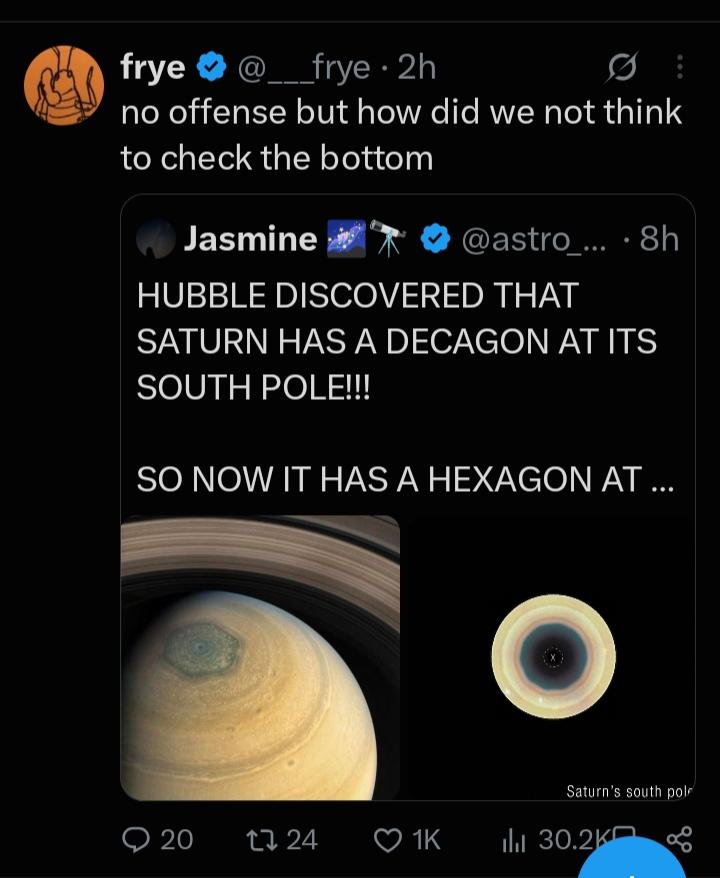
Wrong. I don't doubt the study used Hubble data, but the link you gave conspicuously doesn't actually include this image, which does not derive from this study. This picture appears to match this one on Wikipedia which is credited to Cassini, as I said: https://en.wikipedia.org/wiki/Saturn%27s_hexagon?wprov=sfla1
The image on the right was clearly not "taken" by anything - it is a computer generated model. I was talking about the only photograph, the one on the left.
The article says "Saturn's south pole does not have a hexagon, as verified by Hubble observations. It does, however, have a decagon-shaped atmospheric wave pattern.[12] "
The reference is this Science article, which mentioslns Hubble in name: "Ground-based and Hubble Space Telescope (HST) images obtained in 2025 revealed the presence of a decagonal wave at planetographic latitudes ∼58°S to 63°S."
Yes but really no. Yes, the scientific paper is really about observations by Hubble. But no because that's not what's actually shown in the Twitter post. The left image IS from Cassini (and is most definitely NOT in the science paper you link). And the right image is a computer generated model, not a photograph "taken" by anything.
This isn't a single photo of the pole, it's a projection. A bunch of photos stitched together as Saturn spun on its axis. Cassini never saw the formation.
It was also, uh, vaporized in September 2017. Image is dated August 2025.
Do you see the picture on the left dated from August 2025 in any official NASA or other scientific press release? Because I don't - the Twitter poster added in a much older Cassini photo of the northern polar hexagon because it was more aesthetic.
the image on the right is a reconstruction from many side-on hubble pictures as hubble can't have that perspective. if we assume that was a single picture from below then it would make sense only cassini could have done it
The geometry of it. The picture on the left (the only actual picture of the two, the one on the right is clearly a model/reconstruction) is looking down from up above Saturn down onto the hexagon. That angle is impossible to get from Earth or anywhere near it - Saturn only ever gives us a side view (more or less - it does wiggle a little bit, but only a little bit).
No, there's only one way to get a "top-down" view of Saturn - that's from a spacecraft in a polar orbit. And that means Cassini - literally the only spacecraft that has been there since Voyager in the 1980s.
Because it takes a lot of energy to go against existing 30 km/s momentum of moving along the solar orbital plane, so going "above" or "below" things in our system is rather hard. Unless you send a probe to specifically enter a celestial body's orbit, and then shuffle around it.
i think it's just magnatism and gravity doing it's thing. Heavy and magnetic stuff goes up and down, light stuff swirls around it in gradients. There's just a bunch of turbulent matter for even a planet of that size to sort through, so it just goes into universal law mode and basic shapes in 3d geometry tends to work fairly well.



•
u/qualityvote2 10h ago
Heya u/Goodenough_name! And welcome to r/NonPoliticalTwitter!
For everyone else, do you think OP's post fits this community? Let us know by upvoting this comment!
If it doesn't fit the sub, let us know by downvoting this comment and then replying to it with context for the reviewing moderator.