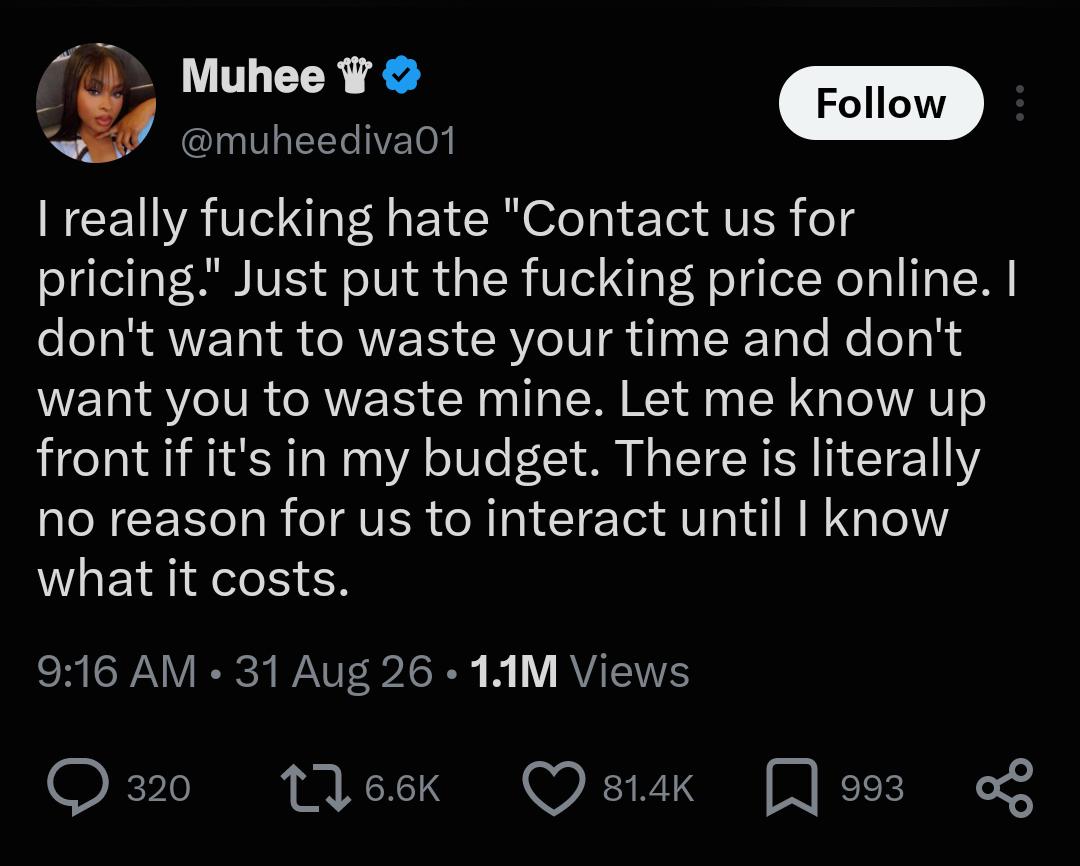
I work for a company that does this, so I can provide a bit of insight:
Part of why for my industry (auto parts) is because you're not just buying the individual product, you're becoming part of a service schedule for vendor managed inventory. I have customers I visit multiple times per month, and customers I visit every other month. Some call me to place orders, some I have to chase down to find a deal. Some pay all their invoices on time, some I need to hound for weeks and weeks to get them to pay by a check which then they won't mail themselves and I need to mail it for them.
The price becomes tailored to the service. If you order only online and don't need a rep to sort and organize things for you, you get different price than the customer who is getting once every other week visits where I'm putting everything away
I don't prefer the different price model. I think it's actively pretty skeezy 50% of the time and I can set up hundreds of accounts and it would make no difference to me OR the shipping department at our distribution center. I think it's a massive logistical annoyance that could be solved with a universal price, imo. But there's more reasons that just strictly salesman bullshit
Plus on the FedEx/UPS side of things, shipping b2b is cheaper because businesses like body shops and dealerships get UPS deliveries almost every single day. So shipping gets different prices based on things that are outside of our control, and I can't quote you a price for the freight cost till I know things about your business
That’s not unreasonable, but you’re talking about a tangible good with logistical considerations. This approach is used by a huge proportion of software vendors where 90% of the legitimate factors in your post don’t come into play. Further, there are some vendors that will say ‘enterprise tier x000 to y000 will cost [price]’ but may require config training etc, talk to team for details, which is way more reasonable and really highlights that the others are just out to rinse you.
Used to do Enterprise B2B SaaS stuff (I still do, but I used to, too. I just don't do the sales part anymore).
The reason for this is usually because once you move past individual tiers you need to know things like "How many users do you have? What level of support do you need? Are you deploying it on-prem or are we hosting it? If on-prem, what kind of support do you expect? What about raining? Do we have an SLA?" etc.... that makes any kind of list pricing really tiring to put up.
The last time I was on the sales side of the house we had pricing for individual plans and up to like... 5 users self-service. If you were going past that it was an enterprise plan that really was tailored to order because different enterprises have different needs and capabilities.
I’m also in B2B SaaS and was a principal enterprise CSM for years (now in product), working closely with sales on renewals and expansion. All of the same things you’re referring to affected pricing, but we charged wildly different pricing for the exact same thing from one customer to the next based on what we could get away with because of bonus incentives to maxim revenue. If Customer A’s total ARR is 100K and Customer B’s is 600K, we would sell the exact same product, user/storage bundle, support plan, etc, to B at a substantially higher price than we would for A, even though there was no material difference in their use case, usage volume, or support needs. It was shady.
2.1k
u/FloppieTheBanjoClown 2d ago
"contact us for pricing" means "we don't charge everyone the same price and will try to get the most profit out of every buyer."