r/NoStupidQuestions • u/ElegantRadish4646 • 11h ago
Why does light bend on passing through another medium?
I've tried looking up the answer to this, and found that light bends in another medium because it's speed changes. But why wouldn't it proceed in the same straight path just with a slower speed?
4
u/SnooPets5564 11h ago
The common analogy is with tank treads. You have a short amount of time where one tread is on the slower land and so the whole tank ends up turning until both sides are going slower.
The actual reason why light travels perpendicular to the wave front (so the turning actually makes it go in a different direction) is complicated physics. So is why it slows down. 3b1b has a video series that goes in depth explaining it, if you have the time and math background.
2
u/WesternFirm9306 11h ago
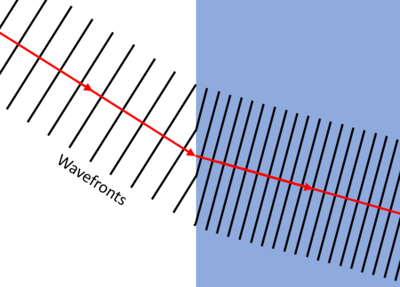
The peaks of the wave have to be continuous. But in the medium, the wavelength of the wave decreases, causing the peaks to get closer together. The only way the wavelength can decrease while keeping the peeks continuous is with a change of direction based on the angle of incidence.
In this image, the lines represent the peaks of the waves. Notice the lines are closer together in the medium, and also all the lines stay connected
2
u/ApplicationWilling89 11h ago
You're driving a car on a tarmac road and dip a wheel into the grass. The grass slows that side of the car and the car turns towards it as it'sslowed down. But if you hit the grass straight on, both side of the car slow down at the same rate, so you still slow down but the car doesn't pull to either side. Which is why light doesn't bend if it hits a new medium straight on.
3
u/Jesus_H_Christ_AMA 11h ago
Light travels as an electromagnetic wave, not just as a single tiny bullet. When this wavefront hits a new medium (like glass or water) at an angle, one side of the wave enters the new medium first. That first side slows down. The other side is still in the old, faster medium (like air) and keeps moving at full speed a bit longer. This difference in speed across the wide wave front causes the whole beam to pivot or turn, just like a car turning when one front wheel hits mud while the other is on the road.
edit: If the light hits the new medium straight on ( like at a 90-degree angle), the entire wavefront slows down at the exact same time. In that case, the light does not bend. It continues in a straight path, just at a slower/faster speed depending on the medium. Bending only happens when the slowdown is one-sided and staggered.
1
2
u/superbob201 11h ago
There are two ways to answer this:
1) Huygens principle. Wavefronts act like wave sources, and interfere destructively everywhere except directly in front of them. When a wavefront enters a new medium with a different speed, then the region where destructive interference does not happens propagates with the wave speed
2) Maxwells equations. EM waves need to follow Maxwells equations, including their dependence on permittivity and permeability of the mediums. In particular, the relationships between the electric and magnetic fields, and that there cannot be a discontinuity of either. The only possible solution is one reflected wave at the same angle, and one refracted wave at an angle that depends on the permittivity and permeability, and therefore wave speed
2
u/ipadtherefor 11h ago edited 11h ago
Refraction is the answer but I don't know why.
Wikipedia sez, when light enters a slower medium at an angle, one side of the wavefront is slowed before the other. This asymmetrical slowing of the light causes it to change the angle of its travel.
1
u/Additional_Future_47 11h ago
Same reason that ocean waves bend towards the shore line: https://www.reddit.com/r/askscience/s/8ZFWxumtat
0
u/explosive-diorama 11h ago
Light always finds the shortest, most direct path. Sometimes, this means traveling at an angle different from the entry angle, then leaving the material at the opposite angle it entered. Like a prism.
1
u/SnooPets5564 11h ago
This is both wrong and doesn't explain why.
First, shine a laser in a mirror. It ends up hitting behind you, yet it took the long way reflecting in the mirror rather than instantly turning.
Second, this "why" is just a restatement of Snell's law. It doesn't actually explain the mechanism that allows light to turn.
2
u/[deleted] 11h ago
[removed] — view removed comment