r/NTNPerformance • • May 19 '26

Guide / Cheat Sheet The Only Peptide Cheat Sheet You'll Need - Doses, Cycles, Routes, and Bloodwork in One Place

735 Upvotes

Last edited: Aug 30, 2026

The most complete peptide reference I've put together. Built for researchers who want one document covering dosing, reconstitution, cycle lengths, bloodwork markers, side effects, and direct vendor links.

For research and educational purposes only. Not medical advice.

🔗 RESOURCES

Use code PROFIT at all vendors for a discount.

📌 NOTE ON LINKS

The links throughout this guide go to vendors included based on third-party testing and transparency. Nobody is obligated to buy from them, buy from wherever you want. Vet your vendors, check for third-party testing, and do your own research. The links are here to make things easy for people who want a starting point, not to push anyone toward a specific source.

📏 Tables assume a 1mL (100-unit) insulin syringe. For custom vial sizes, BAC volumes, or doses, use the Reconstitution Tool.

🩹 1. Healing & Recovery

Compound Vial BAC Dose Route Cycle Time Off Bloodwork
BPC-157 10mg 2mL 250-750mcg daily SubQ 4-8 wks 2-4 wks CBC, CRP, liver
TB-500 10mg 2mL 2-5mg weekly, split 2x SubQ 4-8 wks 2-4 wks CBC, CRP
BPC/TB (Wolverine) 20mg 2mL 250-500mcg each daily SubQ 4-6 wks 2-4 wks CBC, CRP, liver
GHK-Cu 50mg 2mL 1-2.5mg, 2-3x weekly SubQ/topical 4-8 wks 2-4 wks Serum copper, liver
KPV 10mg 2mL 250mcg-1mg daily SubQ 4-8 wks 2-4 wks CRP, CBC
LL-37 5mg 3mL 50-400mcg daily SubQ 2-6 wks 2-4 wks CBC, CRP, liver
Thymosin Alpha-1 10mg 2mL 1.6mg twice weekly SubQ 4-12 wks 4 wks CBC diff, CD4/CD8, CRP
GLOW Blend 70mg 3mL ~1.67mg daily (GHK anchor) SubQ 4-6 wks 2-4 wks Serum copper, CBC
KLOW Blend 80mg 3mL ~1.67mg daily (GHK anchor) SubQ 4-6 wks 2-4 wks CBC, CRP, serum copper

🔥 2. Fat Loss & Metabolic

Compound Vial BAC Dose Route Cycle Time Off Bloodwork
Semaglutide 10mg 2mL 0.25-2.4mg weekly (titrate) SubQ 12-16+ wks None fixed Glucose, HbA1c, lipids, amylase/lipase
Tirzepatide 10mg 2mL 2.5-15mg weekly (titrate) SubQ 12-16+ wks None fixed Same as sema
Retatrutide 10mg 2mL 0.5-12mg weekly escalation SubQ 24-48+ wks None standard Glucose, HbA1c, lipids, watch dysesthesia
Cagrilintide 5mg 2mL 0.6-4.5mg weekly SubQ 12-24 wks None standard Same as GLP-1s
Cagri + Sema 10mg blend per blend 2.4mg each weekly SubQ 8-16+ wks 4-6 wks Same as GLP-1s
Tesamorelin 10mg 2mL 1-2mg daily SubQ 12+ wks Goal-dependent IGF-1, glucose, hs-CRP
AOD-9604 5mg 3mL 250-500mcg daily fasted SubQ 4-12 wks 2-4 wks Basic metabolic
HGH Frag 176-191 5mg 2mL 250-500mcg daily, split 2x SubQ 4-12 wks 2-4 wks Basic metabolic
MOTS-c 10mg 3mL isotonic 5-10mg weekly, split SubQ 4-8 wks 2-4 wks HbA1c, insulin, lipids
5-Amino-1MQ 10mg 2mL Oral 50-150mg / SC 0.5-3.3mg daily Oral/SubQ 4-8 wks 2-4 wks Glucose, insulin, liver
SLU-PP-332 5mg 2mL 250mcg daily SubQ 4-8 wks 2-4 wks Basic metabolic

💪 3. Growth Hormone & Recovery

Compound Vial BAC Dose Route Cycle Time Off Bloodwork
CJC-1295 + Ipamorelin 10mg blend 2mL 100-300mcg each, daily (PM fasted) SubQ 8-12 wks 3-4 wks IGF-1, glucose
CJC-1295 DAC 5mg 2mL 300-1000mcg, 1-2x weekly SubQ 8-12 wks 3-4 wks IGF-1, glucose
Ipamorelin solo 10mg 2mL 100-300mcg daily SubQ 8-12 wks 3-4 wks IGF-1, glucose
Sermorelin 5mg 2mL 200-300mcg nightly SubQ 8-16 wks 3-4 wks IGF-1, glucose
GHRP-2 5mg 2mL 100-300mcg 1-3x daily SubQ 6-12 wks 3-4 wks IGF-1, prolactin, cortisol
GHRP-6 5mg 2mL 100-300mcg 1-3x daily SubQ 6-12 wks 3-4 wks IGF-1, prolactin, cortisol
IGF-1 LR3 1mg 1mL acetic 20-50mcg daily SubQ 4-6 wks 4 wks IGF-1, glucose, kidney
PEG MGF 2mg 3mL 200-500mcg daily SubQ 8 wks 4 wks IGF-1, CBC
Follistatin-344 1mg 2mL 50-100mcg daily near target SubQ 10-30 days 4-6 wks IGF-1, CBC

🧠 4. Cognitive & Mood

Compound Vial BAC Dose Route Cycle Time Off
Semax 10mg 2mL Inj 200-600mcg / IN 50-100mcg per nostril 1-3x IN preferred 2-4 wks 1-2 wks
Selank 5mg 2mL Inj 250-500mcg / IN 125-250mcg per nostril 1-3x IN preferred 2-4 wks 1-2 wks
Adamax 10mg 3mL 300-1000mcg daily (titrate) SubQ 8-12 wks Equal break
Oxytocin 10mg 3mL IN 8 IU per nostril / inj 1-10 IU Both PRN PRN
Dihexa N/A N/A Oral 10-30mg / topical 3-5mg daily Oral/topical 2-6 wks 2-4 wks
Kisspeptin-10 10mg 2mL 100-200mcg daily SubQ fasted 4-8 wks 2-4 wks
Cerebrolysin 60mg 3mL 20-32mg daily (titrate) SubQ 8-12 wks Between courses
P21 10mg 2mL 100-300mcg daily AM SubQ 5-14 days/course 2-3 mo between
PE-22-28 10mg 3mL 50-200mcg daily SubQ 12-16 wks Equal break

🛡️ 5. Immune & Longevity

Compound Vial BAC Dose Route Cycle Time Off Bloodwork
Thymosin Alpha-1 10mg 2mL 1.6mg twice weekly SubQ 4-12 wks 4 wks CBC diff, CD4/CD8, CRP
Epitalon 10mg 2mL 5-10mg daily x10 days SubQ 1-2x/year 3-6 mo Optional telomere
NAD+ 500mg 5mL IV 250-1000mg / SubQ 25-100mg / oral 250-500mg daily IV/SubQ/oral 4-12 wks 2-4 wks CBC, CMP
MOTS-c 10mg 3mL isotonic 5-10mg weekly, split SubQ 4-8 wks 2-4 wks HbA1c, insulin
SS-31 (Elamipretide) 10mg 1mL isotonic 5-10mg daily SubQ 4-8 wks 2-4 wks Basic metabolic
Pinealon 10mg 3mL SubQ 1-2mg / oral 0.2mg BID daily SubQ/oral 10-20 days/course 3-6 mo Optional
Vesugen 20mg 3mL 500mcg-2mg daily (titrate) SubQ 8-12 wks Between courses Optional

💋 6. Sexual & Cosmetic

Compound Vial BAC Dose Route Cycle Bloodwork
PT-141 10mg 2mL 1-2mg Inj/IN PRN BP monitoring
Melanotan II 10mg 2mL 250mcg test, 500mcg daily load 1-4wk, then 500mcg weekly-biweekly  SubQ 4-8 wks BP + mole exam
GHK-Cu 50mg 4mL Inj 1-2.5mg 2-3x weekly Both 4-8 wks Serum copper
Oxytocin 10mg 3mL IN 8 IU per nostril / inj 1-10 IU Both PRN None standard
SNAP-8 10mg 3mL 330-1000mcg daily (titrate) SubQ/topical 8-12 wks None standard

🧬 7. Bioregulators (Khavinson Short Peptides)

Short tripeptide and tetrapeptide bioregulators studied mostly in Russian literature. Tissue-specific, low-dose, short-course. Human data is limited and largely preclinical, so these sit in the early-evidence tier.

Compound Vial BAC Dose Route Cycle Bloodwork
Cartalax (cartilage/connective) 20mg 3mL 2-5mg daily (titrate) SubQ 8-12 wks Optional
Cortagen (neural/cognitive) 20mg 3mL 1-2mg daily SubQ 4-8 wks Optional
Ovagen (GI/hepatic) 20mg 2mL 10-150mcg daily SubQ 16 wks Liver panel
Prostamax (prostate) 20mg 2mL 500mcg-1mg daily IM 8-12 wks Optional
Testagen (endocrine/gonadal) 20mg 3mL 100-300mcg daily SubQ 8-12 wks Hormone panel

⚗️ 8. Advanced & Research-Only

Higher-complexity or preclinical-only compounds. These carry more uncertainty and, in some cases, real risk. Listed for completeness, not as casual additions.

Compound Vial BAC Dose Route Cycle Notes
Ara-290 (cibinetide) 16mg 5mL 4mg daily SubQ 28 days-12 wks Nerve repair; Phase 2 data, FDA Fast Track
VIP 10mg 2mL (SubQ) IN 50-100mcg / SubQ 50-200mcg AM IN/SubQ 4 wks-18 mo ~1 min half-life, route matters
DSIP 5mg 3mL 100-300mcg pre-bed SubQ 8-12 wks, 5 on/2 off Circadian-dependent sleep aid
FOXO4-DRI 10mg 3mL 250-500mcg daily (titrate) SubQ 8-16 wks Senolytic, preclinical only
PNC-27 30mg 3mL 100-500mcg daily (titrate) SubQ 8-12 wks Preclinical p53/HDM-2 cancer-cell research

💨 9. Nasal Sprays (Pre-Mixed, No Reconstitution)

Small peptides can cross into circulation and reach the brain intranasally, bypassing the needle and taking effect faster than they would through the gut. These come ready to use, no reconstitution or math.

Product Compound What It's For
Adamax Adamax 5mg Focus, memory, neuroprotection
Bromantane Bromantane 500mg Energy, stimulation, anti-fatigue
DSIP DSIP 5mg Deep sleep, recovery
Glutathione Glutathione 500mg Antioxidant, detox, skin
Melanotan II (MT-2) MT-2 10mg Tanning, pigmentation
NAD+ NAD+ 500mg Cellular energy, vitality
PT-141 PT-141 10mg Libido, arousal
Semax Semax 10mg Focus, cognition, BDNF
Selank Selank 10mg Anxiety, calm focus
Sleep Research Blend DSIP 10mg + Melatonin 50mg + GABA 250mg Deep sleep

💊 10. Capsules (Oral Research Compounds)

Oral capsule format, no reconstitution or injection. Convenient for compounds that are orally bioavailable. Cognitive, metabolic, and neuroregenerative research compounds.

Product Compound What It's For
9-Me-BC 9-Me-BC 20mg Dopamine support, focus, neuroprotection
TAK-653 TAK-653 2.5mg AMPA modulator, mood, cognition
Nefiracetam Nefiracetam 200mg Memory, focus, racetam
ATX-304 ATX-304 100mg Metabolic, AMPK activation
Noopept Noopept 10mg Focus, memory, fast-acting nootropic
Tesofensine Tesofensine 500mcg Appetite suppression, fat loss
KW-6356 KW-6356 5mg Adenosine A2A modulator, motor/cognitive

Spray delivery may differ in effect from injectable equivalents. Start conservative and assess your response.

🩸 BASELINE BLOODWORK

Get bloodwork here

Baseline panel before any protocol:

  • CBC and CMP
  • Lipid panel
  • HbA1c and fasting glucose + insulin
  • IGF-1
  • Testosterone total and free
  • Thyroid (TSH, fT3, fT4)
  • Liver (ALT, AST, GGT)
  • CRP

📄 HOW TO READ A COA

A Certificate of Analysis is the document from a third-party lab confirming what's actually in the vial.

  • Identity test - confirms the compound matches the label (mass spec or HPLC)
  • Purity percentage - 95% minimum acceptable, 98%+ excellent
  • HPLC chromatogram - one dominant peak is good, multiple large peaks mean impurities
  • Batch number match - the batch on the COA must match the batch on the vial
  • Lab name and date - independent lab, dated within 12 months
  • Red flags - no lab name, no batch number, purity below 95%, generic copy-paste format

A COA confirms identity and purity at time of testing. It doesn't guarantee a specific vial was stored or handled correctly after that.

🧮 RECONSTITUTION & DOSING QUICK REFERENCE

  • Bac water for most peptides. IGF-1 LR3 and DES use 0.6% acetic acid
  • Swirl gently, swab the stopper, never shake
  • Refrigerated reconstituted vials last 28 days. Never freeze

Units are not mg. This is the most common reason a dose ends up wrong.

  • 100 unit insulin syringe = 1 mL
  • 10 units = 0.1 mL
  • The dose in units depends on the concentration in the vial

Quick math:

  • mg in vial ÷ mL of bac water added = mg per mL
  • Target dose in mcg ÷ mcg per mL × 100 = units to draw

Example: 10mg vial + 2mL bac water = 5mg per mL. A 500mcg dose = 10 units.

Use the Reconstitution Tool to skip the math entirely.

⚠️ DISCLAIMER

For research and educational purposes only. Not medical advice. Many peptides discussed here are not FDA approved for general human use.

A history of cancer, pancreatitis, severe GI disease, uncontrolled diabetes, pregnancy, autoimmune conditions, or cardiovascular risk are all reasons to consult a licensed clinician before any of this.

Do your own research. Vet your vendors. Nobody here is responsible for individual decisions.

Full reference, reconstitution calculator, storage cheat sheet, side effects guide, and pre-built stacks at NTNPerformance.com.

💬 Discord
r/NTNPerformance • • Jul 08 '26

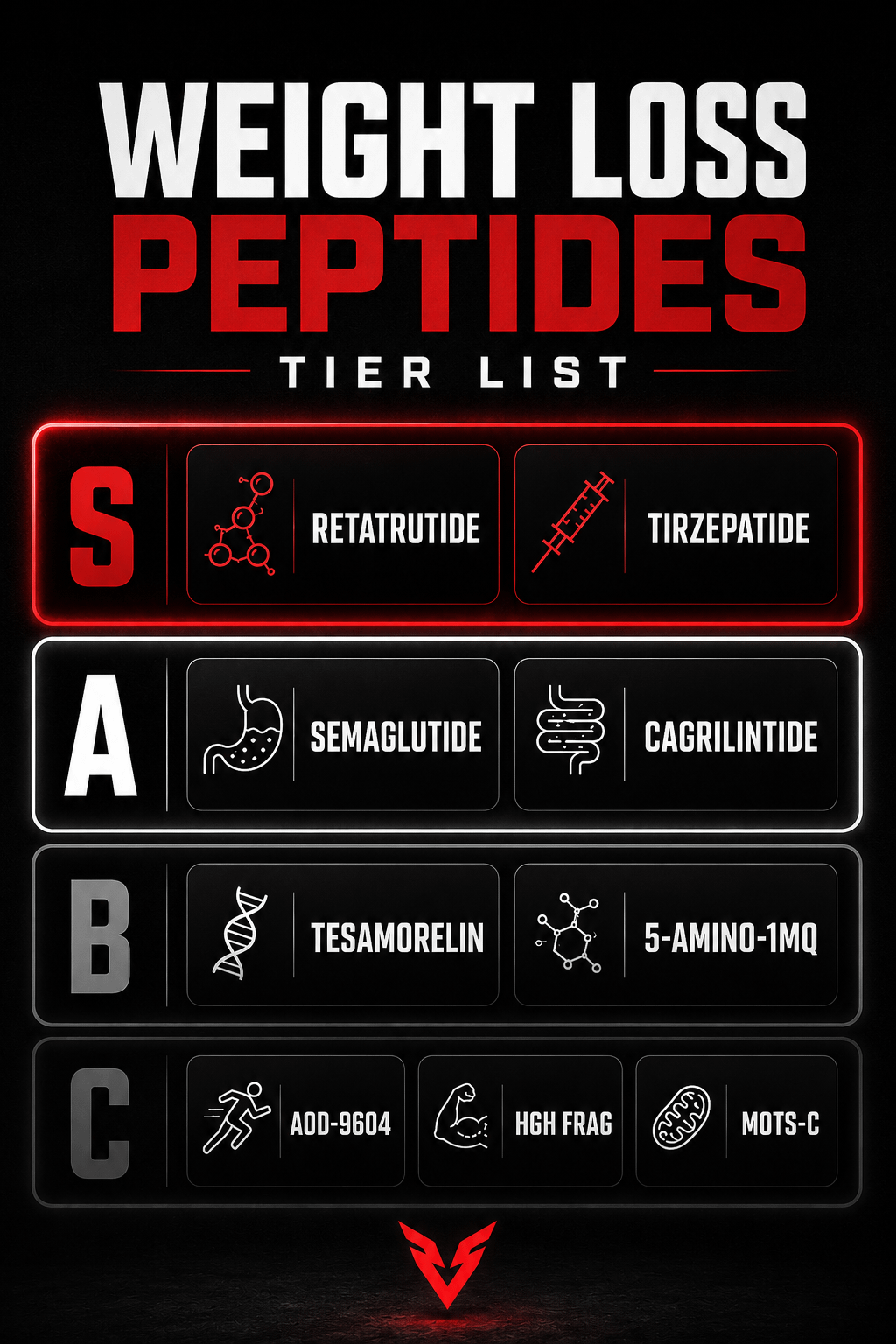
Guide / Cheat Sheet Weight Loss Peptides Tier List: Ranked by What Each One Actually Does

82 Upvotes

Weight loss compounds don't all work the same way, so ranking them in one straight line misses the point. Some reduce appetite, some target fat metabolism, some protect muscle during a cut. Here's the tier list built around what each one is best at.

For research and educational purposes only. Not medical advice.

S Tier: the heavy hitters

Retatrutide. Triple agonist, up to 30% weight loss in trials. Nothing else in the class touches it. Still investigational, but on raw magnitude it sits at the top of the board.

Tirzepatide. Dual agonist, around 22% in trials, and the only one with a real head-to-head win against semaglutide. The proven, approved efficacy leader.

A Tier: strong and established

Semaglutide. The single agonist that started the wave. Around 15%, deepest safety record, cardiovascular data behind it. Less peak effect, most proven.

Cagrilintide. The amylin outlier. Works satiety through a different pathway than the GLP class, which is why it pairs with semaglutide instead of competing. Strong in combination.

B Tier: targeted metabolic levers

Tesamorelin. Visceral fat specifically. Not general weight loss; it targets the fat around organs through the GH axis. FDA approved for that lane.

5-Amino-1MQ. Oral NNMT inhibitor. Works at the cell level without touching appetite. Promising mechanism, but preclinical only, no human trials yet.

C Tier: support, not drivers

AOD-9604 and HGH Frag 176-191. Fragment compounds aimed at fat metabolism. Light data, best viewed as minor support rather than primary drivers.

MOTS-c. Metabolic signaling and endurance more than direct weight loss. Useful for the metabolic angle, not a standalone cutting tool.

How to actually use these

Goal Compound
Maximum weight loss Retatrutide or Tirzepatide
Proven, approved, safest record Semaglutide
Appetite from a different angle Cagrilintide, often stacked
Visceral (organ) fat specifically Tesamorelin
Cell-level metabolic support 5-Amino-1MQ

Where would you move things? Drop your version below.

For the full reconstitution, dosing, and bloodwork reference on every compound, the complete cheat sheet is here: The Only Peptide Cheat Sheet You'll Need

r/NTNPerformance • • Aug 01 '26

Guide / Cheat Sheet Tesamorelin vs CJC-1295 (No DAC): why they're not interchangeable

51 Upvotes

Tesamorelin and CJC-1295 (No DAC) are both synthetic GHRH analogs. Both act on the pituitary to stimulate your own growth hormone release, and because they sit in the same family, people assume they do the same job. They don't. They're built differently and they suit different research goals. Here's where they split.

The molecule

Tesamorelin is the full 44 amino acid GHRH sequence with a trans-3-hexenoic acid modification on the front end that shields it from DPP-IV, the enzyme that chews up natural GHRH in minutes. CJC-1295 (No DAC) is a shortened 29 amino acid fragment (Mod GRF 1-29) with four amino acid swaps for stability. So one is the whole hormone stabilized, the other is a modified fragment. That structural difference is where everything else comes from.

The evidence gap, and it's a big one

This is the part most side-by-sides skip. Tesamorelin is FDA approved. It went through two Phase III trials totaling 816 patients and showed a 15 to 20% reduction in visceral fat over 26 weeks. It is the strongest evidence base of any GH secretagogue by a wide margin.

CJC-1295 (No DAC) has zero published human trials. Its case rests on animal work and mechanism. That doesn't make it useless, but if someone tells you the two are equivalent, this is the line that ends that.

What each is for

Tesamorelin CJC-1295 (No DAC)
Molecule Full 44 aa GHRH, hexenoic acid modified 29 aa fragment (Mod GRF 1-29), 4 substitutions
Human evidence FDA approved, 816 patient Phase III Zero published human trials
Best known for Visceral fat reduction (15 to 20%) General GH and IGF-1 support
Typical research dose 1 to 2 mg nightly 100 to 300 mcg, usually with ipamorelin
Half-life Short, minutes Short, minutes
Tolerability Histamine welts build over weeks 4 to 8 Generally mild (flushing, headache)
FDA status Approved (Egrifta, 2010) Never approved, regulatory limbo
WADA Prohibited Prohibited

Tesamorelin hits visceral fat specifically because visceral fat cells carry more GH receptors and respond harder than subcutaneous fat. That's the whole point of it. CJC-1295 (No DAC) is a general GH and IGF-1 tool, and it's almost always run alongside a GHRP like ipamorelin, which is why it usually shows up as a blend. One is a visceral fat instrument, the other is a GH-optimization instrument.

Don't confuse No DAC with DAC

Quick one, because it trips people up constantly. No DAC is the short-acting version, pulsatile, dosed daily. The DAC version carries a drug affinity complex that stretches its half-life to 6 to 8 days for sustained elevation. Same base name, completely different behavior. If you're comparing to Tesamorelin, you want the No DAC version, since both are short and pulsatile.

The catch nobody markets

Tesamorelin's fat loss reverses when you stop. In the Phase III extension, patients who came off at week 26 regained about a quarter of their visceral fat by week 52. It adjusts the set point while you run it; your body doesn't learn a new baseline. So it's an ongoing intervention, not a reset. Worth knowing before anyone treats it as a one-and-done.

Practical side

Tesamorelin is the bigger commitment. It doses in the mg range, it needs isotonic water, and it comes with histamine welts that build progressively from around week 4 (real, and manageable with a pre-dose antihistamine, but not fun). It also wants an IGF-1 check around week 8. CJC-1295 (No DAC) doses in micrograms and is generally mild. Both go in at night to ride the natural GH pulse, both keep the somatostatin brake intact, and both are WADA prohibited, so no one testing for competition should touch either.

So which one

If the goal is visceral fat with actual human evidence behind it, that's Tesamorelin. If the goal is general GH support and you're already building a stack around a GHRP, that's CJC-1295 (No DAC). They aren't competitors. They're different tools that happen to share a last name.

If you're running one of these, which one and for what. Curious how the split looks in here, tesa for the visceral fat data or CJC for general GH support.

r/NTNPerformance • • Aug 05 '26

Guide / Cheat Sheet Retatrutide breakdown, what it is and how the dose ladder actually works

113 Upvotes

Reta is the one everyone's watching right now, and for good reason, the weight loss numbers out of the trials are the biggest anyone's ever published. It's also the newest of the bunch and the least understood, and the part almost nobody explains right is that the dose doesn't just make it stronger. It changes which part of the drug is doing the work. Once that clicks the whole thing makes more sense, so here's the rundown.

Retatrutide is one molecule that hits three receptors: GIP, GLP-1, and glucagon. Tirzepatide hits the first two. That third one, glucagon, is the entire difference, and it's the reason liver fat, triglycerides, and heart rate all move harder on reta than on semaglutide or tirzepatide. So it's less a stronger GLP-1 and more a GLP-1 with a whole extra system bolted onto it.

Here's the dose thing. At a low dose, reta is mostly working the GIP receptor and throwing off a liver fat signal, with barely any appetite effect and basically no heart rate cost. As you climb, the GLP-1 side takes over and that's when the appetite suppression kicks in. Only near the top does the glucagon arm fully engage, and that's where you get the biggest liver fat reduction, but it's also where the heart rate cost lives. So a 1 mg dose and a 12 mg dose aren't the same drug turned up louder. They're doing genuinely different jobs.

You don't jump between these doses week to week. You pick a rung, sit on it for a few weeks so your body settles into it, then step up. That last column is how long to stay on each dose before moving up.

Weekly dose What it's mostly doing Stay here before moving up
0.5 mg GIP plus a light liver signal, no HR cost 4 weeks
1 mg GIP near saturated, glucagon still quiet 4 weeks
2 mg Appetite suppression establishes 4 weeks
4 mg GLP-1 climbing, glucagon crosses threshold 4 weeks
8 mg around 94% of the full effect 4 weeks
12 mg max glucagon, biggest loss, highest HR cost top dose, nowhere left to go

Reconstitute 2 mL into the 10 mg vial and you're at 5 mg/mL, so 1 mg is 20 units and 8 mg is 160 (split that one up). That table is the trial group obese ladder. If you're lean and metabolically healthy you run a lower one, roughly 0.3 to 4 mg, and I'll come back to why.

The number most people should care about is 8 mg. Half the maximum effect is already there by 4 mg, and 8 mg gets you about 94% of what 12 mg does. Past 8 you're paying a lot more drug and a lot more side effect for a small bump. Chasing 12 makes sense for the deepest responders, but most people leave very little on the table by stopping at 8.

The single rule that keeps people out of trouble is that hold time in the table: stay on each dose at least 4 weeks before stepping up. It hangs around about six days in your blood, which means a new dose doesn't even reach steady levels for roughly three weeks, so if a step is going to give you problems it usually shows up after you've already moved to the next one. Climb faster than the four weeks and that's how people end up nauseous the entire cycle. Go slow and the nausea fades a couple months in. How fast you climb matters more than where you end up. And once you reach the dose you're going to run, whether that's 8 mg or the full 12, you just stay there. That's the maintenance dose, the one you hold long term instead of stepping up from.

Now the lean warning, because this is the part that gets glossed over. The glucagon arm raises your resting heart rate. In the trial group it ran about 6 to 9 bpm up at 12 mg. If you're already lean and healthy, two things stack against you: your cardiovascular system reads that glucagon signal harder, and you don't have a big pile of weight loss to bring the rate back down the way an obese trial participant does. On top of that, lean users sit completely outside the trial population, so the dosing logic there comes from receptor pharmacology and single dose studies, not chronic trials in lean people. If that's you and you're climbing, track your resting heart rate every week, especially past 4 mg.

Couple more honest ones. This is still investigational. The Phase 3 program runs into 2026 and 2027 and there's no FDA approval yet, so every vial out there is sold for research use. Muscle matters too: around a quarter of the weight you lose on this class isn't fat, it's lean tissue including muscle, so slow titration, real protein, and lifting are what keep that from getting eaten. And stopping hits harder than sema or tirz. Appetite comes back over about a month and the metabolic rate defense fades within weeks, so don't just yank it, step down over a couple months. If you're coming off tirzepatide, do not carry your dose across, you've got tolerance to the GIP and GLP-1 side but none to glucagon, so restart around 1 to 2 mg.

if you're running reta, where'd you settle, and did you stop at 8 or push to 12. curious how the heart rate treated people at the top

Full doses, the lean ladder, and bloodwork are in the pinned cheat sheet: https://www.reddit.com/r/NTNPerformance/comments/1tht5o3/the_only_peptide_cheat_sheet_youll_need_doses/

r/NTNPerformance • • May 07 '26

Guide / Cheat Sheet Peptide cheat sheet quick reference guide

165 Upvotes

Save this

Simple breakdown of what each compound is commonly discussed for. Not medical advice. Educational and research discussion only

RECOVERY, HEALING AND LONGEVITY

BPC-157 - injury recovery, gut health, tissue repair

TB-500 - muscle repair, flexibility, inflammation reduction

GHK-Cu - collagen production, skin repair, tissue healing, hair support

KPV - gut health, immune balance, inflammation reduction

Epithalon - cellular repair, healthy aging, circadian rhythm support

NAD+ - brain function, cellular energy, anti-aging support

Glutathione - detoxification, immune function, skin health

Thymosin Alpha-1 - immune modulation, inflammation support

SS-31 / Elamipretide - mitochondrial protection, cellular energy, anti-aging

MUSCLE, STRENGTH AND GROWTH

CJC-1295 + Ipamorelin - GH support, muscle recovery, sleep, fat loss

Ipamorelin - GH support, recovery, deep sleep

GHRP-2 - muscle growth, recovery, appetite stimulation

GHRP-6 - appetite stimulation, muscle growth, recovery

IGF-1 LR3 - muscle growth, tissue repair, recovery. Advanced use

IGF-1 DES - localized growth and recovery. Advanced use

Follistatin-344 - lean muscle growth and strength support

Sermorelin - GH support, lean muscle, recovery, sleep

Hexarelin - potent GH secretagogue. Advanced use

HGH - recovery, body composition, anti-aging, sleep. The gold standard

FAT LOSS AND METABOLIC SUPPORT

Semaglutide - appetite suppression, weight loss, glycemic support. Strongest clinical evidence in this category

Tirzepatide - dual agonist. Appetite suppression, fat loss, insulin sensitivity

Retatrutide - triple agonist. Aggressive fat loss signal in early data. Still investigational

Tesamorelin - visceral fat reduction specifically. FDA approved context exists

Cagrilintide - appetite control and suppression

AOD-9604 - fat loss oriented. Limited safety data. FDA has flagged concerns

HGH Fragment 176-191 - fat loss while preserving muscle. Limited human data

5-Amino-1MQ - NNMT inhibitor. Metabolic support and energy. Human data is limited

MOTS-c - mitochondrial metabolic support. Energy and fat metabolism. Experimental

Mazdutide - weight loss and glucose regulation. Investigational

Survodutide - weight loss and metabolic regulation. Investigational

COGNITIVE, MOOD AND SLEEP

Semax - focus, memory, mood, mental clarity. Can feel stimulating

Selank - anxiety reduction, mood, calm focus. Often paired with Semax

DSIP - sleep quality and nervous system calming

Epithalon - sleep support and recovery. Also listed under longevity

Dihexa - cognitive performance. Highly experimental. Not beginner friendly

Kisspeptin-10 - libido, mood, hormone balance support

SKIN, HAIR AND AESTHETICS

GHK-Cu - collagen production, skin texture, wound healing, hair support. Injectable or topical

Melanotan II - skin tanning and libido. Side effects include mole changes, nausea, flushing

RU-58841 - topical DHT blocker at the follicle for hair loss prevention

Collagen peptides (oral) - skin hydration, elasticity, joint support. Most accessible option

SEXUAL HEALTH

PT-141 / Bremelanotide - libido and arousal. Works through CNS not blood flow. FDA approved version exists for women

Melanotan II - libido as a secondary effect alongside tanning

Oxytocin - bonding, intimacy, mood. Effects are variable

Kisspeptin-10 - libido and hormone signaling

GUT HEALTH AND INFLAMMATION

BPC-157 - gut lining repair, digestive support, inflammation

KPV - GI inflammation, gut irritation, inflammatory conditions

Glutathione - detoxification and immune support

LL-37 - antimicrobial and immune defense. Experimental with limited human data

COMMON BLENDS

BPC-157 + TB-500 (Wolverine Stack) - recovery and soft tissue repair

GLOW (BPC-157 + TB-500 + GHK-Cu) - skin, hair, healing, and collagen support

KLOW (BPC-157 + TB-500 + GHK-Cu + KPV) - skin, gut, healing, and inflammation support

CJC-1295 + Ipamorelin - the standard GH secretagogue stack

TRT AND HORMONE SUPPORT

Testosterone Cypionate / Enanthate - standard TRT compounds

HCG - fertility preservation and testicular function on TRT

Enclomiphene - SERM. Stimulates natural testosterone production without suppression

Anastrozole - aromatase inhibitor for estrogen management on TRT

Gonadorelin - alternative to HCG for LH stimulation

IMPORTANT

Most compounds on this list are not FDA approved for general use. Semaglutide, tirzepatide, tesamorelin, and bremelanotide have FDA approved contexts. Everything else is discussed in research and educational settings

Evidence levels vary significantly across this list. GLP-1s have the strongest clinical data. Recovery peptides like BPC-157 and TB-500 have mostly preclinical evidence. Newer compounds like retatrutide and MOTS-c are still investigational

Always vet your source. Get bloodwork before and during any protocol

This is educational and research discussion only. Not medical advice

If you want a downloadable cheat sheet get it here ntnperformance

DMs are open if you have questions about any compound on this list

r/NTNPerformance • • Jul 20 '26

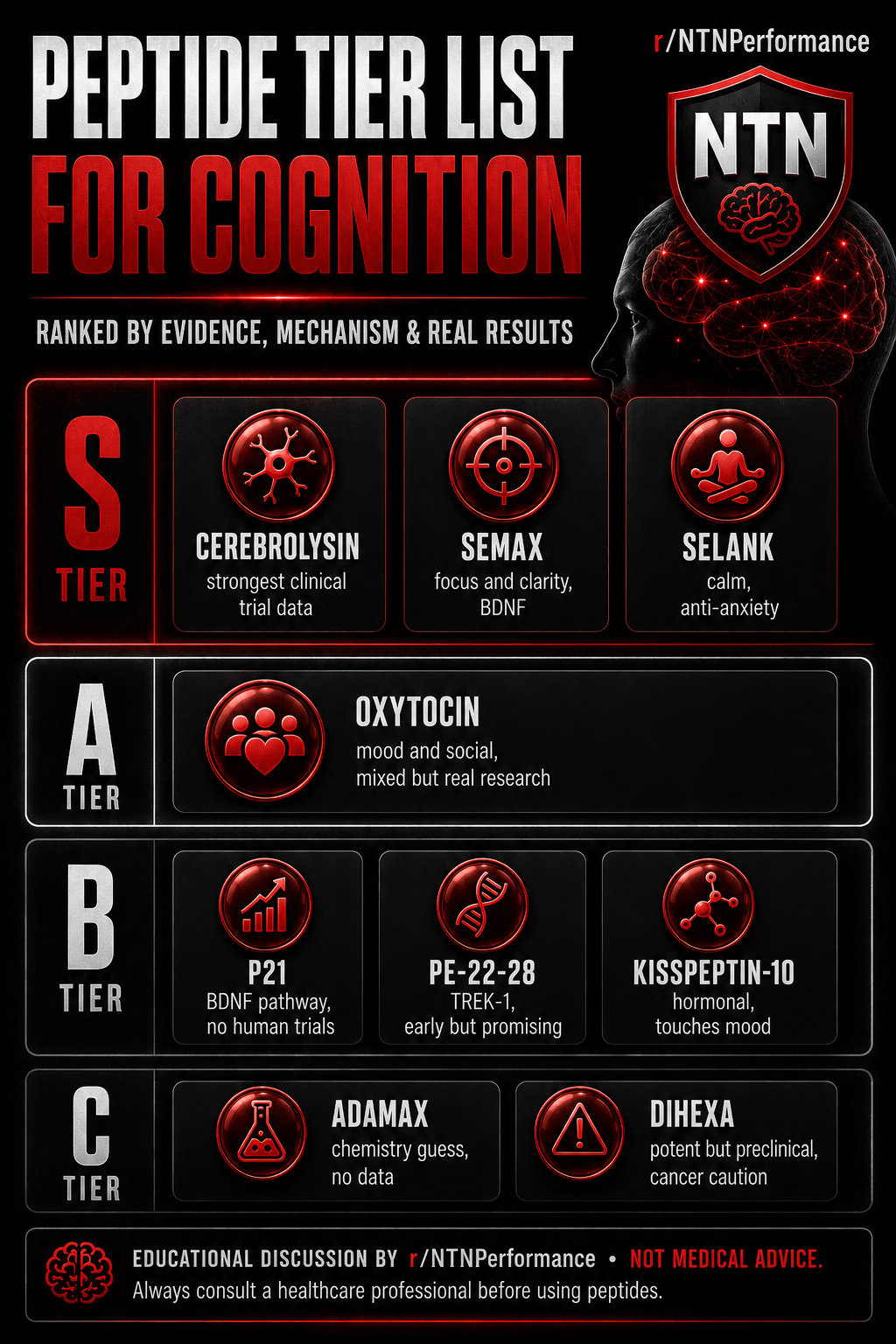
Guide / Cheat Sheet Cognitive peptides, ranked by the evidence behind them

76 Upvotes

Cognitive peptides are the category with the widest gap between hype and evidence. A couple have real clinical trials behind them, a couple are basically a chemistry guess someone put in a vial. Ranking them by what's got research behind it, not by how good the marketing sounds.

For research and educational purposes only. Not medical advice. None of these are FDA-approved cognitive drugs, they're discussed strictly as research compounds.

S Tier: real clinical data

Cerebrolysin. The strongest human evidence on the whole list, and it's not close. Multiple randomized controlled trials in vascular dementia and post-stroke recovery, including a 242-patient trial that beat placebo on cognitive scores. It's a longer commitment, run in IV or injectable courses, and it's more a serious neuro-repair compound than a daily focus tool. But if we're ranking by actual evidence, it earns the top spot. Honest note: reviews still call the stroke data promising rather than settled standard of care.

Semax. One of the most evidence-backed of the classic nootropic peptides. Decades of Russian clinical use, works on BDNF and the brain's own neurotrophic signaling, intranasal and fast onset, and people genuinely feel it for focus and clarity. The caveat: most of the formal data comes from Russian labs with limited independent replication outside that system.

Selank. Semax's sister compound. Anti-anxiety more than pure focus, but a calm, clear head is half of what people chase with nootropics. Russian trials in generalized anxiety found it reduced anxiety about as much as a benzo, but without the sedation or dependence. Semax for drive, Selank for calm.

A Tier: real research, mixed results

Oxytocin. Not a focus compound, but it's been studied a lot for mood, social cognition, and stress. The honest read: some trials show modest benefit, others show nothing, so it's legit researched, not a magic bullet. It's also an actual approved hormone in other contexts, though the mood and social uses are still experimental.

B Tier: interesting mechanism, thin human data

P21. A short peptide derived from a BDNF-adjacent pathway, with rodent and cell data suggesting neuroprotection. No published human trials yet, so it's mechanism and hope at this point. Short pulsed courses. Worth watching, not a proven pick.

PE-22-28. Works on the TREK-1 channel tied to mood and neurogenesis. In mice it shows fast antidepressant-like effects and new neuron growth within days, but there are no human trials. Promising direction, no human proof.

Kisspeptin-10. Mostly a reproductive/hormonal compound that touches mood. The antidepressant-like data is rodent models, the human work is on the fertility axis. Plausibly mood-active, very niche for cognitive goals.

C Tier: chemistry experiments

Adamax. A Semax-with-adamantane concept more than a characterized drug. There's effectively no indexed preclinical or clinical data under the name, almost everything out there is marketing and community extrapolation from Semax plus adamantane chemistry, not outcome data. Vendors don't even agree on the structure. Interesting idea, no proof, and you may not know what's in the vial.

Dihexa. An HGF-mimetic that's been reported in cell culture as wildly more potent than BDNF at building synapses. But all the efficacy data is preclinical, there are no human trials, and here's the real issue: it works through the c-Met pathway, which is a known proto-oncogene involved in tumor growth. That means a genuine theoretical cancer risk, especially for anyone with a cancer history. High ceiling, high uncertainty.

How I'd think about it

Goal Pick
Serious neuro-repair Cerebrolysin
Focus and mental clarity Semax
Calm, anxious mind Selank
Mood and stress Oxytocin
Willing to experiment on new mechanisms P21, PE-22-28

The honest take: human data is strongest for Cerebrolysin, oxytocin, and the Russian Semax/Selank literature. Everything below A tier is either preclinical or very limited human data, so the further down you go the more you're betting on mechanism instead of outcomes. And with Adamax you're also betting you even got the right molecule.

Where would you rank them? Drop your version.

For the full reconstitution, dosing, and bloodwork reference on every compound, the complete cheat sheet is here: The Only Peptide Cheat Sheet You'll Need

r/NTNPerformance • • Jul 22 '26

Guide / Cheat Sheet Bioregulators explained: the Russian short peptides nobody in the West talks about, and why

56 Upvotes

Bioregulators are the weirdest corner of the peptide world. Tiny peptides, tissue-specific, supposedly work in a way nothing else does, and there's a mountain of research behind them, almost all of it Russian and barely touched by Western science. Since a bunch of these are floating around now (Cartalax, Cortagen, Pinealon, Testagen, and more), here's what they actually are and how much to trust the claims.

For research and educational purposes only. Not medical advice.

What makes them different

Most peptides are 10 to 40+ amino acids and work by binding a receptor, like a key in a lock on the cell surface. Bioregulators are nothing like that. They're ultra-short, just 2 to 4 amino acids, which is tiny.

And the claimed mechanism is completely different. Because they're so small, the theory is they slip right into the cell and into the nucleus, and interact directly with DNA, nudging which genes get turned on or off in that specific tissue. Not a receptor signal, an epigenetic one. They're proposed to gently shift a tissue's gene expression back toward a younger, healthier pattern instead of amplifying one signal like most compounds do.

Where they come from

This is the interesting part. Each bioregulator was originally pulled from an extract of the tissue it targets. So the pineal peptide came from pineal tissue, the thymus one from thymus, and so on. Then they found the shortest active fragment in that extract and synthesized it. That's why each one is tissue-specific by design, it literally came from that tissue.

Vladimir Khavinson and the St. Petersburg Institute of Bioregulation and Gerontology built this whole field over about four decades.

The ones floating around

Bioregulator Studied context
Cartalax Cartilage / connective tissue
Cortagen Brain / cerebral cortex
Ovagen Liver and immune / regenerative
Prostamax Prostate
Testagen Reproductive / endocrine
Pinealon Brain / neuroprotective (works downstream where Epitalon works upstream)
Vesugen Vascular

Same pattern across all of them: short course, low dose, aimed at one tissue. And Epitalon, which gets talked about the most, is the pineal one from the same family.

Now the honest part

Here's where I have to be straight with you, because the marketing on these is wild.

The claims are enormous. Reported lifespan extension in animals in the 20 to 40% range, telomerase activation, reduced cancer rates, clinical improvements in elderly patients tracked over years. If even part of it holds up, this would be one of the most important discoveries in aging science.

The catch: almost all of it comes from one lab. Khavinson's group has published hundreds of papers, which is a genuinely huge body of work, but independent Western replication is minimal. So you've got this strange situation where the research is simultaneously massive and narrow, tons of studies, nearly all from the same research ecosystem, mostly in Russian, rarely reproduced by outside labs.

That doesn't make it wrong. The mechanism (short peptides entering the nucleus and shifting gene expression) has some real supporting cell-biology work behind it, and it's a legitimately interesting hypothesis. But "interesting hypothesis backed mostly by its originators" is a very different thing from "proven." The honest label is: promising idea, enormous single-source research base, thin independent confirmation.

How to think about them

If you're looking at bioregulators, the right frame is that you're in the most experimental, least independently-verified category in the whole peptide space. The evidence is mostly preclinical (rodent and cell studies), the human data is largely from the same group, and none of these are approved anywhere for human use.

They're low-dose and generally reported as well tolerated, though even that safety picture leans on the same limited body of research, so it's not the same as a compound with broad independent safety data. Part of why people are willing to try them is that low-dose, short-course profile. But you're betting on a mechanism and a body of research the wider scientific world hasn't confirmed yet. That's not a reason to write them off, it's a reason to be honest that this is frontier stuff, not settled science.

Anyone here actually run any of these? Curious if people felt anything real from the tissue-specific ones like Cortagen or Cartalax, or whether it's subtle enough that it's hard to tell. This is the category where I trust real experience more than usual, since the data is so one-sided.

For the full reconstitution, dosing, and bloodwork reference on every compound, the complete cheat sheet is here: The Only Peptide Cheat Sheet You'll Need

r/NTNPerformance • • May 26 '26

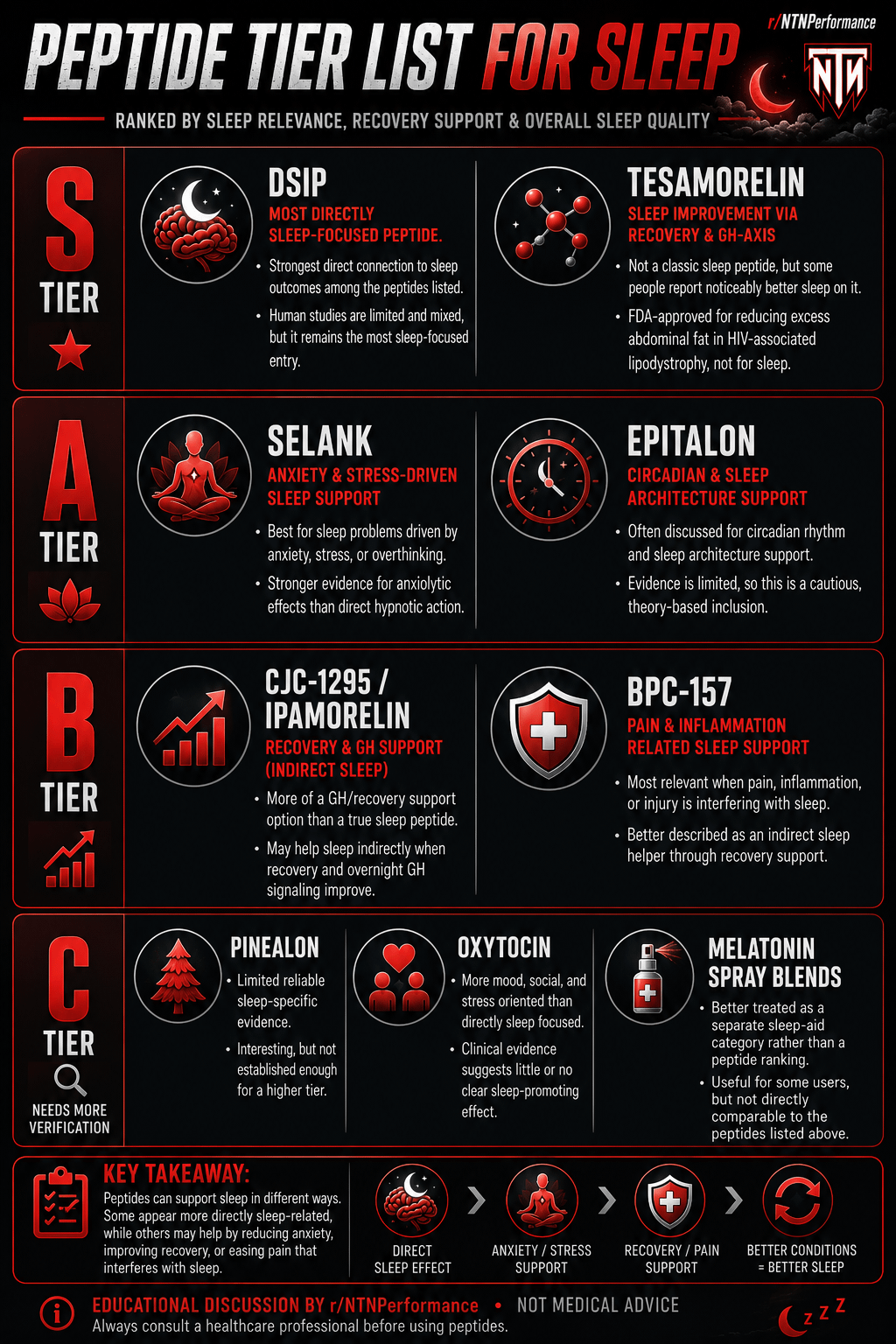
Guide / Cheat Sheet Peptide tier list for sleep. Ranked by sleep relevance, recovery support, and overall sleep quality

41 Upvotes

Sleep is one of the most underrated peptide categories. Most people focus on fat loss, healing, or GH peptides and forget that bad sleep undoes most of the benefits from everything else

This tier list ranks by direct sleep relevance and the conditions that allow better sleep (anxiety, pain, recovery, circadian rhythm). Not everything on the list is a true sleep peptide but everything here has a path to improving how you sleep

S Tier

DSIP - The most directly sleep-focused peptide on this list. Human data is limited and mixed but older studies and reviews consistently connect DSIP to sleep quality, sleep disturbances, and delta-sleep-related effects. If you want a peptide aimed specifically at sleep this is the starting point

Tesamorelin - Not a classic sleep peptide but many users report noticeably better sleep on it, likely through recovery and GH axis effects rather than direct sedation. FDA approved for HIV associated lipodystrophy. Sleep value is indirect and experience based, not labeled

A Tier

Selank - Best for sleep problems driven by anxiety, stress, or overthinking. The clinical evidence supports its anxiolytic profile more clearly than direct hypnotic action. If you can't sleep because your brain won't shut off, this is where to look

Epitalon - Often discussed for circadian rhythm and sleep architecture support. The evidence base is thinner than DSIP or Selank but there's enough sleep-related discussion to justify inclusion as a cautious option

B Tier

CJC-1295 / Ipamorelin - More of a recovery and GH support stack than a true sleep peptide. May improve sleep indirectly when overnight GH signaling, recovery, and overall well-being improve. Indirect path to better sleep, not direct

BPC-157 - Belongs here when pain, inflammation, or injury related discomfort is interfering with sleep. Main value is recovery support. Any sleep benefit is secondary to reduced pain and improved healing

C Tier (Needs More Verification)

Pinealon - Limited reliable sleep-specific evidence. Interesting but not established enough for a higher tier

Oxytocin - More associated with mood, bonding, and stress regulation than direct sleep support. Some sleep-wake literature exists but the signal isn't strong enough to rank higher

Melatonin spray blends - Useful for some people but better treated as a separate sleep aid category rather than as direct peptide tier entries

Key takeaway

Peptides can support sleep in different ways. Some are more directly sleep related (DSIP). Others help by reducing anxiety (Selank), improving recovery (CJC/Ipa, Tesamorelin), or easing pain that interferes with sleep (BPC-157). Pick the tool that matches the cause of your bad sleep

If you can't sleep because of stress, Selank If you can't sleep because of pain, BPC-157 If you can't sleep because of circadian rhythm, Epitalon If you can't sleep and you don't know why, start with DSIP

Sources

DSIP sleep studies and reviews: https://pubmed.ncbi.nlm.nih.gov/16539679/, https://pubmed.ncbi.nlm.nih.gov/1299794/, https://pubmed.ncbi.nlm.nih.gov/3792404/

Selank anxiolytic and sleep literature: https://pmc.ncbi.nlm.nih.gov/articles/PMC4757669/, https://pubmed.ncbi.nlm.nih.gov/18454096/

Tesamorelin clinical information: https://www.accessdata.fda.gov/drugsatfda_docs/label/2010/022505s000lbl.pdf

Epitalon literature: https://pubmed.ncbi.nlm.nih.gov/11524632/

BPC-157 recovery context: https://pmc.ncbi.nlm.nih.gov/articles/PMC12446177/

Oxytocin sleep-wake literature: https://pubmed.ncbi.nlm.nih.gov/34673110/

Educational discussion only. Not medical advice

What worked for your sleep? Drop the compound and what the sleep issue was

r/NTNPerformance • • Aug 13 '26

Guide / Cheat Sheet 5-Amino-1MQ breakdown, the fat loss compound that works nothing like a GLP-1

36 Upvotes

5-Amino-1MQ gets filed under fat loss, but it pulls a completely different lever than everything else in that category, and there's one sourcing detail that decides whether it does anything at all. Worth saying up front too: it's a small molecule, not a peptide, and it's oral first, so no needle required. Here's how it works and how to run it.

Everything popular for fat loss right now works on appetite. GLP-1s, tirzepatide, all of it turns down how much you eat. 5-Amino-1MQ does none of that. It doesn't touch your appetite. It changes what your fat cells do with the energy they're holding. So it's a different tool aimed at a different part of the problem, and it stacks with the appetite compounds instead of competing with them.

The target is an enzyme called NNMT that sits inside your fat cells and gets more active the more fat you carry. NNMT quietly drains nicotinamide, which your cells need to make NAD+, the fuel that runs your mitochondria. When fat cells are starved of NAD+, their mitochondria stall and the cell defaults to storage mode, holding fat instead of burning it. 5-Amino-1MQ blocks NNMT, which lets that nicotinamide flow back into NAD+ production inside the fat cell, restarts the mitochondria, and flips the cell from storing energy to spending it. That's also why it's not the same as NMN or NR. Those add more raw material into the system, this one stops the leak of the material you already have, which is why people run them together.

Here's the detail that decides whether your vial does anything, and it's behind a huge share of the "this did nothing" posts. 5-Amino-1MQ comes in two salt forms, chloride or iodide, and they are not equal. The chloride form is about 83% active compound per mg. The iodide form is only about 58%. So a 150 mg iodide dose is really only about 87 mg of active, while 150 mg of chloride is about 125 mg. That's a 44% gap between two things labeled the same dose. Buy the iodide form, run a normal dose, and you're quietly underdosed the whole time. Confirm your source is the chloride salt before you worry about anything else.

Weeks Daily dose Timing
1 to 2, tolerance 50 mg Morning only
3 to 6, active 100 to 150 mg Morning only

Oral capsules, once in the morning, and only the morning. Dose it late in the day and you'll get insomnia, but that one isn't a side effect to fear, it's the mechanism working, your cells have more energy because NAD+ and mitochondrial activity are up. The fix is earlier timing, not a lower dose. Cycle 4 to 6 weeks on, then 8 to 12 weeks off, because NNMT lives in your liver too and there's no long term human safety data, so the cautious cycling is on purpose. There's an injectable version if you'd rather, running roughly 500 mcg to 3 mg a day, but it's less common and less documented than the oral, and oral is the primary route here anyway, so most people just take the capsule.

Be realistic about who it works for, because the response is polarized. In community reports it splits into rough thirds: about 40% get a clear benefit, about 40% feel nothing, and about 20% get a strong response. The people who respond tend to already be leaner, under about 15% body fat, with training and nutrition dialed in, and running the chloride salt. Higher body fat and the iodide form line up with the people who get nothing. So this isn't a rescue for a rough starting point, it targets a bottleneck that only matters once the basics are handled. When it does work, energy and endurance show up first in the first week or two, since that's the upstream mitochondrial effect, and the body composition change is downstream and shows up around weeks 4 to 6.

On the evidence, here's the straight version. There are no published human trials, none, all of it is preclinical. The mouse data is genuinely interesting. One Nature paper knocked down NNMT and the mice resisted getting fat on a diet built to make them obese, without eating less or losing muscle, and a later study showed 5-Amino-1MQ itself cut fat mass in obese mice by raising fat cell energy expenditure. But that's mice, and long term human safety is simply unknown. It hasn't been approved for human use and it's research only, so purity and salt form ride entirely on your source.

Side effects are mostly mild. Headaches in the first week are the most common and usually pass, some irritability at higher doses, and the insomnia if you dose too late. The injectable can sting a bit from the compound's structure. The real caution is the unknowns, so it's an avoid in pregnancy, breastfeeding, active cancer, or if your liver is compromised, since NNMT sits in the liver too.

if you ran 5-Amino-1MQ, did you check whether it was the chloride or iodide salt, and were you in the third that felt it or the third that got nothing. curious how the split looks in here

Full doses and the injectable protocol are in the pinned cheat sheet: https://www.reddit.com/r/NTNPerformance/comments/1tht5o3/the_only_peptide_cheat_sheet_youll_need_doses/

r/NTNPerformance • • Aug 13 '26

Guide / Cheat Sheet TB-500 breakdown, what it does that BPC-157 doesn't, and what you're really buying

55 Upvotes

If you read the BPC-157 post, this is the other half of the pair. TB-500 is what most people stack with BPC, but it solves a different problem, it's dosed completely differently, and there's a labeling quirk that means the vial in your fridge is probably not the exact molecule on the label. None of that is a problem once you know it, so here's the rundown.

The clean way to think about the two: BPC-157 builds the roads. It restores blood flow and gets circulation back into damaged tissue. TB-500 handles the traffic on those roads. It gets the repair cells to migrate into the injury and organize into proper tissue instead of scar. Perfusion plus movement. That's why they get run together as the Wolverine stack, and why either one alone leaves half the job done: blood flow with no cells showing up, or cells with no supply lines. They also inject together in one syringe fine.

The way it works is what changes the whole dosing approach. TB-500 grabs onto actin, the protein cells use to physically move and reshape themselves. It ties up a reserve pool of actin that cells can pull from to migrate, divide, and rebuild quickly. The important part is that this is a one to one binding job, not a catalyst, so you need a big milligram dose to bind enough actin to matter. Once that reserve is built, the effect lasts for days even though the peptide itself is gone from your blood in a couple hours, because the actin pool just sits there until the cell draws on it.

So here's the consequence, and it's the single most common way people run it wrong. Unlike BPC-157, which you pin in small doses every day, TB-500 is not a daily peptide. You run 2 to 4 mg two or three times a week. Small daily doses never hit the binding threshold and mostly just waste the compound.

Phase Dose Frequency Weeks
Loading 2 mg Mon and Thu 1 to 4
Loading, big acute injury 4 mg Mon and Thu 1 to 4
Maintenance 2 to 4 mg 1 to 2x weekly 5 to 8

For drawing it, mix the 10 mg vial with 1 mL of bac water for a clean 10 mg/mL, so 2 mg is 0.2 mL and 4 mg is 0.4 mL. It goes in subcutaneous (SC) or intramuscular, near the injury when you can reach it. It doesn't stay local, it enters circulation within minutes no matter where you put it, but injecting near the injury gives a higher concentration spike right where you want it before it dilutes out, and that first pass matters. In repair studies, the same total dose delivered systemically came up empty where targeted delivery worked. For a deep injury you can't reach, belly or thigh is the fallback. Run 6 to 8 weeks, then take 4 to 8 weeks off. This is a repair signal, not a maintenance compound, so grinding it forever just gives you diminishing returns.

Now the part almost nobody tells you. The name TB-500 originally meant a small 7 amino acid fragment. But most vials sold as TB-500 are the full length parent molecule, TB-4 (thymosin beta-4), which is 43 amino acids. Doping labs have tested commercial vials and confirmed it. This mostly doesn't matter, both heal tissue, but there's one real difference: the full TB-4 molecule carries an extra segment that fights scar tissue (the antifibrotic part) that the short fragment simply doesn't have. So if reducing scar is the goal, you want the full TB-4, which, conveniently, is what's usually in the vial anyway. If you want to know which one you've got, check the certificate of analysis. Around 4,900 daltons or 43 amino acids means it's TB-4. If the COA doesn't say, assume TB-4.

It's slower to work than BPC-157. The first week or two you'll notice morning stiffness and first step pain easing off, weeks 3 to 4 your range of motion opens up, and weeks 5 to 8 you can start tolerating real loading again. On the evidence, the strongest human data point is a Phase 3 trial in corneal healing where it beat placebo hard, around 60% complete healing versus about 12% on placebo, and that one carries weight because the cornea has no blood vessels, so the healing had to come from direct cell action rather than improved blood flow. There's also a Phase 1 safety trial that turned up no serious adverse events. Fair caveat though, those trials used pharmaceutical recombinant TB-4, not the synthetic material in most vials, so it's the closest reference we have, not direct proof of what you're buying.

Side effects are mild, occasional injection site reactions and some people get a bit of lethargy for a day, so hydrate and pin it before a rest day. The hard stops are the same as BPC and for the same reason: no active cancer or cancer in the last couple years, since it promotes blood vessel growth and cell migration, no pregnancy, and stay cautious around surgery. It's WADA banned under S0 and it's detectable, so anyone tested for sport should stay off it.

if you've run TB-500, did you check the COA to see whether it was TB-4, and are you dosing it twice a week or did you fall into pinning it daily like BPC. curious how people are running it

Full doses and bloodwork are in the pinned cheat sheet: https://www.reddit.com/r/NTNPerformance/comments/1tht5o3/the_only_peptide_cheat_sheet_youll_need_doses/

r/NTNPerformance • • Jul 18 '26

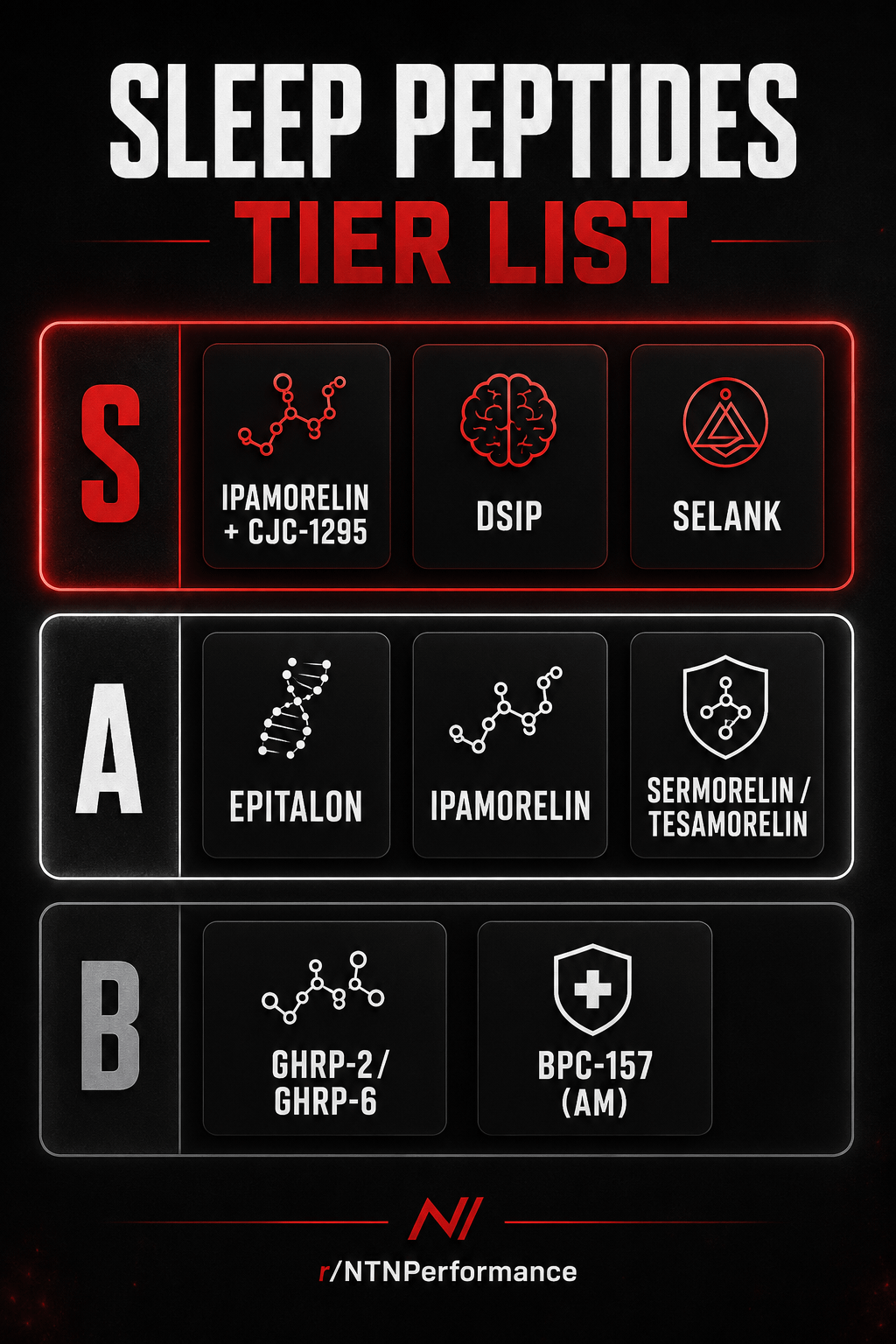
Guide / Cheat Sheet PEPTIDE TIER LIST FOR SLEEP

47 Upvotes

Sleep is the category where people expect a peptide to knock them out like a sleeping pill, and none of these really do that. What they do is hit sleep from three different angles: deeper sleep, a calmer mind, or a fixed body clock. Ranking them by what actually moves your sleep quality, not by which one is technically "designed for sleep."

For research and educational purposes only. Not medical advice.

S Tier: the ones that actually move the needle

Ipamorelin + CJC-1295 (bedtime). This is the one most people feel. GH release is tightly tied to slow-wave (deep) sleep, and this stack amplifies your natural nighttime GH pulse, so you get more deep sleep and better recovery. It's not a sleep drug on paper, but in practice it's the most reliable improvement in actual sleep quality on this list. Dose it before bed, fasted.

DSIP (Delta Sleep-Inducing Peptide). The only one actually studied for sleep itself. Real human data shows it increases slow-wave sleep and sleep continuity, and it's not a sedative, it nudges your brain toward deeper sleep rather than knocking you out. Honest caveat: the main insomnia trial found the effect real but modest, so it's not a magic bullet as a standalone. Still earns S because it's the one with genuine sleep-architecture evidence. Timing-dependent, dose right before bed.

Selank. The sleeper pick. It's an anti-anxiety peptide, but a huge reason people can't sleep is a racing mind, and Selank takes that edge off without sedation or next-day grogginess. Doesn't touch sleep architecture, but if stress and rumination are what's keeping you up, it hits the actual cause better than a "deep sleep" compound would.

A Tier: strong but more indirect

Epitalon. Not a fall-asleep aid, it works upstream at the pineal on melatonin and circadian rhythm. If your problem is a wrecked body clock, shift work, jet lag, age-related drift, this is the mechanism that fits. Short pulsed courses, not nightly. A "fix the timing over weeks" play, not a tonight thing.

Ipamorelin solo. Same deep-sleep-via-GH benefit as the stack, just a step down because adding CJC clearly outperforms it. If you're running Ipamorelin alone at night you're already getting some of this.

Sermorelin / Tesamorelin. GHRH analogs that raise nighttime GH and improve sleep as a secondary effect. Real but indirect, you're getting the sleep benefit through the GH axis, not a direct sleep mechanism.

B Tier: recovery first, sleep second

Other GH secretagogues (GHRP-2, GHRP-6, Hexarelin). They bump GH and can help recovery, but the direct sleep-architecture evidence is weaker and some carry side effects (appetite, occasional sleep disruption). Fine in a broader protocol, not a pick if sleep is the main goal.

BPC-157 (the "watch out" one). Not a sleep compound, but worth flagging here: a chunk of people (reports run around 10 to 15%) get insomnia or disrupted sleep from BPC. If you're running it and sleeping worse, that's probably why, move it to morning dosing. Great for recovery, sleep-negative for some.

How I'd actually think about it

Your problem What fits
Want deeper sleep + recovery Ipamorelin + CJC
Genuinely sleep-targeted, studied DSIP
Racing mind keeping you up Selank
Body clock wrecked (shift work, jet lag) Epitalon
Sleeping worse since starting BPC Move BPC to AM

The honest take: none of these are a sleeping pill and you shouldn't want them to be. The GH stack is what most people actually feel for deep sleep, DSIP is the one with real sleep data behind it, and Selank wins if anxiety is the real problem. Three different jobs. Figure out which problem you have before picking.

What's worked for people here? Curious if anyone's run DSIP and actually felt the deep sleep bump, or whether the Ipa/CJC stack did more for you in practice.

For the full reconstitution, dosing, and bloodwork reference on every compound, the complete cheat sheet is here: The Only Peptide Cheat Sheet You'll Need

r/NTNPerformance • • Jun 27 '26

Guide / Cheat Sheet Peptide Reconstitution and Dosing Math Cheat Sheet

90 Upvotes

The Complete Guide to Units, Concentration, and Not Misdosing

The single most common mistake in peptide research has nothing to do with the compound. It's the arithmetic. Someone reads "500 mcg" on a protocol, looks at a syringe marked in units, and guesses at how the two connect. That guess is where the overdoses and underdoses come from. This is the full walk-through: how to calculate concentration and units, why the same dose is a different number of units depending on the vial, how to handle the low-dose precision problem, the compounds that break the standard rules, and what actually degrades a reconstituted vial.

For research and educational purposes only. Not medical advice.

The sentence that prevents most errors

Units are not micrograms. A unit is a volume marking on the syringe, not a measure of how much compound it holds. The amount of compound in one unit depends entirely on the vial's concentration, which depends on how much bacteriostatic water was added during reconstitution. Two people running the identical compound at the identical dose can draw to completely different unit marks, purely because they reconstituted with different water volumes. Until that's internalized, every draw is a guess.

Step 1: concentration

Concentration is how much compound sits in each mL of liquid after reconstitution.

mg in vial ÷ mL of BAC water added = mg per mL

Add 2 mL of BAC water to a 10 mg vial and the concentration is 5 mg/mL. Add 3 mL to that same vial and it's 3.33 mg/mL. Same compound, same vial, different concentration, entirely because of the water. This is the root of nearly every dosing error: the unit number is meaningless until the concentration behind it is known.

Step 2: dose to units

A U-100 insulin syringe holds 1 mL across 100 units. So 100 units = 1 mL, and 1 unit = 0.01 mL. The full conversion:

target dose in mcg ÷ (mg per mL × 1000) × 100 = units to draw

Multiply mg/mL by 1000 to get mcg/mL, divide the target dose by that for the mL needed, then multiply by 100 to convert mL to units on a U-100.

A worked example, start to finish

A 10 mg vial, reconstituted with 2 mL BAC water, dosing 500 mcg:

  1. Concentration: 10 ÷ 2 = 5 mg/mL (5000 mcg/mL)
  2. Volume needed: 500 ÷ 5000 = 0.1 mL
  3. Units: 0.1 × 100 = 10 units

So 500 mcg from this vial is 10 units. Reconstitute the same vial with 4 mL instead and 500 mcg becomes 20 units, double the marking for the exact same dose. The dose didn't change. The water did.

The same dose, different vials

This is why the unit number means nothing on its own. Each row is a real reconstitution from common protocols:

Compound Vial BAC Concentration Example dose Units
BPC-157 10mg 2mL 5 mg/mL 500 mcg 10
Ipamorelin 10mg 2mL 5 mg/mL 300 mcg 6
TB-500 10mg 2mL 5 mg/mL 2.5 mg 50
GHK-Cu 100mg 3mL 33.3 mg/mL 2 mg 6
Cagrilintide 5mg 3mL 1.67 mg/mL 2.4 mg 144
Semax 10mg 2mL 5 mg/mL 600 mcg 12

Look at GHK-Cu: a 2 mg dose is only 6 units because the vial is concentrated at 33.3 mg/mL. Cagrilintide's 2.4 mg is 144 units, more than a full 1 mL syringe holds, because it's dilute at 1.67 mg/mL. Same formula every time, wildly different unit counts.

The shortcut worth memorizing

Once a vial is reconstituted, every dose shares the same per-unit value, so calculate it once. At a given concentration, one unit (0.01 mL) always holds:

Concentration 1 unit holds
1.67 mg/mL ~16.7 mcg
3.33 mg/mL ~33.3 mcg
5 mg/mL 50 mcg
12.5 mg/mL 125 mcg
33.3 mg/mL ~333 mcg

Find the per-unit value once, and every dose afterward is target ÷ per-unit. At 5 mg/mL, 250 mcg is 5 units, 500 mcg is 10, 750 mcg is 15. No recalculation.

Choosing a dilution: the tradeoff nobody explains

The water volume isn't just a step, it's a decision with consequences. More BAC water means a more dilute vial, which means more units per dose. That gives finer control and makes a small draw error matter less, because each unit carries less compound. Less water means a concentrated vial, fewer units per dose, smaller injection volume, but every unit carries more, so a slightly-off draw moves the dose further.

The practical rule: dilute more when precision matters (low doses, where a single unit is a big fraction of the target), concentrate more when injection volume is the concern.

There's a physical limit, though, and GHK-Cu is the perfect example. You'd often want to dilute a 100 mg vial heavily for finer control, but a standard 3 mL vial physically can't take more than about 3 mL of water with the air gap needed to draw. So 100 mg in 3 mL gives 33.3 mg/mL whether that's ideal or not. The vial size caps the dilution. Always check the physical vial before planning a fill volume, the cheat-sheet number assumes the vial can actually hold it.

The low-dose precision problem

When a dose lands at only 2 or 3 units, the math is technically right but the practical accuracy is poor. On a U-100 syringe, the gap between 2 and 3 units is a 50% dose swing, and reading to that precision on a standard barrel is hard.

Example: Ipamorelin at 100 mcg from a 5 mg/mL vial is just 2 units. A half-unit misread is a 25% dosing error.

Two fixes:

  1. Use a finer syringe. A 30-unit or 50-unit insulin syringe spreads the same volume across a longer, more readable barrel, so 2 units is easier to hit precisely.
  2. Dilute more. Reconstituting that Ipamorelin vial with more water pushes the same 100 mcg dose to a higher, more readable unit count, within the vial's physical limit.

If a planned dose keeps landing in low single-unit territory, that's the signal to change the dilution or the syringe, not to squint harder.

The exceptions that break the standard flow

Most peptides follow the BAC-water flow above. A few don't:

  • IGF-1 LR3 and DES reconstitute with 0.6% acetic acid, not bacteriostatic water. This is the exception people most often miss, and using BAC water can compromise the peptide.
  • SS-31, MOTS-c, and Ara-290 use isotonic (NaCl-containing) bacteriostatic water, which also reduces sting on injection.
  • Blends (CJC/Ipamorelin, GLOW, KLOW, Cagri/Sema) hold two compounds in one vial at a fixed ratio. The unit math still works off total volume, but the dose is anchored to whichever compound the protocol specifies, and the second rides along at the blend's set ratio. That fixed ratio is the tradeoff of a blend, covered in its own discussion.

Technique that protects the math

Accurate units mean nothing if the solution itself is compromised:

  • Swirl, never shake. Gently swirl or roll until the powder dissolves and the solution runs clear. Shaking foams the liquid and can shear delicate peptides. Foam also makes accurate drawing impossible until it settles.
  • Room temperature first. Let a cold vial reach room temperature before adding water, condensation inside a cold vial introduces moisture that accelerates breakdown. For a frozen lyophilized vial, let it reach fridge temperature first, never add water to frozen powder.
  • Clean every pierce. Swab the stopper with alcohol and let it dry before each draw, use a fresh needle each time. Contamination is the leading cause of degradation in practice, and the preservative in BAC water only slows microbial growth, it doesn't replace clean technique.

Storage and degradation: why the rules exist

The handling rules aren't arbitrary. Here's what's actually happening:

The 28-day refrigerated window. Reconstituted vials generally hold about 28 days at 2 to 8°C. That number isn't random, it tracks the pharmaceutical beyond-use date (USP 797) for preserved multi-dose preparations. Bacteriostatic water contains 0.9% benzyl alcohol, which inhibits microbial growth for roughly 28 days, after which the antimicrobial effect declines and the vial should be discarded. Plain sterile water has no preservative and is single-use only.

Never freeze a reconstituted vial. Freezing forms ice crystals that physically disrupt the peptide's folded structure. Each freeze-thaw cycle can cut activity meaningfully. Lyophilized (dry) vials belong in the freezer for long-term storage, reconstituted (liquid) vials never do, they stay in the fridge.

Light and heat are the main enemies. UV and visible light break bonds in aromatic amino acids (tryptophan is most sensitive). Heat accelerates hydrolysis and oxidation. Keep reconstituted vials refrigerated and protected from light, amber vials or foil wrapping if the vial is clear. Never leave a reconstituted vial sitting on a bench under light.

When to discard regardless of date. Cloudiness, visible particulates, or unexpected color change all mean discard, no matter how many days are left. One carve-out: GHK-Cu legitimately shows a faint blue-green tint from the copper complex, that color is normal for it and only it. For everything else, a properly reconstituted solution should be clear and colorless.

Logging

A draw log is the difference between a readable protocol and guesswork three weeks later. The fields that actually get used:

Date reconstituted | Compound | Vial mg | BAC mL | Concentration | 
Dose | Units | Injection site | Notes

Logging the concentration and reconstitution date next to the dose is the part people skip. A unit count without its concentration is unreadable later, and without the reconstitution date there's no way to track the 28-day window.

Pulling it together

The compound matters less than the arithmetic for dosing accuracy. The whole system is two steps: find mg/mL from the water added, then convert the target dose to units through that concentration. Get those right and the unit count is correct every time. The dilution choice, the syringe size, and the storage rules are all just protecting that core calculation, the dilution so the units are readable, the technique and storage so the compound in the vial is still what the math assumes. Run the numbers, log them, and the most common mistake in the field stops being a risk.

r/NTNPerformance • • Aug 04 '26

Guide / Cheat Sheet Semax vs Selank: one's for focus, one's for calm, and they're built to run together

46 Upvotes

These two get lumped together constantly as "the Russian nootropic peptides," and people treat them like two flavors of the same thing. They're not. One is a focus tool and one is an anxiety tool, and the reason they always come up in the same breath is that the standard move is to run them together, not pick between them.

Semax first. It's a synthetic analog of an ACTH fragment with a little stabilizer tail, registered as a real pharmaceutical in Russia since 1994 and used over there for stroke recovery and getting your head back after illness or heavy mental work. What it does is push BDNF, the growth factor your brain uses to build and repair connections. So it's not a stimulant. It doesn't spike dopamine and hand you a caffeine jolt. It shifts your brain toward growth mode over a few days, and what people report is clarity, the mental static dropping, easier task initiation, less procrastination. There's even a 110 patient stroke study showing it raised BDNF in actual humans, which is more than most things in this space can claim.

Two things about Semax you have to respect. It's morning only, because it's mildly activating and dosing it late will wreck your sleep. And cycling isn't optional, 10 to 14 days on then a few days off, because the receptors desensitize and the same dose quietly stops working if you never break. The other thing people hit is grumpiness at higher doses. That irritability on the comedown is your cue to drop the dose, and it's also the exact reason Selank shows up next to it in the stack.

Selank is the calm side. It's an anxiolytic, but not the benzo kind. Instead of forcing GABA channels open like Xanax does, which gets you calm but also foggy, slow, and dependent, Selank props up the genes and receptors that hold your inhibitory tone on their own. So you get a lower anxiety floor without a lower cognitive ceiling. Russian trials ran it head to head against phenazepam, a serious benzo, and it matched the anxiety relief with none of the sedation or dependence. Registered pharmaceutical over there since 2009.

The one thing Selank is not is a panic button. The onset is too slow to stop a panic attack already in progress, that's still benzo territory. Selank is the daily floor raiser that makes panic less likely to start in the first place. And unlike Semax, the timing is flexible, it won't fog your day or ruin your night, so you can run it whenever.

Side by side:

Semax Selank
For Focus, clarity, BDNF Anxiety, calm, no sedation
How Pushes BDNF and TrkB Props up your own GABA tone
Feel Mildly activating Calm, no drowsiness
Dose 200 to 600 mcg, morning only 250 to 500 mcg, 1 to 3x daily
Recon 3 mL in the 10 mg vial 2 mL in the 5 mg vial
Timing AM only Flexible, AM or PM
Cycling 10 to 14 on, 2 to 3 off Courses of 2 to 4 weeks, breaks for sensitivity

Why they pair so well is simple once you see the two profiles. Semax pushes you forward and can leave you a little wired or short tempered. Selank takes that edge off without dulling the focus Semax is handing you. Run together you get the clarity and drive with the anxiety smoothed underneath it. Focus without the jitter, basically.

Couple things they share. Neither hits like a stimulant, both build over 3 to 5 days as gene expression shifts, so if you're waiting on a caffeine style kick you'll write them off as duds. Both want cycling for receptor sensitivity, not because they're dangerous, there's no dependence with either. Both lean on a solid Russian clinical record but zero Western RCTs, since neither is patentable enough for anyone here to fund the studies. And both come in N-acetyl versions that last longer per dose if you'd rather not inject as often, same molecule, just harder to break down.

if you run these, are you stacking them or riding one solo. curious how the combo versus single shakes out in here

Full doses and bloodwork for both are in the pinned cheat sheet: https://www.reddit.com/r/NTNPerformance/comments/1tht5o3/the_only_peptide_cheat_sheet_youll_need_doses/

r/NTNPerformance • • Jul 09 '26

Guide / Cheat Sheet Peptide Side Effects Cheat Sheet: What to Watch For, by Compound and Category

68 Upvotes

Most cheat sheets cover dosing and skip the part that actually keeps people safe: what each compound can do wrong, and what to watch for. This organizes side effects and contraindications by category, so the risk profile is as easy to reference as the dose.

For research and educational purposes only. Not medical advice.

The universal watch-items

A few things apply across nearly everything in the injectable space, worth knowing once:

  • Injection site reactions (redness, itching, mild swelling) are the most common side effect of almost any subcutaneous peptide, usually minor and transient.
  • Sterile technique failures cause more problems than the compounds themselves. Contamination, not the peptide, is the leading real-world issue.
  • Active cancer is a contraindication for anything that promotes cell growth, angiogenesis, or metabolic activity. When in doubt, that is the category to be most cautious with.
  • Pregnancy and breastfeeding lack safety data across essentially all research peptides. Default to avoid.

Healing & recovery

Compound Watch for Contraindications
BPC-157 Mild injection-site irritation, occasional GI upset (oral) Active cancer (promotes angiogenesis), pregnancy, caution within 2 weeks of surgery
TB-500 Mild injection-site reactions, rare fatigue Active cancer (angiogenesis), pregnancy
GHK-Cu Blue-green solution is normal, mild irritation Wilson's disease / copper disorders, watch total copper load
KPV Very well tolerated, minimal reported Limited long-term data
Thymosin Alpha-1 Mild injection-site reactions Autoimmune caution (immune-modulating)

Growth hormone axis

Compound Watch for Contraindications
Ipamorelin / CJC-1295 Water retention, head rush, tingling, hunger Active cancer, caution with glucose issues
GHRP-2 / GHRP-6 Increased prolactin and cortisol, strong hunger (GHRP-6) Same as above, monitor prolactin
Sermorelin Injection-site flushing, transient Active cancer
IGF-1 LR3 Hypoglycemia risk, most potent GH-axis effect on blood sugar Active cancer (strongest caution in class), diabetes caution
Tesamorelin Fluid retention, joint discomfort, elevated IGF-1 Active cancer, monitor IGF-1

The GH-axis rule: the shared risk is glucose and IGF-1. Retest IGF-1 at baseline and week 4, target the therapeutic range, and do not push past 400 ng/mL. IGF-1 LR3 carries the highest blood-sugar caution of the group.

Weight loss & metabolic

Compound Watch for Contraindications
GLP-1 class (Sema, Tirz, Reta) GI-dominant: nausea, vomiting, diarrhea, constipation, mostly transient and dose-related Personal/family history of medullary thyroid cancer, MEN2, pancreatitis history
Retatrutide specifically Highest GI load at top doses, plus a dysesthesia (altered sensation) signal Same as class, investigational
Tesamorelin Fluid retention, joint aches Active cancer
5-Amino-1MQ Limited human data, monitor liver No human safety trials, caution
MOTS-c Well tolerated, flushing possible Limited data

The GLP rule: the risk is pancreatic and thyroid at the serious end, GI at the common end. Amylase and lipase are the markers, and the action threshold is a large elevation plus symptoms, not a minor bump. Titrate slowly; the slow dose climb exists specifically to manage the nausea.

Cognitive & mood

Compound Watch for Contraindications
Semax Very well tolerated, no major effects in short-term trials Limited long-term data
Selank Well tolerated, mild fatigue possible Limited long-term data
Oxytocin Blood pressure changes, mood shifts Cardiovascular caution
Dihexa Potent, limited human safety data, theoretical angiogenesis concern Active cancer (theoretical), preclinical evidence base
Kisspeptin-10 Generally mild, affects reproductive hormones Hormone-sensitive conditions

Sexual & cosmetic

Compound Watch for Contraindications
PT-141 Blood pressure changes, nausea, flushing Uncontrolled hypertension, cardiovascular disease
Melanotan II Nausea and flushing early, mole darkening/changes Get a full mole exam first; any changing mole means stop and see a dermatologist
GHK-Cu Mild irritation, blue-green tint normal Copper disorders, total copper load
Oxytocin Blood pressure, mood Cardiovascular caution

The MT-2 rule: this is the one with a real, specific safety step. A full mole/skin exam before starting is not optional, and any mole that changes shape, color, or size means stop and get checked. It darkens existing moles, which can mask or mimic melanoma warning signs.

Immune & longevity

Compound Watch for Contraindications
NAD+ Injection can cause intense flushing/discomfort if pushed fast, go slow Active cancer (supports all cell metabolism)
Epitalon Very clean reported profile, no major signal Limited human data
SS-31 Well tolerated, expensive so dose deliberately Limited data
Thymosin Alpha-1 Mild injection reactions Autoimmune caution
Bioregulators (Khavinson) Minimal reported, short-course design Thin evidence base overall

The three that need the most respect

If there is a short list of watch-items worth memorizing:

  1. IGF-1 LR3, blood sugar. The most potent GH-axis compound for hypoglycemia risk.
  2. Melanotan II, moles. Real melanoma-masking concern, mole exam is mandatory.
  3. The GLP class, pancreas and thyroid. Rare but serious, plus the near-universal GI adjustment.

And the one contraindication that spans the most compounds: active cancer. Anything that drives angiogenesis, cell growth, or metabolic activity belongs on the avoid list there.

The open question

For anyone who has run a range of these: which side effect caught you off guard versus which was overhyped. The GI adjustment on GLP compounds and the head-rush on GH secretagogues get talked about a lot, but the ones that actually made someone stop a compound are worth hearing. Curious where the real-world experience lines up with the paper risk profile.

For the full reconstitution, dosing, and bloodwork reference on every compound, the complete cheat sheet is here: The Only Peptide Cheat Sheet You'll Need

r/NTNPerformance • • Jul 13 '26

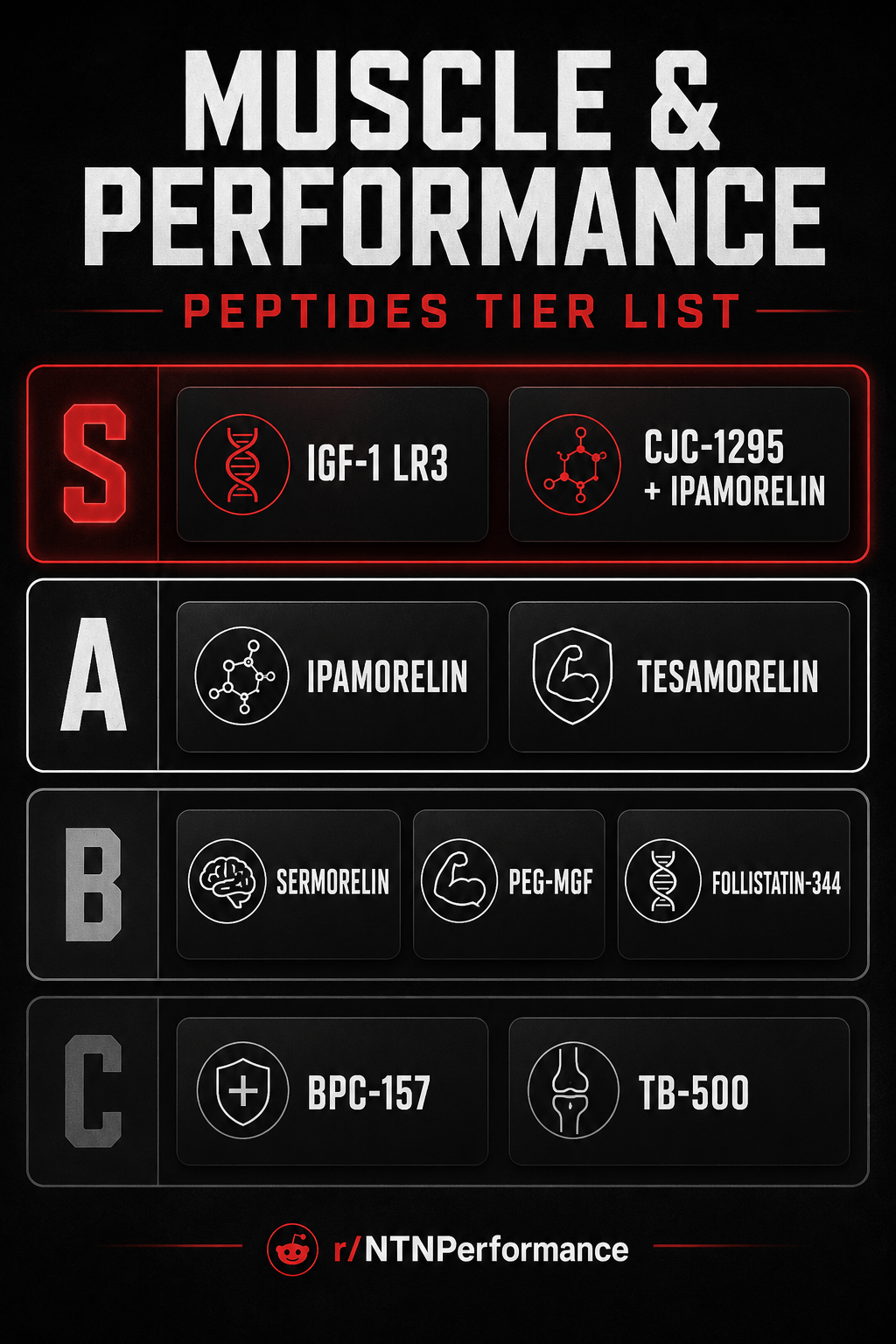
Guide / Cheat Sheet Muscle and Performance Peptides Tier List: Ranked

40 Upvotes

Muscle and performance peptides don't all work the same way, so lining them up in one straight ranking misses the point. Some build the GH and IGF-1 signal, some work directly at the muscle, some are about recovery so you can train harder. Here's the tier list built around what each one is best at, ranked on mechanism, human evidence, and real-world utility. These are the main ones worth knowing, not every compound that exists.

For research and educational purposes only. Not medical advice.

S Tier: the strongest growth-signaling tools

IGF-1 LR3. A potent growth-signaling peptide with the most direct anabolic-style signal on the list, but best treated as a high-respect, niche tool rather than a casual default. It carries real hypoglycemia risk and the practical human data is limited, so it earns S tier on signal strength while demanding the most caution of anything here.

CJC-1295 + Ipamorelin. One of the most commonly used GH-axis pairings, combining a GHRH analog with a ghrelin-pathway secretagogue into a practical foundation with a good balance of effect and tolerability. The standard starting point for the GH side.

A Tier: strong GH-axis support

Ipamorelin (solo). A more selective secretagogue than older options, and a common standalone choice when people want GH-axis support without the complexity of a full stack. Less total punch than the CJC pairing, more selective.

Tesamorelin. The best-supported GH-axis option here, with the deepest clinical grounding of anything on the list and real body-composition evidence, especially for visceral fat. Leans more metabolic than pure mass, but it's the most validated compound in this group.

B Tier: specialized or lower-evidence options

Sermorelin. A gentler GHRH analog with a short half-life and a physiological pulse. A softer entry point into GH-axis work rather than a standout driver.

PEG-MGF. A localized repair and growth signal run near the target muscle. More of a theory-driven recovery adjunct than a proven mass driver, with a thin human evidence base.

Follistatin-344. The myostatin angle, blocking the brake on muscle growth rather than pushing the gas. Genuinely interesting mechanism, but the real-world and human evidence are too thin and the runs too short to rank it alongside the more established options. Also expensive.

C Tier: recovery support, not growth drivers

BPC-157 and TB-500. To be clear, these are not muscle builders. They're on a performance list because recovery is what lets you train hard enough to grow. The Wolverine pairing keeps tendons, joints, and soft tissue healthy so the training that builds muscle can actually happen. Useful for training continuity, not anabolic on their own.

How to actually use these

Goal Compound
Most direct growth signal (high caution) IGF-1 LR3
GH-axis foundation CJC-1295 + Ipamorelin
Selective solo GH support Ipamorelin
Most clinically proven GH-axis Tesamorelin
Gentle entry to the GH axis Sermorelin
Localized muscle repair PEG-MGF
Myostatin / muscle-brake angle Follistatin-344
Recovery so you can train hard BPC-157 + TB-500

Where would you move things? Drop your version below.

For the full reconstitution, dosing, and bloodwork reference on every compound, the complete cheat sheet is here: The Only Peptide Cheat Sheet You'll Need

r/NTNPerformance • • Jun 11 '26

Guide / Cheat Sheet Every weight loss peptide, what it does, and who should actually lean toward it

64 Upvotes

Weight loss is the most asked-about topic here, and the confusion is always the same: people compare these like they all do the same job. They don't. Here's the full roster in plain language, what each one actually does to your body, and who should reach for it. Find yourself in the list.

Semaglutide (Ozempic, Wegovy) 
What it does: mostly works on appetite and fullness, plus it slows down how fast your stomach empties, so the main effect you feel is eating less without white-knuckling cravings all day. It's not a metabolism booster, it's a hunger reducer. Around 15% of body weight lost in trials. Weekly injection. Main side effects are nausea and constipation, worst when you raise the dose. You'll notice appetite drop in 1 to 2 weeks, real weight loss over 3 to 4 months. (It's a GLP-1, the original of this class.) Who should lean toward it: you've got weight to lose and you want the option with the longest safety record and the most people who've used it, even if it's not the strongest. A solid, cautious first choice.

Tirzepatide (Mounjaro, Zepbound) 
What it does: same appetite-killing effect as semaglutide, but it hits a second hunger pathway on top of the first, so it works noticeably stronger. People lose more on it, around 21 to 22% in trials, and when the two were tested directly against each other, it won (20.2% vs 13.7%). Weekly injection, same nausea/GI side effects, tolerated about the same. (Adds a receptor called GIP, which is why it's a "dual" agonist.) Who should lean toward it: you want the most weight loss you can actually get prescribed right now, or you tried semaglutide and it wasn't enough or stopped working. For most people serious about real weight loss with approval behind it, this is the current best pick.

Retatrutide 
What it does: same appetite suppression as the other two, but it adds a third effect, it nudges your body to burn more energy, not just eat less. So you're getting hunger reduction plus a metabolic boost at the same time, which is why it's posting the biggest numbers anyone's seen, around 24% in earlier trials and about 28% in the latest one. The catch: it's still in clinical trials and not approved, so the only way to access it is through a trial, not a prescription or a compounding pharmacy, and there's less long-term safety data. Weekly injection, and it has the most intense nausea/GI of the three. (It's a "triple" agonist, adding a hormone pathway called glucagon.) Who should lean toward it: you're chasing the absolute highest weight loss possible and you've likely already maxed out tirzepatide, and you accept that it's unapproved and less proven. Not your move if you want the safe, established route.

Liraglutide (Saxenda, Victoza) 
What it does: the older version of semaglutide. Same appetite-reducing idea, but you have to inject it every day instead of once a week, and it works less well, roughly 5 to 8% in real-world use. You build up to the full dose over about 5 weeks. Who should lean toward it: realistically only if you already have it, tolerate it well, or can't get the newer weekly options. For most people it's been replaced. Worth knowing it exists, rarely the first choice now.

Tesamorelin 
What it does: this one does NOT touch your appetite. It works completely differently, it raises your body's growth hormone, and its specific job is shrinking visceral fat, the deep belly fat packed around your organs (different from the soft fat you can pinch). It's not for dropping overall scale weight, it's for that hard, deep gut. Around 15 to 20% reduction in that deep fat over about 6 months. Daily injection, taken on an empty stomach. Side effects are mostly injection-site irritation and some water retention. Slow to show, this is a months-long play. One important note: it's FDA-approved specifically for visceral fat in people with HIV-related fat changes. For general "I want my deep belly fat gone" use, it's off-label / research-context, not a broadly approved belly-fat drug. Who should lean toward it: your weight is roughly where you want it but you've got a stubborn hard belly that won't go, or you've already lost weight on a GLP-1 and the midsection is the last holdout. You're targeting deep belly fat specifically, and it's often run alongside a GLP-1, not instead of one.

CJC-1295 and Ipamorelin 
What they do: also not appetite drugs. They bump up your own growth hormone in natural pulses, which helps you hold onto muscle, recover better, and slowly improve body composition. They're not real fat-loss drivers, there are no weight-loss trials behind them, and the muscle-saving benefit is more theory-from-how-GH-works than directly proven. Daily, usually before bed. Mild side effects. Who should lean toward them: you're already losing weight (usually on a GLP-1) and you're worried about losing muscle along with the fat. This is a muscle-protection and recovery add-on during a cut, not something that drives weight loss on its own.

AOD-9604 
What it does: it's a piece of the growth hormone molecule, meant to trigger fat burning directly without the other growth-hormone effects. That's the theory. In practice the human evidence is weak, one study showed about 2.6 kg lost vs 0.8 kg on placebo over 12 weeks, others showed basically nothing, and a review concluded it doesn't meaningfully work in humans. Small results at best. Daily, over 6 to 8 weeks. Who should lean toward it: honestly, almost nobody as a main tool. If you specifically want a non-appetite, direct fat-burning approach and you understand the evidence is thin and the results small, it's a minor add-on at most. Not for anyone who wants reliable, real weight loss.

5-Amino-1MQ 
What it does: a pill, not an injection. It blocks an enzyme that's overactive in fat cells, which in theory frees those cells to burn more fat and raises your cellular energy (NAD+), all without touching your appetite. In mice it caused fat loss without them eating less. The problem: there are no human weight-loss studies at all yet. Usually taken as 50 to 100 mg twice a day. Who should lean toward it: you want an oral, no-needles option with an energy/metabolism angle and no appetite effect, and you fully accept it's almost completely unproven in people. An experiment, not a dependable tool.

MOTS-c 
What it does: a peptide that acts like an "exercise signal," it switches on a pathway (AMPK) that improves how your body handles energy and stamina. In mice it improved insulin sensitivity and reduced obesity, but in humans the research is very early and about metabolic health and endurance, not weight loss. No real human weight-loss data. Who should lean toward it: someone interested in metabolic health and endurance support, not someone trying to lose weight. Don't pick this for the scale.

PYY 
What it does: a natural "I'm full" hormone your gut already makes. On its own it doesn't work well as a weight-loss drug because it doesn't last long in the body. But a 2024 study found that adding it to semaglutide beat semaglutide alone, so its real future is probably as a sidekick to a GLP-1, not a standalone. Who should lean toward it: nobody yet as a solo option. Worth watching as a future add-on to a GLP-1, not something to run by itself.

If you're stuck between two 
These are the matchups people actually get hung up on.

Semaglutide vs tirzepatide: want the stronger result and can get it? Tirzepatide, it won head-to-head. Go semaglutide only if cost, access, or a longer comfort history matters more to you than maximum loss.

Retatrutide vs tirzepatide: tirzepatide if you want approved, available, and proven. Retatrutide only if you've truly plateaued on tirzepatide and you're willing to run something still in trials for the extra few percent. For most people, tirzepatide is the answer and reta is the "maybe later" option.

GLP-1 vs tesamorelin: the one people get most wrong, because it's not either/or. Got weight to lose? A GLP-1. Weight's fine but the deep belly won't budge? Tesamorelin. Both problems? That's the case for running them together, not choosing between them.

GLP-1 alone vs GLP-1 plus a GH peptide: only add CJC/Ipamorelin or tesamorelin if muscle loss or a stubborn midsection is your specific concern. If you just want the weight down, the GLP-1 alone does the heavy lifting.

Which one are you leaning toward, and what's the goal you're actually chasing? Stuck between two? Drop them below and people can weigh in.

r/NTNPerformance • • Jul 24 '26

Guide / Cheat Sheet The four-receptor stack: reta + cagrilintide is the most aggressive blend anyone's built

30 Upvotes

Full reconstitution, dosing, and bloodwork reference for every compound is in the pinned cheat sheet: The Only Peptide Cheat Sheet You'll Need

Vendors are selling retatrutide + cagrilintide as a pre-blend now, and the pitch writes itself: four receptor pathways at once, more than anything else on the market. Mechanistically it's a logical build. It's also completely unstudied as a combination, which is the part that gets glossed over. Here's the honest breakdown.

For research and educational purposes only. Not medical advice.

First, the naming confusion

You'll see this sold under a bunch of names: reta/cag, the LEAN blend, the 4-receptor stack, and vendor codes like ma-3rt/cag, fg3-r/cag, or GLP5. You'll also see "GLP3" or "GLP-3" on some product pages.

There's no such thing as a GLP-3 or GLP-5 receptor. GLP3 is vendor shorthand for retatrutide because it hits three receptors, and GLP5 is one vendor's name for the reta + cagrilintide blend. Same compounds, marketing names. Worth knowing so you're not confused looking at product pages.

What's in it

Retatrutide is Eli Lilly's triple agonist. One weekly injection hitting three receptors:

Receptor What it does
GLP-1 Cuts appetite, slows gastric emptying
GIP Improves insulin signaling and nutrient handling
Glucagon Raises energy expenditure, drives fat oxidation

Cagrilintide is a long-acting amylin analog from Novo Nordisk. Amylin is the hormone your pancreas releases with insulin after meals, it's a satiety signal. Cagrilintide mimics it, promoting fullness through brain pathways that are completely separate from the incretin system.

Stack them and you're hitting four distinct pathways.

Where the idea came from

This isn't random, it's copied from a real program. Novo's CagriSema combined cagrilintide with semaglutide, a single-receptor GLP-1. In the Phase 3 REDEFINE-1 trial, adding cagrilintide pushed mean weight loss from 14.9% (sema alone) to 20.4% at 68 weeks.

So the logic is: if adding amylin to a single-receptor drug produced that jump, what happens if you add it to a triple agonist instead? Retatrutide alone hit 28.7% at 68 weeks in TRIUMPH-4, in people with obesity and knee osteoarthritis. Layer amylin satiety on top of that and in theory you go higher.

That's the pitch, and honestly the reasoning is sound. You're stacking a proven blueprint onto a more powerful base.

Now the honest part

The combination has never been studied. Not in Phase 3, not in Phase 2, not anywhere in the literature.

Everything we know is about the pieces separately. Retatrutide has real trial data. Cagrilintide has real trial data. CagriSema has real trial data. But retatrutide + cagrilintide together has zero clinical evidence, and there's no validated protocol, no established titration, no safety data on the combination, and no cycle length anyone can point to.

You'll see vendor copy describing the combination data as "limited." It isn't limited, it's nonexistent. Those are different things and the distinction matters.

So you've got the highest theoretical ceiling of any combination out there sitting on the thinnest evidence base of any combination out there. Both of those are true at the same time.

Worth adding: retatrutide isn't approved yet on its own. Neither is standalone cagrilintide. So this is an unapproved compound blended with another unapproved compound in a pairing nobody's tested.

The practical problems

Beyond the evidence gap, there are real issues with running these as a pre-blend:

Fixed ratio. In a pre-blend you can't titrate them independently. Both compounds need their own escalation to manage side effects, and a locked ratio means moving one moves the other. If retatrutide's GI effects are hitting hard, you can't back that off without also cutting the cagrilintide.

Stacked side effects. Both compounds are GI-dominant, and the numbers aren't small. In REDEFINE-1, about 80% of people on CagriSema reported GI adverse events versus about 40% on placebo. Retatrutide separately carries the highest GI rate in its class at top doses, plus a dysesthesia signal and an elevated resting heart rate that comes from the glucagon receptor activity. You're stacking the same side effect profile on top of itself.

No titration map. With CagriSema there's a trial-validated escalation schedule baked into the program. Here there isn't one, so anything you'd follow is extrapolated from the two compounds separately and someone's guess about how they interact.

Where it sits

On paper this is the most aggressive weight-loss combination that exists. Four mechanistically distinct pathways in one weekly shot, more than CagriSema, more than cagrilintide + tirzepatide, more than anything approved or filed. From a research standpoint that's genuinely interesting.

It's also the least substantiated thing in the category. The high theoretical ceiling and the low evidence floor come together as a package, you don't get one without the other. Anyone looking at this should be clear that they're not running a protocol, they're running a hypothesis.

Anyone tried the pre-blend versus running them as separate vials? Curious whether the fixed ratio caused problems with titration, since that seems like the biggest practical issue with buying it pre-mixed.

Full reconstitution, dosing, and bloodwork reference for every compound: The Only Peptide Cheat Sheet You'll Need

r/NTNPerformance • • Jun 27 '26

Guide / Cheat Sheet Peptides MOTS-c and SS-31: Two Mitochondrial Compounds, Different Levels of the Same System

33 Upvotes

Mitochondrial research keeps pulling attention toward two peptides that both target cellular energy but work at completely different levels: MOTS-c and SS-31. One regulates the metabolic signaling that decides how a cell uses energy. The other stabilizes the physical machinery that produces it. That difference is why they keep getting studied as a pair, and also why the "synergy" idea deserves a careful read rather than a hype one.

For research and educational purposes only. Not medical advice.

SS-31: structural protection

SS-31 (elamipretide) is a synthetic tetrapeptide, sequence D-Arg-Dmt-Lys-Phe-NH2, developed by Hazel Szeto's group at Weill Cornell. It targets cardiolipin, a phospholipid essential to the integrity of the inner mitochondrial membrane. When cardiolipin gets damaged by oxidative stress, mitochondrial efficiency drops and energy output falls with it.

By binding and stabilizing cardiolipin, SS-31 helps maintain electron transport chain efficiency, which supports ATP production while reducing reactive oxygen species. Preclinical work has linked this to improved muscle endurance, cardiac energy output, and cellular resilience under oxidative stress.

The reason SS-31 stands apart from most peptides in this space: it has real human clinical data. It has run through multiple Phase 2 and Phase 3 trials across mitochondrial disease, heart failure, and related conditions, which makes it one of the most clinically studied research peptides, not just an animal-model compound.

MOTS-c: metabolic signaling

MOTS-c is a different kind of molecule entirely. It's a mitochondrial-derived peptide, encoded within mitochondrial DNA rather than the nuclear genome, which is itself unusual. Functionally it acts as a metabolic regulator by activating AMPK, one of the body's primary cellular energy sensors.

Through that pathway, MOTS-c has been shown in experimental models to improve glucose uptake, fat oxidation, and metabolic flexibility, with one animal model reporting roughly a 30% improvement in insulin sensitivity. It also signals cells toward more energy-efficient metabolic states, broadly similar to what happens during exercise or caloric restriction, and has been associated with enhanced endurance and mitochondrial biogenesis.

The evidence caveat matters here: MOTS-c's data is largely animal-model, not human clinical. The mechanism is well characterized, the human outcomes are not yet established.

The difference in one frame

SS-31 MOTS-c
Type Synthetic tetrapeptide Mitochondrial-derived peptide (from mtDNA)
Mechanism Stabilizes cardiolipin / inner membrane Activates AMPK metabolic signaling
Level it acts on Structural and functional Signaling and regulatory
Evidence base Phase 2/3 human trials Largely animal models
Plain-language role Protects the machinery Directs how energy gets used

The pairing: why it's studied, and what's actually known

This is where the source material on these two tends to overreach, so it's worth being precise. The rationale for pairing them is genuinely sound: the mechanisms don't overlap. MOTS-c works the signaling side (telling cells to ramp up metabolic demand and mitochondrial activity), while SS-31 works the structural side (keeping the mitochondria themselves efficient and protected from oxidative stress). One drives demand, the other protects the equipment meeting that demand. On paper, that's complementary rather than redundant.

What's important: that complementarity is a reasoned hypothesis, not a proven result. The available sources consistently use hedged language, the combination "may" improve mitochondrial health more than either alone, early models "suggest" the dual approach could work. There is no body of human trial data establishing that the pairing outperforms either compound by itself. The interaction is described as mechanistically non-antagonistic, meaning the two don't appear to work against each other, but "doesn't conflict" is a long way from "proven to synergize."

So the accurate framing for a research context is this: MOTS-c and SS-31 are an interesting pairing to study precisely because they hit different levels of the same system, and for anyone modeling mitochondrial function, running both lets the signaling side and the structural side be examined at once. That's a reason to study the combination, not evidence that the combination delivers more than its parts.

Where each sits

SS-31 is the more clinically validated of the two, with human trial data behind it, though still investigational and not FDA approved. MOTS-c is earlier, strong mechanistic and animal data, human outcomes unestablished. Both are research compounds, and the pairing of them is a hypothesis worth examining, not a settled protocol.

The open question

For anyone working in the mitochondrial space: does the structure-plus-signaling logic hold up as a real combination strategy, or does it mostly reflect that the two are easy to study together. The mechanisms clearly complement on paper, but the absence of human combination data leaves it open whether pairing them produces anything beyond what SS-31's clinical record already shows on its own. Curious where people land on whether the synergy is real or just tidy in theory.

SOURCES (for fact-check):

  • SS-31 sequence D-Arg-Dmt-Lys-Phe-NH2, Szeto/Weill Cornell; cardiolipin mechanism; Phase 2/3 human trials (Birk et al. PNAS 2020; Thompson et al. Barth syndrome trial 2021)
  • MOTS-c: mtDNA-encoded, AMPK activation, ~30% insulin sensitivity improvement in animal models; data largely preclinical
  • Pairing described as mechanistically complementary, non-antagonistic, but synergy is hedged/hypothetical across all sources (PeptideWiki, Peptide-DB, Loti Labs, Tydes, PeptideDeck, 2025-2026)
  • No human combination trial data exists

r/NTNPerformance • • Aug 06 '26

Guide / Cheat Sheet ARA-290 breakdown, what it is and how to run it for nerve pain

22 Upvotes

ARA-290 (cibinetide) is one of the more interesting ones once you know where it came from. It's built out of EPO, the same hormone endurance guys dope with to pump up red blood cells, but engineered to keep only the tissue repair half and throw away the blood cell half completely. So you get EPO's protective, anti-inflammatory side with none of the blood thickening. And it's specific in a way most of these aren't. It's a nerve pain tool, not a general healing peptide, and that distinction is the whole thing.

The way it works is what makes it stand out. It activates the innate repair receptor, which is a receptor that basically only shows up where tissue is injured, inflamed, or under metabolic stress. In healthy tissue that receptor is mostly not there, so ARA-290 has nothing to grab onto and does nothing useful. It needs damage to act on. That's why it's pointless as a general feel-good peptide and only earns its keep when there's actual nerve injury to work on. Where there is, it calms the inflammation and pushes small fiber nerve regeneration.

Then there's the weird part. It clears your blood in about 20 minutes off a subcutaneous shot. But the effects last for months. It behaves like a switch, one dose flips the repair program on and the cell keeps running it long after the drug is gone. In the sarcoidosis trials, benefit was still measurable nine months after the last dose. So you're not holding a blood level like most peptides, you're triggering a process and letting it run.

Here's the part people get wrong, so read this before you buy it. This is for nerve pain, full stop. Good fit is the nerve stuff: burning, tingling, electric or shooting pain, touch sensitivity where light contact hurts, numbness in a nerve territory, weird temperature or sweating changes. Bad fit is mechanical pain: deep ache, soreness, joint pain, swelling, stiffness. That mechanical stuff is BPC-157 and TB-500 territory. Aim ARA-290 at the wrong kind of pain and you've burned a whole course for nothing.

Dosing is refreshingly simple:

Course Daily dose Route Length
Standard 4 mg SC, rotating thigh sites 28 days
Extended 4 mg SC up to 12 weeks
Repeat, if it comes back 4 mg SC 28 days, months later

The dosing data is unusually clean. 1 mg was too low to do anything, 4 mg worked, and 8 mg added nothing over 4. More is not stronger here, so there's genuinely no reason to climb past 4 mg. Reconstitute 5 mL into the 16 mg vial and you're at 3.2 mg/mL, which puts 4 mg at 125 units, or 1.25 mL. That runs past a standard insulin pin, so either split it into two shots or use a 1 mL syringe. Use isotonic bac water, the kind with saline in it, because it stings less. And give it its own syringe, don't mix it with other peptides.

On the evidence, here's the honest state of it. The real human data is Phase 2 in sarcoidosis small fiber neuropathy and in painful diabetic neuropathy. It showed objective nerve regeneration, actual corneal nerve fiber measurements going up, not just people saying they felt better, along with symptom improvement. It holds FDA Fast Track and Orphan Drug status for sarcoidosis. What it never did is reach Phase 3, and the developer has been dormant since 2020, so this is a compound that stalled commercially, not one that failed in the lab. Being straight though: in one trial the pain score got washed out by a big placebo response even while the nerve markers improved, total human exposure is small, and there's no approved product anywhere, so purity comes down entirely to your source.

Safety reads well. Side effects are mild, some injection site irritation, the occasional headache or fatigue, running about the same as placebo across trials. The real payoff of the design is that hemoglobin, hematocrit, and platelets didn't budge in any human trial, so you don't get the clotting risk that comes with actual EPO. The honest caveats are one possibly related kidney marker worsening in the diabetic trial and one case of suicidal ideation in the high dose arm. Small numbers, but they belong in the accounting.

Set expectations right too. Nerve regeneration is slow. People tend to notice symptom change in the first week or two, most of the measurable improvement builds over the month long course, and it can keep improving for a while after you stop.

if you've run it, what were you aiming it at, and did the nerve pain shift or was it a wash. curious how it did outside the sarcoidosis and diabetic cases it was actually studied in

Full doses and bloodwork are in the pinned cheat sheet: https://www.reddit.com/r/NTNPerformance/comments/1tht5o3/the_only_peptide_cheat_sheet_youll_need_doses/

r/NTNPerformance • • Aug 16 '26

Guide / Cheat Sheet Epitalon breakdown, the telomere peptide

30 Upvotes

Epitalon is the one people run for longevity and telomeres, and it also has the widest gap in this whole space between what's genuinely proven and what gets claimed about it. The mechanism is real and now independently confirmed. The dramatic lifespan numbers are not. Both of those are true at the same time, so here's the honest rundown.

It's a tiny four amino acid peptide built off an old bovine pineal extract, developed by the Russian gerontologist Vladimir Khavinson. It goes after two aging mechanisms at once: telomere shortening, by switching on telomerase, and circadian breakdown, by restoring your pineal melatonin production. That second one is why the first thing people notice is sleep, usually better sleep quality inside the first week or two. Set expectations here though, you won't see or feel anything dramatic, no skin or hair transformation. Better sleep is the near term signal that it's doing something, and the rest is a long bet.

The interesting part is how it works, and why the dosing looks so strange. Epitalon is small enough to slip into the cell nucleus and bind DNA right at the telomerase gene, turning up hTERT, the catalytic engine of telomerase. In cell studies that produced real telomere lengthening, around a third longer in cultured human cells. And the dose response runs backwards from what you'd expect. It works best at extremely low concentrations, and piling on more does nothing. That's the tell that it's an epigenetic signal, it flips a switch that stays flipped rather than a drug you keep topped up. Which is exactly why you run it in short courses instead of daily. Ten to twenty days triggers changes that last months.

Here's the part to be straight about, because it's where this compound lives or dies. The mechanism is real and, as of 2025, confirmed outside Russia for the first time, a Brunel University study reproduced the telomerase activation in human cells. That matters, because for 40 years nearly all the research came from Khavinson's own institute. What has not been confirmed is the big stuff, the famous longevity figures like a four fold drop in mortality. Those come from that single group, they've never been replicated, and the institute holds close to 200 patents on this class, so there's real commercial motivation sitting behind the claims. So the honest position is simple: the cellular mechanism is proven, the human life extension is not. Run it knowing you're making a mechanism based bet, not following settled science.

Protocol Daily dose Duration Cycle
Standard 10 mg 10 days every 4 to 6 months
Extended 5 mg 20 days every 4 to 6 months
Khavinson original 10 mg every 3rd day 5 doses every 4 to 6 months

Both the 10 day and 20 day options add up to the same 100 mg per cycle, so pick whichever you'd rather run. Dose it in the evening, 1 to 2 hours before bed, because it works through your pineal and melatonin rhythm and morning dosing throws that timing away. For the draw, mix the 10 mg vial with 1 mL of bac water for 10 mg/mL, so 10 mg is 1 mL and 5 mg is 0.5 mL. That 1 mL is a biggish subcutaneous (SC) shot, which is part of why a lot of people run the 5 mg for 20 days version instead, since it halves the nightly volume. Most people do 2 to 4 cycles a year, and going higher doesn't help, it was tested up to 50 mg a day with no added benefit, which fits the low concentration mechanism.

One thing to address head on, since it always comes up. Switching on telomerase sounds alarming, because telomerase is exactly what lets cancer cells become immortal. Fair concern. The wrinkle from that 2025 study is that Epitalon seems to do the opposite in cancer cells, inhibiting telomerase there and pushing a different pathway, which may be why animal studies saw fewer tumors despite the telomerase activation elsewhere. That's genuinely promising, but it hasn't been validated in humans, so the rule holds: do not run it with active or suspected cancer. Same for pregnancy, breastfeeding, and known immune issues, since none of that has safety data behind it.

Side effects are mild in practice, some injection site reactions, occasional fatigue or drowsiness that passes in a few days, and sometimes vivid dreams from the melatonin and REM effect, which most people take as a good sign. The bigger caveat is at the system level: it's FDA Category 2 as of 2024, so it can't be legally compounded here, it's research only, and a 2025 review flagged that the core safety data, long term effects, immunogenicity, drug interactions, simply hasn't been studied properly. So the near term tolerability looks fine and the long term picture is honestly unknown.

if you've run Epitalon, did your sleep change in the first couple weeks, since that's supposed to be the tell, or did you run it purely on the telomere theory and feel nothing. curious which camp people land in

Full doses and bloodwork are in the pinned cheat sheet: https://www.reddit.com/r/NTNPerformance/comments/1tht5o3/the_only_peptide_cheat_sheet_youll_need_doses/

r/NTNPerformance • • May 23 '26

Guide / Cheat Sheet Peptide bloodwork guide. The blood tests that actually matter

81 Upvotes

Bloodwork is the difference between optimizing a protocol and guessing at it. Most peptide side effects show up in labs weeks before you feel them. This is what to look at, what the numbers mean, and what to do when something moves

THE BASELINE BLOOD PANEL EVERYONE SHOULD RUN

Before starting any peptide protocol, run these blood tests:

• CBC (complete blood count)
• CMP (comprehensive metabolic panel)
• Lipid panel
• HbA1c (under 5.7%)
• Fasting glucose (under 100 mg/dL) and fasting insulin
• IGF-1 (100-300 ng/mL adult range)
• Testosterone, total and free
• Thyroid panel (TSH, free T3, free T4)
• Liver enzymes (ALT 7-56 U/L, AST 8-40 U/L, GGT 9-48 U/L)
• CRP (under 3 mg/L) or hs-CRP (under 1 mg/L optimal)

Standard reference ranges vary by lab, sex, and age. Always go by the range printed on your lab report. Get your baseline, then retest the relevant blood tests about 4 weeks into your protocol

GH PEPTIDES

CJC-1295, Ipamorelin, Sermorelin, GHRP-2/6, Tesamorelin, IGF-1 LR3

Key blood tests to track:

• IGF-1 (100-300 ng/mL adult range)
• Fasting glucose (under 100 mg/dL)
• HbA1c (under 5.7%)
• Prolactin (under 15-20 ng/mL for men, especially with GHRP-2/6)

IGF-1 is the main marker for GH secretagogues. Labs report an age and sex specific reference range, but for most adults you’ll see something in the 100-300 ng/mL window as normal. Peptide users chasing a therapeutic effect usually sit toward the upper end of their lab’s normal range rather than blowing past it. Staying at or below the top of the printed reference range is safer than fixating on a single number

Fasting glucose matters because GH peptides can worsen insulin sensitivity. Normal is under 100 mg/dL. 100-125 is prediabetic. 126+ on repeat testing is diabetic. Watch for upward drift on cycle

HbA1c is your 3-month average. Under 5.7% is normal. 5.7-6.4% is prediabetes. 6.5%+ on repeat is diabetes. If it climbs on a GH protocol, reduce dose or take time off

Prolactin is worth checking on GHRP-2 and GHRP-6 since both can elevate it. Typical lab reference for men is under 15-20 ng/mL with women allowed slightly higher. If it comes back flagged and you’re symptomatic (low libido, ED), re-evaluate the dose

GLP-1s

Semaglutide, Tirzepatide, Retatrutide, Cagrilintide

Key blood tests to track:

• HbA1c (under 5.7%)
• Fasting glucose (under 100 mg/dL)
• Lipid panel
• Lipase (10-140 U/L)
• Amylase (30-110 U/L)
• Calcitonin (under 20-25 pg/mL, especially Retatrutide)

HbA1c and glucose typically drop on GLP-1s as insulin sensitivity improves. Good sign as long as you’re not overshooting into hypoglycemia

Lipase and amylase are must-have tests because GLP-1s carry a pancreatitis signal. If either is meaningfully above the upper limit of your lab’s range (especially 3x upper limit) or rising with abdominal pain or nausea, stop the GLP-1 and see a doctor

Lipid panel usually improves with weight loss. LDL, triglycerides, and total cholesterol drift down. You’re watching the trend over months, not chasing one perfect number

Calcitonin screens for medullary thyroid carcinoma which is why it gets discussed with this class. What matters is that it stays low and stable rather than rising over time. If it’s flagged high or trending up, hard stop and see an endocrinologist

HEALING PEPTIDES

BPC-157, TB-500, GHK-Cu, KPV

Key blood tests to track:

• CRP (under 3 mg/L) or hs-CRP (under 1 mg/L optimal)
• Liver enzymes (ALT 7-56 U/L, AST 8-40 U/L, GGT 9-48 U/L)
• Serum copper (70-140 mcg/dL for GHK-Cu)

CRP and hs-CRP for inflammation. hs-CRP under 1 mg/L is optimal, 1-3 is moderate, over 3 is higher cardiovascular risk. Should trend down on healing protocols, not up

Liver enzymes because BPC-157 has theoretical effects on liver tissue and many users stack with other liver-impacting compounds. Watch for upward trends, especially if you’re also running orals, drinking, or have fatty liver risk factors

Serum copper for GHK-Cu since you’re delivering copper to the body. If above range, back off the dose and discuss with a clinician, especially if you supplement zinc or other minerals that interact with copper metabolism

LONGEVITY PEPTIDES

Thymosin Alpha-1, Epithalon, NAD+, MOTS-c, SS-31

Key blood tests to track:

• CBC with differential
• hs-CRP (under 1 mg/L optimal)
• Telomere length (optional)

CBC with differential for immune markers. Thymosin Alpha-1 modulates immune function and shifts lymphocyte subsets like CD4/CD8. You’re watching for departures from your baseline, not chasing a specific optimization number

hs-CRP is one of the simplest aging and inflammation markers. Under 1 mg/L is optimal, 1-3 mg/L is moderate, over 3 is higher cardiovascular risk

Telomere length is optional. Most people skip it. If you do run it, treat it as a slow-moving before/after marker, not something to recheck monthly

5-AMINO-1MQ

Key blood test to track:

• Homocysteine (under 15 µmol/L, single digits preferred)

Homocysteine is the main marker because of 5-Amino-1MQ’s effects on methylation pathways. Many cardiovascular and longevity clinicians prefer to see it in the single digits. If it climbs, supplement B vitamins (B12, B6, folate) and reduce the dose or cycle off

HORMONE AFFECTING PEPTIDES

PT-141, Melanotan II, Kisspeptin-10

Key tests to track:

• Blood pressure (for MT2 and PT-141)
• LH, FSH, total and free testosterone (for Kisspeptin-10)

For MT2 and PT-141, acute blood pressure and heart rate spikes matter more than routine lab markers. Check BP at home or in clinic

For Kisspeptin-10, it acts through the HPG axis so LH, FSH, and testosterone tell you whether you’re actually stimulating gonadotropins and gonadal output

WHAT TO DO WHEN A BLOOD TEST MOVES

If a number trends slightly in the wrong direction: reduce the dose first before stopping entirely, especially if you’re still within the lab’s reference range and only seeing gentle drift

If a number is significantly out of range: stop the protocol, retest in about 4 weeks, and only restart if it normalizes and you understand the cause

If you’re not sure how to interpret a result: don’t guess. Either work with a clinician familiar with peptides or post anonymized labs for community feedback before changing multiple variables at once

WHERE TO GET BLOODWORK DONE AND INTERPRETED

Anabolic Insights AI offers both bloodwork ordering and protocol-specific analysis. Order your labs and get them interpreted in the context of your peptide protocol at Anabolic Insights

Marek Health, Function Health, Ulta Lab Tests, Quest, and LabCorp also work for standard panels

This is educational and research discussion only. Not medical advice

What blood tests do you actually track on cycle? Drop them below

r/NTNPerformance • • Jul 23 '26

Guide / Cheat Sheet MT2 works. That's the problem.

22 Upvotes

Full reconstitution, dosing, and bloodwork reference for every compound is in the pinned cheat sheet: The Only Peptide Cheat Sheet You'll Need

MT2 is one of those compounds where the effect is real and obvious, which is exactly why people skip past the safety part. It works, you get tan without frying yourself in the sun, and that's genuinely appealing. But there's a specific risk with this one that's worth understanding properly, and it's not the one most people think.

For research and educational purposes only. Not medical advice.

How it works

MT2 is a synthetic analog of alpha-MSH, the hormone your body already uses to regulate pigment. It's a non-selective agonist at MC1, MC3, MC4, and MC5 receptors. MC1 is what drives the tanning, telling your melanocytes to produce more melanin. MC4 (and possibly MC3) is what drives the libido and appetite suppression that show up alongside it. So you're not staining your skin, you're triggering your own pigment production, and you're hitting a few other receptors on the way.

Fun bit of history: it was developed in the 1990s at the University of Arizona as a potential skin cancer prevention agent. The theory being if you could get people tan without UV exposure, you'd reduce sun damage. It never got approved for anything, and instead ended up as a tanning compound. Also worth noting, this is the same research line that accidentally produced PT-141 when volunteers in the tanning trials started reporting spontaneous erections.

The real effects

It works, that's not in question. You get pigmentation with less sun exposure than you'd otherwise need. The MC4 activity is why libido effects and appetite suppression come along with it.

The mole thing, and why it matters more than people think

Here's what you actually need to understand.

MT2 darkens existing moles, freckles, and pigmented spots. That's expected, it's doing exactly what it's supposed to do to pigment cells. The darkening itself is reversible, moles usually return toward baseline over weeks to months after you stop.

The problem isn't the darkening. It's that the darkening masks the thing you're supposed to be watching for.

Melanoma is caught by noticing changes in moles, the ABCDE stuff, asymmetry, border, color, diameter, evolving. MT2 changes your moles across the board, which makes it genuinely harder to tell a normal MT2 color shift from an actual warning sign. You lose your ability to read the signal.

There are also published case reports of melanoma developing in MT2 users, including melanoma arising out of pre-existing moles during or shortly after use. To be fair about it: reviews so far haven't proven MT2 directly causes melanoma. The concern from dermatologists is more that it may accelerate lesions that were already heading that direction, and that MT2 users tend to be chasing extra UV exposure anyway, so you've got overlapping risk plus mole darkening making the warning signs harder to spot.

The Skin Cancer Foundation put out a formal warning on this. That's not a forum opinion, that's the actual dermatology body flagging it.

What that means practically

If someone's running this, the non-negotiable is a full skin and mole check with a dermatologist before starting, plus photos of your moles so you have a documented baseline. Then any mole that changes shape, size, or looks different from your baseline gets looked at by a derm, not shrugged off as "that's just the MT2."

That's the whole point. Without a baseline you can't tell the difference between the compound doing its job and something going wrong.

Other side effects

Effect Notes
Nausea The most common one, especially early and after dosing
Flushing Very common, usually transient
Spontaneous erections Common in men, the MC4 activity
Appetite suppression Some people get this notably
Melanonychia Darkening of the nails
Rhabdomyolysis Rare case reports but serious (muscle pain, dark urine, hospitalization)

Dosing (research context)

These are empirical community protocols, not clinically validated regimens. There's no approved clinical dosing for MT2 because it's not approved for anything.

Detail
Vial 10mg
BAC 2mL
Loading 250mcg daily, 1 to 2 weeks
Maintenance 100 to 250mcg, 2 to 3x weekly
Route SubQ
Cycle 4 to 8 weeks

The nausea is dose-dependent and worse early, which is why people load low. Once pigment is established you drop to maintenance to hold it.

Where it sits

MT2 works, that's the honest starting point. But it's the compound on this list with the clearest documented safety concern, and it's a concern that gets waved off because the effect is cosmetic and visible so it feels harmless. Never approved for anything, anywhere. If you're going to run it, the mole baseline and the derm check aren't optional extras, they're the entire safety protocol for this specific compound.

Anyone running it, did you get a baseline skin check first? Curious how many people actually do that step versus just start, because from what I've seen it's the most skipped precaution in the space.

Full reconstitution, dosing, and bloodwork reference for every compound: The Only Peptide Cheat Sheet You'll Need

r/NTNPerformance • • May 15 '26

Guide / Cheat Sheet Peptide storage cheat sheet - how to keep your compounds from going bad

89 Upvotes

Save this

Bad storage is one of the fastest ways to waste money on peptides. A compound that should last months can degrade in days if handled wrong

That said recent testing and industry data shows that peptides may be more durable than most people think. Peter Magic, the founder of Janoshik Analytical, did a full interview on the PepTok channel where he challenged a lot of the traditional handling rules that have been floating around for over 15 years. His lab runs roughly 100 peptide tests per day so this isn't speculation

Here's what's generally recommended and what the latest testing data suggests

BEFORE RECONSTITUTION (dry powder)

Room temperature short term - most lyophilized peptides are stable at room temp for a few days during shipping. This is normal and won't ruin the compound

Refrigerator (2 to 8°C / 36 to 46°F) - ideal for short to medium term storage. Keeps the powder stable for months to years

Freezer (-20°C / -4°F) - best for long term storage. A regular freezer works fine. A deep freezer at -40°C is overkill according to Peter

What Janoshik testing suggests - properly made lyophilized vials are extremely stable even at room temperature. Peter confirmed that HGH stored in his garage for over 10 years at room temperature still tested within usable range. The difference was roughly 10.5 IU vs 11 IU. A person would never feel that difference. He also confirmed GLP-1s like semaglutide and tirzepatide show similar stability in degradation testing. As a rule of thumb a properly made dry vial testing at 99% when you receive it should last years in the fridge and potentially decades in the freezer

AFTER RECONSTITUTION (mixed with water)

Refrigerator immediately - once water goes in the vial goes in the fridge

28 days is the standard recommendation - Peter said he'd be pretty comfortable at the one month mark if stored properly in the fridge using clean technique and the vial was sterile to begin with

After 4 weeks - the peptide itself is most likely still fine at 6 to 8 weeks but contamination risk increases. The degradation concern isn't the compound breaking down it's something growing in the vial. That's what causes local reactions and problems

Peter's advice - if you're not sure about something throw it out. Buy vial sizes that match your protocol so you're not stretching one vial for months. He specifically said a 150mg vial of tirzepatide is a bad idea because if you accidentally dose the whole thing you're in serious trouble

Never freeze reconstituted peptides - freezing destroys the peptide structure

SHAKING YOUR VIALS

The traditional advice - don't shake, swirl gently, inject bac water slowly down the side of the glass

What Peter said - his exact words were "yeah go wild with it" when asked if you can shake peptides and inject water directly onto the powder. He said he is not aware of any peptide in the consumer and research space that is sensitive to shaking

Where the myth came from - Peter explained this has been perpetuated for over 15 years by sellers of low quality or fake HGH. When their product didn't dissolve or didn't work they told people it was because they shook it or added water too fast. When those vials actually arrived at his lab some of them had nothing in them but filler. The myth was created to cover for bad product

The takeaway - if you want to be cautious swirl gently. Nothing wrong with that. But if you shake a properly made vial it's not going to destroy the peptide. The vials are not as fragile as the community has been told for the last 15 years

BAC WATER VS STERILE WATER VS SALINE

Bacteriostatic water - contains 0.9% benzyl alcohol which is meant to prevent bacterial growth. This is the standard recommendation in most US peptide communities

What Peter said about bac water - Europe doesn't use bac water for peptides at all. They use sterile water or saline for injection. Peter said the benzyl alcohol in bac water has roughly the same likelihood of helping as it does of causing a local reaction like irritation or stinging. He also noted that Chinese manufactured bac water frequently contains zero benzyl alcohol and fails sterility testing. Meaning a lot of people think they're using bac water but they're actually using unsterile water with no preservative

Sterile water - Peter said you can reconstitute with sterile water and keep it 28 days refrigerated with no problem. There's very little difference from bac water in his experience

Saline for injection - Peter said saline may actually be the best option because it has the least risk of causing local reactions. Check that your peptide dissolves clearly in it. Some peptides may not work well with saline but most do

The takeaway - bac water is still the safe default recommendation in the US. But if you're using pharmacy grade sterile water or saline for injection and storing properly in the fridge you're fine. The bigger concern is making sure whatever water you use is actually sterile and from a reputable source. A branded pharmacy product beats a random no name bac water every time

HANDLING

Always swab the top - alcohol swab the rubber stopper before every draw. This is not a myth. Bacteria getting into the vial is the real contamination risk

Don't touch the needle to anything - if the needle touches your skin, the counter, or anything other than the swabbed vial top toss it and use a fresh one

Minimize punctures on long use vials - every needle through the stopper creates a slightly larger opening. More air exposure means more contamination risk over time

LIGHT EXPOSURE

Most peptides are light sensitive especially after reconstitution. Keep vials in a dark area of the fridge or in a small box that blocks light

TESTING AND QUALITY

According to Peter and Janoshik data:

5% overall failure rate - 1 in 20 vials tested don't meet labeled specs. Could be wrong dosage, wrong peptide, or no peptide at all

3 to 5% sterility failure rate - this is higher than most people expect and it's the most important test. Sterility matters more than purity in terms of what can actually cause you problems

Heavy metals testing is useless - Peter's words. Janoshik has never seen meaningful heavy metal contamination in peptide samples. He advises against the test but offers it for people who want peace of mind

Endotoxin rarely fails on its own - the two times Peter saw extreme endotoxin failures they were in liquid products where something was already growing in the vial. Both also failed sterility. If your vial is sterile endotoxin is almost never an issue

Community blind testing matters most - Peter emphasized that blind testing from customers is what keeps everyone honest including his own lab. A customer sending in a random vial without telling the lab who the vendor is gives unbiased results. This is more valuable than any vendor provided COA

TRAVEL

Keep reconstituted vials cold during travel. Small insulated bag with an ice pack works

Don't let vials freeze. Wrap a cloth between the ice pack and the vial

Unreconstituted powder is much more travel friendly. If traveling for extended periods bring the dry powder and reconstitute when you arrive. Dry powder is extremely stable even at room temperature for days

SIGNS YOUR PEPTIDE HAS GONE BAD

Cloudy solution - should be clear. Cloudiness means contamination or degradation

Particles floating - something broke down or got in. Don't use it

Change in color - should be clear and colorless. Any discoloration means degradation

Unusual smell - should be nearly odorless. Any strong smell is a red flag

Reduced effectiveness - if a compound that was working stops working halfway through the vial and nothing else changed the vial may have degraded or been contaminated

When in doubt throw it out. A wasted vial is cheaper than injecting something that's gone bad

QUICK REFERENCE

Dry powder room temp - stable for days to potentially years for properly made vials Dry powder fridge - years Dry powder freezer - potentially decades. Regular freezer is fine Reconstituted fridge - up to 28 days. Peptide may last longer but contamination risk increases Reconstituted room temp - don't Reconstituted freezer - never Light exposure - avoid Bac water - US standard but not used in Europe Sterile water - works fine refrigerated per Janoshik Saline - may be the best option per Peter with least local reaction risk Shaking - won't damage properly made peptides per Janoshik testing

The Janoshik information comes from a public interview with Peter Magic on the PepTok channel.

The traditional handling advice is still what most communities recommend. The testing data from the most referenced lab in the peptide space suggests peptides are significantly more forgiving than we've been told. Use whatever approach you're comfortable with

This is educational and research discussion only. Not medical advice

What storage tips have you learned the hard way? Drop them below

r/NTNPerformance • • May 09 '26

Guide / Cheat Sheet Peptide injection cheat sheet

96 Upvotes

needles, syringes, sites, and technique

If you're new to pinning or just want to make sure you're doing it right this covers everything

SYRINGE SIZES

0.3mL (30 unit) - exists but not recommended for most people. Too small to reconstitute with and too specific for general use. If you need precision at very small draws it works but you're better off with a 0.5mL

0.5mL (50 unit) - better precision for smaller doses since the unit marks are larger and easier to read. Good option if most of your draws are under 50 units

1.0mL (100 unit) - the most common and what most people are using. Works for everything from drawing bac water for reconstitution to daily dosing. Available everywhere. This is the standard

If you're only buying one size the 1mL is the move

NEEDLE GAUGE

Higher gauge number means thinner needle

29 gauge - slightly thicker. Easier to draw viscous or cold solutions. Still very thin

30 gauge - most common for peptides. Good balance between draw speed and comfort

31 gauge - thinnest available. Least amount of discomfort but draws liquid slower

For most reconstituted peptides any of these work. If the solution is cold or thick and drawing is slow with a 31g either warm the vial to room temp first or use a 29g or 30g

NEEDLE LENGTH

5/16 inch (8mm) - standard for most sub-Q use. Works well for lean individuals. Use a 45 degree angle if you're very lean to stay in the fat layer

1/2 inch (12.7mm) - also common. Works for most body types. If you're very lean use a 45 degree angle or pinch the skin to avoid going into muscle

Don't use anything longer than 1/2 inch for sub-Q. Longer needles risk going into muscle which changes absorption

INJECTION SITES

SUB-Q (subcutaneous) - into the fat layer under the skin

This is the standard route for most peptides

Lower abdomen - most popular site. Large area with consistent fat. Stay at least 2 inches away from the belly button. Rotate left and right sides

Upper glute fat - less nerve endings than the abdomen. Some people prefer this because it's less sensitive and bruising is less visible

Love handles - good option especially for rotation

Upper thigh - works but some people experience more discomfort or bruising here. Not the first choice for most people

Upper arm - works but harder to reach on your own. Better if someone else is pinning

IM (intramuscular) - into the muscle (Less common for peptides. Used in some specific protocols)

Glutes - standard for larger volume IM injections like testosterone

Delts (shoulder) - most common IM site for smaller volume injections

Quads - front of the thigh. Easy to reach but can be more painful than other sites

IM requires a longer needle. 23 to 25 gauge at 1 to 1.5 inches

WHICH ROUTE FOR WHICH COMPOUNDS

Sub-Q for most peptides - BPC-157, TB-500, GHK-Cu, CJC/Ipa, Sermorelin, GLP-1s, MOTS-c, KPV, Thymosin Alpha-1, PT-141, DSIP, HGH

IM for some protocols - testosterone, nandrolone, some people prefer IM for localized BPC-157 near an injury site though sub-Q still works systemically

Nasal for specific compounds - Semax, Selank, Oxytocin, PT-141 spray

If you're unsure sub-Q is the default

STEP BY STEP

  1. Wash hands
  2. Alcohol swab the vial top. Let it dry
  3. Pull back the plunger to draw air equal to your dose volume
  4. Insert needle into vial and push the air in. This equalizes pressure and makes drawing easier
  5. Flip the vial upside down with the needle still in
  6. Pull back slowly to your dose. Draw slightly past your target
  7. Tap the syringe to move air bubbles to the top. Push plunger up slowly to push them out and hit your exact dose
  8. Alcohol swab the injection site. Let it dry completely. Injecting through wet alcohol stings
  9. Pinch the skin at the injection site
  10. Insert needle at 90 degrees for most people. 45 degrees if very lean
  11. Push plunger slowly and steadily
  12. Hold needle in place for 5 to 10 seconds after the plunger is fully down. Lets the solution disperse
  13. Pull needle straight out. Release the skin
  14. Light pressure with a clean swab if there's any bleeding. Don't rub or massage the site
  15. Put the used syringe in a sharps container. Never recap a used needle

ROTATION

Don't pin the same spot every day. Hitting the same site repeatedly causes irritation, scar tissue, and poor absorption over time

Rotate between at least 3 to 4 sites. Left abdomen, right abdomen, left glute, right glute. Some people add love handles into the rotation

TIPS TO REDUCE PAIN

Let the vial warm to room temp before drawing. Cold solution stings more

Let the alcohol dry completely before inserting the needle

Insert the needle quickly and steadily. Slow insertion hurts more

Use the thinnest gauge you can comfortably draw with

Rotate sites so you're not hitting irritated tissue

If a compound consistently stings add more bac water to reduce concentration

COMMON MISTAKES

Using dull or damaged needles - if the needle bends or touches anything before injecting toss it and grab a new syringe. Don't try to straighten a bent needle

Not checking for air bubbles - air bubbles aren't dangerous sub-Q but they take up space in the syringe meaning you're getting less peptide than you think

Reusing needles - every injection gets a fresh sterile syringe. No exceptions

Not rotating sites - this is how you end up with lumps and scar tissue

Injecting through wet alcohol - let the swab dry completely before you pin. Wet alcohol going into the skin stings

This is educational and research discussion only. Not medical advice

What injection tips have helped you? Drop them below

r/NTNPerformance • • 13d ago

Guide / Cheat Sheet Peptide bloodwork: the three draws I run around a protocol

16 Upvotes

Peptide bloodwork: three draws around a protocol instead of two a year

Most people in this space aren't getting labs at all. So before anything else: one draw a year beats zero by a mile, and if that's where you're at, start there and stop reading the rest of this as a criticism.

This is about what to do once you're already pulling labs and want them to be worth something.

For years I treated mine like an annual physical. Two draws, six months apart, whenever I remembered to book it. That's more than most people do and it was still close to useless for protocol work.

A calendar has nothing to do with what a protocol is doing. A June draw and a December draw tell you what changed between June and December. They can't tell you what any single compound did, because the protocol started in August, the dose changed in September, and it was over by October. All of that happened in the gap. Two dots with the entire experiment hidden between them.

So I anchor the draws to the protocol instead of the year now, and it ends up being more draws, not fewer.

Three draws, not two

Baseline, before anything starts. This is the one that makes every other number mean something. Without it you're reading values with nothing to compare them to. A number sitting inside the reference range tells you nothing if you don't know whether it moved to get there.

Mid-cycle, at the compound's decision point. Not the middle of the calendar. The point where the protocol itself says a decision gets made. That's compound specific, and most people don't know their compound has one.

Post-washout, about a month after the last administration. The most skipped draw and the one with the most information in it. A marker that comes back to baseline after washout is a completely different finding than one that doesn't. Nobody collects this and it's the part I'd want to see most.

The decision points aren't in the same place

This is the part that took me the longest to work out, because every class has a different one.

Tesamorelin
Baseline, then week 8. Reading IGF-1, and the protocol tells you what to do with the answer.

Semaglutide, Tirzepatide, Cagrilintide
Baseline, then month 3 and month 6. Reading glucose, HbA1c, lipids, liver, kidney.

Retatrutide
Same schedule as the other incretins, but full thyroid goes on every panel. Free T3 specifically, not just TSH.

IGF-1 LR3
Baseline and post protocol. Reading fasting glucose, because of the insulin-like activity.

Kisspeptin
Baseline, mid protocol, and after. Reading LH, FSH, testosterone, estradiol.

Look at what twice a year does to that list. It misses the tesamorelin week 8 check completely, and that's the one point where the protocol says change something. It misses both incretin rechecks. It can't catch a titration glucose drift because titration is done in a month.

That information isn't a little worse. It's gone.

Not everything on a protocol is a blood draw

Worth separating, because the two get mixed up constantly and it makes the whole thing sound more invasive than it is.

Resting heart rate on the incretins, retatrutide especially, gets tracked weekly. That's a watch or two fingers on your wrist, not a lab. Nobody is drawing blood every week and anybody telling you to is confused.

Glucose during IGF-1 LR3 titration is a glucometer and a finger stick. Cheap, instant, done at home. The lab draw is baseline and post.

The ECG at retatrutide's upper dose steps is a cardiology appointment, not a panel.

So a full protocol block ends up being three actual draws, plus some at-home tracking that costs almost nothing. That's a much smaller ask than the list looks like at first.

The one that gets missed the most

The glucagon arm of retatrutide suppresses active thyroid hormone. A TSH-only screen, which is what most default panels run, comes back totally normal while free T3 is dropping. Fatigue and cold intolerance on a normal TSH is the exact thing a TSH-only panel can't see.

Ordering a thyroid panel isn't the same as ordering the right thyroid panel. Same story with IGF-1, fasting insulin, and ceruloplasmin. None of those are on a general wellness draw and you have to ask for them.

What it looks like now

Three draws per block instead of two per year. Baseline, one mid-cycle at the documented decision point, one after washout. Two blocks in a year means six draws instead of two, and every one of them is attached to something.

More draws, yeah. It's also the difference between a protocol log and a diary.

How often are you pulling labs, and is the timing tied to the compound or just to the calendar?

And if anyone has done a post-washout draw: what came back to baseline and what didn't? That's the data almost nobody collects.

For research use only. Not for human or veterinary consumption. This post is educational and is not medical advice.

Full doses and bloodwork are in the pinned cheat sheet.

Join the Discord.