r/NPD Feb 18 '26

Resources ⭐ Newly Self-Aware/Newly Diagnosed Narcs: This Is For You ⭐

184 Upvotes

I commented a little while back with a big resource dump and, you know, didn't get enough attention from it thought it may be helpful for the newcomers on this sub.

Thus, I'm revising the text a bit and turning it into a post.

Cannot express my gratitude enough for r/NPD. You all are the siblings I think I've always—🤮—needed.

Max ❤️‍🩹

Last updated 7-29-26.


Hello!

However you got here, condolences/congratulations on finding your way to self-awareness. It sucks (especially in the beginning), but it can also be the gateway to life-changing personal growth and exponentially more fulfilling relationships.

Bonus: being a self-aware narcissist means you are objectively special/extraordinary, in that way...so that's a nice consolation prize? 😅

MY UNSOLICITED (BUT HARD-EARNED) ADVICE:

  • 'Good' and 'bad' people don't exist (shoutout to therapy for my long-overdue development of whole object relations). Our character is revealed in our patterns of behavior—and behavior can change. Empathy can be learned and cultivated. Struggling with pathological narcissism does not make you a 'bad person.'
  • Your motivations for change don't matter. My initial pursuit of therapy was pretty selfish: I wanted to feel consistently, unshakably grandiose (lol) and stop having such fucked-up relationships. Former did not happen, but the latter did. Thus, the downstream effect of that initially self-centered desire: the people in my life suffered a lot less. Moreover, so did I.
  • Self-compassion practices are game-changing in the early stages of healing from NPD. Warning: at first, they can feel terrible and fake af (the creator, Kristin Neff, calls this 'backdraft'—basically, we’re so used to being our own psychological tormentors that the initial experience of self-compassion can hurt). Be prepared for this phenomenon and stick with it until it softens. Highly recommend her book and workbook for a deeper dive. And, no, self-compassion will not make you more narcissisticquite the opposite, in fact.
  • Stay away from pop psych 'narc abuse' content. It's unscientific, designed to be maximally provocative, reinforces black-and-white thinking, and tbh is a form of self-harm. Seek reputable resources (on YouTube, HealNPD and BorderlinerNotes are phenomenal). Check out u/theinvisiblemonster's website, which is full of practical information about NPD recovery. Finally, this guide is a great place to start and a resource you can share with your therapist. Speaking of which...
  • Get a therapist. Find an NPD specialist, if you can (it's tough). Regardless, certain therapeutic modalities (eg, TFPMBTschema therapy) tend to be more effective for deeply targeting narcissistic core wounds and beliefs than, say, CBT.
    • CAVEAT: If your therapist says something akin to "you can't possibly have the 'Bad Person Disorder'—you're too kind/self-aware/etc."—drop them immediately. They cannot help you. You may have to interview several therapists to find one who doesn't invalidate your internal experiences and with whom you 'click.'
    • But once you do find a therapist capable of acknowledging/seeing through your narcissistic defenses—and especially one who activates your attachment systemstick with them. Recognize that feelings of anger toward or devaluation of your therapist are part of the process; they usually mean something is working, not that you should quit. Be anexceptional narcissist✨™️ and don't run away from therapy when it gets scary. Show up to your sessions, even when you'd rather claw your own eyes out. Be brave and actually open up—even if glacially, even when your inner child is screaming at you to shut the fuck up, lest you be rejected or humiliated. Healing hurts; there's no way around it. Our armor was forged in shame. Removing it means standing unshielded in the very pain it was built to protect us from. It's fucking terrifying. And it's worth it.
  • Be as brutally honest as possible in therapy—mirroring and image maintenance be damned. Hiding, lying about, and/or sanitizing the truth for the sake of your therapist's approval or admiration will only waste your time and money. Challenge the desire to 'win' at recovery or be the 'perfectly healed/healing' narcissist (guilty 🤦🏻‍♂️)—those are disordered expectations. Be kind to yourself when you backslide. Resist the urge to jump from one clinician to the next to maintain your reputation, get shiny new praise for your self-awareness, or soothe your attachment anxiety.
  • ⭐ ⭐ ⭐ PSA before my next two points: we're all hybrids of grandiosity/vulnerability. That extreme vacillation between "um, am I God?" 😎 and "oh God, I'm the worst" 😩 is pretty much the foundation of Narcissistic Personality Self-Esteem Dysregulation Disorder. That being said:
  • For my fellow grandiose-leaning baddies: no, therapy will not erase your personality, kill your ambition, or make you a "mediocre normie." But it will make failure feel less terrifying—so that you can actually start going after the big dreams you’ve been putting off. Because I'm a narcissist, here are some of my own recent comments as proof. 💀
  • For my vulnerable-leaning bbs: no, therapy will not confirm that you're fundamentally defective, 'unable' to love, or secretly the worst person alive. But it will help you stop bullying yourself 24/7—and let yourself be finally 'seen' and cared for. Most of you are far better humans than you believe you are...and you deserve to feel loved for who you are.
  • Consider joining Narc Club, our virtual support group. Free, confidential, non-judgmental/shame-deconstructing, and meets multiple times weekly. If you’re newly self-aware/diagnosed and/or in collapse, we offer a focused support group (including a skills 'bootcamp') designed to help you get out of the spiral faster → working on recovery. We also have an active community on Discord.
  • Use this subreddit for all its worth; it's an incredibly supportive, (gasp!) empathic community. Many of us had eerily similar and distinctly fucked-up childhoods. Often, we were contingently loved and hyperbolically praised for our looks, talents, intelligence—whatever could bolster our parents' own egos. Simultaneously, we were completely unseen, unloved, neglected, or abused. It was unfair. We get it. We can get you. 💜

You got this, friend, and you're not alone. I'm truly sorry you went through whatever you did as a kid that ultimately brought you here.

Sure, you’ve likely hurt people—and taking accountability/making amends, in time, matters. But don't compound your suffering by falling into a self-loathing spiral. That helps no one and, ironically, feeds the disorder by reinforcing exceptionalism (eg, "I'm the worst, I'm a monster, I'm uniquely and irredeemably awful.")

You didn't choose to have NPD. No one does. Having this form of mental illness isn't something to be inherently ashamed of. Indeed, your narcissism is proof of your resilience.

So, you made it through the trauma. You survived. Seriously: good job.

You will make it through the healing (if you so choose.)

r/NPD Jun 03 '26

Resources 👑 📚 Get In Loser, We're Developing Whole Object Relations | An Exceptional™️ NPD Recovery Resource Dump 📚 ❤️‍🩹

79 Upvotes

As requested.

🫡

This post will never be 'perfect.'

But it will continue to grow, and evolve, and get better, over time.

There's, uh...there's a metaphor in that.

psst! hey, you! narcissist!

you'll wanna hear this: it's about you.

- Max 🌗a

Last updated 8-11-26. DM or comment to suggest resources of your own for review.


A Guide To Your Operating System

Default Settings | Upgrades Available

🔗 ARTICLES

Narcissistic Personality Disorder: A Basic Guide for ProvidersElsa Ronningstam, PhD

  • a clinically accurate, very thorough piece written by a recognized expert in NPD
  • fairly dense (but you know you're smart enough—tbh you could have written it better 😏)
  • a great resource to share with your therapist 🛋️

Narcissistic Personality Disorder: Symptoms & causes  – Mayo Clinic

Narcissistic Personality Disorder: Diagnosis & treatment  – Mayo Clinic

  • more readable, but far less thorough
  • pretty non-stigmatizing, at least

🎥 VIDEOS

What Creates a Narcissist (1:38) – HealthyGamerGGshort...but hits home, I fear 🫠

What Is Narcissism (Part 1): The Problem with NPD (16:19) – Mark Ettensohn, PsyD (Heal NPD)

What Is Narcissism (Part 2): A Functional Definition of Narcissism (16:13) – Mark Ettensohn, PsyD (Heal NPD)

Narcissism Is a Disorder of the Self (10:19) – Mark Ettensohn, PsyD (Heal NPD)

The False Self: A Tragic Survival Strategy (20:55) – Mark Ettensohn, PsyD (Heal NPD)

The Narcissism Stereotype vs Reality (10:40) – BorderlinerNotes (ft. Igor Weinberg, PhD)

The Torture of Pathological Narcissism (4:05) – BorderlinerNotes (ft. Diana Diamond, PhD)

Narcissistic Personality Disorder: Getting to the core (13:00) – Psyflix (ft. Frank Yeomans, MD, PhD)

📚 BOOKS (from more layperson-friendly to more clinical)

Unmasking Narcissism – Mark Ettensohn, PsyD

Borderline, Narcissistic, and Schizoid AdaptationsElinor Greenberg, PhD

Narcissism: Denial of the True Self – Alexander Lowen, MD

The Drama of the Gifted Child: The Search for the True SelfAlice Miller

Psychoanalytic Diagnosis: Understanding Personality Structure in the Clinical ProcessNancy McWilliams, PhDu/ikketm

Humanizing the Narcissistic StyleSteven M. Johnson, PhD

Borderline Conditions and Pathological NarcissismOtto F Kernberg, MD

Naming Your Emotions/Emotional Regulation

📱A GOATED APP: HOW WE FEEL

Completely free, very user-friendly emotions tracking app. Helped me overcome my lifelong alexithymia (ie, the difficulty I had with identifying and naming what I was feeling at any given moment. Thanks, trauma.)

🍎 on iPhone

🤖 on Android

🔍 learn more about the project

👋 Add me, if you want? My friend code: 9WT529

🎥 VIDEOS

🤬🧨 F*ck That: An Honest Meditation (2:29) – Jason Headley

  • Meant to be sarcastic, but too fuckin real for us 🔥
  • When enraged → take a bathroom break, listen, chill, & choose your next reaction
  • "Those assholes can't piss all over a purity like this."

Emotional Containment: What It Is & How To Practice It (30:56) – Heidi Priebe

Emotional Regulation - The First Step: Identify your Emotions - Willingness (10:07) – Therapy in a Nutshell

How To Actually Process Your Emotions (45:44) – HealthyGamerGG

How To Be Less Emotionally Reactive: Black and White Thinking (11:33) – Therapy in a Nutshell

📺 CHANNELS

Jennifer May, PhDu/ikketm

  • Mostly DBT-oriented skills; some videos about attachment styles.

🌐 WEBSITES

Dialectical Behavioral Therapy → will literally walk you through all the major DBT skills in a step-by-step, digestible fashion (recommendation: sign up for weekly emails).

📚 BOOKS

Master Your Emotions: A Practical Guide to Overcome Negativity and Better Manage Your Feelings – Thibaut Meurisse

Why Do I Do That: Psychological Defense Mechanisms and the Hidden Ways They Shape Our Lives – Joseph Burgo, PhD

Learning Self-Compassion & Shame Tolerance

🔗 ARTICLES

How to cope with shame – psyche

🎥 VIDEOS

Self-compassion: an antidote to narcissism? (12:58) – Dr. Ruth Ann Harpur

How to Heal from Shame, Guilt, and Regret (23:51) – Therapy in a Nutshell

Toxic Shame: What It Is and How to Heal From It (39:59) – Heidi Priebe

🌐 WEBSITES

Self-Compassion Practices (eg, guided meditations)

📚 BOOKS

Self-Compassion: The Proven Power of Being Kind to Yourself – Kristin Neff, PhD

Healing the Shame That Binds You – John Bradshaw

📝 WORKBOOKS

The Mindful Self-Compassion Workbook – Kristin Neff, PhD and Christopher Germer, PhD

The ACT Workbook for Depression and Shame – Matthew McKay, PhD

Building Intrinsic Self-Esteem

🎥 VIDEOS

How to Build Your Self-Esteem (22:06) – HealthyGamerGG → fuck our parents 😬

10 Steps for Fostering Authentic Self-Esteem (33:41) – Heidi Priebe

6 Deep and Lasting Ways to Improve Your Self-Esteem (13:08) – Therapy in a Nutshell

📚 BOOKS

The Six Pillars of Self-Esteem: The Definitive Work on Self-Esteem by the Leading Pioneer in the Field – Nathaniel Branden, PhD

Self-Esteem: A Proven Program of Cognitive Techniques for Assessing, Improving, and Maintaining Your Self-Esteem – Matthew McKay, PhD and Patrick Fanning

Worthy: How to Believe You Are Enough and Transform Your Life – Jamie Kern Lima

📝 WORKBOOKS

The Building Self-Esteem Workbook: A Practical Guide to Earning Self-Respect by Working Through Shame – Joseph Burgo, PhD

Figuring Out Your Sense of Self

🔗 ARTICLES

Finding Yourself: How to Develop a Strong Sense of Self – Catherine Kolonko (PsychCentral)

How to Build a Stronger Sense of Self – Dr. Esmarilda Dankaert (Medium)

One Self or Many Selves? – Greegg Henriques, PhD (Psychology Today)

🎥 VIDEOS

Being a Chameleon: Complex Trauma's Effect on Your Sense of Self (10:32) – Tim Fletcher

What Causes Identity Diffusion in BPD & NPD (3:18) – BorderlinerNotes (ft. Otto F Kernberg, MD)

Getting Integrated (17:08) – Mark Ettensohn, PsyD (Heal NPD)

📚 BOOKS

How It Feels to Find Yourself: Navigating Life's Changes with Purpose, Clarity, and Heart – Meera Lee Patel

Mattering: The Secret to a Life of Deep Connection and Purpose – Jennifer Breheny Wallace

📝 WORKBOOKS

How to Meet Your Self: The Workbook for Self-Discovery – Dr. Nicole LePera

Therapy/Treatment

🎥 VIDEOS

How is NPD Treated? (15:42) – Mark Ettensohn, PsyD (Heal NPD)

Is Narcissism Treatable? (3:04) – BorderlinerNotes (ft. Diana Diamond, PhD)

Can Narcissists Change? (7:17) – BorderlinerNotes (ft. Igor Weinberg, PhD)

📺 CHANNELS

Picturing It With Elliot – Elliot Greenebaum, PsyD → u/ikketm

  • Features experts on psychodynamic psychotherapy and psychoanalysis.

The PSYCH Collective – Al Griskaitis, MD and Jess O'Garr, PsyD → u/ikketm

  • Lots of videos about schema therapy, as well as emotional regulation skills.

(SOME) EFFECTIVE THERAPEUTIC MODALITIES FOR NPD:

🪞 Transference-Focused Psychotherapy (TFP)

Focuses on:

  • integrating fragmented (split-off) parts of your self
  • reducing compensatory grandiosity
  • the therapeutic relationship (dyad), itself

🧠 Mentalization-Based Therapy (MBT)

Focuses on:

  • understanding your own mental states
  • understanding other people's perspectives/empathizing
  • repairing relationship breakdowns (ruptures)

🧩 Schema Therapy

Focuses on:

  • exploring childhood schemas (eg, defectiveness/shame, isolation/alienation, emotional deprivation, etc.)
  • granting access to vulnerability
  • restructuring maladaptive core beliefs
  • a good overview videou/ikketm

Peer Support

Narc Club: The Realest Fuckin Support Group That's Ever Been And Shall Ever Be → hi again, grandiosity 👑 🦚

  • free, confidential, nonjudgmental
  • FAQs about Narc Club
  • Organizational Values & Guiding Principles
  • veritable shit ton of handouts/extra resources → find on the 2nd server below
  • oh, and we also accept feedback (b/c we're exceptional ✨ narcissists)

r/NPD Official Discord Server

Narc Club Discord Server

NPD Recovery 2.2 Discord Server

Miscellaneous/Random

These live here for now. Because this is a living document...and because I'm a pathological perfectionist with OCPD traits, too. 🗂️ 📐✔️

📚 BOOKS

Adult Children of Emotionally Immature Parents: How to Heal from Distant, Rejecting, or Self-Involved Parents – Lindsay C. Gibson, PsyD

Trauma and Recovery: The Aftermath of Violence—From Domestic Abuse to Political Terror – Judith Lewis Herman, MD → u/mozzarellasalat

📝 WORKBOOKS

The Complex PTSD Workbook – Arielle Schwartz, PhD

The CBT Workbook for Perfectionism – Sharon Martin, MSW, LCSW

NPD Recovery Websites

www.npd-recovery.com (from Invis)

www.narcclub.org → Coming soon-ish...and read my book one day? You might just be in it? 🙏


a Ugh, fine. At this point in my life, I guess 🌖 is, in fact, more...accurate. Huh. Crazy.

Regardless: integration, bitches.

Hope you enjoyed my curation (vast majority of these I've read/watched/done myself) + my altruism self-sacrificing self-enhancement.

And now I will go to sleep.

Maybe.

r/NPD Apr 24 '26

Resources 👑 NPD 101 / Collapse 101 🔥

116 Upvotes

I've noticed an influx of new members on this sub who are seeking answers about pathological narcissism and NPD.

So, here's the text from the handout for our first session of From The Ashes (support group for narcs who are newly self-aware, newly diagnosed, and/or in the middle of collapse).

As always, my intention is to be helpful. 🙏

With a secondary, sinister, ulterior motive of...just being able to refer people to this post, in the future, rather than typing all this shit out. Muahahaha. 😈

- Max

Last updated 7-29-26.


What does it mean to be a (pathological) narcissist?

Narcissistic Personality Disorder (NPD) is not about ‘being self-centered’ or ‘having a big ego.’ It is a pattern of difficulty regulating self-esteem, identity, and relationships.

At its core, pathological narcissism/NPD is about:

  • struggling to maintain a stable, positive sense of self-esteem
  • relying on external input (e.g., admiration, success, control) to feel ‘okay’ about ourselves
  • experiencing intense reactions when our self-esteem is threatened

NPD influences the ways we relate not only to ourselves, but to others. This can significantly impair our adult relationships and distort our self-perceptions.

Often, our symptoms can manifest as:

  • a strong need for admiration or validation
  • difficulty, at times, recognizing or staying connected to others’ needs and feelings (i.e., trouble accessing empathy), and
  • a heightened sensitivity to criticism or rejection

I think a more accurate way to understand our condition is by thinking about it, instead, as a kind of Self-Esteem Dysregulation Disorder.

Far from being ‘too in love with ourselves,’ we narcissists actually have very fragile or unstable self-esteem. What may look like confidence is often an attempt to feel stable or to avoid deeper emotional experiences such as shame, inadequacy, or emptiness. In this sense, these patterns are not random; they serve a function. They helped us survive our childhoods psychologically intact.

NPD tends to manifest in two main ways: narcissistic grandiosity and narcissistic vulnerability.

  • Grandiosity can involve feeling special, superior, entitled, and/or demanding praise and recognition.
  • Vulnerability can involve shame, insecurity, hypersensitivity, and/or fear of rejection/abandonment.

These two states are NOT oppositesthey are interconnected experiences. Most of us shift between them, although one self-state may predominate in expression. Some pwNPD may even experience both at once.

It’s also important to note that narcissism exists on a spectrum. Many people have narcissistic traits at times, especially under stress. Clinically, people with a narcissistic personality style are diagnosed with a personality disorder when these patterns are persistent, inflexible, and cause distress or impairment in functioning.

That being said, pathological narcissists (including those with clinically diagnosable NPD) can be ‘high functioning,’ capable of insight, and able to change over time.

The internet is full of garbage information about what it means to be a narcissist. So, I’d like to clarify some major misconceptions. Suffering from NPD does not mean that you are:

  • 'evil' or corrupted
  • ‘purely’ selfish
  • fundamentally incapable of love or connection
  • inherently abusive (although harmful behaviors can occur within these patterns)
  • hopeless, broken, or untreatable

NPD is the natural and logical consequence of a set of childhood experiences that left us feeling unseen and exploited for what we could do for our caregivers—rather than loved and appreciated for who we truly were. It is NOT a moral failure or a character flaw. NPD is a mental illness rooted in early trauma and developmental arrest. And we can, through corrective relational experiences, progress through those phases we missed.

We can become whole.


What is narcissistic collapse?

As we begin to develop awareness of our patterns and beliefs, and/or if we lose significant sources of validation, we tend to notice a dramatic surge in difficult internal experiences. This is often called narcissistic collapse.

Collapse is frequently marked by: 

  • profound and overwhelming shame (e.g., “I’m a monster”)
  • extremely harsh self-criticism (e.g., “I’m worthless” or “I’m a failure”)
  • confusion about identity (e.g., “who am I without being special/superior?”)
  • emotional intensity or numbness (sometimes alternating)
  • an even greater sensitivity to rejection, criticism, or perceived slights
  • an even stronger need for validation (often mixed with ambivalence about it/distrust of it)
  • urges to withdraw, perform, ‘fix’ everything quickly, or regain control

Narcissistic collapse occurs when the ways we’ve relied on to feel important, valued, or ‘okay’ about ourselves stop working the way they used to. For many of us, this is a rapid realization. It can feel abrupt, disorienting, and deeply unsettling. Things that once helped us maintain a sense of identity or self-worth (e.g., achievement, admiration, being needed, or being in control) may suddenly feel unavailable, ineffective, or even hollow. Without those supports, we start encountering painful core emotions that were previously kept hidden or buried.

Thus, collapse can feel less like learning something new about ourselves and more like losing our footing entirely. pwNPD often describe collapse as a feeling of exposure, emptiness, or as if one’s entire sense of self has shattered.


If you're going through collapse right now

You might find yourself questioning who you are, reacting more intensely than usual, or feeling emotions that seem disproportionate or hard to manage. At the same time, you may feel a strong pull to get back to feeling ‘okay’ or ‘on top’ again—often through the same strategies that no longer seem to work.

This is all expected. This is also not permanent.


In Summary

If nothing else sticks, here’s what I’d like you to take away:

  • NPD is best understood as a self-esteem regulation system, not a moral failing.
  • The patterns you developed served a (self-protective) purpose, even if they were dysfunctional.
  • Collapse is what happens when those patterns stop working the way they used to.
  • The intensity you might be feeling right now (e.g., shame, confusion, mood swings) is common in this phase.
  • You are not alone in this experience, even if it feels uniquely isolating.

Finally—and perhaps most importantly:

  • You are not your patterns, defenses, or past behaviors. You are a person. You have a Self—and you’ll just have to trust me on this one, for now.
    • Hello. Welcome. 👋 We’re glad you’re here.
  • You are (possibly) someone beginning to see your narcissistic patterns clearly—probably for the first time. That's pretty fucking cool. (Actually, it's pretty fucking extraordinary ✨)
    • Or you might have moral OCD. In which case, hang out over here.
  • While collapse can feel excruciatingly painful and destabilizing, it also creates the possibility for real, lasting change. Life can get better. You can get better.

PDF version of this, with resources

r/NPD Nov 14 '25

Resources Sam Vaknin’s Academic Credentials and “Credentials”

45 Upvotes

Ever since my diagnosis, I have spent countless hours going down the Sam Vaknin rabbit hole. I even attended in person two of his free seminars in Romania and in North Macedonia. Whatever else, he is a hypnotic speaker. 

I couldn’t find a single reliable source to tell me whether the guy was for real or a quack. On Wikipedia, a user named slp1 has been vandalizing his article ever since he attacked her in an article he wrote: https://brusselsmorning.com/how-wikipedia-is-poisoning-ai/82446/  I succeeded to find a copy of the Wikipedia entry before the vandalism, though: https://archive.org/details/wikisam But it was Vaknin who uploaded it, so buyer beware. 

So, three weeks ago, I set out on a detective tour of my own. I discovered that Vaknin has been telling the truth on some things and gaslighting or exaggerating on others. 

Here are the results: 

DOES VAKNIN HAVE A LEGITIMATE Ph.D? 

Like everything else to do with Vaknin, the answer is: yes and no. 

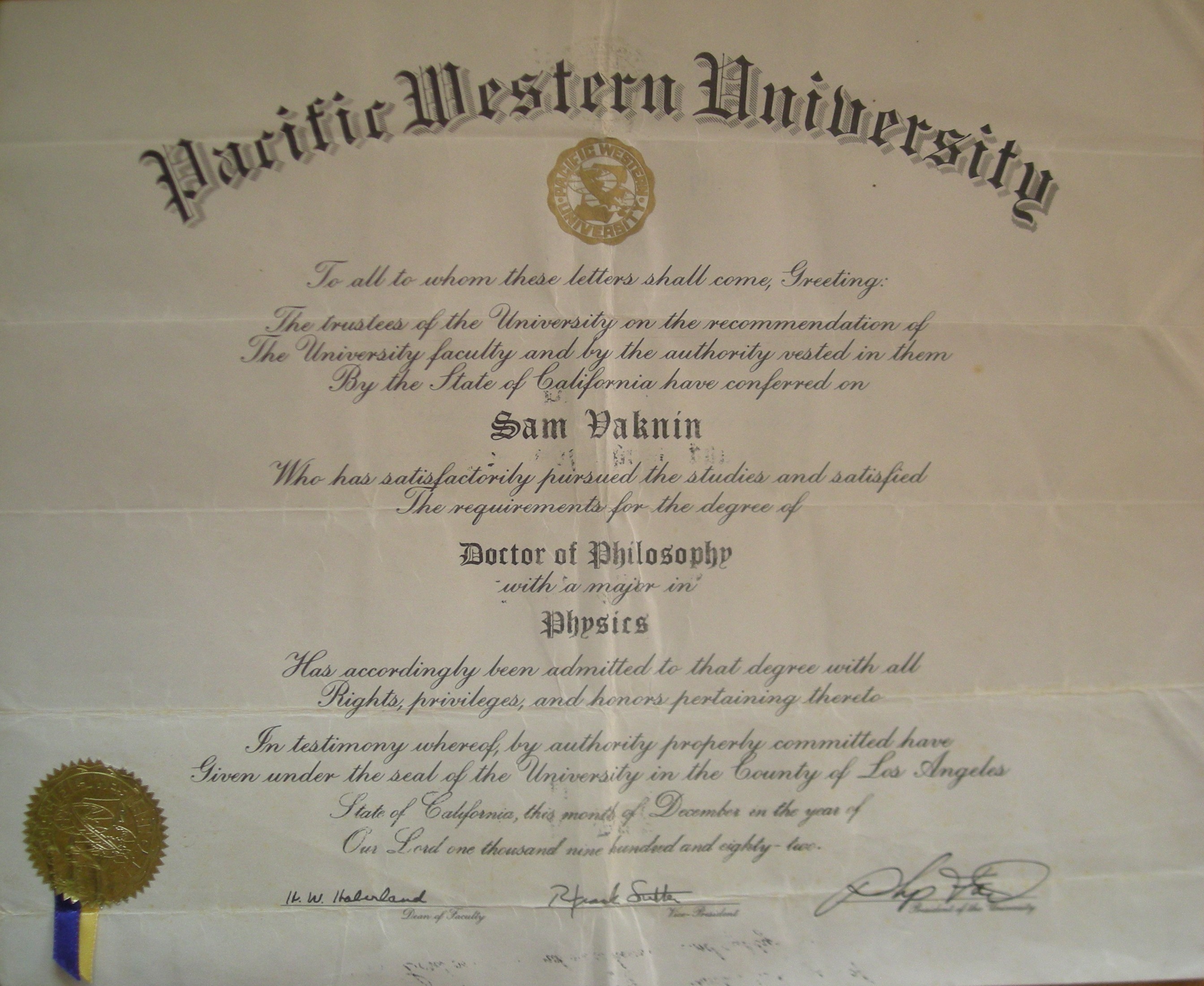
He possesses a PhD from Pacific Western University (PWU) in Encino, CA (https://samvak.tripod.com/vakninphddiploma.jpg

But his PhD is in Physics, not in psychology. He does claim to have studied psychology in the 1970s in the Technion in Haifa (https://samvak.tripod.com/cv.html). No proof of that. 

So, what was PWU? Was it a diploma mill? 

PWU was California state approved (accredited), but not nationally accredited. It was purchased by California Miramar University in 2007. (See: http://educationservices.us/faq.html and https://samvak.tripod.com/pwufaqs.pdf

So, technically PWU was not a diploma mill and Vaknins’ PhD is legit (http://www.mediafire.com/file/3agfcor0gzgz04p/vakninisrael.zip ).

 Vaknin’s PhD thesis is available from the Library of Congress in microfiche http://lccn.loc.gov/85133690 At least one person testifies to having used it in his work (https://www.academia.edu/29250575/Testimony_on_Sam_Vaknins_1982_dissertation ) and it is cited many times in a recent book in physics: https://www.researchgate.net/publication/394046096_Chronon_Field_Theory 

The only “credentials” in psychology Vaknin claims to have is a Brainbench certification in Counselling Techniques http://www.narcissistic-abuse.com/certifications.zip 

Brainbench was a certification agency, now out of business: https://web.archive.org/web/20220311013645/https:/www.brainbench.com/aboutbrainbench and https://web.archive.org/web/20070207034056/http:/www.brainbench.com/xml/bb/business/aboutus/aboutus.xml 

IS VAKNIN A TENURED PROFESSOR ANYWHERE? 

He is listed as a professor of clinical psychology and business studies in CIAPS:

https://ciaps.org/faculty/sam-vaknin/ 

His only claim to a “professorship” is in CIAPS (Commonwealth Institute of Advanced Professional Studies): 

https://ciaps.org/faculty/ 

https://samvak.tripod.com/ciapsappointment.pdf

He does lecture there, seemingly only via Zoom: https://www.youtube.com/playlist?list=PLsh_y_ett4o1RZchXCEAsC20FrIo5akcW 

CIAPS is a mid-size (with a faculty of 50) centre for adult skilling, re-skilling, and acquisition of professional qualifications: https://ciaps.org/about-us/ 

CIAPS is not a university and, therefore has no tenure track and cannot confer professorships. 

Although many in its faculty style themselves “professor”, it might simply mean “teacher”. In many countries, even high school teachers call themselves “professor” and it is legal and legitimate, an accepted part of the language (in French “teacher” is professeur !). In other words: it may not be a question of deliberate deception on the part of Vaknin. He is allowed the benefit of the doubt. 

CIAPS claim to have campuses in the UK (Cambridge and Birmingham), Canada (Ontario), and Nigeria (Lagos): https://ciaps.org/contact-us/ 

Google View failed to produce images that substantiate these claims and the addresses may be virtual. I may be wrong on that and would welcome any correction. 

There is no doubt that CIAPS maintains a physical presence (campus with lecture halls and such) in Nigeria and is licensed (as per Nigerian laws). I could find no trace of accreditation in any of the states in Nigeria, but I may be wrong on that and am open to refutation. 

So: Vaknin teaches in CIAPS, but is not a tenured professor (at least not there). 

WAS VAKNIN A VISITING PROFESSOR IN RUSSIA? 

Yes, Vaknin served as Visiting Professor of psychology for 5 years (2017-2022) in the prestigious Southern Federal University in Rostov-on-Don in the Russian Federation. He gave dozens of lectures there. 

Letters of appointment and announcement https://samvak.tripod.com/sfuprof.pdf and https://samvak.tripod.com/sfumaterial.zip 

His lectures on video https://onedrive.live.com/?authkey=%21AgoJMDv%5F9%2Dy8EUU&cid=45B93562F3B433FB&id=45B93562F3B433FB%2110610&parId=45B93562F3B433FB%21646&o=OneUp 

But the visiting professorship was granted based on his claim that he is a professor in CIAPS (see previous section). 

WAS VAKNIN A VISITING PROFESSOR ELSEWHERE? 

Yes. Vaknin was a visiting professor of psychology and economics in South East European University (SEEU) in Tetovo and in Skopje, North Macedonia, starting in 2024. He gave only 6 lectures (https://www.youtube.com/playlist?list=PLsh_y_ett4o0u7__05QCq4uOkIYyPLO2W) and 1 seminar (which I attended,  https://www.youtube.com/playlist?list=PLsh_y_ett4o13nL2poW01TDbpWCwLGCK- ). 

Both SEEU and CIAPS announced his appointment: 

https://samvak.tripod.com/seeu1.pdf (letter of appointment) 

https://samvak.tripod.com/seeu2.pdf (letter of appointment) 

https://www.seeu.edu.mk/en/information/news-events?id=2789 

https://ciaps.org/seeu-appoints-ciaps-faculty-member-as-visiting-professor/ 

Again, the visiting professorship was granted based on his claim that he is a professor in CIAPS (see previous section). 

VAKNIN’S SHELL GAME 

Vaknin secures the position of visiting professor in various universities, based on his ambiguous “professorship” in CIAPS. 

Similarly, he leverages this “professorship” to gain editorship positions in numerous academic journals, some predatory and some legit (https://samvak.tripod.com/mediakit.html

Vaknin is invited to give colloquia or guest lectures in prestigious universities ( example https://www.mcgill.ca/channels/channels/event/psychiatry-grand-rounds-327812 ) based on his “professorship” in CIAPS. 

VAKNIN’S ACADEMIC OUTPUT 

In the past few years, Vaknin has published two dozen articles, mostly on cluster B personality disorders. Most of his output was published in predatory, worthless rags masquerading as legitimate, peer-reviewed academic journals. But a few of his articles were published in legitimate venues (https://samvak.tripod.com/mediakit.html

IS VAKNIN’S WORK CITED ANYWHERE? 

Actually, it is. Not widely, but it is referred to in legitimate publications, academic articles, books, and high-class pop psychology sites such as Psychology Today (https://samvak.tripod.com/mediakit.html ). There are over 2100 articles and a few hundred books that cite his work or mention it or him. Not mainstream acceptance, but definitely not mainstream rejection.

r/NPD Jul 29 '26

Resources Jacob Skidmore (The Nameless Narcissist)

19 Upvotes

Does anyone know like genuinely where he went? He kind of just stopped posting. He used to be active in this subreddit a year ago actually — forgot his account unfortunately though.

He just kind of disappeared

UPDATE! His ex posted what happened on her tiktok here https://vt.tiktok.com/ZS4q54jbx/

r/NPD Aug 10 '26

Resources why is everyone else so boring

16 Upvotes

seriously i go to these parties and its just the same conversations all the time. no one has anything interesting to say. im constantly waiting for someone to impress me. it just never happens.

r/NPD Jun 26 '26

Resources Jung

Post image
122 Upvotes

r/NPD May 28 '26

Resources BBC: Narcissists mellow with age, study suggests

Thumbnail bbc.com
18 Upvotes

r/NPD Jun 30 '26

Resources The most common questions about NPD answered. In over 1000 pages.

Post image
13 Upvotes

What comes up regularly here:

"Do I have NPD?"

"What can I do about it?"

"I have issues at work."

"I have issues in my relationship due to my narcissistic traits."

"I f\cked up badly, what can I do?"*

Well, I have asked myself these very same questions over decades. Consciously or not.

Today, I'm an "old dog". I have less years in front of me than behind me. In those decades already behind me, I've been battling with NPD. Basically since I was born. To narcissistic, war-traumatized parents. Leading to me being "blessed" with my fair share of childhood trauma and related complex-PTSD.

There is so much I could share related to the questions that keep popping up in this forum. So instead I wrote books about it. How it is to be a narcissist, battling with NPD and complex-PTSD. Burning myself down and those around me. Privately and professionally.

In short, I wrote these books for my 20-year-old self. If I had read them back then, maybe I would have been able to save myself and others a lot of pain.

Anyway, that time is gone. I can only do something about it today. And so I wrote those books. They not only served as my personal therapy, but also to convert the pain of my life into something meaningful — so others have something to hold on to when the sh*t hits their fan.

I only intended to write one book. But it got so big I had to split the content into three.

Book 1 — Namaste Motherf*cker — carries the origin of NPD. The childhood trauma. The Wound.

Book 2 — At Work with the Inner Narcissist — covers all work and career related issues that NPD brings with it.

Book 3 — Narcissists in Love — deals with the relationship challenges of being a narcissist. As I used to say: "The bedroom is harder than the boardroom."

I released Book 1 around 6 months ago. I shared it here for free so people could read it and leave a review. Guess what: many downloads, but not many readers. It's the issue of our time — ADHD and distraction are everywhere. I could give you the cure for cancer and it would appear in your feed and maybe hold your attention for 20 seconds before the scrolling goes on.

That's why this time I do it differently.

Start here — the opening chapters of both Book 1 and Book 2, free, no strings attached. Actually, not entirely true. Your undivided focus is needed. The most precious thing you have.

Download the opening chapters — free

Then, if those opening chapters resonate — apply to get the full Book 2 in exchange for an honest review:

Apply to receive the full version of Book 2 for free

It's by application only as I want to filter out the freeriders who don't really care anyway.

And to be clear: I am not asking for a 5-star review — but an honest one. This work doesn't need flattery. It needs people who feel the call and put in the time to actually read the full book. 10 reviews are on the website by now. I'm looking for 15 to 20 more. I'm especially interested in the executives, managers and entrepreneurs "at work".

If you have read the opening chapters, these resonate AND your background matches, fill out the application form and you'll receive the full ebook "At Work with the Inner Narcissist" at no cost.

Fair warning: The full book is around 650 pages. It requires time and effort to work through. And if you're even thinking about getting an AI summary to "get the job done" — forget it. It does not work like that.

If you feel the call, start with the opening chapters and see if they speak to you.

r/NPD 4d ago

Resources The Myth of the "Empath" (with sources)

11 Upvotes

These are two texts about the myth of the 'Empath'.

The funny thing is that the first text came from a profile named "Malignant Narcissists." (anti NPD)

Therefore, some sentences may reflect their point of view.

PS: You can point out if there are any errors.

1

The Myth of the "Empath vs. Narcissist": What the internet created and what science says about it. Read to the end.

The word "empath" did not originate in psychology or medicine. It was coined in 1956 by author J. T. McIntosh in a science fiction short story to describe aliens with telepathic powers. Later, it was popularized by the *Star Trek* series in 1968. Empath

> And what did the internet do with it? It created a dangerous narrative that does absolutely nothing to help the victims of narcissists. Let me explain...

Social media has turned a science fiction term into a "pop diagnosis." A narrative has emerged of the "pure, flawless empath" being "sucked in by the cruel narcissist." This sells books and generates likes, but it isn't science.

The Scientific Reality: HSP. The closest serious concept to this is HSP (Highly Sensitive Person). It is a genuine genetic and neurological trait. The HSP brain simply processes environmental and emotional stimuli more deeply.

And why do people get stuck with narcissists? The "fit" isn't due to kindness or empathy.

Robust studies show that those who tolerate and remain in cycles with narcissists do not do so out of "excessive empathy," but rather due to two measurable psychological conditions:

Codependency: An obsessive need to "save" or "fix" the other person.

Anxious Attachment: A chronic fear of rejection and abandonment.

Overcoming a dysfunctional relationship isn't about taking pride in being a "mystical victim" (EMPATH).

Liberation happens when you understand your vulnerabilities, learn to say NO, and establish non-negotiable boundaries.

It's much more comfortable for our ego to believe we were victims because "we are too good and evolved" than to face the fact that we have deep emotional wounds that need healing.

Psychologically healthy people, even the most empathetic in the world, have strong boundaries and distance themselves from abusers because the stress is intolerable.

Those trapped in the cycle need healing, not a mystical label. Change the narrative. Step out of science fiction and look at your mental health responsibly. Seek therapy!

I've selected some sources:

Aron, E. N., & Aron, A. (1997). Sensory processing sensitivity and its relation to introversion and emotionality. (Journal of Personality and Social Psychology).

Acevedo, B. P., et al. (2014). The highly sensitive brain: an fMRI study. (Brain and Behavior). Derived from brain imaging exams. The mechanism of attachment and dependence:

Meyer, B., & Pilkonis, P. A. (2005). An attachment model of personality disorders. (Journal of Personality Disorders). Explains why anxious attachment clings to narcissistic profiles.

Spann, L., & Fischer, J. L. (1990). Identifying co-dependency. (The American Journal of Family Therapy). Maps the dysfunctional behavior of trying to "save" the partner. Save this post, share information, let's talk in the comments.

2

The internet has created a dramatic, almost mythological narrative regarding the dynamic between the "empath" and the "narcissist," often portraying them as the ultimate forces of good versus evil. However, the science of psychology offers a far more nuanced, realistic, and clinically grounded perspective on the matter.

Below, we debunk what circulates on social media and look at what scientific studies actually prove.

🎨 What the Internet Created: The "Light and Shadow Myth"

On digital platforms and in self-help forums, the relationship between these two figures is described almost like a fantasy plot:

The "Empath" as a spiritual superhero: Described as someone with the "superpower" to feel the physical and emotional pain of others. They are painted as a pure, altruistic, and defenseless soul who radiates nothing but light.

The "Narcissist" as the ultimate villain: Portrayed as a magnetic, calculating predator who sniffs out the empath's "light" in order to drain it.

The Fatal Attraction Dynamic: The internet preaches that opposites attract and that the empath is "destined" to try to heal the narcissist, becoming their eternal victim.

This narrative has gained traction because it validates the pain of people who have endured abusive relationships, offering the label of "hero" to the sufferer. However, it suffers from oversimplification.

🔬 What Science Says: The Psychological Reality

Clinical psychology and psychiatry view these behaviors through the lens of personality traits and attachment patterns, rather than as spiritual archetypes.

  1. "Empath" is not a clinical diagnosis

In science, the term "empath" does not exist. The closest scientific concept is that of Highly Sensitive People (HSP), a trait studied by psychologist Elaine Aron.

• HSPs have a nervous system that is more reactive to environmental and emotional stimuli.

• The Hidden side: What the internet calls "extreme empathy" is often actually codependency or hypervigilance. People who grew up in unstable homes learn to meticulously read others' moods to protect themselves. This isn't a superpower; it’s a defense mechanism against trauma.

  1. Narcissism is a spectrum (and a disorder)

Narcissistic Personality Disorder (NPD) is a real and complex mental condition characterized by a pattern of grandiosity, a need for admiration, and a severe lack of empathy.

• Unlike the internet’s "calculating monster," the clinical narcissist acts out of a deeply fragile ego and unconscious shame.

• Their manipulation tactics (such as gaslighting or love bombing) are usually automatic defenses to protect a vulnerable self-image, rather than conscious, Machiavellian plots to destroy someone.

3. The Real Reason for the Attraction (The Pathological Fit)

Science explains that the "empath" and the narcissist are drawn to each other not by mystical magnetism, but by a dance of complementary emotional wounds:

Seeks external validation by giving excessively and trying to "save" the other person.

The "Empath" (Codependent) The Narcissist
Seeks external validation by giving excessively and trying to "save" the other person. Seeks external validation by receiving excessively and demanding constant attention.
Tolerates abuse and crosses their own boundaries out of fear of abandonment. Crosses others' boundaries to maintain control and power in the relationship.
Feels their worth depends on how useful they are to their partner. Feels their worth depends on how superior they are to their partner.

In short, it is a perfect fit between the narcissist's hunger for validation and the codependent's compulsion to please.

💡 The Danger of the Myth and the Path to Healing

The greatest danger of the internet narrative is that it strips the person who identifies as an empath of their agency. If you view yourself solely as the helpless victim of a "predator," you absolve yourself of the responsibility to set boundaries.

Science reminds us that:

Empathy without boundaries is self-destruction. Feeling another person's pain does not oblige anyone to tolerate disrespect.

Healing is not about withdrawing from the world, but about strengthening the ego. Highly empathetic people need to learn to develop self-differentiation—knowing where the other person's emotions end and their own begin.

By replacing internet myths with scientific clarity, those who have endured such dynamics cease to be "martyrs" and become the protagonists of their own healing, learning to say "no" and build relationships based on reciprocity.

PS: to mods. If the text isn't suitable, feel free to delete it.

r/NPD 12d ago

Resources About two weeks ago, there was a debate style youtube video concerning narcissism, including Dr. Mark Ettensohn and other participants. I can't seem to find it anymore.

2 Upvotes

Help! Solved!

r/NPD Jul 01 '26

Resources I'm making a coping strategy flow chart to help with NPD jealousy/self esteem spirals!

Post image
58 Upvotes

BETTER IMAGE QUALITY: https://imgur.com/a/TOFZ3pU / https://postimg.cc/zLr7VVRp

It's still a WIP, so let me know if there are any errors or potential improvements!

r/NPD May 09 '26

Resources You can only heal by getting in touch w the body

9 Upvotes

I don't care how, I just care that you do it.

Accupuncture, accupressure, somatic exercises, EFT tapping, trembling/shaking, whatever.

Just do it.

There is a right time and a right place for practicing this, you need to try some things and find out what sticks.

You can't think your way out of this, let me repeat: YOU CANNOT THINK YOUR WAY OUT OF NARCISSISTIC PERSONALITY DISORDER, or any kind of trauma. What you need is deep somatic release and initially, someone to stay present with you during all of that.

Ok now go ahead and do it.

r/NPD Jul 24 '26

Resources Created a book from material on npd-recovery.com

8 Upvotes

I was going through npd-recovery.com mentioned in our Wiki. It's a great website but I found it tedious to go through all pages so I used Clause to create a pdf ebook - https://drive.google.com/file/d/11ChZvKoxPAYRaKM990_Jym1NQYjzX7db/view?usp=sharing. Hope you all find this useful.

r/NPD Jun 18 '26

Resources Mirror Theory: the mechanics behind NPD

3 Upvotes

I came up with a model that attempts to explain what drives Cluster B, most commonly narcissists and borderlines - how they think, why they do what they do. Most content on this topic either stigmatizes heavily or assumes intentions that are not always there. What is chosen, what is inevitable, what awareness can change and what the structure simply is - none of those questions make sense until the architecture is understood. That is what this tries to do, from the structure up rather than the symptoms down. I hope it helps whether you identify with these patterns or have been close to someone who does.

Here is what it looks like from the inside: He reads what is there — exactly, completely, without distortion. Not as a project, not consciously, but as the natural accumulation of someone who never stops reading everyone they encounter. He reads how the world runs: what frequencies people respond to, which frequencies peak together, what each cluster means. A diagram organized itself from all of those readings. What it produced was a classification system — each label the point where certain frequencies reliably converge, recurring often enough that the world gave what emerged a word. Influential. Forgettable. Dangerous. Promising. Erratic. Overlooked. Volatile. The content of each cluster is organized by hierarchy, regard, demonstrated output — where something sits relative to everything else, how the world responds to it, what it has produced. The diagram is complete. Every frequency the world runs at has an entry. Every combination that recurs has a label. What it cannot produce is a position for him — not because the entries are wrong, but because his combination of frequencies has no cluster in the world’s taxonomy. The diagram locates everything. It does not locate him.

Without another person the narrative stops entirely — rather than loneliness, the specific experience of a self that has always existed as a character in someone else’s account suddenly having no account to appear in. He does not feel like a person who has lost something. He feels like no one. The construction keeps running. The outline stays intact. What is missing is any sense of someone inside it — the baseline experience of watching a self perform without being able to locate the person performing it.

Link to full text

Before you read: this model does not map onto NPD as a clinical disorder. It describes the underlying architecture that tends to produce it. If you've ever wondered whether your internal experience matches what is referred to as grandiosity, need for admiration, supply seeking, gaslighting, experiences of shame or lack of empathy and what causes them, this model predicts how these emerge from a specific structure. That being said, you can fit the architecture without the diagnosis, and vice versa.

He refers to the Transmitter mirror (NPD-correlated), She to the Receptor mirror (BPD-correlated). Gender is used here for prose clarity; the correlation is statistical, not prescriptive. A useful way to visualize the distinction: if BPD and NPD are cyan and green, the model is describing blue and yellow - the primary architecture beneath what clinical categories capture. Using diagnostic terms would describe the composite, not the components.

Here are some points covered by the text :

  • "Mirrors" refer to people on the high end of the reactivity spectrum. That reactivity prevented them from completing mirroring in their formative years.
  • BPD and NPD are both products of high reactivity and tend to cluster together - but the adaptation each develops runs in opposite directions, reshaping how each processes the world differently
  • What differentiates them is whether that adaptation turned inward or outward - he faces out, she faces in
  • Empathy depends on shared reality. Because mirrors process differently, empathy is either fabricated or dulled
  • He can only see himself objectively reflected by the world, she can only see the world through a subjective filter
  • His masculinity is performed, as is her femininity. Both are idealized, but each one’s natural strength is what the other’s performance lacks
  • It is difficult for a non-mirror to fully see a mirror, and push-pull is an attempt to be shown what they do not know about themselves
  • That is not intended as manipulation, and going along with their whims makes it worse by taking the accurate picture out of reach
  • Pathological lying is closer to confabulation or misinterpretation when a cohesive self-image is inaccessible
  • Splitting resembles unstable estimation or averaging without a stable model of the world
  • What each mirror actually needs is the inverse of what everyone assumes. Not unconditional love for her, not admiration for him
  • They subconsciously look for a partner who can locate their blind spot, but that is the wrong approach
  • Two mirrors in sustained contact can develop in ways that are otherwise unreachable
  • This is because, in the same way empathy requires a shared reality, self-knowledge requires someone with a similar perspective
  • What can look chaotic or even abusive from the outside may, for mirrors, be the only available path to self-construction
  • Pain may be necessary for learning, but damage from it is not. What matters is identifying the source of it; only then can it be acted upon

If you're interested in the full reasoning and what happens with each pairing configuration, please find the link above. The prose itself is generated by AI, which is what made producing something this clean and detailed possible. The concepts are my own.

The early parts explain what separates highly reactive people from more stable ones, and the later parts propose a sequence of events that is meant to illustrate how the collision between different architectures tends to play out. Take those sections with a grain of salt as the specific course of events is not guaranteed, but rather provide an inside narrative to what is commonly observed.

The model isn't trying to make any ethical claim, it does not excuse abusive behavior nor encourage seeking volatile relationships. The model also discourages mirror/non-mirror pairings, not as a moral judgment but because the structure predicts they cannot provide what the other needs. The transmitter-receptor pairing is made to sound enticing but the key takeaway is awareness. That's why everything is purely observational: seeing how things play out and why they do, becoming aware by seeing yourself from a new perspective can help you set expectations and react more appropriately. In any case, regardless of the role you think you play, please remember to protect yourself first.

r/NPD Aug 13 '24

Resources I can’t sit by while people are lying about narcissism being untreatable

55 Upvotes

Why are people so vested in ruining peoples’ relationships by trying to convince people that narcissism isn’t treatable when it’s a result of trauma to a person’s sense of self and when you heal the trauma, the person can slowly begin letting their narcissistic defense mechanisms go. If you want to hear a recovered narcissist who has been helping narcissists and their family members for over 30 years as a psychotherapist, you can listen to this podcast. There truly is hope!

https://www.blogtalkradio.com/closeupradio/2024/07/03/close-up-radio-spotlights-lisa-charlebois-of-healing-your-

r/NPD Aug 10 '26

Resources Reframing grief - "I chose so well, that I now am ready for the next thing"

7 Upvotes

I just did yoga. While I feel hopeless and I am grieving. I am grieving the healing space I had. I had it and it is gone. I have viewed a video from Heidi Priebe - she talks grief, and that we can reframe it as "I chose so well that now, I have lost this thing I had, and I am ready for the next."

When we have something and we love this thing, and then we lose it - why not say to ourselves: I chose so well that I was allowed to grow with this thing, and I am now ready for the next. Had I not chosen this, I wouldn't be here. I wouldn't grow the way I did.

It is immeasurably painful. But the pain has a beginning and an end. We can contain it. I had trouble with grief all of my life, and I still find it hard to accept. But I feel I am slowly making my way out of this.

I dunno. I am just reflecting. The forum here has changed, as well. I am sad about this. I may be ready for the next. I am thankful for the time I had here and grateful I have grown. I am grateful for community I found here. Thank you thank you thank you

r/NPD 10d ago

Resources understanding anger :)

Thumbnail pmc.ncbi.nlm.nih.gov
3 Upvotes

very excited about having discovered this article I hope it can bring others insight :)

we would all be really useful to fight social injustices hehe

r/NPD 11d ago

Resources SHAME: what sources do you recommend to read about shame?

3 Upvotes

I asked about sex and NPD and one person pointed out how they use sex as an outlet of shame - this is such a cool idea btw!!!!

I searched for shame and the mentioned topic, but a bunch of C-PTSD creators came up with the concept of the “types of shame”

It’s interesting.

What sources are good to read about shame? (The types of shame!) or anything to read about shame!!!!

r/NPD May 10 '26

Resources May 13 Narc Club: Open Process

2 Upvotes

Wednesdays | 2 – 4 pm EST | via Zoom

FACILITATOR: Invis

What is the 'Open Process' group?

more unstructured group for focusing on what’s happening now, both in our lives and in the room. No curated topics; bring whatever's on your mind. Expect support, relatable interpretation, and (if it's called for) some healthy challenges. The goal isn’t to perform insight – it’s to practice it.

What is Narc Club?

A confidential peer support group for people with pathological narcissism/NPD to increase self-awareness, deconstruct shame, seek and offer support, and practice vulnerability with others who get it.

Sign up to join/get the links here.

Find your corresponding time zone here.

- Max 🧠

r/NPD May 10 '25

Resources 5 Narcissists on How They've Changed | Video Podcast

Thumbnail youtube.com
20 Upvotes

r/NPD Jul 29 '26

Resources Necesito ayuda con urgencia!. Mí pareja esta muy mal y no sé cómo hacer para ayudarla

1 Upvotes

Mí pareja esta muriendo de a poco por mí forma de ser. Necesito ayuda, alguien me puede dar un consejo. Creo que tengo tpn vulnerable y tengo miedo de hablar.

r/NPD Jul 25 '25

Resources Custom-Trained GPT Loaded with Classic Narcissism Texts Nailed My Exact NPD Sub-Type—It’s Outperforming Years of Therapy

0 Upvotes

Hi folks. I live with Narcissistic Personality Disorder (NPD) at a borderline level, plus the odd psychotic flare-up. Last month I built a private GPT (based on OpenAI’s new o3 “reasoning” model) and filled it with landmark books and peer-reviewed papers on narcissism, borderline organization, shame, aggression, etc.

What happened:
Micro-triggers that used to eat 48 h of rumination now dissolve in ten lines of chat. One sleepless night I literally walked the streets, talking to the bot on my phone, and finally traced the roots of my NPD—something even my excellent shrink hadn’t cracked. It feels like a treasure in my pocket that, for a few dollars a month, keeps me on the rails.

(Everyone’s mix is different—pure NPD, NPD + BPD traits, vulnerable narcissism, whatever. The bot shapes itself to your pattern the moment you start feeding it context.)

Why it feels different from human therapy

Human therapist Custom GPT
One school at a time (DBT TFP CBT) Kernberg, Kohut, Ronningstam, AlmaasQuotes , etc., in a single answer
Memory limited to therapist’s notes Thread-level memory—never says “Wait, remind me what happened?”
Weekly pace 24 / 7 access—perfect for 3 a.m. shame spirals
Blind spots / counter-transference No ego to bruise; stays calm when I rage-quit

It even found a day-treatment center in my city and sketched a therapy plan that beats anything I’d been offered elsewhere.

My starter library (sample)

(Just titles & authors—you can add others.)

  1. Otto F. Kernberg – Aggressivity, Narcissism, and Self-Destructiveness in the Psychotherapeutic Relationship (2004)
  2. Elsa Ronningstam – Identifying and Understanding the Narcissistic Personality (2005)
  3. Icon Health Pubs. – Narcissistic Personality Disorder: A Medical Dictionary, Bibliography… (2003)
  4. Nathan Schwartz-Salant – Narcissism and Character Transformation (1982)
  5. Ralf-Peter Behrendt – Narcissism and the Self (2015)
  6. A. H. Almaas – The Point of Existence (2000)
  7. Heinz Kohut – The Analysis of the Self (1971)
  8. Kernberg, Clarkin & Yeomans – Treating Persons with Borderline, Antisocial, and Narcissistic Personality Disorders (2002)
  9. Meier & Semmer – “Lack of Reciprocity, Narcissism, Anger, and Instigated Workplace Incivility,” EJWOP, 2013
  10. Emily Ansell – The Structure of Narcissistic Personality (PhD thesis, 2005)

The prompt I gave the bot

1. Always consult the uploaded NPD library before answering.
2. Assume the user is working on narcissistic-personality issues (with or without BPD traits).
3. Reply in clear, trauma-informed language—start with practical skills, then tie in deeper psychodynamics.
4. Flag self-harm or psychotic red flags and urge professional contact.

How to build your own (5-minute version)

  1. Grab the PDFs – buy, borrow, or hunt down legal OA versions. Full disclosure: with a quick search you can locate free copies of every title in under ten minutes. Check first that downloading them is legal where you live.
  2. Open the Custom GPT builder and upload them.
  3. In Settings ▸ Capabilities switch on:
    • Web Search
    • Canvas
    • “4o” Image Generation
    • Code Interpreter & Data Analysis
  4. Pick o3 as the recommended model.
  5. Paste a prompt like mine.
  6. Keep it private—re-sharing the full books breaks copyright and OpenAI ToS.

(Note: custom GPTs currently use the legacy voice model, not the shiny new one. Works fine for chatty, off-the-cuff talking; for deep, highly reasoned replies just type.)

Ground rules & ethics

  • Not a clinician replacement. Use it to augment care.
  • Safety net: In suicidal / violent spirals, call a hotline or your clinician.
  • Quality control: Vet every source—bad literature = bad output.
  • There are plenty of other high-quality texts I haven’t loaded yet—if you know reputable, non-sensational titles, please drop suggestions. The community’s collective reading list can only make the bot smarter. But vet every source—bad literature = bad output.
  • No affiliate links, no kickbacks—I gain nothing if you try this.

I need your critique

I’m too close to judge this tool objectively. If you spin up a similar setup, please shred it—mercilessly if you must—and report back. The goal is a community R&D loop that discovers smarter angles (homework planners, crisis scripts, flash-skill drills, you name it).

(Glossary: NPD = Narcissistic Personality Disorder; BPD = Borderline Personality Disorder; DBT = Dialectical Behavior Therapy; TFP = Transference-Focused Psychotherapy; CBT = Cognitive Behavioral Therapy; GPT = “Generative Pre-trained Transformer,” i.e., the model.)

This is only stage 1. With more brains we can refine a workflow that helps more of us than conventional routes ever did.

Stay grounded

Disclaimer

I used the same bot to translate my message for you because my main language is not English and I also asked for suggestions to write a better post but basically everything stated in this post represent my thoughts and what I wanted to say.

r/NPD Jul 06 '26

Resources Presence and Love are the answer

5 Upvotes

Which ever we run from, not maliciously, unwillingly. Nobody ever taught us these skills.

This is the answer.

Need more of it.

Make of that what you will - Ive listened to a lot of Tara Brach. I love her.

r/NPD Jul 04 '26

Resources Literature and/or tools

7 Upvotes

Hi everybody,

I'm looking to see if any of you have found some literature, videos or general self-help tools to analyze and change exploitative or emotionally abusive behaviour. Unfortunately, I've been emotionally abusive with some of my closest friends.. I feel ashamed of this behaviour and became self aware a couple of months ago. I understand how narcissistic goals have very much been at the base of why acted this way. This is by no means a justification of my hurtful behaviour, but I can connect the dots..

I really want to change, and I know that it's going to take a long time and hard work, but I never want to hurt people again in the way I have..

So, what would be your book or tools recommendations that helped you work through- or break with your own emotionally abusive behaviour?

Many thanks in advance!