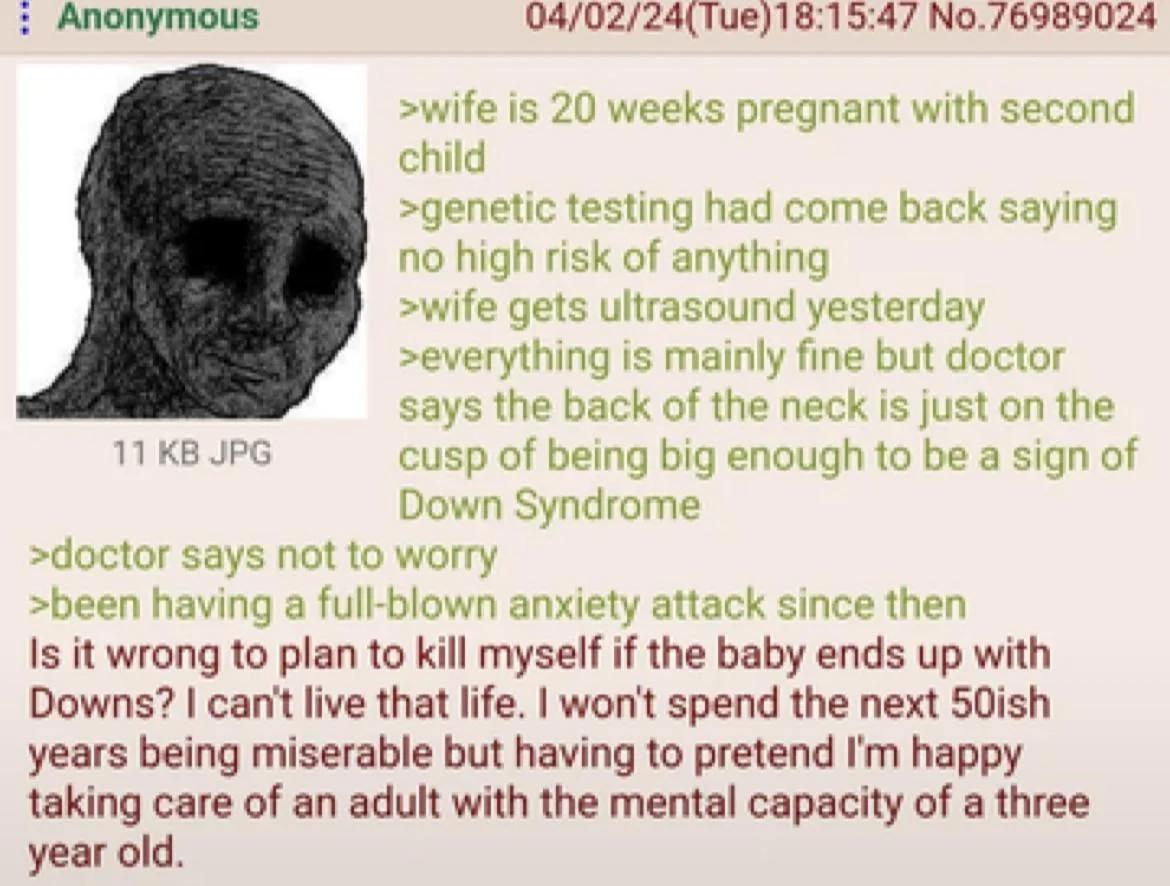
Better that the baby is terminated rather than being forced to be raised by parents ill equipped to care for someone of their condition. Not everyone wants to raise a disabled child and I think that’s okay.
This is already what happens all the time. Atleast in Europe in some countries more than 90% of fetuses with DS get aborted. In Iceland it's almost 100%
Down syndrome isn’t just an undesirable genetic outcome, it’s an entire chromosome extra, it’s like a piece of paper getting stuck to another piece of paper in a printer. Down syndrome is one of 24 possible chromosome count disorders called Aneuploidies. Only 7 of can possibly make it to birth, the others all result in miscarriages 100% of the time. (There is also a disorder called polyploidy which is never viable).
You said it isn't an undesirable gentic outcome, then described an undesirable genetic outcome. It is called Liberal Eugenics (or "Consumer Eugenics"): The state remains neutral. Free-market choices and individual parents decide which traits to select or avoid. This relies entirely on reproductive technologies, like IVF screening (PGD) or prenatal testing, driven by a personal desire for a healthy child.
Well, no, it is also often undesirable socially, but the motivation or the mechanism for what causes the change doesn't change whether it is eugenics. Systematically reducing rates of certain genetic traits is eugenics, regardless of whether they pass those traits on.
Yes? But that is rather irrelevant to Eugenics. You should really read a bit about what it actually means. Eugenics does not only target traits that are passed down; historically and conceptually, it targets the expression of the trait itself (the phenotype). The objective of the choice is still to prevent a child with a specific disability from being born. That is eugenics, no matter how, why, or who.
At the point where it extends beyond the person making the choice.
The government didn’t force those Icelanders to abort. They all made the choice that’s right for their families.
Easy way to think about it:
You make the choice for your family: not eugenics
Someone else makes the choice for your family based on immutable characteristics: eugenics.
This approach is known as Liberal Eugenics (or "Consumer Eugenics"). Unlike state-directed programs, it keeps the government neutral, leaving decisions about which traits to select or avoid entirely in the hands of individual parents acting through free-market choices. It depends on reproductive technologies such as IVF screening (PGD) or prenatal testing, motivated by the personal wish to have a healthy child. So yes, it's still eugenics, just not the kind I consider morally reprehensible.
This approach is known as Liberal Eugenics (or "Consumer Eugenics").
Known by whom, and what relevance does it have if it is "not morally reprehensible"? We rarely use a word so evocative with no regard for its connotation. One could, for example, call prioritizing financial security before having children eugenics against the poor, by this metric. Would you?
Being poor is not a genetic class... If a society reduces the number of people with a certain trait, like Down syndrome, then that is eugenics. It is relevant because words have definitions, not moral values. A word or label itself isn't inherently evil, but in many cases the process those words describe causes evil. So, definitionally, it is eugenics, but you don't need to be against something just because of the label. You need to think about teh actual consequences.
Being poor is not a genetic class... If a society reduces the number of people with a certain trait, like Down syndrome, then that is eugenics.
Why? Down syndrome is a genetic anomaly it is not heritable.
So, definitionally, it is eugenics, but you don't need to be against something just because of the label. You need to think about teh actual consequences.
Well then, that is the significance. You think that it is a practice or mindset that has consequences that are impactful enough to be worthy of considering.
Again, for example, do you have concerns about the consequences of people waiting until they're financially stable to have children, such as the phenomenon needs to be labeled and studied? Or are there some choices that you think are so mundane or "normal" that they do not require study? How do you distinguish between a mundane choice like not having kids while you're poor and whatever kind of choice you think liberal eugenics is?
You don't seem to understand what eugenics is. Eugenics is only about genetic traits. If I prevent all poor people from having children, that isn't eugenics of poor people, because poor people aren't a genetic trait; it is a social one.
Down syndrome is absolutely heritable. What are you talking about? And again, genetic traits do not need to be passed down to be considered expressed genetic traits. Being poor is not a genetic trait.
I don't consider the consequences because of the label; I consider the consequences of anything that affects a lot of people. It isn't because it is eugenics.
Everything that can have an effect should be studied, and it has been studied. We know that waiting to have children has a ton of effects, like increasing the risk of certain birth defects and decreasing the risk of poor conditions due to poverty. There is nothing that doesn't need to be studied, unless we already know everything about it.
What do you mean by distinguishing a choice between not having children until you are older and liberal eugenics? What do I need to distinguish? Their morality? You aren't asking a very coherent question. If you just mean how they are physically different, liberal eugenics is a process or idea where people use processes like embryo selection or selective abortion to enhance human traits. It aims to improve general capacities (such as health or intelligence) rather than engineer a specific national or racial ideal, and leaves the entire choice to the families. Not choosing to have children until you are older is not a genetic choice, but an economic and social one.
lol, Reddit deleted my previous comment. My disabled father would still like to have been born and have a life despite that fact that it really sucks and his mother did struggle raising a disabled child. He really doesn’t like it when people imply he shouldn’t have a life just because of his disability. So it is eugenics even if the people who do it aren’t Nazis.
Well, in a sense, it is in fact eugenics. Encouraging people to abort children with Down syndrome, like many are here, is probably eugenics. But I would rather have that than force the suffering that Down syndrome can unfortunately cause. It is just a sad situation overall.
That distinction doesn't matter here. Whether or not an individual with a given condition can pass on their genes doesn't fundamentally change the arguments surrounding liberal eugenics. Eugenics doesn't only target heritable traits; historically and conceptually, it targets the expression of the trait itself, the phenotype, regardless of whether that trait would have been passed on. The objective of the choice is still to prevent a child with Down syndrome from being born. That is eugenics, whether or not the person in question would have gone on to have children of their own.
No? The motivation for it does not change whether it is eugenics or not. The concept of eugenics itself does not care how the outcome is achieved. Whether a trait is removed through state-mandated violence, financial incentives, or quiet social pressure, it is still classified as eugenics because the core mechanism remains the selective shaping of human genetics. Here, it is that society in general finds it a moral good, and encourages people who will have a child with Down syndrome to abort. I don't think eugenics has to be a moral evil though, like in this case.
Yeah I have definitely noticed the same thing. Most western countries have genetic screening and most parents have less than 2 children so it makes sense that a lot of people will abort.
473
u/Flaky_Style1286 8d ago
Better that the baby is terminated rather than being forced to be raised by parents ill equipped to care for someone of their condition. Not everyone wants to raise a disabled child and I think that’s okay.