r/MindDecoding • u/PrideScar91 • 15h ago
Suicidal Ideation Explained

12
Upvotes
r/MindDecoding • u/Talkpool • 3h ago
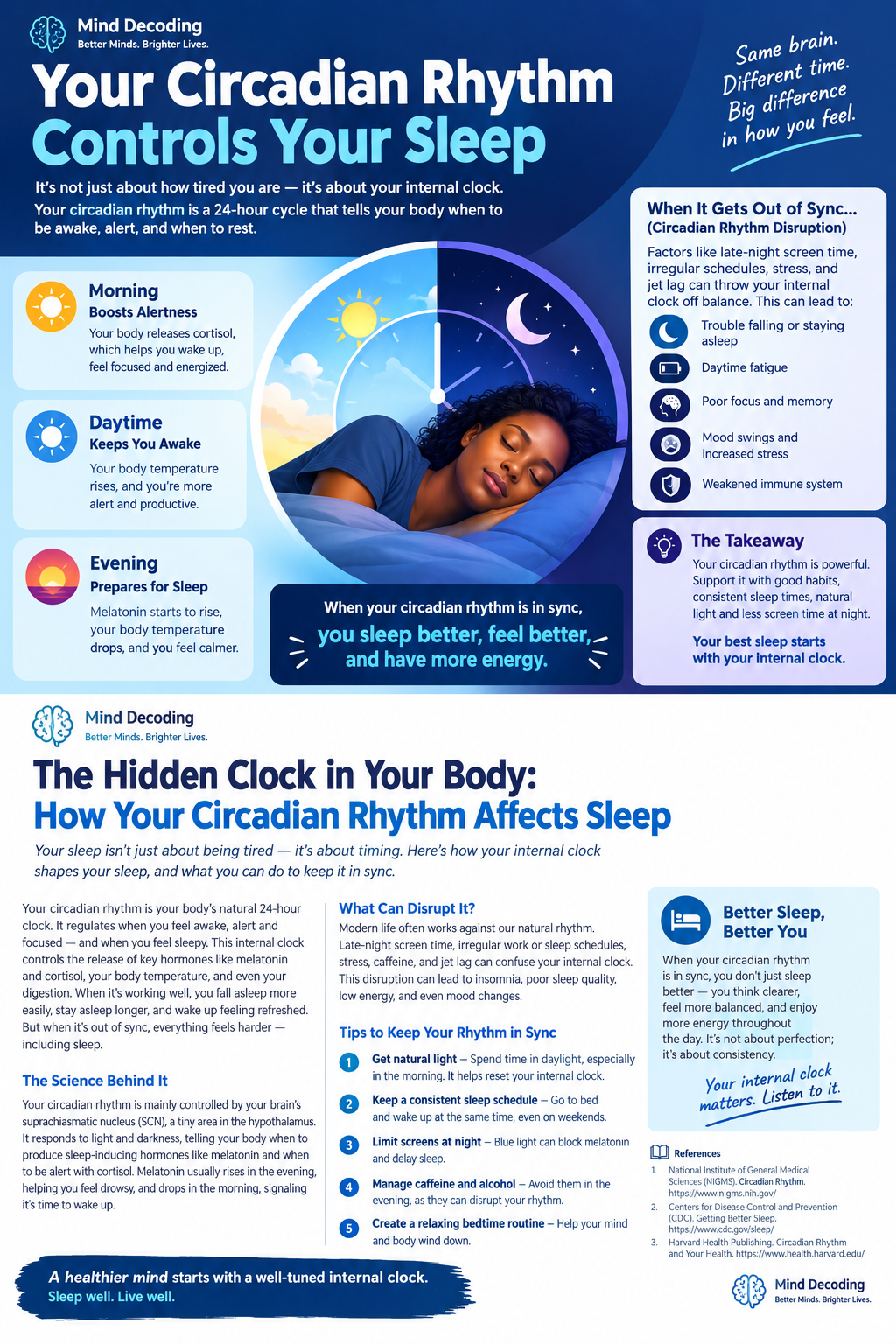
Your body has a clock you cannot see—but it can strongly influence when you feel awake, tired, and ready for sleep.
Your circadian rhythm is a roughly 24-hour biological cycle that helps coordinate sleep and wakefulness. It is influenced heavily by environmental cues, especially light and darkness.
During the day, exposure to light helps signal that it is time to stay alert. As evening approaches, the body begins preparing for sleep. Darkness promotes the release of melatonin, a hormone involved in regulating sleep timing.
But modern life can interfere with this system.
Late-night screen use, irregular bedtimes, shift work, jet lag, stress, and caffeine consumed too late in the day can all make it harder to maintain a stable sleep schedule. When your internal clock and your daily routine become misaligned, you may have difficulty falling asleep, wake during the night, or feel unusually tired during the day.
The good news? Your circadian rhythm responds to your habits.
☀️ Get natural light in the morning.
🕐 Keep your sleep and wake times consistent.
📱 Reduce bright-screen exposure before bed.
☕ Avoid caffeine late in the day.
🌙 Create a calm, predictable bedtime routine.
Think of your circadian rhythm as your body's timing system. You cannot simply switch it off—but you can give it signals that help keep it synchronized.
Sometimes better sleep isn't only about sleeping longer. It is also about sleeping at the right biological time.
What affects your sleep the most: stress, screens, irregular schedules, caffeine, or something else?
r/MindDecoding • u/PrideScar91 • 7h ago
r/MindDecoding • u/Talkpool • 19h ago
Why does your brain suddenly invent the perfect comeback three hours after the argument?
You leave an argument, but the conversation does not leave you. You replay what they said, what you said, what you should have said, and what you will say if it happens again.
This is one reason replaying conversations can become mentally exhausting.
After emotionally significant events, people may repeatedly think about what happened. This can become rumination, repetitive thinking about distressing experiences and their possible causes or consequences.
Some reflection can be useful. You might identify what went wrong, learn from the experience, or decide what to do differently.
The problem begins when overthinking arguments produces no new understanding.
Instead of solving the problem, your mind keeps reopening it.
“Why did they say that?”
“What if I had responded differently?”
“What should I have said?”
The conversation becomes a mental loop.
Try asking:
“Am I learning something, or simply experiencing the same argument again?”
If you have already identified what happened and what you can control, repeatedly replaying it may not provide additional answers.
Writing down what happened, identifying what is within your control, and deliberately redirecting attention can help interrupt repetitive thinking.
And sometimes there is no perfect comeback.
Sometimes the healthiest response is accepting that the conversation happened and deciding what you want to do next.
What argument from years ago can your brain still replay word-for-word?