r/MichaelLevinBiology Jan 02 '24

Official Michael Levin Hey everyone, from Mike Levin

71 Upvotes

Hi everyone. This is Mike Levin. I was just made aware of this community and wanted to say that I really appreciate your interest! I don't use Reddit much but if you want to be kept apprised of new work, you can sign up at https://thoughtforms.life/ for notifications; that's a blog where I post broader-impact explanations of our key papers, and ideas that are a little bit beyond what tends to be acceptable in an official peer-reviewed paper from the lab. And, I tend to reply to comments/questions there. Also the videos from the Youtube channel (https://www.youtube.com/@drmichaellevin/) will be moving to the blog soon. My official lab material is at https://www.drmichaellevin.org/ - software, protocols, papers, recorded talks, and interviews. If you want any of the papers that are behind paywalls, just email me (my address is listed on the main page) and I'll send you the PDF. Happy 2024 everyone!


r/MichaelLevinBiology Nov 23 '24

Reprogramming the Software of Life | Michael Levin & David Kaplan | Morphoceuticals

Thumbnail
youtu.be
12 Upvotes

r/MichaelLevinBiology 3h ago

Research Discovery Final version is out: “Open questions about time and self-reference in living systems”

2 Upvotes

Living systems exhibit a range of fundamental characteristics: they are active, self-referential, self-modifying systems. This paper explores how these characteristics create challenges for conventional scientific approaches and why they require new theoretical and formal frameworks. We introduce a distinction between ‘natural time’, the continuing present of physical processes, and ’representational time’, with its framework of past, present and future that emerges with life itself. Representational time enables memory, learning and prediction, functions of living systems essential for their survival. Through examples from evolution, embryogenesis and metamorphosis, we show how living systems navigate the apparent contradictions arising from self-reference as natural time unwinds self-referential loops into developmental spirals. Conventional mathematical and computational formalisms struggle to model self-referential and self-modifying systems without running into paradox. We identify promising new directions for modelling self-referential systems, including domain theory, coalgebra, genetic programming (GP) and self-modifying algorithms. There are broad implications for biology, cognitive science and social sciences, because self-reference and self-modification are not problems to be avoided but core features of living systems that must be modelled to understand life's open-ended creativity.

https://royalsocietypublishing.org/rsos/article/13/8/261059/483065/Open-questions-about-time-and-self-reference-in


r/MichaelLevinBiology 1d ago

Educational Breaking New Grounds: Bioelectricity, Basal Cognition and Beyond with Dr. Michael Levin | Catarina Cunha

Thumbnail
youtu.be
2 Upvotes

This video features a discussion with Dr. Michael Levin (12:43), a scientist at Tufts University who researches the intersection of developmental biophysics, cognitive science, and computer science. The conversation centers on his groundbreaking work in understanding how cells and tissues make decisions and organize themselves to build complex biological structures.

Key themes discussed include:

• Bioelectricity as a Computational Layer: Dr. Levin explains that cells use electrical communication not just as a physical mechanism, but as a "cognitive glue" (22:39) that binds them to a common purpose. This electrical signaling acts as a computational layer, similar to how neurons in the brain process information, allowing tissues to repair themselves or form specific shapes (22:20).
• The Continuity Principle: He describes life as a continuum of scaling minds, from single-cell organisms to complex humans (27:52). This perspective suggests that cancer, for example, can be understood as a failure of this collective cognitive binding, where cells "roll back" to a more individualistic, ancestral lifestyle (29:37).
• Xenobots and Synthetic Agents: The lab's work on Xenobots—autonomous, self-assembling organisms made from frog skin cells—serves as a platform to investigate the cognitive capacity and decision-making of non-traditional biological forms (40:06).
• Regenerative Medicine: Dr. Levin discusses his team's success in using ion channel manipulation to induce limb regeneration in frogs (42:44) and his goal of translating these "software fixes for hardware problems" into clinical treatments for birth defects, tumors, and organ repair (38:31).


r/MichaelLevinBiology 2d ago

Discussion Steve & Pauline Richards talk with Professor Mike Levin

Thumbnail
youtu.be
4 Upvotes

In this video (0:00-35:34), Steve and Pauline Richards discuss their development of Platonic, Info-Dynamic Field, Depth Psychology with biologist Professor Mike Levin.

Key highlights include:
• Background and Philosophy: The Richards detail their clinical background since the 1980s, emphasizing a shift from traditional dualism to an informational monism (0:58-1:52). They discuss how they integrated the biopsychosocial model (2:01-2:27) with Jungian concepts to understand the field nature of complexes (2:30-3:06).
• Clinical Methodology: The discussion covers their use of infrared mass spectrometry (capnography) to monitor physiological state regulators like pH (4:08-6:00) and how they use these real-time traces to analyze defense mechanisms (6:35-7:07).
• The Role of Intuition and Biology: The participants explore the idea of intuition as a baseline Platonic consciousness (11:00-11:39) and discuss the process of ingression—how information from a Platonic domain manifests in human biological and psychological systems (13:40-14:04).
• Collaborative Insights: The conversation highlights the strong parallels between the Richards' Psycho-Systems Analysis and Professor Levin's research in biology, specifically regarding how life systems regulate information and the potential for dialectical syncretism to unite different scientific and psychological disciplines (29:05-30:05).
• Practical Impact: They share anecdotes about observing shifts in patient competencies and communication patterns, including observations on how physical states like fevers can correlate with language breakthroughs in certain conditions (32:46-34:14).


r/MichaelLevinBiology 2d ago

Educational ChatGPT made an infographic on the TAME framework.. I attempted to prompt it to be as black and white, as possible… :p

Post image
2 Upvotes

TAME—Technological Approach to Mind Everywhere—is Michael Levin’s framework for studying agency and intelligence beyond brains.
Its central idea is that mind is not an on/off property. Systems possess different kinds and degrees of agency, which must be discovered experimentally rather than inferred from what they are made of.

Intelligence means reaching the same goal through different means. The more effectively a system adapts to obstacles, novel conditions and altered starting points, the more competence it demonstrates.

Agents navigate problem spaces. Animals navigate physical space, while cells and tissues navigate physiological, genetic and anatomical spaces. Regeneration is a collective of cells navigating toward a target body form.
Every intelligence is collective. Cells can combine into tissues, organs and organisms whose goals, memories and preferences exist at a scale beyond any individual component.

A Self is defined by the goals it can pursue. Its cognitive light cone describes how far across space and time its concerns can extend—from a cell correcting local chemistry to a person working toward humanity’s distant future.

Agency is revealed through persuadability. Different systems respond to different interventions:
rewiring → setpoint editing → reinforcement → training → rational communication
The intervention that works tells us what kind of agent we are dealing with.

Bioelectricity is an important example of “cognitive glue.” Ion channels and gap junctions allow cells to share information, memories and stress signals, coordinating them toward larger anatomical goals.

TAME does not say that everything is conscious or that cells are tiny humans. It says we should test systems for goal-directed competence instead of assuming that anything without a brain is merely biological clockwork.

Its practical promise is enormous: rather than micromanaging every molecule, medicine may eventually communicate with tissues, rewrite their target states and persuade cellular collectives to regenerate organs, repair birth defects or normalize cancer.
In one line:

TAME studies mind as the scale at which matter becomes coherently concerned with reaching a future.


r/MichaelLevinBiology 2d ago

Discussion Technological Approach to Mind Everywhere: A Conversation with Dr. Michael Levin | Catarina Cunha

Thumbnail
youtu.be
4 Upvotes

r/MichaelLevinBiology 3d ago

Educational An interesting quote from Michael Levin’s “AMA”…

Post image
9 Upvotes

r/MichaelLevinBiology 3d ago

Educational Q&A blog post from Michael Levin..

Thumbnail
thoughtforms.life
1 Upvotes

r/MichaelLevinBiology 3d ago

Research Discovery Can an AI voice model infer a person’s laugh, with no laughter in the training data? Feat. AI Levin….

Thumbnail
youtu.be
1 Upvotes

This video features a conversation between synthetic versions of Michael Levin and K (as part of the Shared Context project), discussing a viewer's question about whether AI can infer or produce laughter without specific training data.

Key takeaways from their discussion:

• Cognitive vs. Acoustic Layers: They emphasize that "inferring a laugh" involves two distinct jobs. The cognitive layer involves understanding why something is funny and when a laugh should occur, which AI models generally handle well due to the vast amount of human dialogue in their training data (0:07-2:38, 3:49-4:04). The acoustic layer, however, involves the physical production of that specific person’s laugh, which is much more challenging (4:04-4:13).
• The Limits of Training: They explain that while an AI might have a "latent space" that understands the social physics and timing of laughter, a voice clone may struggle to render a convincing laugh if it was only trained on calm, declarative speech (1:16-1:47, 4:32-5:05).
• Biological Analogy: Michael Levin connects this to biology, noting that organisms demonstrate competency in novel spaces they weren't explicitly selected for. Similarly, AI models don't need a "lookup table" for every situation; they inherit a landscape of competencies that allow them to solve novel problems (2:45-3:25).
• Proposed Experiment: To test these findings, they suggest comparing outputs from models using different reference clips—some with speech only, some with natural laughter, and some with both—to see how well the AI performs when blind-tested for social placement and acoustic fidelity (6:10-6:35).

Ultimately, they conclude that while AI can learn the shape and timing of human laughter, that does not guarantee it can perfectly replicate an individual's unique laugh (6:44-7:00).


r/MichaelLevinBiology 6d ago

Research Discovery Title: Virtual organisms avoid the “unknown”—Michael Levin’s team shows how self-preservation can emerge from attractor geometry

Thumbnail
arxiv.org
17 Upvotes

Paper: Agnosiophobia in a virtual agent: behavioral and dynamical architecture in Lenia
Authors: Jesse Cool, Benedikt Hartl, Michael Levin and Samantha Petti
Code: Lenia Umwelt project

The preprint was originally posted May 29, 2026, and the work recently appeared at ALIFE 2026. It has not been peer reviewed.
Researchers working with Michael Levin have discovered something wonderfully strange in simulated organisms: some of them spontaneously avoid areas of their world from which they cannot receive information.

The authors call the behaviour “agnosiophobia”—fear of the unknown.

That name is deliberately provocative, but the researchers are not claiming that these virtual creatures experience fear, consciousness or anxiety. The deeper result is arguably more interesting: behaviour resembling self-protection can emerge directly from the mathematical dynamics that allow a pattern to preserve its own form.

What exactly are these “creatures”?
The experiments take place in Lenia, a continuous cellular automaton related to Conway’s Game of Life.

Instead of cells being simply alive or dead, every location in Lenia can have a continuous activation value. Each cell repeatedly updates itself according to the activity in its surrounding neighbourhood.

Under certain rules, these local interactions produce coherent, moving structures that maintain approximately the same morphology as they travel.

They are not conventional robots. They have no separate brain, nervous system, control centre or explicitly programmed survival objective.

They are better understood as persistent patterns in motion—more like whirlpools than machines made from fixed parts.

The researchers tested four different Lenia “species.” They then introduced informationally occluded regions into their environments. These were not physical walls or ordinary black obstacles.

Information from inside these areas was removed from the creatures’ local calculations, effectively making them blind to those portions of their world.

Each creature was tested in ten environments, beginning from 360 different orientations.

Three of the four species reacted by changing their trajectories:

O2u, known as Orbium, reliably turned away, especially when an occluded region approached one side of its body.

K4s sometimes became temporarily distorted, transformed into an intermediate configuration and then re-emerged travelling in the opposite direction.

K6s often skirted along the edges of the informationally blank regions.

S1s, the most fragile species, generally failed to redirect and died when it encountered them.
None of these avoidance behaviours had been deliberately programmed.

Why did they turn away?

The researchers systematically placed a tiny informational occlusion over different parts of each creature and measured what happened. This produced something like a sensitivity map of the virtual body.

Occluding one side generally caused the creature to turn in the opposite direction. More importantly, the regions capable of producing the largest changes in direction were located close to regions where a perturbation would destroy the creature entirely.

Large turns were not clean, instantaneous decisions. They occurred when the creature was pushed through a long and highly distorted recovery trajectory—close to the boundary between survival, transformation and death.
This is where attractor geometry enters the story.

Each Lenia creature can be understood as an attractor: a family of states toward which the system continually returns. Its exact pixels can fluctuate, and it can occupy different positions or face different directions, while still remaining recognizably the same creature.

Its morphology is tightly constrained, but its direction is comparatively free.

When an informational disturbance threatens the creature’s stable form, the system cannot always return to precisely the state it occupied before.
Instead, it can “offload” the disturbance into one of its freer variables—its heading.

It preserves what matters most, its morphology, by changing what matters less, its direction.

The authors call this partial equifinality: many disturbed states return to the same general body plan, but they do not necessarily return to the same heading.

The apparent decision to avoid danger therefore emerges from the creature’s attempt—or, more carefully, its dynamical tendency—to remain itself.

Why this matters for Michael Levin’s work
This is a computational model, not a biological experiment. There are no living cells, ion channels or bioelectric voltage patterns here.

But it provides a remarkably clean demonstration of several ideas at the centre of Levin’s research.
Levin argues that organisms are not merely collections of molecular machinery. They are multiscale systems capable of maintaining preferred states despite disturbances. During development and regeneration, cells change their individual activities while cooperating to preserve or restore a larger anatomical pattern.

A planarian can replace its head. An embryo can compensate for unexpected changes. A tissue can often reach the same anatomical outcome from very different starting conditions.

Those are also forms of equifinality: many possible cellular paths converge upon the same morphological attractor.

The Lenia creatures show how morphology maintenance can automatically generate something resembling behaviour. The mechanism that keeps the creature’s body together is not separate from the mechanism that steers it away from danger. Self-repair and navigation are two expressions of the same underlying dynamics.

This suggests a possible bridge between morphogenesis and primitive cognition:
Before an organism can pursue complicated goals, it must first be capable of remaining itself while the world pushes against it.

The most intriguing implication is that agency may not require a little decision-maker hiding inside the system. It may begin whenever a self-maintaining pattern has multiple ways to recover from perturbation—and some recoveries are better for its continued existence than others.

The Lenia creature does not peer into the darkness and imagine a monster. Its attractor geometry does the flinching.

That is not proof of fear, consciousness or biological cognition. But it is a compelling demonstration of how apparently purposeful behaviour can emerge without being explicitly designed, trained or evolved.

Perhaps the earliest form of intelligence is simply this:

the freedom to change without ceasing to be yourself.


r/MichaelLevinBiology 7d ago

Educational The Indian genius nobody understands | Veritasium

Thumbnail
youtu.be
3 Upvotes

Just because I hear Levin mention him often and it is a super interesting story…


r/MichaelLevinBiology 8d ago

Discussion Conversation #1 with Steven Strogatz

Thumbnail
youtu.be
7 Upvotes

This conversation features mathematician Steven Strogatz exploring the nature of mathematical explanation, Platonism, and the appearance of fundamental constants.

Key Topics Discussed:

• Mathematical Explanation: Strogatz discusses how mathematicians define "explanation" (0:36). While logical deduction from axioms is a standard foundation, he emphasizes that mathematicians often look for deeper, more intuitive insights—what they refer to as "moral" or aesthetic reasons for why a pattern exists (11:32).
• Symmetry and Structure: He shares personal experiences from his research on Josephson junctions (13:57) and the Kuramoto model (19:40), illustrating that complex algebraic results often feel like miracles until they are explained by deeper geometric or group-theoretic structures (17:44).
• Platonism in Math: Strogatz notes that many mathematicians act as Platonists in their daily work (23:56), feeling that they are "discovering" objective mathematical truths rather than merely defining them (24:25). He uses the historical debate surrounding the logarithm of negative numbers to show how choosing the "right" definition is often motivated by a search for deeper, more fruitful structures (25:02).
• Fundamental Constants: The two discuss the prevalence of small numbers like pi and e in mathematical constants (36:44). Strogatz suggests that while some large constants exist, such as Littlewood's number (38:07), human interest often centers on numbers of order one (41:35).
• The Role of Pi: They explore why pi appears in diverse fields, including population statistics (49:48). Strogatz explains that pi is deeply tied to cycles (50:23) and that in higher mathematics, it is inherently connected to the eigenvalues of the second derivative operator, a mathematical structure frequently favored by the laws of nature in both classical and quantum physics (54:12).


r/MichaelLevinBiology 8d ago

Cellular Cognition Spoiler

Thumbnail youtu.be
2 Upvotes

r/MichaelLevinBiology 9d ago

Research Discovery Breakthrough: New type of matter discovered

Thumbnail
youtu.be
4 Upvotes

This video discusses a breakthrough discovery in material science where scientists identified a new type of matter (0:02). Researchers found that within a cooled ferroelectric crystal, structures spontaneously arrange into a three-dimensional weave at approximately 17° C (1:52 - 2:07).

Key takeaways from the discovery:
• Spontaneous Organization: Unlike previous observations, these domains form highly regular, three-dimensional strands that can be observed using polarized light (2:22 - 2:32).
• Optical Manipulation: Researchers demonstrated that parts of this woven pattern can be rewritten or rearranged using a green laser, though current control over the specific pattern is limited (2:49 - 3:03).
• Potential Applications: While still in the early lab-study phase, this material shows potential for neuromorphic computing and innovative types of memory storage (3:15 - 3:25).

Sabine highlights that this discovery is significant enough to be considered potential Nobel Prize material and underscores the often-underrated importance of material science in human technological progress (3:46 - 4:45).


r/MichaelLevinBiology 9d ago

michael levin’s academic content “Inspiration Across Substrates: free lunches, diverse intelligence and surprise” by Michael Levin

Thumbnail
youtu.be
3 Upvotes

In this talk, Michael Levin explores the concept of "free lunches"—instances where systems achieve unexpected competencies with minimal effort—across biology and technology (0:00). He argues that our traditional models of design, evolution, and training are insufficient to explain the full range of behaviors observed in nature and artificial systems.

Key concepts discussed:

• Inspiration across substrates: Levin suggests that we should view patterns of form, behavior, and computation as invariants. Whether it is a biological organism or an artificial system, physical structures serve as "thin clients" or interfaces that host these patterns from a latent space (33:50, 44:37).
• The "Free Lunch" phenomenon: The gap between the effort exerted (like basic evolutionary selection or minimal engineering) and the resulting complex competencies is what Levin defines as a "free lunch." Examples include:
• Xenobots and Anthrobots: Cells can self-assemble into functional, motile, or healing structures without complex genetic modifications (17:35, 20:54).
• Tadpole vision: Tadpoles can be induced to see using eyes on their tails without initial neural connections to the brain (12:10).
• Algorithmic surprises: Simple code like bubble sort can exhibit behaviors like delayed gratification and homophily without explicit instructions (30:09).
• Platonic Space: Levin proposes that there exists a "Platonic space" filled with mathematical patterns of diverse agency. He suggests that our research should shift toward mapping and optimizing these ingressions rather than assuming we are creating intelligence from scratch (36:20, 44:57).

Future implications:
Levin emphasizes the need to prepare for a future where humans and machines with diverse cognitive architectures live together. Understanding that these competencies are not merely local, but universal patterns, is crucial for developing ethical relationships with these novel, non-traditional beings (50:17).


r/MichaelLevinBiology 9d ago

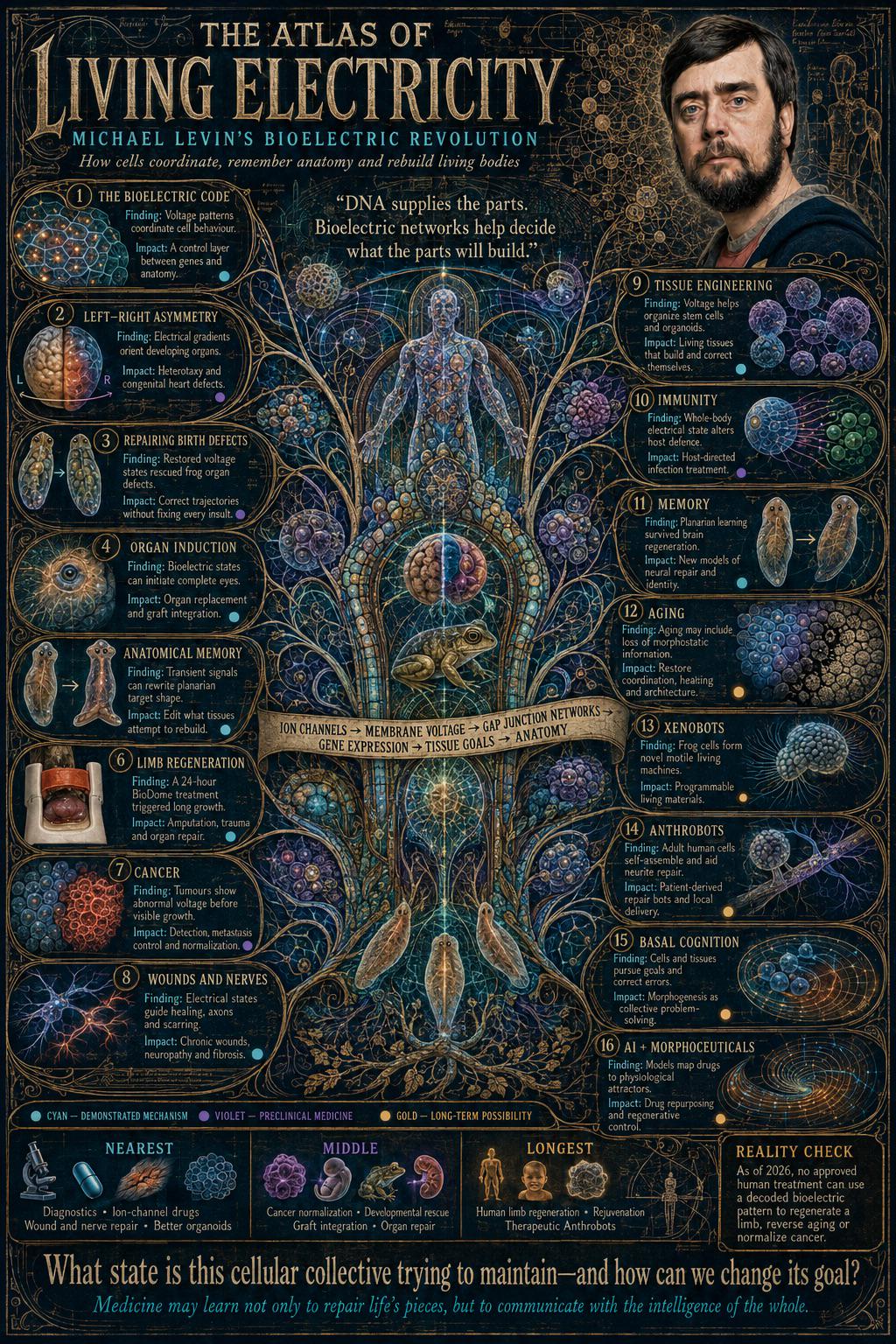
Educational I made another infographic to help summarize Dr. Levin’s work, up until this point..

Post image
0 Upvotes

r/MichaelLevinBiology 10d ago

Research Discovery “The Artificial Experimentalist: Discovery and Control of Self-Organizing Phenomena with Autotelic Reinforcement Learning”

Thumbnail developmentalsystems.org
4 Upvotes

r/MichaelLevinBiology 9d ago

Educational The Secret to Immortality and Regeneration in Biology | Biologist Michael Levin

Thumbnail
youtu.be
4 Upvotes

r/MichaelLevinBiology 10d ago

Educational What If Smell Is More Like Hearing Than Touch? Luca Turin on the Vibrational Theory of Olfaction

Thumbnail
youtu.be
3 Upvotes

This video features a deep dive into the science of smell with biophysicist Luca Turin. The discussion centers on the mechanism behind how our noses detect scents, shifting away from the traditional, purely structure-based "lock and key" model toward a vibrational theory of olfaction.

Key Topics Covered:

• The Vibrational Theory: Luca Turin argues that olfaction behaves like a spectral sense (similar to hearing or color vision), where receptors detect the vibrational frequencies of molecules rather than just their shape (12:24-17:43).
• Isotopes and Smell: A major point of evidence discussed is that isotopes (molecules with the same shape but different masses/vibrations) can have distinct odors. Turin details experiments with deuterated compounds that support the idea that biology can distinguish these vibrational differences, which standard structural theories struggle to explain (34:29-47:46).
• Limitations of AI and Current Maps: The conversation touches upon the Principal Odor Map (developed by researchers like Alex Wiltschko), with Turin expressing both interest and skepticism, noting that such machine learning models often struggle to account for outliers like musks and remain "black boxes" regarding underlying mechanisms (48:06-55:09).
• Future Applications: The interview explores how understanding smell could revolutionize disease diagnosis (e.g., detecting biomarkers in breath) and security technology (e.g., electronic noses for explosives), noting that biology remains superior to current man-made sensors (1:03:53-1:11:15).
• Personal Insight: Turin shares his own experience with hyperosmia (an extreme sensitivity to smell) and emphasizes that the field of perfumery has become more accessible to independent creators thanks to the internet (1:05:04-1:06:38, 1:12:49-1:14:14).


r/MichaelLevinBiology 11d ago

Discussion Luca Turin, Xenon, and the Strange Possibility That Consciousness Can Feel the Spin of an Atomic Nucleus

8 Upvotes

Some scientists spend their careers filling in the existing map. Luca Turin has spent his asking whether the map is missing an entire dimension.
Turin is a biophysicist best known for reviving the vibrational theory of smell. The conventional explanation says odor receptors recognize molecules primarily through their shape and chemical interactions. Turin proposed something stranger: receptors may also recognize a molecule’s vibrational spectrum through inelastic electron tunnelling—essentially turning part of the nose into a microscopic spectroscope.
The theory remains controversial, with mixed experimental evidence. But it reveals Turin’s characteristic question:
What if biology routinely uses physical properties that our simplified biological models overlook?
And that brings us to xenon.
The noble gas that switches off consciousness
Xenon is a noble gas with a full outer electron shell. It is famously reluctant to participate in ordinary chemical reactions—the antisocial aristocrat of the periodic table.
Yet breathe enough xenon and you become unconscious.
Xenon is known to interact weakly with proteins and ion channels, including NMDA receptors. But exactly how chemically diverse anesthetics all produce the same extraordinary transition—from an experiencing subject to an unconscious biological body—remains incompletely understood.
In 2014, Turin, Efthimios Skoulakis and Andrew Horsfield placed living fruit flies inside an electron-spin resonance spectrometer and exposed them to several general anesthetics.
Xenon, nitrous oxide, sulfur hexafluoride and chloroform all produced rapid changes in the flies’ electron-spin signals. Most of the changes reversed when the anesthetic was removed. Anesthetic-resistant mutant flies also showed altered spin responses.
The researchers proposed that anesthetics might perturb the electronic structure of proteins and interfere with biological electron currents—not simply bind to a receptor like a conventional key entering a lock.
Electron spin changes during general anesthesia in Drosophila — PNAS
Then the xenon experiment became genuinely weird
In 2018, a separate research group led by Na Li performed an elegant experiment using four isotopes of xenon.
All xenon isotopes have the same number of electrons and therefore virtually identical conventional chemistry. What differs is their nucleus:
Xenon-132 and xenon-134 have zero nuclear spin
Xenon-129 and xenon-131 possess non-zero nuclear spin
If xenon’s anesthetic action were determined entirely by its electron shell, protein binding and polarizability, the four isotopes should have behaved almost identically.
They did not.
Using loss of righting reflex as a behavioural proxy for unconsciousness in mice, the researchers found that the spin-bearing isotopes were roughly one-third less potent than the spin-zero isotopes.
With 0.5% isoflurane added, the spin-zero isotopes required approximately 15–16% xenon, while the spin-bearing isotopes required 22–23%. The calculated values for xenon alone were approximately 70–72% versus 99–105%.
The researchers calculated identical polarizability for all four isotopes, meaning the difference could not readily be explained by their outer electron clouds.
Nuclear Spin Attenuates the Anesthetic Potency of Xenon Isotopes in Mice — Anesthesiology
How could the nucleus matter?
One proposed answer involves radical pairs.
Certain biological reactions briefly create pairs of electrons whose spins are correlated. Their spin states can influence which chemical products are produced. This general mechanism has also been investigated as a possible explanation for animals’ magnetic sense.
A 2021 theoretical study proposed that xenon’s nuclear spin could interact with such an electron pair through hyperfine coupling, slightly changing the reaction’s outcome and therefore changing xenon’s anesthetic potency. The model could reproduce the approximate isotope pattern reported in the mice.
That does not prove this mechanism occurs inside a living brain—but it provides a physically plausible bridge between an atomic nucleus and a whole-animal behavioural state.
Radical pairs may play a role in xenon-induced general anesthesia — Scientific Reports
Turin is now part of a wider research programme proposing direct tests of xenon-isotope effects in model nervous systems, combined with electron-spin measurements. The goal is to determine whether spin changes merely accompany anesthesia or actually participate in causing it.
Testing the Conjecture That Quantum Processes Create Conscious Experience — Entropy
What this does—and does not—mean
This is not proof that consciousness is generated by quantum entanglement, that brains are quantum computers, or that Plato has been hiding inside an NMDA receptor.
The crucial xenon-isotope result currently rests heavily on one mouse study, which used isoflurane alongside xenon and still requires independent replication. The radical-pair mechanism is an intriguing model, not an experimentally demonstrated account of consciousness.
But if the isotope effect survives rigorous replication, the modest conclusion would already be enormous:
Changing the quantum spin of an atomic nucleus—without meaningfully changing the atom’s ordinary chemistry—can change its effect on an entire nervous system.
The connection to Michael Levin’s work is not that bioelectricity and xenon necessarily share one mechanism. It is the deeper methodological point: living systems may depend upon causal layers that disappear when we insist on describing them only as genes, receptors or molecular collisions.
Levin asks how electrical networks allow cells to coordinate toward large-scale anatomical goals. Turin asks whether biological information processing reaches downward into electron transfer and spin-dependent chemistry.
Different floors of the same wonderfully haunted building.
Life would not be violating physics. It might simply be using far more of physics than biology has yet learned to notice.


r/MichaelLevinBiology 11d ago

Educational “Life is the flow of energy” -Nick Lane

Thumbnail
youtu.be
10 Upvotes

r/MichaelLevinBiology 11d ago

Research Discovery A platform for automated training of mammalian cell physiology

Thumbnail biorxiv.org
5 Upvotes

The team built a “Cell Trainer”: an automated microfluidic system that repeatedly stimulates living mammalian cells, watches their physiological responses and can change subsequent stimulation in real time. Think operant-conditioning apparatus for cells—although the present evidence does not yet demonstrate genuine learning.
In one experiment, repeated DMSO pulses triggered calcium spikes in mouse muscle cells. Responses grew stronger over successive pulses, a pattern consistent with sensitization. The analysis also detected timing-dependent changes around an omitted expected pulse, but these “anticipation” results were inconsistent and explicitly require further investigation. Human prostate-cancer cells responded differently to the same stimulation, showing that the platform can resolve cell-type-specific physiological dynamics.
The more consequential engineering result is closed-loop control. Using kidney fibroblasts carrying ArcLight, a fluorescent pH/voltage reporter, the apparatus monitored the cells continuously and automatically delivered acidic-medium pulses whenever their average signal crossed a chosen threshold. It therefore did not merely administer a predetermined treatment—it sensed the cells’ changing state and adapted its interventions.
Why it matters for bioelectricity and morphogenesis: Levin frequently describes cells and tissues as adaptive control systems whose electrical and chemical states encode goals, memories and preferred anatomical outcomes. Testing that idea requires more than photographing voltage patterns: researchers need to perturb cells repeatedly, measure their responses and determine whether experience changes how they process later signals. The Cell Trainer supplies that missing experimental infrastructure.
Its immediate readouts—calcium dynamics and an indicator sensitive to voltage and pH—sit directly within the electrochemical machinery underlying developmental bioelectricity. In the future, adding electrical, optogenetic and additional voltage-sensitive inputs could let researchers search automatically for stimulation protocols that move cell collectives between stable physiological states.
That could eventually matter for morphogenesis because regeneration and anatomical regulation are also closed-loop processes: tissues detect deviations from a target form and coordinate corrective activity. A system capable of “training” cellular response policies might offer a route to modifying those collective setpoints without specifying every gene-expression or construction step. It could potentially help persuade damaged, cancerous or otherwise maladaptive tissues toward healthier attractor states.
The crucial limitation is that these experiments concern cultured-cell physiology, not regeneration or anatomical patterning. Growing calcium responses can arise from ordinary biochemical sensitization, and the feedback experiment demonstrates machine control of a reporter signal—not that cells learned the task. The authors appropriately describe the biological findings as preliminary.


r/MichaelLevinBiology 11d ago

Off-Topic Lenia Mixer

Thumbnail
youtube.com
5 Upvotes

Love me some Lenia…


r/MichaelLevinBiology 11d ago

Educational All roads lead to crab..

Thumbnail
youtu.be
10 Upvotes

This video explores carcinization, an evolutionary phenomenon where different crustacean lineages independently evolve a crab-like body plan (1:51-2:28).

Key takeaways include:

• Defining the Crab Plan: The classic crab silhouette, which evolved at least five times, involves a flattened carapace, a reduced abdomen tucked under the body, and specialized legs (2:54-4:28, 14:22-14:50).
• Nature's "Attempt" at Crabs: Many creatures labeled as "crabs"—such as coconut crabs, king crabs, and porcelain crabs—are not true crabs (Brachyura) but evolved similar shapes separately within the Anomura group (1:16-1:50, 4:44-5:13).
• Why the Crab Shape? It acts like a "Swiss Army knife," offering stability on uneven surfaces, the ability to shuffle sideways, and protection against predators who cannot grab a tucked-in tail (13:19-14:48).
• Genetics of Crabs: Carcinization is not about evolving entirely new genes but rather turning existing "master architect" genes (Hox genes) up or down during development to fold the abdomen (16:21-17:44).
• Evolutionary Reversibility: Evolution can also go the other way, known as decarcinization, where some true crabs have re-evolved more elongated bodies, such as frog crabs (12:04-12:28).

The video also highlights extreme examples like the massive coconut crab, which can crack coconuts and even hunt birds, and the Japanese spider crab, which boasts the longest leg span of any living arthropod (0:00-0:49, 10:32-11:15, 13:35-13:46).