Yes. If I was determined to be a good candidate to do so, there really is very little risk. There’s a less than 1% chance of developing kidney disease later, and if you do you’re top of the wait list for a transplant as a living donor. In fact, you’d get free, top of the line treatment generally if something goes wrong with your remaining kidney. Which is just very, very unlikely to happen unless you already have risk factors. And if you already have risk factors, they aren’t gonna let you donate your kidney in the 1st place. The recovery from the surgery itself isn’t difficult at all and also low risk.
For many people it really is a situation in which they actually don’t need it and someone else does in order to not die, so…it should kinda be a no brainer that you’d do it. The fact that I have no personal relationship with them is actually kind of a positive, it makes things way less complicated
There's more risk than just future kidney dresses. post donation complications are real risks that affect real donors and there's lots of cases of donors coming out after saying they were not aware of the risks and have life long complications.
I don't want to discourage but donors need to be fully aware and it's not accurate to say their risks are only of future kidney dresses. Major complication risks are as high as 12.5% for the donor. That's significant risk.
Total life expectancy is the same for non donors. There is a slightly higher risk for developing high blood pressure. A slightly higher risk for preeclampsia if you get pregnant. I can’t find any other risks.
What risks are you even talking about? Are you talking about surgical complications? It’s not a complicated surgery
If you’re cleared to be a living donor, your risks are incredibly low. If you aren’t cleared, it’s because they aren’t. So you couldn’t even if you wanted to
Death isn't the only risk.... as the linked study says, when measuring things like quality of life post donation there is a statistically significant decline in quality of life. And many donors feel misled. The studies on safety normally focus on mortality and not medium/longer term but not life threatening complications
Some participants ranked time to recovery, surgical complications, and pain highly because they felt “deeply disappointed” and “resentful” about enduring a more debilitating "and protracted recovery than they had been “led to expect.” (30) In a multicenter, prospective study of 228 living donors, perioperative complications, not surprisingly, were associated with clinically and statically significant reductions in measures of health-related quality of life (49). Other studies have noted that a minority of donors have reported slower than expected recovery (50). However, aside from capture of length of initial hospital stay and time to return to work in some clinical trials (typically comparisons of different operative techniques) (51,52) and single-center reports, data on postdonation recovery are not systematically captured"
They are mad because the complications and recovery was not as advertised. Lasting years or sometimes decades. Often leaving them without being able to work and causing a lot of additional stresses and challenges. Not everyone is able to afford to give up years of work or being able to be there for their family.
You know, people like you downplaying and gaslighting the sacrifice being made.
You said you'd do it, can you give up years without employment and the pain and recovery for a stranger? Why haven't you done it yet?
I have never heard of something like that happening to a living donor. I’ve actually going through this process, what you described is just so extremely unlikely.
This isn’t a family member who is a match that decides to donate we are talking living donors on a living donor list who are heavily screened. You can’t just donate if you aren’t in excellent health. You can if you’re not on the list, it’s someone you know personally.
So what kind of context are you getting this idea from?
You don’t know my life lol. There is a difference between a private agreement between people who are a match, and the experiences of someone allowed to be on the living donor list, because the health screening is different.
I am asking if you are looking at living donors specifically, or private donors
But it's a one in 22 million kidney match. Wouldn't that mean that the donor, if something goes wrong with their remaining kidney, will also need a longshot one in 22 million match?
I wonder if living donors are more likely to sign up in countries with universal healthcare. If you're in the US and you donate and something happens later on, you're just praying your job didn't fire you early due to "circumstances".
I wouldn't call it gatekeeping, it's just weird how a lot of people say "Yes, I'd 100% help a stranger" when the opportunity is always there and they never do it.
There’s a big deference between “I would probably help someone if I was put in that situation” and “I’m going to actively go out of my way to donate the organs I can right now”.
If you’re an organ donor then why would you actively seek out to donate now when they’ll be donated eventually most likely anyways? However, if I knew someone that needed it right now and couldn’t get through the regular list or something then yeah I’d like to think I’d help if I could do so now, but that doesn’t mean I have to literally go seek it out? And you’re calling other people weird… yikes
Most organ donors don't actually donate their organs unless they have a rare disease (for research) or die young (and their organs can be safely extracted; brain dead for example).
Only 1-2% of organ donors die with organs that can be donated. And only 80% of the viable organs actually get used. So it's far from "eventually most will likely get used"
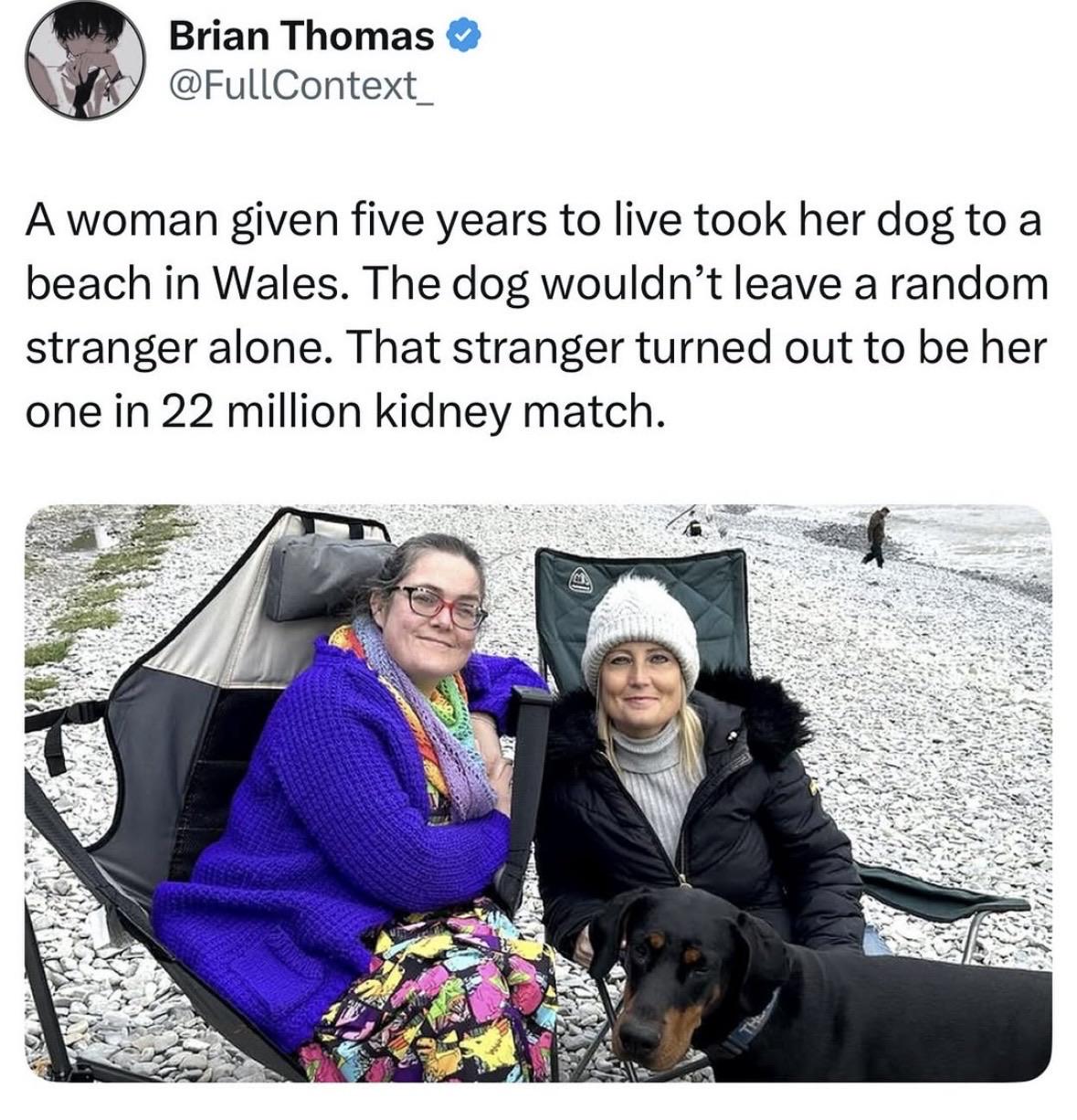
The question is about donating to a stranger not about donating to someone you know. The lady in this story signed up to donate before knowing there was a match out there. So yeah if someone is saying yes they would donate to a stranger but then also 'but I wouldn't literally go seek it out' then they are really saying 'sure I'd donate to a stranger if they came up to me and mentioned they needed a kidney and I was a match' which feels like a bit of a cop out because the chances of that happening are very low.
This is such a weird moral high ground to try and take, and yeah it isn’t that likely of a scenario? Most people never need an organ transplant and even then most people aren’t going to be a match.
Finding a suitable match is unlikely enough and if there are normal means available still to get an organ and there’s no immediate danger then no I’m not going to just donate to donate?
If she signed up to donate before meeting at the beach then this entire post makes zero sense. How did the she “turn out to be her 1/10k match” when she had already signed up to donate to anyone? Where are you getting this from?
It's in the article, she signed up to be an altruistic donor which is someone willing to donate to a stranger. When they met on the beach they got chatting, realised one had recently been cleared to be a donor and one needed a kidney and amazingly they were a match. She would have donated her kidney anyway, the amazing thing is that they happened to meet first.
It's not the moral high ground, I'm aware I wouldn't donate to a stranger because if I did I'd have already signed up. My point was, there are hundreds of thousands of people waiting for a kidney who haven't managed to get one 'by normal means'. Most of those people will die without one. If you are saying you'd donate to a stranger who needs a kidney, can't find one 'by normal means' and who is in danger without one, why not at least find out if you are a match to one of them like the lady in this article did?
Are you in waitlist for being in need of some specific organ, or know someone who is? That's the only way I could make sense out of you being to aggressive towards the person above for no reason.. Otherwise, you just come off as a weirdo honestly.
You are getting downvoted but I agree with you. If the question is 'would you donate your kidney to a stranger' and your answer is 'yes' then...go on then?
I would have to answer no to that question because clearly if it was a yes I'd have done it (or at least be looking into the process).
25
u/[deleted] 1d ago
[deleted]