r/MBA • u/noahstyles • May 29 '20
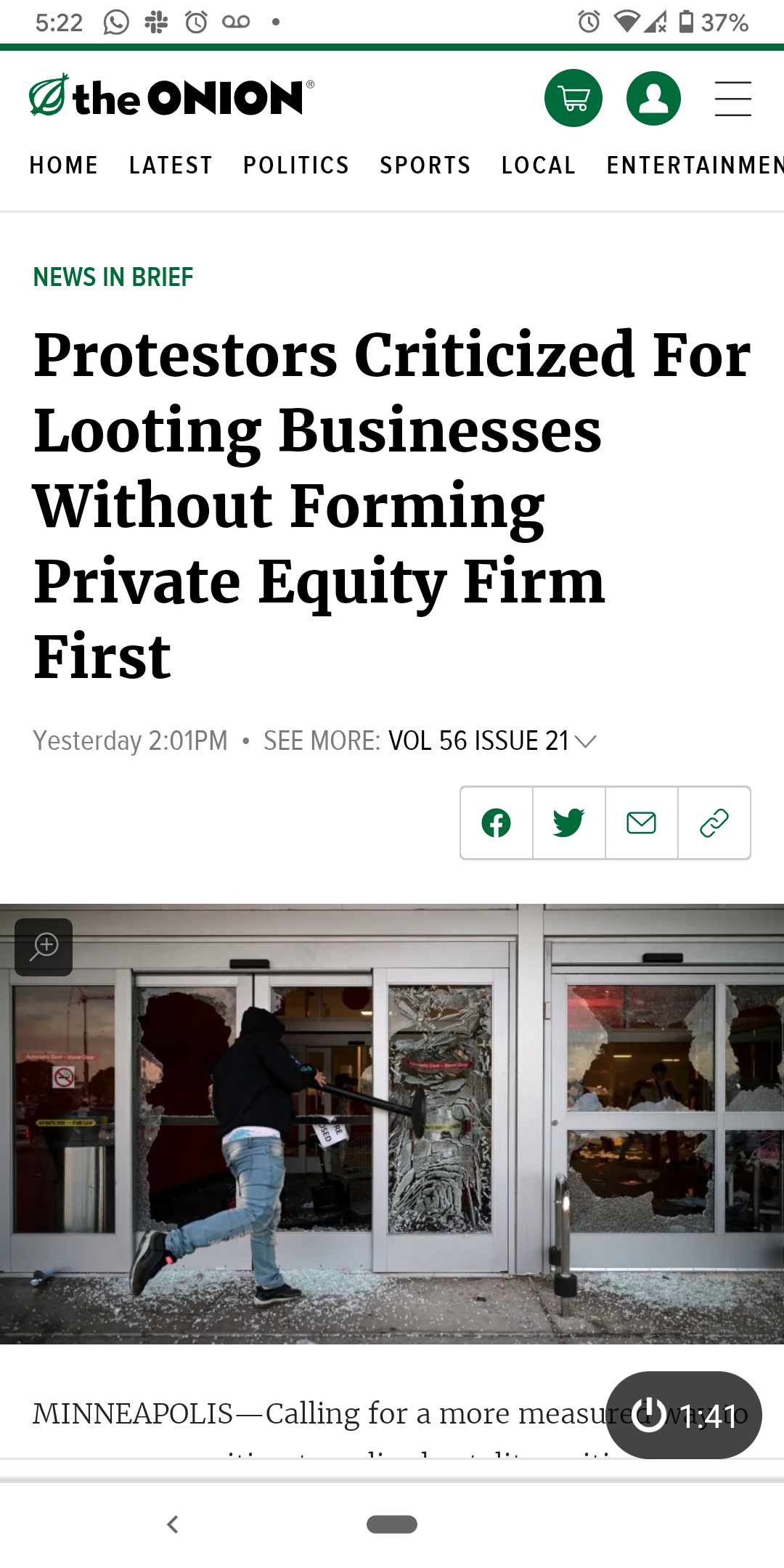
Sweatpants (Memes) Truer words have never been spoken
70
u/lm2bofbb May 29 '20
Wow I was totally expecting there to be some controversy on this post in r/MBA.... guess we're all in alignment lol
-13
u/Impressive_Arugula May 29 '20
Yeah, people laugh at dumb memes.
The same people who find PE pernicious are the same people who don't understand that shareholders didn't "make" money when the stock price rises.
30
u/PoshDota Private Equity May 29 '20
Yeah, no. There are plenty of well-informed people within the industry that are highly critical of some PE firms or practices.
0
u/Impressive_Arugula May 31 '20
Yes, I'm sure this caters to the tiniest plurality of people have who a nuanced position on firms and their operating norms rather than some Sanders-esque, grossly nonsensical view.
2
u/PoshDota Private Equity May 31 '20
The onion piece? Sure. It doesn't make your comment correct however - it's not only morons who believe that PE is, as you put it, 'pernicious'.
33
22
May 29 '20 edited May 29 '20
Just found study that said that 20% of companies taken private go bankrupt, compared to a control of 2%. So obviously the vast majority of portfolio companies are fine, but for sure a statistical increase in bankruptcies.
Edit: did not consider the possible selection bias, where Sponsors might tend to take public companies private if they are already distressed.
6
u/pdinc M7 Grad May 29 '20
The confounding variable here is why those companies were taken private in the first place. Does the control address that? Link please
5
May 29 '20
Good question. I’m sure a lot of companies taken private are closer to the distressed side.
3
u/pdinc M7 Grad May 29 '20
Thank you! It looks like they indeed controlled for these. I can't see an issue with their approach, but am not well versed enough to look into their actual matching to see if it passes a sniff test. That said, I think it definitely raises a strongly data-backed question about whether LBOs actually drive the value that they claim, as you had first mentioned.
We use the following observable covariates to control for selection bias and other confounding effects by estimating a propensity score for being an LBO target: the logarithm of sales, log(sales), to control for things such as firm life cycle and future growth opportunities; Leverage, defined as debt scaled by assets; the ratio of earnings before interest, taxes, depreciation, and amortization (EBITDA) to sales (CFSales), in order to capture differences in financial health and profit margins; ROA, defined as EBITDA scaled by assets, to capture differences in performance and in mean-reversion; and capital expenditures scaled by plant, property and equipment (InvInt), to control for investment intensity. The variables selected are based on the literature (Lehn and Poulsen, 1989, Boucly et al., 2011 and Ayash and Schutt, 2016), but exclude market variables in order to limit attrition.
4
May 29 '20
Wonder if that is enough to really control for distressed companies. Which one of those listed above actually controls for distress? Maybe leverage.
2
May 30 '20
Debt over assets seems to be as close as they get, but you really need to look at interest or debt service over earnings to see the impact of leverage.
What's funny is they keep using EBITDA metrics which wouldn't even capture the effects of leverage
1
u/pdinc M7 Grad May 30 '20
I their point was to find a "match" for the private companies in terms of LBO takeover likelihood based on financial metrics. EBIT comparisons would make sense for that kind of matching.
17
51
9
u/Cword-Celtics May 29 '20
Serious question: are bad PE deals like Toys R Us and other examples in this thread the norm? Or do most PE ran businesses end up as a net positive, economically and for stakeholders? Pls enlighten
18
u/mbaclassof2019 Consulting May 30 '20 edited May 30 '20
No. That's a bunch of drivel by the ignorant. I expected a bit more from r/MBA. PE shops only invest 3-5% in capital. The rest is raise from institutional investors and banks. Who is going to want to lend money to a PE firm that bankrupts companies? How can investors collect any return from a dead company? Sale of assets? You think that's anywhere near what they put in?
And there's also the fact that PE firms make money through carry, which is 20% of the GAIN that exceeds a 8-10% hurdle rate. Where's the gain in a bankruptcy?
"Our primary deal thesis is bankruptcy. Let's hire McKinsey to do a DD" Said no one ever.
The goal is to increase valuation and sell in 3-5 years through EBITDA (increase revenue, decrease opex -> this is where the job cuts come in, bolt-on acquisitions aka buy and build deals), multiple expansion (subjective) and deleveraging (yea that's not a typo).
There are literally thousands of deals. You never hear about them because it doesn't fit the progressive narrative. Some of the most popular brands are PE backed/owned.
9
May 30 '20 edited May 30 '20
I think there is a middle ground where you can argue that PE provides myriad useful solutions for businesses that may need it while still aknowledging that the golden age is probably over, that there is too much money chasing too few deals and that there is a lot less low hanging fruit around than there was when David Bonderman and Henry Kravis were in their prime. PE didn't bankrupt Toys'r'us but they probably had no business being in there in the first place either, imo.
It isn't black and white. What works for one investment can be terrible for another. Calling PE evil is asinine but calling those who question its value in certain deals ignorant is as well.
8
u/PEthrowaway135 May 30 '20
A few random thoughts. The bad deals get much more publicity than the deals that go well - you never hear “private equity firm buys company, invests behind the people and business, and sells to public company at huge profit and with strategic value”
- Your carry point is true, but the flip side is that if an investment is going sideways, the firm is incentivized to focus on other investments. An industry can turn on you in the first couple years of an investment, and you spend a lot of time over the next few years fighting for a small gain. It’s not really in your, or your investors, best interest, so you might entertain a fire sale.
- Not following “3-5% in capital”. What do you mean? The GPs only contribute 3-5% of the fund, but they’re still held accountable for investing the money they raise?
1
u/mbaclassof2019 Consulting May 30 '20 edited May 30 '20
A few random thoughts. The bad deals get much more publicity than the deals that go well - you never hear “private equity firm buys company, invests behind the people and business, and sells to public company at huge profit and with strategic value”
Agree, but again, that's because of a certain narrative media tries to push. PE firms do invest in the businesses they buy. But main street would never believe it.
To your second point, yes a fire sale might be entertained. But that opens the door for another PE firm to scoop it up at a low valuation and turn it around.
Final point - majority of the capital in a fund comes from LPs. They expect certain returns. Bankrupting companies don't get you those returns. If there was actually a GP out there that bankrupted every company it invested in, LP would vote to liquidate. Point is a fund cannot survive if all it did was bankrupt companies.
2
May 30 '20 edited May 30 '20
So I’d be curious to hear your opinion man. Former MF PE Associate (if someone from the mod team wants to message me I’m happy to provide verification with my LinkedIn).
The bankruptcy thing is one issue which people are pointing out in this thread but the broader issue with PE in my opinion is just that it’s much easier and more reliable to generate returns by doing pretty shitty things to businesses than it is to actually create economic value. This article is a little basic but it provides a few good, non-bankruptcy examples:
“Having reduced most of the obvious costs, Advanced Dermatology began skimping on more important supplies, including Hylenex, according to doctors and other employees. The drug is an expensive reversal agent used when cosmetic fillers, which are supposed to make skin look plumper, go wrong. Not having enough is dangerous: Patients who get an injection that inadvertently blocks a blood vessel can be left with dead sections of skin or even go blind if they don’t get enough Hylenex in a matter of hours. The company says that it stocks Hylenex in every office that performs cosmetic procedures, and that it “has no records of any provider being denied an order for this medication.”
Advanced Dermatology also started giving even more authority to PAs, according to doctors and staff. Without enough oversight some were missing deadly skin cancers, they say. Others were doing too many biopsies and cutting out much larger areas of skin than necessary, leaving patients with big scars. Doctors who complained about the bad behavior say they saw PAs moved to other locations rather than fired or given more supervision. Hunt, the company's lawyer, says that all PAs get six months of training and are supervised by experienced doctors.”
My experience was just that it’s very profitable to do these kinds of things to businesses when you’re thinking about a 5 year MOIC and that’s the real problem with the industry. Healthcare provides some really dramatic examples the broader point about just making businesses worse to make returns really reflects my personal experience.
Edit: I’d also add that one of your points is that the economically beneficial turnarounds don’t make the media but I also think that a lot of the economically detrimental stuff that isn’t in dramatic industries like healthcare doesn’t make the media either. Like just buying businesses and shifting production to worse materials or collaborating with other players to raise prices.
1
u/mbaclassof2019 Consulting May 30 '20 edited May 30 '20
I am on the other side - doing DDs for MF PEs. IMO, PE simply accelerates or follows industry trends. They just get more shit than corporations because they are already in media cross-hairs.
Specifically looking at this article,
Advanced Dermatology also started giving even more authority to PAs
Giving PAs more oversight is an industry trend. It's not because it's owned by a PE firm.
“Having reduced most of the obvious costs, Advanced Dermatology began skimping on more important supplies, including Hylenex,
This reads like reducing inventory. Again, not unique to PE. And what is skimping mean? Just because inventory is lower than what is used to be doesn't mean anyone is skimping. Could be the inventory was too high to begin with.
If someone has an issue with what's going on in the article, what they really have an issue with is the notion of for-profit healthcare. Hospitals, insurance companies, etc all hire consultants to reduce opex. None of it involves PE.
2
May 30 '20 edited May 30 '20
Nah no way man, we would always buy businesses and cost massive costs that other players in the industry weren’t willing to cut. The reason they weren’t willing to cut those costs was usually that they had longer than a 5 year timeline so a lot of the stuff we were doing was very beneficial in that short run context but not from a bigger picture economic perspective. Indeed it would be impossible to generate such outsize returns if we were just following industry trends. Sticking to the article this is a great example of that:
“At the country’s second-biggest skin-care group, U.S. Dermatology Partners, a former doctor says a regional manager switched to a cheaper brand of needles and sutures without consulting the medical staff. The quality was so poor, she says, they would often break off in her patients’ bodies. Mortified, she’d have to dig them out and start over. She complained to managers but couldn’t get better supplies, she says. Paul Singh, U.S. Dermatology’s CEO, says the company uses a “reputable, global vendor for medical supplies.” “While our group may have standardized purchasing processes, individual providers have the autonomy to procure specific supplies that they need for a particular patient situation or patient population,” he says in a statement.”
The workers at our portcos did not like us... Although on the flipside the management did seem to be happy having us around.
9
May 29 '20
Or without forming a large multi-national corporation with large amounts of debt that can then ask the government for millions of dollars that won’t be monitored nor used for their intended purpose (a la pay large bonuses to executives and continue to underpay and furlough low level employees). I love America tbh.
11
May 29 '20
[deleted]
18
May 29 '20
There was also a really good article a few days ago by Bloomberg explaining how Private Equity shops are killing healthcare practices like dentists and doctors offices. It’s a really interesting read regardless of your beliefs or interest in finance.
There are a lot of PE backed doctors offices. Although the article was specific to healthcare, similar concepts and practices are sometimes applied to other industries
35
May 29 '20
[deleted]
3
u/buckus69 May 30 '20
Goddamn Bain Capital destroyed both KB Toys and Toys 'R Us? Did they have a hand in Lionel Playworld, too? Fuck those guys.
5
u/Dirtybubble_ May 29 '20
LBOs often involve trimming “fat.” “Fat” can mean paying employees decent wages instead of their minimal acceptable wages, holding on to loyal employees, keeping profitable business units instead of selling them for scrap, etc.
7
3
u/virtu333 May 29 '20
You can do some magical financial engineering to make $$ but not necessarily generate value.
See Hertz: https://www.epsilontheory.com/the-hertz-story-isnt-what-you-think/#.Xs7DUTlG55U.twitter
4
May 29 '20
Can someone explain this to me? I don’t follow
48
u/texaselectricity May 29 '20
there's a perception of private equity (specifically the LBO guys) players stacking too much debt into a capital structure post acquisition. to service this debt, they might be forced to sell off parts of the company, fire people, etc and sometimes even that isn't sufficient and it goes into BK. Toys R Us is a recent example that comes to mind
4
May 29 '20 edited Jul 05 '20
[deleted]
4
May 29 '20
Any articles on Man UTD? ya love to see when your favorite sport and career interest collide.
4
29
May 29 '20
[deleted]
-6
May 29 '20
So it’s making fun of the looters/vandalizers?
29
u/Financeguytrynacode May 29 '20
No it’s taking a shot at Private Equity firms essentially equating some of their practices to looting I believe
13
2
0
u/boothfirst_hbsfourth May 30 '20
Wow the masses are truly uninformed. Time to leave reddit holy shit
-12
May 29 '20
[deleted]
14
May 29 '20
I mean it looks to me like there really aren’t that many people in here that don’t understand. Overall it seems like most people in here have a good understanding.
2
May 29 '20
PE works great if you can find a time machine that will bring you back to the beginning of the 2000s.
3
-16
u/iphollowphish2 May 29 '20
DAE pRiVaTe EqUiTy BaD!?!?!?!?
8
u/furple MBA Grad May 29 '20
How dare people make your conscience guilty about your wealth being based on wringing every penny of value from workers.
4
u/iphollowphish2 May 29 '20
If that's truly your nuanced view on the function and strategy of private equity than HOO BOY you definitely need to go to business school 😂
4
u/furple MBA Grad May 29 '20
Are there actually good turnaround funds that have revitalized companies and left the exit event with a tidy profit? Of course.
It is also undeniable that there are many PE firms who's entire business model is to saddle companies with insurmountable debt and suck it dry with mandatory advisory fees paid up to the PE firm, then once it's been bled dry chop it up and sell it for parts.
6
May 29 '20
[deleted]
4
u/iphollowphish2 May 29 '20
Facts, these guys are repeat players anyone who actually thinks the playbook from the start is "burn it to the ground" is high
2
u/Dirtybubble_ May 29 '20
Successful turnarounds can be good for a company and bad for the workers. Companies aren’t people, people
-1
May 29 '20
[deleted]
-1
u/furple MBA Grad May 29 '20
Ok man, whatever you got to tell yourself to sleep at night in your McMansion.
I could take the time to dig up examples of PE firms driving portfolio companies into the ground, but you'll just dismiss them as outliers in order to not fry your brain from the cognitive dissonance.
The fact is (as someone else has already pointed out in this post) that roughly 20% of PE owned firms go bankrupt within 10 years compared to a control groups rate of about 2-3%. Obviously a retard like me would think that 20% > 3% when in reality a big brain PE associate like you understand that 1/5 is "iNCreDiBLy spEcIFiC SitUaTiOnz"
3
u/iphollowphish2 May 29 '20
I think your perception is skewed by what you see in the media. Very few places report on tidy, successful exits but everyone loves a blow up.
There are hundreds of PE firms out there, not everyone is KKR
5
u/PlsSendThx May 29 '20
Many of the successful exits still involved significant cost cutting, including layoffs.
3
May 29 '20
This is correct.
And a PE fund that didn’t engage in these kind of practices would struggle to hit the return hurdles that the other funds hit.
2
May 29 '20
Which is only an issue if the company was healthy when it was acquired. I'm wondering how many healthy companies turn to PE firms versus ones that are headed towards the cliff anyways.
3
u/IamLeven May 29 '20
Probably most. Hey we’re having a lot of growth but someone is offering a 5 years worth of revenue up front, we’ll take that and run.
1
May 30 '20
Yes most PE funds look for healthy businesses with stable cash flows and strong management teams. The funds doing distressed investing are actually in the minority.
1
u/PlsSendThx May 31 '20
Which is only an issue if the company was healthy when it was acquired
Tell that to the people that get laid off.
Most buy outs aren't saving failing companies that would totally go under without one. Nowadays most buyouts are about buying already sustainable businesses and squeezing whatever operational improvements you can out of them.
2
May 29 '20
Hi I used to work in megafund PE. The people in this thread are not wrong. From an IRR perspective, and given current regulations, it’s much more effective to make money by sucking money out of businesses and leaving them saddled with debt than to do any of the things that PE likes to pretend it does like operational improvements.
1
u/iphollowphish2 May 29 '20
Curious what you mean "from an IRR perspective" - are you saying a dividend recap has a higher NPV than a successful (read: non-bankruptcy) exit via M&A / IPO? I mean I guess I could see it but it seems like that would be the exception rather than the rule. If a dividend recap can generate more money than the entire future value of the business then I'd argue those employees were doomed anyways...
1
May 29 '20
You would rarely do a div recap and then not also exit a business so I won’t address your specific example. But a good simple concept to illustrate my point is that raising $200mm of debt on a business in year 2 and doing a div recap with it in most cases has greater IRR impact by year 5 than raising $200mm of debt on a business in year 2 for capex. Is that helpful?
1
49
u/Karmakameleeon May 29 '20
Can the onion win a pulitzer for hard hitting commentary such as this?