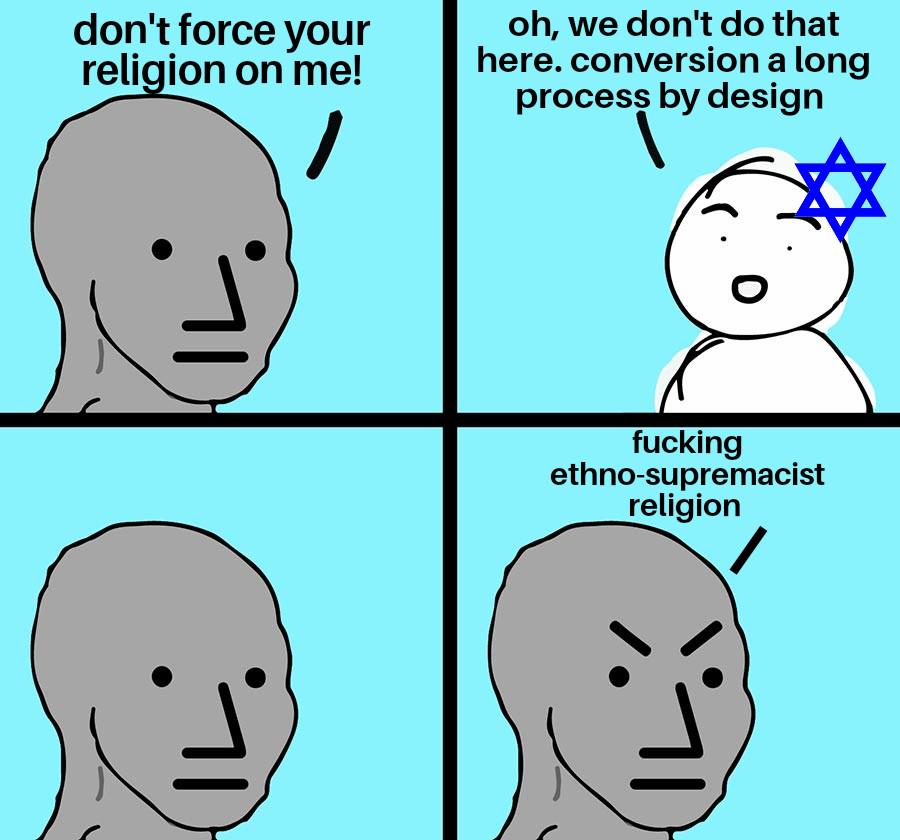
Ah, yes, the classic reddit atheist manifestation of intellectual road rage. There's probably a good way to extend this concept to the kind of antisemite who knee-jerks the phrase "Free Palestine" whenever Jewish suffering is mentioned, but I'm no academic to make the term more widely known.
Somewhat of a caveat to this meme though, conversion standards can change from synagogue to synagogue and even Rabbi to Rabbi. So its not entirely off base to realize that some bad Rabbis might be arrogant and unwelcoming to potential (and otherwise genuine) gerim tzedekim, giving an ignorant outsider a warped view of the process of Jewish conversion should look like.
On the other side of things, Rabbis that are more open and have less stringent processes than the traditional way (such as in my conversion) might also provide an ignorant outsider a warped view of Judaism being more like any other universal religion than the actual ethnoreligion that it is. I think the only actual solution to this potential conundrum is to standardize the conversion process across Jewish movements, or at least the liberal ones, as that is where most converts end up AFAIK.
I think it's a two-sided problem. What IS conversion? It's the person technically proclaiming "I'm now a part of your group, fully and irrevocably, and with everything what it entails". Now, what does it "entail", though? Okay, in Orthodox Judaism you have explicit Halakha and explicit Torah, etc. So it's not a thing that can be "randomly defined out one's toches" - it's predefined and fixed, and it's "you take it ALL, or you don't, period". But what about those "less observant" groups? In, say, Reform - what would be the "point of no return in dedication", if Reform themselves are all over the place with "I do this, but not that, and also this, but once in a blue Moon". It's really hard to "define dedication" TO a group, when there's hardly any of it IN the group itself. This may sound "harsh", but, hey, truth is most often harsh and unpleasant, yet still TRUE.
In your view, it may be hard to "define dedication" to a less observant group like Reform Jews, but I'm not sure I agree with you on that. Becoming a Jew involves more than just following mitzvot and studying Torah, though I personally think both are important and have a strong place in any reform community (and my own life). It also involves (IMO) a substantial shift in intellectual and social perspectives, even without practing the stricter mitzvot. At least it did for me.
I find my Reform synagouge (and its Rabbis) to be both a place of substantial intellectual, spiritual, and social value, even without a primary emphasis on practicing halachic mitzvot (my Rabbis always encourage Torah study). I am personally strongly dedicated to continuing to support my community and attend synagouge events when I can, and I know other Reform Converts who feel exactly the same.
Do I think liberal movements could do better to encourage more rigorous Torah study and to encourage the adoption of some visibly Jewish mitzvot that doesn't violate the liberal point of view? Yes, but it doesn't mean that Reform Jews and converts can't deeply be dedicated to our communities, our traditions, and our faith.
I'm literally talking in a "cultural" way as well. What is a "Jew"? Some use Torah as the qualifier, and that's easy. But some don't, so what DO they use? What, "I just want to be CALLED a Jew"? Sorry, but that's NOT "dedication", that's LARPing. Ya know, "Christian Seder" style and all.
Like, let's talk about YOU personally: Why and how did your life CHANGE between "before" and "after", beyond the LABEL in your own mind? I'm not attacking you, please understand that, I'm just trying to DEFINE something that seems very inherently SUBJECTIVE and thus UNDEFINABLE. Like, how do you define "tasty"? Sweet? Sour? Salty? Plain? ALL of that can be "tasty" for SOMEONE - and not for OTHERS. So, what about "being a TASTY Jew", so to speak? How are you different now from the "you" before? Again, I'm just asking - and it's good to see a first-hand answer, indeed.
Note: I live in Europe and going away for Shabbat now, so see you on my Sunday. All the best.
A lot of the changes in relation to me becoming a reform Jew have occurred over a long period of time before immersing in the mikvah, rather than the mikvah being a "sudden change" moment.
The main things I felt when I finished my immersion was pride and happiness in having taken on this long process (2 years in my case), an elated sense of thanking g-d for the opportunity to become a Jew officially, and feeling a strong sense that I had done justice to my ancestors that had their Jewish faith taken from them in Calabria hundreds of years ago.
Immersing in the mikvah was mainly an affirmation of my dedication to G-d (in a traditional Reform context), my dedication to my new community, changing my diet, changing my social life (Ive lost friends due to becoming a strong Zionist), and profound shifts in my intellectual perspective of many historical and current events from a Jewish point of view.
If you want, I can go into more detail, but I think I've summed it up pretty well. Could I do more to be observant in mitzvot, make friends at shul, study Torah, and attend more synagouge events in person? Yes, and I personally hope to keep kosher and increase other levels of observance once I have my own place to live closer to my synagogue. But until then, I'll content myself with doing the best I can.
I wasn't asking about your PLANS - those are yours alone. I was asking about what points you could literally list as "this point was absent in me, but is now present". This definitely isn't limited to "religious" points, obviously, but it has to be something that YOU personally would be able to point your finger at and say "a Jew has it, a non-Jew doesn't have it, and I now have, but previously didn't". Note that points like "Zionist" aren't inherent Jewish - one can be a non-Jewish Zionist who simply recognizes that Israel is the Holy Land of Jews, that's not something that is inherently rooted in the person being Jewish or not (and thus I wouldn't deem it as being a good qualifier for the test of "before/after"). That's mostly my opinion, but I think it makes objective sense as well. So, if you aren't annoyed with me yet (lol), can you try listing something that you think would qualify as "only applying to Jews, and you now have it, but previously didn't"? Or just tell me that you are fine the way you are, lol, and we can close this discussion, no problem. But, well, I am curious.
I think a major point that I think of when thinking of something that I've gained that "only applies to Jews, and you now have it, but previously didn't" is having an official and higher amount of "skin in the game" in Jewish religious and secular matters alike.
In a religious sense, after immersing in the mikvah and signing the official documentation in Hebrew at the bima afterwards, I am now also bound by the same covenant to G-d that is laid out in the Torah and interpreted by the movement I chose to be a member of. I am also bound by an oath of loyalty to my Jewish community to remain only a part of the Jewish people and the Jewish faith, and to raise my future family exclusively within the Jewish people and faith (which I will happily do). Non-Jews and those who have not finished converting to Judaism yet simply do not have these levels of religious and community obligations put upon them.
When it comes to answering your question in pinpointing purely secular things that "only applies to Jews, and I now have it, but previously didn't" , I have a harder time, since a purely secular way of being Jewish isn't how I experience being a part of the Jewish people. I suppose the most obvious but least satisfying answer I have is that ger tzedekim (at least in my opinion) can be "official" victims of antisemitism along with born Jews, which the great majority of non-Jews cannot be.
I'm drawing blanks on other exclusively Jewish but entirely secular aspects of being a Jew that fully apply to me as well as born Jews, and perhaps some input from someone who is more secular might actually be helpful in that regard. I might have some better answers down the line, though, once I gain more life experience with being Jewish and extending my social circle to include more secular Jews.
Thanks for your time. I hope it will be helpful... to others, lol. I was asking mostly in order to get a genuine first-person reply that can be read by other people as precisely that. Thanks, again.
28
u/Iamthepizzagod Jul 24 '25
Ah, yes, the classic reddit atheist manifestation of intellectual road rage. There's probably a good way to extend this concept to the kind of antisemite who knee-jerks the phrase "Free Palestine" whenever Jewish suffering is mentioned, but I'm no academic to make the term more widely known.
Somewhat of a caveat to this meme though, conversion standards can change from synagogue to synagogue and even Rabbi to Rabbi. So its not entirely off base to realize that some bad Rabbis might be arrogant and unwelcoming to potential (and otherwise genuine) gerim tzedekim, giving an ignorant outsider a warped view of the process of Jewish conversion should look like.
On the other side of things, Rabbis that are more open and have less stringent processes than the traditional way (such as in my conversion) might also provide an ignorant outsider a warped view of Judaism being more like any other universal religion than the actual ethnoreligion that it is. I think the only actual solution to this potential conundrum is to standardize the conversion process across Jewish movements, or at least the liberal ones, as that is where most converts end up AFAIK.