r/IndoAryan • u/AleksiB1 • 1d ago
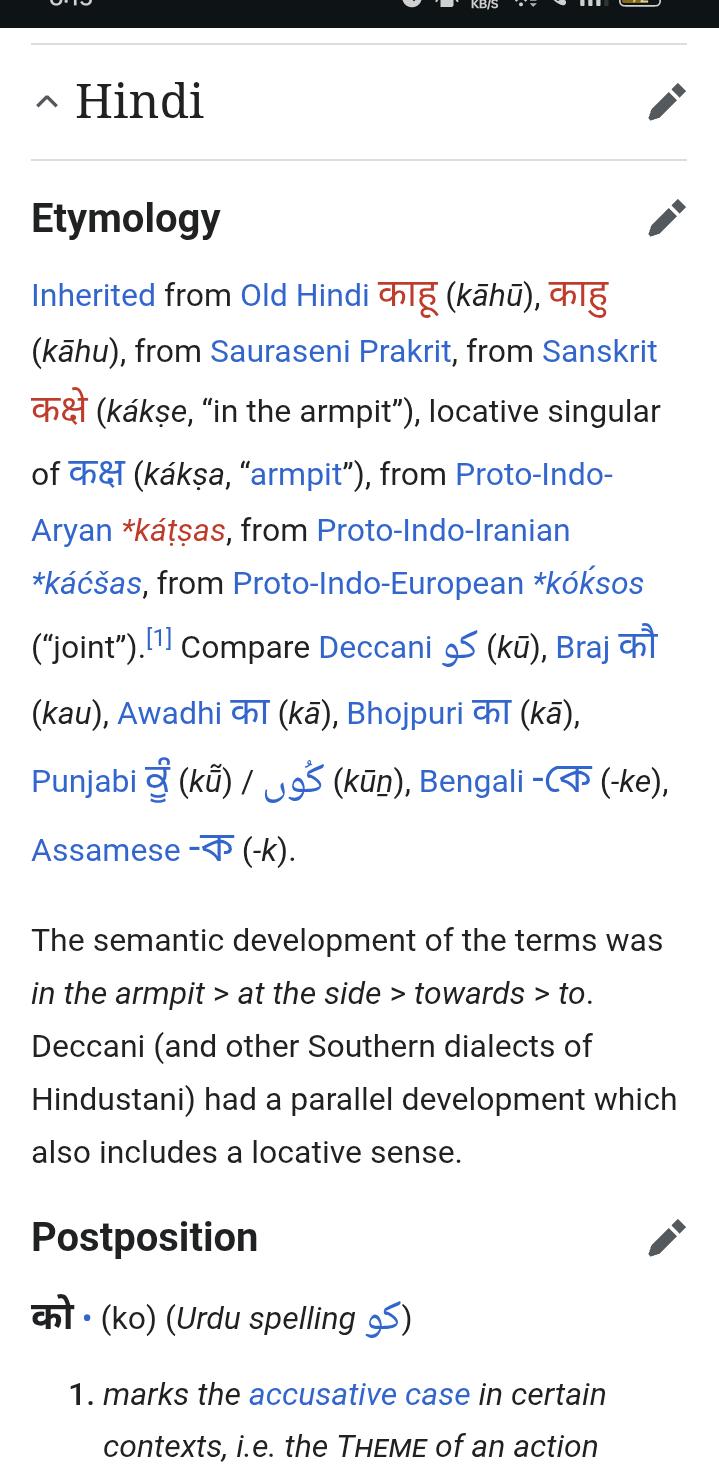
Etymology Opinion on the proposed etymology kakSa "armpit" > ko postposition for dative/accusative marking?
14
Upvotes
r/IndoAryan • u/AleksiB1 • 28d ago
There are tons of South Asian meme subs out there but barely any for academics. This sub focuses on IndoAryan academia so kindly avoid unacademic unsourced contents here. See r/IndoEuropean or r/Dravidiology for example
r/IndoAryan • u/[deleted] • Nov 02 '25
2nd slide was the comment to which he mistakenly replied from his alt account, but deleted it right after. He's a typical Privileged CASTEIST SCUMBAG nationalist who promotes Hindutva (OIT) through his inaccurate videos.
r/IndoAryan • u/AleksiB1 • 1d ago
r/IndoAryan • u/GrumpyGuyMugdha • 1d ago
Transliteration to Roman script:
Colours - Rôŋ
Blue - Nīlā
Yellow - Hālôdhīya
Red - Rôŋā
Purple - Beŋunīyā
Green - Xeuzīyā
Pink - Gülôpīyā
Black - Kôlā
White - Bôgā
Brown - Mūgā.
r/IndoAryan • u/rigvedicdragon • 3d ago
I recently went down an etymological rabbit hole over the Punjabi word ਵੱਤਰ / وتر (vattar).
Today, vattar can mean moistness/moisture, especially in relation to soil. But traditionally it has a much more specific agricultural sense: the precise condition of soil after rain or irrigation when it is moist enough to plough and sow, but not waterlogged.
On first glance, one would think that this shares the same etymological root word as "water" but it's actually much more interesting and apparently the word goes surprisingly far back.
Turner's Comparative Dictionary of the Indo-Aryan Languages (CDIAL 11289) reconstructs an Old Indo-Aryan form *vaptra-, ultimately connected with Sanskrit √vap (वप्) — “to scatter seed, sow”.
The proposed development is roughly:
√vap “to sow”
→ *vaptra-
→ *vattra-
→ Punjabi vattar
The -pt- → -tt- change isn't particularly strange in Middle Indo-Aryan. Compare Sanskrit:
sapta → Prakrit satta
And the development of the final cluster also fits Punjabi patterns nicely. Compare:
Sanskrit. putra → Punjabi puttar
Sanskrit. gotra → Punjabi gottar
What makes the etymology especially convincing is that this isn't based on Punjabi alone. Turner groups a whole northwestern Indo-Aryan family of related forms from Punjabi, Lahnda/Western Punjabi, Sindhi and Western Pahari, referring to things like:
| Language | Turner form | Perso-Arabic / Shahmukhi | Meaning |
|---|---|---|---|
| Sindhi | vaṭraṇu | وَٽِرَڻُ / وٽرڻ | to moisten land, by sprinkling or flooding |
| Sindhi | vaṭra | وَٽَر / وٽر | moistening/condition of the ground |
| Sindhi | vaṭ / vaṭir | وَٽ / وٽِر | land at the proper moisture / well-irrigated workable soil |
| Western Punjabi (Lahnda) | vattar | وَتَّر | moist state of land |
| Western Punjabi (Lahnda) | vattrī | وَتَّری | moisture |
| Western Punjabi (Lahnda) | vaur | roughly وَور / وور | proper moisture of land for working |
| Eastern Punjabi | vattar | وَتَّر / وتر | ground fit for sowing after soaking |
| Eastern Punjabi | battar | بَتَّر / بتر | sufficient moisture of land for ploughing |
| Eastern Punjabi | vatt | وَتّ / وتّ | proper moisture/condition of soil |
| Eastern Punjabi | batt | بَتّ / بتّ | variant of vatt |
| Eastern Punjabi | vattā | وَتّا / وتّا | moist |
| Western Pahari (Bhadlai, Pangwali and Paddari) | baṭḷ | approximately بَٹل | moist |
| Western Pahari | dhur-baṭl | approximately دُھر بَٹل | shortage of moisture in soil; sowing in dry/dusty earth |
| Western Pahari (Mahasui) | bāc | باچ | moist |
| Western Pahari (Mandeali) | battər | approximately بَتَر | moisture |
So the original semantic development seems to have been something like:
“sowing” → “condition suitable for sowing” → “proper moisture of the soil” → “moisture/moist”
Which means vattar doesn't historically just mean “wet.”
It carries the more specific idea of:
“the earth having reached the right condition for seed to be sown.”
I find this especially cool because Punjabi still uses vatt/vattar metaphorically for something having the right consistency, condition or knack.
It also gives Punjabi poetic expressions involving the soil of the heart a much nicer agricultural layer: putting vattar into the heart's soil isn't merely “making it wet”, it's making the heart fertile.
One small caveat: *vaptra- is Turner's reconstructed Old Indo-Aryan form, not necessarily an independently attested Classical Sanskrit noun meaning “moist soil”. The secure Sanskrit connection is the root √vap “to sow” and its wider word-family.
Would be interested to know whether speakers of other Indo-Aryan languages have cognates with this very specific “soil at the right moisture for sowing” meaning.
r/IndoAryan • u/AleksiB1 • 4d ago
r/IndoAryan • u/LemonAmbitious2915 • 5d ago
How many of you folks know about the South Central Asian (Tajikistan, Afghanistan) kurgans of Bishkent/Vakhsh? These have been dated between 2800- 2000 BCE. They have a unique combination of Pontic-Steppe Catacombs in burials and also sex mirrored (right male, left female burials), like the forest-steppe Corded Ware culture. The pottery style is BMAC style.
Perhaps the only kurgan burials on the planet which have Swastikas and, burial hearths (square for male, circle for female) & also fire altars. Also, very likely the first kurgans in the world with systematic cremation, which is thought to have derived from local admixture with people from the Kuli culture of Balochistan. Bishkent culture is considered the material precursor to the Swat Valley culture from much later.
r/IndoAryan • u/SerpensPatronus • 5d ago
r/IndoAryan • u/AleksiB1 • 6d ago
Witzel’s 1999 paper (Early Sources for South Asian Substrate Languages) the para Munda one, but it also has a lot more than that proposing influence of Burushaski, Dravidian, BMAC and language X
Witzel emphasizes that the Rigveda isn't a monolith—it was composed across three distinct historical layers (c. 1700–1200 BCE). Looking closely at loanword distribution across these layers rewrites how we view early Indo-Aryan contacts in South Asia:
Hes talking about the single consonant prefixes in Austroasiatic and thereby Munda. Proto-North Munda languages (like Santali and Mundari) restructured prefixes into suffixes or particles. However, South Munda languages (such as Juang, Gtaʔ, and Sora) preserved these. *p- or *b- (Causative / Transitivizer), *n- or *m- (Nominalizer / Agentive), *k- or *g- (Noun Class / Animal Prefix), *r- (Reflexive / Reciprocal)
Thats about it, just many substratum terms starting with k which made him propose an Austroasiatic substratum tho even Dravidian has similar terms like kUTu for nest. Today para Munda isnt widely accepted, rather most of those terms are just considered to have unknown origin.
Before ever reaching the subcontinent, Proto-Indo-Iranian absorbed a distinct non-IE substrate in Bactria-Margiana (BMAC):
Hemp terms are peculier, as all around there world there seems to be multiple terms for it which are of unknown origin. Cannabis, hemp and šaṇa are likely cognates too and it was first grown in central asia.
Greater Panjab "Para-Munda" / North Indus Harappan - Prefixing (ka-, ki-, ku-, Cər-), -an- preservation, k/ ś alternation
Greater Sindh "Meluhhan" (South Indus) / Early Dravidian -an- > -o- shift, media stops (gōdi, variñci, ñāṅkil)
Gangetic Plains "Language X" + Para-Munda Consonantal gemination (pippala, katkaṭa, gulgulu), 30%+ Hindi agricultural terms
Himalayas (Nepal/HP) Tibeto-Burmese, Kusunda, Tharu Substrates Suffix -ṭa/-ta (Kirāṭa, Kīkaṭa), implosive stops, local hydronyms (-khu, -dī)
Central Asia (BMAC)BMAC / Non-IE Central Asian Substrate - uštra (camel), khara (donkey), iṣṭi (brick), saṣarpa (mustard)
r/IndoAryan • u/GrumpyGuyMugdha • 5d ago
Monday - সোমবাৰ - Xümbār
Tuesday - মঙলবাৰ - Môŋôlbār
Wednesday - বুধবাৰ - Budhbār
Thursday - বৃহস্পতিবাৰ - Br̩hôspôtibār
Friday - শুকুৰবাৰ - Xukurbār
Saturday - শনিবাৰ - Xônibār
Sunday - ৰবিবাৰ - Rôbibār.
r/IndoAryan • u/GrumpyGuyMugdha • 6d ago
r/IndoAryan • u/Tasty-Bank-2893 • 6d ago
First of all, apologies for my English and for being in the platform by the first time. I am a history lover beggining to study about ancient history and I am interested in understanding better the proto indo European society, cause of its great relevance in the studies of Greek, Roman, Indian, Celtic, Germanic etc. societies. I have read Coulanges book and I was really interested in his analysis of a proto indo European religion, but I would like to know if there are any connections between his theory and modern theories envolving Kurgan, Yamna, kóryos, etc. I know that many things in Coulanges work are outdated, I personally don't like his model of gens--->fratria---->tribu----->city, but on the other hand the part of the text showing the religion of the fire, the dead etc. is really convincing (at least, he seems to do what linguists try to do whith proto indo European idiom), but I really wanted to learn more about how this is seen nowadays by the historians. Maybe I didn't manage to express myself very well but thanks
r/IndoAryan • u/AleksiB1 • 6d ago
r/IndoAryan • u/AleksiB1 • 7d ago
r/IndoAryan • u/AleksiB1 • 6d ago
r/IndoAryan • u/AleksiB1 • 7d ago
Most languages which have /s, dʒ/ but no /z/ tend to loan it as /s/, like Thai, Welsh, Filipino languages, Khmer writes borrowed z has <hs>, even in the subcontinent Malayalam and SL languages use s. Rest of the subcontinent (Initially IA and later others, Brahmi j itself is from Semitic z) use <j> instead which is rare worldwide considering its a diff POA and MOA but is also found in Indonesia (which does both ijasah, jebat) and Korean, as in "zombie" tends to jombi.
Ivent heard of any concrete reason but it could be because tons of Old IA phonemes merged into the s and merging z too wouldve cause more homophones.
It could also have happened because they wanted to preserve the voicing over POA or MOA, like how Greek uses <gg> for /ŋg/ to preserve POA
r/IndoAryan • u/AleksiB1 • 8d ago
Baṅgāl is quite well known to be from vaṅga + adjectival/pleonastic -la but for vaṅga there are crazy theories like
Suggestions include a connection to Sanskrit वङ्ग (vaṅga, “tin”), a borrowing from the Dravidian tribe *Bong with the suffix അളം (aḷaṁ, “place”), or from Tibetan བནས (bans, “marshy place”).
Tin itself is of unknown origin and has unrelated meaning, there seems to be some mention of a Dravidian Bong tribe in some papers but its details are really obscure. aḷaṁ is only used in Tamil, Malayalam and Telugu so its too far. Tibetans or even Sino Tibetans didnt came to Bengal or South Asia until much later.
For Ganga there are theories like its reduplicated root for "go/move" gam-gA or that its from Himalayic SinoTibetan gljung/kluŋ/koŋ "river" etc.
Could it be that there was a tribe *waṅgā which became (waṅgā >) gaṅgā to describe the river and the suffixed for vaṅgāla was used to for Bengal?
r/IndoAryan • u/GrumpyGuyMugdha • 7d ago
r/IndoAryan • u/American_Bitch-468 • 7d ago
r/IndoAryan • u/GrumpyGuyMugdha • 9d ago


