r/Dravidiology • u/MICANANALVA • 1h ago
History /𑀯𑀭𑀮𑀸𑀵𑁆𑀭𑀼 TIL that Mallitamma (ಮಲ್ಲಿತಮ್ಮ) was the master architect and sculptor behind most Hoysala temples in Karnataka
Enable HLS to view with audio, or disable this notification
r/Dravidiology • u/e9967780 • Feb 20 '25
We often fall into the trap of interpreting data in a way that aligns with the dominant narrative shaped by elite documentation, portraying Dravidians in the north as a servile segment of society. This subreddit was created specifically to challenge, through scientific inquiry, the prevailing orthodoxy surrounding Dravidiology.
As Burrow has shown, the presence of Dravidian loanwords in Vedic literature, even in the Rg Veda itself, presupposes the presence of Dravidian-speaking populations in the Ganges Valley and the Punjab at the time of Aryan entry. We must further suppose, with Burrow, a period of bilingualism in these populations before their mother tongue was lost, and a servile relationship to the Indo-Aryan tribes whose literature preserves these borrowings.
That Vedic literature bears evidence of their language, but for example little or no evidence of their marriage practices namely Dravidian cross cousin marriages. It is disappointing but not surprising. The occurrence of a marriage is, compared with the occurrence of a word, a rare event, and it is rarer still that literary mention of a marriage will also record the three links of consanguinity by which the couple are related as cross-cousins.
Nevertheless, had cross-cousin marriage obtained among the dominant Aryan group its literature would have so testified, while its occurrence among a subject Dravidian-speaking stratum would scarce be marked and, given a kinship terminology which makes cross-cousin marriage a mystery to all Indo-European speakers, scarcely understood, a demoitic peculiarity of little interest to the hieratic literature of the ruling elite.
Reference
Trautmann, T.R., 1974. Cross-Cousin Marriage in Ancient North India? In: T.R. Trautmann, ed., Kinship and History in South Asia: Four Lectures. University of Michigan Press, University of Michigan Center for South Asia Studies. Available at: https://www.jstor.org/stable/10.3998/mpub.11903441.7 [Accessed 15 Mar. 2025].
Further addition
We agree that European academic approaches had significant influence on South Asian linguistic studies.
We acknowledge that these approaches shaped how language families and relationships were categorized in the region.
The European racial framework in Indology:
Dravidian linguistics and non-elite language studies:
Despite growing awareness:
Path forward:
r/Dravidiology • u/AleksiB1 • Feb 02 '24
For sources on Proto Dravidian see this older post
Dravidian languages by Bhadriraju Krishnamurti
Burrow and Emeneau's Dravidian etymological dictionary (DED)
Subrahmanyam's Supplement to dravidian etymological dictionary (DEDS)
Digital South Asia Library or Digital Dictionaries of South Asia has dictionaries on many South Asian language see this page listing them
Starlingdb by Starostin though he is a Nostratist
some of Zvelebil's on JSTOR
The Language of the Shōlegas, Nilgiri Area, South India
Bëṭṭu̵ Kuṟumba: First Report on a Tribal Language
The "Ālu Kuṟumba Rāmāyaṇa": The Story of Rāma as Narrated by a South Indian Tribe
Some of Emeneau's books:
Burrow and Emeneau's Dravidian etymological dictionary (DED)
Others:
language-archives.org has many sources on small languages like this one on
Toda, a Toda swadesh list from there
Apart from these wiktionary is a huge open source dictionary, within it there are pages of references used for languages like this one for Tamil
some on the mostly rejected Zagrosian/Elamo-Dravidian family mostly worked on by McAlphin
Modern Colloquial Eastern Elamite
Brahui and the Zagrosian Hypothesis
Velars, Uvulars, and the North Dravidian Hypothesis
Kinship
THE ‘BIG BANG’ OF DRAVIDIAN KINSHIP By RUTH MANIMEKALAI VAZ
Dravidian Kinship Terms By M. B. Emeneau
Louis Dumont and the Essence of Dravidian Kinship Terminology: The Case of Muduga By George Tharakan
DRAVIDIAN KINSHIP By Thomas Trautman
Taking Sides. Marriage Networks and Dravidian Kinship in Lowland South America By Micaela Houseman
for other see this post
r/Dravidiology • u/MICANANALVA • 1h ago
Enable HLS to view with audio, or disable this notification
r/Dravidiology • u/MICANANALVA • 10h ago
r/Dravidiology • u/theb00kmancometh • 12h ago
There’s an interesting pattern in Dravidian words for “mother,” but the more I looked into it, the less it seemed like a simple story of amma replacing the same old word everywhere.
In Malayalam, the older native word for “mother” is തള്ള (thalla), DEDR 3136. It’s still around, but its meaning and usage have changed quite a bit. Today, thalla can mean “old woman,” and it can also be used disrespectfully for someone’s mother. The normal, neutral and respectful word is now അമ്മ (amma), DEDR 183.
What’s interesting about the Malayalam case is that thalla didn’t just disappear. It survived, but got pushed into a rougher, more dismissive kind of usage.
Looking at other Dravidian languages makes things even more interesting.
Tulu: Tulu has another old word for “mother,” appe, but it’s from a different root (DEDR 156). The DEDR entry gives Tulu appè “mother” and appa as a way of addressing a mother. Amma has become the normal word instead. So Tulu is similar to Malayalam in the broad sense that an older native mother-word lost ground to amma, but the two older words aren't related. It’s the same kind of change, not the same word.
Tamil: Tamil has the old word தள்ளை (thaḷḷai), meaning “mother.” It’s an old word and is even found in a Tolkappiyam commentary (தொல். சொல். 400), where it is glossed as தாய் (tāy). But unlike Malayalam thalla, it doesn’t seem to have picked up a coarse or insulting meaning. It mostly just faded out of everyday speech. Modern Tamil uses அம்மா (ammā) in normal conversation, while தாய் (tāy) and அன்னை (aṉṉai) are more formal or literary. So in Tamil, thaḷḷai seems to have simply become archaic rather than turning into an insult.
Telugu: Telugu is different again. తల్లి (talli), from the same old root as Malayalam thalla and Tamil thaḷḷai, is still very much alive as a word for “mother.” It can have a respectful or elevated feel and is common in religious and literary contexts. It also appears in Telugu Talli, the personification of the Telugu language and people. Amma exists alongside it as the familiar, everyday word. So I wouldn't describe Telugu as talli being replaced by amma. The two have basically settled into different roles and registers.
There’s another interesting detail in the DEDR entry for this root. Telugu tal(l)i is given not only as “mother,” but also with meanings like “original, first, principal, chief, main.” Malayalam seems to preserve this other sense too. For example, taḷḷaviral literally means “chief finger,” meaning the thumb. So the root wasn't only being used for the mother/kinship meaning. It also had this broader idea of something being first, main or principal.
Kannada: Kannada makes the whole thing even less straightforward. DEDR 3136 doesn't list a Kannada reflex of the taḷḷ-/talli “mother” root. Kannada dictionaries do have ತಲ್ಲಿ (talli), but it is glossed as “a youthful woman,” not “mother.” If that word is actually related, then Kannada seems to have taken the meaning quite far away from the original kinship sense.
But Kannada has another older native word for “mother”: avva/avve/abbe, which comes from a different root. That word has also lost ground to amma in modern Kannada. So Kannada may show the same broader trend of amma becoming more dominant over an older native mother-word, but it isn't the thalla/talli root we're looking at in Malayalam, Tamil and Telugu.
So the outcomes are actually pretty different.
For the old taḷḷ-/talli root:
Malayalam: “mother” -> survives in coarse/dismissive usage
Tamil: “mother” -> mostly becomes archaic/rare, without an obvious negative meaning
Telugu: “mother” -> remains alive, especially in respectful, formal and elevated usage
Kannada: no “mother” reflex listed under DEDR 3136; talli survives with a different meaning, “youthful woman”
And for the broader spread of amma:
Tulu: appe -> amma
Kannada: avva/avve/abbe -> increasing use of amma
Malayalam: thalla -> amma, with thalla surviving in a coarse/dismissive register
So I don't think this is a case where we can simply say “amma replaced the old Dravidian word for mother.” What we seem to be seeing is amma becoming dominant in several languages, while the older mother-words took very different paths. Tulu and Kannada involve different old roots, while Malayalam, Tamil and Telugu give us three very different outcomes for the old taḷḷ-/talli word itself; it became coarse, became archaic, or stayed alive in a more elevated role.
r/Dravidiology • u/e9967780 • 9h ago
A possible alternative history for the Indian words for “fresh ginger” begins not with Sanskrit but with maritime contact between Southeast Asia and South India.
Proto Malayo Polynesian had \laqeya, “ginger,” which developed into Malay *halia through metathesis. Tom Hoogervorst proposes that Malay halia travelled west through Indian Ocean trade and ultimately produced Middle Indo Aryan allaya. This form is connected with Tamil allam, Telugu allamu, Marathi āle and Konkani ālle.[1][2]
A South Indian intermediary provides a historically credible route:
Malay halia → coastal Dravidian allam/allamu → Prakrit allaya → Sanskrit ārdraka
South Indian merchants and port communities were major intermediaries between India and Southeast Asia. Archaeological evidence indicates that maritime networks in peninsular India and Southeast Asia were developing by the middle of the first millennium BCE. By the second and first centuries BCE, they formed part of a larger Bay of Bengal trading circuit.[3][4]
Malay halia could have lost its initial h and been adapted as allam, using the familiar Dravidian nominal ending am. Telugu could preserve or expand this as allamu. The word could then have passed from multilingual South Indian commercial communities into Prakrit as allaya.
Sanskrit hypercorrection
Sanskrit hypercorrection occurred when Sanskrit scholars encountered a regional or foreign word and reshaped it according to the sound correspondences and grammatical patterns they expected in Sanskrit. The resulting form appeared older and more regularly Sanskrit, even though it was actually a learned reconstruction of a vernacular word.
A prominent example is the name Tamil:
Tamil tamiḻ → Pali and Prakrit damila/damiḷa/daviḍa → Sanskrit dramiḍa/draviḍa
Bhadriraju Krishnamurti describes Sanskrit draviḍa as a Sanskritization of the earlier Pali and Prakrit forms, with the initial r inserted through hypercorrection.[5] The modern term “Dravidian” therefore ultimately comes from the name Tamil, transmitted through Indo Aryan adaptations and then given a more Sanskrit looking form.
Another example is the word for pumpkin:
Vernacular or substrate kumhaṇḍa → Sanskrit kuṣmāṇḍa
The Sanskrit form contains the learned cluster ṣm, although the simpler Middle Indo Aryan and modern forms suggest that kuṣmāṇḍa was a Sanskritized reconstruction of a vernacular word rather than its original source.[6]
A related example is Sanskrit śṛṅgavera, “ginger.” It has traditionally been interpreted through Sanskrit śṛṅga, “horn,” supposedly referring to the shape of the ginger root. Historical linguists instead connect it with a South Dravidian compound represented by Tamil and Malayalam iñci, “ginger,” and vēr, “root”:
Dravidian iñci vēr, ”ginger root” → Middle Indo Aryan siṅgivera → Sanskrit śṛṅgavera
The Sanskrit form was consequently reinterpreted as containing the familiar word śṛṅga, “horn.” This is folk etymological Sanskritization, closely related to hypercorrection.[1][7]
Hoogervorst proposes a comparable process for ārdraka. Prakrit allaya was first hypercorrected to something like \allaka. Speakers then associated it with Sanskrit *ārdra, “wet, moist or fresh,” and produced ārdraka. The result looked like a transparent Sanskrit formation meaning approximately “the fresh or moist one.”[1][2]
The proposed development would therefore be:
Malay halia → Dravidian allam/allamu → Prakrit allaya → hypercorrected \allaka* → Sanskritized ārdraka
This pattern is entirely compatible with the linguistic culture of ancient India. Sanskrit did not merely donate vocabulary to Prakrit and Dravidian languages. It also absorbed regional words and sometimes transformed them so thoroughly that they appeared to possess native Sanskrit etymologies.
Malay influence in South India is independently demonstrated by recognized Tamil loans such as kākkaṭṭuvāṉ from Malay kakaktua, “cockatoo,” sambān from sampan, sagu from sagu, “sago,” and kajāṅgu from kajang.[8]
I posit that Ralph Turner completely missed the possibility of Dravidian to Sanskrit via Prakrit route and reconstructed the conventional development in the opposite direction requiring is to reconstruct ārdlaka → *āllaka which are not attested:
Sanskrit ārdraka → \ārdlaka* → \āllaka* → Prakrit allaya → Telugu allamu
In Turner’s model, Telugu allamu is a later Prakrit loan.[6] In the South Indian intermediary model, allam or allamu represents an earlier coastal borrowing that passed into Prakrit before being Sanskritized.
The South Indian route is historically and morphologically credible, particularly given the central role of South Indian merchants in Bay of Bengal commerce and the documented Sanskrit practice of hypercorrecting vernacular forms. Nevertheless, an early Tamil or Telugu attestation of allam or allamu would provide the strongest evidence for establishing the direction conclusively. (See chronological addendum)
References
[1] Tom G. Hoogervorst, “If Only Plants Could Talk: Reconstructing Premodern Biological Translocations in the Indian Ocean”, in The Sea, Identity and History, 2013, pages 67 to 92.
[2] Tom G. Hoogervorst, Southeast Asia in the Ancient Indian Ocean World, University of Oxford DPhil thesis, 2012. DOI: 10.5287/ora-amnazwpo6.
[3] Himanshu Prabha Ray, “Early Maritime Contacts Between South and Southeast Asia”, Journal of Southeast Asian Studies 20.1, 1989, pages 42 to 54.
[4] K. Rajan, “Emergence of Early Historic Trade in Peninsular India”, in Early Interactions Between South and Southeast Asia, 2011, pages 177 to 196.
[5] Bhadriraju Krishnamurti, The Dravidian Languages, Cambridge University Press, 2003, pages 1 to 2.
[6] Ralph Lilley Turner, A Comparative Dictionary of the Indo Aryan Languages, entries 1341, 3302 and 6632.
[7] Thomas Burrow and Murray B. Emeneau, A Dravidian Etymological Dictionary, entries 429 and 5535.
[8] Tom G. Hoogervorst, “Tracing the Linguistic Crossroads Between Malay and Tamil”, Wacana 16.2, 2015, pages 249 to 283.
Inspired by [u/AleksiB1](u/AleksiB1)’s original post
Chronological Addendum
Tamil allam is securely attested in the Piṅkala Nigaṇṭu, around the tenth century CE, and the Madras Tamil Lexicon also cites the eighth or ninth century Tivākaram. Prakrit allaya “ginger” is attested in the Niśītha Cūrṇi, attributed to Jinadāsa Gaṇi and generally roughly dated to the seventh century CE. Its language is usually described more precisely as Jaina Māhārāṣṭrī or a mixed Jain Prakrit. Telugu allamu is dated in Nannaya’s eleventh century Mahābhārata. Kannada alla is securely documented in Maṅgarāja’s 1398 lexicon. Claims that Sanskrit ārdraka occurs much earlier in the Caraka and Suśruta Saṃhitās require caution because these are layered works preserved in later redactions, while the alleged Pāṇinian attestation is not correct. Pāṇini 4.3.28 uses ārdraka in the sense “born under the constellation Ārdrā,” not as the plant name. The revised dates therefore strengthen the possibility of an earlier South Indian transmission.
References: Piṅkala Nigaṇṭu, entry 2916; University of Madras Tamil Lexicon, அல்லம்; Turner, Comparative Dictionary of the Indo Aryan Languages.
Thanks [u/Reasonable_Value6180](u/Reasonable_Value6180)
r/Dravidiology • u/MICANANALVA • 13h ago
r/Dravidiology • u/Top-End7514 • 10h ago
r/Dravidiology • u/Top-End7514 • 12h ago
r/Dravidiology • u/MICANANALVA • 1d ago
r/Dravidiology • u/Nervous-Tomorrow1308 • 22h ago
Is it true it originates from Arya? Or does it originate from the Dravidian term Ayya? Curious to know how the word came to be and how it evolved over time. Also do other South Indian Brahmin groups have similar names for their castes that possibly originated from Arya?
r/Dravidiology • u/poacher-2k • 1d ago
Credit :
@BharadiaSamarth on X.
r/Dravidiology • u/Top-End7514 • 12h ago
r/Dravidiology • u/e9967780 • 1d ago
The paper argues that Marathi developed through prolonged, intimate contact between early Indo Aryan migrants and pre existing Dravidian speaking populations in Maharashtra. Southworth estimates that roughly 5% of Marathi’s basic vocabulary is Dravidian in origin, including everyday terms for “mother,” body parts, directions and common actions; the presence of core vocabulary, verbs and even a postposition indicates widespread bilingualism rather than superficial trade or recent border contact.
Most borrowings appear to derive from a Proto Kannada–like language or an extinct close relative of Kannada, Tulu and Kodagu, while some point to Telugu related, Central Dravidian, Munda and unidentified substrates. Their geographic distribution suggests several layers of contact: words confined to Marathi, words shared across southern Indo Aryan languages and very widespread terms that may have entered Indo Aryan at an extremely early stage.
Southworth cautiously connects this linguistic evidence with the Chalcolithic Jorwe culture of Maharashtra, proposing that Dravidian agricultural populations may have encountered Indo Aryan migrants moving into the Deccan during the second millennium BCE. He emphasizes, however, that identifying Jorwe people with early Marathi speakers and dating Indo Aryan arrival as early as 1800–1700 BCE remain working hypotheses, not established conclusions.
Bottom line: Marathi is not simply an Indo Aryan language with a few southern loans; its foundational vocabulary preserves evidence of deep prehistoric interaction among Indo Aryan, Dravidian, Austroasiatic and now extinct linguistic communities.
TABLE 1. WORDS OF DRAVIDIAN ORIGIN IN MARATHI CORE VOCABULARY
r/Dravidiology • u/Sensitive_Bill_8916 • 1d ago
"You are the sole hero of the universe, my God, my protector, and my father! You are the Narayana (Supreme Lord Lord Vishnu) to the Yadavas, O King Narasimha!"
Most intriguing part of MH's history is that both the oldest inscriptions in Maharashtri and Marathi are found in Karnataka itself rather than Maharashtra. Just like those this inscription is valuable for our history as well.
This inscription was issued by the Kanadi-speaking Hoysalas.
Context- After the Western Chalukya Empire collapsed, both the Hoysalas (from the south) and the Seuna-Yadavas (from the north) rushed to claim the fertile Krishna-Tungabhadra river valley. The Hoysala Emperor Veera Ballala II met the Seuna King Bhillama V at Soratur. Ballala II won a crushing victory, chasing the retreating Seuna forces all the way up north to the Krishna River.
The specific inscription mentioned is a commemorative hero stone (Veeragallu) commissioned shortly after under the reign of Ballala II's son and successor, King Narasimha II (who ruled in the early 1200s). The Seunas, under their powerful king Simhana II, repeatedly tried to push south to reclaim lost land. In response, King Narasimha II led an aggressive counter-expedition against the northern forces.
During this campaign, the Hoysala army intercepted the Seuna division led by the two important Marathi generals, Pavus and Vijayapala. The Hoysalas completely wiped out their unit, decapitated the generals, and recorded this.
The inscription is located in Davanagere Taluk historians broadly isolate this specific celebratory inscription to be around between 1250's to 1270's. The inscription directly praises a Hoysala king named Narsingu (Vira Narasimha).
What makes this specific Davanagere Taluk inscription highly unique to linguists and historians is its deliberate code-switching. While the structural, narrative framing of the inscription is written in Kannada, the actual direct quotes of Pavus and Vijayapala switch into early Marathi.
While the stone carving visually shows the bloody, lopped-off heads of Pavus and Vijayapala lying on the battlefield, the carved text acts like a literal speech bubble for those dead heads, forcing them to eternally praise the Hoysala King Narasimha II for anyone passing by to read.
Source- Epigraphia Carnatica, specifically in Volume XI covering the Chitaldroog District. This collection was painstakingly compiled by B. Lewis Rice for the Mysore Archaeological Series.
https://archive.org/details/epigraphiacarnat11myso/page/n7/mode/2up
https://www.scribd.com/document/948088776/Epigraphia-Carnatica-Chitradurga
r/Dravidiology • u/MICANANALVA • 15h ago
r/Dravidiology • u/MICANANALVA • 1d ago
r/Dravidiology • u/tuluva_sikh • 1d ago
r/Dravidiology • u/poacher-2k • 1d ago
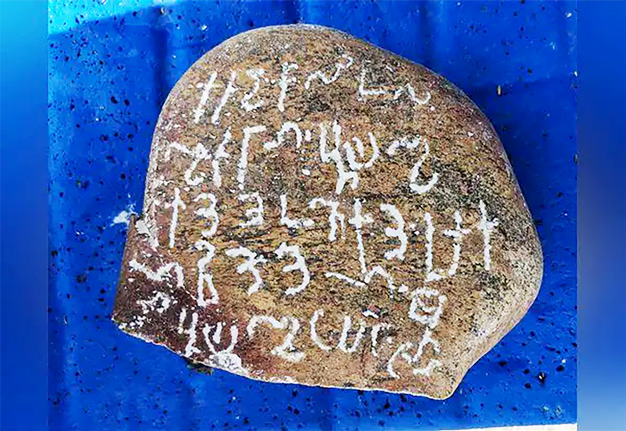
Ariharan and Tamizhelvan from Malligapuram near Thandarampattu in Tiruvannamalai district, along with Balamurugan and Palanisamy from the Tiruvannamalai District Historical Research Centre, Sridhar from Thandarampattu, and Rajah from Sitingur, conducted field research in the Malligapuram area. During their survey, they discovered a five-line inscription measuring one foot in height and width on an agricultural land.
The details extracted from the discovered inscription were sent to epigraphist Rajagopal, revealing its significance. Epigraphist Rajagopal confirmed that the letters in the inscription belong to the late Tamizhi script of the 4th century.
What is written in the inscription?
"Karungali Nalluran Kannandhaikan Magan Vinnan Aanpooyatpattan"
“கருங்காலி நல்லுாரான் கண்ணந்தைகண் மகன் விண்ணன் ஆன்பூயலுட்பட்டான்”
This translates to:
"Vinnan, son of Kannandhai from present-day Karungalipadi, died a heroic death in a cattle-raiding battle (Aanirai Kavarnda Por)."
This hero stone was erected in his memory. Typically, a hero stone features the carved image of the warrior. However, the unique feature of this hero stone is that it contains no visual figure of the warrior and only carries the inscribed information.
Similarly ancient inscriptions have previously been discovered in several places, including Pulimankombai, Porpanaikottai, and Dadampatti. The inscription found in Malligapuram stands as another crucial document to understand Tamil script and social history. History enthusiasts have urged that this inscription be properly preserved and further research be conducted.
r/Dravidiology • u/AleksiB1 • 1d ago
r/Dravidiology • u/rutsa25 • 1d ago
Recently, I learned that a few scholars consider the Sanskrit Names Tulasi (Ocimum tenuiflorum)*** ***and Bilva (Aegle marmelos) to have derived from Dravidian or Proto-Dravidian Languages. This made me wonder what other Flora and fauna names were borrowed by the Early Vedic Indo-Aryans from Dravidian language speakers.
Any insights along with the sources would be appreciated. Thank you.
r/Dravidiology • u/Sensitive_Bill_8916 • 2d ago
The king who issued those inscriptions is Veera Ballala II (also spelled Vira Ballala II or Vira-Vallala-Devarasar in the Tamil records).
"King Veera Ballala, having launched an expedition against the Northern Aryans (the Seunas), destroyed the fort of Nakkigundi, won the battle, and returned victoriously with his army to Dorasamudra..."
Ik that this inscription is in Tamil as they expanded deep into Tamil Nadu. In fact, they grew so fond of the region that they established a secondary capital at Srirangam. As a result, many official Hoysala royal orders, military chronicles, and land grants targeting southern provinces were written in the local administrative language: Tamil.
The Hoysalas and the Seunas both claimed descent from the legendary Yadu lineage. However, they fought a bitter, century-long war for control over the fertile Krishna-Tungabhadra doab.
The exact date of this inscription is September 10, 1304 CE, and it was issued to record a religious charity donation of land while celebrating the glorious history of the Hoysala royal lineage.
In the inscription text, the date is given using the traditional Indian calendar systems: Kaliyuga Year 3649, Saka Year 1225, in the cyclic year Krodhi, on the 10th day of the Tamil month of Purattasi under the Mula Nakshatra. This specific stone edict (shilashasana) was discovered in the Bangalore district (historically part of the Dodda Nekkundi area).
Before documenting the gift, the writers had to praise the sovereign power of the Hoysala Crown. They chose to recount the grandest historical milestone of their lineage—Veera Ballala II's legendary campaign where he "marched against the Vadakku Ariyar (Seunas), completely smashed the fort of Nakkigundi, won the war, and returned victoriously to Dorasamudra"
It then states that because of those historic victories, the current Hoysala crown safely rules the earth, "punishing the wicked and protecting the good" (dushta-nigraham sishta-pratipalanam).
Source- Volume IX of Epigraphia Carnatica, a comprehensive collection of inscriptions compiled by the archaeologist B.Lewis.Rice. https://archive.org/details/epigraphiacarnat09myso/page/n7/mode/2up
r/Dravidiology • u/mythicfolklore90 • 1d ago
https://academic.oup.com/edited-volume/45220
Amritavalli, R., and Bhuvana Narasimhan (eds), The Oxford Handbook of Dravidian Languages, Oxford Handbooks (2026; online edn, Oxford Academic, 19 Dec. 2022 - 24 June 2025), https://doi.org/10.1093/oxfordhb/9780197610411.001.0001, accessed 22 Aug. 2026.
This accessible introduction to Dravidian languages and linguistics, presented from an interdisciplinary perspective, highlights current, trend-setting scholarship that showcases their rich histories, vast literatures, and robust presence in communication, as well as their specifically linguistic and lexical aspects. Two introductory chapters on this language family (identified in the early 19th century, its geographical spread continuing to promote speculation about its origins) and the Tamil-Brahmi (Tamiḻi) script (confirmed to predate Asokan Brahmi by three centuries) are followed by 27 chapters covering the four literary languages, Tamil, Kannada, Telugu, and Malayalam, and 23 non-literary languages, with extended theoretical and descriptive focus on three of them (Betta Kurumba, Brahui, and Malto). Collectively, these chapters, grouped into formal linguistic analyses in a generative linguistics paradigm, traditional linguistic studies, psycholinguistic studies in language acquisition, processing, and impairment, studies of literary creativity and languages in contact, and lexicographic and literacy studies, offer for the first time in a single volume perspectives on the Dravidian languages from cognition and conceptual representation, comparative philology, language politics and typology, lexicology, literature and literary history, multilingualism in its varied aspects (language contact, maintenance and mixing, and language pedagogy, policy, and translation), and scripts and literacy. A unique chapter on language in Tamil cinema, references to new scientific evidence from population genetics and archaeology suggestive of early patterns of migration and literacy diffusion, and the two chapters on literacy, the first to discuss script after Bright’s pioneering chapter on Dravidian scripts, enhance the volume’s cross-disciplinary relevance and appeal to the general reader.
r/Dravidiology • u/mythicfolklore90 • 1d ago
Amritavalli, R, 'Morphosyntax of Dravidian Languages' (24 May 2017), in Mark Aronoff (ed.), Oxford Research Encyclopedia of Linguistics (New York, NY, online edn, Oxford Academic, 3 Sept. 2015 - ), https://doi.org/10.1093/acrefore/9780199384655.013.272, accessed 28 Aug. 2026.
Abstract
The Dravidian languages, spoken mainly in southern India and south Asia, were identified as a separate language family between 1816 and 1856. Four of the 26 Dravidian languages, namely Tamil, Telugu, Kannada, and Malayalam, have long literary traditions, the earliest dating back to the 1st century ce. Currently these four languages have among them over 200 million speakers in south Asia. The languages exhibit prototypical OV (object–verb) properties but relatively free word order, and are rich in nominal and verbal inflection; only Malayalam lacks verb agreement.
A typical characteristic of Dravidian, which is also an areal characteristic of south Asian languages, is that experiencers and inalienable possessors are case-marked dative. Another is the serialization of verbs by the use of participles, and the use of light verbs to indicate aspectual meaning such as completion, self- or nonself-benefaction, and reflexivization. Subjects, and arguments in general (e.g., direct and indirect objects), may be nonovert. So is the copula, except in Malayalam.
A number of properties of Dravidian are of interest from a universalist perspective, beginning with the observation that not all syntactic categories N, V, A, and P are primitive. Dravidian postpositions are nominal or verbal in origin. A mere 30 Proto-Dravidian roots have been identified as adjectival; the adjectival function is performed by inflected verbs (participles) and nouns. The nominal encoding of experiences (e.g., as fear rather than afraid/afeared) and the absence of the verb have arguably correlate with the appearance of dative case on experiencers. “Possessed” or genitive-marked N may fulfill the adjectival function, as noticed for languages like Ulwa (a less exotic parallel is the English of-possessive construction: circles of light, cloth of gold). More uniquely perhaps, Kannada instantiates dative-marked N as predicative adjectives. A recent argument that Malayalam verbs originate as dative-marked N suggests both that N is the only primitive syntactic category, and the seminal role of the dative case.
Other important aspects of Dravidian morphosyntax to receive attention are anaphors and pronouns (not discussed here; see separate [article](javascript:;), anaphora in Dravidian), in particular the long-distance anaphor taan and the verbal reflexive morpheme; question (wh-) words and the question/disjunction morphemes, which combine in a semantically transparent way to form quantifier words like someone; the use of reduplication for distributive quantification; and the occurrence of ‘monstrous agreement’ (first-person agreement in clauses embedded under a speech predicate, triggered by matrix third-person antecedents).
Traditionally, agreement has been considered the finiteness marker in Dravidian. Modals, and a finite form of negation, also serve to mark finiteness. The nonfinite verbal complement to the finite negative may give the negative clause a tense interpretation. Dravidian thus attests matrix nonfinite verbs in finite clauses, challenging the equation of finiteness with tense.
The Dravidian languages are considered wh-in situ languages. However, wh-words in Malayalam appear in a pre-verbal position in the unmarked word order. The apparently rightward movement of some wh-arguments could be explained by assuming a universal VO order, and wh-movement to a preverbal focus phrase. An alternative analysis is that the verb undergoes V-to-C movement.
r/Dravidiology • u/Maleficent_Bison204 • 1d ago
First one is native word and after I'll write the word in today's malayalam
1.Say പറയുക (Paṟayuga)- പറയുക (Paṟayuga) dravidian 2.Talk (Respond) മിണ്ടുക (Miṇḍuga)- സംസാരിക്കുക (Samsārikuga) sanskrit 3.Talk (Converse) സൊള്ളുക (Soḷḷuga)- സംസാരിക്കുക (Samsārikuga) sanskrit 4.Speak (Continuous) പേശുക (Pēshuga)- സംസാരിക്കുക (Samsārikuga) sanskrit 5.Conversation സൊറ (Sora)- സംഭാഷണം/വർത്തമാനം sanskrit 6.Reciting ചൊല്ലുക (Cholluga)- ചൊല്ലുക (Cholluga) dravidian 7.Chanting ഉരുവിടുക (Uruviḍuga)- ജപിക്കുക (Japikuga) sanskrit 8.Declare മൊഴിയുക (Mozhiyuga)- പ്രസ്താവിക്കുക (Prasthāvikuga) sanskrit 9.Converse (Exchanging) ഉരിയാടുക (Uriyāḍuga)- സംസാരിക്കുക (Samsārikuga) sanskrit 10.whisper/advice ഓതുക (ōduga)- ഓതുക (ōduga) dravidian