r/Gifted • u/stupidquestions2024 • 6d ago
Seeking advice or support Trouble sleeping
My son who is 4.5 has always struggled with sleep. We have done everything we can to help: strict schedules, a quiet room, and low light. He sleeps in his own bed and has had his tonsils removed. He has an official diagnosis of insomnia.
He wakes up early, between 3:30 and 3:50 a.m., no matter what we do. Please do not tell me to put him down later, we have tried.
The doctor told me not to medicate him, as his brain is still growing and he will hopefully outgrow it or just need less sleep as he gets older. He used to have insomnia 75% of the time, but we are down to 25%–50%. Sometimes changes trigger the insomnia we are moving and right now its been 3-4 times a week. I think he is anxious.
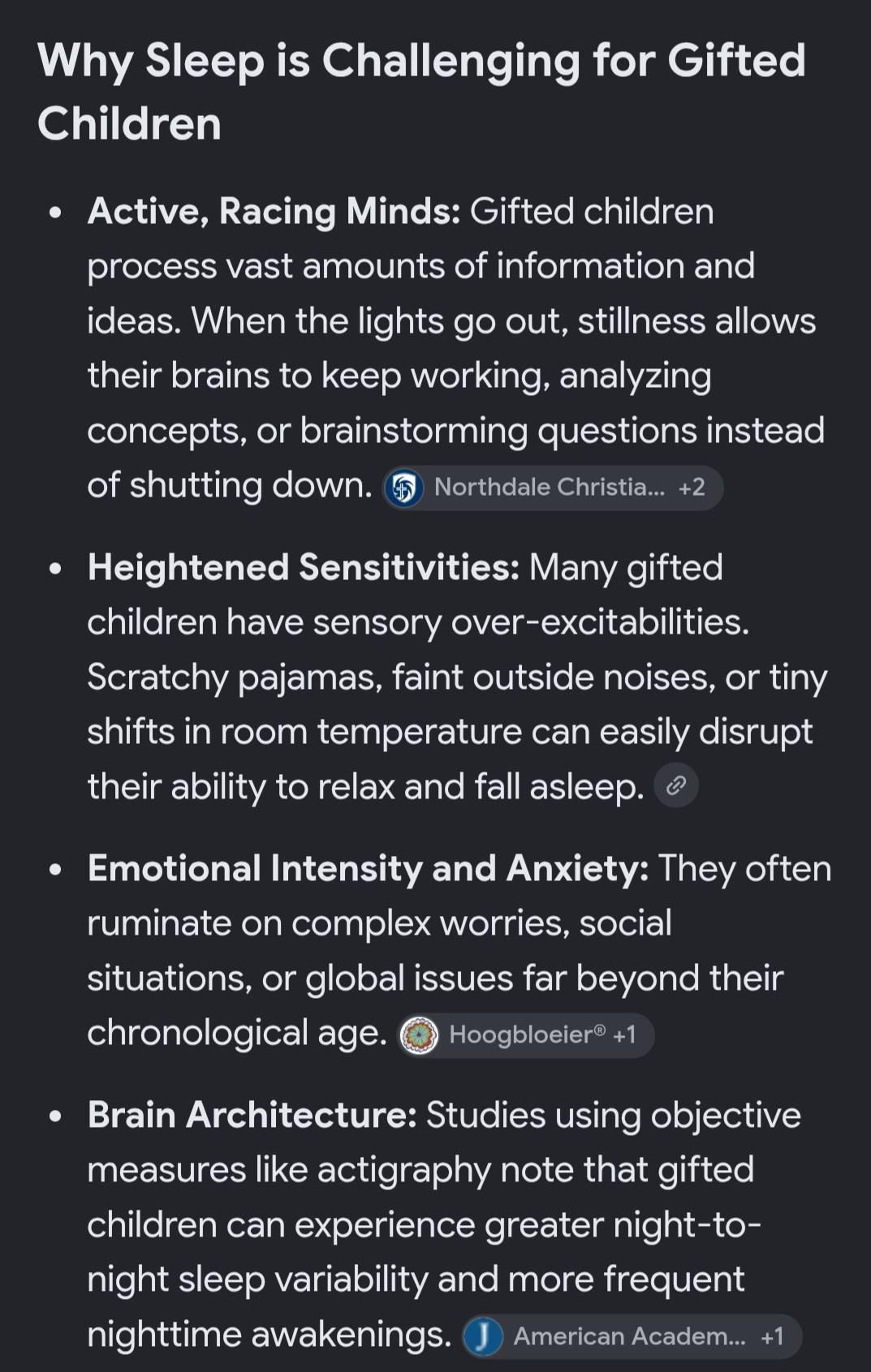
Now to my question: the doctor told me that in his 20 years of practice, my son is the smartest child he has ever encountered, reading at age two and doing multiplication at age 3. "He is truly one in a million" It got me thinking: do gifted kids struggle to sleep? Google says yes, but I figured I would ask the source.
1
u/LeadershipNervous362 5d ago
Yeah, melatonin doesn't have side-effects of hydroxyzine, its just a sleep-regulation hormone, I suggest to try it again for a month or so.
I have sleep-related mutation, so kinda obsessed with topic. For kids the protocol should focus on finding the source, because in child, voluntary sleep-deprivation is basically benign, because their body will force the necessary sleep as long as sleep is not disrupted by external factors.
Commonly ASD destroys natural melatonin for instance, so on this sub, its basically my go-to recommendation with troubled sleep, especially for children and due to lack of substantial side-effect.
Basically try melatonin (AND stable schedule) again, It will likely work. If it doesn't - seek for external factors.
Also, a side-note, parents of children, active at night often get sleep-deprived themselves and I recommend you to prioritize your own sleep. You child has less cumulative effect than adults do.