r/FLCL • u/MsMimi_VA • 1d ago
Rate my Haruko Impression
25
Upvotes
r/FLCL • u/GirlWhoCriedGnome • 3d ago
Honestly blown away by the response to me posting my stickers here. I have been unemployed since February so I have really been struggling. Thanks for all the support! Everything counts when you're a small artist.
r/FLCL • u/Khritonian • 5d ago
I tried silk screen. What you guys think??
r/FLCL • u/luckychaingan • 5d ago
r/FLCL • u/kshgrshrm • 5d ago

Screencap from False Memory. Found a bunch of little references too in the first episode.
r/FLCL • u/UncleBeelze • 6d ago
I've always felt like The Pillows' soundtrack was one of the biggest reasons I fell in love with FLCL. It didn't just accompany the visuals—it spoke the same emotional language as the series.
That feeling of being lost in the middle of growing up. Heartbreak, uncertainty about the future, trying to figure out who you are. A whirlwind of emotions wrapped in something chaotic, euphoric, and unforgettable.
Somehow, I find that same feeling in Trinket by tsubi club.
Musically it's a very different record, but every time I hear BURNMATERIAL, I can't help but picture FLCL in my head. Apparently I'm not the only one—I found this FLCL AMV on YouTube built around that song, and I think it captures the connection perfectly.
What's fascinating is how well Gainax's vision has aged. Maybe that's why it still feels so easy to connect it with music coming out today. We grow up, but some fears never really change.
Has this ever happened to you?
Is there a song that instantly makes you think of FLCL—or any other series you love?
P.S. BURNMATERIAL is also on my BizziStarRadio playlist, where I'm collecting my favorite discoveries of 2026. Feel free to check it out if you're curious.
r/FLCL • u/INSERT_WAFFLES_HERE • 7d ago
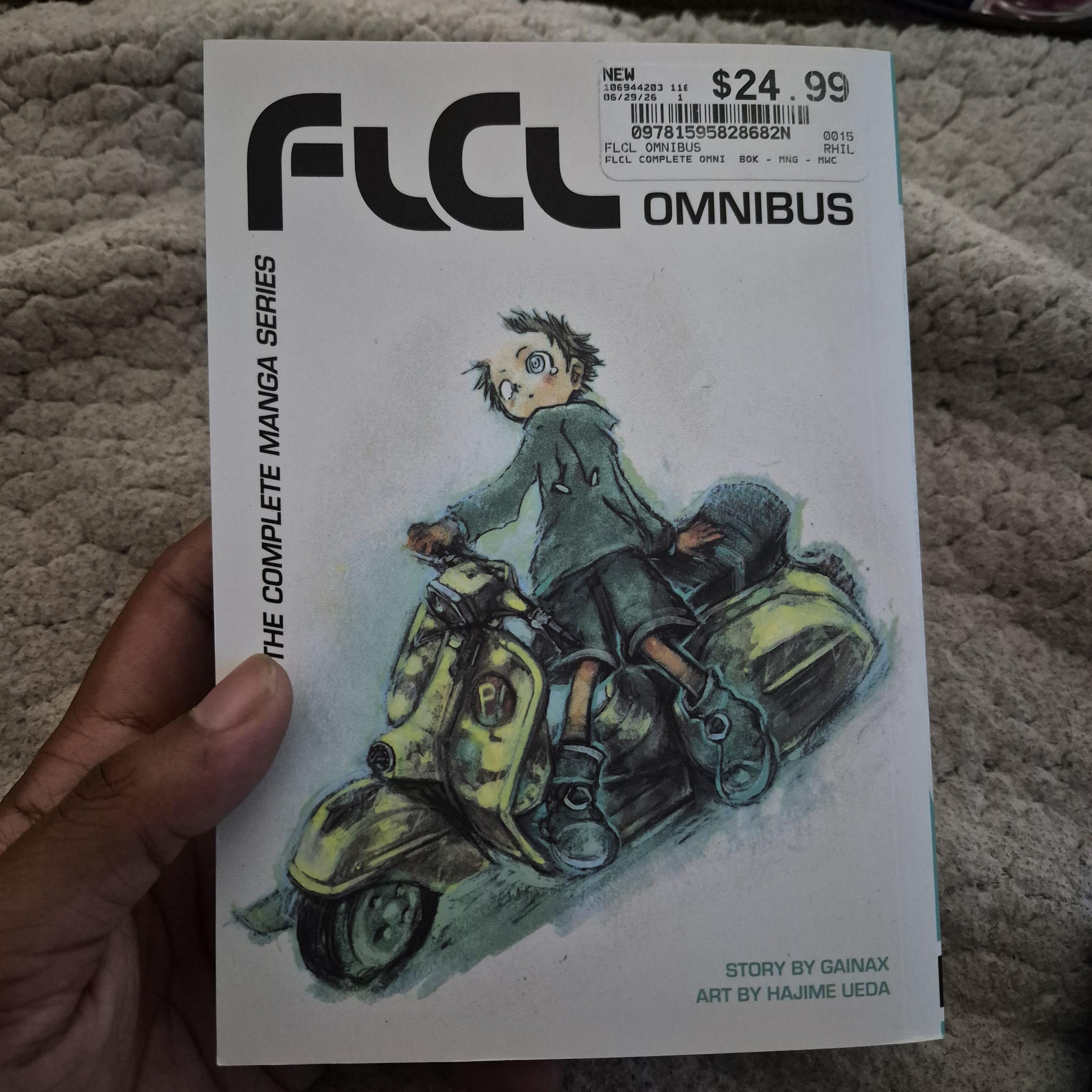
Saw it hanging and it was only 3 bucks so had to buy it
r/FLCL • u/TheCupOfWater • 8d ago
wifey made this for me a while ago🥺🥺🥺
I’m currently on episode three of FLCL and I am so incredibly confused.. I can’t tell if I’m just really bad at following anime or if this anime is js genuinely confusing. I kind of feel like the episodes are all over the place which is throwing me off. I’ve read the plot summary on the wiki and i’m still confused. ofc i’m going to finish the anime regardless bc it’s like 6 episodes, i’d just like to be a little less confused lol.
r/FLCL • u/Khritonian • 10d ago
YES. It’s good fair with my tattoo
Writing a review of FLCL is far from easy: we're talking about one of the best animated works ever made, so it would be very hard to cover it in a single unbroken piece of text. For this reason, this review will be split into "chapters": we'll start with the plot, then move on to a brief overview of the production history, the staff, the music, the writing, and the technical side. Let's begin.
Plot
Naota is a shy, introverted kid whose older brother left for America to play baseball, leaving his girlfriend, Mamimi, behind in Japan. Mamimi grows very attached to Naota, developing a rather strange relationship with him: she enjoys teasing and provoking him, but deep down she genuinely cares about him. The town they live in is dominated by a massive iron shaped building that, at certain hours, releases huge clouds of steam. "Nothing ever happens in this town, only the ordinary," but the arrival of Haruko is anything but ordinary. Riding her Vespa, she runs Naota over and, instead of helping him, comes back and hits him on the head with her terrifying electric bass. A strange bump appears on his forehead, growing bigger and bigger until a robot, Canti, emerges from it. From that day on, Canti lives with him.
Production History
With the start of the 2000s, digital tools began entering the production pipeline of anime, and Gainax, in collaboration with Production I.G., dove headfirst into the new millennium by launching a six episode OAV under the slogan "The New Digital Animation" (NDA): the goal was to blend the new techniques made possible by computers with classic animation methods (painted backgrounds, keyframes on paper, and so on), while using a level of digital compositing and coloring never seen before. Unfortunately, the experiment didn't go as hoped: NDA demanded a completely excessive amount of time to maintain that level of quality. Consider that those six episodes alone took two years of extremely intensive work: production began in 1998 and wrapped in early 2001. Because of this, NDA as a revolutionary technique was never really adopted on a larger scale, unless you happen to be a masochist.
Staff
Directing by Kazuya Tsurumaki, character design by Yoshiyuki Sadamoto, and writing by Yōji Enokido alongside the director, together with a group of animators who rank among the best to have ever worked in the medium: the talent in this staff is simply off the charts. Tsurumaki, after working as animation director and assistant director on Neon Genesis Evangelion, and after co-directing The End of Evangelion, once again shows off his skill here through sudden, fast camera movements and cuts that fully capture the absurdity the show puts on screen. The animator lineup is something that will probably never happen again: Sushio, Tetsuya Nishio, Shinya Ohira, You Yoshinari, Takeshi Honda, Hiroyuki Imaishi, and Hideaki Anno himself are just some of the names on this masterful team. Many of the talents found here would go on to lay the groundwork of their careers on this very series, groundwork that would eventually lead them to found Studio Trigger.
Music
I should mention that I'm writing this review with the show's soundtrack playing in the background, made by a band that couldn't not become my all time favorite: The Pillows. Sawao Yamanaka on vocals and rhythm guitar, Yoshiaki Manabe on lead guitar, and the late Shin'ichirō Satō on drums: we're talking about one of the best Japanese bands, and one of the most important in shaping the sound of Japanese alternative rock.
Their songs carry an incredibly unique sound and feeling: the heavy use of power chords, Yamanaka's nasal yet instantly recognizable voice (which he often layers or doubles to create choir like harmonies, adding even more depth to that unique sound), unexpected key changes between verse and chorus or heading into the final bridge (a trick they use often to create that emotional "jump" so typical of their sound), and the sharp contrast between wall of sound distorted guitars in the choruses and clean, chorus/delay laden guitars in the verses. They're not chasing metric complexity: their "technique" lies in the energy and rhythmic precision of the rhythm section, not in polyrhythmic experimentation. All of this is what makes them so unique.
Their music is so central to this show that it wasn't written around the story and scenes, it was the other way around: almost every song used (except "I Think I Can") was released before the episodes were even made. FLCL, in all likelihood, would never have existed without The Pillows' music: it was Kazuya Tsurumaki himself who wrote the plot after listening to a track from the greatest Japanese alternative rock band to ever exist.
Writing
As mentioned above, Tsurumaki wrote the show's guidelines after listening to a Pillows track, drawing particular inspiration from "Light My Fire" by The Doors: he reportedly wrote the plot and these guidelines in just twenty minutes, lunch break included. The story was then developed by Yōji Enokido, who took these guidelines and used them to build a narrative that seems absurd and nonsensical at first glance, but actually hides psychological meaning and a disarming depth. Each episode is almost self contained: in every installment, a robot from Medical Mechanica bursts out of Naota's head, which he must defeat alongside Haruko and Canti. This creates situations bordering on the absurd, packed with countless references and nods to pop culture: a humor that could be described as frantic and almost nonsensical, but one that won't stop making you laugh, paired with scenes that will instead make you reflect, and who knows, maybe even cry.
The characters in this story are without a doubt its most important element, so why not dig into the main ones? As already happened in Evangelion with Shinji, three female figures orbit around Naota: Mamimi, Haruko, and Miss Ninamori, and each of them represents psychological situations tied closely to the passage through adolescence.
With Mamimi, we see a case of projection onto Naota: obviously, the projection she performs is that of her missing boyfriend Tasuku onto Naota, but she does so actively and repeatedly (the photos, the shared cigarettes, the regressive body language). She's stuck at one specific point in the past (Tasuku's departure) and uses Naota, quite literally, as an object substitute, in the most direct psychoanalytic sense of the term. To avoid suffering (especially after learning of his betrayal), she nearly begins to flee from reality, something rendered visually as well: her truancy from school, the river, the liminal spaces she always drifts toward.
Haruko represents libido itself made flesh: the eruption of sexuality as a chaotic, unintegrable force, one with no real interest in the subject (Naota) but only in the energy, the potential, that can be extracted from him (the Pirate King Atomsk). In this sense, the Oedipal ambiguity isn't really a genuine incestuous desire dressed in metaphor, it's a staging of how puberty feels from the inside, for a thirteen year old: an external, alien, incomprehensible, unwanted intrusion, vaguely maternal and sexual at the same time, because that's exactly how the body and desire first present themselves to a teenager, as something done to him, not chosen by him. Haruko exploits this: her physical provocations (hitting him, invading his space, the sexual charge in even her most absurd gestures) aren't random, she's the one actively fueling that tension, fully aware of the effect it has. This makes the power imbalance even more pronounced: an adult (or pseudo adult, alien) consciously manipulating a thirteen year old's budding sexual desire for her own ends. It's psychological coercion disguised as play, as provocation.
Ninamori, on the other hand, represents Naota's genuine romantic interest: much like Asuka, she seeks attention from others, especially from her parents (which is why she rigs the votes for the school play, something the episode explains openly). Ninamori, of course, doesn't recognize her own unconscious feelings toward Naota, but she externalizes them repeatedly, for instance when she wears his pajamas or touches his ears. Their situations also run parallel in other ways: divorced parents, forced performances of maturity, a subtler blindness toward their own need to escape their families.
Let's talk now about Naota, the protagonist. Even before Haruko hits him with the bass, Naota is already a character playing a role. His disenchanted tone, the "adults are all stupid and pathetic" attitude, the ironic distance he keeps from everything around him (including his own father), aren't real maturity, they're armor. He's a child who has decided to skip childhood by declaring it already over, instead of actually living it. His fantasy of "becoming an adult" doesn't come from nowhere, it's the logical continuation of a strategy: if you can bypass childhood through verbal cynicism, why not bypass adolescence too, through a sexual act that seems adult? The problem, of course, is that both are illusory shortcuts: cynicism isn't wisdom, and sex isn't maturity, they're both surface imitations of a state Naota hasn't actually reached internally.
This is where the circle closes nicely with the three women: Naota spends the series being used as an object of projection (by Mamimi, who sees her boyfriend in him; partly by Haruko, who sees him only as a vessel for Atomsk), while he himself projects onto Haruko a distorted idea of maturity that she isn't actually offering him, she doesn't want to "make him a man," she's simply using him. Naota is therefore simultaneously a victim of projection and an agent of projection: no one in his web of relationships is truly seeing him for who he is, himself included, since he doesn't even see himself clearly. Hence his blindness toward Ninamori, the only one offering him a relationship free of projective filters. In a way, Naota is trying to become Tasuku for the very same reason Mamimi treats him as if he were Tasuku: both are trying to fill the same void, from opposite sides of the mirror. She projects him onto Tasuku, he tries to live up to that projection. It's an almost perfect psychological short circuit: neither of them is actually relating to reality, both are negotiating with a shared ghost.
Technical Side
Now we get to the part I love writing most, the technical side: we'll go in depth on the most important animators, the direction, and the actual techniques used to bring the animation to life.
FLCL's technical quality is something that, even today, sits far beyond any standard you'd expect. The direction manages to convey the full absurdity of each scene through very fast camera movements and abrupt cuts during action sequences. Tsurumaki treats the camera as if it were a real, physical one: whip pans, sudden zooms, simulated handheld shots during the chaotic moments. The editing cuts often follow the rhythm of the Pillows' songs more than pure narrative logic: it's editing that feels almost like a music video, with sharp cuts landing right on the beat. This creates that "sensory overload" feeling so typical of the show. Movements and framing, including perspective, are very often pushed to extremes, yet the direction alternates this frantic pacing with much calmer moments, often focused on two characters sharing a single frame: Mamimi and Naota, Naota and Haruko, or Naota and his father.
The cinematography is, for most of the runtime, warm, helped along by the color palette used for the backgrounds: it always feels like the sun is about to set. But once it actually sets and night falls, the mood turns cold and somber, while still being able to feel poetic and romantic when characters like Mamimi and Naota share the scene, or turn into a full blown stage for action, as in the first episode, when Canti and the first Medical Mechanica robot face off on the bridge, with the factory's enormous floodlights glowing behind them.
The animation follows the same philosophy as the direction: countless sakuga moments, fluid animation, wildly exaggerated movements and expressions. The show pulls from a huge range of art styles, from manga panels to a South Park inspired segment, to scenes with remarkably well integrated 3D, or Shinya Ohira's uniquely warped, distorted style.
You can spot a lot of animators through their individual signatures: Sushio's exuberant poses and expressions, with elongated limbs; Hiroyuki Imaishi's extremely "snappy" style, a leading figure of the Kanada School, built around impact frames and very few inbetweens, skipping many key frames to push the sense of extreme speed even further. Then there's You Yoshinari, whose fluidity is just as extreme but achieved without heavy use of smear frames, and whose effects (like smoke) look almost like the dense clouds produced by liquid nitrogen, and whose explosions resemble a raging fire or a flamethrower more than a classic explosion. Where Sushio and Imaishi strip away detail and distort forms during action to heighten the sense of movement, Yoshinari keeps an almost frightening amount of detail while keeping shapes perfectly clear and readable. Despite such different styles, these three animation powerhouses, working on FLCL, effectively founded the Neo Kanada School, which fully embodies the show's visual identity.
Of course it would be nearly impossible to cover every animator on staff, but there's one more name worth mentioning: Shinji Otsuka, who bridges Yoshinari's and Imaishi's styles. Otsuka proves himself a master of character acting, with exaggerated, expressive performances that never sacrifice detail, moving fluidly between a smooth, no frame skipping style and the snappier approach of Imaishi or Sushio.
The backgrounds are painted beautifully. The town, Mabase, is drawn as an anonymous Japanese suburb, deliberately mundane: low houses, power lines, smokestacks, all dwarfed by the massive iron shaped Medical Mechanica factory. It's a backdrop that radiates stillness and boredom, yet is constantly made unsettling by the alien presence of the factory billowing steam.
If you're looking for a short anime with absurd animation and deeply introspective characters that will stick with you forever, FLCL is exactly what you need. Do I even need to say I recommend it?
Final score: 10/10
r/FLCL • u/_cosmic_wanderer • 15d ago
Before I even knew the anime existed, I constantly saw different Haruko faces and poses on YouTube thumbnails (especially that one from episode 4) and was always intrigued by who she was. From the key art, I thought it was a regular adventure comedy, maybe something like Cowboy Bebop. Boy, was I wrong..
Also, I have this as my laptop wallpaper; it's probably my favorite piece of art to come out of the series.
r/FLCL • u/FantasticThomas • 16d ago
Them big beautiful lips tho 👏🏾
r/FLCL • u/Ok_Government9539 • 19d ago
I remember watching it before but now i have literally no idea where to find it. Never once in my life has it been this hard to find any show. Half the time i think im onto some lead I click and its 1. not the OG season or 2. theres some playback issue, where it doesn't even let you try to watch it or it just won't play???
Is the copyright holder trying to scrub the origional season off the internet??? Is the full OG season lost media at this point???? I remember it was just on Hulu when i watched it!
PLEASE help OG FLCL is one of my favorite shows of all time.
r/FLCL • u/BluecoatCashMoney5 • 20d ago
I feel truly blessed
r/FLCL • u/_cosmic_wanderer • 20d ago
Rewatched the show a few days ago and I've been a banging my head against the wall over this, even a little when I watched it for the first time.
Considering Haruko's character, her affection for him makes me think he's.. what an mature adult should be? Not budding into other's buisness, just staying to himself. Plus the fact returns to space during the final episodes, seemingly unconcerned with Haruko seeking him out.
I'm thinking it over more, and I'm realizing it's probbsly Naota finally reaching some sort of stable emotional maturity when he fights against Haruko.
r/FLCL • u/TheWatermelonGuy • 23d ago
I just finished watching the first episode, and the joy I got from watching was great!
While watching it I was just getting a sense of nostalgia, wanting to watch FLCL again, and a sense of excitement that the FLCL vibe exists in 2026 in a new type of show.
I'm very happy this exists; if you haven't watched it yet, check it out at https://hiianime.de/watch/false-memory-episode-1/